

Introduction
Firms’ nonmarket strategies can help unlock new markets, reduce costly regulation or harm market rivals.Footnote 1 Competitive nonmarket advantage is often secured by engaging in corporate political activities (CPA), including lobbying,Footnote 2 asset freezing,Footnote 3 and making financial contributions to electoral candidates.Footnote 4 The objective of CPA is to secure an edge in both the market and nonmarket environments.Footnote 5 Because of the connection of market to nonmarket strategy, activities in the nonmarket environment, such as whether and who to lobby, influence a host of market decisions such as product positioning, market entry, and the organization of supply chains. Indeed, it is natural to expect that firms, because of both market and nonmarket competition, make strategic choices conditional on both their own and their rivals’ activities. Yet, despite the obvious connection of market to nonmarket activities, research into firm-level CPA frequently treats firms as independent, focusing on bilateral interactions between firms and politicians, regulators or other external stakeholders, while ignoring important interactions between market rivals. This bilateral focus, where firms’ nonmarket choices are assumed independent of their market rivals, overlooks a key feature of the business environment: firms that compete in the market will consider rivals’ responses when engaging in strategic CPA.
Through studying the CPA of market rivals in the US tobacco industry, we show how ignoring nonmarket interactions leads to endogeneity bias from simultaneity and correlated unobservables. Simultaneity occurs when one firm's decision depends on its rival's decision (and vice versa), while correlated unobservables arise when a common factor motivates both firms’ choices, but that factor remains unobservable to the researcher. Despite a long-standing acknowledgment of these prospective problems, until recently, the management literature lacked the tools to directly address these issues. This article establishes a framework facilitating the estimation of strategic nonmarket interactions. Specifically, we estimate a static complete information game, recovering firms’ best response functions. Our parameters of interest are identified with “plausibly exogenous” instrumental variables.Footnote 6 That is, we employ an econometric method, developed by Conley, Hansen, and Rossi (Reference Conley, Hansen and Rossi2012), that swaps distributional assumptions for exclusion restriction assumptions, enabling us to recover structural strategy parameters in our instrumental variables models. We compare both point and interval estimates to coefficients recovered using the application of naive least squares, where the term “naive” is used to refer to an empirical model of CPA that neglects the actions of market rivals. Our main results show that the two largest US tobacco firms, Altria and US Tobacco (UST), strategically coordinated their CPA by making campaign contributions to the same set of House and Senate candidates from both parties. Moreover, failing to address endogeneity concerns yields attenuated estimates that are six to fifteen times smaller than coefficients from instrumental variable models that address the interaction and associated endogeneity problems.
Hillman, Keim, and Schuler (Reference Hillman, Keim and Schuler2004) were among the first to call for a deeper investigation into industry structure and strategic intraindustry interactions as antecedents to CPA. In response, management researchers studied the strategies of firm CPA,Footnote 7 its determinants,Footnote 8 and how CPA influences firm outcomes.Footnote 9 An extensive literature also investigates the factors influencing firms’ nonmarket strategies.Footnote 10 Industry concentration and regulation,Footnote 11 firm diversification,Footnote 12 dependence on government contracts,Footnote 13 and political institutionsFootnote 14 are all shown to shape firm-level CPA and stakeholder interactions.
Still, only a handful of papers place the strategic dynamics between firms within their nonmarket environments at the center. Schuler (Reference Schuler1996) examines the relationship between firm size and free-ridership incentives in the steel industry's lobbying over trade policies, while Hersch and McDougall (Reference Hersch and McDougall2000) study competitive interactions in the automobile market. The seminal analysis is Olson's (Reference Olson1965) classic study of collective action. This work hypothesizes precisely the types of nonmarket interactions emphasized in this article. Olson (Reference Olson1965) predicts prevalent free-ridership problems in the nonmarket environmentFootnote 15 with firms reducing their CPA expenditures as an equilibrium response to the strategic choices of their market rivals. (Baron [Reference Baron1995] stresses these same free-ridership problems in his overview of nonmarket strategy.) Yet, despite the theoretical appeal of the free-ridership argument, it is not immediately obvious that firms will free-ride on their market rivals’ activities. A central challenge with the analysis of firm-level CPA is that incentives to compete in the market may influence the nonmarket environment. Firms that compete in the market may cooperate when dealing with policy makers—as long as it is in their interests to do so. This means that CPA may be strategically coordinated within industries or that firms may free-ride on rivals’ political activities. In fact, one of the contributions of this study is to develop an illustrative, stylized model that shows precisely these conflicting incentives. The model demonstrates how firms face a trade-off with respect to their nonmarket activities. Free-ridership incentives do exist, but firms also have an opportunity to strategically harmonize their CPA, effectively obtaining greater market returns from their nonmarket activities. The degree of nonmarket interaction between market rivals is therefore an empirical question, one that we investigate in a particular sector: the US tobacco industry during a period of regulatory change.
While this article's main focus involves tackling the prospective endogeneity challenges in the empirical management literature on CPA, we motivate our econometrics with a model that rationalizes a range of firm behaviors. This theoretical model outlines a key mechanism driving the trade-off to coordinate CPA versus the incentive to free-ride on rivals’ activities. Intraindustry dynamics depend on the magnitude of spillovers arising from CPA. As Olson (Reference Olson1965) emphasizes, firm-level nonmarket activities have traits similar to public goods (i.e., nonrivalry and nonexcludability). The model demonstrates that corporate political expenditures have either a competition-hardening effect or lead to strategic coordination of political activities. Competition-hardening refers to the strategic incentive to free-ride on a rival's CPA. It occurs when the benefits of a rival's CPA accrue to all firms in the industry (i.e., are nonexcludable in the language of public goods). Of course, the rival may recognize these free-ridership incentives and (depending on the structural parameters of the game) there may be a Nash equilibrium in dominant strategies where both firms withdraw from the nonmarket environment. In contrast to the competition-hardening outcome, the nature of the nonmarket spillovers may imply that firms have incentives to strategically coordinate their CPA. This equilibrium manifests when firms simultaneously make strategic nonmarket choices that have both private advantages and benefits for market rivals.
The theoretical model's key insights are twofold. First, it highlights that even in the simplest of strategic frameworks it is difficult to make clear qualitative predictions on firm-level CPA. The ambiguity of the model's prediction entails two competing, but testable, hypotheses; only one of which can hold in the data. Because of the spillover mechanism, market rivals may either free-ride or coordinate their CPA. Second, contextual and institutional information is typically required to interpret observed equilibrium behavior in nonmarket strategy. Context-free results are scarce precisely because it is difficult to formulate clean predictions—even with simple models.Footnote 16
Ours is not the first article to address these issues. Several dimensions of the conflicting free-ridership versus strategic coordination incentives have been studied previously. Results show that outcomes vary with market characteristics like industry concentration,Footnote 17 institutional structure,Footnote 18 and the ability to monitor rivals.Footnote 19 The theoretical ambiguity of the model also means that evaluating firms’ strategic CPA is ultimately an empirical question, with only a handful of studies probing the relationship between market competition and nonmarket activities. Ozer and Lee (Reference Ozer and Lee2009) investigate the role of intraindustry heterogeneity and the relationship between individual and collective political action. They hypothesize that competition over government contracts may moderate the relationship between industry concentration and firm's private pursuits. Bombardini and Trebbi (Reference Bombardini and Trebbi2012) show that product differentiation is an important link between individual lobbying and industry concentration. Holburn, Raiha, and Rao (Reference Holburn, Raiha and Rao2020) study lobbying in a contested regulatory environment, finding that incumbent and new entrants strategically target different groups of legislators to build majority coalitions in the legislature. Each of these papers highlights a feature of the existing market structure (e.g., heterogeneity, product differentiation, regulatory status) and its relationship to firms’ nonmarket strategy. That is, they bring contextual information on the existing market structure and use this to infer patterns in the nonmarket environment. This article, in contrast, emphasizes the bilateral strategic interactions between firms in a hotly contested nonmarket environment.Footnote 20 The empirical setting used to test these hypotheses is the US tobacco industry between 1992–2008, a period of regulatory and market upheaval for key players. This context is important as it adds depth to existing analyses, one based on the inherent simultaneity of intraindustry decisions during a period of heightened uncertainty in the tobacco industry.
The simultaneity of firm choices poses empirical challenges for management researchers as it implies a fundamental endogeneity problem. As Holburn, Raiha, and Rao (Reference Holburn, Raiha and Rao2020) highlight, if political markets are characterized by interactions between competing interest groups, aggregate data cannot identify the strategies of specific parties. A key contribution of this research then is to present a method to overcome this fundamental endogeneity problem. To maintain tractability, we focus on the activities of two large US tobacco firms, Altria and UST, producing similar, but not identical products, during a changing and contested business environment. The empirical model is a static game of complete information, where Altria's corporate political activity is a function of UST's decisions and vice versa. Because, first, each firm's choice is a variable in the other firm's best response function, and, second, these choices are made at the same time, simple least squares yields biased coefficients: there is both an omitted variables problem and correlated unobservables. This is the endogeneity that has been overlooked by much of the existing empirical CPA literature and for which we apply new methods. We overcome this endogeneity problem using the application of instrumental variables and by probing the robustness of the underlying empirical assumptions by constructing plausible intervals for the estimands. Specifically, we use what Conley, Hansen, and Rossi (Reference Conley, Hansen and Rossi2012) refer to as “plausibly exogenous” instrumental variables and bound the strategic interaction parameter of interest. Further, by comparing the intervals to the naive least squares estimates, the bias of the latter becomes clear.
As stated, the industrial context for our analysis is critical. On June 22, 2009 President Obama signed the Family Smoking Prevention and Tobacco Control Act, ending more than fifteen years of legal and regulatory wrangling between the tobacco industry and federal government. This bill shifted control over US tobacco regulation from the state level to federal jurisdiction under the Food Drug and Administration (FDA).Footnote 21 This period (1992–2008) is also one where AltriaFootnote 22 was the most politically active firm in the United States.Footnote 23 As the largest cigarette manufacturer in the country, Altria sought to influence this transition, forestall public health regulations, and counteract the upsurge in antismoking advocacy. Altria's activities combined with the evolving business environment also provides a unique opportunity to examine the prospects for strategic intraindustry coordination of firm-level CPA. Given the broad scope of Altria's CPA, it is theoretically and empirically unclear how other tobacco manufacturers—Altria's market rivals—should and did respond to these political activities. Firms such as UST, the country's second-largest tobacco producer and largest smokeless tobacco manufacturer, might be expected to free-ride on Altria's expenditures. In contrast, UST may seek to strategically coordinate their CPA with Altria, targeting the same set of policy makers.Footnote 24
Using more than 12,000 candidate-firm-election-cycle observations, we demonstrate two main empirical results. First, between 1992 and 2008, Altria and UST strategically coordinated their nonmarket activities, by making political contributions to the same set of House and Senate candidates from both parties. Altria contributed an additional $11,000 to candidates who received contributions from UST.Footnote 25 This amount is over and above what Altria would have contributed in the absence of UST's actions. Similarly, UST's strategic response to Altria is smaller but still meaningful. UST contributed an additional $10,000 to the average candidate targeted by Altria. Given conventional magnitudes of political contributions, these values are notable. Further, ignoring the simultaneity of decision making leads to substantial underestimation of the degree of CPA coordination. Naive least squares attenuates the estimates by between six- and fifteen-fold compared with our preferred models, highlighting the importance of acknowledging and addressing endogeneity problems in the empirical research on strategic management.
The remainder of this article is structured as follows. The second section presents a brief overview of the empirical setting and then introduces a stylized model of firms’ nonmarket political interactions. The third section presents the empirical methodology and discusses the data. The results are in the fourth section, and the fifth section concludes.
Institutional Background, Illustrative Model, and Empirical Hypotheses
Before outlining our conceptual model and testable hypotheses, we provide a brief overview of the tobacco industry's regulatory and legal environment during our period of analysis.
Overview of the Tobacco Business Environment, 1992–2008
Gruber (Reference Gruber2001) describes the shifting legal landscape of the tobacco industry in the early 1990s. Prior to 1994, with exception of one small case, the industry had not paid any legal damages. Fortunes turned in 1994 when the state of Mississippi launched a suit against the industry. (The industry was also embroiled in another series of class actions [e.g., Castano et al. v. American Tobacco Company].) Mississippi's action was joined by forty-six other states. This lawsuit motivated tobacco manufacturers to seek a negotiated settlement with states’ attorneys general in April 1997. Among other details, tobacco firms agreed to pay more than $250 billion over twenty-five years in exchange for future immunity. While initially appearing broad in scope and cost, this deal was viewed as too lenient by many. The Clinton administration, in particular, refused to endorse the agreement, believing it insufficiently punitive. Critically, the administration declined the industry's demand for immunity, one of the linchpins of the agreement. A consequence of this decision was that a new deal was needed, one accompanied by new legislation.
Senator John McCain, as a consequence, attempted to formulate an alternative agreement. The McCain agreement contained a larger payment from the tobacco producers and, importantly, required FDA regulation of tobacco products. North Carolina Senator Jesse Helms, among others, led efforts to stall and water down this legislation with the eventual result that McCain's proposal failed to obtain congressional approval and died in June 1998.
Working in parallel to the state-level lawsuits, the FDA independently sought further control over the industry through the courts. In 1996, it asserted its regulatory authority over tobacco products and was promptly sued by a consortium of tobacco firms led by Brown & Williamson Tobacco. The case worked its way to the US Supreme Court, which finally ruled in favor of the federal regulator. Of note, the Brown & Williamson lawsuit supplied the legal precedent and structure for what would become the Family Smoking Prevention and Tobacco Control Act. The Family Smoking Prevention and Tobacco Control Act adds Chapter IX to the Food, Drug and Cosmetic Act, giving the FDA authority to regulate the manufacturing, marketing, and sale of tobacco products. Prior to 2009, the tobacco industry was exempt from federal health and safety laws, hence this represents a dramatic shift for producers.
The foregoing events represent a small handful of the legal and regulatory changes occurring in the industry during our period of analysis—namely, the years 1992 to 2008 mark an overhaul of the business environment for tobacco manufacturers, one where they faced strong incentives to engage in CPA. Interestingly, two final points are worth noting. First, the FDA is limited in its authority. In particular, the Family Smoking Prevention and Tobacco Control Act does not allow the FDA to ban the production or distribution of cigarettes or smokeless tobacco in the United States, a potential concession to manufacturers. Second, much of the political wrangling during this period tended to focus on cigarettes (e.g., forbidding smoking in public locations). While implicated by association, less attention was paid to smokeless tobacco. This heterogeneity entails potentially meaningfully different nonmarket incentives for UST and Altria.
Model of Interacting Tobacco Firm CPA
Our empirical analysis identifies a specific parameter: the strategic response to a market rival's CPA. This strategic response coefficient measures the dollar-valued amount that one firm contributes to a specific candidate in the same election when a rival makes a contemporaneous contribution to that exact politician. This strategic response parameter can be understood as the reduced-form from a wide array of theoretical models. To fix intuitions, we present one such model. This is not the only model or interpretation available for our empirical results. Rather, this model helps illustrate three main points: (1) the difficulty of articulating clear qualitative predictions when firms behave strategically in the nonmarket environment, (2) the endogeneity challenges that arise when researchers neglect the strategic responses of market rivals when investigating CPA, and (3) the value of contextual knowledge in interpreting estimands. In our model, firms’ incentives to engage in political activity depend on the level of spillovers from their activities to those of market rivals. In the empirical context of the US tobacco industry, a spillover means that Altria's CPA has the potential to benefit or harm UST and vice versa. This is the “reduced-form” best response used to derive two testable hypotheses that are subsequently taken to the data.
Consider an example. Assume that Altria uses CPA in an attempt to sway policy makers to limit warning labels on tobacco packaging.Footnote 26 These efforts benefit UST as the package-labeling regulations cover both cigarettes and smokeless tobacco. But UST has an incentive to free-ride Altria's CPA. If Altria's CPA is sufficient, UST can save political resources and obtain the benefits from weaker regulation. These free-ridership incentives depend on how much Altria's political activities translate into outcomes for UST. Depending on the magnitude of CPA spillovers, it may be suboptimal for UST to free-ride. For instance, if there are increasing returns to CPA, UST may want to strategically coordinate with Altria by contributing to the same candidates in the same elections, creating a “tobacco block.” By jointly targeting the same legislators Altria and UST may have disproportionately better outcomes than if each acted alone. As such, strategic coordination becomes optimal for both firms.
The example highlights the core idea of our model: firms face a trade-off between free-riding on rivals’ political activities and capitalizing on potential increasing returns from coordinated CPA. To formalize this trade-off, consider a symmetric Cournot duopoly model of interfirm spillovers, a framework is akin to canonical R&D investment models.Footnote 27 The model is illustrative and one of several that can rationalize the subsequent empirical patterns, so it is kept simple. Despite its simplicity, it demonstrates the underlying behaviors that generate the subsequently tested empirical hypotheses.
Assume Altria and UST face a linear inverse demand: P = α − γQ and a constant, common regulation-inclusive marginal cost of production. That is, but-for tobacco regulations, marginal costs of production would be lower. The firms can make corporate campaign contributions that delay costly regulations and reduce marginal costs but it is possible that these benefits spillover to rivals.
Also, assume Altria spends X A on CPA, while UST spends X U. X A and X U are converted to reductions in marginal costs, x A and x U through some unmodeled, but well-behaved, function x A = g(X A) and x U = h(X U). Without loss of generality, we assume that Altria and UST choose x A and x U directly. Altria and UST's marginal costs, then, are:Footnote 28


The interpretation of these costs is as follows: if all regulations are enacted, marginal costs equal c, but CPA modifies some of these rules, lowering Altria and UST costs. β is the critical parameter. Bound between zero and one, it measures the degree to which CPA activities from one firm spillover to the other firm. CPA, x i, therefore, has both pecuniary (direct) and nonpecuniary (spillover) effects for the firms. The direct effect for firm i is through lower marginal costs, whereas the indirect effect arises from the product βx j. This βx j product means that firm j's CPA lowers firm i's marginal cost by some proportion captured by β.
Assume own-firm CPA exhibits decreasing returns with quadratic costs:

A two-stage game is played. In stage 1, Altria and UST choose the level of resources to devote to CPA, x i. In the second stage, they compete in the output market. This timing illustrates the fundamental idea that firms that compete in the market also interact in the nonmarket environment. The game is solved backward.Footnote 29 Equilibrium choices are well-behaved with each firm's output increasing in its own CPA expenditures. CPA reduces costly regulations, thus campaign contribution expenditures reduce a firm's costs, making higher output more profitable. But CPA is costly, so each firm wants to minimize the amount allocated to its political activities given profit maximization in the second stage.
The central question in this article is how, in equilibrium, one firm's CPA changes their rival's CPA expenditures. This comparative static is derived by, first, solving for Altria and UST's CPA reaction functions, R A and R U:

Given each firm's reaction functions, it is possible to differentiate $x_A^\ast$ with respect to $x_U^\ast$
 (and vice versa). This comparative static gives the strategic response of Altria to UST's CPA:

The reduced form parameter, δ i, represented in (3) is the empirical object of interest in this study.Footnote 30 For this set-up, the sign of (3) and the strategic role of CPA spillovers hinges on the value of β. As β increases from zero to one, two possible outcomes are observed, and hence there is an indeterminate prediction for the effect of CPA on market activity. Consider the first prospective outcome with β > 0.5 and 2β − 1 > 0. In this circumstance UST's CPA induces more CPA from Altria. There is a positive spillover or a “nonmarket coordination” effect. UST and Altria mutually benefit from strategic coordination by targeting the same candidates in the same election cycle (i.e., there are increasing returns to CPA). Importantly, δ A, the reduced-form parameter estimated in the empirical section, does not exclusively reflect the strategic interaction. Rather, it captures the joint effect of the market demand parameters, γ, and the CPA spillover parameter, β; yet, the magnitude of β determines the sign of δ A. Next, consider (3) when β < 0.5. Small cross-firm spillovers yield a competition-hardening effect where UST's CPA induces less CPA from Altria. Altria finds it optimal to free-ride on UST, because there is no prospect for increasing returns from CPA.
The conclusion from this model is that the sign of (3) is an empirical question that depends on the magnitude of β. Yet, while qualitative predictions are elusive, the mechanism underlying both strategic coordination of CPA and competition hardening is the same: cross-firm nonmarket interactions are determined by the degree of CPA spillovers, or how much one firm's CPA benefits its market rival. Given our data, we cannot identify β directly, but are able to estimate an analogue to δ A. We also evaluate what happens when we ignore the interaction of market rivals in the nonmarket environment. Neglecting these strategic interactions is tantamount to assuming that β = 0 and that rivals’ activities are irrelevant to marginal costs in (1) and (2). Empirically, the cross-partial in (3) becomes a constant that is swept away by a fixed effect, producing a null hypothesis of zero for δ A.Footnote 31 Therefore, even though we are limited to estimating a reduced-form parameter, two distinct outcomes are reasonable. These lead to our empirical hypotheses.
Testable Hypotheses
The model demonstrates that Altria may increase or decrease its CPA in response to UST's activities (and vice versa). Thus two competing hypotheses, a and b, result for each firm, only one of which can be true.
Hypothesis 1a: UST will strategically respond to Altria's political campaign contributions by making larger contributions to the same candidates in the same election cycle.
Hypothesis 1b: UST will strategically respond to Altria's political campaign contributions by making smaller, or no, contributions to the same candidates in the same election cycle.
Hypothesis 2a: Altria will strategically respond to UST's political campaign contributions by making larger contributions to the same candidates in the same election cycle.
Hypothesis 2b: Altria will strategically respond to UST's political campaign contributions by making smaller, or no, contributions to the same candidates in the same election cycle.
Hypotheses 1 and 2 underscore that the prospect for free-ridership or strategic coordination of nonmarket activities is an empirical question. These hypotheses can be tested by determining the sign (and magnitude) of δ i. We emphasize that hypotheses 1b and 2b are composite predictions. They include both the possibility that firms free-ride and the option to act independently. The next section outlines an empirical strategic coordination game that does this.
Estimation
Empirically, we model the strategic nonmarket interactions of tobacco firms during a period of regulatory upheaval. Interactions take the form of a simultaneous game of complete information where Altria's choices and payoffs depend on UST's and vice versa. Unobservables are known to the players but not the analysts. The equilibrium is Nash in pure strategies and the principle of revealed preference is the foundation for the empirical set-up. In what follows, we first describe the basic regression model, as a benchmark to describe how much of the nonmarket strategy and CPA literatures have overlooked the inherent simultaneity and correlated unobservable issues endemic to this type of model. We outline how instrumental variables offer one solution to identify the structural parameters of the game. Still, while our solution can technically address the endogeneity problems, our instrument is imperfect. So, we highlight how prospective questions about the validity of our assumed exclusion restriction are explored with a bounding exercise, measuring the sensitivity and “plausible exogeneity” of our instrument. Lower bounds from these intervals, shown in the “Robustness Check” section, are still meaningfully larger than the point estimates from the naive least squares approach. Finally, we review the data used in this application.
Set-up and Naive Least Squares Regression Model
The basic game is straightforward. Start by considering the campaign contribution decisions of firm i (e.g., Altria). Let k represent distinct candidates. In each election cycle, t, there are k = 1, …, K candidates. Thus a firm's “market” is a candidate-cycle and firms simultaneously choose how much to contribute to, or invest in, a particular candidate in a specific cycle. Let y ikt represent the continuous amount of money that firm i contributes to candidate k in cycle t. The level of y ikt, the amount of money, depends on the actions of the other firm, j. Let a jkt = 1 when firm j makes any contribution to candidate k in cycle t and a jkt = 0 if they do not.Footnote 32 The principle of revealed preference entails that for each firm $\{ {y_{ikt} > 0} \} \Leftrightarrow \{ {\pi_{ikt}( {a_{jkt}, \;\epsilon_{ikt}} ) > 0} \}$ , where π( ⋅ ) is profit: a firm only contributes to candidate k in cycle t if it is profitable to do so. As stated, the equilibrium concept is Nash in pure strategies.
Critically, firm i will consider the action, a jkt, of firm j when making its contribution decision. For firm i, a simple least squares regression for this game is:

where y ikt is the dollar-valued contribution of firm i's political action committee (PAC) to candidate k in election cycle t. The coefficient of strategic nonmarket interaction is δ i. This is the parameter of interest: δ i represents the reduced form parameter from the model in section 2. Hypotheses 1 and 2 are tested by examining the sign and significance of δ. A positive δ supports part (a) of each hypothesis and rejects part (b). A negative or zero coefficient, in turn, supports part (b), rejecting part (a).
ε ikt should be interpreted as a composite error term that is further decomposed to include both candidate- and cycle-specific factors: ε ikt = ψ k + τ t + u ikt. ψ k is a candidate-specific fixed effect. This is unique to each candidate and common to all firms. τ t is an election cycle fixed effect, which is unique to each election and common to all firms. These fixed effects are the state variables of the model. They capture candidate-specific and election-cycle observables and unobservables that are known to the firms. The residual unobservable, u ikt, represents firm-candidate-cycle factors that influence firm choices. The assumed complete information structure implies that u ikt is known to the players, but not to the econometrican. Complete information is viewed as a reasonable appropriate assumption for the tobacco industry during this period. Based on the scale of the firms’ political activities, it is plausible that the firms understood the unobserved (to the analyst) characteristics of the political candidates they supported.
Problems with Least Squares and an Instrumental Variables Approach
The fixed effects model depicted in (4) yields an unbiased estimate of δ i if firms acted independently.Footnote 33 Indeed, a special case is δ = 0. However, as specified, (4) has two potential sources of endogeneity: simultaneity and correlated unobservables. Both sources introduce the prospect for biased coefficients and incorrect conclusions, especially if ordinary least squares is naively applied. Simultaneity biases δ upward. It arises because Altria's contribution decision, y ikt, depends on UST's decision, while UST's choice simultaneously depends on Altria's decision. Correlated unobservables attenuates δ and occurs because some factor in the error (i.e., u ikt), that is observable to the firms but not to the researcher, leads both firms to change their contribution behavior. In a least squares model, this unobservable is attributed to the market rival, when, in fact, it is independent of their strategic interactions.
Instrumental variables is applied to deal with these endogeneity problems. Consider the two-equation framework:


with the system estimated separately for each Altria and UST.
The dependent variable in (5) is continuous. Because y ikt is continuous, instrumenting for a jkt using two-stage least squares generates consistent estimates of δ i. The structural model, (5), contains the reduced form parameter of interest, δ i. δ i has the same interpretation as in (4), except that in (5), we attempt to mitigate the bias due to simultaneity and correlated unobservables. This is done by specifying a first stage model, (6), and exploiting variation in our instrument, chief executive political donations. Predicted values of a jkt, $\hat{a}_{jkt}$ , those purged of the endogeneity are used in (5) (assuming the exclusion restriction is valid). Two versions of the CEO contribution instrument are used, a candidate-cycle-specific dummy and as candidate-cycle-specific dollar amounts. The instrument where CEO campaign contributions is a dummy equals one if the CEO made a positive contribution to candidate k in cycle t and zero otherwise. Second, the dollar-valued amount of money donated by CEO to candidate k in cycle t is used as an instrument. (As they do not have unique variation, the instruments should not be included in the same model and hence separate regressions are estimated.)
Several criteria are required for valid instrumental variable estimation.Footnote 34 Appropriate instruments must be relevant and excludable. The exclusion restriction requires that the instrument only influence the structural model through the variable of interest. Typically, the exclusion restriction cannot be tested and economic arguments must support it. In the “Robustness Check” section, we relax the strong assumptions on the excludability of the instrument by applying methods developed in Conley, Hansen, and Rossi (Reference Conley, Hansen and Rossi2012). These methods enable us to estimate bounds on δ i within a two-stage least squares framework, even in situations in which it is challenging to argue that the instrument is perfectly excludable. This approach is more fully described in the “Robustness Check” section. Still, there are reasons to expect that CEO contributions are plausibly, if not perfectly, exogenous in this framework. Fremeth, Richter, and Schaufele (Reference Fremeth, Richter and Schaufele2013, Reference Fremeth, Richter and Schaufele2016) review the relationship between CEO and same-firm PAC contributions, demonstrating how CEO political behavior is primarily driven by exogenous regulatory limits on PACs and by intraorganizational dynamics. Thus, the campaign contributions of Altria executives should only matter to UST insofar as they influence Altria's PAC contributions. In other words, UST does not strategically respond directly to contributions made by Altria's CEO, but to Altria's PAC which is in turn influenced by Altria's CEO. We view this as “plausible” if not ideal. As mentioned, we explore sensitivity to this assumption by applying distributional assumptions and formulating bounds on our parameter of interest.
The second condition for instrumental variable estimation is relevance. Weak instruments may exacerbate, rather than eliminate, the bias of least squares. Testing instrument relevance is straightforward and involves inspecting the F-statistic from first-stage model in a two-stage least squares set-up. The typical rule-of-thumb is that a first-stage F-statistic must be greater than 10 to avoid a weak instrument problem. We perform this test.
Data
Data on Altria and UST's PAC and CEO campaign contributions are obtained from FEC filings processed by the Center for Responsive Politics. Variables are at the firm-candidate-cycle level. The FEC mandates that all contributions greater than $200 be disclosed while lesser amounts can be voluntarily filed. Raw FEC records are prone to spelling errors, miscoding, and partial entries, so the data require notable manual processing to reduce measurement error. The information used in this study spans 1992 through 2008, covering the period of regulatory upheaval in the tobacco industry. In total, there are 12,345 observations.
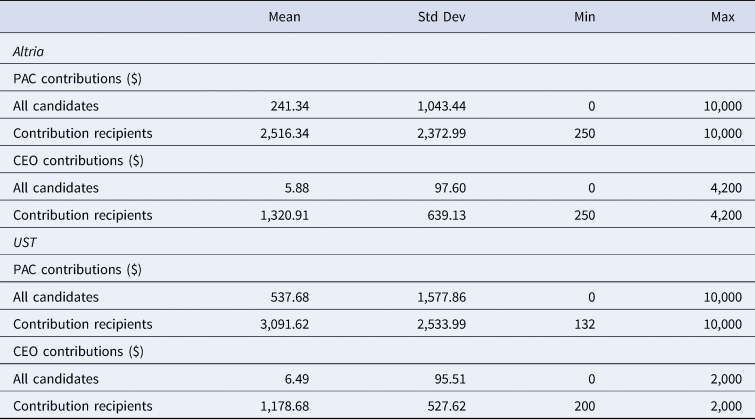
Table 1 presents key summary statistics. The focus of this article is on the strategic response to a market rival's nonmarket activity, still these summary statistics indicate that, in general, campaign contributions from firm PACs are modest. Altria was the most politically active firm in the United States during this period, but its PAC made a mean per candidate-cycle campaign contribution of $241. Restricting the sample to only those candidates receiving a positive contribution, the average contribution increases by an order of magnitude to $2,516, still a relatively small amount. UST's contributions are roughly comparable. The average contributions to all candidates and to only those candidates to whom they contributed are $538 and $3,092, respectively.Footnote 35 Table 1 also shows the mean campaign contributions from Altria and UST's CEOs. Altria's CEO made an average contribution of $6, increasing to $1,321 when only considering those candidates to whom he contributed. Likewise, UST's CEO contributed an unconditional average amount of $6. Conditioning on those candidates that received a positive contribution, his mean contribution equals $1,179.
Summary Statistics for PAC and CEO Contributions

Note: This table provides the summary statistics on the dollar amounts given by Altria and UST as well as their CEOs. All candidates refers to the unconditional values for the population of congressional candidates. Candidate recipients are the conditional values conditioned on the subset of candidates to which the firm made a positive contribution.
Results
The preferred econometric results are presented in tables 2 and 3 for, respectively, UST's response to Altria and for Altria's response to UST. The main conclusion from both tables is that hypotheses 1b and 2b must rejected and that there is support for hypotheses 1a and 2a. It appears as though UST and Altria strategically coordinated their CPA. Firms that compete in the output market responded to their market rival when making strategic nonmarket decisions. Compared to a counterfactual scenario where the other did not contribute, each firm donated more to the same candidates in the same election cycle than would be otherwise predicted had their market rivals not taken this decision.
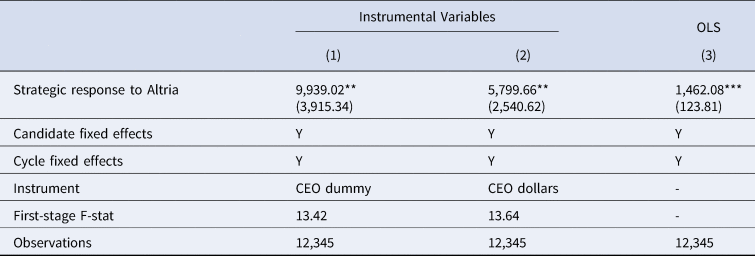
Table 2 examines UST's strategic response to Altria's campaign contribution decisions. The “Institutional Background” section outlined how the predicted response of UST to Altria is ambiguous, implying that the predicted sign of the coefficient could be positive, negative, or zero. Positive spillovers from Altria's activities to UST imply that the firms’ actions act as a strategic complement. In contrast, a competition-hardening or free-ridership effect may dominate and UST may strategically reduce its corporate political activity in response to Altria. Table 2 shows two main results. First, UST strategically responds by making larger contributions to those same candidates that received money from Altria's PAC. Column (1), for example, shows that, when Altria contributes to a candidate in a specific cycle, UST donates an additional $9,939 to that same candidate. This amount is well in excess of their mean contribution level $3,091. This coefficient is identified by using variation in whether Altria's CEO gave to a candidate or not—that is, a CEO dummy. Changing the instrument to the amount Altria's CEO donates attenuates the response slightly. In column (2), UST strategically coordinates on the same candidates as its market rival by contributing an additional $5,800 to Altria's targets. Both models show the strategic response coefficients are statistically significantly different from zero at a 1 percent level, with standard errors clustered at the candidate level. Both models also include cycle and candidate fixed effects, which means that the strategic coordination of political activity effect is identified using within cycle and within candidate variation. The implication is that, even though UST and Altria are market rivals, they are cooperating in the nonmarket environment. Market competitors are bedfellows when it comes to CPA. Moreover, appealing to the principle of revealed preference, this strategic nonmarket complementarity is profitable for UST; otherwise they would have free-rode on Altria's activities.
UST's Response to Altria's Political Activity

Note: This table measures UST's strategic response to Altria's campaign contributions at the candidates-cycle level. The main coefficient shows the average amount of the money that UST donates when Altria makes any contribution to given candidate in a specific election cycles.
Clustered standard errors are in parentheses with clustering on individual candidates.
*** significantly different from zero at 0.1 percent; ** significantly different from zero at 1 percent; * significantly different from zero at 5 percent.
A second main result is evident in table 2. Column (3) shows the importance of dealing with simultaneity and correlated unobservables. Column (3) reestimates (4) using basic least squares, without accounting for the endogeneity of Altria's choices. The point estimate in this model equals $1,462, less than one sixth that of column (1) and less than one-third of column (2). Failing to exploit the exogenous variation in Altria's PAC contributions leads to a substantial underestimate of the strategic response. Empirical research in strategic management needs to be cognizant of these endogeneity concerns, because, as these results demonstrate, the magnitude of the bias can be large. Finally, as the bottom panel of table 2 shows, the first-stage F-statistics of the instruments are greater than 10, the conventional rule-of-thumb. In column (1), the F-stat equals 13.42, while the value in column (2) is 13.64. Thus the instruments are relevant for explaining PAC contributions.
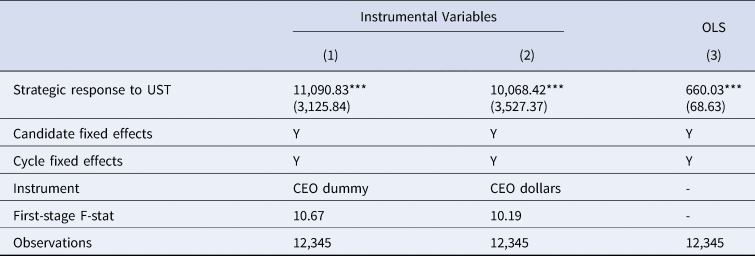
Table 3 presents the results of Altria's strategic response to UST's PAC. As in table 2 all models include cycle and candidate fixed effects and all coefficients are significant at the 1 percent level with standard errors clustered at the candidate level. Moreover, the first-stage F-statistic is greater than 10 in both models, equaling 10.67 and 10.18 in columns (1) and (2), respectively. Like with UST, this indicates the instruments satisfy the relevance criterion. The main results, as shown in column (1), demonstrate that whenever UST donates to a specific politician within a particular cycle, Altria responds by contributing a supplementary $11,000 to that same candidate. In practice, this means that Altria effectively makes the maximum allowable contribution to candidates to whom UST donates.Footnote 36 The coefficient is attenuated slightly in column (2), but still suggests that Altria strategically responds to UST's CPA by contributing $10,000 more than they would, had UST not given money. In other words, as with UST, the results hold for Altria: market rivals are coordinating their nonmarket activities, hypothesis 2a is supported while hypothesis 2b is rejected. Ultimately, the revealed activities of Altria and UST demonstrate that they strategically coordinated their CPA on a subset of politicians when dealing with the evolving tobacco regulation in the late 1990s and early 2000s.
Altria's Response to UST's Political Activity

Note: This table measures Altria's strategic response to UST's campaign contributions at the candidates-cycle level. The main coefficient shows the average amount of the money that Altria donates when UST makes any contribution to given candidate in a specific election cycles.
Clustered standard errors are in parentheses with clustering on individual candidates.
*** significantly different from zero at 0.1 percent; ** significantly different from zero at 1 percent; * significantly different from zero at 5 percent.
Finally, the bias from overlooking the simultaneity problem is even larger for Altria than for USTs. Column (3) of table 3 shows that a least squares estimate of Altria contributions on the UST indicator, after controlling for cycle and candidate-level unobservables, yields a strategic response of $660. This point estimate is less than one-fifteenth the values in columns (1) and (2). Controlling for the endogeneity of firms’ strategic responses is plainly important when analyzing their nonmarket activities.
Robustness Check: Probing the Exclusion Restriction
This section directly addresses residual concerns about the validity of our instrument, specifically that it might not perfectly satisfy the exclusion restriction. We restrict attention to the CEO dummy instrument as this was used in our preferred models from tables 2 and 3. Applying the methods described in Conley, Hansen, and Rossi (Reference Conley, Hansen and Rossi2012) enables us to assess the robustness of our instrument using weaker assumptions on excludability than are typically required in two-staged least squares. Weakening the assumptions comes at a cost, however. We are no longer able to provide point estimates of the strategic nonmarket response to a market rival. Instead, we estimate bounds on our parameter of interest, δ i, and must consider our instrument as “plausibly exogenous” rather than strictly exogenous. Two methods—the union of confidence intervals (UCI) and local-to-zero (LTZ)—as described by Conley, Hansen, and Rossi (Reference Conley, Hansen and Rossi2012) are implemented (both generate bounds on our parameter of interest). The central idea of these methods is summed up as two-stage least squares with an instrument that is not perfectly, but is plausibly, exogenous.
The intuition for the UCI and LTZ bounding process is as follows. Assume the following two-stage econometric model:

for each Altria and UST. The difference between this specification and (5) and (6) is the inclusion of the term γ iCEO Contributionsjkt in the structural model. The exclusion restriction and strict exogeneity, within a typical instrumental variable model, assumes γ i = 0. Allowing γ ≠ 0, within this same instrumental variable model, yields a biased estimate of δ. Yet, it is possible to relax this strict exogeneity assumption, if we are willing to assume a distribution for γ instead of restricting it to be precisely zero. Given this alternative assumption, we calculate the minimum and maximum δ, effectively correcting for the bias and producing a plausible interval for the point estimate. In essence, in place of the γ i = 0 assumption, we assume that γ is close to, but not necessarily equal to, zero and that it falls within a particular distribution. Based on the summary statistics in table 1, we allow the indirect effect of the CEO contribution dummy to vary between –$100 and $100 for the UCI method. We also use values from table 1 to parameterize prior distribution for γ in the LTZ approach. We choose a normal distribution with a mean equal to $6 (based on the unconditional mean of CEO contributions to all candidates) and variance of $100 as in the UCI method.
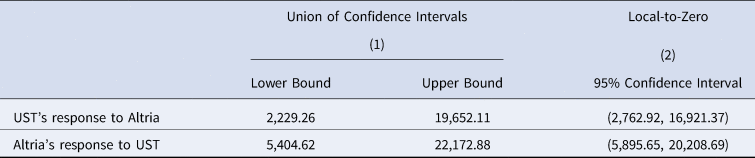
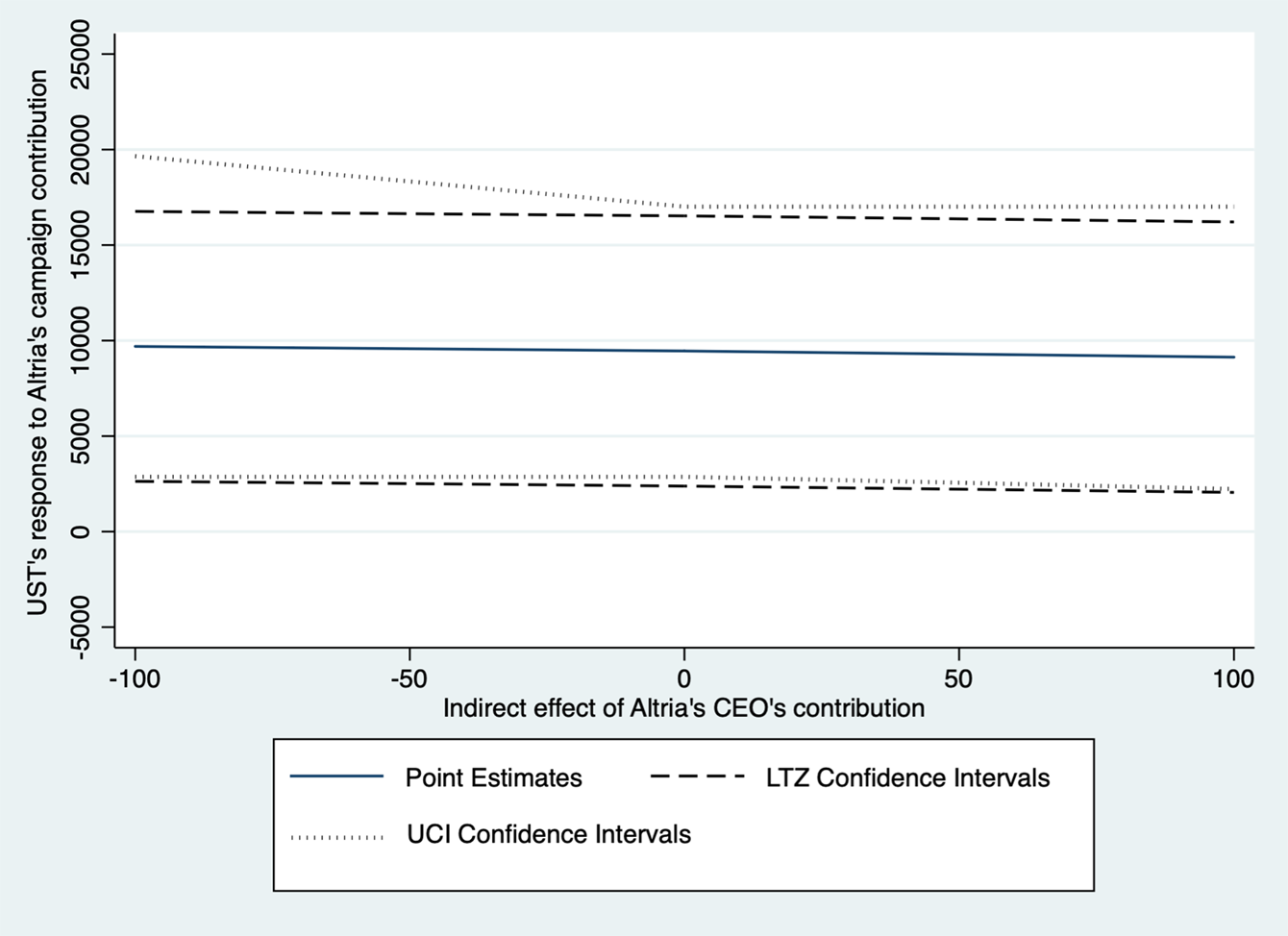
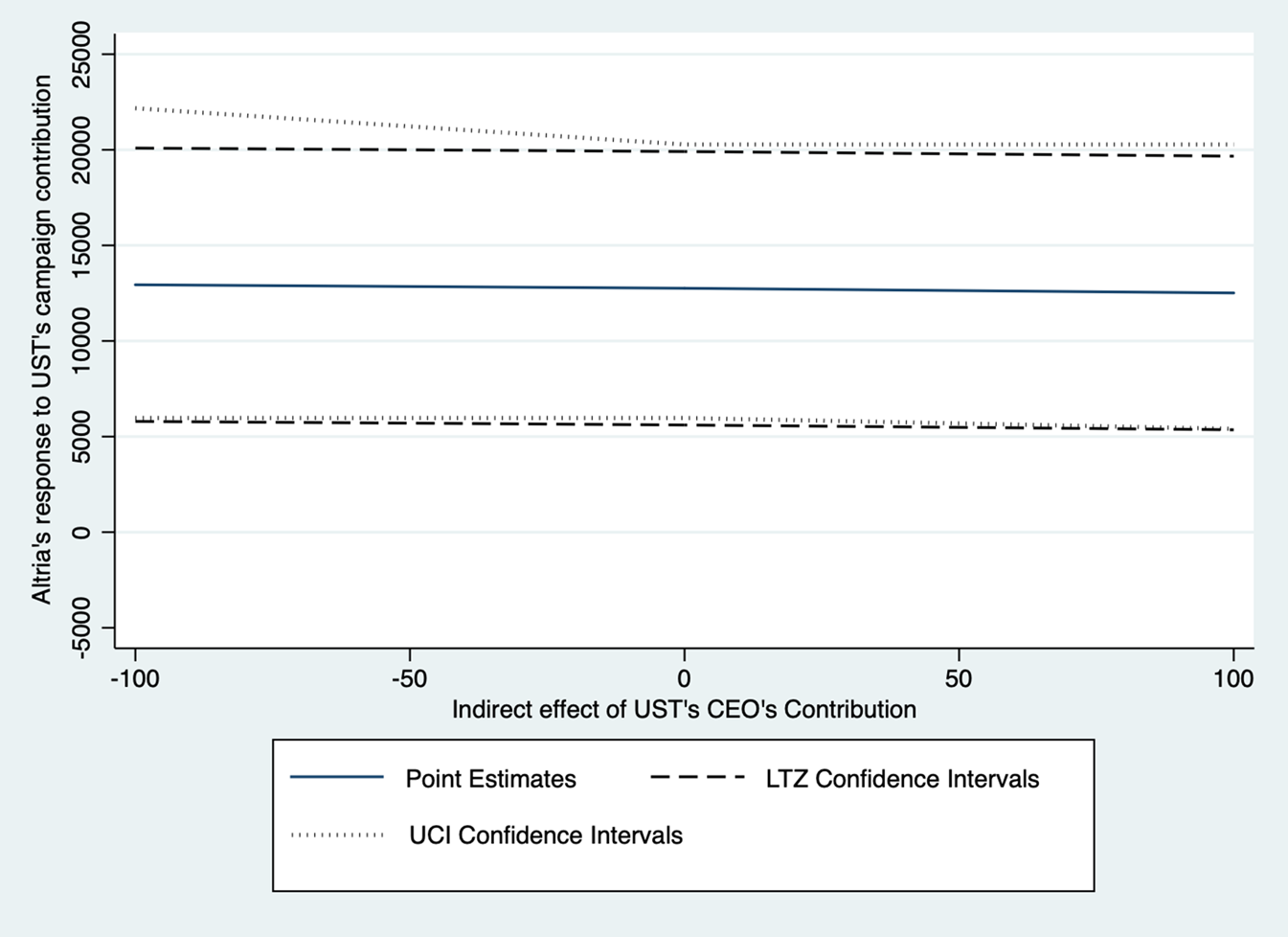
Table 4 shows the results of this exercise. Column 1 presents the results for the UCI method. The lower bounds, when employing the relaxed assumptions, remain positive for both UST's and Altria's responses to their rival firm's contribution to a candidate. For UST, the lower bound value indicates that it contributes an additional $2,230 to a candidate if Altria contributed to the same candidate. This lower bound is still statistically significantly greater than the least squares estimate of $1,462 presented in table 2. Likewise, the lower bound value for Altria indicates that it responded to the contributions made by UST to a candidate by contributing an additional $5,404 to the same candidate, notably more than the $660 least squares estimate. The fact that the lower bounds from this UCI method generates economically meaningful estimates for strategic interaction effect, δ, which are greater than zero and greater than the least squares estimates lends support to the validity of our preferred instrumental variable parameter even when we are willing to relax the assumption of perfect excludability.
Probing the Exclusion Restriction for the Instrumental Variable Estimates

Note: This table presents the coefficient interval estimates by relaxing the exclusion restriction of the instrumental variable using the union of confidence intervals and local-to-zero methods described in Conley et al. (Reference Conley, Hansen and Rossi2012). All estimates include cycle and candidate fixed effects.
Table 4 also shows a confidence interval using the LTZ method.Footnote 37 As Column (2) shows, a 95 percent confidence interval estimates for UST and Altria's response to their market rival remains positive. Indeed, the interval is narrower than the one generated by the UCI approach. For UST, the lower bound confidence interval indicates that it contributed, at least, an additional $2,763 to a candidate if Altria contributed to the same candidate. Similarly, Altria contributed, at least, an additional $5,896 to a candidate if UST contributed to the same candidate.
Figures 1 and 2 plot the point estimates and the confidence intervals derived from relaxing the exclusion restriction using the UCI and LTZ methods for UST and Altria, respectively. While the lower bound values from both methods are attenuated from the coefficients in our main results, they nonetheless indicate meaningfully larger contributions from firms in response to their rivals—and larger estimates than would be obtained had naive least squares been applied and the fundamental endogeneity problem ignored. In sum, the confidence intervals from both procedures suggest that our preferred estimates are robust to potential violations of the exclusion restriction.
Coefficient intervals for UST's response to Altria's campaign contributions, allowing for potential violations of the exclusion restriction.

Coefficient intervals for Altria's response to UST's campaign contributions, allowing for potential violations of the exclusion restriction.

Conclusion
Research into firm-level CPA typically treats firms as independent, yet firms that compete in the market are likely to consider rivals when making strategic nonmarket decisions. This article demonstrates that during a period of regulatory transition in the US tobacco industry, Altria and UST, two of the largest American manufacturers of tobacco products, coordinated their political activities. Both firms made larger contributions when their market rival contributed to the same politician than they would have in a counterfactual scenario in which their rival did not donate. The managerial implications of these results are broad. Shapiro (Reference Shapiro2017), for example, points to collusion in CPA and nonmarket activities as an obstacle to effective antitrust policy. These results hint that there may be some merit to this claim. More generally, regulatory and legislative processes need to consider whether information provided by firms is part of a strategic coordinated effort or whether firms are acting independently—and firms need to appreciate that their market rivals will optimally respond to any nonmarket actions taken, with the obvious conclusion that they should work to further integrate nonmarket activities into their market strategies.
Our article makes several contributions to the nonmarket strategy and CPA literatures. Studies on how firms collaborate in the nonmarket environment to influence policy outcomes have largely focused on collective actions between firms using industry associations.Footnote 38 In contrast, our study examines the competitive dynamics between two market rivals, demonstrating how they strategically coordinate their activities in the nonmarket arena. While industry associations certainly present an important means through which firms collaborate in the nonmarket, the implication of our analysis is that, bilateral interactions between firms are also an important channel for interfirm coordination, one worthy of study. Ignoring these bilateral, firm-to-firm relationships results in an incomplete characterization of a firm's nonmarket strategy and may shroud important mechanisms that explain firm-level CPA. Moreover, if actions by industry associations are indeed subject to problems of collective action, bilateral coordination represents a viable means for firms to strategically collaborate in the nonmarket arena, perhaps without engaging all players. A second key contribution of our article is that we overcome the fundamental endogeneity problem faced by nonmarket strategy researchers. We do this by employing instrumental variables. While theoretical models in the literature have acknowledged the role of demand-side competition in political markets,Footnote 39 empirical studies have largely treated actions of firms independent of competition between firms. Our results demonstrate that ignoring the simultaneity of decision making between firms in the political market can lead to substantial underestimation of the degree of coordination between firms.
The lesson from these results is simple. Whether nonmarket interactions amplify or mitigate the CPA of rivals is theoretically ambiguous, so careful empirical analysis and an appreciation for specific contexts are required to assess firms’ CPA. This insight also highlights a potential drawback from our empirical analysis—the focus of our econometric study on a single industry during a period of regulatory upheaval. While this is an interesting and important case study, its lessons may not be generalizable to other sectors at different times and the coordination incentives we identify may manifest as free-ridership in other markets. Likewise, as we emphasize throughout, we estimate a reduced-form parameter that represents firms’ strategic responses to rivals’ actions. Several theoretical models of firm interaction can be formulated that are consistent with the empirical set-up. Persuasive institutional arguments add credibility to our interpretation, but we recognize others are available. Existing literature finds that interest groups tend to target ideologically aligned allies when making financial campaign contributions (Ansolabehere et al., Reference Ansolabehere, Snyder and Stewart2001; Bronars and Lott, Reference Bronars and Lott1997). McKay (Reference McKay2010) finds ideology is a key predictor of interest groups contributions with, for instance, trade unions and environmental groups (such as Sierra Club) being more likely to give to democrats whereas firms in the energy and natural resources sectors were more likely to give to republicans (also see Brunell, Reference Brunell2005). Given these regularities in empirical findings, scholars have argued that campaign contributions often seek to influence electoral outcomes to get natural allies elected to office (Grenzke, Reference Grenzke1989; Wright, Reference Wright1989). As such, we interpret our findings as evidence of how market rivals may strategically coordinate their CPA by targeting friendly legislators and aligned interests.