INTRODUCTION
Performance consequences of diversification have remained a central topic in the strategic management research for decades (Ahuja & Novelli, Reference Ahuja and Novelli2017; Rumelt, Reference Rumelt1982). Prior studies document benefits and risks of product and international diversification (Ahuja & Novelli, Reference Ahuja and Novelli2017; Hitt, Tihanyi, Miller, & Connelly, Reference Hitt, Tihanyi, Miller and Connelly2006). Drawing on the diversification literature, scholars have recently examined the role of ‘diversification experiences’ in enabling organizational learning and performance (Andreou, Louca, & Petrou, Reference Andreou, Louca and Petrou2016; Nguyen & Cai, Reference Nguyen and Cai2016). The concept of diversification experience is distinct from diversification. Whereas the benefits of diversification accrue through economies of scope and sharing of resources (Ahuja & Novelli, Reference Ahuja and Novelli2017; Zahavi & Lavie, Reference Zahavi and Lavie2013), the benefits of diversification experience accrue through experiential learning in diverse markets (Andreou et al., Reference Andreou, Louca and Petrou2016; Zahavi & Lavie, Reference Zahavi and Lavie2013). Firms that face diverse circumstances over time learn and enhance their knowledge-base (Vermeulen & Barkema, Reference Vermeulen and Barkema2001).
The knowledge accumulated through the activities in different product and international markets have consequences for future strategic choices and firm performance (e.g., Andreou et al., Reference Andreou, Louca and Petrou2016; Barkema & Vermeulen, Reference Barkema and Vermeulen1998; Nguyen & Cai, Reference Nguyen and Cai2016; Shukla & Mital, Reference Shukla and Mital2016). Learning from prior diversification experience can enable a firm to create superior values in subsequent diversification moves (Andreou et al., Reference Andreou, Louca and Petrou2016). Firms are able to reduce their coordination and control costs as they gain experience in different cultural and institutional contexts (Wang & Larimo, Reference Wang and Larimo2020). Thus, broadly, the extant literature suggests positive implications of diversification experiences.
While the performance-enhancing effects of diversification experiences have drawn some attention from scholars, there is little understanding about firm-level contingencies that can affect performance outcomes. For example, firms may vary in their abilities to accumulate and utilize knowledge from their diversification experiences (Cohen & Levinthal, Reference Cohen and Levinthal1990; Zahra & George, Reference Zahra and George2002). Without the right abilities, there is a higher chance that knowledge acquisition may be ineffective or acquired knowledge may be applied inappropriately, leading to negative transfer of experience (Cohen & Levinthal, Reference Cohen and Levinthal1990; Finkelstein & Haleblian, Reference Finkelstein and Haleblian2002; Levitt & March, Reference Levitt and March1988). The risks of negative transfer may be even more salient when prior diversification experiences are highly unrelated (Finkelstein & Haleblian, Reference Finkelstein and Haleblian2002). In this regard, absorptive capacity, which refers to firms’ abilities to value, acquire, and utilize external knowledge (Cohen & Levinthal, Reference Cohen and Levinthal1990; Zahra & George, Reference Zahra and George2002), can enable the acquisition and utilization of knowledge from firms’ diversification experiences (Cohen & Levinthal, Reference Cohen and Levinthal1990; Dushnitsky & Lenox, Reference Dushnitsky and Lenox2005; Zahra & George, Reference Zahra and George2002). Thus, the contingent role of absorptive capacity presents an important gap in our understanding of the performance effects of diversification experiences.
This study aims to bridge the abovementioned gap by addressing the following two research questions: (1) how absorptive capacity moderates the relationship between diversification experience and firm performance; (2) how absorptive capacity mitigates the challenges associated with unrelatedness in diversification experiences and, consequently, moderates its performance consequences. Drawing primarily on the absorptive capacity literature (Cohen & Levinthal, Reference Cohen and Levinthal1990; Zahra & George, Reference Zahra and George2002), this study suggests that absorptive capacity moderates the performance effects of product and international diversification experiences positively. Furthermore, it mitigates the negative transfer effects of unrelatedness in product and international diversification experiences. Results of an empirical investigation conducted using a longitudinal dataset, for the period 2008–2018, of Indian firms from knowledge-intensive manufacturing sectors broadly support to our theoretical arguments.
Our findings extend the literature on performance effects of diversification experiences (Andreou et al., Reference Andreou, Louca and Petrou2016; Hitt et al., Reference Hitt, Tihanyi, Miller and Connelly2006; Nguyen & Cai, Reference Nguyen and Cai2016) by suggesting that the performance outcomes of diversification experiences are moderated by absorptive capacity. Furthermore, our findings contribute to the learning perspective (mainly the ‘experience transfer theory’) by highlighting that absorptive capacity can help mitigate the risks of negative transfer associated with high level of unrelatedness in diversification experiences (Finkelstein & Haleblian, Reference Finkelstein and Haleblian2002; Haleblian & Finkelstein, Reference Haleblian and Finkelstein1999).
THEORETICAL BACKGROUND AND HYPOTHESES DEVELOPMENT
Learning from Diversification Experiences
Prior studies suggest two distinct types of diversification experiences – product diversification experience and international diversification experience – that help firms accumulate knowledge (Barkema & Vermeulen, Reference Barkema and Vermeulen1998; Mayer, Stadler, & Hautz, Reference Mayer, Stadler and Hautz2014; Shukla & Mital, Reference Shukla and Mital2016). Firms’ diversification experiences enable their abilities to appreciate new value creation opportunities (Barkema & Vermeulen, Reference Barkema and Vermeulen1998). Learning from product and international diversification experiences improves firm growth and performance (e.g., Ahuja & Novelli, Reference Ahuja and Novelli2017; Nguyen & Cai, Reference Nguyen and Cai2016; Tallman & Li, Reference Tallman and Li1996; Zahavi & Lavie, Reference Zahavi and Lavie2013).
Firms with product diversification experience accumulate functional and organizational knowledge from their prior exposure in diverse product markets (Barkema & Vermeulen, Reference Barkema and Vermeulen1998). Firms can leverage their prior experience in related product markets to minimize costly mistakes in subsequent diversifications, reduce coordination costs, and generate ideas of new products (Andreou et al., Reference Andreou, Louca and Petrou2016; Finkelstein & Haleblian, Reference Finkelstein and Haleblian2002). On the other hand, firms’ prior experience in unrelated product markets can enhance their abilities to sense and seize emergent opportunities in the unrelated markets (Ng, Reference Ng2007). Furthermore, firms with prior experience in diverse markets can develop coordination capabilities by establishing appropriate systems, structure, routines, and processes to manage their multiple businesses.
Similarly, international diversification experience helps firms accumulate knowledge from various knowledge systems and institutional contexts. It also helps enhance understanding of customer needs and preferences in various country-contexts (Barkema & Vermeulen, Reference Barkema and Vermeulen1998; Fang, Wade, Delios, & Beamish, Reference Fang, Wade, Delios and Beamish2007; Granstrand, Reference Granstrand1998). An internationally diversified firm gets opportunities to learn through interactions with competitors, partners, and other stakeholders present in diverse knowledge systems and institutional settings (Barkema & Vermeulen, Reference Barkema and Vermeulen1998; Granstrand, Reference Granstrand1998). Such experience is crucial not only for managing and coordinating operations efficiently across multiple countries but also for accumulating novel and diverse technological and market knowledge (Granstrand, Reference Granstrand1998). The literature suggests that international diversification experience increases firms’ access to new technologies and enhances their reach to new markets (Barkema & Vermeulen, Reference Barkema and Vermeulen1998) and improves firm performance (Delios & Beamish, Reference Delios and Beamish2001; Fang et al., Reference Fang, Wade, Delios and Beamish2007).
In summary, prior studies broadly suggest that both product and international diversification experiences can improve firm performance. However, the extant literature also emphasizes that the extent of relatedness (or unrelatedness) in prior diversification experiences has implications for effective learning transfer (Finkelstein & Haleblian, Reference Finkelstein and Haleblian2002; Haleblian & Finkelstein, Reference Haleblian and Finkelstein1999). For example, Finkelstein and Haleblian (Reference Finkelstein and Haleblian2002) found that when learning from prior acquisition experience is applied to subsequent acquisition where the industry of the target was different from the earlier one, it led to poorer performance, indicating negative transfer of experience. Similarly, Haleblian and Finkelstein (Reference Haleblian and Finkelstein1999) found that acquisitions which were similar to the earlier ones led to superior performance, indicating positive transfer of experience. Thus, the findings of these studies underscore that relatedness (or unrelatedness) in prior diversification experiences may play an important role in determining the extent to which firms’ prior diversification experiences can translate into superior performance. Drawing on the findings of the extant literature, we consider two baseline expectations: (1) in general, diversification experiences improve firm performance; (2) unrelatedness in diversification experiences can lead to negative transfer, such that firm performance decreases with unrelatedness in diversification experiences.
In the below sub-sections, we present a brief overview of the concept of ‘absorptive capacity’ and then examine the contingent role of absorptive capacity in affecting performance consequences of product/international diversification experiences and unrelatedness in such experiences.
Absorptive Capacity
Absorptive capacity, which refers to firms’ abilities to recognize value, acquire, and leverage knowledge (Cohen & Levinthal, Reference Cohen and Levinthal1990), can help firms accumulate and leverage knowledge from prior experiences in diverse product and international markets. It helps firms in opportunity recognition and value creation (Camisón & Forés, Reference Camisón and Forés2010). Absorptive capacity of a firm is reflected in its diverse and deep knowledge stock, which resides in its human, structural, and relational resources (Dushnitsky & Lenox, Reference Dushnitsky and Lenox2005; Zahra & George, Reference Zahra and George2002). Firms develop absorptive capacity by engaging in research and development (R&D) activities, maintaining research collaborations with universities and research institutes, and incorporating functions to gather intelligence from diverse markets (Cohen & Levinthal, Reference Cohen and Levinthal1990; Lewin, Massini, & Peeters, Reference Lewin, Massini and Peeters2011). These activities help firms broaden and deepen their knowledge stock and enable them in processing, acquiring, and utilizing external knowledge (Vasudeva & Anand, Reference Vasudeva and Anand2011).
Prior studies highlight the benefits of absorptive capacity in enabling learning from product and international diversification experiences, suggesting that absorptive capacity enables managing diverse and complex product portfolios of young firms (Fernhaber & Patel, Reference Fernhaber and Patel2012) and enhances benefits of international acquisitions and alliances (Zahra & Hayton, Reference Zahra and Hayton2008). Absorptive capacity may have an important role in determining the extent to which a firm could reap the benefits from their diversification experiences.
Effects of Diversification Experiences: The Contingent Role of Absorptive Capacity
We suggest that firms that possess superior absorptive capacity may take better advantage from their diversification experiences (Camisón & Forés, Reference Camisón and Forés2010). Firms with superior absorptive capacity possess diverse and deep knowledge stock that helps them process and absorb the variety of information and knowledge accessible in diverse product and international markets (Fernhaber & Patel, Reference Fernhaber and Patel2012; Zahra & Hayton, Reference Zahra and Hayton2008). The extant knowledge stock will enable firms to make appropriate inferences from their diversification experiences while coordinating operations across diverse markets (Fernhaber & Patel, Reference Fernhaber and Patel2012; Zahra & Hayton, Reference Zahra and Hayton2008).
Absorptive capacity helps industrially diversified firms recognize the value of information accessible in diverse businesses and leverage them in future strategic moves (Nguyen & Cai, Reference Nguyen and Cai2016). Furthermore, diversification experiences expose firms to new value creation opportunities in different product markets, which firms with superior absorptive capacity can leverage to create value (Cohen & Levinthal, Reference Cohen and Levinthal1990). Firms that possess a broad and deep understanding about functional activities across various business sectors can identify synergistic opportunities and create value by sharing knowledge across their business units (Ahuja & Novelli, Reference Ahuja and Novelli2017).
Similarly, absorptive capacity is crucial in gaining benefits from international diversification experience as well. Diverse technological and market knowledge tend to cluster in various geographic regions of the world (Granstrand, Reference Granstrand1998). International diversification experience, thus, exposes firms to diverse knowledge (Fang et al., Reference Fang, Wade, Delios and Beamish2007). Firms that possess absorptive capacity can process, acquire, and utilize such knowledge effectively. Moreover, firms with higher absorptive capacity may be able to understand the nuanced differences between technological, cultural, and institutional knowledge gathered through experiences in different countries and apply them appropriately in future international market decisions (Fang et al., Reference Fang, Wade, Delios and Beamish2007). Thus, we suggest that absorptive capacity can enhance the benefits of both product and international diversification experiences.
Hypothesis 1a: Absorptive capacity positively moderates the relationship between product diversification experiences and firm performance.
Hypothesis 1b: Absorptive capacity positively moderates the relationship between international diversification experiences and firm performance
Effects of Unrelatedness in Diversification Experiences: The Role of Absorptive Capacity
The relatedness (unrelatedness) in prior diversification experiences may have implications for effective acquisition and utilization of knowledge from such experiences. The literature on ‘experience transfer’ suggests that related (or similar) diversification experiences are better transferrable than unrelated (or dissimilar) ones (Ellis, Reus, Lamont, & Ranft, Reference Ellis, Reus, Lamont and Ranft2011; Finkelstein & Haleblian, Reference Finkelstein and Haleblian2002; Haleblian & Finkelstein, Reference Haleblian and Finkelstein1999). Indeed, prior studies have found that unrelatedness in diversification experiences can lead to negative transfer and, consequently, impact firm performance negatively (Finkelstein & Haleblian, Reference Finkelstein and Haleblian2002; Haleblian & Finkelstein, Reference Haleblian and Finkelstein1999).
There are two mechanisms through which unrelatedness in diversification experiences can lead to negative performance consequences. First, firms face challenges in processing and integrating highly unrelated experiences (Haleblian & Finkelstein, Reference Haleblian and Finkelstein1999). Consequently, firms may not be able to translate their unrelated diversification experiences into performance effectively (Finkelstein & Haleblian, Reference Finkelstein and Haleblian2002). Second, a high level of unrelatedness in prior diversification experiences led to negative transfer that arise from inappropriate use of prior experience to a new situation (Finkelstein & Haleblian, Reference Finkelstein and Haleblian2002; Haleblian & Finkelstein, Reference Haleblian and Finkelstein1999). Negative transfer also reflects firms’ inadequate appreciation of contextual differences in past experiences across industries and geographies (Ellis et al., Reference Ellis, Reus, Lamont and Ranft2011). Thus, both these mechanisms highlight that firms face challenges in accumulation and utilization of knowledge from their highly unrelated diversification experiences.
In this regard, we suggest that firms with superior absorptive capacity can mitigate the challenges associated with unrelatedness in their diversification experiences. As highlighted by prior studies, the major source of negative transfer is the reliance on prior experience to make inferences about current situations without appreciating the contextual differences (Ellis et al., Reference Ellis, Reus, Lamont and Ranft2011; Finkelstein & Haleblian, Reference Finkelstein and Haleblian2002). Firms with diverse and deep knowledge stock can discriminate and integrate diverse knowledge streams (Vasudeva & Anand, Reference Vasudeva and Anand2011) and can make better sense of the similarities and differences in the context of their prior experiences. A deeper appreciation of the context of past experiences helps firms refrain from overgeneralizing their experience (Ellis et al., Reference Ellis, Reus, Lamont and Ranft2011).
In a similar vein, firms that have diversified into multiple countries with dissimilar knowledge systems and institutional contexts may face high risks of negative transfer (Vachani, Reference Vachani1991). However, with superior absorptive capacity, such firms can make relevant inferences from their experience in dissimilar contexts and mitigate negative transfer (Finkelstein & Haleblian, Reference Finkelstein and Haleblian2002). Firms with superior knowledge stock and intellectual assets will have deeper appreciation of the similarities and differences of the technological and market knowledge embedded in diverse geographic regions (Granstrand, Reference Granstrand1998; Ng, Reference Ng2007), which reduce the risks of negative transfer. Thus, firms with superior absorptive capacity will be better able to address challenges arising from high level of unrelatedness in their diversification experiences.
Drawing on the above, we suggest that firms with superior absorptive capacity can mitigate the challenges of negative transfer associated with unrelatedness in their product and international diversification experiences. Hence, we hypothesize that:
Hypothesis 2a: Absorptive capacity positively moderates the relationship between unrelatedness in product diversification experiences and firm performance
Hypothesis 2b: Absorptive capacity positively moderates the relationship between unrelatedness in international diversification experiences and firm performance
METHODS
Data and Sample
We examined our hypotheses using a panel dataset of Indian firms from the knowledge-intensive manufacturing sector for the period 2008 and 2018.[Footnote 1] The initial sample for this study included 232 publicly traded firms. The first stage of the analysis, using Heckman's approach, included all 232 firms. However, the final sample effectively included 167–168 firms[Footnote 2] after excluding firms for which data for some of the variables were not available. Appendix I (online Supplementary Material) presents details of the research context, data collection, and coding of diversification events. Furthermore, to facilitate causal inference, we lagged all independent variables by a year with respect to the dependent variable (DV) in both first and second stages of analysis. There were 1,282 firm-year observations (pertaining to 232 firms) in the first stage of the Heckman (Reference Heckman1979). However, in the second stage, the number of observations for product diversification experience-related models was between 983–985 (168 firms) and those for international diversification experience-related models were between 977–979 (167 firms)[Footnote 3] for different models.
Variables and Measures
Dependent variables
Firm performance. We considered both market- and accounting-based measures of firm performance. Following prior studies, we used Tobin's Q as a market-based measure of firm performance (Chang & Wang, Reference Chang and Wang2007). We calculated Tobin's Q as the ratio of market to book value of a firm's assets, where a market value is calculated as the market value of common equity plus a book value of assets minus the book value of common equity (Chang & Wang, Reference Chang and Wang2007). The market value of common equity is calculated as the product of a firm's daily share price and the number of common stock shares outstanding, averaged over all trading days in a year. Additionally, we also considered return on assets (ROA) as an accounting-based measure of firm performance. ROA was calculated as the ratio of net profit to total assets (Richard, Devinney, Yip, & Johnson, Reference Richard, Devinney, Yip and Johnson2009; Yamakawa, Yang, & Lin, Reference Yamakawa, Yang and Lin2011).
Independent variables
Product diversification experience. Following prior studies (Haleblian & Finkelstein, Reference Haleblian and Finkelstein1999; Nguyen & Cai, Reference Nguyen and Cai2016), we measured product diversification experience as the number of diversifications made by a firm in the different industries, categorized based on the four-digit Standard Industrial Classification (SIC) code, in the last ten years.[Footnote 4]
International diversification experience. International diversification experience captures the learning that accrues to a firm through the scope of internationalization (Hitt et al., Reference Hitt, Tihanyi, Miller and Connelly2006; Tallman & Li, Reference Tallman and Li1996). This variable was measured as the number of countries in which a firm diversified in the last ten years. To measure this variable, we considered all key modes of international diversification, such as exports, greenfield subsidiaries (through internal development), non-equity alliances, join ventures, and acquisitions.
Product diversification experience unrelatedness. We measured product diversification experience unrelatedness as the ratio of the number of diversification moves made by a firm in unrelated industries to the total number of diversification moves made the firm (i.e., including related and unrelated industries) in the last ten years (Nguyen & Cai, Reference Nguyen and Cai2016). Following prior studies (Haleblian & Finkelstein, Reference Haleblian and Finkelstein1999; Palepu, Reference Palepu1985), industries that share two-digit SIC but not four-digit SIC codes were considered related, whereas industries that do not have common two-digit SIC codes were considered unrelated. We considered four-digit SIC codes of the primary industry of the focal firm as the reference industry.
International diversification experience unrelatedness. This variable was measured as the ratio of the number of unique countries in which a firm has diversified to the total number of international diversification moves taken by a firm in the last ten years. In other words, if a firm has taken 10 internationalization moves in the last ten years, out of which four moves were in distinct countries, then the value of unrelatedness is 0.4.
Absorptive capacity. Prior studies consider patent-based measures to capture a firm's learning potential (Dushnitsky & Lenox, Reference Dushnitsky and Lenox2005; Nieto & Quevedo, Reference Nieto and Quevedo2005). Following the literature, we considered patent stock diversity as the primary measure of absorptive capacity, which captures a firm's abilities to process and absorb diverse knowledge (Quintana-García & Benavides-Velasco, Reference Quintana-García and Benavides-Velasco2011). We measured patent stock diversity using the Herfindahl index of diversification (Berry, Reference Berry1975; Quintana-García & Benavides-Velasco, Reference Quintana-García and Benavides-Velasco2011). Additionally, we measured absorptive capacity as intellectual capital efficiency, which captures a firm's ability to utilize and transform knowledge that resides in its intellectual assets into value (Pulic, Reference Pulic2000; Zahra & George, Reference Zahra and George2002). We calculated intellectual capital efficiency using the ‘intellectual capital efficiency’ component of the value added intellectual coefficient (VAIC™) model suggested by Pulic (Reference Pulic2000). A detailed description of the measurement of absorptive capacity is presented in Supplementary Material, Appendix II.
Control variables. We included several control variables, which can potentially confound the effects of our key explanatory variables. Prior studies suggest that firm age, firm size, leverage, current ratio, business group affiliation, R&D intensity, and existing knowledge stock affect firm performance (Chakrabarti, Singh, & Mahmood, Reference Chakrabarti, Singh and Mahmood2007; Delios & Beamish, Reference Delios and Beamish2001; Khanna & Palepu, Reference Khanna and Palepu2000; Kim, Hoskisson, & Lee, Reference Kim, Hoskisson and Lee2015; Yamakawa et al., Reference Yamakawa, Yang and Lin2011; Zahavi & Lavie, Reference Zahavi and Lavie2013). Hence, we controlled for these variables. Additionally, we controlled for product diversity and international diversity while examining the effects of product and international diversification experiences, respectively (Delios & Beamish, Reference Delios and Beamish1999; Zahavi & Lavie, Reference Zahavi and Lavie2013). Finally, year and industry dummies (based on two-digit SIC codes) were included to control for year and industry fixed effects. Supplementary Material, Appendix III (Table A1) presents measures of all variables used in this study.
Analysis
Firms’ diversification decisions may be driven by certain unobserved factors such as managerial assessment of opportunities in different product or international markets, which may make diversification experience potentially endogenous (Dastidar, Reference Dastidar2009; Zahavi & Lavie, Reference Zahavi and Lavie2013). To handle the potential endogeneity concern, we used Heckman's (Reference Heckman1979) two-stage procedure. In the first stage, we used probit models for panel data to predict whether a firm has diversified in product or international markets in the last ten years. The inverse Mills ratio (IMR) generated from the first-stage probit models – IMR_PD and IMR_ID for product and international diversification models respectively – were used as control variables, for respective models, in the second stage to account for the potential selection bias. The description and results of the first stage of Heckman's procedure are presented in Supplementary Material, Appendix IV.
In the second stage, we used cross-sectional time-series feasible generalized least square (FGLS) regression models for our unbalanced panel data (Cuervo-Cazurra, Reference Cuervo-Cazurra2008; Kang, Zhu, & Zhang, Reference Kang, Zhu and Zhang2020). Because of heteroscedasticity and autocorrelation in the error terms (White, Reference White1980; Wooldridge, Reference Wooldridge2010), FGLS regression, with correction for heteroscedastic and auto-correlated error terms, provides more reliable estimates than the ordinary least squares regression (Cuervo-Cazurra, Reference Cuervo-Cazurra2008; Wooldridge, Reference Wooldridge2010; Yamakawa et al., Reference Yamakawa, Yang and Lin2011). Furthermore, unlike fixed- and random-effect models, FGLS allows to control for both heteroscedasticity and autocorrelation in the same model (Cuervo-Cazurra, Reference Cuervo-Cazurra2008). Additionally, fixed- or random-effect panels with AR(1) corrections have assumption of common autocorrelation across all panels, which may not hold in some cases of cross-sectional panels (Cuervo-Cazurra, Reference Cuervo-Cazurra2008). FGLS, on the other hand, also allows specifying panel-specific AR(1) (Greene, Reference Greene2003; Kang et al., Reference Kang, Zhu and Zhang2020). Thus, in the second stage, we decided to use FGLS regression with corrections for heteroscedasticity and first-order autocorrelation.
RESULTS
Findings
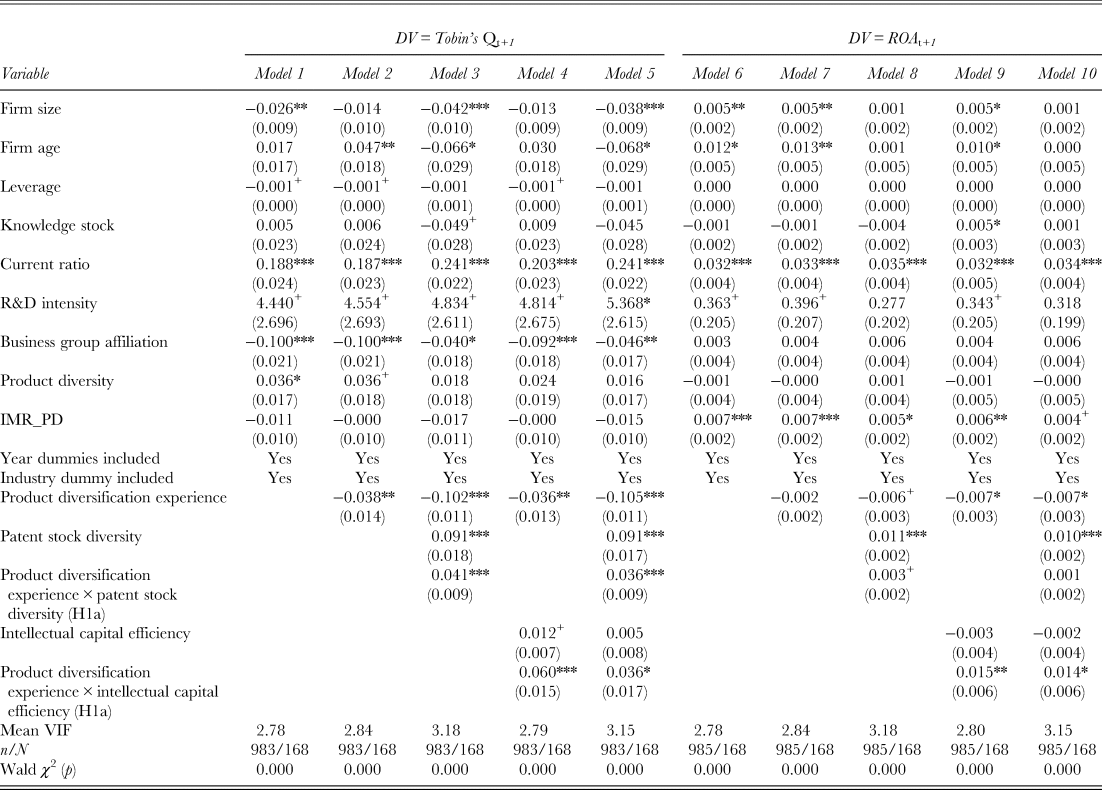
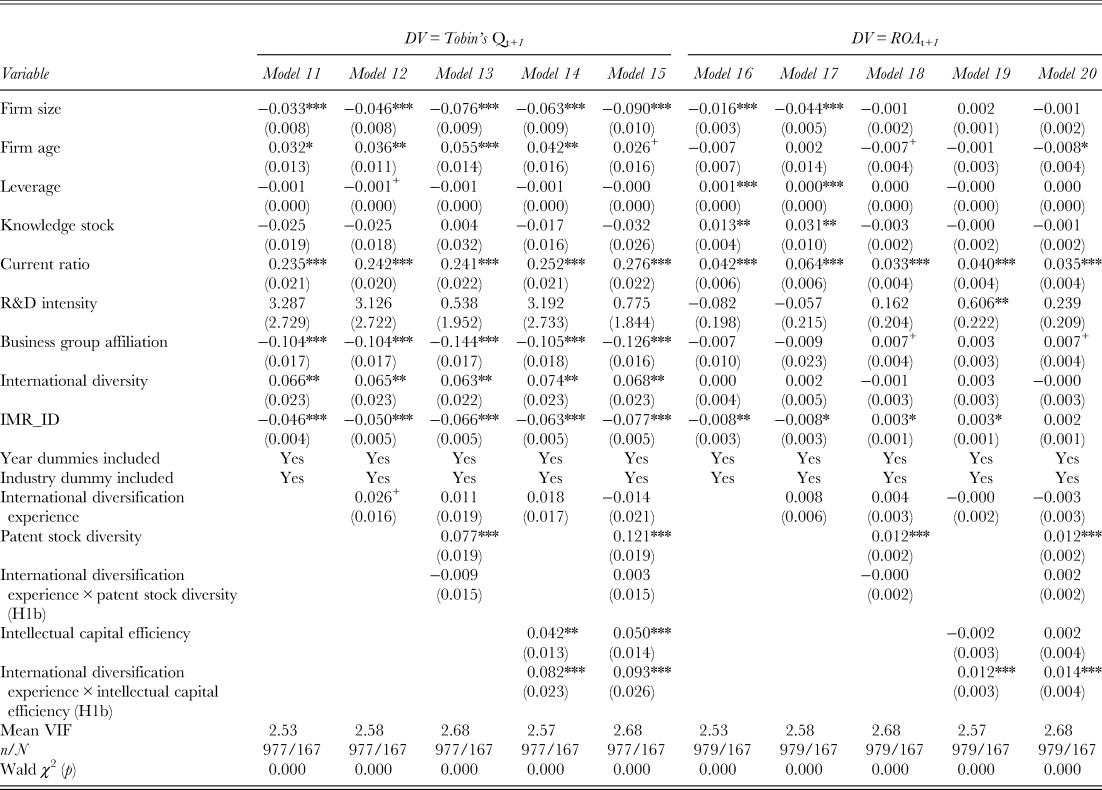
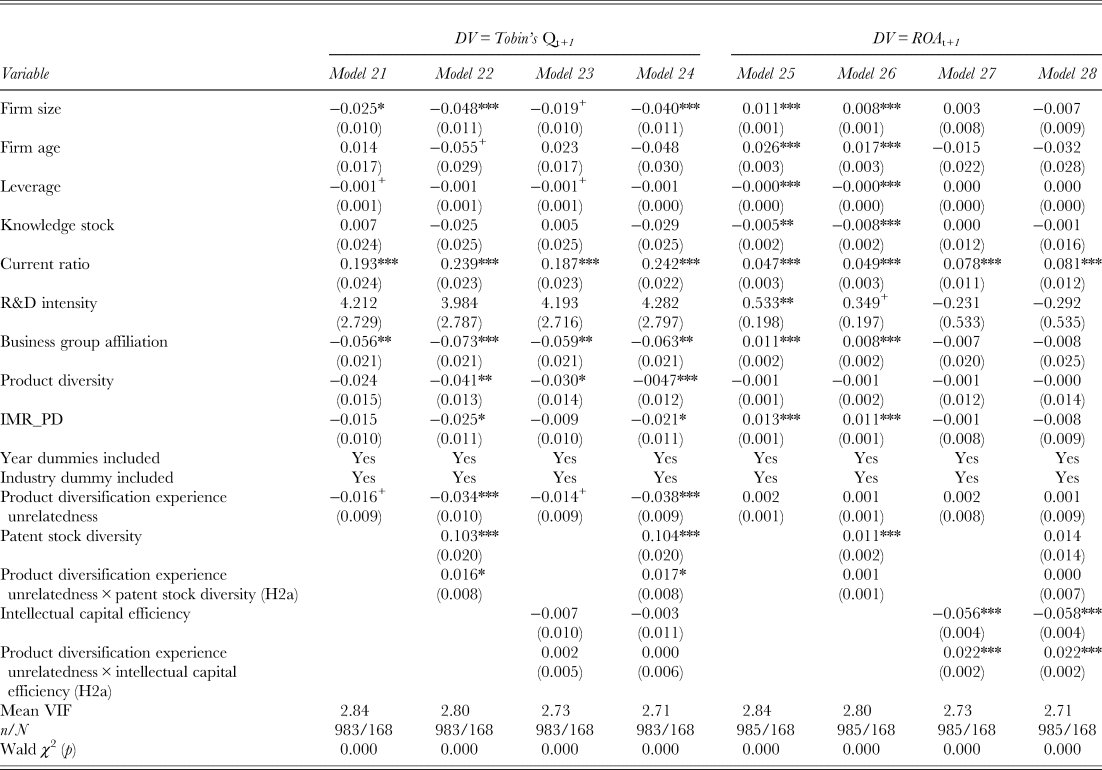
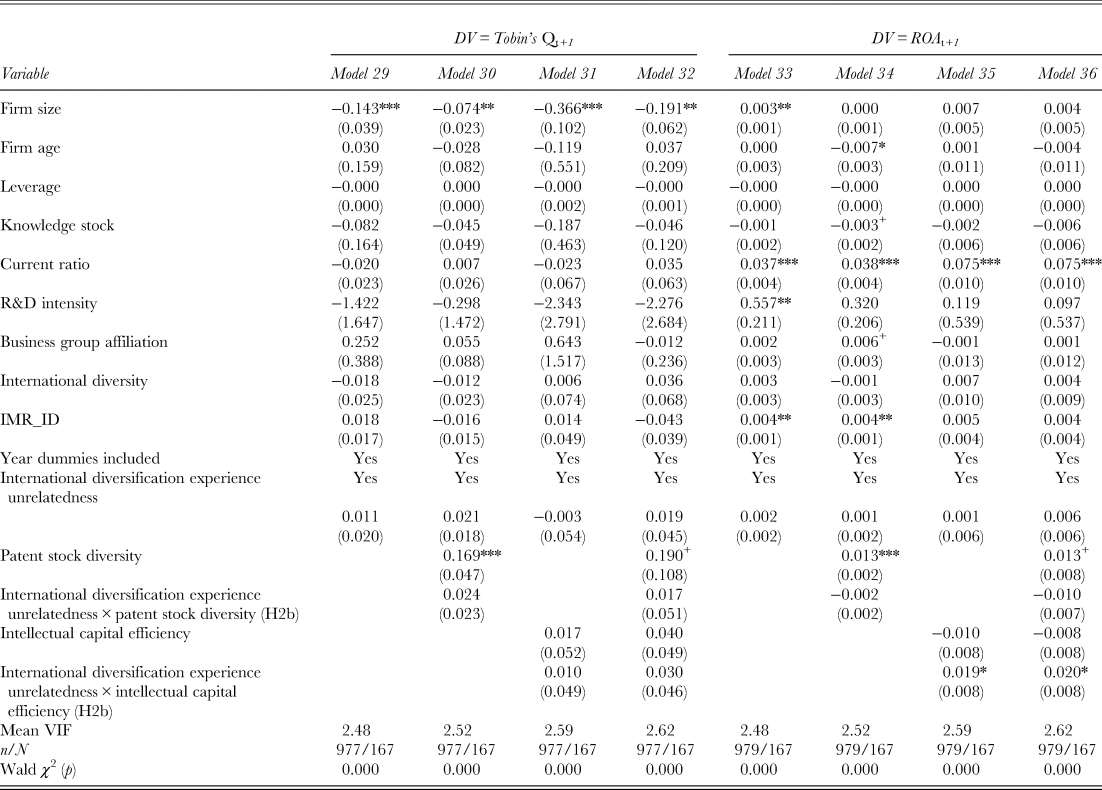
The descriptive statistics and correlation matrix of the variables are presented in Table 1. Tables 2–5 present results of the second stage of the Heckman procedure. H1a is examined in Models 1–10 (Table 2) and H1b is examined in Models 11–20 (Table 3). Furthermore, H2a is examined in Models 21–28 (Table 4) and H2b is examined in Models 29–36 (Table 5). The interaction terms used to examine the moderation effect of absorptive capacity were created using standardized variables to reduce non-essential multicollinearity (Dalal & Zickar, Reference Dalal and Zickar2012). Variance inflation factors (VIFs) for all the variables in all the models were less than the critical value of 10. Thus, multicollinearity was not a concern.
Descriptive statistics and correlation matrices

Notes: p-value<0.05 for r ≥ |0.05|. ROA = return on assets; R&D = Research and Development; SD = standard deviation; IMR_PD = inverse Mills ratio (product diversification); IMR_ID = inverse Mills ratio (international diversification).
Second-stage FGLS models for firm performance (product diversification experience)

Notes: Unstandardized regression coefficients are reported with standard error in parenthesis. Intercept terms are included but not shown. n = firm-year observations; N = firms; ROA = return on assets; R&D = Research and Development; IMR_PD = inverse Mills ratio (product diversification); H = hypothesis; VIF = variance inflation factor.
+p < 0.1, *p < 0.05, **p < 0.01, ***p < 0.001.
Second-stage FGLS models for firm performance (international diversification experience)

Notes: Unstandardized regression coefficients are reported with standard error in parenthesis. Intercept terms are included but not shown. n = firm-year observations; N = firms; ROA = return on assets; R&D = Research and Development; IMR_ID = inverse Mills ratio (international diversification); H = hypothesis; VIF = variance inflation factor.
+p < 0.1, *p < 0.05, **p < 0.01, ***p < 0.001.
Second-stage FGLS models for firm performance (product diversification experience unrelatedness)

Notes: Unstandardized regression coefficients are reported with standard error in parenthesis. Intercept terms are included but not shown. n = firm-year observations; N = firms; ROA = return on assets; R&D = Research and Development; IMR_PD = inverse Mills ratio (product diversification); H = hypothesis; VIF = variance inflation factor.
+p < 0.1, *p < 0.05, **p < 0.01, ***p < 0.001.
Second-stage FGLS models for firm performance (international diversification experience unrelatedness)

Notes: Unstandardized regression coefficients are reported with standard error in parenthesis. Intercept terms are included but not shown. n = firm-year observations; N = firms; ROA = return on assets; R&D = Research and Development; IMR_ID = inverse Mills ratio (international diversification); H = hypothesis; VIF = variance inflation factor.
+p < 0.1, *p < 0.05, **p < 0.01, ***p < 0.001.
Hypothesis 1a. Models 3 and 8 examine H1a using patent stock diversity as a measure of absorptive capacity. The results show that the coefficients of Product diversification experience × Patent stock diversity are positive and significant in both models (Model 3: DV = Tobin's Q, β = 0.041, p < 0.000; Model 8: DV = ROA, β = 0.003, p < 0.08), supporting H1a. To understand the effect size, in Model 3, we found that when patent stock diversity is low[Footnote 5] (i.e., one standard deviation (SD) below mean) and other independent variables are at mean, a one unit increase in the product diversification experience leads to 0.14 unit decrease in Tobin's Q (i.e., marginal effect[Footnote 6] is −0.14), whereas when patent stock diversity is high (i.e., one SD above mean) one unit increase in product diversification experience leads to only 0.06 unit decrease in Tobin's Q (i.e., marginal effect is −0.06). This finding suggests positive moderation effect, which can also be observed from Supplementary Material, Figure A1 in Appendix VI. Similarly, in Model 8, we found that at low level of patent stock diversity, the marginal effect of product diversification experience is −0.008, whereas at high level the marginal effect is −0.003, suggesting positive moderation.
Next, we examined H1a, using intellectual capital efficiency as a measure of absorptive capacity, in Models 4 and 9. In both the models, the coefficient of the interaction term Product diversification experience × Intellectual capital efficiency is positive and significant (Model 4: DV = Tobin's Q, β = 0.060, p < 0.000; Model 9: DV = ROA, β = 0.015, p < 0.009), suggesting a positive moderation effect. In terms of effect size, for Model 4, the marginal effect of product diversification experience at low level of intellectual capital efficiency is −0.096, whereas that at high level is +0.024, suggesting a very strong positive moderation. The same can be observed in Supplementary Material, Figure A2 in Appendix VI. Similarly, for Model 9, the marginal effect of product diversification experience is −0.022 at low level, whereas that is +0.009 at high level of intellectual capital efficiency, supporting H1a. Thus, findings support H1a with this measure of absorptive capacity as well. Furthermore, Models 5 and 10 present results of the full model where both measures of absorptive capacity are considered together. Results of full models also support H1a.
Hypothesis 1b. In Models 13 and 18, we examine H1b using patent stock diversity as a measure of absorptive capacity. The coefficient of the interaction term International diversification experience × Patent stock diversity is not significant in both Model 13 and Model 18. Next, in Models 14 and 19, intellectual capital efficiency is considered as a measure of absorptive capacity. The coefficient of the interaction term International diversification experience × Intellectual capital efficiency is positive and significant in both the models (Model 14: DV = Tobin's Q, β = 0.042, p < 0.000; Model 19: DV = ROA, β = 0.012, p < 0.001), suggesting a strong positive moderation effect of intellectual capital efficiency for both Tobin's Q and ROA. In terms of effect size, for Model 14, the marginal effect of international diversification experience on Tobin's Q is −0.06 at low level, whereas it is +0.10 at high level of intellectual capital efficiency. This suggests a strong positive moderation effect, which can also be observed in Supplementary Material, Figure A3 in Appendix VI. Similarly, for Model 19, the marginal effect of international diversification experience is −0.01 at low level, whereas it is +0.01 at high level of intellectual capital efficiency. Thus, findings support H1b with this measure of absorptive capacity. Furthermore, H1b is supported in full models (i.e., Models 15 and 20) as well.
Hypothesis 2a. We examined H2a, using patent stock diversity as a measure of absorptive capacity, in Models 22 and 26. Patent stock diversity positively moderates the effects of product diversification experience unrelatedness on Tobin's Q (Model 22: β = 0.016, p < 0.05), supporting H2a. In terms of effect size, for Model 22, the marginal effect of product diversification experience unrelatedness is −0.05 at low level of patent stock diversity, whereas it is −0.02 at high level. This suggests a positive moderation effect, which can also be observed in Supplementary Material, Figure A4 in Appendix VI. However, this moderation effect is not significant when firm performance is measured using ROA (Model 26).
Furthermore, Models 23 and 27 examine H2a using intellectual capital efficiency as a measure of absorptive capacity. The moderation effect is insignificant in Model 23. However, H2a is supported in Model 27 (DV = ROA, β = 0.022, p < 0.000).[Footnote 7] In terms of effect size, for Model 27, the marginal effect of product diversification experience unrelatedness is −0.02 at low level, whereas it is +0.02 at high level of intellectual capital efficiency, supporting a positive moderation effect. Similar results are also observed in full Models 24 and 28. Thus, findings broadly support H2a.
Hypothesis 2b. We examined H2b, using patent stock diversity as a measure of absorptive capacity, in Models 30 and 34 (Table 5). The moderation effect is not significant in both the models. Models 31 and 35 examine H2b using intellectual capital efficiency as a measure of absorptive capacity. H2b is not supported in Model 31 (DV = Tobin's Q). However, H2b is supported in Model 35 (DV = ROA, β = 0.019, p < 0.05).[Footnote 8] In terms of effect size, the marginal effect of international diversification experience unrelatedness is −0.017 at low level, whereas it is +0.019 for the high level of intellectual capital efficiency. Similar results were observed in full Models 32 and 36 as well. Thus, the findings weakly support H2b.
Robustness Checks
We conducted several robustness checks and additional analysis using alternative estimation techniques and variable measures. Our findings remained broadly consistent. These results are included in Supplementary Material, Appendix V.
DISCUSSION
We hypothesized that absorptive capacity positively moderates the outcome of product and international diversification experiences and those of unrelatedness in such experiences. A longitudinal investigation using a panel dataset of Indian firms from knowledge-intensive manufacturing industries, for 2008–2018, broadly supports our theoretical arguments. Although we observed significant relationships in our data, the effect size of our models is relatively small (Cohen, Reference Cohen1988). In robustness checks, we observed that R 2 statistics of all the random-effect models were relatively low, explaining only around 12–24% of total variance across all models. Furthermore, there are small changes in R 2 when moderating variables were included in the base models (see Tables C1–C4 in Supplementary Material, Appendix V). Such small effect size for firm performance models is not surprising, as the variance in firm performance can be attributed to multiple individual-, firm-, and industry-level factors (Wales, Parida, & Patel, Reference Wales, Parida and Patel2013; Yang, Narayanan, & De Carolis, Reference Yang, Narayanan and De Carolis2014), whereas we considered only observable firm-level variables, such as diversification experiences and absorptive capacity, to understand their performance outcomes. Furthermore, although we relied on the organizational learning perspective to explain the outcomes of learning from experiences, our measures of explanatory variables – diversification experience and absorptive capacity – are indirect, which may not adequately capture the organizational routines and processes that enable learning and help firms develop absorptive capacity (Lewin et al., Reference Lewin, Massini and Peeters2011). Although patent-based measures are established proxies for absorptive capacity (Dushnitsky & Lenox, Reference Dushnitsky and Lenox2005), such indirect measures may not capture the internal and external routines and socially enabling mechanisms that facilitate learning and knowledge sharing (Lewin et al., Reference Lewin, Massini and Peeters2011). Nonetheless, although our data and measures did not allow us to look at the microfoundations of absorptive capacity and organizational learning, our findings enhance the extant understanding about the crucial role of absorptive capacity in enabling performance from prior diversification experiences. Given our focus to understand the enabler of performance from prior diversification experiences, our findings make meaningful contribution with reasonable models (Cohen, Reference Cohen1988; Wales et al., Reference Wales, Parida and Patel2013; Yang et al., Reference Yang, Narayanan and De Carolis2014). However, we suggest that future studies use direct measures of learning and absorptive capacity to improve explanatory power of our models (Camisón & Forés, Reference Camisón and Forés2010). We discuss the theoretical implications of our findings below.
Theoretical Implications
We advance the research on performance effects of diversification experiences by examining the contingent role of absorptive capacity (Andreou et al., Reference Andreou, Louca and Petrou2016; Nguyen & Cai, Reference Nguyen and Cai2016; Zahavi & Lavie, Reference Zahavi and Lavie2013). Extant literature suggests that diversification experiences can enhance performance, provided they are not highly unrelated (Andreou et al., Reference Andreou, Louca and Petrou2016; Finkelstein & Haleblian, Reference Finkelstein and Haleblian2002; Haleblian & Finkelstein, Reference Haleblian and Finkelstein1999). However, there has been limited understanding about the contingent role of firms’ learning capabilities (i.e., absorptive capacity) in affecting the outcome of diversification experiences. This study highlights that absorptive capacity is crucial for creating and capturing the value from prior diversification experiences (Cohen & Levinthal, Reference Cohen and Levinthal1990; Dushnitsky & Lenox, Reference Dushnitsky and Lenox2005; Levitt & March, Reference Levitt and March1988).
Furthermore, the findings also suggest that absorptive capacity may help mitigate some of the negative transfer effects associated with unrelatedness in diversification experiences. Drawing on the learning perspective (mainly the ‘experience transfer theory’), prior studies have highlighted how unrelatedness in prior diversification experiences can lead to negative transfer, affecting the performance outcomes negatively (Finkelstein & Haleblian, Reference Finkelstein and Haleblian2002; Haleblian & Finkelstein, Reference Haleblian and Finkelstein1999). Our findings contribute to this stream of literature by suggesting that firms with superior absorptive capacity can mitigate some of the challenges associated with unrelatedness in diversification experiences. That is, firms that possess superior knowledge stock and intellectual assets can better manage the diverse knowledge flow and reduce negative transfer effects associated with unrelatedness. Our study, thus, has implications for the learning perspective as it highlights absorptive capacity as an important firm-specific learning capability that can explain why some firms are able to accumulate and make better use of their unrelated diversification experiences than others (Cohen & Levinthal, Reference Cohen and Levinthal1990; Levitt & March, Reference Levitt and March1988).
Furthermore, in a more general sense, our findings also add to our understanding of the role of absorptive capacity in enhancing firm performance by enabling acquisition and utilization of knowledge from diverse contexts (Tsai, Reference Tsai2001; Zhang, Li, Li, & Zhou, Reference Zhang, Li, Li and Zhou2010). Our findings are consistent with prior studies which suggest that a firm's absorptive capacity can positively affect the performance outcome of learning from diverse sources (Tsai, Reference Tsai2001; Zhang et al., Reference Zhang, Li, Li and Zhou2010). We extend this stream of research in two important ways. First, our findings add nuance to the extant understanding by highlighting that absorptive capacity helps translate experiences gathered in both diverse product and international markets. The diversification experiences gathered in product and international domains are distinct (Mayer et al., Reference Mayer, Stadler and Hautz2014). Thus, our findings emphasize that firms’ abilities to value, acquire, and utilize knowledge are important for both types of diversification experiences. Second, although the extant literature suggests that absorptive capacity can enable learning from diverse contexts (Tsai, Reference Tsai2001; Zhang et al., Reference Zhang, Li, Li and Zhou2010), there has been little empirical evidence about whether its benefits will accrue if sources of learning are highly diverse or unrelated (i.e., unrelatedness in the diversification experiences in this study). In this regard, our findings highlight that absorptive capacity can mitigate the challenges associated with high level of diversity or unrelatedness in sources of learning. However, it is important to emphasize that we have not captured the minute differences (unrelatedness) in the sources of learning within product or international markets, such as differences in buyers, suppliers, partners, and technological and institutional contexts in these markets. Future studies can measure the level of diversity (unrelatedness) in a more nuanced manner and contribute to the ongoing debates on the role of absorptive capacity in enabling learning from diverse sources (Tsai, Reference Tsai2001; Vasudeva & Anand, Reference Vasudeva and Anand2011).
Limitations and Future Research Directions
There are a few limitations of this study which provide avenues for future research. First, for empirical analyses, we used a relatively small sample of firms from the knowledge-intensive manufacturing sector only. Accordingly, our findings are generalizable to the manufacturing industries which are characterized by high use of knowledge assets (Cavaliere, Lombardi, & Giustiniano, Reference Cavaliere, Lombardi and Giustiniano2015). Future studies may consider knowledge-intensive service sectors as well to enhance generalizability of the findings. Second, data are taken from a single-country context. We suggest that a multi-country sample will be helpful in establishing generalizability of the findings across multiple broad empirical contexts. Third, we measured diversification experience as a count of a firm's diversification moves in the past ten years in product or international markets. However, despite wide use in the literature (Haleblian & Finkelstein, Reference Haleblian and Finkelstein1999; Nguyen & Cai, Reference Nguyen and Cai2016), a count-based measure has a limitation as it loses out the richness of the experience gained through different levels of exposure in different business sectors or international markets. We could not measure experience based on the number of years of exposure because of the unavailability of reliable data. Future studies can survey firms to get rich information about their experience in diverse product and international markets. Finally, we measured absorptive capacity using proxies based on financial and patenting data. Although these proxies are well established (Dushnitsky & Lenox, Reference Dushnitsky and Lenox2005; Nieto & Quevedo, Reference Nieto and Quevedo2005), managerial assessment of learning and performance may provide further insights. Future studies may use surveys to operationalize absorptive capacity (Camisón & Forés, Reference Camisón and Forés2010).
CONCLUSION
In conclusion, this study suggests that absorptive capacity is a crucial firm-specific capability that impacts the extent to which firms could translate their product and international diversification experiences toward superior performance. Absorptive capacity helps mitigate challenges associated with unrelatedness in diversification experiences and reduces the negative transfer effects. Thus, our findings apprise managers that the development of absorptive capacity is important to enhance benefits of diversification experiences.
SUPPLEMENTARY MATERIAL
The supplementary material for this article can be found at https://doi.org/10.1017/mor.2022.44
DATA AVAILABILITY STATEMENT
The data that support the findings of this study are openly available in Open Science Framework at https://osf.io/4sxkh/?view_only=8c49fa2a2f6949399685bf64dfe7baa4. The folder name is ‘Data File and Instruction for Replication’.