Introduction
In 1963, the Nobel Prize for chemistry was awarded to Karl Ziegler and Giulio Natta “for their discoveries in the field of chemistry and technology of high polymers.”Reference Ziegler 1 , Reference Natta 2 The economic access to polymers with desirable properties enabled by their discoveries paved the way for the widespread introduction of polymeric materials into modern society and was heralded to mark the beginning of the “polymer age” of mankind.
By hard work, not (only) by luck
Often claimed as a typical example of serendipity in science, the development of what became known as “Ziegler catalysts”Footnote * was in fact a combination of careful observation and intensive work. Ziegler was working since 1949 at the Max-Planck-Institut in Mülheim, Germany, on the “Aufbaureaktion” (growth reaction), the slow, stepwise oligomerization of ethylene with lithium and aluminum hydrides to give mixtures of metal alkyl species. When Ziegler’s PhD student, Erhard Holzkamp, obtained 1-butene in a nearly quantitative yield, this precipitated what Ziegler described later as a “strenuous investigation” in his laboratory.Reference Ziegler 3 – Reference Martin 7 Contamination of the autoclave with traces of nickel, either from a previous hydrogenation experiment or from aggressive cleaning, turned out to be responsible for this outcome. The presence of nickel thus greatly increased the speed of the insertion reaction.
This “nickel effect” prompted Ziegler to systematically investigate the effects of transition metals on the “Aufbaureaktion,” in other words, the reaction of ethylene (and in some cases propylene) with aluminum alkyls.Reference Ziegler 3 – Reference Fischer, Jonas, Misbach, Stabba and Wilke 8 In investigating V, Cr, Mo, Mn, Fe, Ru, Os, Co, Pt, Cu, Ag, and Au metal salts in combination with trialkyl aluminum, they observed either no influence on the growth reaction, catalytic di- or oligomerization, or even production of small amounts of solid “paraffin” products. In 1953, Ziegler’s student Heinz Breil investigated the reaction of ethylene with a mixture of triethylaluminum and zirconium acetylacetonate under typical conditions (100°C and 10 MPa) to obtain a linear polyethylene, very different from the highly branched, low-density polyethylene (LDPE) obtained by radical polymerizationReference Peacock 9 at that time (see Figure 1 for the structure of polyethylene). Shortly afterward in the same year, postdoctoral student Heinz Martin was able to polymerize ethylene at room temperature and atmospheric pressure with a mixture of (CH3CH2)2AlCl and TiCl4. Ethylene polymerization under atmospheric pressure was unprecedented and caused Martin to burst into Ziegler’s office announcing “Es geht in Glas!” (It works in glassware!) The Ziegler laboratory, used to working under elevated pressures, had been ill-equipped for these experiments, and the polymerization had been conducted in a five-liter conserving jar borrowed from the kitchen of his wife, Maria Ziegler.Reference McMillan 5 – Reference Martin 7
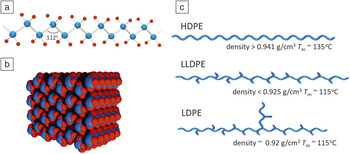
(a) A polyethylene chain (blue: carbon, red: hydrogen) adopts a zigzag conformation. In this conformation, the polyethylene chains can bundle and form (b) crystallites, in which chains are densely packed. The size of these crystallites and their relative volume fraction in the polymer greatly influences its mechanical properties. Any defect along the polymer chain, such as branches, will impinge on crystallite formation and consequently affect polymer density and the melting point (T m). Polyethylene is conventionally classified (c) as high-density polyethylene (HDPE), linear low-density polyethylene (LLDPE), and low-density polyethylene (LDPE). HDPE is prepared by Ziegler-Natta or Phillips catalysis, and it has a very low number of branches (as low as 1 branch per 1000 carbons). LLDPE, a copolymer of ethylene with an α-olefin (see Figure 2) is also prepared by catalytic polymerization and contains short branches that are all two carbons shorter than the number of carbon atoms in the starting α-olefin. The choice of the catalyst allows tailoring the number of branches per 1000 carbons (typically between 10 and 100 branches/1000C). LDPE, prepared by radical polymerization, contains both short and long branches of various lengths. It is not prepared by Ziegler-Natta catalysis, and therefore will not be considered further here.

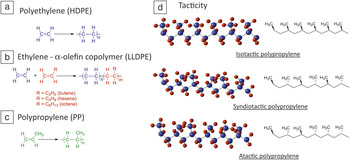
Main polyolefins produced by Ziegler-Natta catalysis: (a) High-density polyethylene (HDPE) is obtained by catalytic polymerization of an ethylene monomer, whereas (b) linear low-density polyethylene (LLDPE) necessitates two monomers, ethylene and an α-olefin (in red), which most often is 1-butene, 1-hexene, or 1-octene. Polypropylene (PP), obtained by the polymerization of propylene (c), exists with different tacticities (d). In isotactic PP (T m ≈ 162°C), the CH3 groups have all the same absolute configuration along the chain (i.e., they are all on the same side of the polymer backbone). In syndiotactic PP (T m ≈ 160°C), the CH3 groups occupy alternate sides of the polymer backbone, and they are randomly distributed in atactic polypropylene. The latter is amorphous and does not have a melting point (T m).

In the beginning of 1953, before the breakthroughs in the Ziegler laboratory occurred, the Italian company Montecatini purchased, on incitation by Giulio Natta in Milan and his assistant Piero Pino, the rights for the industrial developments of Ziegler’s discoveries in Italy. Aware of Ziegler’s success in ethylene polymerization, Natta’s interest in rubber prompted him to use the TiCl4/(CH3CH2)2AlCl catalyst for the polymerization of propylene ( Figure 2 ). In 1954, they obtained, by fractionation of the reaction product, a highly crystalline material. From the x-ray diffraction pattern, they concluded that they had obtained a stereoregular polymer with all methyl substituents on the main chain of the same configuration. In the subsequent publication of his findings, Natta proposed the term “isotactical chains” for this unexpected stereoregularity and thus coined the first of the terms used nowadays to describe the microstructure of polymers (see Figure 2 for the definition of tacticity).Reference Natta, Pino, Corradti, Danusso, Mantica, Mazzanti and Moraglio 10 Some years later (1959), Natta also reported the isolation and structure of syndiotactic polypropylene.Reference Natta and Corradini 11 , Reference Pasquini 12
The time for transition metal-catalyzed olefin polymerization had come in 1950. While Ziegler and Natta clearly deserved the Nobel Prize for their seminal scientific work, they were actually neither the first to observe transition-metal catalyzed olefin polymerization, nor the first to obtain isotactic polypropylene. J. Paul Hogan and Robert L. Banks from Phillips Petroleum investigated a similar route as Ziegler (i.e., to produce low-molecular weight alkanes and alkenes from ethylene and propylene). In 1951, they obtained polypropylene, containing a notable amount of isotactic material, using a mixture of nickel oxide and chromium oxide as the catalyst.Reference Ziegler 1 , Reference McMillan 5 , Reference Martin 7 Phillips concentrated subsequently on the production of polyethylene based on chromium catalysts, and half of today’s world production of high-density polyethylene (HDPE) is obtained using a “Phillips catalyst” based on the initial results of Hogan and Banks (see the article by McDaniel in this issue). Due to its low stereoregularity, the Phillips catalyst is not applied for the commercial production of polypropylene.
Unknown to the other parties, Alexander Zeltz and Ron Carmody from Standard Oil of Indiana had already used a molybdenum catalyst on alumina to polymerize ethylene and propylene in 1950.Reference McMillan 5 , Reference Martin 7 Standard Oil, however, was less aggressive in pursuing this discovery, and the Standard Oil catalyst never achieved academic or industrial importance.
While none of the previous catalysts were initially intended for the polymerization of olefins, they were developed during systematic investigations to obtain higher molecular weight materials from ethylene and propylene. Instead of referring to serendipity, one might rather claim that these systematic investigations succeeded beyond expectations. The near simultaneity of the discoveries described previously and others obtained shortly thereafter, combined with the immediately recognized economic potential of olefin polymerization, resulted in heated and extended intellectual property disputes. In the extreme case, in the United States, the patent for the use of Ziegler-Natta catalysts for propylene polymerization was granted to Ziegler in 1978, while the composition-of-matter patent for “crystalline polypropylene” was awarded to Phillips in 1983, more than two decades after the respective applications.
The battle to find a homogenous model
Over the years, heterogeneous Ziegler-Natta catalysts were significantly improved (fifth generation and beyond, see the article by Gahleitner et al. in this issue), and modern Ziegler-Natta catalysts contain TiCl4 deposited on a MgCl2 support, activated by aluminum alkyls and modified with two suitable Lewis bases (external and internal donors).Reference Peacock 9 , Reference White and Choi 13 Ziegler-Natta catalysts account for half of the production of HDPE, for linear low-density polyethylene (LLDPE) and nearly exclusively for isotactic polypropylene. With the combination of commercial interest, high catalytic activity, and high stereoselectivity for isotactic polypropylene, it is not surprising that Ziegler-Natta catalysis immediately caught the attention of the academic community, which tried to find well-defined molecular species that reproduce the catalytic activity of the heterogeneous catalyst.Reference Scheirs and Kaminsky 14 – Reference Brintzinger, Fischer, Mülhaupt, Rieger and Waymouth 16 Breslow as well as Natta reported on ethylene polymerization by a homogenous Cp2TiCl2/Al(CH2CH3)2Cl catalyst (Cp = cyclopentadienyl), but activities were well below those of the heterogeneous catalyst. In addition, the catalyst was inactive toward propylene. Reichert and Meyer found, this time by real serendipity, that the addition of water to Cp2TiCl2/Al(CH3CH2)2Cl increased the activity of the catalytic system. Similarly, Sinn and Kaminsky observed that the addition of water to Cp2ZrCl2/Al(CH3)3 rendered this system active not only for ethylene, but also for propylene polymerization. This finally offered a real homogenous model for the polymerization reaction. For a short primer on the mechanism of polymerization and examples of homogeneous catalysts, see Figure 3 . The crucial role of water lies in the formation of oligomeric methylalumoxanes (MAO) by reaction with AlMe3. MAO not only serves as an alkylating agent, thus providing the initiating group, it also abstracts one chloride ligand from the metal center to form a weakly coordinating anion and a Cp2ZrR+ cation, identified as the active species. MAO, sometimes nicknamed “magic aluminoxane,” soon became the activator of choice for metal-catalyzed olefin polymerization.Reference Brintzinger, Fischer, Mülhaupt, Rieger and Waymouth 16 However, while the activity of the heterogeneous system was thus reproduced, the polymerization of propylene was unselective and led to atactic polymers. This was resolved by Ewen as well as by Brintzinger and Kaminsky, who obtained highly isotactic polypropylene by using chiral, bridged, stereorigid “ansa-metallocenes.”Reference Brintzinger, Fischer, Mülhaupt, Rieger and Waymouth 16 – Reference Razavi and Thewalt 19 Finally, a true molecular Ziegler-Natta catalyst was born, allowing not only the study of the polymerization mechanism, but also the establishment of structure-reactivity relationships and rational catalyst design.
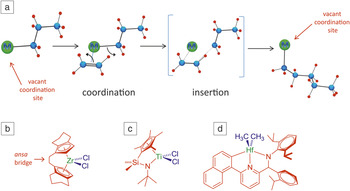
(a) Simplified Cossee-Arlman mechanism for the catalytic polymerization of olefins. The active site consists of a metal (M) alkyl (here a propyl chain) and a vacant site to which the monomer readily coordinates. During the insertion step, the electrons in the double bond and in the metal alkyl bond migrate (symbolized by the curved arrows) to form two new bonds (dotted bonds in the bracketed transition state). The resulting product is thus a metal alkyl elongated by two carbons. Note that the active site again contains a vacancy and is therefore apt to coordinate and insert a monomer. Although all catalysts operate by a series of coordination and insertion steps, their structure and environment are key elements in determining catalytic activity and polymer microstructure. Conventional Ziegler-Natta catalysts are heterogeneous (i.e., insoluble solids), and their precise chemical structure is still under debate. Homogeneous (i.e., soluble) catalysts such as (b) ansa-bridged metallocenes, (c) a constrained geometry catalyst, (d) or post-metallocene catalysts clearly illustrate the diversity of existing structures. The ligands (in red) around the metal atom (in green) remain unchanged during the polymerization. It is the role of a co-catalyst (alkyl aluminum, methylalumoxane, or borane) to generate the required alkyl chain and vacant site upon reaction with the chlorine atoms or methyl groups of the catalyst (in blue).

The genie is out of the bottle
With a homogenous model system in hand, academic interest in Ziegler-Natta polymerization increased drastically. The easy tunability of a molecular catalyst allowed control of the polymer microstructure not available with traditional Ziegler-Natta catalysts, and the community tried (often very successfully) to establish structure-reactivity relationships to address activity, regiochemistry, and—most importantly—stereoselectivity of the polymerization reaction. In a textbook example of a structure-selectivity relationship, the symmetry of the catalyst allowed prediction of polymer tacticity from catalyst symmetry.Reference Ewen 18 Consequently, the commercial production of stereoblock-copolymersReference Chum and Swogger 20 has been rendered possible by using either catalysts “oscillating” between two stereoisomers or by “chain-shuttling” between catalysts of different stereoselectivity.Reference Resconi, Cavallo, Fait and Piemontesi 17 , Reference Gibson 21
Before the field of metallocene-catalyzed α-olefin polymerization was exhausted, the knowledge gained therein started progress in other areas: constrained geometry catalysts allowed the placement of a few long chain branches along a linear polyethylene chain, resulting in polymers that are easier to processReference Chum and Swogger 20 and post-metallocene catalysts, avoiding the well-studied biscylopentadienyl metal framework, provided activities, and stabilities higher than metallocenesReference Makio, Terao, Iwashita and Fujita 22 , Reference Gibson and Spitzmesser 23 as well as the possibility to precisely control the molecular weight distribution via a so-called “living” polymerization.Reference Coates, Hustad and Reinartz 24 , Reference Busico, Talarico and Cipullo 25 After Keim’s and Brookhart’s work on Ni- and Pd-catalyzed ethylene polymerization,Reference Ittel, Johnson and Brookhart 26 polymerization catalysts based on late transition metals became accessible, which did not suffer from the sensitivity of Ziegler-Natta catalysts toward polar monomers, such as methyl acrylates (see the article by Takeuchi later in this issue).Reference Boffa and Novak 27 , Reference Nakamura, Ito and Nozaki 28
Ziegler-Natta catalysis also proved to have far-reaching applications, and the family of polymerizable monomers significantly expanded past α-olefins. Thus, the polymerization of conjugated dienes with lanthanide catalysts became an essential technology for the elastomer industry.Reference Osakada and Takeuchi 29 Thanks to the new generation of metallocene catalysts and late transition metal catalysts, it became possible to incorporate the highly rigid norbornene backbone within polyolefins, resulting in materials combining excellent transparency and high modulus (see the article by Boggioni and Tritto in this issue). Cyclic olefin copolymers were thus marketed in the early 2000s for the first time. Styrene also became polymerizable, yielding a syndiotactic polystyrene with a staggering melting point of 270°C in comparison to the usual 100°C glass temperature for atactic polystyrene. Last, but not least, polyketones were prepared by alternating copolymerization of olefins and carbon monoxide (see the article by Zehetmaier et al. in this issue). The realization that polymer properties might be governed not only by the use of more elaborate monomers, but also (and more economically) by controlling the microstructure of polymers made from monomers as simple as ethylene or propylene, led to the preparation of unprecedented materials (see the article by Busico in this issue). Strategies were devised to control the molecular weight distribution, the possibility to transfer chains from an active to a dormant state, to prepare block copolymers via a living polymerization process, to control branching pattern, and most specifically to generate sparse long chain branches with essential rheological consequences.Reference Chum and Swogger 20 , Reference Gibson 21
A cornucopia of discoveries
The tremendous amount of insights gained into the mechanism of Ziegler-Natta polymerization could not remain without impact onto other areas. To mention just a few: (1) Insights into the reactivity of metal carbon bonds, especially in early transition-metal catalysts, were quickly transposed and extended to the numerous other catalytic processes for which metal carbon bonds play a pivotal role.Reference Labinger and Bercaw 30 (2) Crystallographic and kinetic evidence firmly established the concept of “agostic interactions,” the intermolecular interaction of a CH-σ-bond with an empty metal-orbital, as a structural motif with significant impact on transition-state geometries.Reference Coates and Grubbs 31 (3) The newly arrived density functional theory seemed to be a perfect choice to investigate the mechanism of insertion polymerization in silico. Reference Woo, Margl, Deng, Cavallo and Ziegler 32 (4) The oxophilicity of the metal carbon bond (i.e., its tendency to undergo hydrolysis or oxidation) could be radically altered by moving from early to late transition metals, leading to a polymerization reaction with a much broader scope.Reference Boffa and Novak 27 , Reference Nakamura, Ito and Nozaki 28 (5) Besides significant advances in the understanding of the reactivity of metal-carbon bonds, the quest for well-defined homogeneous Ziegler-Natta catalysts also highlighted the importance of weakly coordinating anions.Reference Beck and Sünkel 33 Highly Lewis-acidic fluorinated boranes and corresponding borates are now crucial components in hydrogenation and hydrosilylation processes, numerous reactions involving superacids, and even in applied electrochemistry. (6) The field of coordination chemistry was also strongly changed by the continuous development of novel Ziegler-Natta catalytic assemblies. For example, the introduction of ansa-bridges to control the structure and reactivity of metallocenes as well as the great potential of α-diketimine and β-diketiminates as unreactive spectator ligands spread widely into areas not related to polymerization.
Fifty years after the Nobel Prize and still young
No reaction of the same academic and technological magnitude as Ziegler-Natta catalysis has withstood the passage of time so well. Ziegler-Natta catalysis is still a thriving field of research and development, both in academia and industrially. It is and will continue to be the object of important conceptual improvements, whereas other essential industrial catalytic processes (Haber process, hydrogen production, and syn-gas reactions) are believed to have reached a mature state. One reason for this might be that Ziegler-Natta catalysis, a term originally coined soon after its discovery, should in fact be referred to as Ziegler-Natta catalytic processes, in consideration of the wealth of polymeric products that can be prepared via this route. Where is this domain evolving? As usual, future scientific predictions are meant to be inaccurate; however, it is our belief that significant advances will be made by bridging the gap between the realm of coordination polymerization (where the metal-bound carbon atom is polarized) and the realm of free-radical polymerizations. Already, organometallic-mediated radical polymerizationReference Hurtgen, Detrembleur, Jerome and Debuigne 34 has highlighted the possibility to tune the reactivity of a free radical by means of an organometallic complex. In an interesting twist, the reverse process of polymerization, that is to say the depolymerization of polyolefins, was demonstrated for the first time in 1997 using supported tantalum hydride complexes.Reference Vidal, Théolier, Thivolle-Cazat and Basset 35 This reaction clearly opens interesting avenues for chemical recycling and valorization of spent polyolefins, and we predict that it will be the object of significant progress in the future.
Conclusion
Let us emphasize that Ziegler-Natta catalysis is still well and alive. As proof of this, renowned experts from industry and academia have provided their opinion on modern aspects of the field in this issue of MRS Bulletin, starting with Busico’s critical review of the state of Ziegler-Natta catalysis in general. Gahleitner et al. cover recent industrial developments and challenges, and McDaniel discusses chromium-based catalysis. We also selected three special topics for this issue of MRS Bulletin that are representative of contemporary Ziegler-Natta catalysis: polyketones, which are reviewed in the article by Zehetmaier et al.; cyclic olefin polymerizations, addressed in the article by Boggioni and Tritto; and polar olefins polymerization by late transition metal catalysts, reviewed in the article by Takeuchi.
Common terms in Ziegler-Natta-type polymerizations
Please note: many of the terms described below have a broader general meaning outside the area of Ziegler-Natta-type polymerization.
α-olefin: Alkene with a terminal double bond.
β-hydrogen elimination: Chain transfer mechanism in which a hydrogen atom on the second (β) carbon atom of the growing polymer chain is transferred to the metal center. The metal hydride thus formed remains active and starts a new polymer chain.
Bicyclic olefins/monomers: Olefin monomers that contain two fused (e.g., indene) or bridged (e.g., norbornene) carbocycles. The double bond is part of a cycle.
Catalyst symmetry: Symmetry of the catalyst framework, ignoring the growing polymer chain. Typical symmetries are chiral catalysts with or without a two-fold axis (C 1, C 2) and mirror-symmetric catalysts with or without a two-fold axis (C s, C 2v).
Clarifier/clarifying agent: A polymer additive that enhances the clarity of the obtained polymer by controlling its crystallization behavior.
Copolymer: Polymer derived from two or more different monomers.
Cyclic olefins/monomers: Monomers whose double bond is part of a carbocycle.
High polymer: Polymer of high molecular weight, typically above 10,000 Dalton.
Heterogenous catalyst/catalysis: The catalyst is not dissolved in the reaction medium. Catalysis occurs at catalytically active centers on the surface of the catalyst.
Homogenous catalyst/catalysis: Catalyst and substrate are both dissolved in the reaction medium.
Homopolymer: Polymer derived from a single monomer.
Insertion (reaction): The insertion of the carbon atoms of the double bond in the monomer into the metal-carbon bond of a metal-bound polymer chain. The product is another metal alkyl with an elongated polymer chain.
Living Ziegler-Natta catalysis/polymerization: Polymerization without a notable degree of chain termination and transfer. Living polymerizations allow, among other things, increased control of the polymer molecular weight.
Oligomer: Comparable to a polymer but of low molecular mass. Contrary to polymers, the physical properties of oligomers are significantly altered by the removal of a few repeating units.
Polymer, monomer: A polymer is a substance composed out of chain-like molecules (macromolecules) of high molecular mass that are obtained, in fact or conceptually, by the enchainment of molecules of smaller molecular mass (monomers). The physical properties of a polymer are not noticeably altered by the removal of a few repeating units.
Polyolefin: A polymer obtained from the polymerization of olefins (alkenes).
Regiochemistry, regioselectivity: The regiochemistry of the polymerization reaction (insertion), in other words, if the alkyl group on the metal center is transferred to the less substituted carbon atom (2,1-insertion) or the more substituted carbon atom of the double bond in the monomer (1,2-insertion).
Stereochemistry, stereoselectivity: The relative orientation in which the substituents on the double bond of the monomer are found in the polymer. Typical observed stereochemistries are atactic, isotactic, and syndiotactic.
Ziegler-Natta catalyst: A heterogenous catalyst prepared from titanium chloride and an aluminium alkyl on a solid support such as MgCl2. Sometimes also used as a general term for homogenous or heterogenous transition-metal catalysts applied in the polymerization of olefins by a coordination-insertion mechanism.