Nigeria is the most populous country in Africa with an absolute number of more than 180 million people. Yet it has no functional cardiac hospital for both adult and children. A sustainable cardiac programme demands highest level governmental support, leadership, and a dedicated multidisciplinary team with profound know-how.Reference Edwin, Tettey and Aniteye1 Cardiac and to a lesser extent general thoracic surgery require relatively sophisticated diagnostic and surgical techniques and high-level infrastructure operated by personnel with advanced training and expertise.Reference Edwin, Tettey and Aniteye1 Nigeria, shortly after independence was ravaged by 3-year civil war, followed by 29 years of military governance.
Between 1970 and 1980, British-Nigerian trained cardiothoracic surgeons performed external cardiac surgeries due to knowledge deficit and lack of technology.Reference Adebonojo2 However, very few open heart surgery cases were recorded through foreign cardiac missions, precisely at University of Nigeria Teaching Hospital, Enugu and University College Hospital, Ibadan.Reference Anyanwu, Ihenacho and Okoroma3 The two centres transited to independent open heart surgery programme in valvular heart diseases and simple CHD in the middle of 1980s.Reference Nwafor, Eze and Anyanwu4 Prolonged military rule coupled with its total neglect of health sector, brain drain syndrome, interprofessional conflict as well as dishonest and corrupt leadership stifled establishment of sustainable open heart surgery programme.Reference Ogbeidi5,Reference Akokuwebe and Adekumbi6
With the enthronement of sustained democratic rule in 1999, Nigeria was divided into six geopolitical zones.Reference Ogundiya7 All the teaching hospitals within each zone utilised different models towards establishing a sustainable programme. The centres in trying to resuscitate the open heart surgery programmes embarked on sending cardiac team(s) abroad for training. While in others, individual members of cardiac team travelled abroad to different centres for training and some used the visiting cardiac surgical teams. After 20 years of various efforts, no sustained independent cardiac surgical programme exists. We investigated the various models to assess the reasons for this failure.
Methods
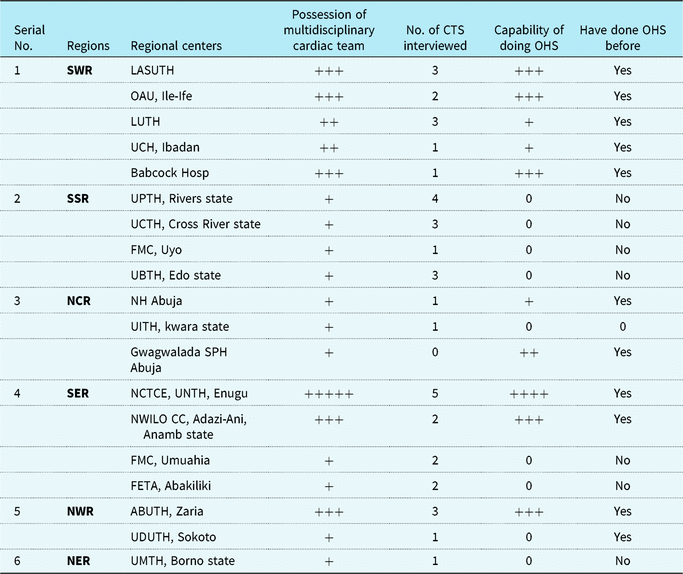
The teaching hospitals that had started to develop cardiothoracic and cardiology units in the six geopolitical zones were visited by the authors. The six geopolitical zones include southeast, southsouth, southwest, northcentral, northwest, and northeast. Discussions were held with the surgeons as well as with the surgical residents from those centres who came for training in the authors’ centre. The number of surgeons, the types of cardiac model, limiting factors, and outcome were discussed at each site. The surgeons interviewed in each geopolitical zone were grouped into six parts, according to their preferred model. The outcome is defined as independence in open heart surgery at least in traditional valve surgery, common CHDs like atrial septal defect, ventricular septal defect, and mild form of Tetralogy of Fallot. It is generally believed that each model being effectively implemented should achieve the above outcome within a period of 3–4 years, if there is an already existing structure. The models had limitations. These and outcome were studied. Cardiothoracic surgeons and cardiologists were trained by West African College of Surgeons, and West African College of Physicians, and or the national counterparts. The data were analysed using number interviewed excel and the results presented in Table 1.
Showing the distribution of regional centres, number of CTS interviewed, possession of multidisciplinary cardiac team and capability of performing OHS

ABUTH = Ahmadu Bello Teaching Hospital; CC = Cardiac Center; FETA = Federal Teaching Hospital Abakiliki; FMC = Federal Medical Center; LASUTH = Lagos State University Teaching Hospital ; LUTH = Lagos University Teaching Hospital ; NCR = Northcentral region; NCTCE, UNTH = National Cardiothoracic Center of Excellence; NER = Northeastern Region; NH = National Hospital; NWR = Northwestern Region; OAU = Obafemi Awolowo University ; SER = Southeastern Region; SSR = SouthSouth Region; SWR = Southwestern Region; UBTH = University of Benin Teaching Hospital; UCH = University College Hospital ; UCTH = University of Calabar teaching Hospital ; UDUTH = Usman Dan Fodio Teaching Hospital; UITH = University of Ilorin Teaching Hospital; UMTH = University of Maiduguri Teaching Hospital; UPTH = University of Port Harcourt Teaching Hospital.
Keys: ++++ → comprehensive yes – OHS has taken place in that hospital; +++ → almost comprehensive no – OHS has never taken place in that hospital; ++ → almost inadequate; + → inadequate; 0 → exist only by name.
Results
Different models being adopted or proposed to be adopted towards establishing sustainable open heart surgery programme
Foreign cardiac mission model.
Ghana–German model.
Employment of expatriate consultant.
Sending selected cardiac team abroad for training.
Individual members of the cardiac team travelling abroad to undertake training at different centers for limited period of time.
Provision of special incentives to highly skilled Nigerians in diaspora to relocate home to establish a cardiac hospital through private–public partnership.
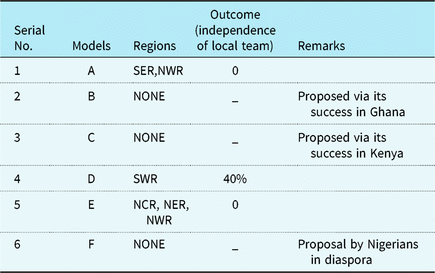
In this Table 2, the outcome is independent open heart surgery programme for valve simple surgeries (aortic and mitral replacement) as well as CHDs like atrial septal defect, ventricular septal defect, and mild form of Tetraology of Fallot. It shows with doubt that southwestern region, applying model D, was the highest.
Outcome of application of different models

Outcome of the application of the different models
Southwest Region
Lagos State University Teaching Hospital, local team is capable of independence in open heart surgery for mild valvular heart diseases. Output is about 30 cases in any year.
Obafemi Awolowo University, Ile-Ife, local team is capable of independence in open heart surgery for mild CHDs like atrial septal defect and ventricular septal defect. Output is about 15 cases in a year.
Babcock Private University teaching hospital is capable of independence in open heart surgery for mild valvular heart diseases. Output is about 50 cases in a year.
Funding is a major limitation affecting the outcome here.
The reasons why independence is possible in the south-western region is that some of the surgeons received their training abroad and also that their cardiac team received abroad training (model D).
Southsouth Region
No local team is independent of open heart surgery. This region practised model E.
Southeast Region
National Cardiothoracic Center Excellence, University Nigeria Teaching Hospital, Enugu, local team is not independent of open heart surgery, despite 6 years of adoption of cardiac mission model (2013–2019). This region, principally practised model A for about 6 years but the type of mission practised is Safari or Blitzer, which usually does not inculcate educational programme for the local team.
Northcentral Region
No local team is capable of independence in open heart surgery. The region practised models E and A for very few period.
Northwest Region
No local team is capable of independence in open heart surgery. This region once practised model A but presently practises models D and E.
Northeast Region
No local team is capable of independence in open heart surgery. This region practised model E.
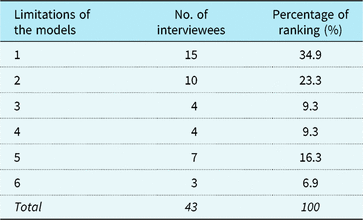
This distribution showed the ranking of the limitations listed below. It showed that funding is the major challenge closely followed by competition of open heart surgery with other burden of diseases. The least is brain syndrome.
Limitation of the models
Inability of patients to pay for the cost of open heart surgery due to non-inclusion of the programme in National Health Insurance Scheme (NHIS).
Open heart surgery programme, competing with other burden of diseases like communicable diseases such as malaria, gastroenteritis, and HIV-Aids.
Corruption, nepotism, and interprofessional conflicts.
Brain drain syndrome.
Lack of stable public power supply.
Inadequate national blood banks.
Discussion
The double burden of disease in developing countries or low-middle-income countries and emerging economies remains an obstacle for the development of increased medical access and care, especially for the increasing non-communicable diseases and the lingering communicable diseases.Reference Nguyenu, Leon-Wyss, Iyer and Pezzella8 The median length of cardiothoracic surgery training in West Africa is 6 years. West African residents obtain much less hands-on experience compared with their European and American counterparts.Reference Tchantchaleishvili, Mokashi, Rajab, Bolman, Chen and Schmitto9 A young cardiothoracic surgeon in sub-Saharan Africa, therefore, does not meet the requirements for board certification in Europe and therefore might need to go elsewhere for additional surgical skill training. This critical situation can be improved by developing close collaboration with visiting cardiac teams in various African regions, including Nigeria and encouraging them to become involved in the cardiac surgery training programmes.Reference Yanka, Fynn-Thompson and Antune10
The outcome of the mission programme in Nigeria (model A) is far from success. This is because, very few if any of the centres that engaged in cardiac missions are independent. A humanitarian surgeon’s focus will always be upon patient, but local health care providers and the community they serve can and should both benefit. Ultimately, success should not be measured by the number of successful operations of any given mission but by the successful operations that the local team performs after the visiting leave.Reference Maluf, Franzoni, Melgar, Hernandez and Perez11,Reference Corno12,Reference Pezzella13 In a similar study by Velebit et al., a team of fully trained specialists did a cardiac mission in Tbilis Georgia for a period of 5 years where the frequency was monthly of 1 week duration with an average of 10 times in a year, After 5 years, the local team was able to become independent and has performed 111 cases within the first 7 months in 2008 out of 204, while the remainder was done by foreign team during irregular support visits in relationship to difficult cases.Reference Velebit, Montessuit, BednarkKiewicz, Khatchatourian, Mueller and Neidhart14 In Nigeria, the mission programme can be described as surgical Safari type rather than educational. They are not regular and no targeted end point.Reference Nwafor and Eze15 This explains why it worked in other developing countries of the world but not Nigeria.
For example, at University of Nigeria Teaching Hospital, Enugu (SER), 30 mission trips took place between February 2013 and January 2019. During this period, about 209 cases were performed both in adults and children with a ratio of 34.2 cases per year. The ratio of the local/visiting surgeons as the primary surgeon is about 5/43 and the local surgeon given the opportunity as the primary surgeon happened during the mission trips of Cardiostart International and William Novick Cardiac Alliance.Reference Nwiloh, Smith and Mestress16 Some foreign surgeons do come with their foreign residents who displace the local surgeon as the first assistant surgeon. The local surgeon often becomes the second assistant or become an observer. They strive to do many cases on their own rather than teaching the local surgeon because as a surgical Safari type, the emphasis is on the number and not on skill transfer.
Model E involves individual member of cardiac team travelling abroad for training especially India and South Africa, but the fellowship programmes in cardiothoracic surgery in India and Republic of South Africa for trainees from sub-Saharan Africa which began with great enthusiasm and promise have lost their momentum and practical value and need to be revisited on a governmental level. The flaw is attributed to lack of strategic planning with the policy-makers and benchmarking of the training programme.Reference Yanka, Fynn-Thompson and Antune10 Despite this short coming, West African College of Surgeons and National Post Graduate Medical College of Nigeria have made it mandatory that a trainee cardiothoracic surgeon in Nigeria must undergo a year fellowship training in accredited centre either in India, South Africa, Europe, or America as one of the conditions for qualifying for part II or exit examination in cardiothoracic surgery.Reference Bode, Nwawolo and Giwa-Osagie17 In view of the afore-mentioned shortcoming, this model is a failure. See Table 2.
In view of the failure of models (A, E, F), the Ghana–German model (model B)Reference Yanka, Fynn-Thompson and Antune10, successfully adopted by a small neighbouring country, Ghana became the cynosure of some centres. Unfortunately, no respective government, state or federal government has been convinced to support the programme and no highly skilled senior cardiac surgeon(s) among Nigerians in diaspora is willing to relocate home like the Frimpong Boateng did in Ghana.Reference Kwabena18 Rather, many highly skilled cardiac surgeons, cardiac anesthetists, perfusionists, and intensivists, all of Nigerians in diaspora believe that provision of special incentives by the Federal Government of Nigeria will enable them to return home and establish a successful and enviable open heart surgery programme in NigeriaReference Bode, Michael, Adetinuwe, Ifeoluwa, Ariyo and David19 (model F). However, at this point in time, this idea as well intended as it is, has not well been packaged enough to sell successfully to the Federal Ministry of Health en route to the Federal Government of Nigeria.
Any model without governmental support is unlikely to succeed. In Nigeria, budgetary allocation to health is very low due to competing demands. Ironically, the amount of money government officials spent on medical tourism to treat heart-related diseases and other illnesses is very huge.Reference Leon-Wyss, Veshti and Veras20 This misplacement of priority makes it impossible for health insurance to cover patients needing open heart surgery.
Corruption, interprofessional conflicts, and nepotism create avenue for stealing public funds and stashing them away in foreign countries, thereby denying the poor masses access to basic health care. Inadequate remuneration of trained cardiac surgeons and other highly skilled ancillary staff created wave of brain drain syndrome of some of the staff to Europe and America, thereby making it impossible for the models A, E, and F to succeed.
Due to the failure of models A, E and F to produce independent local team in open heart surgery in almost all the centres, there is suggestion currently that the best method that will quickly establish the independence is the employment of expatriate consultant (model C). This model was practised in Kenya: senior expatriate cardiac surgeon on contract is paid by the host government to develop a cardiac surgery programme and organise capacity building. This is similar to the cooperation between Deutsches Herzzentrum Berlin and Sarajevo Heart Centre.Reference Ogundiya7 It is hoped that any interested state government within any given region aided by selfless non-governmental organizations will buy into this model.
The popular but almost impractical model (model F) is the provision of special incentives to highly skilled Nigerians in diaspora to relocate home and establish a sustainable open heart surgery programme via public–private partnership.Reference Bode, Michael, Adetinuwe, Ifeoluwa, Ariyo and David19 This is similar to Ghanaian–German and Namibian models. They are associated with an integrated health care system with part government and part private funding managed by a senior local consultant cardiac surgeon. The Ghanaian programme, for example, is independent, has political support, has trained more than 20 local and foreign cardiac surgeons, maintains stable surgical load though lower than that of its counterparts in Europe, and produces scientific works. The model requires 7–10 years for infrastructure development and stability and 3 more years for the mixed team until the unit becomes independent.Reference Edwin, Tettey and Aniteye1,Reference Turina21
Prof Frimpong Boateng of Ghana upon completion of his training in Hannover, Germany, had a vision to return home against the wishes of his boss, to establish a sustainable open heart surgery programme in Ghana. While still in Germany, he made several frustrating trips to Ghana to get his governmental support but never gave up. By divine intervention, he was able to convince then head of state of Ghana, Frank Jerry Rawlings. By his in-depth knowledge of heart surgery coupled with his exemplary leadership, qualities, National Cardiothoracic Center Accra, Ghana was born in 1989. By the 20 years anniversary, the centre has not only become the only accredited place of training cardiothoracic surgeons by the West African College of surgeon, but has produced six extra cardiothoracic surgeons of Ghanian indigenes.Reference Edwin, Tettey and Aniteye1 The Ghanaian–German model has demonstrated that the determinant factor for sustainability of a cardiac surgery programme in sub-Saharan Africa is leadership rather than the distribution of health expenditure per capita income and the gross developmental product. The density of the cardiothoracic surgeons could be directly related to the distribution of gross developmental product and the health budget, but it was not a determinant factor for sustainability and success of the cardiac programmes.Reference Edwin, Tettey and Aniteye1,Reference Nwafor, Arua, Eze and Ezemba22
Model D is largely practised in southwestern region and some centres there have transited to independence. See Table 2. However, their yearly output is still relatively low as a result of poor funding. See Table 3.
Limitations of different models based on the interviewees (ranked)

Currently, the Federal Ministry of Health indirectly supports the old fashioned but failed to thrive cardiac mission model of the Safari or Blitzer type.Reference Kwabena18
To this end, highly skilled Nigerians in diaspora should emulate the pioneering leadership of Ghanian Frimpong Boateng. This Ghanaian–German model has proved to be a successful programme in the long term and could inspire health care policy-makers in sub-Saharan Africa and senior colleagues planning to establish cardiac programmes in their home countries.Reference Bode, Michael, Adetinuwe, Ifeoluwa, Ariyo and David19
Even while practising model A, E, and F, there were limitations as obtained while interviewing the surgeons and the trainees. See Table 3. These limitations are ranked according to the respondents/interviewees. Funding of open heart surgery programme is a major limitation. Nigerian Heart Foundation is inefficient but Rotary Club of Nigeria, public spirited individuals, and occasionally governmental support have been helpful.
Private cardiac hospital either for adult or children in Nigeria with a large population is almost non-existent. Over-dependence on private power supply, inadequate national blood banks, and dependence on paid blood donors make cost of open heart surgery extremely unrealistic that such venture even if it is initiated from outside Nigeria is bound to fail.Reference Falase, Sanusi, Majekondunmi, Ajose, Idowu and Oke23
Conclusion
The different models currently being adopted in Nigeria towards establishing a sustainable cardiac programme are good but of the five mentioned, the easiest and the cheapest is hiring a senior or retired expatriate consultant surgeon(s) in the established centres in two or more regions of the country. A bill about that should sponsored in the floor of the National Assembly. When this is done, the great potentials of Nigerians in the area of open heart surgery will be unveiled.
Acknowledgements
The authors express profound gratitude to the secretarial staff of the department of surgery for helping in the production of the manuscript.
Conflict of Interest
None.