Introduction
The inhabitant of termite colonies generally consists of the reproductive, workers and soldiers, and these differ in morphology and/or behaviour. This, according to Oster & Wilson (Reference Oster and Wilson1978), leads to division of labour among these individuals, resulting in greater colony efficiency and effective maintenance of colony integrity.
Foraging in termites is a social procedure, where groups of individuals search in an organized manner for new food sources (Traniello et al., Reference Traniello, Leuthold, Abe, Bignell, Higashi, Abe, Bignell and Higashi2000). The activities of hundreds or thousands are coordinated by trail pheromones that stimulate foragers to leave the nest and orient them to a food source (Traniello & Busher, Reference Traniello and Busher1985). Accordingly, a scouting termite returns to the nest after locating food in trail-laying posture and discharging sternal gland pheromone (Kaib, Reference Kaib, Gribakin, Wiese and Popov1990).
In general, workers are predominantly involved in foraging and recruitment activities in many termite species. However, in Nasutitermes costalis, soldiers carry out scouting and recruitment activities (Traniello, Reference Traniello1981). These soldiers are involved in communicating the presence and location of food by laying chemical trails, which resulted in the recruitment of more soldiers. As trail concentration increases, workers are eventually recruited (Traniello & Busher, Reference Traniello and Busher1985). This unusual role by soldiers in social insects, according to Traniello (Reference Traniello1981), appears to be a component of a foraging/defence system that controls the recruitment of foragers and effectively deters attacks by ants.
Malaka & Leuthold (Reference Malaka and Leuthold1986) observed quantitative recruitment in colonies of Amitermes evuncifer whenever food was discovered by the scouting foragers. Olugbemi & Malaka (Reference Olugbemi and Malaka1994, Reference Olugbemi and Malaka2007) established the generation of recruitment activities and communication by pheromones in Microcerotermes fuscotibialis whenever food was detected by the scouting foragers. Kaib (Reference Kaib, Gribakin, Wiese and Popov1990) obtained similar result in Schedorhinotermes lamanianus.
According to Noirot (Reference Noirot1990), termite soldier caste is unique among social insects in terms of its morphology, development and behaviour, as they could be derived from all worker instars, pseudergates or apterous immature forms. This, according to Roisin et al. (Reference Roisin, Abe, Bignell, Higashi, Abe, Bignell and Higashi2000), may account for their polymorphic and/or trimorphic forms in some termite families.
Caste differentiation is a major phenomenon, which helps to reveal the adaptive meaning of social organization in several eusocial insects (Oster & Wilson, Reference Oster and Wilson1978). Hence, polyethism, as an instar-dependent behavioural difference in the intra-castes of termites (Watson et al., Reference Watson, Metcalf and Sewell1977), can be observed in nest repair or building, foraging and defence activities.
Dimorphism is not a rare occurrence in termites, as it occurs in all the castes, except in reproductives. Termite worker castes are generally of both sexes, but remain permanently juvenile (Malaka, Reference Malaka1996). The soldier caste is also permanently juvenile and may include both sexes in some species. Size differences are also notable features in both worker and soldier castes of termites. These morphological differences may determine the role to be played by these castes as dictated by the needs of the colony, as well as other factors (Watson et al., Reference Watson, Metcalf and Sewell1977; Roisin & Pasteels, Reference Roisin and Pasteels1991; Crosland & Traniello, Reference Crosland and Traniello1997; Crosland et al., Reference Crosland, Lok, Wong, Shakarad and Traniello1997).
Rosengaus & Traniello (Reference Rosengaus and Traniello1993) studied division of labour in colonies of the dampwood termite, Zootermopsis angusticollis, and classified the behaviour of the six instars into six different task-based categories. Crosland et al. (Reference Crosland, Lok, Wong, Shakarad and Traniello1997) reported similar findings from studies of temporal polyethism in the lower termite, Reticulitermes fukienensis, by examining task performance based on class sizes of workers. From a later study, Crosland et al. (Reference Crosland, Ren and Traniello1998) observed differential performance of task by three different worker sizes and found no evidence of temporal polyethism in the three identified behavioural tasks, as all the three worker groups performed all the tasks. However, the older castes performed at higher frequency than the medium- and small-sized workers.
Temporal polyethism was also observed among soldiers in Macrotermes bellicosus, as Konates et al. (Reference Konates, Leuthold, Hari and Veivers2000) demonstrated that only older soldiers accompanied workers on foraging trips, while younger ones remain in the nest. They further observed that younger individuals showed flexibility by replacing older workers when a significant number of older individuals are lost. Similar findings had been made earlier by Hinze & Leuthold (Reference Hinze and Leuthold1999).
Horiuchi et al. (Reference Horiuchi, Yamamura and Abe2002) developed and constructed a mathematical model to explain two strategies adopted by termites to produce soldiers from their instars. The first model predicts that, when the colony is young (when it still has enough food and needs high ratio of soldiers to workers), it produces soldiers from young instars. The second model postulated that, when the colony is old (when it does not have enough food anymore and needs a lower ratio of soldiers to workers), it will produce soldiers from old instars. As the colony matures, it produces soldiers from the older instars.
The primary role of termite soldiers is defence. However, they have also been implicated in other activities of the colony as a whole, such as initiating and acting as scouts during foraging for food, nest construction/repairs, recruitment activities, as well as serving as guards to the exploratory and foraging columns during the search for food (Kriston et al., Reference Kriston, Watson and Eisner1977; Watson et al., Reference Watson, Metcalf and Sewell1977; Traniello, Reference Traniello1981; Kaib, Reference Kaib1985; Traniello & Busher, Reference Traniello and Busher1985).
This study was undertaken in order to investigate the role of termite soldiers during the process of food search, as well as the effect of varying the caste population percentage in the regulation of foraging activities in the termite, Coptotermes intermedius.
Materials and methods
Underground cardboards were laid over three foraging areas of Coptotermes intermedius within the campus of University of Lagos, Akoka, Lagos, Nigeria. Each of the foraging area measured 16 m2 and was covered with four large (4 m2) cardboards over a period of three months. These cardboards were observed and analyzed for termite composition and replaced every three months for 12 months.
Following the methods of Casarin et al. (Reference Casarin, Costa-Leonardo and Arab2008), termite castes observed were separated and counted. The caste mean, percentage and ratio were calculated, and values obtained were subjected to analysis of variance (P<0.01) in other to compare the mean occurrence of each caste present in the field population.
The test statistics follows the following assumptions: Ho: μ1–μ2–μ3=0 and HA: μ1–μ2–μ3≠0 at n1+n2+n3–3 degrees of freedom (df). For the soldier caste, two sets of three means were compared at n1+n2–2 degrees of freedom. When the calculated t-test statistic, t c, is greater than the tabulated, t t, then significant difference between the means is assumed. However, if t c is less than t t, then it is assumed that there was no significant difference between the tested means.
In the laboratory, exploratory and foraging activity was monitored by using a 15 cm Petri-dish (artificial nest) that had been moistened with sterilized soil and connected by means of a rubber tubing (diam. 2.5 cm) to another Petri-dish, herein referred to as soil/food arena (Olugbemi & Malaka, Reference Olugbemi and Malaka2007). The food material used was a cut piece from the stem of Theobroma cacao (20 mm×15 mm). One hundred termites of varying caste ratio were placed in the artificial nest and allowed 24 hours adaptation period before a bioassay was conducted. This was done by allowing the test termites in the artificial nest to forage undisturbed through the rubber tubing into the foraging arena in order to acclimatize to the operating laboratory conditions at temperatures of 27±3°C and 70±5% relative humidity. The numbers of termites foraging and/or recruited to the arena were determined at ten-minute intervals for 60 min. This exercise was replicated five times or as otherwise specified.
In determining the caste involved in the exploratory phase of foraging, three bioassays were carried out. In the first bioassay, 100 termite individuals, comprising 80 workers, ten minor and ten major soldiers, were placed in the Petri-dish and activities of the termites were observed for the first ten minutes. In the second bioassay, the termites were made up of 60 workers, 30 minor soldiers and ten major soldiers. For the third bioassay, the termites comprise 60 workers, ten minor soldiers and 30 major soldiers. Ten replicates of each bioassay were carried out.
Preliminary studies showed that recruitment usually takes place at about ten minutes after food find. Therefore, the involvement of the soldier caste in foraging activities, based on the above composition, was also investigated after food was placed in the food arena. Recording was done every ten minutes for the next 60 min (Olugbemi & Malaka, Reference Olugbemi and Malaka1994, Reference Olugbemi and Malaka2007). This was replicated five times.
Results
Analysis of the caste composition from the field colonies of Coptotermes intermedius showed a significantly higher number of workers to soldiers (table 1). In comparing the means of the castes, results showed that the composition of these castes were not significantly different from one colony to the other (P<0.01; table 1). The percentage of the worker caste constitutes about 80% of the termite population in each of the three colonies and is not significantly different from one colony to the other (t c<t t): t c=−8.704; t t (9 df)=2.821 at 0.01 level of significance.
The mean and percentage values of caste composition of C. intermedius found at the three foraging sites.

The soldier population constitutes about 20% of the field population in the three colonies in a 1:1 ratio between the minor and major soldiers. ANOVA test also showed that there was no significant difference in the population of these soldiers when their means were compared (t c<t t): t c=1.784; t t (4 df)=3.747 at 0.01 level of significance.
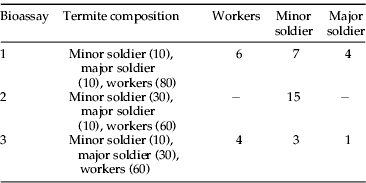
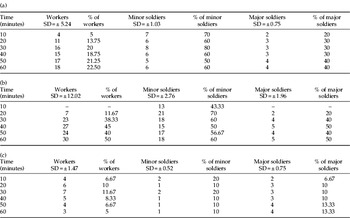
In the laboratory foraging situation, using the soldier:worker caste ratio of 1:4 as found in the field colonies, a high number of minor soldiers (7 out of 10), led the exploratory phase of the foraging activities within the first ten minutes into the arena (table 2). The rewarded scouts, thereafter, recruited a significantly higher number of workers to the food arena, whilst the percentage proportion of minor soldiers involved was also high (table 3a). The minor/major soldier caste ratio of 1:1 from field studies was not obtained during the recruitment phase in the laboratory. A higher ratio was rather observed.
Frequency of occurrence of individual castes involved in the exploratory phase of foraging in C. interrmedis.

Frequency of castes in the food chamber during the exploratory phase depends on the number of soldiers present in the nest. Test of independence: df=4, χc2=15.40; χ0.992=13.28.
Recruitment behaviour in soldier-mediated foraging activities in C. intermedius: minor soldiers (10), major soldiers (10), workers (80). Recruitment behaviour in soldier-mediated foraging activities in C. intermedius: minor soldiers (30), major soldiers (10), workers (60). Recruitment behaviour in soldier-mediated foraging activities in C. intermedius: minor soldiers (10), major soldiers (30), workers (60).

After the exploratory phase of the first ten minutes, a range of 11 to 18 workers were recruited to the food arena between the 20th and 60th minute of this exercise. These worker populations were maintained by a range of five to eight minor and two to four major soldiers, respectively (table 3a).
Observations showed that only minor soldiers initiated the exploratory phase of foraging when the percentage value of soldiers was increased to 40% of the total population (30% minor soldier: 10% major soldier) (table 2). This resulted in an increase in foraging activities, leading to higher recruitment of workers to the food arena (table 3b). Termite worker traffic ranged from seven to 30 termites between the 20th and 60th minute of the recruitment phase and were accompanied by an equally higher number of minor soldiers (15–21 soldiers). Major soldiers fluctuated within two to five termites over the same period. The percentage proportion of minor-major soldier ratio in this bioassay was comparable to those of bioassay 1 (tables 3a, b) but at a higher frequency level.
However, there was a significant reduction in foraging activities when the percentage value of major soldiers was increased and those of minor soldiers reduced (30% major soldier: 10% minor soldier, respectively) (tables 2 and 3c). The worker's population in the arena ranged from three to seven termites, with an accompanying range of one to four soldiers. The presence of a significant population of major soldiers over minor soldiers masked the recruitment abilities of the minor soldiers, resulting in low termite population during the recruitment phase (table 3c).
The results also showed that the frequency of the castes during foraging activity in the three bioassays (table 2) was dependent on the number of soldiers present in the test arena (test of independence: df=4, χc2=15.40; χ20.99=13.28).
Discussion
Foraging in termites is a social procedure, and this has been poorly studied in subterranean termites, largely due to their cryptic nature and foraging under shelter. Therefore, investigating this aspect of termite behaviour had been a herculean task. A few studies on foraging and exploratory activities in termites had been carried out by Traniello & Buscher (Reference Traniello and Busher1985), Malaka & Leuthold (Reference Malaka and Leuthold1986), Malaka (Reference Malaka1987), Kaib (Reference Kaib, Gribakin, Wiese and Popov1990), Olugbemi & Malaka (Reference Olugbemi and Malaka1994, Reference Olugbemi and Malaka2007), Traniello et al. (Reference Traniello, Leuthold, Abe, Bignell, Higashi, Abe, Bignell and Higashi2000) and Casarin et al. (Reference Casarin, Costa-Leonardo and Arab2008).
Differences in the function of termite castes have been recognized for many years. However, the fact that termites of the same caste could show differences in behaviour according to their instars was noted by McMahan (Reference McMahan1970, Reference McMahan1974, Reference McMahan1977) and Kriston et al., (Reference Kriston, Watson and Eisner1977). Caste polyethism has been described as an instar-dependent behavioural difference in the intra-caste of termites (Watson & McMahan, Reference Watson and McMahan1978). However, this behaviour has been poorly studied in subterranean termites (Miura & Matsumato, Reference Miura and Matsumoto1998). Studies by Casarin et al. (Reference Casarin, Costa-Leonardo and Arab2008), on the role of soldiers in initiating foraging activities in Heterotermes tenuis, indicated that the soldier caste are not only involved in foraging activities but also initiate the exploratory phase of this activity. Similar observations were made by Traniello (Reference Traniello1981) on Nasutitermes costalis and Kaib (Reference Kaib1985) and Traniello et al. (Reference Traniello, Leuthold, Abe, Bignell, Higashi, Abe, Bignell and Higashi2000) on Schedorhinotermes lamanianus.
The results obtained from the field colonies showed a representation of caste occurrence of 80% of workers to 20% of soldiers in the three studied areas. These percentages, when maintained in the laboratory situation, resulted in the initiation of exploratory activities, which eventually resulted in recruitment of workers to the food arena. The exploratory phase occurs within the first ten minutes after food find by the scouts, while the recruitment phase begins from the 15th minute. However, when the percentage of minor soldiers was increased to 30% and those of the major soldiers to 10%, only minor soldiers initiated the exploratory phase, and even recruited them to the food arena. Workers were eventually recruited from the 25th minute. Further investigation revealed a reduction in recruitment activities when minor soldiers were reduced to 10% and major soldiers increased to 30%. This indicated the inhibitory role of major soldiers in recruitment activities when present in a significant population level over minor soldiers. It may also points to their role as major defenders of the colony, and their occurrence in large numbers could impose a restriction on the activities of minor soldiers and workers. Furthermore, soldier-initiated foraging in some species of Rhinotermitinae, Nasutitermitinae and Termitidae (Malaka & Leuthold, Reference Malaka and Leuthold1986; Schedel & Kaib, Reference Schedel, Kaib, Elder and Rembold1987; Reinhard et al., Reference Reinhard, Hertel and Kaib1997; Konates et al., Reference Konates, Leuthold, Hari and Veivers2000) may be an adaptive strategy to reduce predation during the exploratory and/or recruitment phases (Traniello, Reference Traniello1981; Cornelius & Grace, Reference Cornelius and Grace1997).
Observations from this study, therefore, suggest that the exploratory and, to a large extent, the recruitment phase of foraging may be regulated by the number of soldiers present in the foraging arena. As observed by Hinze & Leuthold (Reference Hinze and Leuthold1999), Konates et al. (Reference Konates, Leuthold, Hari and Veivers2000) in Macrotermes bellicosus and Casarin et al. (Reference Casarin, Costa-Leonardo and Arab2008) in Heterotermes tenuis, caste polyethism also occurs in foraging activities of Coptotermes intermedius.
In addition to the statutory role of termite soldiers in defence and alarm, they are also involved in foraging activities (Traniello, Reference Traniello1981; Traniello & Busher, Reference Traniello and Busher1985) and are indeed the first to explore the unknown terrain in C. intermedius. According to Malaka & Leuthold (Reference Malaka and Leuthold1986), two stimuli initiate recruitment and trail-laying in termites. These are a virgin substrate and the presence of food.
This study, therefore, has demonstrated the role of soldiers during the exploratory and recruitment phases of foraging in C. intermedius and the consequence of varying their percentages on the participatory role of other castes present in the colony.
Conclusion
The role of soldiers in initiating the exploratory phase of foraging in C. intermedius has been demonstrated. It was also established that caste polyethism occurs in this termite species, especially when the number of soldiers was increased in the test chamber.
The recruitment phase of foraging may be regulated by varying the composition of soldier percentage in the colony. This is an important consideration that could assist in termite control systems.
This study further revealed that a rewarded exploratory phase will lead to a successful recruitment activity in this termite species.