Theories and clinical interventions emphasize the role of inadequate parenting in the development of behavioral problems during late childhood and adolescence (Gottfredson & Hirschi, Reference Gottfredson and Hirschi1990; Jessor, Reference Jessor1987; Patterson & Yoerger, Reference Patterson, Yoerger and Osgood1997). The assumption that a lack of parental monitoring contributes to the development of behavior problems is based on reports that youth who behave antisocially often have parents who are not assiduous about tracking how their children spend their time (Glueck & Glueck, Reference Glueck and Glueck1950; Patterson & Stouthamer-Loeber, Reference Patterson and Stouthamer-Loeber1984). One suggested strategy to reduce and prevent antisocial behavior during this time is to encourage parents to monitor their children's whereabouts and activities (Dishion & McMahon, Reference Dishion and McMahon1998; Pettit, Bates, Dodge, & Meece, Reference Pettit, Bates, Dodge and Meece1999; Steinberg, Fletcher, & Darling, Reference Steinberg, Fletcher and Darling1994). Monitoring is thought to minimize antisocial behavior by limiting youths’ opportunities to engage in activities that promote delinquency, such as spending time with deviant peers (Fletcher, Darling, & Steinberg, Reference Fletcher, Darling, Steinberg and McCord1995). However, there is controversy surrounding the measurement of parental monitoring and whether and how it influences youths’ antisocial behavior. As a consequence, the interpretation of monitoring-behavior correlations has been called into question (Kerr, Stattin, & Burk, Reference Kerr, Stattin and Burk2010; Stattin & Kerr, Reference Stattin and Kerr2000). The aim of the present study was to examine the association between parental monitoring and youths’ antisocial behavior across preadolescence.
Parental Monitoring and Parental Knowledge
Parental monitoring comprises parents’ efforts at tracking their children's activities and whereabouts, including setting rules about where children go, and with whom (Dishion & McMahon, Reference Dishion and McMahon1998). However, instead of assessing deliberate efforts by parents to find out and control how children spend their time, several studies have collected information on parents’ awareness of their children's activities, that is, parental knowledge (Crouter & Head, Reference Crouter, Head and Bornstein2002; Stattin & Kerr, Reference Stattin and Kerr2000). The approach of operationally defining parental monitoring as parental knowledge has been criticized on the grounds that parents’ monitoring of their children and the knowledge they have about their children's lives represent two different constructs that may be differentially associated with antisocial behavior (Stattin & Kerr, Reference Stattin and Kerr2000). Parents might know about their child's social life but not do anything about it, or parents might think they monitor their child's social life but not really know much about it. As a result of sparse data for these two constructs, the independent contributions of parental monitoring and knowledge to antisocial behavior are seldom studied. In the present study, we used separate measures of parental monitoring and parental knowledge and, in a first step, compared their cross-sectional associations with antisocial behavior during preadolescence. We predicted that both monitoring and knowledge would be associated with antisocial behavior, that is, that youth who display more antisocial behavior have parents who make fewer attempts to monitor them and who know less about their activities and whereabouts.
Longitudinal Associations Among Monitoring, Knowledge, and Antisocial Behavior
There are two reasons why youths’ antisocial behavior may be associated with their parents’ monitoring and knowledge. First, it is possible that parents’ lack of monitoring and knowledge increases antisocial behavior in their offspring. This explanation is in line with theories and studies of child socialization that assumed the association between parenting and children's behavior was mostly unidirectional, with parents’ influencing their children (Baumrind, Reference Baumrind1991; Darling & Steinberg, Reference Darling and Steinberg1993; Dishion & McMahon, Reference Dishion and McMahon1998; Weintraub & Gold, Reference Weintraub and Gold1991). Consistent with this notion, longitudinal research has reported a reducing effect of earlier parental monitoring and knowledge on youths’ later antisocial behavior (Abar et al., Reference Abar, Jackson and Wood2014; Lahey, Van Hulle, D'Onofrio, Rodgers, & Waldman, Reference Lahey, Van Hulle, D'Onofrio, Rodgers and Waldman2008; Willoughby & Hamza, Reference Willoughby and Hamza2011). However, it is now also accepted that children are not passive recipients of parenting, but actively shape their environment, including their parents’ parenting (Bell, Reference Bell1968; Gault-Sherman, Reference Gault-Sherman2012; Pardini, Reference Pardini2008; Sameroff, Reference Sameroff2010). Second, another explanation is therefore that youth who engage in antisocial behavior behave toward their parents in a way that leads parents to reduce their monitoring efforts and to become less knowledgeable. It has been demonstrated that the knowledge parents have is mostly a function of youths’ willingness to share information about their lives with their parents, rather than the result of parent-initiated efforts to obtain knowledge, such as asking or tracking activities (Kerr & Stattin, Reference Kerr and Stattin2000; Stattin & Kerr, Reference Stattin and Kerr2000). The association between parental knowledge and children's antisocial behavior may thus not involve deliberate actions from parents, but instead reflect that youth who engage in antisocial behavior tend to withhold information about themselves and their activities from their parents (Keijsers, Branje, Van der Valk, & Meeus, Reference Keijsers, Branje, Van der Valk and Meeus2010). In the present study, we considered potential reciprocal influences between youths’ and their parents’ behavior. Testing reciprocal parent–child effects is not new, but this study took the novel approach of doing so while testing different predictions about parental monitoring and knowledge. We expected that higher levels of monitoring would predict lower levels of antisocial behavior (more so than the other way around). In contrast, we hypothesized that low parental knowledge would mostly be a consequence of youths’ antisocial behavior, rather than a risk for it.
Genetic and Environmental Influences on Monitoring and Knowledge
Furthermore, we tested the influence of youths’ behavior on their parents’ monitoring and knowledge using genetically sensitive twin methods. Twin designs can further our understanding of the associations between parenting and children's behavior by providing information about the nature of the relationship between children and their environment (Knafo & Jaffee, Reference Knafo and Jaffee2013; Moffitt, Reference Moffitt2005). They stringently test child effects by directly indexing the extent to which children's genetically influenced characteristics affect parental behaviors, while holding environmental family-wide or child-specific factors constant. There is evidence that children's characteristics explain variability in numerous measures relating to parenting behavior, such as parent's warmth, protectiveness, and affect (Kendler & Baker, Reference Kendler and Baker2007). These findings lend further support to a bidirectional framework of child–parent interactions, where youths’ inherited characteristics influence their parents’ behavior. In the present study, we examined whether youths’ genetically influenced behavior affected their parents’ monitoring and knowledge. We expected to find strong genetic influences on parental knowledge, more so than on monitoring, consistent with the reinterpretation of knowledge as an indicator of youth characteristics instead of parent efforts (Stattin & Kerr, Reference Stattin and Kerr2000). We also expected the genetic influences on knowledge to be due specifically to youth antisocial behavior.
Consistency of Child Effects Across Different Developmental Phases
The reinterpretation of parental knowledge as an indicator of youth characteristics, instead of parent efforts, is mostly based on studies of adolescents (Stattin & Kerr, Reference Stattin and Kerr2000). There is less research that examined how parents’ and children's characteristics and behavior in early childhood shape parents’ knowledge at the beginning of preadolescence. We therefore extended our analysis to test whether young children's antisocial behavior influenced parental knowledge at the beginning of preadolescence, over and above maternal warmth. We chose to compare the effects of early antisocial behavior to maternal warmth because it is an important factor for building and maintaining supportive parent–child relationships, which may in turn enable parents to gain more knowledge about their children's activities (Racz & McMahon, 2011). We hypothesized that parental knowledge in preadolescence is already influenced by children's antisocial behavior early in life.
A Multiple-Informant Approach
Parents tend to overestimate the extent of their monitoring and knowledge in comparison to youths’ own perceptions, as indicated by mean differences between parents’ and youths’ reports (Stattin & Kerr, Reference Stattin and Kerr2000). In addition, parents’ and children's views of parenting correlate only moderately (De Los Reyes, Reference De Los Reyes2011; De Los Reyes, Goodman, Kliewer, & Reid-Quiñones, Reference De Los Reyes, Goodman, Kliewer and Reid-Quiñones2010). Low agreement between parents’ and youths’ reports of parenting are mostly due to informant-specific perceptions, rather than measurement error (Feinberg, Neiderhiser, Howe, & Hetherington, Reference Feinberg, Neiderhiser, Howe and Hetherington2001). This underlines the importance of collecting information from parents and youth, to not only assess the extent to which parents think they monitor and know their children but also consider youths’ own perspectives. In addition to considering mothers’ and youths’ views, we sought a better understanding of the role of fathers’ monitoring and knowledge. The majority of research on the effects of the family context on children's antisocial behavior focuses on mothers, either by assessing behaviors in mothers, such as parenting or psychopathology, or by collecting their reports of other family members’ behaviors. The emphasis on mothers may not capture the full picture of parenting because it neglects the involvement of fathers. This is despite research demonstrating the impact of fathers on children's long-term social, emotional, behavioral, and educational development (Lamb, Reference Lamb and Lamb2010; Sarkadi, Kristiansson, Oberklaid, & Bremberg, Reference Sarkadi, Kristiansson, Oberklaid and Bremberg2008), including children's antisocial behavior (Harold, Elam, Lewis, Rice, & Thapar, Reference Harold, Elam, Lewis, Rice and Thapar2012; Jaffee, Moffitt, Caspi, & Taylor, Reference Jaffee, Moffitt, Caspi and Taylor2003; Ramchandani et al., Reference Ramchandani, Domoney, Sethna, Psychogiou, Vlachos and Murray2013). In the present study, we included reports from mothers, fathers, and youths to examine whether our findings varied across different family members. We predicted similar findings when using reports of each of these informants.
Sex Differences
Parents monitor girls more than boys, and they have more knowledge about their daughters’ whereabouts, compared to their sons’ (Kerr & Stattin, Reference Kerr and Stattin2000; Li, Feigelman, & Stanton, Reference Li, Feigelman and Stanton2000). There is some evidence to suggest that parental monitoring is more strongly associated with low levels of antisocial behavior in girls compared to boys (Pettit et al., 2001; Racz & McMahon, 2011). We have previously shown that etiological influences on preadolescents’ antisocial behavior differ by sex (Wertz et al., Reference Wertz, Zavos, Matthews, Gray, Best-Lane and Pariante2016), and here we hypothesized that parental monitoring is one such influence that may be more relevant for girls’ antisocial behavior compared to boys’. In this study, we tested this hypothesis by examining sex differences in the longitudinal reciprocal associations among parental monitoring, knowledge, and youth antisocial behavior.
The Present Study
The aim of this study was to examine the associations among parental monitoring, parental knowledge, and youths’ antisocial behaviors between ages 10 and 12, in a prospective cohort of families and their twin children. Previous research has shown that parental monitoring and parental knowledge are two different constructs; we therefore used separate measures for them. We first compared their cross-sectional associations with antisocial behavior during preadolescence, predicting that both monitoring and knowledge would be associated with antisocial behavior. We next examined the longitudinal reciprocal associations among monitoring, knowledge, and antisocial behavior. Theoretical formulations highlight monitoring as a parental strategy that reduces antisocial behavior; we tested this hypothesis by examining whether higher levels of monitoring predicted lower levels of antisocial behavior. In contrast, it has been suggested that parental knowledge is mostly a function of youth characteristics and behavior. We therefore expected that higher levels of antisocial behavior would predict lower levels of parental knowledge later on. We then tested further the hypothesis of a child effect on parental knowledge: first, by analyzing the genetic and environmental influences on parental monitoring and knowledge, expecting that variability in parents’ knowledge would be mostly accounted for by children's genetic influences; and second, by comparing the influences of earlier parental warmth and child antisocial behavior on later knowledge, hypothesizing that children's behavior in early life would already be influential for parental knowledge later on. We included information on family's socioeconomic status (SES) and parents’ mental health in our analyses because parental monitoring, knowledge, and youths’ antisocial behavior not only influence each other but also may be affected by other family characteristics that could explain the associations. We also considered different sources of information, including mothers, youths themselves, fathers, and teachers, to test whether results were similar across informants. Finally, we tested for the presence of sex differences in the levels of parental knowledge and monitoring and in their longitudinal associations with antisocial behavior.
Methods
Sample
Participants were members of the Environmental Risk (E-Risk) Longitudinal Twin Study, which tracks the development of a birth cohort of 2,232 British children. The sample was drawn from a larger birth register of twins born in England and Wales in 1994–1995 (Trouton, Spinath, & Plomin, Reference Trouton, Spinath and Plomin2002). Full details about the sample are reported elsewhere (Moffitt & E-Risk Team, Reference Moffitt2002). Briefly, the E-Risk sample was constructed in 1999–2000, when 1,116 families (93% of those eligible) with same-sex 5-year-old twins participated in home-visit assessments. The sample comprised 55% monozygotic (MZ) and 45% dizygotic (DZ) twin pairs; sex was evenly distributed within zygosity (49% male). Families were recruited to represent the UK population of families with newborns in the 1990s, on the basis of residential location throughout England and Wales and mother's age. Teenaged mothers with twins were overselected to replace high-risk families who were selectively lost to the register through nonresponse. Older mothers having twins via assisted reproduction were underselected to avoid an excess of well-educated older mothers. The average age of mothers at first birth was M = 23 (SD = 5.89). When children were age 5, 77% of mothers lived with the twin's biological father. Ninety percent of E-Risk children are white British.
Follow-up home visits were conducted when the children were aged 7 (98% participation), 10 (96% participation), and 12 (96% participation). Home visits at ages 5, 7, 10, and 12 years included assessments with participants as well as their mothers. Each twin participant was assessed by a different interviewer. Parents gave informed consent, and children gave assent between 5 and 12 years. With parent's permission, questionnaires were posted to the children's teachers, who completed and returned questionnaires. The Joint South London and Maudsley and the Institute of Psychiatry Research Ethics Committee approved each phase of the study.
At follow-up, the study sample represented the full range of socioeconomic conditions in the United Kingdom, as reflected in the families’ distribution on a neighborhood-level socioeconomic index (A Classification of Residential Neighbourhoods [ACORN], developed by CACI, Inc., for commercial use in Great Britain; Odgers, Caspi, Russell, et al., Reference Odgers, Caspi, Bates, Sampson and Moffitt2012). ACORN uses census and other survey-based geodemographic discriminators to classify enumeration districts (~150 households) into socioeconomic groups ranging from “wealthy achievers” (Category 1) with high incomes, large single-family houses, and access to many amenities, to “hard-pressed” neighborhoods (Category 5) dominated by government-subsidized housing estates, low incomes, high unemployment, and single parents. ACORN classifications were geocoded to match the location of each E-Risk study family's home (Odgers, Caspi, Bates, Sampson, & Moffitt, Reference Odgers, Caspi, Russell, Sampson, Arseneault and Moffitt2012). E-Risk families’ ACORN distribution closely matches that of households nationwide: 25.6% of E-Risk families live in “wealthy achiever” neighborhoods compared to 25.3% nationwide; 5.3% versus 11.6% live in “urban prosperity” neighborhoods; 29.6% versus 26.9% live in “comfortably off” neighborhoods; 13.4% versus 13.9% live in “moderate means” neighborhoods; and 26.1% versus 20.7% live in “hard-pressed” neighborhoods. E-Risk underrepresents “urban prosperity” neighborhoods because such households are likely to be childless.
Parental monitoring and knowledge
Mothers’ reports on the monitoring and knowledge of their children's activities and whereabouts were collected at ages 10 and 12 using 10 items from the Monitoring and Supervision Questionnaire (Stattin & Kerr, Reference Stattin and Kerr2000). Mothers were asked about their monitoring and knowledge during the last 6 months. The items capture, for each twin separately, whether the child needed permission to leave home or before deciding what to do on the weekend, and whether they had to report on where and with whom they go out. Mothers also reported on whether they knew the friends their child hangs out with, where they go in their spare time, how they spend their money, what type of homework or tests and projects they have, and how their child performs in different subjects. Answers were recorded as no, never (0), sometimes (1), and yes, always (2). Data were available for 96% of the sample, both at age 10 (N = 2,136) and at age 12 (N = 2,141).
To determine the presence of two factors of parental monitoring and knowledge in the scale, we conducted an exploratory factor analysis of maternal ratings at age 10, using geomin rotation and the WLSMV estimator for categorical items (Muthén & Muthén, Reference Muthén and Muthén2010). We retained a two-factor solution, based on the eigenvalue greater than one rule (Kaiser, Reference Kaiser1960) and structural parsimony. As anticipated, the two factors represented monitoring and knowledge. The first factor contained six items, and the highest loading items on this factor assessed knowledge about children's homework and tests or projects at school and about children's leisure time activities. We named this factor “parental knowledge.” The second factor contained four items, and the highest loading items on this factor assessed whether children required permission to leave the home or before deciding what to do on the weekend. We named this factor “parental monitoring.” The monitoring and the knowledge factors correlated (r = .41, p < .001). The internal consistency reliabilities were α = 0.63 for parental monitoring and α = 0.75 for parental knowledge. We tested the two-factor solution that we retained at age 10 for its suitability to describe maternal ratings of monitoring and knowledge at age 12, using a confirmatory factor analysis. The model provided a satisfactory fit to the data: χ2 (34) = 249.38, p < .001; comparative fit index = 0.91, root mean square error of approximation = 0.05 (0.048–0.061). At age 12, the monitoring and knowledge factors correlated (r = .45, p < .001). Internal consistency reliabilities at age 12 were α = 0.53 for parental monitoring and α = 0.68 for parental knowledge. Age 10 parental monitoring did not predict age 12 knowledge, over and above prior levels of knowledge that parents had about their 10-year-olds. Similarly, parents’ knowledge at age 10 did not influence their subsequent efforts of monitoring their 12-year-olds.
Youths’ reports of their parents’ monitoring and knowledge were collected when they were 12 years old, using the same items used with mothers but worded slightly differently (e.g., “Do your parents know …”). Data was available for 95% of twins (N = 2,120). Internal consistency reliabilities were α = 0.65 for parental monitoring and α = 0.58 for parental knowledge.
Fathers’ reports of monitoring and knowledge were available for a subset of youths at age 12; 30% (N = 671) of twins had a father who participated. Information on monitoring and knowledge was collected using the same items as for mothers. The internal consistency reliabilities were α = 0.70 for paternal monitoring and α = 0.75 for paternal knowledge. The families of fathers who provided information were socioeconomically more privileged: 25% of the responders were from low SES backgrounds, whereas of the nonresponders, 37% were from low SES backgrounds (p < .01). The means of fathers’ antisocial behavior (as reported by mothers when twins were age 5) were 13.49 (SD = 15.94) for responders and 19.07 (SD = 18.59) for nonresponders. The means for youths’ antisocial behavior were 14.30 (SD = 14.41) for offspring of responders and 16.31 (SD = 14.44) for offspring of nonresponders.
The agreement in reports of parental monitoring and knowledge across informants was moderate. The correlation between mothers’ and fathers’ reports was .24 for monitoring and .33 for knowledge. Mothers’ and youths’ reports were correlated .21 for monitoring and .28 for knowledge. Fathers’ and youths’ reports correlated .15 for monitoring and .20 for knowledge. All of these correlations were statistically significant (p < .01).
Antisocial behavior
We assessed antisocial behavior when the twins were aged 5, 10, and 12 using the Child Behavior Checklist for mothers (Achenbach, Reference Achenbach1991a) and the Teacher's Report Form (Achenbach, Reference Achenbach1991b). Mothers were given the instrument as a face-to-face interview and teachers responded by mail. Both informants rated each item as being not true (0), somewhat or sometimes true (1), or very true or often true (2) in the 6 months before the interview. The antisocial behavior scale is the sum of the delinquency and aggression subscales, including items such as “gets in many fights,” “lying or cheating,” and “screams a lot.” The internal consistencies of mothers’ and teachers’ reports were 0.89 and 0.94 at age 5, 0.93 and 0.96 at age 10, and 0.92 and 0.96 at age 12. We combined mothers’ and teachers’ reports to obtain a reliable and comprehensive measure of antisocial behavior across settings (Achenbach, Krukowski, Dumenci, & Ivanova, Reference Achenbach, Krukowski, Dumenci and Ivanova2005). The correlation between mothers’ and teachers’ reports of children's antisocial behavior was .30 at age 5, .41 at age 10, and .40 at age 12 (all p < .01). Data were available for 96% of the sample at age 10 (N = 2,138) and age 12 (N = 2,142). We also used teacher reports of antisocial behavior alone, to rule out potential artifact from shared bias in mothers’ reports of knowledge, monitoring, and child behavior.
Childhood variables
Maternal warmth was assessed when children were aged 5 using procedures adapted from the Five Minute Speech Sample method (Caspi et al., Reference Caspi, Moffitt, Morgan, Rutter, Taylor and Arseneault2004; Magana et al., 1986). Mothers were asked to speak for 5 min about each of their children. Warmth is a global measure of the whole speech sample and was assessed by the tone of voice, spontaneity, sympathy, and/or empathy toward the child. Warmth was coded on a 6-point scale. Interrater reliability was established by having the raters individually code audiotapes describing 40 children. The interrater agreement was r = .90. Raters were blind to all other E-Risk study data. The mean score of age 5 maternal warmth was 3.27 (SD = 1.00, observed range = 0–5).
Family SES was defined at age 5 using a standardized composite of parents’ income, education, and social class, which loaded significantly onto one latent factor (Trzesniewski, Moffitt, Caspi, Taylor, & Maughan, Reference Trzesniewski, Moffitt, Caspi, Taylor and Maughan2006). The latent factor was divided into tertiles. Thus, 33% of families were characterized as living in a low SES situation during childhood.
Mothers’ major depressive disorder was assessed when the children were 5 years old, using the Diagnostic Interview Schedule (Robins, Cottler, Bucholz, & Compton, Reference Robins, Cottler, Bucholz and Compton1995) according to the DSM-IV (American Psychiatric Association, 1994). Mothers were asked about the timing of their depression episodes using a life-history calendar; from the twins’ birth to age 5, 29% of mothers experienced at least one episode of depression.
Fathers’ and mothers’ history of antisocial behavior was reported by mothers when the children were 5 years old, using the Young Adult Behavior Checklist (Achenbach, Reference Achenbach1997), modified to obtain lifetime data and supplemented with questions from the Diagnostic Interview Schedule (Robins et al., Reference Robins, Cottler, Bucholz and Compton1995) that assessed the (lifetime) presence of DSM-IV symptoms of antisocial personality disorder (e.g., deceitfulness and aggressiveness; American Psychiatric Association, 1994). Mothers have been shown to be reliable informants about their partners’ antisocial behavior (Caspi et al., Reference Caspi, Taylor, Smart, Jackson, Tagami and Moffitt2001). A symptom of antisocial personality disorder was considered to be present if the mother endorsed the symptom as being very true or often true. The mean score for mothers’ antisocial behavior was 12.72 (SD = 10.58, observed range = 0–60), and the mean score for fathers’ antisocial behavior was 17.39 (SD = 17.99, observed range = 0–88). We combined reports of mothers’ and fathers’ antisocial behavior to obtain a summary measure of parental antisocial behavior. The correlation between reports of antisocial behavior in mothers and fathers was .53 (p < .01).
Analytical approach
To examine the bivariate associations among parental monitoring, knowledge, and antisocial behavior, we used correlations. To test whether parental monitoring reduced later antisocial behavior and whether antisocial behavior influenced parental knowledge 2 years later, we used separate cross-lagged, autoregressive models for monitoring and knowledge between ages 10 and 12. These models account for the cross-sectional overlap and stability of variables. The models included maternal ratings of monitoring and knowledge at ages 10 and 12 because mothers’ reports were available at both time points. We tested the robustness of our findings in three different ways. First, we repeated the analyses using twins’ and fathers’ reports in the cross-lagged models. Twins’ and fathers’ reports were collected at age 12, so we tested whether antisocial behavior at age 10 predicted monitoring or knowledge at age 12. To control for age 10 levels of monitoring and knowledge in the twins’ and fathers’ models, we used maternal reports from age 10. Second, we added covariates to the cross-lagged models, including SES, parents’ antisocial behavior, and maternal depression. Third, we examined teacher reports of antisocial behavior at ages 10 and 12, instead of a combination of mother and teacher reports. In all models, we accounted for nonindependence of twin observations and nonnormality of the data by using robust standard errors (Muthén & Muthén, Reference Muthén and Muthén2010). We tested sex differences in the cross-lagged paths by equating these across sex and examining whether this worsened model fit.
We examined the influences of youths’ antisocial behavior on mothers’ reports of parental knowledge and monitoring using twin methodology (Rijsdijk & Sham, Reference Rijsdijk and Sham2002). MZ twins are genetically identical, whereas DZ twins share, on average, 50% of their genes. Comparing the correlation of a phenotype within pairs of MZ and DZ twins allows us to estimate the relative influence of additive genetic (A), shared environmental (C), and nonshared environmental (E) factors on measures. Here, C represents environmental factors that make members of a family similar, and E represents factors that make members of a family different and includes error of measurement. Phenotypes are behaviors or traits that can be measured separately for each twin. Phenotypes include variables of the child's environment that may be influenced by children's behavior, such as parental monitoring and knowledge.
We evaluated the influences of youth antisocial behavior on mothers’ reports of parental knowledge and monitoring in two ways. First, we analyzed genetic influences on parental knowledge and monitoring. Aspects of children's rearing environments such as parental monitoring and knowledge may show genetic influence because children can shape their parents’ behaviors through evocative processes or child effects, some of which have child genetic origins. A finding that parental monitoring or knowledge are under genetic influence would suggest that children's heritable characteristics account for some of the variance in these variables. An influence of mothers’ own heritable characteristics on their rating of monitoring or knowledge would be reflected in a finding of shared environmental, rather than genetic influences. This is because maternal characteristics (including maternal genetic makeup) affect mothers’ behavior toward their MZ twins as much as toward her DZ twins, thereby minimizing the difference between MZ and DZ twins in their phenotypic similarity. If MZ twins are as similar to each other as DZ twins, this increases estimates of shared environment. Finally, a finding of nonshared environment would indicate that even genetically identical twins differ in the level of their parents’ monitoring and knowledge of their whereabouts.
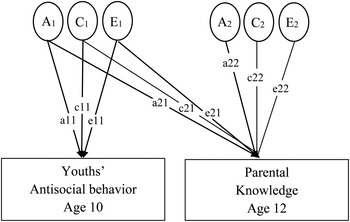
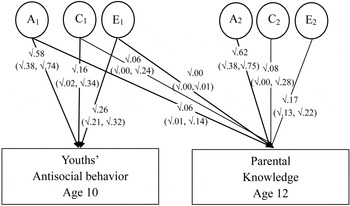
Second, we tested more specifically whether children's heritable antisocial behavior could account for the hypothesized genetic influences on parental knowledge, using a bivariate Cholesky decomposition (Loehlin, Reference Loehlin1996). This model estimates how much of the genetic and environmental influences on one variable explain variance in the other. An example is provided in Figure 1. Paths a11, c11, and e11 indicate the genetic and environmental influences on antisocial behavior at age 10. Paths a21, c21, and e21 reveal whether influences on antisocial behavior at age 10 also explain variance in parental knowledge at age 12. Finally, Paths a22, c22, and e22 indicate genetic and environmental influences on knowledge at age 12 that remain after accounting for all influences shared with antisocial behavior at age 10. Thus, if children's heritable antisocial behavior accounted for genetic influences on parental knowledge, Path a21 would be significant. We used bootstrapped standard errors (with 1,000 samples) in the behavior genetic analyses.
Bivariate Cholesky decomposition. A, Additive genetic influence; C, shared environmental influence; E, nonshared environmental influence. Paths a11, c11, and e11 indicate the genetic and environmental influences on antisocial behavior at age 10. Paths a21, c21, and e21 show whether influences on antisocial behavior at age 10 also explain variance in maternal knowledge at age 12. Finally, Paths a22, c22, and e22 indicate genetic and environmental influences on maternal knowledge at age 12 that remain after accounting for all influences shared with antisocial behavior at age 10.

To examine whether children's antisocial behavior influenced parental knowledge at the beginning of preadolescence, over and above mothers’ characteristics, we used a multiple regression analysis, where children's age 5 antisocial behavior and age 5 maternal warmth predicted age 10 maternal knowledge. All analyses were conducted using Mplus (Muthén & Muthén, Reference Muthén and Muthén2010).
Means, standard deviations, and ranges
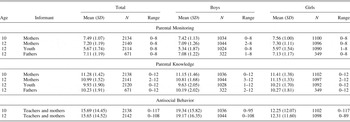
The mean level of parental monitoring and knowledge was relatively high, indicating that on average, parents, and particularly mothers, perceived themselves as highly monitoring and knowledgeable of their youths’ activities and whereabouts (Table 1). As in prior research, mean levels of youth-reported parental monitoring and knowledge were lower. There were significant differences between boys and girls for all variables, indicating that girls displayed fewer antisocial behavior problems and that their parents perceived themselves to be more monitoring and knowledgeable of their whereabouts, compared to boys (Table 1).
Means, standard deviations, total numbers, and observed range for parental knowledge, parental monitoring, and youths’ antisocial behavior at ages 10 and 12

Note: The range reflects the observed range of values. Values are unstandardized. Gender differences were significant for all variables (p < .01).
Results
Are higher levels of parental monitoring and knowledge associated with lower levels of antisocial behavior in preadolescence?
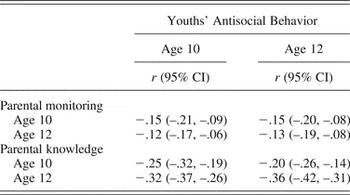
As expected, monitoring and knowledge reported by mothers were both correlated with children's antisocial behavior, cross-sectionally and longitudinally at ages 10 and 12 (Table 2). The correlations were all negative, indicating that youth who displayed higher levels of antisocial behavior had mothers who monitored and knew less. The magnitude of associations with youths’ antisocial behavior differed between monitoring and knowledge; correlations were smaller for monitoring than for knowledge (Table 2).
Correlations among parental monitoring, parental knowledge, and youth's antisocial behavior at ages 10 and 12

Note: r, Correlation coefficient; CI, confidence interval. Mothers and teachers reported on antisocial behavior, and mothers reported on parental monitoring and knowledge.
Does greater parental monitoring predict lower levels of youths’ antisocial behavior?
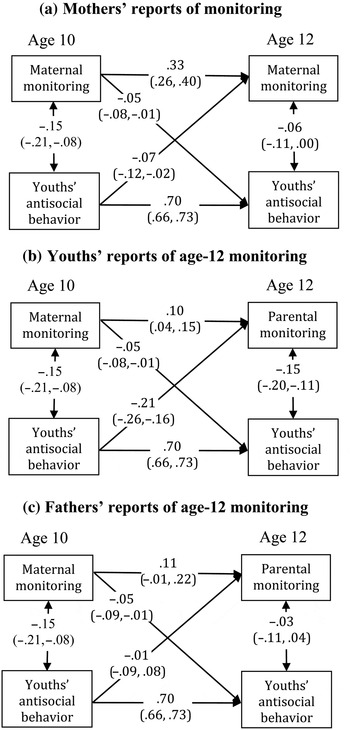
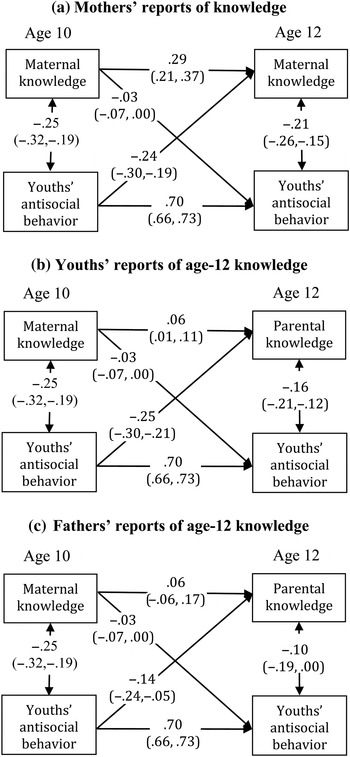
We examined the results for monitoring, hypothesizing that higher levels of monitoring would predict lower levels of youths’ antisocial behavior, more so than the other way around. Results were consistent with our prediction, indicating that the more mothers monitored their youths at age 10, the less antisocial behavior youths displayed at age 12 (Figure 2a). We also found that higher levels of antisocial behavior at age 10 were associated with reduced monitoring efforts by mothers 2 years later.
Longitudinal associations between parental monitoring and youths’ antisocial behavior using (a) mothers’ reports of monitoring at ages 10 and 12 and (b) youth and (c) fathers’ reports of monitoring at age 12. All associations are expressed as standardized path coefficients. The 95% confidence intervals are reported in parentheses. Sex differences were nonsignificant for longitudinal path estimates.

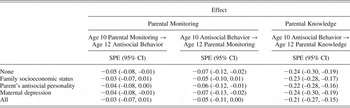
We extended our investigation to test the robustness of our findings. First, we examined whether the results remained similar when replacing mothers’ reports of parental monitoring at age 12 with youths’ and fathers’ reports. We unexpectedly found that the results varied across informants (Figures 2b and 2c): youths’ antisocial behavior predicted youth-reported parental monitoring more strongly than it predicted mother-reported monitoring, although youths’ antisocial behavior did not predict father-reported monitoring significantly. Second, we took into account the potential influence of family SES, parents’ antisocial behavior, and mothers’ depression on youths’ antisocial behavior and parents’ monitoring to test whether these variables accounted for the associations we found. When including these family characteristics in the analyses, greater monitoring reported by mothers no longer predicted less antisocial behavior, and youths’ behavior no longer reduced monitoring efforts by mothers 2 years later (Table 3). Taken together, these results indicate that the reciprocal associations between monitoring and preadolescent antisocial behavior are not robust in this cohort; they were small, inconsistent across informants, and were better accounted for by family background and parents’ characteristics.
Associations between parental monitoring, knowledge, and youths’ antisocial behavior adjusting for family and parent characteristics

Note: SPE, Standardized path estimate; CI, confidence interval.
Does youths’ antisocial behavior influence parental knowledge?
We next examined the results for parental knowledge, expecting that higher levels of youth's antisocial behavior would predict lower parental knowledge, but that greater knowledge would have little effect on later antisocial behavior. We found that the more antisocial behavior youths displayed at age 10, the less knowledge their mothers had at age 12 (Figure 3a). Knowledge reported by mothers at age 10 did not statistically reduce youths’ antisocial behavior 2 years later.
Longitudinal associations between parental knowledge and youth's antisocial behavior using (a) maternal reports of knowledge between ages 10 and 12 and (b) youth and (c) fathers’ reports of knowledge at age 12. Associations are expressed as standardized path coefficients. The 95% confidence intervals are reported in parentheses. Sex differences were nonsignificant for longitudinal path estimates.

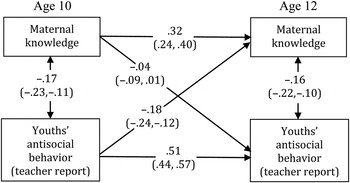
We tested the robustness of these results as previously. First, the results remained similar across different informants of parental knowledge, with higher levels of youths’ antisocial behavior at age 10 predicting less parental knowledge as reported by both youth and fathers at age 12 (Figures 3b and 3c). Second, taking family characteristics into account did not change the pattern of results (Table 3). In addition, we tested whether the results remained when an informant outside the family reported on youths’ antisocial behavior. When using only teachers’ reports of youths’ behavior, the results did not change (Figure 4). Taken together, our findings show that youths’ antisocial behavior predicted lower levels of parents’ knowledge. This effect was consistent across different informants of parental knowledge and youths’ antisocial behavior, and also when someone other than mothers reported on youths’ antisocial behavior, and was robust when family background and parents’ characteristics were taken into consideration.
Longitudinal associations between parental knowledge and youth's antisocial behavior using teacher reports of antisocial behavior at ages 10 and 12. Associations are expressed as standardized path coefficients. The 95% confidence intervals are reported in parentheses. Sex differences were nonsignificant for longitudinal path estimates.

Are there genetic influences on parental monitoring and parental knowledge?
We expected genetic influences on knowledge, more so than on monitoring. For monitoring, genetic influences were small and nonsignificant (Table 4), indicating that genetically influenced child characteristics accounted for less variability in monitoring relative to environmental factors. Our results also revealed substantial heritability when examining knowledge: 68% of variance was accounted for by genetic influences, indicating that mothers’ knowledge about their children's lives was mostly explained by youths’ genetically influenced behavior.
Genetic and environmental influences on antisocial behavior at age 10 and parental knowledge and monitoring at age 12

Note: A, Additive genetic influences; CI, confidence interval; C, shared environmental influences; E, nonshared environmental influences.
Does youths’ genetically influenced antisocial behavior account for the heritability of parental knowledge?
We hypothesized that genetic influences on knowledge would reflect youths’ antisocial behavior. Our findings provide some confirmation of this prediction. Our results indicated that genetic influences on antisocial behavior at age 10 also accounted for some of the heritability of knowledge at age 12 (Figure 5). More specifically, knowledge showed genetic influence partly because it was influenced by youths’ heritable antisocial behavior. The proportion of variance in knowledge that was explained by genetic and environmental influences on antisocial behavior at age 10 is denoted by the diagonal path estimates in Figure 5, indicating that of the total genetic influences on age 12 knowledge, 6% were genetic influences that also explained variance in children's antisocial behavior at age 10.
Results of a bivariate Cholesky decomposition of youths’ antisocial behavior at age 10 and parental knowledge at age 12. A, Additive genetic influence; C, shared environmental influence; E, nonshared environmental influence. The 95% confidence intervals are provided in parentheses. The diagonal paths reveal whether genetic and environmental influences on antisocial behavior at age 10 also explain variance in parental knowledge at age 12. All estimates are squared standardized parameter estimates. To obtain the total A, C, and E for parental knowledge at age 12, add age 12 paths to diagonal paths (e.g., for genetic influence: .62 + .06 = .68, interpretable as 68% of total variance in age 12 parental knowledge accounted for by genetic influence.

Does early childhood antisocial behavior influence later parental knowledge?
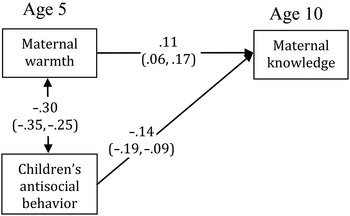
We extended our analysis further by examining whether children's antisocial behavior early in life influenced later parental knowledge. Consistent with our hypothesis, children's antisocial behavior at age 5 predicted lower levels of knowledge reported by mothers at age 10 (Figure 6). This effect was comparable to the influence of early maternal warmth on later knowledge. This finding indicates that parental knowledge at the beginning of adolescence is influenced not only by children's behavior early in life but also by the warmth that mothers display. We did not conduct this test for parental monitoring, given that we did not hypothesize or find a child effect for monitoring once family background variables were taken into account.
Prediction of knowledge at age 10 by children's antisocial behavior and maternal warmth at age 5. Associations are expressed as standardized path coefficients. The 95% confidence intervals are reported in parentheses.

Discussion
We used data from a prospective cohort of families and their twin children to examine the associations between parental monitoring and knowledge with youths’ antisocial behaviors in preadolescence. There were two main findings. First, young people who displayed antisocial behavior had parents who, 2 years later, lacked knowledge about their activities at school and in their leisure time. This child effect was solid: it was consistent whether reports came from mothers, fathers, children, or teachers; it was robust despite controls for family characteristic and parents’ psychopathology; and it was partially genetically mediated by youths’ earlier antisocial behavior. Second, parental monitoring did not predict lower levels of youth antisocial behavior in this cohort of preadolescents.
Parental monitoring does not reduce subsequent antisocial behavior during preadolescence
Although it is intuitive to assume that parents’ monitoring of their youths’ activities and whereabouts minimizes problem behavior, our findings suggest that on its own, this parenting strategy is not a deterrent of antisocial behavior during preadolescence. We found that whether parents did monitor their youths’ whereabouts more or less during preadolescence did not affect youths’ levels of antisocial behavior later once we accounted for the influence of family and parents’ characteristics. This finding suggests that the reason why youth who behave antisocially are more likely to have parents who monitor little is because a family's social situation influences both parents’ monitoring and the level of antisocial behavior youths display. Other studies that examined the influence of parental monitoring on later antisocial behavior have obtained inconsistent findings, with some of them reporting an influence of monitoring (Gault-Sherman, Reference Gault-Sherman2012; Kiesner, Dishion, Poulin, & Pastore, Reference Kiesner, Dishion, Poulin and Pastore2009; Willoughby & Hamza, Reference Willoughby and Hamza2011). There are several possible explanations for these inconsistencies. Some of the studies that found an association assessed antisocial behavior using items that reflect risk behaviors more broadly, including sexual risk taking and substance abuse (Fletcher, Steinberg, & Williams-Wheeler, Reference Fletcher, Steinberg and Williams-Wheeler2004; Willoughby & Hamza, Reference Willoughby and Hamza2011). We did not include such behaviors in our study because they are relatively rare in preadolescence. In addition, it is possible that some of the effects of monitoring on antisocial behavior are moderated by the context in which they occur. For example, monitoring of children's whereabouts may be particularly meaningful and consequential in samples drawn from deprived neighborhoods where there is more exposure to violence, substance use, and deviant peers (Lahey et al., Reference Lahey, Van Hulle, D'Onofrio, Rodgers and Waldman2008; Pettit et al., Reference Pettit, Bates, Dodge and Meece1999).
Youths’ antisocial behavior reduces parents’ knowledge
Our findings indicate that parent's knowledge about their preadolescents’ activities, friends, and whereabouts decreases in response to youths’ antisocial behavior, regardless of who reports their perception of parental knowledge. These results are consistent with findings in older adolescent samples (Kerr, Stattin, & Özdemir, Reference Kerr, Stattin and Özdemir2012; Laird, Pettit, Bates, & Dodge, Reference Laird, Pettit, Bates and Dodge2003) but extend previous research by demonstrating that an effect of youths’ behavior on parental knowledge is already present in preadolescence.
One pathway through which youths’ antisocial behavior may reduce parents’ knowledge is through youth disclosure, one of its primary sources (Stattin & Kerr, Reference Stattin and Kerr2000). Youth are skilled information managers, who consider carefully and strategically which information they disclose to their parents (Marshall, Tilton-Weaver, & Bosdet, Reference Marshall, Tilton-Weaver and Bosdet2005; Smetana, Reference Smetana2008). Youth who engage in antisocial, risky behaviors and suspicious leisure activities have more to hide and may therefore be particularly prone to lying or concealing and more hesitant to disclose information, resulting in less parental knowledge (Darling, Cumsille, Caldwell, & Dowdy, Reference Darling, Cumsille, Caldwell and Dowdy2006; Keijsers & Laird, Reference Keijsers and Laird2010; Marshall et al., Reference Marshall, Tilton-Weaver and Bosdet2005). Some knowledge may be gained by parents spending time with their children (Laird, Pettit, Dodge, & Bates, Reference Laird, Pettit, Dodge and Bates2003; Willoughby & Hamza, Reference Willoughby and Hamza2011). Antisocial youth tend to have more conflictual relationships with their caregivers (Burt, McGue, Krueger, & Iacono, Reference Burt, McGue, Krueger and Iacono2005), and they may be less willing to spend time with them. Likewise, parents may minimize their involvement when confronted with challenging behavior because they grow frustrated and tired of interacting with difficult children (Dishion, Nelson, & Bullock, Reference Dishion, Nelson and Bullock2004). This absence of positive parent–child involvement would in turn prevent adults from gaining knowledge about their offspring's activities and whereabouts.
The influence of children's antisocial behavior on parental knowledge was not unique to preadolescence, but was already present when we extended our analysis to early childhood. Maternal warmth was also important, so that mothers who expressed more warmth had more knowledge about their children's activities and whereabouts later on. Maternal warmth may help to establish more trusting parent–child relationships in which children feel more comfortable to disclose information about their lives, leading to higher levels of parental knowledge (Blodgett Salafia, Gondoly, & Grundy, Reference Blodgett Salafia, Gondoli and Grundy2009). However, even at this early age, children's antisocial behavior was already as important as maternal warmth in predicting later parental knowledge, indicating that to understand the origins of parental knowledge at the beginning of preadolescence, we need to take into account children's as much as parents’ behavior during early childhood.
Contrary to common perceptions, we found that the association between parents’ knowledge and youths’ antisocial behavior was due to youths’ behavior reducing knowledge over time, rather than the other way around. This finding is consistent with the notion that the association between antisocial behavior and knowledge is driven by youths’ characteristics, for example, antisocial behavior (Keijsers et al., Reference Keijsers, Branje, Van der Valk and Meeus2010; Kerr et al., Reference Keijsers, Branje, Van der Valk and Meeus2010; Stattin & Kerr, Reference Stattin and Kerr2000). There are some studies that report a significant, but small link between parents’ knowledge and later antisocial behavior, even when accounting for youths’ initial behavior problems (Abar et al., Reference Abar, Jackson and Wood2014; Graber, Nichols, Lynne, Brooks-Gunn, & Botvin, Reference Graber, Nichols, Lynne, Brooks-Gunn and Botvin2006; Marceau et al., Reference Marceau, Narusyte, Lichtenstein, Ganiban, Spotts and Reiss2015). It is notable that studies reporting such an effect were often conducted at a later age, whereas our study period was during preadolescence. Any positive effects of knowledge may be confined to later adolescence. In addition, there are differences across our and previous studies in the questions used to assess parental knowledge, with specific questions about parents’ ongoing knowledge about health habits, sexual behaviors, and use of drugs (Marceau et al., Reference Marceau, Narusyte, Lichtenstein, Ganiban, Spotts and Reiss2015). It is possible that knowledge about these health risk-taking behaviors is more strongly related to future antisocial behavior.
Genetic and environmental etiology of parental knowledge and monitoring
There is little research on the genetic and environmental influences on parental knowledge. Our findings showed that youths’ genetically influenced characteristics were important in explaining why some mothers knew more about their children than others. This underlines that parental knowledge is largely a function of youths’ behavior, as opposed to parents’ actions (Stattin & Kerr, Reference Stattin and Kerr2000). In contrast, individual differences in mothers’ reports of parental monitoring were not explained by genetic influences, suggesting that monitoring is mostly a function of mothers’ own behavior, such as her warmth or her mental health, and family characteristics, such as SES. Different etiological influences on monitoring and knowledge lend further support to the idea that these are different constructs, and that their associations with problem behaviors need to be examined separately.
The child effect on parental knowledge that we found in the cross-lagged models was largely genetically mediated, via youths’ antisocial behavior. This is further evidence for the importance of youths’ antisocial behavior in influencing their parents’ knowledge (Stattin & Kerr, Reference Stattin and Kerr2000). Although genetic influences largely explained the association between youths’ antisocial behavior and parents’ knowledge, they accounted for only a small proportion of the observed total genetic influence. This indicates that, in addition to antisocial behavior, parental knowledge is also influenced by other youths’ behaviors, possibly the tendency to be secretive, withdrawn, or shy (Keijsers & Laird, 2010).
There have been reports of environmentally mediated effects of parental monitoring and knowledge on youths’ problem behavior (Marceau et al., Reference Marceau, Narusyte, Lichtenstein, Ganiban, Spotts and Reiss2015; Neiderhiser, Marceau, & Reiss, Reference Neiderhiser, Marceau and Reiss2013). These studies differ from our research in some important ways. First, the outcome we examined in this study was antisocial behavior, as opposed to substance use (Neiderhiser et al., Reference Neiderhiser, Marceau and Reiss2013). In studies where assessments of youths’ problem behavior contain measures of substance use, effects of monitoring appear to be stronger than when problem behavior is measured as antisocial, disruptive behavior only (Fletcher et al., Reference Fletcher, Steinberg and Williams-Wheeler2004; Willoughby & Hamza, Reference Willoughby and Hamza2011). Thus, it is possible that parental monitoring is an effective and environmentally mediated deterrent of substance use, more so than of other forms of antisocial behavior. A second difference lies in the type of knowledge that this study assessed. We collected information on parents’ knowledge of youths’ spare time and school activities, whereas some previous studies also assessed what parents knew about youths’ health habits, sexual behaviors, and use of drugs (Marceau et al., Reference Marceau, Narusyte, Lichtenstein, Ganiban, Spotts and Reiss2015). These behaviors and parents’ knowledge about them may be more predictive of youths’ future antisocial behaviors. This interpretation raises the possibility that it is not the extent of parental knowledge, but also the type of knowledge that parents possess, that is important for preventing youths’ future antisocial behaviors.
Sex differences
Consistent with previous studies (Kerr & Stattin, Reference Kerr and Stattin2000; Li et al., Reference Li, Feigelman and Stanton2000), we found that girls were monitored more closely by their parents, and that parents reported they knew more about their daughters’ whereabouts compared to their sons’. Differences in monitoring could be due to parents’ greater safety concerns for their daughters (Vieno, Nation, Perkins, Pastore, & Santinello, Reference Vieno, Nation, Perkins, Pastore and Santinello2010) or more acceptance of boys’ autonomy. Differences in parents’ knowledge may also be due to girls’ disclosing more information about their lives to their parents, particularly to their mothers (Kerr & Stattin, Reference Kerr and Stattin2000; Smetana, Metzger, Gettman, & Campione-Barr, Reference Smetana, Metzger, Gettman and Campione-Barr2006). Contrary to our hypothesis, we did not find sex differences in the longitudinal, reciprocal associations among parental monitoring, knowledge, and youth antisocial behavior. These findings indicate that parents’ monitoring does not predict lower antisocial behavior in girls compared to boys, and even though boys show higher levels of antisocial behavior, girls’ problem behavior decreases subsequent parental knowledge as much as boys’ behavior.
Limitations
Our findings must be interpreted in light of some limitations. First, there were a few statistical issues that may have attenuated the effect of earlier parental knowledge and monitoring on later levels of youth antisocial behavior. Maternal ratings of parental monitoring and knowledge at age 10 were skewed and showed little variance, with the majority of mothers reporting they monitored and knew well their children's activities and whereabouts. With a small number of mothers who monitored or knew only little about their child, it was difficult to statistically detect whether less monitoring and knowledge predicted more antisocial behavior. However, our conclusions are supported by previous research that did not have this problem (Keijsers et al., Reference Keijsers, Branje, Van der Valk and Meeus2010; Kerr et al., Reference Keijsers, Branje, Van der Valk and Meeus2010). In addition, our scales of monitoring and knowledge showed relatively low internal consistency reliability. In future studies, it might be worthwhile using a more extensive assessment of these two constructs. In addition, antisocial behavior was more stable over time compared to parental monitoring and knowledge, which means that there was less variability in antisocial behavior at age 12 to be predicted by monitoring and knowledge. As shown in our results, we obtained very similar findings when using teachers’ reports of antisocial behavior across time, which exhibited a degree of stability that was more comparable to parental knowledge. However, we are unable to completely exclude the possibility that differential stabilities may have contributed to the pattern of results. Second, we examined the associations among monitoring, knowledge, and antisocial behavior at a relatively early age. Preadolescence is a time when there is a sharp decrease in the amount of time children spend with their families and an increase in their unstructured and unsupervised leisure time (Larson & Richards, Reference Larson and Richards1991), which may provide opportunities to engage in antisocial behaviors. The prevalence of antisocial behavior rises between childhood and adolescence as well (Bendixen & Olweus, Reference Bendixen and Olweus1999). Examining the effects of parental knowledge and monitoring during this time is therefore both developmentally and clinically relevant. Third, our sample comprised twins, and we cannot be certain that our results generalize to singletons. However, twins and singletons do not differ in their prevalence of antisocial behaviors or antisocial personality traits (Johnson, Krueger, Bouchard, & McGue, Reference Johnson, Krueger, Bouchard and McGue2002; Moilanen et al., Reference Moilanen, Linna, Ebeling, Kumpulainen, Tamminen and Piha1999), and effect sizes for associations between risk factors and psychopathology outcomes have generally been found to be similar across behavioral genetic and nongenetic studies (Moffitt & E-Risk Team, Reference Moffitt2002). Fourth, our analyses of the effects of monitoring and knowledge on antisocial behavior could not be entirely repeated with data from fathers or youth. However, other studies indicate that youths’ own ratings of parental monitoring or knowledge are no more predictive of antisocial behavior than mothers’ (Kerr & Stattin, Reference Kerr, Stattin, Crouter and Booth2003). Fifth, our sample of fathers was not representative of the population with regards to SES and parents’ antisocial behavior. Our findings using fathers’ information should be interpreted with caution, but they were consistent with the results obtained for youths’ and mothers’ reports.
Implications for research and clinical practice
Our study has implications for future research. First, examining the association between children's antisocial behavior and parental knowledge in the context of families’ day-to-day functioning may contribute to a better understanding of the effect of youths’ behavior on parents’ knowledge. For example, assessing interactions between parents and children using experience sampling or diary data (Smetana, Villalobos, Rogge, & Tasopoulos-Chan, Reference Smetana, Villalobos, Rogge and Tasopoulos-Chan2010) may reveal the day-to-day processes underlying bidirectional influences between children and their parents. Second, our findings show disagreement between parents’ and youths’ perceptions of parenting. It is worth studying the origins of these different perceptions in more detail, particularly because parent–child disagreement has been associated with negative future outcomes in previous studies (De Los Reyes, Reference De Los Reyes2011; Ringoot et al., Reference Ringoot, van der Ende, Jansen, Measelle, Basten and So2015). Third, the relevance of monitoring and knowledge for the effects of parenting on antisocial behavior may lie in other more meaningful measures. For example, parental knowledge whether gained through youth disclosure or other means may only become meaningful for youths’ antisocial (or other) behavior when it is translated into parental actions such as disciplining or communicating disapproval (Mounts, Reference Mounts2001; Tilton-Weaver & Galambos, Reference Tilton-Weaver and Galambos2003). Likewise, parents’ attempts at monitoring their children may be futile if attempts are executed ineffectually or if children are defiant. Incorporating measures of these processes will advance our understanding of the role of monitoring and knowledge for antisocial behavior.
Our study also has implications for clinical practice. First, our findings emphasize the impact that youths’ behavior, including antisocial behavior, can have on their parents’ behavior. Our results should not be interpreted as minimizing the importance of parenting, but of demonstrating that youths’ behavior is also relevant. Clinicians should be aware that youth influence their families. Likewise, prevention and intervention programs that exclusively focus on parents’ behavior may omit meaningful aspects of the parent–child relationship. Our finding of a genetically mediated child effect on parenting does not preclude changeability of youths’ or parents’ behavior because genetic influences on children's antisocial behavior may themselves be moderated by environmental circumstances (Hicks, South, Dirago, Iacono, & McGue, Reference Hicks, South, Dirago, Iacono and McGue2009). Second, our findings underline the importance of taking both youths’ and parents’ perceptions of family dynamics into account in clinical practice, because these perceptions may differ and show different associations with problem behaviors. Parents may perceive themselves as diligently monitoring their children's behavior and activities, whereas youth may not recognize their parents’ monitoring attempts. Third, until it is clearer whether and under what conditions monitoring reduces antisocial behavior, it will be more promising to direct resources toward comprehensive interventions that aim to modify a variety of risk factors for youths’ antisocial behavior (Scott, Spender, Doolan, Jacobs, & Aspland, Reference Scott, Spender, Doolan, Jacobs and Aspland2001; Webster-Stratton & Taylor, Reference Webster-Stratton and Taylor2001). Improving these may also create a climate in which youth disclose more to their parents, parents have more knowledge about their children, and parents are able to use monitoring strategies in a way that has an influence on youths’ behavior.