Without the capacity to regulate thoughts, emotions, and behaviors, children are unable to flexibly respond to environmental demands to produce socially appropriate, goal-directed behavior. The formation of the regulatory systems necessary for flexible responding requires early environmental input, which then interacts with genetic predispositions in complicated, bidirectional ways. Early dyadic coregulatory experiences with caregivers provide the foundation upon which the infant's self-regulatory systems build (Feldman, Reference Feldman2007). However, this is largely promoted within the context of the child's genetic parameters, and the types of interactions caregivers provide will be dependent on the child's responses (Crockenburg, Reference Crockenberg, Lerner and Lerner1986). Within this complex developmental context, both adaptive and maladaptive regulatory systems are shaped, and produce predictable responses to environmental experiences (Fox & Calkins, Reference Fox and Calkins2003). Within the framework of developmental psychopathology, maladaptive self-regulatory styles (that may result in problem behaviors) can be seen as outcomes of normal efforts at self-control.
The types of problem behaviors that manifest in childhood are often grouped into two classes: internalizing symptoms and externalizing behaviors (Achenbach & Ruffle, Reference Achenbach and Ruffle2000). Internalizing symptoms reflect problems that include internal distress, and consist of depression and anxiety. Externalizing behaviors are impulsive and in conflict with others, and consist of rule-breaking behaviors, attention deficits, and hyperactivity. These two forms of psychopathology seem to reflect different types of elementary self-regulatory systems (Dishion & Stormshak, Reference Dishion and Stormshak2007) that develop over time through interacting genetic and environmental factors.
Specific patterns of self-regulatory deficits may predict the types of problem behaviors children are more likely to experience (Derryberry & Rothbart, Reference Derryberry and Rothbart1997; Eisenberg, Hofer, & Vaughan, Reference Eisenberg, Hofer, Vaughan and Gross2007). The child's ability to respond and regulate behavior depends on individual differences in reactivity and effortful control (Rothbart & Bates, Reference Rothbart, Bates, Damon, Lerner and Eisenberg2006). Interactions between individual differences in reactivity and effortful control could promote patterns of maladaptive regulation of emotion and behavior, and may increase the risk for developing problem behaviors (Nigg, Reference Nigg2006). Reactivity reflects automatic initial physiological, cognitive, and emotional responses to novel stimuli. It involves two independent systems of approach and avoidance (Rothbart & Bates, Reference Rothbart, Bates, Damon, Lerner and Eisenberg2006). Approach, which involves moving toward new experiences and increased positive affect, could be seen as exaggerated in children with externalizing problems, as they act impulsively without appropriate anxiety over social consequences. In contrast, avoidance, which includes vigilance toward threat and withdrawal from novel stimuli, could be seen the normal temperament dimension that is exaggerated in children with internalizing problems, as they disengage from the environment in response to perceived threat.
Within current models of normal temperament, reactivity is seen as modulated by effortful control (Rothbart & Bates, Reference Rothbart, Bates, Damon, Lerner and Eisenberg2006). Effortful control includes activational control (the ability to activate new behaviors), attentional control (the ability to attend to stimuli), and inhibitory control (the ability to inhibit behaviors). Effortful control allows a child to voluntarily orient away from threatening stimuli and simultaneously increase attention toward calming inputs (Derryberry & Rothbart, Reference Derryberry and Rothbart1997). It also allows a child to inhibit strong approach tendencies to delay reinforcement or act in a socially appropriate manner. From this perspective, both externalizing (high approach) and internalizing (high avoidance) forms of reactivity could be seen as modulated by effortful control, with greater effortful control leading to more adaptive regulation. An interaction between individual differences in reactivity and limitations in effortful control predicts the development of problem behaviors and emotional distress (Nigg, Reference Nigg2006). Specifically, two types of regulatory styles (undercontrolled and overcontrolled) are thought to uniquely promote risk for externalizing and internalizing symptoms, respectively (Eisenberg et al., 2001).
Undercontrolled Regulatory Style
Undercontrolled individuals are conceptualized to have high levels of approach, low levels of avoidance, and low effortful control (Eisenberg et al., Reference Eisenberg, Hofer, Vaughan and Gross2007; Nigg, Reference Nigg2006). Because of high approach tendencies, undercontrolled children are more likely to act impulsively. Low levels of avoidance predispose these children to respond to novel situations without increases in anxiety or distress. Because these children also have low levels of effortful control, they are unable to mobilize attentional mechanisms to inhibit impulses and promote socially appropriate behavior. As a result, these children are poor in behavioral control, as measured by difficulty delaying reinforcement, greater emotional liability, restlessness, and a short attention span (Rothbart, Ellis, Rueda, & Posner, Reference Rothbart, Ellis, Rueda and Posner2003). Research suggests that undercontrolled children are at increased risk toward developing externalizing problems (Eisenberg et al., Reference Eisenberg, Cumberland, Spinrad, Fabes, Shepard and Reiser2001; Gilliom, Shaw, Beck, Schonberg, & Lukon, Reference Gilliom, Shaw, Beck, Schonberg and Lukon2002; Ormel et al., Reference Ormel, Oldehinkel, Ferdinand, Hartman, De Winter and Veenstra2005).
Overcontrolled Regulatory Style
Overcontrolled individuals are described as having low levels of approach and high levels of avoidance (Eisenberg et al., Reference Eisenberg, Hofer, Vaughan and Gross2007). Greater activation in the avoidance system results in the containment of impulses, delay of gratification, inhibition of behaviors and affect, and insulation from environmental distracters (Valiente et al., Reference Valiente, Eisenberg, Spinrad, Reiser, Cumberland and Losoya2006). Thus, children high in avoidance are behaviorally inhibited and fearful as a result of high reactive control. Although highly rigid and controlled in behavior, they may be low in the higher order dimension of effortful control (Derryberry & Rothbart, Reference Derryberry and Rothbart1997; Oldehinkel, Hartman, Ferdinand, Verhulst, & Ormel, Reference Oldehinkel, Hartman, Ferdinand, Verhulst and Ormel2007). Higher levels of effortful control have been shown to reduce the effect of emotions related to high reactive control (like fear) on the development of internalizing symptoms (Oldehinkel et al., Reference Oldehinkel, Hartman, Ferdinand, Verhulst and Ormel2007; Oldehinkel, Hartman, De Winter, Veenstra, & Ormel, Reference Oldehinkel, Hartman, De Winter, Veenstra and Ormel2004; Ormel et al., Reference Ormel, Oldehinkel, Ferdinand, Hartman, De Winter and Veenstra2005). However, the relationship between low effortful control and internalizing symptoms is not always found (Eisenberg et al., Reference Eisenberg, Sadovsky, Spinrad, Fabes, Losoya and Valiente2005). Research suggests that this inconsistency occurs because overcontrolled children have a more specific deficit in shifting attention away from distressing stimuli (Derryberry & Reed, Reference Derryberry and Reed1994). These children respond by physically withdrawing but will continue to engage their attention toward the object of distress. Because of this bias, they are be more sensitive to punishment and negative feedback from the environment, because not only are they more reactive, they are also unable to disengage from the information. This tendency biases overcontrolled children toward experiencing high levels of negative emotion and puts them at greater risk for developing internalizing symptoms (Fox, Henderson, Marshall, Nichols, & Ghera, Reference Fox, Henderson, Marshall, Nichols and Ghera2005).
Temperament research suggests that normally adaptive styles of self-regulation can become maladaptive when exaggerated or when poorly modulated by higher cognitive and affective capacities. However, the concepts of control are obviously complex, with some aspects integral to reactive levels of control (more rigid self-control with greater avoidance; less self-control with increased approach), and some aspects (described as “effortful” control) seen as operating at a higher level to provide greater adaptive flexibility in bringing elementary (“reactive”) modes of self-regulation to life challenges. Facing these questions of psychological theory, we can ask whether advances in neuroscience have provided theoretical insight into the basic mechanisms of motivational control in self-regulation. Although the theoretical answers remain tentative, recent research in frontolimbic mechanisms of attention, motivation, and self-monitoring has suggested that activity in the anterior cingulate cortex (ACC) is important to individual differences in anxiety, self-monitoring, and self-control.
Frontolimbic Relations in the ACC
The ACC is a region located along the medial surface of the two hemispheres bordering the corpus callosum. In a position between the executive functions of the frontal lobe and the motivational functions of the limbic system, the ACC has been implicated in providing the intersection between reactive, emotional information processing, and top-down, attentional mechanisms of cognitive control. Evidence from cytoarchitecture, electroencephalography (EEG), and functional magnetic resonance imaging studies suggests that ventral and dorsal regions of the ACC are specialized to differentially process emotional and cognitive information respectively (Bush, Luu, & Posner, Reference Bush, Luu and Posner2000). The unique connectivity patterns of the ventral ACC with limbic and paralimbic regions involved in emotion, and dorsal ACC with prefrontal regions involved in planning and impulse control, suggest that there is specialization of function within the anterior cingulate. The position of the dorsal and ventral ACC in mediating cognitive control and emotional processing makes each important in mediating under- and overcontrolled regulation.
Dorsal ACC
The role of the dorsal ACC in self-regulation has been demonstrated in tasks that require executive attention, conflict resolution, and cognitive control, such as Stroop tasks, the attention network task, go no/go tasks, and stop tasks. These tasks activate a network that includes the dorsal ACC and lateral prefrontal areas (Bush et al., Reference Bush, Luu and Posner2000). The network involving the dorsal ACC is further engaged by behavioral response conflicts and is sensitive to conflicts in goals and expectation violations (Luu, Tucker, Derryberry, Reed, & Poulsen, Reference Luu, Tucker, Derryberry, Reed and Poulsen2003). Unlike the ventral ACC, the dorsal region maintains interconnections with the lateral prefrontal cortex, parietal cortex, and premotor and supplementary motor areas (Bush et al., Reference Bush, Luu and Posner2000), and coactivations between the ACC and the lateral prefrontal cortex during tasks described above are demonstrated only in the dorsal subdivision (Paus, Reference Paus2001). Poorer performance on tasks that require inhibitory control (e.g., undercontrolled regulation of action) could be seen as resulting from insufficient mediation by the dorsal ACC, although ventral regions have also been associated with impulse control (see Bokura, Yamaguchi, & Kobayashi, Reference Bokura, Yamaguchi and Kobayashi2001). This dysfunction could explain children's difficulty inhibiting approach behaviors and provide risk for the development of externalizing behaviors.
Ventral ACC
In contrast, the ventral region of the ACC has been implicated in evaluating emotional and motivational information. It appears to be particularly important for processing negative emotions, particularly anxiety and depression (Kawasaki et al., Reference Kawasaki, Kaufman, Damasio, Damasio, Granner and Bakken2001). Furthermore, evidence suggests that reductions in anxiety symptoms are associated with decreased activation in the ventral ACC (Davidson, Pizzagalli, Nitschke, & Putnam, Reference Davidson, Pizzagalli, Nitschke and Putnam2002). Both induction of emotions in normative samples and symptom provocation in patient populations activate the ventral ACC (Bush et al., Reference Bush, Luu and Posner2000). Higher levels of rumination are correlated with increased activation in the ventral ACC (Ray et al., Reference Ray, Ochsner, Cooper, Robertson, Gabrieli and Gross2005). Evidence also suggests that as blood flow increases in the ventral ACC (and other emotion processing areas like the amygdala and posteromedial orbital cortex) during emotion eliciting tasks, there is a corresponding decrease in blood flow in the dorsal ACC and dorsolateral prefrontal cortices (Drevets & Raichle, Reference Drevets and Raichle1998). As neural activity increases in ventral regions during emotion eliciting experiences, there may be a corresponding suppression of activity in areas that promote cognitive processing (and top-down control). Taken together, this evidence suggests that greater activity in ventral ACC provide an index of limbic overengagement in anticipation of negative consequences. Greater activation in the ventral ACC could indicate that more resources are being allocated to processing negative emotional information (specifically anxiety provoking information) received from the environment, leading to risk for developing internalizing symptoms.
Specific dysfunctions in ventral and dorsal networks may thus provide one mechanism through which specific disorders of self-regulation manifest as internalizing and externalizing behaviors. With the ACC at the crossroads of the dorsal and ventral frontolimbic networks (Tucker & Luu, Reference Tucker and Luu2007), assessing the activity of dorsal and ventral regions of the ACC in relation to problem behaviors could provide evidence for these mechanisms being differentially related to under- and overregulatory styles. Several findings have suggested that assessment of contributions from the ACC and more posterior regions of the cingulate cortex with event-related potential (ERP) measures may be informative in understanding the development of self-regulatory capacity in children.
Indexing Ventral and Dorsal Activity Using ERPs
Using EEG, the scalp potentials associated with activity in the brain are measured by computing ERPs, averaged waveforms time-locked to the event of interest. Two ERP components in particular appear to index the self-regulatory mechanisms involved in over- and undercontrolled regulatory styles: error-related negativity (ERN) and the medial frontal negativity (MFN). Source analysis of these two ERP components has implicated a region near the ACC (Bokura et al., Reference Bokura, Yamaguchi and Kobayashi2001; Dehaene, Posner, & Tucker, Reference Dehaene, Posner and Tucker1994). More specifically, the sources of the two components have been differentiated: the MFN has been found to have primarily dorsal ACC sources, whereas the ERN has additional ventral ACC in addition to dorsal sources (Kiehl, Laurens, Duty, Foster, & Liddle, Reference Kiehl, Laurens, Duty, Forster and Liddle2001; Luu et al., Reference Luu, Tucker, Derryberry, Reed and Poulsen2003; Menon, Adleman, White, Glover, & Reiss, Reference Menon, Adleman, White, Glover and Reiss2001). There is also evidence, however, that does not fit this simple model: the ERN is not always found to have ventral sources (Gehring, Himle, & Nisenson, Reference Gehring, Himle and Nisenson2000; Ladouceur, Dahl, & Carter, Reference Ladouceur, Dahl and Carter2007), and some evidence suggests that the MFN has additional ventral sources (Bokura et al Reference Bokura, Yamaguchi and Kobayashi2001; Lewis et al., Reference Lewis, Granic, Lamm, Zelazo, Stieben and Todd2008). Taken together with behavioral evidence, however, making a case for different contributions of dorsal and ventral networks to the MFN and ERN is compelling. The behavioral evidence suggests that the MFN and ERN are sensitive to individual differences in self-regulation that are relevant to under- and overcontrolled regulation (Hajcak, McDonald, & Simons, Reference Hajcak, McDonald and Simons2005; Lewis et al., Reference Lewis, Granic, Lamm, Zelazo, Stieben and Todd2008; Pliszka, Liotti, & Wolderff, Reference Pliszka, Liotti and Wolderff2000; Stieben, Lewis, Granic, Zelazo, Segalowitz, & Pepler, Reference Stieben, Lewis, Granic, Zelazo, Segalowitz and Pepler2007).
ERN
The first ERP component used to assess self-regulatory mechanisms is the response-locked ERN, a negative deflection occurring 0–100 ms after making an incorrect response. This component is used to index error monitoring (Gehring, Goss, Coles, Meyer, & Donchlin, Reference Gehring, Goss, Coles, Meyer and Donchlin1993). The amplitude of the ERN is dependent on the subject's awareness that they have made an incorrect response (Dehaene et al., Reference Dehaene, Posner and Tucker1994). The ERN is thought to reflect a mechanism that checks the response made against the representation of the correct response (Falkenstein, Hoormann, Christ, & Hohnsbein, Reference Falkenstein, Hoormann, Christ and Hohnsbein2000). Carter and colleagues (Reference Carter, Braver, Barch, Botvinick, Noll and Cohen1998) propose that it is more likely a conflict detector, and is larger in error trials because there is greater conflict in response. Luu, Flaisch, and Tucker (Reference Luu, Flaisch and Tucker2000) suggest that the ERN does not check a representation against a correct response or check for conflict specifically; rather, it serves to self-monitor performance more generally, regardless of whether it is monitoring for errors or speed. In addition, subjects higher in neuroticism and negative affect (Luu, Collins, & Tucker, Reference Luu, Collins and Tucker2000) and subjects with obsessive–compulsive disorder (Gehring et al., Reference Gehring, Himle and Nisenson2000) and higher in anxiety (Hajcak, McDonald, & Simons, Reference Hajcak, McDonald and Simons2005) have larger ERNs compared to less anxious individuals, suggesting that the ERN amplitude is sensitive to the amount of distress caused when self-monitoring performance. These results have been replicated in children as well: children with anxiety disorders also show an elevated ERN response (Ladouceur, Dahl, Birmaher, & Axelson, Reference Ladouceur, Dahl, Birmaher and Axelson2006). This evidence suggests that the ERN provides an index of individual differences in vigilance toward making errors. We propose that children with overcontrolled regulatory styles would have larger ERN amplitudes because of their enhanced vigilance toward negative feedback, promoting risk for developing internalizing disorders.
MFN
The second component of interest, the stimulus-locked MFN (also called the frontal or no-go N2), has been shown to be sensitive to individual differences in inhibitory control (Pliszka et al., Reference Pliszka, Liotti and Wolderff2000). The MFN is a negative deflection in the averaged EEG occurring 200–500 ms after stimulus presentation. It occurs at medial frontal sites when a prepotent response is inhibited and is often assessed as an index of inhibitory control (Eimer, Reference Eimer1993). The MFN is larger in correct “no-go” trials (when subjects withhold a potent response) than in “go” trials (when subjects act on a potent response; Falkenstein et al., Reference Falkenstein, Hoormann, Christ and Hohnsbein2000). Evidence that the MFN is related to individual differences in inhibitory control comes from findings that children with attention-deficit/hyperactivity disorder have significantly smaller MFNs, and they demonstrate an inability to initiate response inhibition (Pliszka et al., Reference Pliszka, Liotti and Wolderff2000). In addition, children with clinically elevated externalizing behaviors without co-occurring internalizing symptoms display the smallest MFN amplitudes when compared to controls and comorbid populations (Stieben et al., Reference Stieben, Lewis, Granic, Zelazo, Segalowitz and Pepler2007). Thus, MFN amplitude may provide an index of inhibitory control. We propose that children with undercontrolled regulatory styles would have smaller MFNs, indexing poor top-down control of high approach tendencies.
Design and Hypothesis
The present study investigates the relationship between regulatory style and behavior problems using a frustrating go/no-go task developed by Lewis, Lamm, Segalowitz, Stieben, and Zelazo (Reference Lewis, Lamm, Segalowitz, Stieben and Zelazo2006). The task introduces a challenge to self-regulation by generating frustration under conditions that require perseverance and goal-directed action. Lewis and colleagues have demonstrated that this challenging task can distinguish subtypes of aggressive children by their self-regulatory mechanisms. Children clinically elevated only in externalizing behaviors (pure externalizers) and children elevated in both internalizing and externalizing behaviors (comorbid children) show distinct mechanisms of self-regulation that suggest different developmental pathways toward disordered behavior (Stieben et al., Reference Stieben, Lewis, Granic, Zelazo, Segalowitz and Pepler2007). In addition, Lewis et al. (Reference Lewis, Granic, Lamm, Zelazo, Stieben and Todd2008) have found that ERP evidence of decreased ventral ACC activity in the frustrating go/no-go task was related to improvement in self-regulation related to clinical intervention for aggressive behavior in a sample of comorbid children. Evidence from Lewis et al. (Reference Lewis, Granic, Lamm, Zelazo, Stieben and Todd2008) using this task thus suggests that frustration induction elicits activity in frontolimbic circuits (including the ACC) that may track clinically significant improvement.
Similarly, within normal development, the ability to self-regulate during a frustrating event is critical particularly in the transition to adolescence. Using the task developed by Lewis and colleagues, we examined normal variation problem behaviors and medial frontal mechanisms with EEG measures. We hypothesized that during the difficult, frustration-inducing block of the frustrating go/no-go task, normal variations in externalizing and internalizing behaviors would be related to the amplitude of the MFN and ERN components, respectively, tapping distinct deficits in self-regulation in dorsal and ventral networks. Specifically, we hypothesized that children with greater externalizing behaviors would have significantly smaller MFNs, indexing poor top-down modulation by the dorsal ACC, and therefore poor inhibitory control and an undercontrolled regulatory style. Conversely, children with greater internalizing symptoms were not expected to have deficits in inhibitory control (or dorsal mediated self-regulation), and therefore we did not anticipate that there would be a relationship between children's internalizing symptoms and the amplitude of the MFN component. We instead hypothesized that children with greater internalizing symptoms would have larger ERN amplitudes, indexing exaggerated ventral ACC engagement associated with distress and self-monitoring when making errors.
Methods
Participants
Participants were 75 children and adolescents (38 females) ages 9–13 recruited from the Eugene, Oregon, community. Twelve children were 9 years old, 16 children were 10 years old, 10 children were 11 years old, 24 children were 12 years old, and 13 children were 13 years old (mean age = 11.58, SD = 1.34). Three children refused to complete the task, 2 children were noncompliant with the task, and 1 child was not included in the analysis because of excessive eye-blink and movement artifacts resulting in low trial counts for the ERPs. A total of 69 children and adolescents were used in the ERP and behavioral analysis.
Measures
Child Behavior Checklist (CBCL)
Behavioral and emotional symptoms were assessed using mother reports on the CBCL (Achenbach, Reference Achenbach1991). The CBCL is one of the most commonly used questionnaires in research on behavioral and emotional problems in children and adolescence (Achenbach, Reference Achenbach1991). It contains a list of 112 items that each parent rates as being not true, somewhat or sometimes true, or very or often true in the past 6 months. The instrument yields standardized T scores for total behavioral problems, internalizing problems, and externalizing problems, as well as T scores for syndrome subscales measuring anxious/depressed, withdrawn/depressed, somatic complaints, social problems, thought problems, attention problems, aggressive behavior, and rule-breaking behaviors. For the purposes of this study, we looked at internalizing and externalizing behavior T scores.
Emotional go/no-go task
The go/no-go task used in this study was developed by Lewis and colleagues (Reference Lewis, Lamm, Segalowitz, Stieben and Zelazo2006) and presented using E-Prime software (Psychological Software Tools, Pittsburgh, PA). Participants were instructed to press a button when a letter was presented on the screen (the go condition) and not press the button when a letter was repeated a second time in succession (the no-go condition). The stimuli were presented in three blocks, with different pairs of stimuli used for each block (Block A: x, y; Block B: o, p; Block C: u, d) to enhance novelty without modifying the level of difficulty. Blocks A and C consisted of 200 trials (including 66 no-go trials in pseudorandomized order). Block B had fewer trials (150 trials, 40 of which were no-go trials).
Unlike a typical go/no-go study, the task was dynamically adjusted to equate accuracy for all participants and manipulated in Block B to elicit frustration. The error rate for no-go trials was kept at 50 ± 10% by adjusting the stimulus duration and thus the intertrial interval. This error rate adjustment was intended to provide the same level of difficulty for participants of all ages. Block A and Block C were adjusted to promote high levels of performance. When participants correctly withheld their response on a no-go trial, the stimulus duration was decreased by 50 ms. When participants responded incorrectly on a no-go trial, the stimulus duration was increased by 50 ms. Across all three blocks, the floor and ceiling times for stimulus duration were 300 and 1000 ms, respectively. The intertrial interval for the no-go condition ranged from 700 and 1400 ms for correct trials to 1350–2050 ms for error trials (this included stimulus duration and error feedback).
Children were provided with immediate and overall feedback on performance. Immediate error feedback (a red bar) was provided in the middle of the screen immediately following incorrect responses, omitted responses, and late responses (i.e., responses that occurred following the stimulus window). No feedback was provided for correct responses. The error bar was presented to provide children direct feedback on the previous trial. Overall performance feedback was also provided by displaying the number of points accumulated on the screen every 20 trials. Points were added for correct no-go responses and deducted for response errors on both go and no-go trials. If the child increased the number of points since the last feedback display, the number of points would be displayed in green and accompanied by a pleasant “ding” sound. If the child decreased in the number of points since the last feedback display, the number of points were displayed in red and accompanied by an unpleasant buzzing sound. The algorithm for adjusting points was maintained at +50 points for correct responses and –10 points for errors in Blocks A and C.
Alternatively, the stimuli in Block B were adjusted to be more difficult for the children and to introduce predominantly negative feedback by increasing the penalty for incorrect responses. To respond correctly, children needed to respond to go-trials more quickly, and the dynamic adjustment provided less of an increase in response time after an incorrect no-go. Specifically, correctly withholding a response in Block B resulted in a 60-ms decrease in stimulus duration (increased from 50 ms in Block A and C), and responding incorrectly on a no-go trial resulted in an increase of 30 ms in the stimulus duration (decreased from 50 ms in Block A and C). Negative feedback was increased by ensuring participants had a steep drop in points in Block B. The algorithm for adjusting points was maintained at +15 for correct responses and −55 points for incorrect responses, as opposed to +50 and −10 points, respectively, in Block A and C. By making the task more difficult and increasing the amount of negative feedback presented, Block B was expected to elicit negative emotion in participants.
Procedure
Children were brought into the lab and informed that they would get a prize at the end of the task. Children were shown two different toy boxes at the beginning of the session. They were instructed that if their performance were simply “okay,” they would get a prize from a small toy box, which included stickers and dice. However, if their performance was exceptional, they could choose from a large toy box, which included highly favorable prizes (e.g., action figures and dolls). This manipulation resulted in high levels of motivation for most children.
After being shown the toys, the electrode sensor net was applied and impedances were checked until all were acceptable. Subjects moved into a chair in front of the monitor and were instructed to use a chin rest during the task. Responses were made by clicking a button on the response pad using the index finger of the dominant hand. Each child had a practice block of 30 trials with the option to repeat if more practice was requested. The practice block was followed by the three experimental blocks. At the end of the three blocks, children were asked to report on their feelings after each block from a list the experimenter showed them that included excited, satisfied, nervous, mad, and upset.
EEG data and analysis
The EEG was recorded from 256 scalp electrodes using the HydroCel Geodesic Sensor Net (Electrical Geodesics, Inc., Eugene, OR), a device that positions a dense array of sensors in a regular pattern over the head surface (Tucker, Reference Tucker1993). The 256-channel net provides improved density of sampling and improved coverage of the lower head surface in relation to sparse sensor arrays. Application was made with reference to skull landmarks, and impedances were maintained below 80 kΩ. To avoid saline bridges between adjacent sensors (Tenke & Kayser, Reference Tenke and Kayser2001), we placed the sensors below the hair, directly on the scalp, and tested for bridges with software tests for intersensor shunting. The data were recorded (0.1- to 100.0-Hz bandpass, 250 samples/s) with a vertex reference. The data were average referenced off-line (Bertrand, Perrin, & Pernier, Reference Bertrand, Perrin and Pernier1985). The EEG was digitally filtered with a 40-Hz low-pass filter using a finite impulse response with zero phase distortion. The filter was set with a pass band attentuation of 0.1 dB and stop band attenuation of 40 dB with a 4-Hz transition band. Epochs of (a) 200 ms before and 800 ms after the onset of the stimulus on no-go trials where subjects responded correctly and (b) 200 ms before and 800 ms after incorrect response on no-go trials were segmented from the continuous recording. Artifacts were screened with automatic detection methods (Net Station, Electrical Geodesics, Inc.), and epochs with blink, movement, or eye movement artifacts were not included in the analysis. Trials in each block were averaged for each subject, and the average EEG was then baseline corrected using the 200-ms window prior to response.
ERP coding
ERPs were coded and extracted separately for each block, and were only included in the analysis if they contained greater than 14 trials for each subject. The average number of trials that made up the MFN in Blocks A, B, and C were 31.70, 16.45, and 34.59, respectively. The average number of trials that made up the ERN in Blocks A, B, and C were 23.39, 18.36, and 22.00, respectively. The ERPs were extracted from the single subject averaged EEG by taking the peak amplitude in the time window suggested in previous research. The MFN was coded as the peak negative amplitude 250–350 ms poststimulus in the correct no-go condition, and the ERN was coded as the peak negative amplitude 0–100 ms postresponse in the incorrect no-go condition.
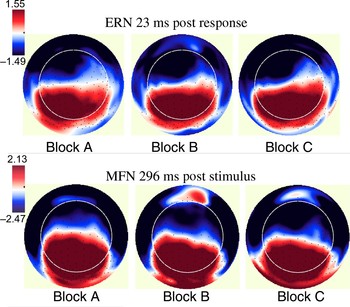
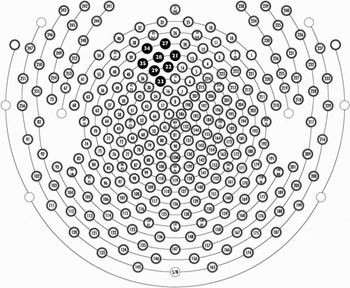
Visual inspection of the topography of the scalp potentials demonstrated that both the MFN and ERN had a left lateralized, frontal distribution near F1, FC1, and FZ (see Figure 1). The peak amplitude of nine electrodes in this area were averaged together separately for each block (A, B, and C), for each component (MFN and ERN). Figure 2 displays the electrodes that were used in this average on the 256-channel sensor net. The differences in peak amplitude between Block B and Block C (Block C minus Block B) was also computed for each ERP component to investigate recovery after the frustrating block, given that how neural measures of self-regulation recover after frustration may provide important information about the flexibility of these systems. This resulted in a total of eight measures of self-regulation for both the MFN and the ERN.
Medial frontal negativity (MFN) and error-related negativity (ERN) scalp potentials. Snapshots of the scalp potentials of the MFN (at 287 ms poststimulus) and ERN (at 23 ms postresponse) during Blocks A, B, and C. The top of picture represents the nose and the bottom represents the back of the neck. In the Web version of the figure, blue is more negative, white is 0, and red is positive. The topography of the negativity is left lateralized and more frontally distributed for both components than is typical for these components. [A color version of this figure can be viewed online at journals.cambridge.org/dpp]

Image of the Hydrocel GSN 256-channel net array. The top of the picture represents the nose and the bottom represents the back of the head. The electrodes used in the average for the event-related potential components are displayed with white text over black circles. We chose more frontal, left lateralized components to correspond with the topography demonstrated by the scalp distribution of the potentials.

Results
Mean and standard deviations of parent-report internalizing symptoms and externalizing behaviors are presented in Table 1. The scores on these measures are within the normal range. The vast majority of the children in this sample did not have clinically significant behavioral or emotional problems. Three children were in clinical range for internalizing symptoms (t > 70) and two children were in clinical range for externalizing problems (t > 70). However, a normal distribution of internalizing symptoms and externalizing behaviors were displayed. The sample of children in this study can provide a means to look at how self-regulatory mechanisms vary across a continuum of symptom expression. Children were also grouped into those who were 1 SD above and below the mean on internalizing and externalizing problems (see Table 1).
Mean parent-reported internalizing and externalizing symptoms

Note: n = 75.
Correlations between the measures of interest were explored. Externalizing and internalizing symptoms were found to be highly positively correlated, r (74) = .502, p < .001, such that a greater number of externalizing behaviors are related to a greater number of internalizing symptoms. Given our focus on variables related to these behavioral problem measures, we considered this covariation in our statistical analysis to determine if relationships with internalizing and externalizing symptoms are unique and not related to problem behaviors in general.
Gender was also found to significantly relate with behavioral symptoms. Males (M = 53.35, SD = 9.88) displayed a greater number of internalizing symptoms than females (M = 47.82, SD = 10.14), t (73) = 2.39, p < .05. Similarly, males (M = 50.86, SD = 10.06) were reported to have a greater number of externalizing behaviors when compared to females (M = 46.84, SD = 9.76) at the level of a trend, t (73) = 1.76, p = .08. Given these relationships, gender effects were controlled for when relating parent-report measures to ERP components.
Children's ratings of their emotion after each block were explored to ensure that they were more upset and frustrated after Block B. Sixty-five children reported that they felt either excited or satisfied after the first block, whereas 5 children reported being nervous. After Block B, 5 children reported feeling excited or satisfied, 25 children reported feeling nervous, and 40 children reported feeling mad or upset. After Block C, all children reported feeling excited or satisfied. This suggests that the manipulation was successful, such that children seemed to report negative emotions primarily after Block B and not after the two other blocks.
Behavioral analysis
Correlations between accuracy and reaction time on the task with the ERP measures, internalizing symptoms, and externalizing behaviors were explored. There were no significant correlations between the behavioral measures and the neural measures of self-regulation. This suggests that behavioral measures as manipulated by the task do not provide information about differences among children in this sample.
ERP results
Results for the ERN and MFN are presented separately. To investigate the covariation between the ERPs and parent report of internalizing symptoms and externalizing behaviors, correlations were computed between (a) the peak amplitude of the ERP in each block and differences in ERP amplitude from Block B to Block C and (b) internalizing and externalizing behaviors (from the CBCL). Both the ERN and MFN are negative components of the ERP waveform. Thus, a negative correlation between the ERP components and parent report of symptoms indicates a positive association. Gender effects on each ERP component were statistically controlled to determine if effects were independent of gender.
ERN amplitudes
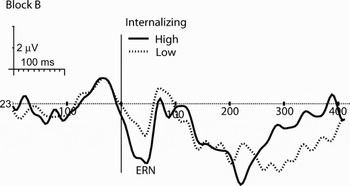
Figure 3 presents the response-locked grand-averaged waveform at channel 23 (a channel directly to the left of Fz in the 10–20 system) for incorrect no-go trials collapsed across blocks. Channel 23 is presented instead of all nine electrodes to simplify viewing, as it was highly representative of the waveforms across the channels of interest. The ERN appears as the sharp negative deflection peaking roughly 50 ms after the response.
Response-locked grand-averaged waveform at electrode 23 in Block B for children 1 SD above (high) and below (low) the mean for parent-reported internalizing problems. ERN, error-related negativity.

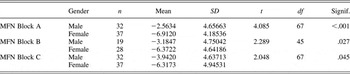
Age and gender differences in ERN amplitudes were explored. Gender differences were found only in Block A. ERN amplitudes were significantly larger in females (M = −4.14, SD = 2.70) than males (M = −2.71, SD = 2.70) in Block A, t (62) = 2.10, p < .05. There were no gender differences in ERN amplitude in the other two blocks or in the difference measures, and there were no significant correlations between age and ERN amplitude in any of the blocks or for any of the difference measures.
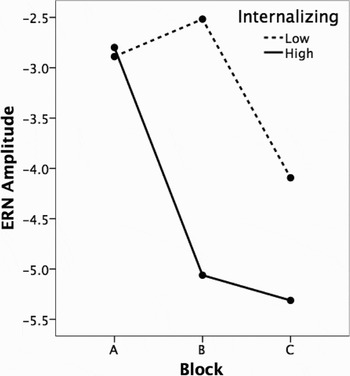
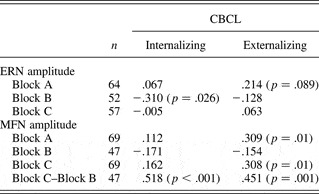
Correlations between the ERN peak and difference amplitudes and internalizing symptoms and externalizing behaviors are presented in Table 2. As hypothesized, larger ERN amplitudes were related to greater internalizing symptoms in the more difficult block (Block B), r (52) = −.310, p < .05. The ERN was not related to internalizing symptoms in the other two blocks, suggesting that the manipulation was necessary to demonstrate individual differences in self-regulation. Figure 3 displays the response-locked waveform in Block B separately for children 1 SD above and below the mean in parent-reported internalizing symptoms. This figure suggests that children lower in internalizing symptoms have smaller ERN amplitudes than children higher in internalizing symptoms. ERN amplitudes were significantly larger in children high in internalizing symptoms (M = −5.03, SD = 3.05) than children low in internalizing symptoms (M = −2.51, SD = 2.08) only in Block B, t (19) = 2.25, p < .05 (see Figure 4). It appears from Figure 4 that children low in internalizing symptoms may have a larger ERN amplitude in Block C compared to Block A or Block B, but these differences are not significant. There were also no differences in ERN amplitude between groups in the other two blocks, and no relationship was found between the ERN and externalizing behaviors in Block B, r (52) = −.087, ns. We also controlled for segment count in each analysis and found no differences in the results, suggesting that differences in segment count did not affect the relationship between ERNs and measures of interest.
Mean error-related negativity (ERN) amplitudes in each block for children 1 SD above (high) and below (low) the mean for parent-reported internalizing problems.

Correlations between ERN and MFN amplitudes with internalizing and externalizing symptoms

Note: CBCL, Child Behavior Checklist; ERN, error-related negativity; MFN, medial frontal negativity.
Of importance, when controlling for externalizing behaviors and gender, internalizing symptoms still account for a significant portion of the variance in the Block B ERN (β = −0.381), t (48) = −2.51, p < .02. In a model with Block B ERN as the criterion, and gender, externalizing symptoms, and internalizing symptoms as the predictors, externalizing behaviors do not contribute to the variance in Block B ERN when controlling for internalizing symptoms and gender (β = −0.017), t (48) = −0.116, ns, whereas gender accounts for a marginally significant portion of the variance in Block B ERN (β = −0.270), t (48) = −1.941, p = .06. This suggests that internalizing symptoms in particular, and not problem behaviors in general or gender differences in symptom expression, were related to a larger ERN in the frustration-inducing block.
Greater externalizing behaviors are related to smaller ERN amplitudes in Block A at the level of a trend, r (64) = .214, p = .09. Controlling for gender, however, externalizing behaviors do not account for a significant portion of the variance in ERN amplitude in Block A (β = 0.169), t (61) = 1.35, ns, whereas gender accounts for a marginally significant portion of the variance in ERN amplitude in Block A when controlling for externalizing symptoms (β = −0.223), t (61) = −1.80, p = .08. Females overall had larger ERN amplitudes in Block A and had significantly fewer externalizing symptoms. Controlling for externalizing symptomology and finding that gender predicts ERN at a trend level suggests that something else about gender (and not its relationship to externalizing symptoms) predicted ERN amplitudes at the level of a trend.
MFN amplitudes
Effects of age and gender with MFN amplitudes were explored. There was an effect of age on the MFN in Block B, such that greater age was related to a smaller MFN in Block B, r (47) = .356, p = .014. Age was also related to the difference in MFN from Block B to Block C, such that older children had a greater increase in their MFN from Block B to Block C, r (47) = −.465, p = .001. Gender was also a factor in MFN amplitude: in all blocks, females displayed significantly larger MFN amplitudes than males (see Table 3).
Gender differences in MFN amplitudes

Note: MFN, medial frontal negativity.
The correlations of the MFN peak amplitudes and difference measures with internalizing and externalizing symptoms are presented in Table 2. Unlike our predictions, neither behavioral measure related to MFN amplitudes in Block B. We also controlled for segment count in each analysis, suggesting that differences in segment count do not affect the relationship between MFNs and measures of interest.
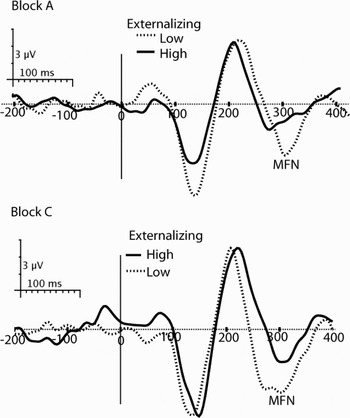
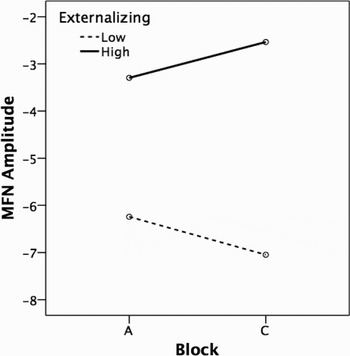
The anticipated relationship between the MFN and behavioral measures was instead found in Blocks A and C. Greater externalizing behaviors were related to smaller MFN amplitudes in Blocks A and C, r (68) = 0.296, p = .014, and r (68) = .311, p = .010. Figure 5 displays the stimulus-locked waveform in Block A and Block C separately for children 1 SD above and below the mean in parent-reported externalizing problems. The MFN appears as the second negative deflection peaking roughly 300 ms after the no-go stimulus. MFN amplitudes were significantly smaller in children higher (>1 SD from the mean) in externalizing behaviors (M = −2.54, SD = 3.30) than children lower in externalizing behaviors (M = −7.05, SD = 5.52) in Block C (equal variances not assumed), t (28.36) = −2.89, p < .02 (see Figure 6). In Block A, there was a trend toward significance, with smaller MFN amplitudes for children high in externalizing behaviors (M = −3.30, SD = 5.66) compared to children low in externalizing behaviors (M = −6.24, SD = 4.76), t (30) = −1.60, p = .12. There were no differences in MFN amplitude between groups in Block B.
Stimulus-locked grand-averaged waveform at electrode 23 in Block A and Block C for children 1 SD above (high) and below (low) the mean for parent-reported externalizing problems. MFN, medial frontal negativity.

Mean medial frontal negativity (MFN) amplitudes in Blocks A and C for children 1 SD above (high) and below (low) the mean for parent-reported externalizing problems.

It was important that by controlling for both gender and internalizing symptoms (in two separate regressions with MFN in Block A as the criterion in one regression and MFN in Block C as the criterion in the other, and gender, internalizing, and externalizing problems as the predictors in both regressions), externalizing behaviors independently contribute to the variance of the MFN in both Block A (β = 0.275), t (66) = 2.297, p < .05, and Block C (β = 0.272), t (66) = 2.096, p < .05. This suggests that independent of gender, larger number of externalizing behaviors specifically (and not problem behaviors in general) were related to smaller MFN amplitudes both before and after emotion induction.
Greater externalizing behaviors were also related to a smaller increase in MFN amplitudes from Block B to C, r (46) = .421, p = .003, suggesting that children with greater externalizing behaviors had difficulty recovering from the negative emotion experienced in Block B. Greater internalizing symptoms were also significantly correlated with a increase in the MFN amplitude from Block B to Block C, r (46) = .468, p = .001. Both internalizing and externalizing behaviors, as well as gender, were entered into a regression to determine if internalizing and externalizing behaviors independently explained variance in the difference in MFN amplitude from Block B to Block C. Internalizing symptoms independently explained a significant portion of variance in the difference measure (β = −0.396), t (44) = −2.871, p < .01, as did externalizing behaviors (β = −0.275), t (44) = −1.99, p < .05.
Discussion
In the present study, neurophysiological data were collected during a self-regulation task manipulated to engage reward monitoring and reactive control mechanisms in a sample of children in the transition to adolescence. Specifically, the task attempted to identify children's ability to regulate responses to a stressful, emotion inducing experience (in Block B). In addition, recovery from the stressful experience (the difference in ERPs from Block B to Block C) was measured to gauge resiliency. We expected that during the challenging block, children with greater internalizing symptoms would display an overcontrolled regulatory style involving strong ventral influence on the frontal lobe regulation of cognition and behavior and indexed by larger ERN amplitudes for errors. At the same time, we expected children with greater externalizing behaviors to show an undercontrolled regulatory style, with less dorsal ACC modulation, as indicated by smaller MFN amplitudes. Results were generally consistent with these hypotheses, and suggest that there may be functional differences in the neural mechanisms of self-regulation in children with internalizing and externalizing behaviors related to reactive under- and overcontrol of behavior and emotion.
As predicted, children with larger ERNs (suggesting overcontrol) demonstrated a greater number of symptoms of depression and anxiety. During the frustrating block, greater internalizing symptoms were correlated significantly with larger ERN amplitudes. In line with previous research on error monitoring and the ERN, these results indicate that participants with internalizing symptoms are more vigilant to making errors and engage in more intensive self-monitoring (Hajcak et al., Reference Hajcak, McDonald and Simons2005; Luu, Collins, & Tucker, Reference Luu, Collins and Tucker2000). Of importance, this relationship was only significant during the frustrating block and not in the blocks before or after the manipulation. The specificity of the effect in the frustrating block could be related to the fact that the task was adjusted in the other two blocks to promote high performance. Making errors in the first and third block did not feel as threatening because overall performance was high. Children watched the number of points they were earning steadily rise, and therefore incorrect performance was less distressing. In the difficult block, however, as participants saw their points steadily decrease, children with greater internalizing symptoms were highly affected by the negative feedback and became more vigilant toward the errors they made. These results suggest that during a potentially frustrating experience, children who (by parent report) experience more internalizing symptoms have larger ERN amplitudes, suggesting possible overengagement of ventral ACC regions. These are areas of the frontolimbic cortex that play a role in processing negative emotional information and self-monitoring. Although some level of recruitment of the ventral limbic regions is necessary for normal self-monitoring of actions and enhancement of performance, dysfunctional overactivation in ventral circuits may promote increased anxiety and attention to the distressing information (M. D. Lewis, personal communication). As a regulatory style that develops early and remains relatively stable over time, overcontrolled children are likely to appear rigid and inflexible and experience more distress in anticipation of negative consequences as a result of increased engagement in ventral circuits.
Also as predicted, children with smaller MFNs (suggesting undercontrol) demonstrated a greater number of externalizing behaviors, although this relationship was not in the frustrating block as we hypothesized. Greater externalizing behaviors were significantly related to smaller MFN amplitudes in Blocks A and C, but not in Block B. These results are supported by previous research demonstrating that children with externalizing behaviors have deficits in inhibitory control (Pliszka et al., Reference Pliszka, Liotti and Wolderff2000; Stieben et al., Reference Stieben, Lewis, Granic, Zelazo, Segalowitz and Pepler2007). As the stimulus-locked MFN seems to indicate inhibitory mechanisms, smaller MFN amplitudes in children with a larger numbers of externalizing behaviors suggests that dysfunction in dorsal mechanisms involved in executive control may play a role in risk taking and antisocial behavior (M. D. Lewis, personal communication). Undercontrolled children are likely to be uninhibited and impulsive in their actions as a result of underrecruitment of dorsal circuits. Children who (by parent report) engage in a greater number of externalizing behaviors have smaller MFNs, suggesting an underrecruitment of dorsal ACC regions, a key region in the frontolimbic network for executive self-control.
Explaining the lack of a relationship between the MFN and externalizing behaviors in the difficult block requires a closer look at the task's demands. During Block B, children received a barrage of negative feedback. Specifically, the task was manipulated to ensure poor performance and an immediate dramatic drop in children's point totals. Alternatively, Blocks A and C were constructed to promote high levels of positive feedback. Children lost fewer points when making errors, and therefore, were almost always accruing points. During these blocks, children with greater externalizing problems show smaller MFN amplitudes, suggesting an underactivation of the ACC when there is no threat to the acquisition of rewards. Under these conditions, children with externalizing symptoms do not carefully monitor their behaviors and act more impulsively. In Block B, however, when the difficulty increases and their rewards are in danger, these children increase their dorsal ACC activity to normal levels, and the correlation between externalizing problems and the MFN is eliminated.
Another possible explanation for the lack of relationship between externalizing behaviors and MFN amplitudes in the difficult block is the lower number of trials that were incorporated into the ERP average in Block B. Because of the increased speed and difficulty, there was greater movement artifact in this block. Furthermore, the task was designed to include fewer trials overall in Block B to moderate the impact of the induced negative emotion. Fewer trials resulted in less reliability in the average ERP. Because of these methodological issues, Block B may not capture individual differences as well as other blocks. Although this alternative explanation must be considered, it is not supported by the ERN data. The average number of trials making up the ERN in Block B was made up of fewer trials as well (an average of 19 trials per single subject average). Despite fewer trials, the ERN in Block B still reflected individual differences in internalizing symptoms, suggesting that trial count is not likely to be the cause of the lack of relationship between the MFN and externalizing behaviors in Block B. Furthermore, segment count in each block was found to be unrelated to the magnitude of MFN and not related to any parent-reported measure of behavior, suggesting that segment count does not account for the relationship of the MFN with any individual difference of interest.
Unexpected was the relationship between internalizing symptoms and the change in MFN amplitude from Block B to Block C. We hypothesized that only externalizing behaviors would be related to MFN amplitudes, but found that there was also a relationship between internalizing symptoms and the change in MFN when children were recovering from the difficult block. Children with greater internalizing as well as children with greater externalizing behaviors demonstrated a smaller increase in MFN amplitudes after the difficulty manipulation. These results suggest that children with internalizing and externalizing behaviors have similar difficulties tolerating experiences of frustration and have difficulties reasserting executive control after the stressor. Similar deficits in recovery in children with greater internalizing and externalizing behaviors (as indexed by the change in MFN amplitude) suggests that both types of symptoms may be related to a difficulty recruiting dorsal regions and exerting effortful control after the frustrating block as indexed by a smaller change in MFN from Block B to Block C.
Evidence from this study linking ERP components with normal variation in internalizing symptoms and externalizing behaviors suggests that each type of psychopathology may be linked to specific deficits in the basic mechanisms of motivational control in self-regulation. A rigid, overengaged style of emotion regulation was characteristic of children with greater numbers of internalizing symptoms, as has been found previously in clinical populations (Lewis et al., Reference Lewis, Granic, Lamm, Zelazo, Stieben and Todd2008) and is consistent with the theory of overcontrolled regulation (Eisenberg et al., 2001). Overcontrolled regulation involves an anticipation of negative outcomes as it relates to increased avoidant responses to novel experiences. Children with this style anticipate negative outcomes and as a result tend to engage in greater levels of self-monitoring and increased attention when mistakes are made (Derryberry & Rothbart, Reference Derryberry and Rothbart1997). In contrast, an impulsive, unrestrained style of emotion regulation was consistent of children with a greater number of externalizing problems, which has also been demonstrated in clinical populations (Stieben et al., Reference Stieben, Lewis, Granic, Zelazo, Segalowitz and Pepler2007). Undercontrolled children respond to novel experiences with increased approach and impulsiveness, do not anticipate negative consequences, and instead seek rewards impulsively. However, when rewards are in danger, undercontrolled children are likely to increase their level of self-monitoring to attempt to maintain their rewards, which may be why no differences were found in Block B. Interestingly, after a stressor, both under- and overcontrolled children demonstrate poorer recovery compared to flexible children, showing similar difficulties reasserting effortful control when recovering from frustrating experiences.
Comorbidity
The high level of comorbidity in the sample raises the question of whether the results reflect levels of general problems rather than specific effects of over- and undercontrolled regulatory styles. By controlling for levels of externalizing behaviors when predicting variance in ERNs with internalizing symptoms, and levels of internalizing symptoms when predicting variance in the MFN with externalizing behaviors, we can say that the relationships found were not due solely to a relationship between problems in general with ERP components, and that there was a specific relationship in the direction predicted. However, if internalizing symptoms and externalizing behaviors are often found in the same child, how can these children demonstrate both under- and overcontrolled regulatory styles? One important factor to consider is how symptomology was measured. On the CBCL, parents reported to what degree their children had exhibited specific behaviors. Research suggests that if the same reporter provides information about both internalizing and externalizing constructs, they are more likely to endorse both types of problems (Eisenberg et al., Reference Eisenberg, Sadovsky, Spinrad, Fabes, Losoya and Valiente2005). It may be that if parents are willing to endorse problematic symptoms in their children, they will endorse both internalizing and externalizing symptoms. Parents have also been shown to be imperfect reporters of their children's emotions, particularly of internalizing symptoms (Sourander, Helstela, & Helenius, Reference Sourander, Helstela and Helenius1999), and therefore some of the comorbidity may be a result of reporter biases. In addition, the accuracy of measuring the co-occurrence of emotional and behavior problems has been shown to have low levels of agreement across reporters (κs = 0.14–0.4; Youngstrom, Findling, & Calabrese, Reference Youngstrom, Findling and Calabrese2003) This finding suggests that it is particularly difficult to assess symptoms as different settings may produce different patterns of symptomology. Taken together, this evidence indicates that some of the comorbidity may be a result of measurement error, as parents could distort levels of symptoms in either domain.
In addition, it may be that the types of internalizing symptoms that are endorsed on the CBCL are not specific to the anxiety in anticipation of negative consequences and excessive self-monitoring of errors to which overcontrolled children are prone. It also includes negative emotional reactions in response to the loss of rewards and frustration, to which undercontrolled children may also be susceptible. Children with both externalizing and internalizing problems demonstrate high levels of negative emotion in response to frustration (Eisenberg et al., 2005; Lengua, West, & Sandler, Reference Lengua, West and Sandler1998). In response to a loss of reward, undercontrolled children are likely to respond with high levels of negative emotions (Eisenberg et al., Reference Eisenberg, Hofer, Vaughan and Gross2007). However, this is different from the type of distress overcontrolled children demonstrate when expecting negative feedback. The CBCL does not ask for information about what types of events elicit negative emotions, and if it did, parents may have difficulty identifying the internal events that precipitated their child's distress. A better measure of internalizing symptoms specific to anxiety and attention to negative feedback versus distress after losing potential rewards may better differentiate the types of emotional problems under- and overcontrolled children are prone to experiencing, and decrease the level of comorbidity.
Limitations
Although these results are promising, there are several limitations that must be addressed. Notably, gender differences were not fully anticipated in the hypotheses. The relationships between gender and ERP amplitudes, and gender with externalizing behaviors, provided unexpected complications for interpreting the results. Females had larger MFN amplitudes in every block, larger ERN amplitudes in Block A, and fewer internalizing and externalizing behaviors. Clearly, gender and behavior problems suggest a more complicated relationship with self-regulatory mechanisms than was anticipated by our hypotheses.
We did not find developmental changes in ERP amplitudes as has been reported in previous research, which was surprising. With increasing age, both decreases in MFN amplitudes (Lamm, Zelazo, & Lewis, Reference Lamm, Zelazo and Lewis2006) as well as increases in MFN and ERN amplitudes (Davies, Segalowitz, & Gavin, Reference Davies, Segalowitz and Gavin2004; Ladouceur, Dahl, & Carter, Reference Ladouceur, Dahl and Carter2004) have been reported. Considerable developmental changes occur during this period resulting from pubertal onset, the development of neurocognitive function, and even increases in skull density and thickness. There are also improvements in executive function and cognitive control that could relate to changes in self-regulation. In our sample, however, age was only related to MFN amplitudes in Block B, and unrelated to ERN amplitudes. By equating difficulty across participants, the task used in this study may have minimized differences in ERP amplitudes that have been reported previously. Developmental differences may not have been found because the age range was too narrow, and because the children in this study were at the cusp of adolescent onset, when gender differences and differences in pubertal onset may confound age effects.
An important limitation is that the use of a normative sample in this study precludes direct application of the results to clinical samples. The participants were recruited from the community and displayed a range of problem behaviors, with very few demonstrating clinical levels of problem behaviors. Although the results do demonstrate differences in ERP amplitudes for children at increasing risk for developing internalizing and externalizing disorders, it may be that there are qualitative differences at higher levels of problem behaviors that are not captured in this sample. Our use of a normative sample may explain why our findings differed from Stieben and colleagues (Reference Stieben, Lewis, Granic, Zelazo, Segalowitz and Pepler2007), who used the same task to examine self-regulation in children referred for externalizing behaviors. They found that comorbid children with clinical levels of both internalizing and externalizing behaviors had greater MFN amplitudes than children with purely externalizing behaviors and controls. We did not find any relationship between the MFN and internalizing symptoms, possibly because of the sample differences. Normative variation of symptoms on these scales may not relate to the predictor variables of interest in the ways that clinically significant symptomology would.
Despite these limitations, the present study indicates that utilizing ERP methodology in paradigms that elicit cognition–emotion can provide insight into the regulatory deficits that relate the development of internalizing and externalizing behaviors.