Introduction
This article has four main aims and the main sections of the paper below are numbered accordingly. First, it will explain briefly the function and historical context of the Mental Health Commission for England and Wales (MHAC), which existed between 1984 and 2009. From 1 April 2009, the Commission's functions were subsumed in the work of the Care Quality Commission in England and the Healthcare Inspectorate Wales.
Second, data from its final report (MHAC, 2009) will be used to provide a snapshot of the relationship between social group membership and mental health status in modern British society. The focus of the report was on race, gender and age in settings that, over time, have become more not less coercive and less not more therapeutic.
Third, the work and findings of the MHAC will be discussed in the context of ‘mental health work’ remaining highly controversial and its social and political worthiness contested. This section considers material adversity as an underlying factor in over-determining the emergence and re-emergence of mental health problems in society.
Fourth, in the light of the MHAC furnishing further evidence of the social patterning of mental health problems, the limited power of State-appointed visitorial bodies, with their human rights approach, to mitigate the adverse impact of State-sanctioned coercion or to reverse the pathogenic role of social forces is discussed.
Thus the paper begins with a social administrative discussion of the MHAC and then the findings generated by it in its work are situated in wider sociological accounts of mental health problems. These discussions in the middle sections form a shared context by the end point of the paper to appraise in the final sections the social policy utility of bodies such as the MHAC.
The work of the MHAC in historical context
The MHAC is the most recent body to come and go since the Lunacy Commission was established in 1845 in England to monitor the management of risks to and from detained lunatics under the legal control of the State. With the 1890 Lunacy Act, and then the 1913 Mental Deficiency Act, the governmental principle of legalism in the twentieth century was established. With this principle, the function of mental hospitals and all who worked in them would be controlled by legal statute and monitored by government bodies, such as the Board of Control (Bean, Reference Bean1986; Fennell, Reference Fennell1996). By the time the Mental Treatment Act of 1930 emerged, with its new emphasis on voluntary admissions, checking by the State on the role of mental hospitals and medical discretion to make decisions about the admission and treatment of patients was the norm. Also, in line with public concerns, the risk of ‘unfair’ detention of the sane was attended to in the work of the Board of Control between 1930 and 1960.
The powers and position of the Board were weakened by the National Health Service Act of 1946 and in the wake of the Mental Health Act of 1959 the Board's functions fell into disuse (Cohen, Reference Cohen, Shaw, Middleton and Cohen2007). Judicial control prior to admission to hospital was abandoned and discretion given much more fully to local medical staff. However, the re-establishment of a body directed by central government (the MHAC) then emerged in the immediate wake of the 1983 Mental Health Act, after the Boynton Report (1980), about the abuse of patients at Rampton Hospital, had made clear a need for such a body. Thus, the period of greatest professional discretion was during the 1960s and 1970s. Before and since then, legalism can be seen to predominate.
The MHAC continued the above function noted from the old Board of Control (about humane risk management and unfair detention) but went further. Increasingly, at the end of the twentieth century, a discourse of human rights was becoming evident. This emboldened the work of the MHAC in relation to such matters as racial bias in detention and the human rights violations created by the de facto detention of voluntary patients (who, in practice, were not really free to leave hospital at their will).
As with past government bodies, the MHAC was ‘visitorial’ in nature: it was not a true inspectorate. It could not impose sanctions or directly manage hospitals. It merely observed, recorded and gave frank and robust feedback about organisational matters affecting care standards or individual patient concerns. Its main function was to monitor the practical use of the 1983 Act wherever there were detained patients (mainly hospitals, but occasionally nursing homes). It inspected hospital documentation and listened privately to the general views of detained patients, and investigated specific complaints by them. In addition, it collected aggregate information about coercive conditions and social group membership. We now turn to this by summarising some of the useful findings of the Commission's final biennial report.
Coercion and social group membership during the life of the MHAC
The prospect of true voluntarism is always problematic, when a background threat of compulsion exists for those with serious mental health problems. The very existence of ‘mental health law’ (so called, as it is actually about mental disorder not mental health) means that the boundary between true and notional voluntarism is inevitably fuzzy in practice, with a range of inducements and threats operating at the point of admission, even for those deemed to be voluntary patients (Szmukler and Appelbaum, Reference Szmukler, Appelbaum, Thornicroft and Szmukler2001).
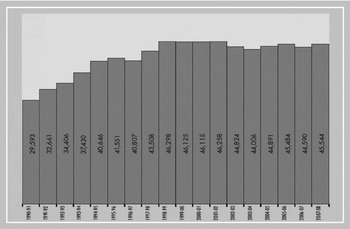
Currently, many patients are inevitably ‘pseudo-voluntary’ (coactus voluit- ‘at his will although coerced’) and it is common for voluntary patients to be on locked wards and so they become de facto detainees. The latter untoward tendency was noted in the MHAC report and not for the first time. The trend of more locked wards on acute units, where non-criminal psychiatric patients reside, has, in recent years, increasingly constrained all patients, including those officially recorded as ‘informal’ or voluntary. This trend is shown in Figure 1 (reproduced from the MHAC report).
Locked and unlocked acute psychiatric wards visited by the MHAC, England and Wales, 1 April 2004–31 January 2009

The arguable illegality of this trend of locked wards neatly reveals that acute units are risk containers, not treatment centres, in our midst in local communities. In the latter regard, concern was expressed about poor conditions for inpatients in the Report in this way:
In our last report we stated that busy acute wards appeared to be ‘tougher and scarier places’ than we saw a decade ago. That phrase has been quoted by commentators and in newspaper editorials, having been highlighted by the Royal College of Psychiatrists’ Fair Deal campaign. The College's president, Professor Dinesh Bhugra, has stated to the press that he would not use these wards, nor let any of his relatives do so . . . The Fair Deal campaign, which was based upon a year-long consultation with psychiatrists, service users and carers, has confirmed our criticisms in stating that many inpatient units are unsafe, overcrowded and uninhabitable. For many inpatient services, these are the most pressing problems, against which all attempts at good practice in other respects will founder. (MHAC, 2009: para. 161)
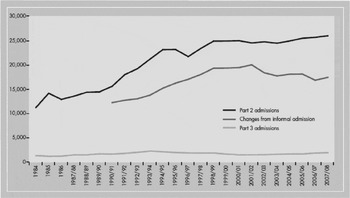
This broad concern is consistent with other research at the turn of this century, which demonstrated that acute inpatient facilities were sites of risk to patients and were ‘non-therapeutic’ (Sainsbury Centre for Mental Health, 1998; Gourney et al., Reference Gourney, Ward, Thornicroft and Wright1998). Moreover, these conditions have been linked to greater pressure on beds with a continuing rise in ‘formal’ (i.e. involuntary) admissions (a net increase of about 50 per cent since the early 1990s) at a time when the old Victorian asylums were closing down. The trend is shown in Figure 2, which is taken from the MHAC report.
Detentions under the Mental Health Act of 1983 (admission and detention of informal patients), England, 1990/91–2007/8

A problem with interpreting these data is that, as already noted above, those officially recorded as ‘informal’ may enter hospital under the threat of coercion and so it may misrepresent the true experience of patients, who do not actually feel themselves to be seeking help voluntarily. The records of those described as Part 2 admissions (‘sectioned’ involuntary patients) show this trend in Figure 3.
Mental Health Act admission trends, England, 1984–2007/08

With this general upward trend in mind, we now turn to the containment and coercive treatment of groups of patients codified specifically by race, age and gender in the MHAC report.
Race
The MHAC, not for the first time, noted the over-representation of black patients in psychiatric detention. As the report notes in paragraph 1.37:
It is now well-known that, even when standardised for age, such data on admission levels show disproportionately high levels of detention amongst Black patients (in particular Black-Caribbean and Black-African patients). We discussed issues of overrepresentation and institutional racism in our last report . . . all Black groups (including the ‘Black Other’ group largely comprised of second or third generation Black British young men and women) show the highest bed occupancy ratios in comparison with the White British population, and most other BME groups (with the important exceptions of Indian and Chinese patients) also have substantially higher rates of bed occupancy than the White British population.
This finding is consistent with previous epidemiological data (see later discussion). The report goes on to complain that, despite previous recommendations, the Department of Health had taken no steps to produce translated information leaflets in services and that BME (black and minority ethnic) patients continued to complain about regular racist abuse (MHAC, 2009:14).
Age
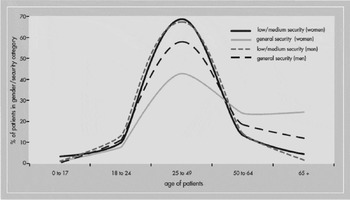
According to the consensus in psychiatric epidemiology, the life-span distribution of mental health problems is a u-shaped curve (see later discussion) (Rogers and Pilgrim, Reference Rogers and Pilgrim2003). That is, most recorded mental health problems occur in the very young and the very old. Maybe counter-intuitively, on average our positive mental health peaks in late middle-age. Despite this, the age distribution of psychiatric detention is a variation on the bell-shaped curve, as Figure 4, taken from the MHAC report, shows by different levels of security.
Age range of detained patients by gender and security level, England and Wales, 31 March 2008

The divergence in later life (with an upward trend of female admissions compared to men) probably reflects the greater longevity of women and so their prevalence of mental disorder deemed to require control in statutory services (depression and dementia). This bucks the trend in younger groups where men, not women, are disproportionately processed in the statutory mental health system – as we see in the next section.
Gender
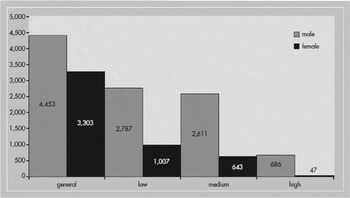
Turning to the MHAC data on gendered psychiatric detention, this mirrors that of prison populations. The more secure the mental health service, the more that it will include men rather than women. Indeed, in the case of maximum security (as will be discussed later) women are even less visible now than in prison populations. Men are represented at over four times the rate of women in medium secure psychiatric care and over twelve times the rate in high security. This pattern relates to one sub-group of those with a diagnosed mental disorder (mentally disordered offenders) shown in Figure 5, reproduced from the MHAC report.
Male and female detained patients by security level, resident in hospital on 31 March 2008

We can also look at those on ‘civil’ sections of the Mental Health Act admitted to local acute psychiatric units, which are typically in District General Hospitals. The pattern relevant to our discussion here about acute admissions is demonstrated in Figure 6.
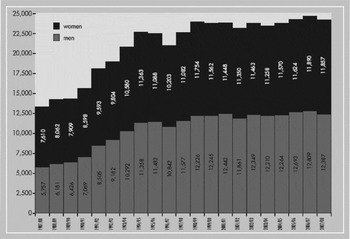
Male and female patients admitted to hospital under Part 2 of the Mental Health Act, England, 1997/98–2007/08

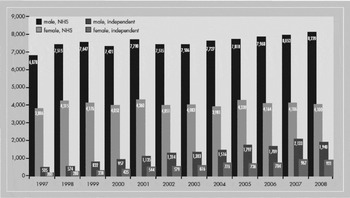
Note that, over time, there is no clear discernable pattern of sex bias at the point of admission (men and women have been admitted at roughly equal rates in recent years). In the 1990s, there was a slight preponderance of women and more recently that trend reversed. However, the data on residence (rather than admission) show that men are much more likely to be inpatients, as is shown in Figure 7, which is reproduced from the report.
Resident detained population, NHS and private sector by gender, England, 1999–2008

The two figures above show that the incidence of risky action warranting admission under civil sections (i.e. those responding to non-criminal risk) of the Mental Health Acts of 2003 and then 2007 has been about equal for men and women, but the latter remain in hospital for shorter periods. This leads to a point prevalence of residence in which men are present at around twice the rate of women. This in turn mirrors risky action which is gendered more generally in society.
Men are dangerous to others more often than women and they are more likely to abuse substances (which increases the probability of anti-social action). As with the control of mentally disordered offenders, this indicates that the mental health system is normative in character and it is an extension of an apparatus of coercive social control (largely and typically associated with the criminal justice system). What makes debates about the coercive social control role peculiar in mental health policy is that the legal arrangements for the ‘management’ of mental disorder are not consistent with those linked to criminal justice. This point begins our discussion section.
Controversy about contemporary mental health work
The above provided a context and description of the work of the MHAC, along with some of its most recent findings, which offer useful insights about the differential risk of coercive management associated with social group membership. Below, those findings are placed in the context of the wider social epidemiological literature about mental disorder. We turn first though to some more fundamental socio-political questions about the role of mental health work and the normative assumptions about legalism and the putative safeguards and mitigations provided by a visitorial wing of the State.
In current debates about mental health policy, the desirability, or otherwise, of legislation remain contested for a number of reasons. Deprivation of liberty is not always exchanged for mental health gain for the identified patient (Wexler, Reference Wexler1992). Lawfully enforced medication is not always effective and it contains risks of adverse somatic and social effects for all recipients, whether or not they gain any symptomatic relief (Fisher and Greenberg, Reference Fisher and Greenberg1997; Breggin, Reference Breggin1993). Opponents of these criticisms in their turn point out the risk of not treating, both for patients and others, and that psychiatric diagnosis and detention offer a needed opportunity for mental health gain (Staunch, Reference Staunch1995; Gove, Reference Gove1970).
Thus, there are starkly contrasting views about the central purpose of ‘mental health services’. Put simply, the dominant ideological position adopted of legitimate (or, for some, inevitable) State paternalism insists on not just the right, but also the obligation, of professionals to control and treat patients in their ‘best interests’; a version of parens patriae (this latter refers to powers of the State to look after those deemed unfit to be autonomous citizens, such as children and those with learning difficulties or mental health problems). For those adopting this view, whether professionals, politicians or their voting public, the very existence of ‘mental health’ legislation inherently represents a form of social progress.
The contrary position, adopted by civil libertarians, is that unless criminal laws are broken, adult citizens should be left in peace and only ever be helped in a spirit of true mutual voluntarism. Moreover, those adopting this position argue that criminal action should entail equal consideration under the law, independent of mental state, i.e. there should be a ubiquitous guarantee of due legal process, defence advocates and specified periods of detention, when and if guilt is established (Scull, Reference Scull, Cohen and Scull1985; Bean, Reference Bean1986; Campbell and Heginbotham, Reference Campbell and Heginbotham1991; Pols, Reference Pols2001). In other words, the criminal law should be applied equally about the matter of dangerous individual action and mental state should be ‘bracketed’.
Currently, such an equal ‘due process’ formula is not applied to those deemed to be mentally disordered; advocates for the client's freedom are absent and detention can be open ended. Moreover, many groups in society are clearly dangerous to self and others, from boxers and politicians taking us to war to young people drinking heavily in town centres at the weekend, but no dedicated law exists to detain them without trial. Thus, it is not dangerousness per se at issue here, but the ‘manner in which one is dangerous’ (Szasz, Reference Szasz1963) and the very existence of ‘mental health legislation’ is thus, from this ideological position, both discriminatory and an offence against human liberty.
The questionable basis of legalism-plus-safeguards
One resolution to this challenge of dealing with accusations of human rights violations is to extend State paternalism to include safeguards against the adverse impact of the State's own delegated lawful powers of coercive social control. For example, the World Health Organization (WHO) (2005) recommends a policy to national jurisdictions that enshrines both coercive powers and measures to mitigate their consequences: legalism-plus-safeguards. For example, the WHO spells out the appropriate ‘components [to be] included in legislation on mental health’:
1. Access to mental health care including access to the least restrictive care
2. Rights of mental health service consumers, family members, and other care givers
3. Competency, capacity, and guardianship issues for people with mental illness
4. Voluntary and involuntary treatment
5. Accreditation of professionals and facilities
6. Law enforcement and other judicial system issues for people with mental illness
7. Mechanisms to oversee involuntary admission and treatment practices
8. Mechanisms to implement the provisions of mental health legislation.
(WHO, 2005:16, emphasis added)
The measures currently evident in the UK and most other developed countries are consistent with this list, which is pregnant with practical contradictions arising from the ‘components’ italicised. The MHAC provided the ‘mechanisms to oversee involuntary admission and treatment practices’. Implied here by the WHO is the legitimate devolution of coercive State powers, on a daily basis, to clinicians, with some protection of rights in the lay arena. The WHO position, and the same adopted by receptive countries accepting its advice, means that medical discretion to operate coercively is retained, while attempts are also made to protect the human rights of patients and their significant others. These rights are sometimes incommensurable.
The WHO formula might obscure the substantive (not aberrant) role of psychiatry as an extension of a coercive apparatus of social control. It might also have the effect of obscuring the role of social inequalities in relation to that apparatus by emphasising that the problem being addressed simply relates to the aggregate effects of individual pathology; the social dimension is mystified by a focus on the symptoms of patients always self-evidently warranting professional action. This creates a discourse of ‘mental health needs’ and the doctor's ‘right to treat’ and their ‘duty of care’. Thus, we can observe a self-fulfilling pattern of the individualisation of mental health problems and the inevitability of current service characteristics.
The view that ‘access to services’ should be defined by professional assessments and impositions, when judged appropriate, is not neutral and interest free. It is dominated by the interests of the psychiatric profession, within WHO deliberations and reflected in their policy advice noted above, and indirectly the pharmaceutical industry, which funds psychiatric campaigns about detection, treatment and management policies (Pilgrim and Rogers, Reference Pilgrim and Rogers2005). For example, apart from the legislative focus, there is also an emphasis from the WHO on the mass screening of children to detect and treat mental disorder and the increasing availability to populations of psychotropic medication.
Tensions about this matter can be found in the WHO's own policies. For example, in its wider deliberations it is highly sensitive to the impact of human rights violations on health in general (WHO, 2002). However, State-sanctioned psychiatric paternalism is seen as part of the solution not part of the problem in this regard. In the light of psychiatry's internal and external critics noted above, the relationship between human rights and ‘mental health services’ continues to be a recurrent point of both presumption (from conservative legalists and radical libertarians), and therefore contention, globally.
Does the ‘inverse care law’ apply to ‘mental health services’?
A strong indication that our understanding of social inequalities takes on a new meaning in the context of mental healthcare utilisation can be considered in relation to the ‘inverse care law’. The latter phenomenon was highlighted by Tudor-Hart (Reference Tudor-Hart1971) when he demonstrated that, in the case of physical health problems, those with the greatest need, the poor, had the poorest access to healthcare. This point even applied to ‘socialised’ healthcare, such as the British NHS. However, quite dramatically, the reverse is the case with psychiatric problems. Although a class gradient is evident in the prevalence of all health problems, whether designated as physical or mental (the poorest are the most ill), the presence of the poor in mental healthcare is greater not lesser than richer citizens. Thus, ‘access’ to mental healthcare seemingly contradicts the ‘inverse care law’.
Since the run down of the old large Victorian asylums and the reliance on smaller numbers of beds in acute units and medium secure units, the threshold of risk to warrant admission has now changed, with increasing numbers being admitted involuntarily and, even when notionally voluntary, they are still placed on locked wards. These features were noted earlier from the MHAC data, as was the conclusion that these units are now not ‘treatment centres’ but sites of risk management, which create new risks to patients as well as managing risks from patients.
A further indication that Tudor-Hart's arguments about the inverse care law need to be applied cautiously in relation to mental healthcare is the pattern of MHAC findings on race, age and gender. As we saw earlier from the MHAC report, Black African and Black African-Caribbean patients are over-represented in compulsorily detained parts of the mental healthcare system and we also know that they are under-represented in primary mental healthcare, with its ethos of voluntarism (Nazroo, Reference Nazroo2003; Commander et al., Reference Commander, Odell, Surlees and Sashidharan2003).
This ‘imposed access’ pattern is gendered as well as racialised. Women are over-represented overall in terms of diagnosed mental disorder, and they are admitted as frequently as men to inpatient care, but male patients remain longer in the system (see MHAC findings earlier). For both men and women, psychiatric admission typically reflects a point of social transition or family crisis (Barnes et al., Reference Barnes, Bowl and Fisher1990) and all psychiatric crises are social crises (Bean, Reference Bean1980).
Thus, the incidence (first cases) of serious mental health problems is about the same in men and women, because both men and women are prey to social crises, but the point prevalence detained in services (cumulative cases) is not. This suggests greater caution in discharging men, who are more often assumed to be riskier than women. Also men under-report problems voluntarily in primary healthcare compared to women (Rogers and Pilgrim, Reference Rogers and Pilgrim2010). Most of the difference in prevalence of recorded mental disorder between the sexes is accounted for by the diagnosis of depression and anxiety disorders in primary care (i.e. the very settings in which coercion is absent, along with the absence therefore of the jurisdiction of bodies like the MHAC).
As was clear from the MHAC data, men, not women, are disproportionately regulated by involuntary psychiatric provision. Indeed, now at the harshest end of psychiatric control (high secure provision) female patients have virtually disappeared, following successful campaigning by professional and lay advocates. The other consideration about women (in both acute and secure detention) relates to greater risk taking by services to permit them to return to gendered roles (such as child rearing). This gendered risk-taking takes an actuarial trend (women on average are less dangerous in society than men) and turns it into a stereotype (all women are less dangerous than all men). Again this reflects a normative process: male risk is sequestrated and the latter is justified more often than female risk. Moreover, those differences in risky action are replayed in acute units themselves, where women are at greater risk than men of sexual harassment and assaults (Johnson et al., Reference Johnson, Bingham, Billings, Pilling, Morant, Bebbington, McNicholas, Dalton and 2004).
Thus, with these complex processes, related to risk assessment and management, being shaped by societal norms in ‘mental health services’, the principle of ‘patient-centredness’ is then rendered problematic. ‘Patient-centredness’, now at the top of the health policy agenda more widely, inherently focuses on voluntarism and mutually negotiated decision making between patients and professionals. Such an emphasis is on ‘expressed need’, whereas psychiatric decision making, backed up by legislative powers and expectations, requires an emphasis on ‘defined need’; it is an explicitly legitimised form of parens patriae. Logically and pragmatically, it is not, and cannot, be a negotiation between equal citizens. Accordingly, when a person becomes a psychiatric patient ‘expressed need’ is displaced by ‘defined need’, identified first in the lay arena and then rubber-stamped by professionals (Coulter, Reference Coulter1973). Psychiatric decision making and action are inherently normative and psychiatrists are inevitably (even if not knowingly) rule enforcers (Bean, Reference Bean1986).
The distribution displayed earlier about the age profile of those psychiatrically detained exemplifies this point. Note that epidemiological studies suggest that the greatest prevalence of mental health problems is in the very young and the very old (Rogers and Pilgrim, Reference Rogers and Pilgrim2003). And yet, when we look at the age distribution of those detained from the MHAC findings, we find that the most prevalent group are those of child-rearing and working age. Detention is roughly a bell-shaped curve in the MHAC data, but social epidemiology suggests that the prevalence of problems is a roughly a u-shaped life span distribution; apparently opposite trends. This picture about the age profile of detained inpatients suggests that the concerns of psychiatric professionals and legislators is about the exercise of power to regulate rule transgressions and role failure in an age cohort actuarially with fewer, not more, mental health problems overall (judged by life span prevalence data).
If ‘mental health services’ accurately and proportionately responded to the prevalence of problems across the life span, then we would expect resources to be devoted overwhelmingly to treating the very young and the very old. Instead, most of the cost of mental healthcare is absorbed by the containment and treatment of those exhibiting risky behaviour in young and middle adulthood (Knapp, Reference Knapp, Thornicroft and Szmukler2001). For example, statutory child and adolescent mental health services have been significantly under-resourced even though the community prevalence of mental health problems in childhood is estimated to be 50 per cent and the incidence of mental health problems, in this life phase presenting in primary care, is around 10 per cent (Ford et al., Reference Ford, Goodman and Meltzer2003; Meltzer et al., Reference Meltzer, Gatward, Goodman and Ford2003).
These socio-political patterns revealed by the MHAC report in relation to race, age and gender may, at least in part, obscure, but also hint at, a deeper social structural point. As noted already, in relation to Tudor-Hart's overall thesis and confirmed subsequently by 40 years of medical sociology, health status is strongly correlated with social class: the poorest in society are the sickest (Link and Phelan, Reference Link and Phelan1995). This is true for mental disorder as well as for physical illness.
Not surprisingly then, we find chronic psychiatric patients also dying younger both from both physical causes and suicide. For example, smoking rates are higher in psychiatric patients and they have poor general healthcare when living outside of hospital. They also have regular access to prescribed powerful psychotropic drugs (which can be dangerous in overdose) and they live in neighbourhoods with high crime rates and ready access to illicit drugs. This combination exposes poor patients living in poor community settings to high health risks and this leads to an increased rate of relapse compared to those in richer and less socially disorganised neighbourhoods (Silver et al., Reference Silver, Mulvey and Monahan1999; Soyka, Reference Soyka2000; Stockdale et al., Reference Stockdale, Wells, Tang, Belin, Zhang and Sherbourne2007; Padgett et al., Reference Padgett, Henwood, Abrams and Drake2008).
This underlying pattern of material deprivation associated with chronic mental health problems, might go some way to explain the racialised profile revealed by the MHAC data. As the latter confirm, people of African and African-Caribbean origin remain over-represented in compulsory care and under-represented in voluntary outpatient settings. This might suggest that lay and/or professional decision-making is racially biased. It could, alternatively suggest that these groups are actually more mentally disordered because of the pressures of racism. However, many other groups, such as those of South Asian origin, are also exposed to the chronic pressure of racism but they tend to be under-represented in inpatients settings or the findings on incidence and prevalence have been contradictory. Thus the data on BME communities is confusing, with neither hypothesis fully explaining the data on racially skewed psychiatric detention (Rogers and Pilgrim, Reference Rogers and Pilgrim2010).
Moreover, in the recent past a white group (Irish people) has also been over-represented in this regard in Great Britain. Their white skin might signal an interpretive problem with a direct thesis of the stress from racism, based on colour, and might suggest, instead, shifting socio-economic factors (Abbotts et al., Reference Abbotts, Williams and Ford2001; Leavey et al., Reference Leavey, Rozmovits, Ryan and King2007). This mixed picture about racialised patterns found in descriptive epidemiology remains, but most of it can be accounted for by underlying material inequalities (because, on average, BME communities are poorer and suffer greater social exclusion) (Nazroo and Williams, Reference Nazroo, Williams, Marmot and Wilkinson2005). As we noted above, people with severe and enduring mental health problems are disproportionately unemployed and live in poor and stressful neighbourhoods, with high rates of crime and substance misuse and low levels of social capital (Rosenfeld and Wenzel, Reference Rosenfeld and Wenzel1997; Pescosolido and Wright, Reference Pescosolido and Wright2004; Berry, Reference Berry2008).
In the case of BME patients, they relapse less often if they live in localities with higher rates of those from a similar origin (Velling et al., Reference Velling, Susser, van Os, Mackenbach, Selten and Hoek2008; Boydell et al., Reference Boydell, van Os, McKenzie, Allardyce, Goel, McCreadie and Murray2001). This important finding is more than a point about race, it also points up the protective functions of social bonds, which are not equally distributed in society. Thus, those in richer areas and ones with greater ‘ethnic density’ for the identified patient, the less likely they are to relapse and so be exposed to coercion and iatrogenic treatments. Those living in poor areas and/or who are ethnically isolated are more exposed to ‘ambient hazards’ (raised rates of crime and illicit drug use, poor social capital, dirt, noise, traffic dangers, etc.) when out of hospital and to coercion and iatrogenesis at admission, in the wake of the resulting raised risk of relapse, noted earlier (Hiday, Reference Hiday1995). This implies a vicious circle of the poor getting poorer and being disproportionately exposed to health risks both inside and outside of hospital; a cue for the next section.
‘Mental health services’ as a risk to wellbeing
Apart from this broad confirmation from the MHAC that some social groups are disproportionately controlled coercively by psychiatric professionals, there are other important implications of its final report. Such social patterning and the over-representation of some social groups and not others is not inherently a problem. Indeed, if psychiatric treatment was always benign, effective and given to all those requesting it voluntarily, then those expressing the need for help and support would get it. However it is not – hence the public and political concern since Victorian times about ‘unfair detention’.
Psychiatric care is certainly effective at controlling unwanted behaviour (using locks and tranquillisation), but is of debatable value in creating mental health gain for identified patients (Pilgrim and Vassilev, Reference Pilgrim and Vassilev2007). Much of this lack of effectiveness and progress about treatment is because of extensive iatrogenic effects offsetting symptom reduction. Iatrogenic effects are often misleadingly dubbed ‘side-effects’, implying their triviality when they are actually adverse or unwanted effects which may not be trivial in their consequences for patients. (The term iatrogenesis or ‘doctor made illness’ can be discussed in a wider social and cultural context of dependency on medical ministrations (Illich, Reference Illich1978). Here though the term is limited to the adverse clinical impact of treatment.)
Psychiatric treatments are life diminishing and occasionally life threatening, whether received voluntarily or under compulsion (Breggin, Reference Breggin1993; Fisher and Greenberg, Reference Fisher and Greenberg1997). Thus, if some social groups are subjected to disproportionate compulsion, then they are also being subjected disproportionately to enforced treatments that may actually do them harm or even kill them in entrapped conditions (Brown and Funk, Reference Brown and Funk1986; Kellam, Reference Kellam1987). It is little surprising then that sudden deaths in secure provision have disproportionately contained black men, given the cumulative findings reported by the MHAC about this group of patients and noted earlier.
The questionable value of ‘visitorial’ bodies like the MHAC
The above wider social epidemiological literature and evidence of risk to patients suggests that the MHAC provided data to confirm a social patterning of coercive psychiatric action in relation to race, gender and age. Its human rights focus meant though that those categories of data collection led to the omission of a more obvious and cross-cutting variable: direct material adversity and its bedfellows of low social class, personally experienced poverty and neighbourhood degradation and its various ‘ambient hazards’. The latter pattern of material adversity is a background source of risk both for first cases of mental health problems and of relapse.
However, the prime role of the MHAC was not one of formal social research (though its findings make a useful incidental contribution in this regard). Its main intention was to monitor legal powers and investigate complaints. It could expose human rights violations and draw attention to the need for service improvements, but it had no judicial powers to restore justice for individuals on the first count or managerial powers to ensure organisational change on the second count. In other words, legalism does not inevitably or routinely bring power to account; it merely increases the chances that social or personal injustice and service inefficiency are revealed.
The presence of bodies like the MHAC, in the tradition noted earlier of the Lunacy Commission and the Board of Control, was thus intended to create an effective safeguard against unwarranted coercive control and its risks to individual patients. Whether it was effective in these terms is not easy to gauge. On the one hand, its own repeated laments about de facto detention, racial bias and poor conditions in acute psychiatric care suggest that it was achieving little. On the other hand, there was no controlled comparison, and there could not have been in an open social system. For example, the unresolved concerns and disappointment of the MHAC, at the end of its life, were real enough, but the conditions in mental health care may have been even worse had it not existed.
As the MHAC came to the end of its existence, Boyes and Gunn (Reference Boyes, Gunn, Shaw, Middleton and Cohen2007) concluded that its effectiveness had been limited because its powers were not sufficiently ‘heavyweight’. However, they were also of the view that the imminent demise of the MHAC would make matters worse, because the specialist knowledge of the Commissioners would be replaced by weaker generic regulatory bodies. Boyes and Gunn highlighted accusations, during its life, that the MHAC was ‘toothless’, because it could only advise not direct services, and that it was, like all regulatory bodies, vulnerable to ‘regulatory capture’. The latter phrase refers to the expectation from the State of a working partnership between those regulating and those being regulated. Pragmatic necessity will, to some extent, always allow those regulated to soften the critical powers of the regulators (Baldwin and Cave, Reference Baldwin and Cave1999).
In an earlier review of pre-MHAC conditions, Martin (Reference Martin1984) examined the series of scandals attending institutional care in England from the mid-1960s up to and including the Boynton Report (1980) about Rampton Special Hospital. By looking to the work of the Scottish Mental Welfare Commission, he queried, fundamentally, whether the presence of such a body (i.e. the incipient MHAC) would have been preventative of neglect and abuse in these cases south of the border. According to Martin, a range of systemic features, especially about forms of organisational and professional isolation, would have limited the realistic success of ‘visitorial’ work in regard to that aspiration. Moreover, confirming Martin's pessimism, after the MHAC came into being, one of the largest scandals of brutality against psychiatric patients at Ashworth Special Hospital still occurred, with its inquiry chaired somewhat ironically by the judge, who was also the Chair of the Commission (Blom-Cooper et al., Reference Blom-Cooper, Brown, Dolan and Murphy1992).
These wider systemic features of mental health services noted by Martin still include: the very presence of coercive powers; staff dealing with unrewarding patients; rewards for ‘false positive’ decision making and few political consequences for this bias; the proven iatrogenic impact and uneven effectiveness of psychiatric treatment; and discriminatory processes in wider society, demanding the control of some social groups and not others. The latter discriminatory processes both determine who enters and who stays out of ‘mental health services’ and they are then reproduced in a mirrored form inside the psychiatric system.
It might be that these limitations, noted by the above critics of visitorial bodies, can be lessened by greater resourcing and a more liberal mandate. For example, the amount of analysis and follow up work from reporting was limited by the funding available to the MHAC (Shaw et al., Reference Shaw, Middleton and Cohen2007) and, even within the UK, the ‘wiggle room’ available for visitorial bodies to be effective has been shaped by cross-border cultural differences. In the latter regard, during the life of the MHAC in Northern Ireland and Scotland, visitorial bodies there were not limited in their brief to detained patients alone but overviewed the welfare of all patients (the Mental Health Commission and Mental Welfare Commission respectively). These differences and prospects, related to resource levels and feedback powers, keep alive a debate about the utility of such bodies, in the light of all of the strong evidence rehearsed earlier about the over-determination of mental health by social conditions.
Put differently, it might be that visitorial bodies are not always ineffectual in practice in all cases but they will always be limited in principle. And even in practice the work of the MHAC revealed itself to be less than effective. For example, its medical focus meant that it did not routinely draw attention to the importance of social assessments as a balancing power in favour of the patient in the face of RMO discretion. Moreover, it did not routinely challenge that discretion, despite (or maybe because of) the collegial presence of doctors who were visiting Commissioners. And when it did attempt to be politically impactful in relation to government it failed. For example, in 1991 it did make recommendations to the government of the day about legislative changes, but they were simply ignored (MHAC, 1991).
More resources and a wider granted mandate in service quality assurance would maximise the utility of these visitorial bodies, but that is all they can offer at best. The over-determination of social patterning of mental health problems has been noted as one reason for this conclusion. Another is the inherent discrimination of ‘mental health law’, which means that some forms of risk in society are being dealt with differently to others. The social administrative pathway for this discriminatory legislation had to be cleared by exempting psychiatric decision making from both common and human rights law. ‘Mental health law’, so called, means that patients can be denied their right to freedom under the European Convention on Human Rights (Article 5.1) (Council of Europe, 1966) and it ensures that psychiatric professionals are not accused under common law of assault and false imprisonment.
Conclusion
This paper has used data from the final report of the MHAC in order to demonstrate the social patterning of mental health problems and to rehearse arguments about the discriminatory dimension to mental health policy. It is not possible to assess the cost-effectiveness of the MHAC, but it probably contained the same strengths and weaknesses of all visitorial bodies, as part of an optimistic policy package of ‘legalism-plus-safeguards’, whereby it is hoped that a priori discriminatory coercive legal powers are then softened by more legalism post hoc.
Mental health law is inherently discriminatory and mental health services exist to do more than alleviate the distress of identified patients. Psychiatrists are rule enforcers, whose actions are protected from accusations of human rights violations and common assault by the existence of a legal apparatus to legitimise parens patriae. Bodies like the MHAC, as part of that legal apparatus, may mitigate some of the contradictions created by a system of care, some of the time, when the interests of those other than patients are constantly in play. What they will never do is reverse the dominant impact of the social conditions that both create mental health problems and the normative character of ‘mental health work’.
As for the latter, mental health professionals may ‘rubber stamp’ normative judgments in the moral order of a particular time and place: they may reinforce, but they did not create, the norms and mores of their host society. Moreover, some social determinants seem to operate quite separately from decision biases, whether from lay people or professionals. They arise simply from direct material disadvantage. In response to this strong combination, of stigma and material adversity, legalism-plus-safeguards is a questionable basis for meaningfully bringing discriminatory powers to book, or for reversing the differential impact of pathogenic social forces.