The planetary situation, increasingly and pointedly referred to using terms such as the ‘Anthropocene’ (Crutzen, Reference Crutzen2002), requires a radical new approach to education and a deep rethinking of the position of environmental education as a means to enable coherent ecological change and social justice. Of course, there are many approaches that one could take for environmental education to produce these outcomes. Recent intellectual developments in the field have included applying the posthuman construct to environmental education, which highlights everything that is not human (Braidotti, Reference Braidotti2013) and therefore critiques the centrality of humanism in environmental education. Similarly, the new materialisms have been foregrounded as a means to circumvent focusing on the ideal of the human as a privileged site for investigation in environmental education, and this approach has helped to redirect attention to the many and complex material relations that are apparent in any situation (Coole & Frost, Reference Coole and Frost2010). The difference that critical realism makes is that the human is retained in the frame for environmental education as agency, and this agency is linked to the critical and realist paradigms of thought. In this article, the critical realism of Roy Bhaskar (e.g., Reference Bhaskar1978, Reference Bhaskar1986) is foregrounded as an underpinning philosophy to a rethought and reformulated curriculum and pedagogic practice because:
1. Bhaskar’s philosophy encourages interdisciplinarity. As will be demonstrated in the four examples below, the fundamental reorientation of environmental education from the periphery to the centre of education means a discarding of artificial and increasingly meaningless disciplinary silos. All knowledge and knowledge-skills are reinterpreted from the Bhaskarian perspective in terms of ontology (Bhaskar, Reference Bhaskar1991). Therefore, education as an act changes from ‘What do you know?’ to ‘What is your being in the world?’. As such, the ontological preconditions for being in the world, and their accompanying ecological principles, become paramount to all knowledge-transmission and interaction.
2. Critical realism enables agency in education. The turning away from facts and learnt knowledge as being primary to educational practice creates a place and space for agency (Archer, Reference Archer2000). Climate change is the challenge of our age, requiring action at every level. Bhaskarian critical realism enables agency on the individual, collective and social levels through rational and progressive dialogue.
3. The critical realism of Roy Bhaskar helps to solve many of the unhelpful dualisms that remain in educational practice and research. For example, the possible divisions between qualitative and quantitative researchers in education (Scott, Reference Scott2005) are resolved because they enter into a new metaphysical rendering of the situation that does not favour either science or the humanities and social sciences (Bhaskar, Reference Bhaskar2002). Rather, all evidence produced may be fed into a progressive dialogue about what to do about climate change globally and locally.
4. In sum, this article will progress through describing four interdisciplinary units that can be seen as practical outcomes of applying Bhaskarian thinking in an educational and environmental context. The Bhaskarian philosophy that underpins this article, known as ‘critical realism’, was evolved over 50 years from the late 1960s until Bhaskar’s death in 2014. Bhaskar began his career by addressing the philosophy of science, and formulated a realist approach to science (Reference Bhaskar1978), after which he incorporated critical, dialogic philosophy into his ideas (Reference Bhaskar1993); and lastly, he developed a metaphysical, combinatory philosophy that pulled the realist and critical strands of his thought together (Reference Bhaskar2002). The environmental aspect of this article is addressed through Bhaskar’s realism, which deals with the facts of climate change. The educational part of this essay is dealt with through the critical attention that one may direct towards the effects of climate change, which is a pivotal social justice issue of our time. As such, these units are to be understood as a new environmental education that moves from a possible outlier to the most pressing educational matter. Critical realism works through and in each of these inquiry-based units, as it provides a coherent philosophical framework through which local educational inquiry may be rethought. As such, these units represent positive contributions to the field of environmental education in times of planetary crisis.
Climate Change and Social Justice
One of the basic problems of the Anthropocene and what to do about it is that the production of carbon dioxide as an outcome of everyday life is unequal. One could therefore argue that climate change is fundamentally about social justice. In privileged, first-world countries, where coal, oil and gas are used as basic energy sources, cars, planes and the technology that runs the infrastructure produces as a percentage of the population a far greater amount of carbon dioxide (Malm, Reference Malm2016). One could say that the economies of the first-world countries are toxic for the environment in terms of their CO2 output. This specific problem is incrementally mirrored and doubled by poorer countries wishing to emulate the economic successes and development of first-world countries, and hence, for example, not wishing to agree on cuts to climate-change emitting technologies, due to their desire to improve their lifestyles and to become more like the first-world countries with all the imagined benefits that this entails (Nordhaus, Shellenberger, & Blomqvist, Reference Nordhaus, Shellenberger and Blomqvist2012). This specific problem can be addressed through a critical realist inspired unit of work that investigates the situation of particular local communities.
Children and teachers need to work out the amount of carbon dioxide emitted per capita in their locale. The locale should not extend further than where the children and adults interact on a daily basis. The result of this investigation on climate change would be that schools that are located in privileged, first-world countries would have a higher per capita emissions total than those in less privileged, third-world countries. Of course, these calculations are complicated by pockets of under-privilege in first-world countries and the same but in reverse in poorer countries (cf. Cole & Mirzaei Rafe, Reference Cole and Mirzaei Rafe2017). The cohorts will have to take into account the lifestyles, careers, agriculture, industry and energy sources of the local areas. In the first place, this inquiry-based investigation could be seen to be of a quantitative, empirical nature. The difference that the deployment of critical realism makes as a philosophical underpinning to this investigation is that it does not stop there. Later, the teacher and cohort will extend the calculation of CO2 per capita in their locales as being about collective action on climate change, and these emissions.
Movements Towards a Carbon-Free Economy
Once the primary calculations about CO2 emissions have been completed, a whole class discussion should be initiated with the focus: How do we move towards a carbon-free life? This question takes on the highest of priorities in the current situation of the Anthropocene, and students should have every resource at their disposal, and enough time, to come to reasonable solutions. For example, what technologies are available in their locality to replace carbon intensive ones, and how should they be deployed? Students need to do research on these technologies, as well as develop an understanding of the politics and social consequences of moving away from a fossil fuel economy, which has dominated the ways in which privileged societies in the West have operated for the last 250 years (Newell & Paterson, Reference Newell and Paterson2010). This is where we begin to see the Bhaskarian, interdisciplinary, agency-based approach to education taking shape (the critical element). The point of the investigation is not only to produce facts about climate change and the ways in which this is happening in everyday activity in a particular locality, but to do something about it in and through rational, progressive dialogue that questions what is currently holding us back from changing to a carbon-free economy.
At this point, students and teachers will legitimately come up against hard questions with respect to their positions on climate change, and may wonder what they can do about it. Research into the effects of critical pedagogy has found that it democratises the classroom and puts under pressure any authoritarian relationship between the teacher and the students (Cole & Mirzaei Rafe, Reference Cole and Mirzaei Rafe2018b). This will also occur at this point in the investigation of climate change, with a necessary ongoing questioning of authority happening due to the Bhaskarian design and thinking behind the educational encounter, and the laminate systems as he perceived them. Bhaskar describes reality in terms of interlocking, ‘laminate’ systems (Bhaskar & Danermark, Reference Bhaskar and Danermark2006), which help us to define who we are and where we are situated in any system at any given time. The children and teachers might define themselves as relatively powerless after investigation into how to move towards a carbon-free economy, especially when they realise how embedded and strategically defended the fossil fuel economy has become. Yet, the lamination of the systems that the cohorts are investigating should give them the impetus to carry on, and would enable them to know that their contribution to the politics and economics of climate change is important, as all systems are connected.
The second unit of this four-pronged approach to realigning environmental education in the Anthropocene according to critical realism would give students and teachers an appreciation of scale and time. The laminate systems that we find ourselves in are flexible in that social change is possible to the extent that we interact and meaningfully engage with the structures that binds us (Bhaskar, Reference Bhaskar1993). The critical realist approach to environmental education is therefore not laissez faire in terms of political intervention and in terms of making the students’ voices heard at a level beyond the classroom context. In contrast to freedom being associated with a certain level of economic power, and as is often promulgated by the political systems in the West, freedom in the context of applying Bhaskarian critical realism to environmental education relates to one’s dialectical relationship with and in the universe. These dialectical, structure-agency relationships of freedom, that indicate one’s social being, can be defined as a:
… four-planar social being, which implies that every social event must be understood in terms of four dialectically interdependent planes: (a) material transactions with nature, (b) social interaction between agents, (c) social structure proper and (d) stratification of embodied personalities of agents. The stratification of embodied personality connotes psychological aspects that may come into play, whereas the notion of material transactions with nature connotes ecological aspects. (Næss, Reference Næss2015, p. 1232)
In terms of the interdisciplinary unit of work, and the section where students and teachers work together towards a carbon-free economy, clearly incremental, time-based and fractional changes will be apparent to the social being of the cohort. The stratification of the ‘embodied personalities of the agents’ (Cruickshank, Reference Cruickshank2002) involved with the project will be the most obvious blocking points to being able to move towards a carbon-free economy. How could the students and teacher effect change on and in the economy, when they do not have access to the boardrooms of big business, or to governmental cabinets rooms, where system-level decisions are being made about the economy, and how it should be run? The point here is to not give up, but to realise that the interdisciplinary investigation into how to move towards a carbon-free economy is a four-planar dialectic, or it is a dialogue with four dimensions that does not end if the class or individual find dead ends — for example, to changing the ways in which society is organised. Rather, the rational outcome of the second interdisciplinary unit into a carbon-free economy that emphasises agency and equally deploys science and the humanities/social sciences to achieve its ends, moves onto fundamental questions that are embedded and uncovered in its very conception. These dialectical questions surround water, food and population.
Water, Food and Population
Below the surface of the move towards a carbon-free economy are the fundamental needs for and of water, food and the nature of the population, given the momentous changes needed to solve climate change in the Anthropocene (Powell, Larsen, & van Bommel, Reference Powell, Larsen and van Bommel2014). Conventional environmental education may remain within its remit of teaching and learning in and of the environment. Environmental education influenced by the critical realism of Bhaskar necessarily strays outside of this remit through its dialectical restructuring of the world, and, in the case of this particular unit of work, engaging on many simultaneous, laminate levels with respect to how water, food and population are influenced and influence the Anthropocene. As Malcolm Plant commented in Reference Plant2001:
‘Dialectics’ implies that an object is not simply a thing but has a history of development, and it is always ‘caught up’ in this process. That is, the world is not a ready-made system (as positivism would have it), comprising concrete objects that exist independently of other objects, but it exists as a system of processes, flows and relations through which all things come into existence, then flourish and pass away. Objects, structures and systems do not exist outside of the processes, flows and relations that create, sustain or undermine them. So, for example, when we recognise that the complex pattern of social life created by humans is currently responsible for exploiting the biophysical world in unsustainable ways, we may become motivated … to change our technologies so as to bring about a more ecologically and socially sustainable future. Such a shift in thinking confronts the troubling social and environmental realities of industrialism’s transformation of the biophysical world. For example, it recognises that technological developments … do not remain inside the black box labelled ‘nature’ but escape to spread through the ecosphere — returning from ‘out there’ to society ‘in here’. (p. 3)
When we engage with the fundamental needs of society — that is, clean water, nutritious food, and the space and time to live out one’s life — we are endeavouring to think through ‘the real’ of these concepts, and not just isolate them as independent objects. Clearly, there are many profound connections between the ways in which we live our lives and the resources that we demand and expend. Certainly, there are social justice questions attached to these questions, with climate change driving certain communities in perilous ecological situations closer to the edge of extermination, while richer communities might be able to stockpile food and safeguard their water supplies through any means possible (Chu & Majumdar, Reference Chu and Majumdar2012). The point of critical realism in the four units of work is to make sure that such imbalances are addressed and that an equitable distribution of resources and energies is achieved through and in the transition to a carbon-free economy in the Anthropocene. These arguments may sound like communism, and certainly there is an expression of ‘concrete utopianism’ in critical realism through which Bhaskar argues for the ‘role of intellectuals as envisaging alternate possible futures for humanity’ (Bhaskar & Parker, Reference Bhaskar, Parker, Bhaskar, Frank, Høyer, Næss and Parker2010, p. ix). The problem as Bhaskar describes it is that traditional political narratives and polarised positions fail to be able to imagine a possible future that successfully deals with the problem of climate change from the realist and critical perspectives simultaneously. In contrast, ‘concrete utopianism’ is based on ‘the deep structures of what already exists, of what people already know and have’ (Bhaskar, Reference Bhaskar, Bhaskar, Frank, Høyer, Næss and Parker2010, p. 23).
People need clean water, enough food to live, and populations that are able to live in supportive communities that function socially and culturally. This section of the four interlocking units of work has to explore how this might happen in the particular location where the cohorts are situated. How likely is the population to experience drought, or flooding? What are their food sources, and how secure are these sources in the changing circumstances of the Anthropocene? What are the population structures in which people live? How resilient or vulnerable are these structures to the changes that will be incumbent upon them through and due to climate change? The environmental education of critical realism does not offer ready-made solutions to these problems, but can intervene at these levels though education, and by enabling engaged discussion and combining the known science of these situations with an understanding of the value structures, beliefs, and the communication arts from the humanities and social sciences (Birdsall, Reference Birdsall2010). For example, the religious beliefs, rituals, songs and artworks of Indigenous peoples might point investigators in a new and sustainable direction in times of climate change, and could redirect the investigation into water, food and population, away from the ways in which they have been previously constructed from modern, Western, industrialised and standardised directives (Payne, Reference Payne2016). By getting back to understanding and investigating human knowledges that have been overlooked by settler and colonial societies, and the units of work produced on water, food and population, a different future other than one dominated by the increasing technologisation of and in society could be envisaged. Rather, by coming back to a deeply understood and valued system of belief about the land on which they live, the cohorts would be able to understand new ways for them to live more in harmony as and in nature (Bookchin, Reference Bookchin1980). Of course, there is the possibility of romanticising these forces and their efficacy in changing the world today, yet according to critical realism, these beliefs are part of the possible agency that these units of work will reveal, as agency is complex and we should not be locked into one viewpoint or a reductionist perspective on possible knowledges that arise from inquiry. Further, the critical realist perspective includes a speculative, metaphysical level as an important part of its functioning, and this can work on questions of the future.
The Future of Human Habitation
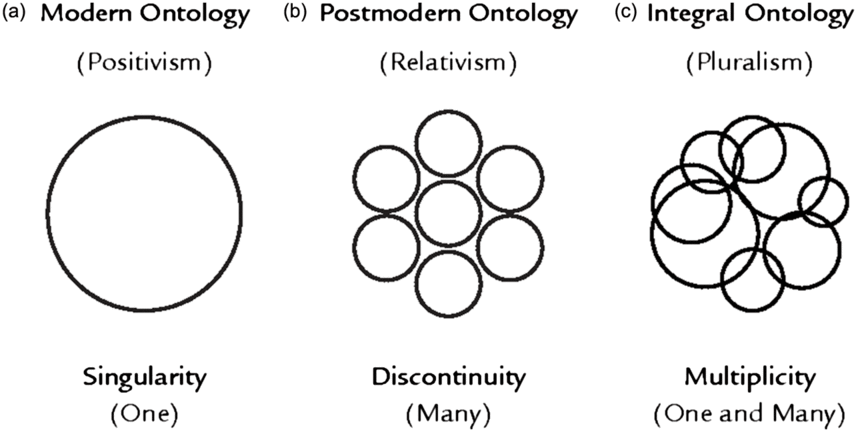
The metaphysical perspective of critical realism was termed by Bhaskar (Reference Bhaskar2002) as ‘meta-Reality’. This meta-Reality combines the power of scientific method to describe reality in precise terms (realism) with critical theory from the humanities and social sciences that understands and places humans in dialectical relationships with other humans (society) and nature (Shipway, Reference Shipway2011). However, the move to the metaphysical perspective of meta-Reality was met with resistance by critical realists with a Marxist orientation, who saw it as mysticism (e.g., Sells, Reference Sells1994). Bhaskar defended his construction of meta-Reality as the final and combinatory act of critical realism, one that crowned his investigations of 50 years. As such, Bhaskar (Reference Bhaskar2002) suggested a combined, integral ontology (Figure 1) through his research and philosophy. The integral ontology of critical realism does not simply place and determine phenomena as objects, as would scientific positivism, nor does it leave multiple objects as separate and relative, as might postmodernism; rather. critical realism tends to combine objects as ‘One and Many’ (Figure 1). Critical realism (Bhaskar, Reference Bhaskar1993) can be applied to environmental education as an ontological perspective that looks to comprehend the agency of complex social life in and of nature, and which complements the post-dualisms of the posthuman and the new materialisms while retaining the power of human agency. Further, there is synchronicity between the ontology of critical realism that Bhaskar (Reference Bhaskar1978) describes in his early work, A Realist Theory of Science, and the flat ontology of Deleuze and Guattari in A Thousand Plateaus (Reference Deleuze and Guattari1988) that has been gaining traction in recent environmental work. While not entirely compatible due to Deleuze and Guattari’s ontological resistance in terms of scale (their flat ontology does not cover everything, but emerges from planes of immanence), Bhaskar’s integral ontology does work in a similar way to Deleuze and Guattari’s in terms of liberating multiplicities.
Three variations on ontology and their consequences (Esbjörn-Hargens, Reference Esbjörn-Hargens2010, p. 149). Reproduced with permission of the author.

The ontologies of Figure 1 may be translated into the future of human habitation for the benefit of the fourth interdisciplinary unit of work. The overlapping nature of the multiplicities as described in Figure 1 (One and the Many) helps to explain the complexities experienced in social life and the subsequent future of human habitation. We know that a redistribution of human habitation is not likely to happen given historical evidence and the truth of present-day human habitation (Sack, Reference Sack1986). Habitation in the West has followed economic lines for millennia, with the close relationship between capital, power and property, meaning that those who are successful in their accumulation of capital, or those inheriting capital, are likely to be able to inhabit large, resource-hungry properties that signify an unequal sharing of the burden of climate change. Those unable to earn or inherit capital will be consigned to dwelling in modest properties that consume fewer resources and contribute less to climate change. The nature of future human habitation is likely to follow this division according to a realist perspective in human history, and an analysis of human nature and environmental impacts (Redman, Reference Redman1999). However, this perspective is put under pressure by the critical element in the meta-Reality, as the theory comes from a human perspective that is subject to belief, passion, ideology, subjective interpretation, and possible social change (revolution). Both of these perspectives on human habitation (the realist and the critical) should be understood by students and teachers, and debated as to their validity and truth.
The overwhelming truth of the fourth interdisciplinary unit of work (the real) is that the owners of large properties, and the corresponding, unequal resource consumption and CO2 emissions that have come about due to the accumulation of fossil fuel riches in countries, for example, such as Saudi Arabia and the United Arab Emirates (UAE), will not be given up, despite the climate emergency. On the contrary, these properties, populations, and their consumption and waste are a central pillar of a global (fossil fuel) capitalist society and act as important aspects of the identity that is produced and desired in contemporary human (capitalist) life (Marx, Reference Marx, Moore, Aveling and Engels1887). The facts of climate change, human population and available technology that could make human dwellings greener and more sustainable do not account for the embedded human desire to live in unequal ways, and to accumulate capital and power through property, both as a sign of success and as an extra source of income when property markets are buoyant (Moore, Reference Moore2017). The future of human habitation as a green utopia and as a variation on Bhaskar’s ‘concrete utopia’ will only be realised if human communities give up on the basic desire to live in hierarchical (capitalised) ways, and society does not reward those who display their wealth through property ownership and who invest in property. As such, society needs to push towards a post-capitalist landscape (Hawken, Lovins, & Lovins, Reference Hawken, Lovins and Lovins2013), one in which property and ownership are not part of the problem but help with the mitigation of negative climate effects, such as the uninterrupted release of CO2. In effect, society has to be remodelled on the basis of communal housing, with zero emissions and shared, sustainable, recycled resources and waste disposal. This does not seem to be a realistic possibility for the future of human habitation at the moment, but circumstances are changing, and the climate emergency may force society into taking action before it is too late.
For this unit of work to enact a critical realist approach to environmental education, students will study the facts of future human habitation, and any green(er) futures, such as shared communal living options, renewable local energy sources, the sustainable disposal of waste, the decarbonisation of the home, and changes in property laws, mortgages and inheritance (Alamel, Reference Alamel2015). Again, in similar ways to imagining and moving to a carbon-free economy, students and teachers may run into barriers to their ‘concrete utopias’, such as laws they cannot change, and hard-set attitudes to capital accumulation, but they should not be discouraged in their efforts to rethink the future of human habitation. On the contrary, the enaction of critical realism in this context requires a thoroughgoing analysis of the meta-Reality of human habitation, combining the real (meta-Reality), the empirical, and the actual in an interdisciplinary unit of work. The empirical in this context would be the observable and testable house designs and their relationships with carbon emissions and sustainability, and could follow a conventional scientific approach. The actual follows on from the real and includes events that are generated by the real; in this context, the ways in which human habitation can be changed, away from a capitalist, accumulative model (Hawken et al., Reference Hawken, Lovins and Lovins2013). The real is the meta-Reality of human habitation, and includes beliefs, imaginings, the structures of human societies, and any existing hierarchies.
The important outcome from this interdisciplinary unit of work is that students are encouraged to foster nonreductive and open minds with respect to the future of human habitation. The ethical challenge of the Anthropocene is to imagine and move towards better ways to live that would help to address the unravelling global climate crisis. Clearly, human habitation is a vital aspect of this challenge, and encouraging groups of teachers and students to be aware of this is an important part of environmental education that is often not acknowledged. This schema for change feeds into the observations made by Bhaskar (Reference Bhaskar, Bhaskar, Frank, Høyer, Næss and Parker2010) with respect to responses to climate change: (1) their global and interconnected character; (2) their holistic and four-planar social laminated character; (3) the role played by inaction, omission and absence, as distinct from their positive counterparts, and correspondingly of prevention in public policy (p. 18)
In other words, the combined effects of these interdisciplinary units of work and, in particular, the future of human habitation, is to work on these characteristics in terms of new environmental education units of inquiry, guided by critical realism. The theme of human habitation is open-ended, in need of discussion, and not something to be pigeon-holed as only applicable to private (capitalised) decisions. The envisaged cohorts of students and teachers studying the future of human habitation according to the principles of critical realism is an optimistic designation; it signals the notion that: Something can be done to arrest climate change. Whether or not this is the case will only be resolved by future generations working across national and international borders, and by educationalists talking to other professions, such as architects and town planners, who might be involved with the future of human habitation.
Conclusion
In the end, these units of work bring Bhaskar’s critical realism from a peripheral philosophy of science to mainstream educational practice. This transition will depend upon teachers, curriculum developers and educational researchers working together to align realism with critical theory. In a similar way to how the philosophy of A.N. Whitehead can be deployed for social justice in the Anthropocene (Cole & Mirzaei Rafe, Reference Cole and Mirzaei Rafe2018a), the ideas of Bhaskar can be used as a bridge from scientific analysis to social action. One of the major problems that exists today for environmental education is that the science and politics of climate change can seem to be remote and abstracted from the everyday lives of students and teachers working in the localities to improve their environments on the ground. Bhaskar (Reference Bhaskar1978, Reference Bhaskar1986) highlighted what is transitive and what is intransitive in science and action. What is transitive is changeable and subject to human agency; what Margaret Archer (Reference Archer2000) latterly called the ‘morphogenesis of agency’. Whitehead’s (Reference Whitehead1967) approach to the Anthropocene is hopeful because he worked to dissolve the bifurcation between humans and nature, making the ways in which humans act, interact and know filled with the joy and wonder of nature. Similarly, the ways in which nature and humans may be artificially separated through knowledge work (objectivity) may be meaningfully addressed through Bhaskar’s emphasis on ontology, and subsequent agency in the Anthropocene, which would focus on what can be changed due to and in connection with local action. These four interdisciplinary units of work are offered in the spirit of practical, pan-national, educational constructs that could purposefully help to solve climate change from the ground up. Now we are only left to assign teachers, resources and ongoing research to their implementation and continuous improvement to make these units fit with local needs, beliefs and practices. As such, the four units work to establish a connection between what is known and what can be done in the Anthropocene.