A Soviet icon
Heinrich Gustavovich Neuhaus (1888–1964) was one of the most acclaimed Russian pianists of his generation. Photo-portraits of him graced the walls of conservatoires and could be found standing on countless pianos in the nation's apartments. His entrance onto the stage was greeted with long ovations and even ‘tears of joy’ by his devoted fans.Footnote 1 But although his strenuous and lauded pianistic career was an important feature of Soviet artistic life, it is his activities as a teacher and especially his treatise About the Art of Piano Playing which continue to define him today.Footnote 2 Neuhaus's unrivalled stature as a pedagogue was sealed by his charisma, his sharp wit and his rare oratorical gift, which attracted hundreds of students from across the USSR. As summarized by his student Sviatoslav Richter, Neuhaus was, along with Alexander Goldenweiser and Konstantin Igumnov, one of the ‘three pillars of the Russian piano school’ to whom ‘all the pianists in Moscow beat a path’.Footnote 3 Such was Neuhaus's fame that – despite the era's political tensions and limited interchange of information – students from as far afield as America defied the cold war tensions to be admitted to join the class in the Moscow Conservatory's legendary ‘Room 29’, in which Neuhaus taught for some 42 years.
It is unsurprising to find Neuhaus lauded in the literature of the time as an epitome of the success of Soviet culture. The image of him as one of the foremost Soviet artists of the day was linked by many, including Sofia Khentova, to his role in producing a reliable and growing trend of laureates from the USSR in the politically charged arena of international piano competitions.Footnote 4 Similarly, the pianist and musicologist Yakov Milstein defined him as a figure who had selflessly dedicated his whole life as an educator to the service of raising artistic standards across the entire USSR: Neuhaus was head of the Moscow Conservatory between 1935 and 1937, and formal advisor to the Tbilisi and Ural state conservatories after the Second World War, as well as a touring examiner, and his name became ‘inseparable from the successes of the Soviet piano school’.Footnote 5
This outward notion of success, however, measured through the politicized lens of the Soviet competition machine, has become one of the most difficult hindrances to a contemporary re-evaluation of Neuhaus's wider significance. While we have perhaps moved away from cold war generalizations regarding Soviet-era pianism,Footnote 6 performers have generally attracted scholarly attention as strategic commodities in the USSR's wider propaganda machine.Footnote 7 Rigorous recent scholarly investigations, such as Kiril Tomoff's study of Soviet instrumentalists, demonstrate in great detail that efficiency and reliability were the main criteria for selecting potential competition participants and artists permitted to accept foreign engagements at a governmental level.Footnote 8 The political motivation to provide an infallible and supreme system to spectators of both the international and the home stage simply could not risk exposing implicit weaknesses of the regime as a result of potentially uneven performances or, worse still, criticism or defection. In revealing the traumatic consequences of state bureaucracy on the careers of the country's greatest performers (the violinist David Oistrakh, the cellist Mstislav Rostropovich and Neuhaus's students Richter and Emil Gilels), such studies can seem at times to continue to reinforce the widely accepted notion of the Soviet Union being engulfed by a ‘system of total, all-embracing control over the actions of all cultural figures' zealously enforced by the NKVD, the predecessor of the KGB.Footnote 9
In recent years, however, the long-standing tendency to view Soviet-era music as being trapped in simplistic cycles of political coercion and submission has begun to be dispelled, and we are increasingly presented with far more complex interactions between behavioural and aesthetic concerns in relation to artistic life. For instance, newly available archival materials, such as those investigated by Marina Frolova-Walker in relation to the Stalin Prize committee meetings, and by Tomoff in relation to the Union of Soviet Composers, have shown that, although it would be naive to call the meetings of these organizations completely autonomous, many of the policy-makers involved were not state officials, but the creative artists themselves.Footnote 10 Similarly, narratives concerned with the epoch's cornerstone musical figures (namely Dmitri Shostakovich, Sergei Prokofiev and Nikolai Myaskovsky) have begun to undergo radical transformation through the work of Laurel Fay, Simon Morrison and Patrick Zuk,Footnote 11 and those concerned with figures representing the wider arts (Sergei Eisenstein, Ilya Ehrenburg and others) through the work of Katerina Clark.Footnote 12 These studies have already pointed to the fact that, given the vagueness of official policy, events such as the infamous 1936 denunciation of Shostakovich were arbitrary and relatively few and far between,Footnote 13 reflecting the secondary, if not tertiary, level of importance attached to music by senior party members.Footnote 14 Without trivializing in any way the harrowing consequences of life under the Soviet state, there are thus clear challenges to the case for seeing a ‘centralized totalitarian control of the arts' whose proportions, according to Richard Taruskin, exerted a degree of ‘extreme moral duress' mirrored only by torture victims.Footnote 15
These studies, however, have not focused on performers and pedagogues. Situating an investigation of Neuhaus against this context, it becomes evident that this reappraisal is particularly apt since the abstract nature of instrumental music (as opposed to opera, literature, theatre and film) guaranteed a greater distancing from the outside scrutiny of the regime's representatives, who found it difficult to censor or control that which they did not understand and to which they could assign no meaning. Coupled with this, widespread confusion within the party itself over the Communist position with regard to the merits of studying the art of performance had drastically slowed political infiltration into this sphere. As aptly put by Pauline Fairclough, ‘When we look at Soviet musical culture in practice rather than in theory […] extreme views, by and large, did not exert a far-reaching influence on concert programming.’Footnote 16
Simply put, the performance of classical music was an area whose compatibility with Communist life was regarded with suspicion, and thus avoided:
So you finish the conservatory and join an orchestra where you will spend your whole life piping away on the flute. What will become of you? Would you really become a Communist? The republic needs workers for cooperatives, engineers, agronomists, pilots and social workers. Rather than do something decisively important to economic construction would you rather study a luxury, strumming an instrument for your sole listening pleasure?Footnote 17
Hence, as put by Lynn Sargeant, conservatoires and their faculties were of ‘little concern to the state which remained focused on the universities and technical institutions’.Footnote 18 As an illustration of this, the institution with which Neuhaus was affiliated for almost half a century was able to exist largely in a sheltered microclimate of its own. While Stalin's paranoia ratcheted up the tension that escalated into the purges of the 1930s and the Great Terror of 1936–8, at the same time the Moscow Conservatory was actually undergoing a phase whereby it was returning a substantial degree of normality to the undertaking of its affairs. Neuhaus's directorship of the institution from 1935, following the death of Stanislav Shatsky in 1934, reversed party intervention (through Boleslav Pshibishevsky between 1929 and 1931) and symbolically reinstated the Moscow Conservatory's unique position as the only institution of higher education in the Soviet Union not presided over by party members.
Highly influential figures like Neuhaus did not simply keep their opinions hidden in the shadows of their home or institutional microclimate. As will be seen in the course of this article, despite being one of the most lauded performers and pedagogues of his time, Neuhaus was known for his liberal tongue and sardonic mockery of state cultural and political policy. Neuhaus openly defied bans such as that on the public performance of music by Nikolai Medtner in the 1930s, and kept close company with many of the regime's blacklisted personae non gratae including Osip Mandelstam, Vsevolod Meyerhold and Boris Pasternak. Despite informants submitting reports to the NKVD detailing Neuhaus's anti-Soviet remarks, which, exacerbated by his German name, caused his detention in Lubyanka in 1941–2 (and despite Neuhaus himself reiterating his vitriolic criticism of the USSR's repressive artistic censorship, political annexation of the Baltic States and totalitarian rule ‘with many political parallels to Nazi Germany’ during interrogation), not only did he miraculously survive, but the ordeal had virtually no detrimental effect on his career.Footnote 19
Sentenced for offences committed under Article 58.10.2 of the Criminal Code of the RSFSR (Russian Soviet Federative Socialist Republic) (promulgating ‘anti-Soviet propaganda’, punishable by execution during times of conflict), Neuhaus escaped with temporary expulsion to Sverdlovsk, and thus effectively joined the same struggles of daily wartime life as all his other evacuated colleagues. Even during Stalin's lifetime, Neuhaus was never removed from his professional position or denied performance opportunities in the country's most prestigious concert halls. Furthermore, even though on file Neuhaus was an unrehabilitated ‘enemy of the State’, he went on to receive honours including the Order of Lenin in 1954 and People's Artist of the RSFSR in 1956, and was even given permission to travel as a jury member and speaker-performer on several occasions to the Soviet bloc – all privileges that routinely demanded unblemished records and were far less commonly bestowed upon non-party members.Footnote 20
Neuhaus's expression of heretical views and marked conscious loathing of state policy, however, falls in ambiguous territory. As will be seen in this article, his personal agenda for defining an alternative narrative of selfhood that positioned him within a self-constructed sphere of Russian cultural heritage eschewing Socialist Realism never aimed at a narrative designed in essence as a statement of outward dissidence. Thus, while the political context may well be considered to have contributed something to its intensification, the narrative rather arose from marked personal resistance and a stance of cultural ‘otherness’. Yet this does not detract from the fact that it does, at times, exhibit striking moments of apparent consonance with elements of wider Soviet culture. It is these paradoxes that this article seeks to illuminate through the discussion of the kind of musical and personal subjectivity that Neuhaus fashioned for himself in both private and public spheres.
Russian, not Soviet
Beyond Neuhaus's image as one of the most successful Soviet pedagogues, his capacity as a performer was also defined by reviewers as being marked by an apparent Soviet style. In 1933, when Neuhaus was at the height of his career, a prominent music critic writing under the pseudonym K. Grimikh wrote, following an all-Beethoven recital:
[Neuhaus] remains a son of his time, one of the brightest representatives of the Soviet artistic intelligentsia. He lives our life, with our interests at heart: with us he thinks, feels, searches, falters, experiences joy and suffering – and all these thoughts and feelings are those of a Soviet man, worker and citizen which are filtered through the prism of his brightly talented individuality.Footnote 21
This type of rhetoric was rooted in the 1917 Revolution which, as summarized by Jochen Hellbeck, ‘promoted a new thinking about the self as a political subject […] linked to the goal of remaking the life of [a collective] society as well as of each individual [into] the perfect human being, human machine’.Footnote 22 As further outlined by Stephen Kotkin, the ability to identify oneself as Soviet was part of a process of ‘positive integration’ into a powerful new national identity that developed under Stalin. People quickly learnt that engagement with this ‘official society’ became more advantageous than a subordinate ethnic or national identity, such as Russian.Footnote 23 As found by Kotkin, the process of identifying oneself as Soviet required an astuteness to ‘work the system to [one's] minimum disadvantage’ – creating a boundary between public behaviour and private thought.Footnote 24
Igal Halfin, however, has questioned this ‘high degree of discrimination’ between the ‘true self’ and ‘public performance’, suggesting that it was not simply the ‘outcome of a process of coercion but one of cooptation, which drew the subject to self-destruction’. Communist ‘self-fashioning’ therefore ‘turned the messianic aspiration of the state into [the individual's] own intimate affair’.Footnote 25 Thus, as proposed by Hellbeck, the participation in this ‘enlarged life of the collective’, rather than being an official mask adopted unwillingly by Soviet citizens as ‘liberal subjects' who otherwise shielded their true private opinions from the intrusive gaze of the state, became a highly desired selfhood ‘fermented’ by ideology into the minds of 1930s society.Footnote 26 As defined by Hellbeck, the zealous upholding of this vision of selfhood by all levels of society was therefore an illiberal but sincere act.
The height of Neuhaus's career, from the mid-1920s, throughout the 1930s and into the early 1940s, took shape as the mechanisms of Soviet self-identity under Stalin were at their most intense. Yet it is striking that despite his awareness of the sociopolitical pre-eminence of the new Soviet Man and its associated rhetoric, he made a deliberate point, whenever possible, to avoid defining himself as Soviet. Although he was not immune to the censor's pen, he was irate at the ‘Bolshevik-speak’ routinely inserted into the printed word, and was not unknown to withdraw from publication certain articles that he felt were severely contaminated.Footnote 27 In his diaries, personal correspondence, sketches for an autobiography planned for posthumous publication and wherever possible in print he referred to himself as a ‘Russian pianist and teacher of music’ who happened to live in Soviet times.Footnote 28 Applying the term ‘Russian’ to his colleagues as much as to himself, in his 1941 article ‘Dmitri Shostakovich’, for instance, Neuhaus hailed the composer as the ‘continuation of all the greatest classical Russian art’ – the word ‘Russian’ in place of ‘Soviet’ being hardly accidental.Footnote 29 In this way, Neuhaus consciously positioned himself outside what Hellbeck describes as the age's ‘illiberal Soviet subjectivity’.Footnote 30 Concurrently, in reversing the hierarchy from Soviet to Russian, his intention was implicitly to disregard the pressure to ‘work the system’ (as described by Kotkin's study of Soviet self-fashioning) to his advantage.
In calling himself a Russian musician, however, Neuhaus presents us with a non sequitur. Having been born in Russia, he had essentially lived beyond the country's borders until the age of 26. During this time, his cosmopolitan lifestyle in various European cities led him staunchly to believe that ‘affection to a country etc. are all feelings which I have always found alien to me’.Footnote 31 Neuhaus's famously lisped accent and dandified manners remained perpetual reminders of his youth: he was the son of an émigré family who had grown up speaking and writing predominantly in Polish and German. His return to the country of his birth was in many ways a return to an alien homeland, as he had hardly shown any interest in Russian music, literature, history or other arts before the outbreak of the First World War in 1914. Indeed, upon his first arrival in Petrograd in 1915, his début recitals, which included the music of Max Reger and Neuhaus's cousin Karol Szymanowski, had aroused the curiosity of Russian artists and intellectuals wanting to hear the musicianship of this foreign, Austro-German-educated pianist.Footnote 32 Were it not for the war unexpectedly closing the border behind him after celebrating his graduation from the Vienna Academy of Music, and then the Russian Empire becoming gripped in the violence of the Revolution, it is far more likely that he would have settled in Europe alongside his friends, who included Artur Rubinstein, or his extended family. Thus, it would be naive to suggest that Neuhaus really had any claim to an instinctive inheritance of the tropes associated with constructed Russian identities that might be recognized in contemporary artists or thinkers in his milieu. It was instead a meticulously crafted, volatile amalgamation of personal circumstances and choices that drew from complex intellectual adaptations of historically displaced ideas.Footnote 33
Unlike numerous Russian artists and thinkers including Alexander Blok and the young Pasternak, who were excited by the fervent revolutionary ideas that filled the air (even if they were horrified by their violent human sacrifices), Neuhaus and his family had always maintained a deliberate and wary stance. In an early manuscript of his autobiography Neuhaus simply stated: ‘We had nothing to do with the Revolution.’Footnote 34 Yet he had weathered the unrest in the family home in Elisavetgrad (Kherson Governorate), which had seen occupation and atrocities carried out by the Bolsheviks, the Central Powers following the 1918 Brest–Litovsk Treatise, the White Army, the Ukrainian Nationalist Army of Symon Petlura and the Anarchist Black Army of Nestor Makhno, and in May 1919 had been the location of the heinous Elisavetgrad pogroms of Ataman Nikifor Grigoriev.Footnote 35
Amid the growing hunger, daily violence and ruins, the town eventually succumbed to Bolshevik control. While Neuhaus's letters relating to this period of his life were destroyed in conjunction with his arrest in 1941–2, the surviving letters of Szymanowski speak of the terror they mutually felt with regard to the harrowing ‘sacrifices' of the Revolution and the ensuing anarchy, which sought to destroy everything in its path in the name of the new social cause.Footnote 36 Writing for the Russian newspaper Voyna i mir (War and Peace) in October 1919, Szymanowski gave an indication of the extended family's thoughts when he denounced the Revolution, seeing it not as the painful cure of the ‘Tsarist disease’, but as its agonizing consequence.Footnote 37 Expressing himself more overtly, he wrote: ‘The Russian Revolution is a fit of premortem convulsions, a rebellion of the cellular substance against the organising principle of life, a hypertrophy of collective tissue to the disadvantage of the more noble tissues such as the nerves and the brain.’Footnote 38
Witnessing famine and living in fear of massacre at the hands of bandits or swift-changing militia, Neuhaus observed that loyalties were severed even between old acquaintances. This was graphically demonstrated, for instance, by his warning to Szymanowski about the corruption of their mutual friend Alexander Dubiansky, a prodigious pupil of Neuhaus's uncle Felix Blumenfeld and one of the dedicatees of Szymanowski's Masques, op. 34 (the others being Neuhaus and Artur Rubinstein), who would commit suicide a year later aged just 20: ‘One terrible thing: Sasha has been completely Bolshevized […] a typical specimen of the functional communist – you know the background.’Footnote 39
Notwithstanding these hardships and concerns, Bolshevik control, which Neuhaus first encountered in Elisavetgrad, had actually brought an advantageous stabilizing effect. With extensive plans to put education at the heart of their campaign, the Bolsheviks came with the intention of securing the cooperation of the local artistic and intellectual circles at a governmental level. Part of their ambitious plans for Elisavetgrad included the establishment of a network of schools from nursery age to higher education, and a conservatoire which would provide free tuition on all instruments, establish an active research department and provide a pedagogical training centre. The Neuhauses, Szymanowskis and Blumenfelds were quickly given official engagements in leading the regional Elisavetgrad Music Department of the People's Commissariat for Education (Narkompros). Neuhaus and Szymanowski were given positions at the helm of this initiative. Certainly the regular salary and substantially more generous ration allocations provided by such roles were welcome privileges.Footnote 40
While the young cousins maintained that their engagement by Narkompros was ‘not for themselves, but for the money’, they obviously undertook this work seriously.Footnote 41 During what was only a short-lived tenure, prompting the cousins to flee as the Bolsheviks temporarily lost control to Denikin's White Army in the summer of 1919, Neuhaus boasted that the intensity of his work with Szymanowski led to a ‘flourishing’ of Elisavetgrad's musical life far beyond the scale it had ever witnessed.Footnote 42 The best halls of the town and two well-maintained Steinway grand pianos were placed at their disposal for their concert activity. Despite their acute recognition of the heavily politicized Bolshevik agendas which saw this music-making as essentially a vehicle to reinforce a new, predetermined collective identity, the cousins' programmes nevertheless exclusively reflected their own passions as well as those of the largely ethnic-German town community, featuring Beethoven, Brahms, Chopin, Reger, Schumann, Skryabin, Szymanowski, Tchaikovsky and Wagner.Footnote 43
This complex and ambiguous relationship with Bolshevik rule, which was seen as ideologically corrupting but affording beneficial privileges and a greater artistic freedom than was usually allowed to those of talent, was the fate of many among Russia's intelligentsia. As the Bolsheviks temporarily lost control to Denikin's White Army, Neuhaus's sweetheart, Militsa Borodkina, urged Szymanowski never to forget, as he fled to Warsaw, his ‘burning homeland’ – the ‘poor Russia’ which was shortly to be sealed by a ‘huge stone wall which even the entire magic of imagination cannot break’.Footnote 44 For Neuhaus – an artist of strongly cosmopolitan outlook – it was a trauma that prompted the start of an active engagement with, and transformation of, some select aspects of Russian culture from the nineteenth century and the fin de siècle that had until then passed him by.
Positioning himself within a self-fashioned utopic Russian cultural legacy, he began to pit this historically displaced fusion of aesthetics as a nobler cultural phenomenon against the primitive crudeness of the mass-culture ideologies of Socialist Realism. The intent of this process is a clear demonstration of Neuhaus's ability to reject the mainstream ‘Bolshevized’ public discourse of his time, and instead to set up a distinct personal realm of action. Engaging with these aesthetic and philosophical territories would not simply distance him from reality. They were part of a process to reconcile his adoption back into an idealized country of his birth, and as such provided space for a personal definition of the self that was not inherently political. This self-constructed Russia was endowed with a wider social value through bestowing culture and the arts with the power of healing. An important catalyst for the intensification of this conviction became his new-found friend, the equally cosmopolitan-minded poet and writer Pasternak.
Silver Age reverberations: creating ‘autobiographicality’
A chance encounter at a Moscow tram stop in the winter of 1928–9 ignited a lifelong friendship between Neuhaus and Pasternak. Having already formed an enthusiastic appreciation for one another's work, the two regularly met after Neuhaus's recitals at the Moscow Conservatory, often in Pasternak's home at Volkhonka, and would discuss music and aesthetics well into the small hours. It was an experience that Pasternak, who considered Neuhaus to be intellectually something of a ‘genius' (not a word the poet threw around lightly), would describe as ‘the only joy in my existence’.Footnote 45 The inspiration was mutual, with Pasternak persuading his friend to overcome his apathy and frequent bouts of melancholy and to continue practising the piano.Footnote 46 It is evident that Neuhaus cherished these opportunities to exchange ideas and enrich the scope of the cultural fabric that underpinned his interpretative decisions and coaxed him back to the instrument: ‘Aesthetic questions, questions of dignity, human values, of the beauty of man's soul, of spiritual greatness [always] concerned me at least as much as, if not actually more than, the most beautiful sonata of Beethoven.’Footnote 47
Pasternak's own, albeit short, time as a student at the Moscow Conservatory ended abruptly in 1910, and the fact that the door of the Pasternak family home had always been open as a place of gathering for the brightest figures of the contemporary Moscow intellectual elite (its frequent guests included Andrei Beliy, Blok, Rachmaninov and Skryabin) was an appealing prospect in Neuhaus's mind.Footnote 48 The rapport between Neuhaus and Pasternak was so great that soon the pianist began adopting the poet's ideas and inspirations, while Pasternak began to enshrine elements of Neuhaus's personality and pianism into some of his poetry – including Ballada (Ballade, 1930); Leto (Summer, 1930); Mne Bramsa sïgrayut (They'll Play Brahms for Me, 1931); and Muzïka (Music, 1956).
One of the most striking offerings that Pasternak was able to encourage in Neuhaus's already vast cultural base was the voracious study of the poetry of Blok. After showing scarcely any notable interest in the Silver Age poet in the years around the Revolution, when Blok's direct influence on the wider literary and artistic community was arguably at its most potent, Neuhaus was now almost driven to obsession, writing in 1931: ‘I have just now, nearly without a break, read again almost all of Blok: poems, articles, diaries and notebooks. He is extremely close to me.’Footnote 49 It is clear that it was around the time of these close artistic exchanges between Neuhaus and Pasternak that the pianist began to conceive of his most ‘sacred’ playing for which he ‘loves and lives' as one arising from the same spiritual source as ‘Blok, Pasternak and Chopin’, and which therefore united them as ‘brothers’.Footnote 50
Neuhaus's engagement with Blok's poetry beyond the narrative of revolution and Russian Orthodoxy had awakened in him a sense of cultural belonging that did not merely hinge on supposed national tropes or events.Footnote 51 Rather, it depended on a sophisticated constructed kinship rooted in personal belief in a shared national temperament that allowed him to enter an artistic state of emotional outpouring perilously close to the border of self-control. Such a feeling had not been new in itself to Neuhaus. Throughout his European studies and early career he had become used to being mocked by his professors, critics and friends for his near absence of emotional restraint. Although the young Neuhaus had thought of his own temperament as typical of a ‘Polish dandy (paniczyk)’, his easily moved disposition was put down by his professors to his being ‘stuck in a Russian skin’, which needed to be shaken off if progress was to be made.Footnote 52
Now, however, he felt that he had observed the same disposition in a Russian artist of whom he had been in awe. Neuhaus's then wife, Zinaida (who, traumatically for Neuhaus, was soon to divorce him and marry Pasternak), recalled how at this time, whether in Moscow or at the holiday dacha in Irpen, she would frequently find her husband playing to Pasternak late at night while the latter recited Blok's poetry, the two of them weeping together.Footnote 53 Speaking of the moments he felt closest to mirroring the essence of Blok's poetry, Neuhaus said: ‘I played so wonderfully […] Boris [Pasternak] would have cried like [all those present] cried (with joy): […] it was precisely that unique, sacred [playing] in which everything was felt through to the very end.’Footnote 54 He found it a painful experience when he could not give the same level of ‘sincerity’ as ‘at home [as] something stands in the way’. In those cases, Neuhaus complained, ‘One puts on a “mask”: but that is terrible.’Footnote 55 Such instances drove him to despair, as he associated them with all the faults he perceived in the attitude to pianism that he had encountered during his studies in Europe, including those of his professor, Leopold Godowsky, who believed that, ‘One somewhat prostitutes oneself on stage. On stage you [should only] give 25% of that which you have inside you because on stage you put on a mask.’Footnote 56
Whether or not it was the casual performances in Pasternak's company where they wept at each other's work and at the recitation of Silver Age poetry that encouraged Neuhaus to view this state as particularly Russian is difficult to tell. Critically, however, through Silver Age poetry Pasternak had introduced Neuhaus to a body of Russian art whose core aesthetic, originating in the French visions of modernité epitomized by poets such as Théophile Gautier and Charles Baudelaire, sublimated the individual through the glorification of emotional expression.Footnote 57 Within this aesthetic, as summarized by the Symbolist poet Valery Bryusov, the goal of art was beauty, which elevated and ennobled man because it went beyond the limitations of reality: the real world was ‘merely a prop used by the artist to give shape to his dreams' through his feelings and imagination, and in doing so the creative act thus gave rise to the closest spiritual reflection of that artist.Footnote 58
Neuhaus was so transfixed by the works arising from this distinct Russian body of thought that, with Silver Age writings being largely unavailable in print,Footnote 59 in addition to Blok he committed to memory much of the poetry that was openly indebted to him (including that of Nikolai Gumilev, Anna Akhmatova and Pasternak) and wrote it out by hand.Footnote 60 Whether or not the deliberate nature and urgency with which Neuhaus began to explore this link was influenced by the Soviet state's determination to expunge the Silver Age's cult of the individual from mass consciousness and replace it with culture that aimed to unify and connect a wide audience is difficult to ascertain. What is certain, however, is that it pushed him to define these particular Silver Age goals as a core element of his practice.
Speaking of this fragile confessional state, in which he could dare to ‘pour out all that which is sometimes so torn, polluted, maimed and tortured’ within himself, Neuhaus was consolidating an idea which he would later call the interpreter's ‘autobiographicality’ (avtobiografichnost′).Footnote 61 As reported by Neuhaus's student Berta Kremenstein, ‘autobiographicality’ was ‘a distinctly Neuhausian idea […] undoubtedly meaning the soulfulness, genuineness and depth of feeling expressed, and all this with restraint and simplicity’.Footnote 62 Another student who was certainly influenced by her professor's ideas, Vera Razumovskaya, talked about this state as one which the interpreter enters at his most vulnerable, for he has no place to hide his personal and spiritual failings: ‘He involuntarily reveals himself in the music – gives his self-portrait.’Footnote 63
Synthesizing his own understanding of Russian artistic temperament, Neuhaus sought to align himself unmistakably with Blok's belief that ‘only that creation which is a confession and in which the artist has burned himself to ashes […] can become great’.Footnote 64 Applying this to the act of performance, Neuhaus was careful to indicate that, for him, the implication of such a process was that this confession should be a deeply subjective one – tempered to the spirit of what he perceived to be the composer's intention, but nonetheless not enslaved to it, and reinterpreted from personal experiences. The significance of such a stance in an age in which the notion of Urtext and stylistic authenticity, driven by a desire for obedience to a composer, was already showing its hold among the faculty of the Moscow Conservatory is striking.Footnote 65 The crucial distinction here for Neuhaus was not one of authenticity, but one of ‘truth’, which he, like Blok, held to come not from the intellect, but from the realm of an individual's emotional or lived experience (perezhivaniye).Footnote 66
Singling out this autobiographical quality of art as one which ought to resonate with the Russian psyche, Neuhaus maintained: ‘There is a direction – and it was born in the deepest strata of the Russian soul and the Russian people – a direction that sought truth in interpretative art: truth with which all great Russian art is marked.’Footnote 67 Yet to say that this kind of approach to interpretation was unequivocally accepted in the manner Neuhaus had sought to imply would be a mistake. The supremacy bestowed upon such emotional subjectivity by Neuhaus in his attitude to music was heavily criticized by the musicologist Lev Barenboim, and garnered a substantial degree of resistance, especially from the younger generation.Footnote 68
Illustrating this point were the resulting altercations between Neuhaus and some of his students, for whom the absence of objectivity in this approach of ‘autobiographicality’ led them to question its artistic validity. For instance, Gilels was deeply critical of Neuhaus's approach to Beethoven's ‘Waldstein’ (‘Aurora’) Sonata no. 21, op. 53: ‘The second movement (Adagio molto), according to Neuhaus, is a “velvet night”; a southern-Italian velvet night which is followed by dawn. It is beautiful, but it is excessively brought about by feelings – the desire to express the personally gained pleasure from this “velvet night”.’Footnote 69 Similarly, in a lesson in which Anatoly Vedernikov was playing Bach's Prelude and Fugue in E♭ minor from the first volume of The Well-Tempered Klavier, Neuhaus had proposed that he should perhaps think about the image of cypresses in an Italian cemetery.Footnote 70
Vedernikov could not understand why his professor was insisting on an image which seemed to have so little to do with Bach, and was left so irate with Neuhaus's suggestion that he ‘left and slammed the door’.Footnote 71 Whereas neither student was taken with the image of Italy, for Neuhaus this country was his self-professed spiritual homeland, where he spent what he felt to be the most artistically productive years of his youth. It was a country from which he parted with a heavy heart in 1909, not least because of a never-to-be romantic attachment to a ‘widow’ (possibly a euphemism) 13 years his senior, and a country to which he hopelessly longed to return, with permission to visit Italy being granted to him by the Soviet authorities only shortly before his death.Footnote 72
Autobiographical art as a drawbridge into a desired Russia
Outside the Silver Age, notions of autobiography and truth held their own particular roles in the mechanisms of mass Soviet selfhood in the Stalinist era. As explained by Halfin, ‘Hermeneutics of the soul (inner moral disposition) emerge as a manifest, objectively verifiable way of distinguishing true revolutionaries from imposters.’Footnote 73 Narration about the self – whether as an artist, a party member or simply as a rank-and-file worker – was to make one's persona or lichnost′ ‘nameable and describable’ – a useful tool for authorities in a regime seeking surveillance and conditioning. With the arts identified by the political machine as a target through which to project an example of a glorified Soviet self, an official triad of criteria became applied: partiynost′, ideynost′ and narodnost′ – terms roughly translatable as ‘serving the ends of the party’, ‘having correct ideological content’ and ‘being accessible to all of the people all of the time’.
In conjunction with a view of pre-Revolutionary Russian culture it is clear that these are usurped abstractions. The aesthetic of art as an autobiographical practice – and the intricately related territory of psychorealism – is rooted in the emerging Russian intelligentsia of the mid-nineteenth century where, following on from European historicism, the notion of lichnost′ and self-reflective art was taken as a barometer of society's liberal development. As discussed by Hellbeck, in the backwardness of Nicolaevan Russia, ‘personal narrative could endow loss with new meaning and certainties by anchoring the self in [an alternative] History’.Footnote 74 Self-reflection was thus a means through which to create a ‘historically conscious personality’ that saw the artist carry ethical and moral obligations to effect historically progressive change. As formulated by the peredvizhniki painter Ivan Kramskoy, artists are not ‘free as birds’, since, given the ‘backwardness and misery of the Russian people (narod), they are obliged to take a stand on moral and political issues’.Footnote 75
For many intellectuals and artists in the Soviet era the continuing engagement with art as a psychorealist creation of a historically conscious personality became a drawbridge into a long nineteenth century, and hence provided a displacement into a pre-Soviet world. So evident was its continuing presence, even as an undercurrent, that Stravinsky's Harvard Lectures noted, albeit cynically, not only that it existed ‘side by side with the official atheism of the Communists’, but also that it played its part in ‘poisoning the whole field of art in Russia, with the famous arguments over the “meaning of Art” and of “what is Art and what is its Mission”’.Footnote 76 Differentiating it from the new politicized context of Socialist Realism, Pasternak, for instance, redefined it as ‘artistic realism’ (khudozhestvennïy realizm): ‘the depth of the biographical imprint which becomes the main driving force of the artist, and which pushes him onto the path of innovation and originality’.Footnote 77 Supporting his territory of what he defined as ‘only’ realism, which should be a marker of Russian art, Pasternak was vocal in proclaiming as exemplary Blok's ability to erase the distinction between real life and its artistic manifestation – an artistic obligation to put ‘all experiences, from every aspect of life, together’ into the lyric poetry of one ‘musical chord’:Footnote 78
Blok's St Petersburg is the most realistic St Petersburg ever depicted by a contemporary artist. It exists equally in real life and in [Blok's] imagination. It is full of everyday routine, which fuels the poetry with tension and anxiety, and in its streets the language of the common people is heard, which refreshes the language of poetry. At the same time, the image of this city consists of features which were depicted by the nervous hand of the poet who spiritualized the city to such an extent that it was transformed into a breathtaking phenomenon of the rarest inner world.Footnote 79
Blok's vision that the poet's soul is tempered by the experiences and anxieties of his epoch likewise found its way into Neuhaus's realist understanding of art as life:
The emotional attribute (let's call it the subconscious state of the spirit) is found in even the most rational, the most apparently unemotional movements, actions and thoughts […] What a musician gains in knowledge is expressed by him in creation or interpretation. This is why I have the right to voice a paradoxical thought: everything knowable is musical (for the musician of course). Or more precisely (and tediously): any knowledge is at the same time lived experience (perezhivaniye) […] The absence of such experiences – and especially the complete lack of experiences – gives birth to unsoulful, formalistic music and empty, uninteresting interpretation. Everything […] that lives in the human soul, everything that is ‘subconscious' (often it is ‘superconscious’) is the kingdom of music.Footnote 80
Crucially, unlike Socialist Realism and autobiographical art arising from Communist self-fashioning, the search goals of this kind of self-reflective art were not predetermined by a defined future. Because the process of defining lichnost′ was seen as more valuable than the result, there could be no limit on an artist's individuality: the sense of unreachability rather is glorified as proof of the profundity of the artist's transformative vision. Urgently trying to communicate this to his students, Neuhaus cryptically remarked to them: ‘Most of all, I wish I could give you the gift of The Demon.’Footnote 81
Embodying the demon
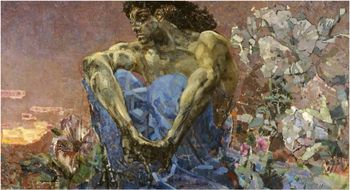
Mikhail Lermontov's poetic masterpiece The Demon (1842) inspired many artists to respond to it in their own way, from Anton Rubinstein's six-act opera of the same title (1871), made iconic by Fyodor Chaliapin, to the series of paintings by the Silver Age artist Mikhail Vrubel.Footnote 82 Neuhaus was gripped by Vrubel's The Seated Demon (1890; see Figure 1), and often spoke about it as the epitome of genius.Footnote 83 What compelled Neuhaus so much about this Silver Age painting was that this was an image which had inspired Blok to set down his famous definition of the qualities of the Russian artist. In a direct allusion to the painting, Blok expressed his vision in his article ‘O lirike’ (‘About the Lyric’; 1907):
Among the mountain ranges where the ‘solemn sunset’ mixed the blue hues of the shadows, the scarlet of the evening sun and the gold of the dying day – mixed and poured out into one viscid and glinting violet mass – was a Man: suffering and sorrowing, [he was] the owner of all the world's riches […] yet did not know where to lay his head. This Man – the fallen Angel-Demon – was the first lyric [Lyric Poet]. Footnote 84
Although, unlike Vrubel's painting, this article was never directly mentioned in Neuhaus's writings, interviews or lecture transcripts, it was one (along with Blok's entire oeuvre) he undoubtedly knew intimately. This image of the Lyric Angel-Demon evidently impressed itself on Neuhaus's imagination, as it reappears in various guises throughout his thoughts on music. However, where for many the obvious Orphic musician who might be seen through this mystical legend, which had such great significance to the Symbolists, would be Skryabin (whose music so often ventured into the demonic),Footnote 85 Neuhaus offered in this place the figure of Beethoven.Footnote 86
Mikhail Vrubel's The Seated Demon (1890). The State Tretyakov Gallery, Moscow. Oil on canvas. 117 × 214cm.

Beethoven had occupied a special place in Neuhaus's thoughts on music. Despite the fact that Neuhaus was the foremost interpreter of Skryabin in the USSR (rivalled only perhaps by Vladimir Sofronitsky and Samuil Feinberg), Beethoven was a composer whose philosophy he believed was never sufficiently challenged with the ‘sobering word of truth’.Footnote 87 Rather, he believed that Beethoven epitomized the greatest achievements of European philosophical endeavours. Neuhaus was keen to show his early immersion in this philosophical world, saying: ‘When I was 15 I felt really sorry that Beethoven did not “process” his music into philosophy, as I thought that his philosophy would have been better than Kant's or Hegel's – deeper, more truthful and more human.’Footnote 88 Yet, with Hegel's philosophy (like Nietzsche's) being ‘out of favour’ with the Soviet regime, Neuhaus would first need to contend with the fierce revolutionary narrative that had already been claimed for Beethoven by late imperial Russia and, crucially for his time, Beethoven's status as an honorary standard-bearer for the Socialist Realism propaganda of Soviet Russia:
From the time of the revolution [1917], the music of Beethoven became to us one of the most loved and dear. […] Our first Soviet People's Commissar of Enlightenment, A. V. Lunacharsky [said of] Beethoven: ‘Beethoven is closer to our day, Beethoven is a more intimate neighbour of socialist art than the chronological neighbours of the past decades.’ […] The Great Patriotic War [the Second World War] and our movement into a Communist future have deepened and strengthened the Soviet people's love of Beethoven.Footnote 89
Such visions were all the more intensified by authors such as Romain Rolland, whose work found fertile ground in this socialist climate. Remarkably, it was the image of the Demon which would allow Neuhaus to compose an alternative narrative with which he privately challenged this.
Neuhaus believed that the wider Russian tendency to depict Beethoven as a ‘bundle of misery’, which arose from the work of Rolland, was overstated, and – unlike his elder colleague and equally esteemed Beethoven interpreter Goldenweiser – he was vocal in sharing this opinion.Footnote 90 Beethoven's deafness, according to Neuhaus, was not a cause of despair but a blessing, because it compelled him to compose exclusively out of the experiences of his soul:
His spirit, which was now undisturbed by any noise of this divine and damned world, was able to be in that silence, that real silence to which other artistic people aspire and sometimes attain at such a cost. He heard only the imagined sound of the piano – but for such a person the imagination was greater and more real than actuality.Footnote 91
Hegel's The Phenomenology of the Spirit (1807) described the spirit as undergoing three stages of evolution: the first, the (implied) stage of unconsciousness; the second, the stage of seeing the spirit acquiring a mind but misinterpreting that which it understands as something beyond the self; and finally, the stage of self-consciousness, when the spirit understands itself as all reality (including all humanity) and that it is, in a pantheistic manner, ‘God’ or the ‘divine’.Footnote 92 Evoking his understanding of this, Neuhaus had sought to align Beethoven with the attainment of this last, superhuman state from which the composer ‘sang to the world’ his ‘monologues for the ideals of mankind’.Footnote 93
With Beethoven (despite his own pronounced atheist stance) being the only composer about whom he used words such as ‘divine’ or ‘other-worldly’, Neuhaus emphasized the strength of his desire to convey the vision of Beethoven as being beyond simply human.Footnote 94 What is particularly striking here – and so sympathetic to the image of the Demon – is that Neuhaus's spiritual elevation of Beethoven was one that rested on the idea of that spirituality being flawed and hence bound to exist on Earth. Mirroring Blok's language that the Demon was ‘Man’, Neuhaus claimed that he felt there was something that prevented Beethoven from being ‘divinus’: ‘The human […] this is the strength of Beethoven, but also it is his downside (if it is even possible to talk of downsides here): there is something higher than him.’Footnote 95
Neuhaus mirrored his view of Beethoven's late period (once his spirit had attained its Hegelian transformation) closely with Blok's presentation of the Lyric as the fallen Angel-Demon: a solitary genius who, despite owning all the spiritual riches of the Earth through his re-imagined experiences and thus having the ‘clearest’ possible view of the world, was always desperately reaching out for the stars.Footnote 96 In defining his concept of the necessary atmosphere to Beethoven's Hegelian transcendence, Neuhaus calls to mind the very colours associated with the Lyric Angel-Demon as presented in Vrubel's famous painting:Footnote 97 the Variations from op. 109 (Sonata no. 30 in E minor) depict a ‘majestic, solemn sunset’ in which the ‘glinting mountain peaks' are seen through gold, bronze, scarlet and violet before mixing with the shadows of the coming ‘blue-blue night’ (sinyaya-sinyaya noch′); and the slow movement of the Fifth Piano Concerto, op. 73, presents an ‘azure-golden glow’ (lazurno-zolotistogo siyaniya).Footnote 98 Echoing something of the forceful expulsion of the Angel-Demon from the heavens, Neuhaus even called Beethoven's soul an embodiment of a ‘salto mortale: a fall from the sky to Earth’.Footnote 99 Emphasizing the spiritual height and isolation of Beethoven, Neuhaus unfailingly returned to the imagery of mountains (an allegorical device strikingly absent from his critiques of other artists or thinkers), comparing his achievements to the Himalayan peaks in relation to the ravines of other composers.Footnote 100
The image of the Lyric Angel-Demon's isolated abode high up in the mountains, surrounded by a glistening bejewelled garden lit by the setting sun's rays, was not simply one limited to Neuhaus's words. His cryptic wish to give his students the ‘gift’ of the Demon, and to portray Beethoven as the ultimate philosophical genius, may well be seen to have impressed itself on his own approach to some techniques that he brought to the piano to play Beethoven's music. Frustratingly for even his most talented students, as testified by Yakov Zak and Vera Gornostaeva, who were keenly aware of something special in the way their professor performed this repertoire, Neuhaus seldom revealed the ‘sorcery’ behind his playing. With the mechanisms shrouded in a certain aura of secrecy, Gornostaeva remarked that there was simply an awareness that ‘the sound which he commanded was like a tuning fork – you understood that you were listening to a different piano, to a different type of thought’.Footnote 101 Some of these distinct techniques, however, can be ascertained and re-enacted through the combination of the imagery behind the Lyric Angel-Demon and some principles about pedalling and resonance that he did set out in his writings and applied to his recorded performances.
Discussing the famously unusual and problematic recitative from Beethoven's ‘Tempest’ Sonata in D minor, op. 31 no. 2 (see Example 1), with his then student Richter, Neuhaus had tried to encourage him to ‘open up the piano's pores’. Unable at the time to work out this riddle, Richter admitted defeat.Footnote 102 Years later, a postcard Richter sent to Neuhaus when embarking on a lengthy international concert tour giddily shares the triumph of what he felt was a successful performance of the ‘Tempest’ – one, Richter wrote, that captured something of ‘that demonic voice, that resonant echo of his song amid the mountains’.Footnote 103 So what did Neuhaus understand by ‘opening up the piano's pores’?
The recitative from the first movement of Beethoven's Sonata in D minor (‘Tempest’), op. 31 no. 2, bars 143–58.

Neuhaus had a particular love of utilizing the ‘most “un-percussive” sound possible on the piano’ – when the note ‘doesn't answer to the hammer [but instead] sounds exclusively from sympathy with the [other] strings’.Footnote 104 While several examples deriving from variation in the application of this principle can be discerned in various recorded performances (notably of Skryabin and Chopin) and have survived within the framework of certain pedagogical legacies, in the case of the ‘Tempest’ it is most likely that the application that Neuhaus had in mind was to use the left hand silently to depress and cover the lowest reaches of the keyboard just before beginning the recitative. Those open strings (the piano's ‘pores’) will now react as a result of sympathetic resonance to the frequencies of the right hand's strains of the recitative – the vibrations of the string struck by the hammer setting off a chain of vibrations through these open strings. Without using the damper pedal to sustain a legato line, this chain of vibrations nevertheless produces a glowing halo of sound that echoes through the piano.Footnote 105
The idea that a note directly struck by the hammer might be able to leave something of itself behind by means of awakening vibrations in an opened unstruck string would have been appealing to Neuhaus's desire to align Beethoven with the Lyric Angel-Demon. The coupling of such a mysterious and unorthodox technique with Neuhaus's view that the D minor ‘Tempest’ Sonata with its unique recitative was the germ from which the Ninth Symphony (in the same key) would be born decades later served as a practical demonstration that – contrary to the Soviet narrative (adopted by contemporaneous musicologists such as Yurii Keldish)Footnote 106 that actively tried to portray Beethoven as an ‘authentically proletarian’ composer who was always accessible to all people all of the time – the greatest art should not be instantly ‘accessible’. Thus, Neuhaus was adamant that ‘a lot of stupidity was committed in the name of the vsenarodnost′ (literally: “all-peopleness”) of art’.Footnote 107 Instead, he claimed that the voice of the greatest art, such as that embodied by Beethoven's music, existed at a ‘nearly inaccessible height’ and, like the songs of the Demon, could initiate an echoing halo of sound only in the hearts and souls of an audience that was receptive and prepared, the opened strings ready to vibrate of their own accord through the phenomenon of sympathetic resonance.
Indeed, Blok had warned that the Lyric, having the whole world, ‘will not give you, people, anything other than momentary splashes, other than far-away songs, other than a stupefying drink. […] A Lyric cannot give anything to people. But people come and take. A Lyric is “poor and bright” (nisch i svetel); from his “bright generosity” (svetloy schedrosti) people create countless riches.’Footnote 108 The reason why great art therefore could not be instantly accessible was that it had never set out its aim as a communication for sharing. It was nothing short of egocentric – born and sustained through personal autobiographical experience. Defining lichnost′ through self-reflective art was a process towards the unattainable, and therefore, unlike Socialist Realism, could never claim definable results: Blok's Lyric had come from Heaven, but now imprisoned on Earth was doomed never again to return. Despite owning all the world's riches (and so embodying the ultimate assimilation of lived experience), he was isolated in a prison – in the case of Beethoven's Hegelian spirit, literally so through his deafness – where his eternal existence was one fated to strike at the ‘green earth and blue skies of its walls’.Footnote 109
Thus, the amalgamation of Blok's Lyric and Beethoven gave Neuhaus the ultimate example of art. Gained exclusively from personal experience, it was therefore an art that relied on a confessional outpouring of the artist, and hence answered to Neuhaus's concept of ‘autobiographicality’ as an alternative kind of Russian realism:
That is how I want it. If a Lyric loses this motto and replaces it with another – he will no longer be a Lyric. This motto is his curse – immaculate and bright. All freedom and servitude are in this motto: in it his free will, and in it his imprisonment in the walls of [his] world – ‘the blue prison’. Lyricism is ‘I’, a microcosm, and the whole world of the lyric poet lies in his process of perception.Footnote 110
It was a subjectivity which underpinned his definition of himself as an artist through both appropriation and rejection of artistic thought (and presented both confluence and aversion to cultural policy around him) as much as it underpinned his volatility as a performer. Not being a politicized act of dissidence against a regime whose policies he abhorred, it was nonetheless stimulated by his desire to contextualize himself as a Russian rather than a Soviet artist – driven by what he described as part of his private efforts to make his ‘life's roses have fewer thorns’.Footnote 111
Presenting a cultureless Soviet
Neuhaus's deliberate choice to forgo aligning Skryabin (or, indeed, any other Russian or Slavic composer) with the image of the Lyric in favour of Beethoven might be seen as a surprising decision in his move to define himself within a sphere of Russian, rather than Soviet, sensibilities. For a time, however, the cosmopolitan aspect of actively positioning oneself within a national narrative was shared by many of the artistic intelligentsia of Neuhaus's time, and had formed the backbone of much socialist cultural policy. Indeed, the Bolsheviks' desire, already investigated by Fairclough, to ‘identify the [urban proletariat and rural peasantry making up the] Soviet masses as inheritors of the greatest traditions of Western civilization’ led to the glorification of cosmopolitan outlooks around the Revolution,Footnote 112 though the cleansing of what was presented as ‘bourgeois heritage’ that went alongside this was a muddled and inconsistent policy.Footnote 113
Furthermore, as revealed by Clark, the overt manifestation of cosmopolitanism in the Stalinist epoch, traditionally seen as the ultimate insular society, played an important part in the socialist experiment, where ‘competing claims of nationalism and internationalism were a problem that neither the Soviet leadership nor the intellectuals ever really resolved’.Footnote 114 On the one hand, this can be discerned in the mawkish ‘hypernationalism’ of the state's cultural policy, which aimed to unify a multi-ethnic Soviet Union (including the distinct cultural identities of the Central Asian Republics) and which, as found by Frolova-Walker, was dissected by Soviet committees such as those assembled to decide the most suitable candidates for the Stalin Prize.Footnote 115 On the other hand, as identified by Clark, the distinct coexistence of nationalism and internationalism, particularly through an indebtedness to German Romanticism, had a profound effect on those internationally recognized as some of the era's greatest intellectuals and artists, such as the film director Sergei Eisenstein. In both cases, the appropriation of Western cultural achievement into the formation of a canon of Soviet ‘classics' went in tandem with the preoccupation of the post-Revolutionary leadership to promote ‘culturedness' (kulturnost′) as one of the most vital components of the ideal Soviet citizen.Footnote 116
With this Soviet manifestation resonating with Russia's pre-Revolutionary Germanic (and French) intellectual legacies that arose equally from elements of both Enlightenment and Romantic philosophy,Footnote 117 Neuhaus found the spirit of such ideals entirely sympathetic. In his capacity as both a performer and a pedagogue, he believed first and foremost in the need to instil a sense of belonging into a continuum of world culture: ‘Culture, starting with Hesiod and Homer (and even substantially earlier) up to our day, is a conceivable whole that can not only be understood, but also felt, in other words emotionally experienced.’Footnote 118 It was an ideal which he advocated with mission-like zeal in official meetings, open lessons and lectures, and over which he likewise anguished in private spheres: ‘I wanted to drag the student into the sphere of spiritual culture, into the sphere of moral understanding – and the only way I had to do this was through teaching how to play the piano!! What a weak, miserly means for such challenges!’Footnote 119
What separated Neuhaus's deep-rooted inclination to define his own artistic endeavours within a cultural and historical continuum of great works from the late imperial, revolutionary and Soviet narratives was its apparent lack of agenda in relation to what Clark identified as a desire to present national ‘dominion and dominance’, or the ‘Soviet imperialism’ investigated by Tomoff.Footnote 120 Rather than seeking to present Soviet citizens collectively as inheritors of the greatest cultural achievements of the Western world against a perceived faltering of Western society (an embodiment of what Hans Günther has called the ‘Soviet Superman’ in relation to literature studies),Footnote 121 Neuhaus believed that it was folly to think of culture as an inheritance (‘Real culture does not simply come (s kondachka)’Footnote 122), let alone to think that Soviet society could surpass the ‘Himalayas' of Western intellectual history.Footnote 123 For Neuhaus, culture was not a race that promoted either a Russian or a Soviet nation for the premier position in a Western world, but rather a shared international body of intellectual and artistic achievement to which admittance came through ‘reverence, will and targeted effort’.Footnote 124
Further repelling the notion of culture as a unifying and indeed levelling social factor that would be inherent in every Soviet citizen, Neuhaus was fixated on presenting ‘true’ culture as beyond the understanding of the masses and as the domain of artists, intellectuals and highly specialized, select audiences: ‘Pushkin is less widely read than [Mikhail] Zoschenko […] It is possible to convince people that Pushkin is better than Zoschenko, or that Bach and Beethoven are better than Albéniz, but one needs to be led to such a conclusion.’Footnote 125 Relating to a Schillerian notion of ‘noble minds' or ‘men of elevated disposition’, Neuhaus had no qualms about presenting artists as occupying a superior order of man, whatever their nationality, above the surrounding masses of ‘sheep’. Neuhaus was so concerned about the elevation of the artist to this superior status that he controversially subjected even students like Gilels (who then, in the 1930s, was heralded as a beacon of ‘healthy’ Soviet art by the state, and as a ‘mature artist of world class stature’ by his colleagues)Footnote 126 to the rebuke of having technical polish, but lacking culture.Footnote 127 Thus, as recalled by Juri Jelagin, who (much to Gilels's exasperation) came to hear Neuhaus's teaching: ‘Often, instead of studying piano playing, Neuhaus recited his favourite poetry to [Gilels] – most often, Pasternak's. Or, he would take him to one of Moscow's art galleries.’Footnote 128
Few public platforms show Neuhaus's vehement concern about the Soviet canonization and assumption of automatic cultural entitlement more potently than his speech of 1936 during the meetings summoned by the Union of Soviet Composers on 10, 13 and 15 February in response to the denunciation of Shostakovich in the notorious Pravda newspaper articles ‘Sumbur vmesto muzïki!’ (‘Muddle Instead of Music!’, 28 January 1936) and ‘Baletnaya fal′sh′’ (‘Balletic Falsehood’, 6 February 1936). The purpose of these meetings was to bring together ‘composers, music critics and performers' to discuss the ‘bright and happy event’ of the vitriolic criticisms of Shostakovich's opera Lady Macbeth of the Mtsensk District and his ballet The Limpid Stream. Both had enjoyed opulent success until Stalin had come to hear Lady Macbeth for himself, leaving in disgust before the final scene. Overnight they were pulled from the repertoire and denounced as ‘formalist’ creations. In a matter of weeks the witch-hunt across the wider artistic community for formalist scapegoats was rampant, and its malignant effects were witnessed by Neuhaus within his own close circle of friends as he remained one of the few people to dare to continue being seen alongside his now denounced friend Pasternak.Footnote 129
The address made by Neuhaus as director of the Moscow Conservatory has largely been sidelined as an opportunistic attack on Shostakovich.Footnote 130 In his short speech transcribed in Sovetskaya muzïka it is apparent that he did not hide his dislike of this particular opera, saying that it had ‘bored’ him, prompting him to leave immediately after the second act. Similarly, he maintained at this time that ‘neither Shostakovich nor Myaskovsky are comparable with Bach or Tchaikovsky’; yet it is all too often ignored that Neuhaus held the same conviction when it came to the music of his beloved Skryabin.Footnote 131 Beyond this politicized meeting and this particular work, however, Neuhaus's admiration for Shostakovich's later symphonic and piano output is undeniable. Not only did Shostakovich's photograph stand on his bookshelf overlooking the piano, but he regularly performed Shostakovich's piano works: most frequently the Piano Preludes, op. 34, from 1933 (which he chose to perform to Rolland at Maxim Gorky's dacha, alongside the music of the then banned Medtner, shortly before the 1936 Pravda publications, and which he later recorded) and the Second Piano Sonata, op. 61.
Later, Neuhaus – after hearing Shostakovich's Preludes and Fugues, op. 87, in the winter of 1951,Footnote 132 and again in the spring of 1952 as part of the official previews in front of the directorship which took place at the Moscow Conservatory (more than half a year in advance of their première by Tatyana Nikolayeva in Leningrad) – would hail Shostakovich as the new Bach (not an opinion shared unanimously by Moscow's piano faculty or by the committee of the Stalin Music Prize). Being moved to tears, he had touchingly even written out the scores of six of the preludes and fugues from the manuscript for himself by hand.Footnote 133 Neuhaus regularly introduced his students to Shostakovich's string quartets, the ‘genius’ of his Fourth Symphony and the ‘broken-heartedness' of the Fifth through playing four-handed arrangements with them, keenly showcasing his knowledge of the Seventh and Eighth Symphonies from memory.Footnote 134 All these actions are hardly relatable to the contemporary myth of Neuhaus being what Sheila Fitzpatrick calls the state's ‘most articulate spokesman for the new classicism’.Footnote 135
Beyond the specific issue of his personal dislike of Lady Macbeth, Neuhaus's address provides a striking but rare public glimpse of his critical view of Soviet cultural policy – using it as a platform to condemn what he saw as the issue of erroneous ‘simplicity’ expected of Soviet art by officials and policy-makers. The mockery in his speech is unmistakable. Initially avoiding the subject of Shostakovich altogether, he instead opened his speech with a somewhat long-winded account of the ‘joy’ of being sent that summer as part of a delegation of musicians to meet Rolland. Neuhaus began to explain how they talked together about a recent sports parade and how discussions turned to the issue of the way in which it should be reflected in music. Neuhaus's open dislike of Rolland would not have been a secret to his most respected colleagues: ‘I find his work in some way distorted, even unpleasant,’ he wrote.Footnote 136 The idea that serious art music should in any way be degraded to the level of a simplistic spectacle such as a sports parade is ironic enough in itself without knowing of Neuhaus's ardent love of Romantic philosophy and his complete aversion to sports.
Given the menacing warnings in the Pravda article, Neuhaus's direct criticism of Soviet cultural achievements would have been precarious. And yet, amid a climate of escalating purges, Neuhaus took the opportunity to tell his colleagues that they must not complacently view the Pravda article as an attack on Shostakovich, but rather as a wake-up call for all serious artists to be wary of the ‘boastful nature’ of Soviet art: ‘Our arguments and quibbles here are petty and inconsequential. Art which is great, true art, is like the peaks of the Himalayas, [and] we have not yet created such an art. Everything which our Soviet art brings – is not it.’Footnote 137 It was a bold statement to make, knowing that the Soviet cultural revolution of the 1930s claimed to have eradicated formalist and bourgeois art, and to have replaced it with examples of Soviet masterworks – heralded by various political agencies including Stalin himself – which surpassed all other Russian and Western art and thus deserved emulation.Footnote 138
In rejecting the possibility that Soviet culture had somehow attained a perfect art whose artistic spirit might be cloned, Neuhaus had by extension refuted the existence of the age's New [Soviet] Man, who had risen from a perfect type of humanity. As described by Halfin, the ‘new self’ was part of a perfect society standing on the ‘threshold of the Communist paradise’. Since this new self was healthy and mature, ‘only the individual could be blamed for negative actions [and] those who thought otherwise were quite simply criminals’.Footnote 139 With the crime of counter-revolution seen more as a state of mind than as a course of action, expressing any doubt in the superiority and perfection of Soviet society was a dangerous move. Indeed, Neuhaus's critique was so unwelcome that in the Pravda summary of the meeting that appeared on 17 February 1936 it was skewed beyond recognition by the enforced transcription of state censorship. Thus, the readers (as well as numerous contemporaneous commentators on Neuhaus's relationship with both Shostakovich and the state) were to be made aware that in a speech ‘imbued with deep and genuine feeling, Professor Neuhaus said: “We are going to the Himalayas of art. How petty and inconsequential seem those feelings and passions which are depicted in music like Lady Macbeth.”’Footnote 140
No matter how cosmopolitan or indeed international the Soviet state claimed its roots or its ambitions to be at this time, Neuhaus became adamant that the process of cultural assimilation into the personality was the distinguishing moment in the creation of a Russian rather than Soviet lichnost′ – hence his definition in the article of 1941 already mentioned of Shostakovich as a Russian, rather than a Soviet, artist. Personality, he claimed and continued to claim throughout his life, could never come into being in the ideological climate of the Soviet Union:
In my opinion, the concept of man's worth (his beauty, strength, superiority, charm, ‘effectiveness’, etc., etc., many more epithets can be added …) cannot be determined by any prepared moral, religious, philosophical, aesthetic, sociopolitical principles. They must be directed, or created anew.Footnote 141
Relating this more bluntly during the interrogations that followed his arrest for anti-Soviet propaganda in 1941–2, Neuhaus told the NKVD officer that:
[Socialist] realism limits the creative potential of the self […] and that is why truly great culture has not and could not have been achieved during the Soviet State's existence. Beginning in 1937–8 […] I believed that a period of cultural destruction and great suffering for people had been initiated by the All Union Communist Party of Bolsheviks and the Soviet State […] believing them among other things to limit the creative potential of the talented personality (lichnost′).Footnote 142
While Neuhaus did not openly speak about his arrest even with those closest to him, it was an event that left a deep trauma. In the remaining years of his life, it seems to have become a catalyst for his greater desire to indicate that the struggle to express the transcendence of an artistic personality, rather than capture the crude objectiveness of a mass identity, made autobiographical art the most honourable human cause. Keenly aware of the power of public image, Neuhaus aligned himself openly with Soviet artists (such as Pasternak) who had at one time or another fallen into the regime's disapproval for the transgressions of their artistic personality against the state's approved vision, and he used their image to link himself to that common cause. This is implied, for instance, by his choreographed colour anniversary photograph in which he is holding not piano music, but a copy of Shostakovich's Tenth Symphony.Footnote 143
However, unlike the narratives of struggle and otherness carved out respectively by Slavophiles and Bolsheviks, which pitted imperial Russia and the Soviet Union as morally superior subjects that disavowed foreign ‘bourgeois' anti-personalities in contemporary Europe who were driven by the idea of progress, Neuhaus's narrative of selfhood looked back to the past. In using autobiographical art as a means to displace himself as a personality outside Soviet aesthetics, he was drawn to engaging with a past Russian cultural heritage of the late nineteenth century and individual aspects of the fin de siècle and Silver Age. But for all the nostalgia and escapism with which he imbued it, it was a cultural world that in his youth he never knew, and, with all its imagined links and intricacies, one which those around him would find hard to comprehend.
As a trope, ‘Russian’ became for Neuhaus a personalized and idealized ahistoric moment in which there was no need to ‘march in step’ with Soviet history or aspire to a concretely defined future. Despite the Soviet ‘eschatological concept of time’ and rhetoric of progress,Footnote 144 Neuhaus saw the Soviet Union as a barren environment for the expression of the self, and thus a historical stasis. It was a ready-made world of sanctioned experiences that destroyed the need for personality. For a talented personality, ahistoricism, however, was liberating. To be ahistoric meant that boundaries between time and space became fluid and could be grafted together in manifold ways. Thus, like the Demon, an artist's world was defined by the riches of his experiences – an artist's worth was directly relatable to his commitment to a confessional outpouring of these through his art.
On the surface, both positions – the Soviet canonized narrative of cloneable classics and Neuhaus's displaced Romantic aesthetic of autobiographical art that refuses to attempt to define the future – form an ambiguous territory that may well appear be a result of the ‘outwardly highly palatable stuff’ stigmatized by Taruskin as the by-product of ‘hothouse isolation, servile affirmation, cultural stagnation, and intellectual limitations' driven by a lack of originality as a mask for the ‘indigestible’ terror faced by the artistic intelligentsia.Footnote 145 Neuhaus's narrative of selfhood, however, is one that refuses to confirm the established mechanisms of Soviet self-fashioning. Being too outspokenly critical to become a victim of illiberal Soviet subjectivity, and too sheltered by the virtue of the state's marginal interest in performance outside the international competition circuit to have needed routinely to ‘play the game’ of Bolshevik-speak, Neuhaus presents a unique phenomenon in Soviet-era culture.
Oscillating between expressing his views in the public arena, such as through his evolving engagement with the persona of Shostakovich on the one hand and the entirely private pleasure that he felt through extrapolating the symbolism of the Demon on the other, his enigmatic allegiance to a self-constructed Russianness requires a sympathetic understanding of Neuhaus's own persona. To date, more than half a century after his death, despite his iconic and at times contentious status and his significance in relation to the epoch's greatest figures, Neuhaus has escaped serious study. Yet, as we continue to move towards dispelling the remaining cold war preconceptions of the era's arts as existing in a simplistic cycle of coercion and capitulation against the state, it is increasingly evident that our understanding will come about not through monolithic surveys that seek to identify transferable concepts and trends, but rather through individual case studies that will reflect the incredibly nuanced complexities of life in the USSR.
I wish to acknowledge with gratitude the support of the Guildhall School of Music and Drama, London, which enabled me to visit archives in Moscow in order to undertake research for this article. Translations from Russian are my own unless otherwise stated. Russian titles are given in transliteration following the system employed in Grove Music Online, <http://www.oxfordmusiconline.com>. Common Anglicized spellings are adopted, and Germanicized Russian names are not transliterated. It should be noted that readers may encounter references to Neuhaus's first name elsewhere as Harry and Henryk (both used by his cousin Karol Szymanowski) and as Garik (frequently used by Boris Pasternak); his name also appears as Genrikh Neygauz or Neigauz in other anglophone literature.