


How do persistent terrorist attacks influence political tolerance, a willingness to extend basic liberties to one's domestic enemies? After 9/11, several studies in the U.S. and elsewhere documented a sharp increase in public support for policies restricting a range of civil liberties, such as warrantless government searches and surveillance and indefinite detention of terrorism suspects without charge or trial. As Merolla and Zechmeister (Reference Merolla and Zechmeister2009) argue, these and other public responses to terrorism pose a real threat to the health of democracy because not only are laws passed that compromise democratic values and practices for years to come, but the “war on terrorism” is unlike traditional wars in that there is no clear end date and the threat of terrorism is unlikely to recede in the near future. And in more extreme cases, such as Sri Lanka in the early 1980’s and Peru in 1992, terrorist threat can quickly destabilize democracies and interrupt democratic sustainability.
While studies in the U.S. and elsewhere have yielded valuable insights, they are limited in two important respects. First and foremost, the attacks from international terrorists in the U.S. in 2001, like those in Spain in 2004 and the U.K. in 2005, were singular and massive attacks, whose magnitude was without precedence or recurrence. It is therefore difficult to determine whether Americans’ response to the 9/11 attacks can be generalized to countries where terrorism is a more frequent occurrence. Indeed, scholars have been left to speculate about whether additional attacks would seriously erode political tolerance and support for democratic values among U.S. citizens (Davis Reference Davis2007; Gibson Reference Gibson2008, 97; Hetherington and Suhay Reference Hetherington and Suhay2011, 558). Thus, the question of the impact of persistent terrorist attacks on political tolerance remains unsettled.
Another limitation of U.S. studies is that most surveys that followed on the heels of the 9/11 attacks focused on the public's support for civil liberties policies, such as approval of increased surveillance (i.e. Berinsky Reference Berinsky2009, Brooks and Manza Reference Brooks and Manza2013, Davis Reference Davis2007, Hetherington and Suhay Reference Hetherington and Suhay2011) instead of what is commonly considered to be the essence of toleration—i.e., “putting up” with groups and ideas one opposes, as assessed by the least-liked political tolerance measureFootnote 1 (Sullivan et al. Reference Sullivan, Piereson and Marcus1982). The distinction is an important one because as Gibson (Reference Gibson2013) makes plain, the two measures—support for restrictive policies and least-liked tolerance—are only weakly related, and their association with various covariates suggests they are tapping substantially different constructs. Although both measures have their use, in addition to providing a proper test of political tolerance, the least-liked method has been used extensively in the U.S. (e.g., Gibson Reference Gibson2008) and in cross-national research (e.g., Gibson Reference Gibson1998; Gibson and Gouws Reference Gibson and Gouws2003; Sullivan et al. Reference Sullivan, Walsh, Shamir, Barnum and Gibson1993).
To gain more insight into the potential for persistent terrorist attacks to threaten support for political tolerance over time, we turn to Israel. Along with several other democracies (e.g., India, Northern Ireland), Israel has experienced chronic and persistent terrorism, characterized by a large number of attacks over several years. During the years of our study, from 1980 to 2011, Israel endured over 1,500 attacks, averaging almost 50 terrorist attacks per year, according to the Global Terrorism Database (GTD) (National Consortium for the Study of Terrorism and Responses to Terrorism 2014). Furthermore, terrorism has a salient and daily presence in the lives of Israelis. A survey of Israeli citizens in 2000–2001, for example, reported that 12% of respondents had personally been present at an attack; a further 60% were acquainted with a victim of terrorist violence (Kirschenbaum Reference Kirschenbaum, Friedland, Arian, Kirschenbaum and Fleisher2005). Given such high levels of exposure to chronic terrorism, Israel provides an invaluable case study for investigating how persistent terrorist attacks over time influence Israeli citizens’ support for political tolerance. Does chronic terrorist threat present a virtual death sentence for citizens’ support for the political freedoms of unpopular minorities, the provision of which is a core requirement of a liberal democracy? How resilient are democratic publics in the face of chronic security threats?
In this study, we take advantage of a unique collection of 18 Israeli public opinion surveys tracking political tolerance among Israeli JewsFootnote 2 from 1980 to 2011, where tolerance is measured using the least liked method. In fact, we know of no other country in the world, outside of the U.S., where political tolerance, classically defined, has been assessed more often over such a long sweep of time. As we argue below, the Israeli case allows us to distinguish the short-term influences of terrorist attacks from the long-term impact of democratic longevity on political tolerance. In addition, we can assess how the impact of terrorism changes over time and how it is moderated by individual characteristics like Left-Right identification in Israel. Although any single country has its share of unique characteristics, there is no denying that the large number of terrorist attacks poses a potentially serious threat to democratic support in Israel, making it a valuable case for studying democracies under chronic threat from terrorism and a necessary complement to studies in countries like the U.S., with few but massive terrorist attacks.
THE “PUSH” AND “PULL” OF MACRO-LEVEL CONDITIONS ON POLITICAL TOLERANCE
Political tolerance has been called “an essential endorphin of a democratic body politic” (Gibson Reference Gibson2006, 21). Defined as the willingness to put up with groups or ideas that one finds objectionable (Sullivan et al. Reference Sullivan, Piereson and Marcus1982), political tolerance is crucial to democratic politics because without tolerance, open competition for power—the hallmark of a liberal democracy—cannot take place (Dahl Reference Dahl1971). As Gibson (Reference Gibson2006, 22) points out, central to this definition is the idea that “one cannot tolerate (i.e., the word does not apply) ideas of which one approves. Political tolerance is forbearance; it is the restraint of the urge to support the repression one's political enemies.”
Because the degree to which publics are willing to tolerate their domestic enemies is an important predictor of political repression and the health of democracies, it is not surprising that scores of tolerance studies have been undertaken around the globe.Footnote 3 Although tolerance levels are low, on average, cross-national studies reveal large differences across countries due to various state-level factors that either facilitate or suppress tolerance, including democratic longevity and state-level threat environments as well as other factorsFootnote 4 (Duch and Gibson Reference Duch and Gibson1992; Hutchison and Gibler Reference Hutchison and Gibler2007; Peffley and Rohrschneider Reference Peffley and Rohrschneider2003). Considered together, these factors represent the proverbial “push-pull” of contextual forces on individual tolerance levels: democratic longevity pushes citizens toward greater tolerance over time, with various state-level threats pulling citizens away from tolerance.
Democratic longevity is important because democratic institutions establish the rules of the system and, more importantly, promote and deepen democratic norms and political culture over time. The democratic learning thesis asserts that political tolerance should be higher in more stable democratic nations that have successfully persisted over time (see Marquart-Pyatt and Paxton Reference Marquart-Pyatt and Paxton2007; Rohrschneider Reference Rohrschneider1996, Reference Rohrschneider1999). Tolerating one's enemies is a difficult lesson to learn (Sniderman Reference Sniderman1975; Stouffer Reference Stouffer1955); and in stable democracies where civil liberties have been in place for longer periods, citizens have more opportunities to apply abstract democratic norms to disliked opponents. Empirically, several studies have uncovered strong evidence for the impact of democratic learning on individual-level tolerance (e.g.,Marquart-Pyatt and Paxton Reference Marquart-Pyatt and Paxton2007, and Rohrschneider Reference Rohrschneider1996).
To the extent that democratic longevity is associated with political tolerance in Israel, the Supreme Court is undeniably an important institution in the democratic learning process in its rulings over the years, protecting freedom of speech and minority rights, and in the “Constitutional Revolution” led by Justice Aharon Barak in the 1990s. Shamir and Weinshall-Margel (Reference Shamir, Weinshall-Margel and Shamir2015), for example, show that since the mid-1980s the Israeli Supreme Court has played an increasingly important role in protecting the right of Arab minority representatives to be elected to the Knesset, providing some of the most prominent examples of political tolerance. More generally, the development of an independent judiciary has been found to play a critical role in preventing antidemocratic reversals among democracies facing military threats from neighboring states (Gibler and Randazzo Reference Gibler and Randazzo2011).
In contrast to the push of democratic longevity and democratic learning, the pull of elevated levels of objective threat to the state appear to seriously dampen political tolerance among the citizenry. In their study of 33 countries using the 1995–1997 World Values surveys, Hutchison and Gibler (Reference Hutchison and Gibler2007) found that external militarized threats involving territorial disputes drastically lower individual tolerance. Internal threats to the state are consequential as well. In another cross-national study using the World Values surveys, Hutchison (Reference Hutchison2014) found that violent conflict, including terrorist attacks, civil wars, and insurgency-based armed conflict, reduces individual tolerance. By contrast, the decline in threat in Israel in the Oslo periodFootnote 5 was accompanied by growing support for democracy and higher levels of political tolerance (Arian et al. Reference Arian, Barnea, Ben-Nun, Ventura and Shamir2005, 91–111; also see Figure 1).
Fluctuations in Terrorist Attacks and Political Tolerance over Time

Terrorist attacks constitute the kind of salient state-level threat that has been shown to pull citizens away from political tolerance. As is well understood, the goal of terrorists is to strike fear into the hearts of citizens by attacking civilians, and indeed, the impact of terrorism extends well beyond its immediate victims and destruction to include a much broader target population of the entire nation (Huddy et al. Reference Huddy, Feldman, Taber and Lahav2005). Thus, the forbearance required for tolerating one's domestic enemies may be extremely difficult to sustain in the face of heightened national threat from terrorist attacks. Almost everything we know about political tolerance—that it is difficult to learn, that it is more pliable than intolerance, that it is heavily influenced by perceived threat—strongly suggests that it is likely to be compromised by salient state-level threats from terrorist groups.
THE IMPORTANCE OF THE ISRAELI CASE
Although prior studies make a strong circumstantial case for tying persistent terrorist attacks to the erosion of political tolerance, they are limited in several important respects. To be sure, survey studies in the U.S. provide a wealth of evidence showing that the threat of terrorist attacks ratchets up support for counterterrorism policies (e.g., Huddy and Feldman Reference Huddy and Feldman2011). And innovative experimental studies show that several years after 9/11, manipulating terrorist threat through information, reminders about past attacks, or threatening images invariably raises support for counterterrorism policies restricting individual freedoms (Brooks and Manza Reference Brooks and Manza2013; Malhotra and Popp Reference Malhotra and Popp2012; Merolla and Zechmeister Reference Merolla and Zechmeister2009). But very few studies have examined how terrorism affects political tolerance in its essential meaning of “putting up” with groups and ideas one opposes (cf., Merolla and Zechmeister Reference Merolla and Zechmeister2009, 94–6). And even the most realistic and evocative experimental manipulations are unlikely to capture the effects of chronic terrorism encountered in the real world.
Cross-national studies of political tolerance suffer from a tendency to rely on a single cross section of surveys. Theoretically, both political tolerance and its antecedents—e.g., democratic longevity and terrorist attacks—should be assessed over time. Cross-sectional studies thus make it difficult to unravel various causal influences from the existing evidence. By contrast, our design, which combines repeated cross sections of Israeli survey data with terrorism data over a 30 year period,Footnote 6 permits a more dynamic analysis of how variation in the level of terrorist attacks over time helps to explain fluctuations in political tolerance. In this way, our study complements available studies and allows us to overcome their major limitations.
Israel represents an invaluable case because in almost every sense of the term, Israel is a democracy truly under threat from terrorism. Since its founding in 1948, Israel has experienced serial external and internal threats, including chronic terrorist attacks involving two highly organized campaigns in the last 30 years. But while Israel is often described as unique, its global ranking in terms of both terrorist threat and democratic longevity is distinctive but not unique. Among the top 25 countries targeted by terrorist attacks between 1979 and 2010, 10 were democracies, at least half of which experienced more attacks and fatalities from foreign actors than Israel.Footnote 7 And with 62 years of uninterrupted democratic government from the time of its creation in 1948 to 2011, the last year of our study, Israel's status as a “middle-aged” democracy is far closer to the average age of the top 10 democracies targeted by terrorists from 1979 to 2010, also 62 years, than “mature” democracies like the U.K. (130 years) and U.S. (201 years).
Even more important is the fact that Israel along with other countries still qualifies as a democracy after years of terrorist threat, while some democracies failed or experienced serious backsliding in the face of similar threats. And like other democracies under threat, Israel's commitment to minority rights lags behind its commitment to political rights and electoral democracy. Thus for a number of reasons, our study, which captures 30 of Israel's 62 years of existence, provides an unparalleled opportunity to evaluate the influence of state-level factors pushing and pulling individual tolerance over time in a democracy.
DOES THE IMPACT OF TERRORISM ON TOLERANCE VARY ACROSS INDIVIDUALS?
The impact of terrorism on political tolerance is expected to vary across different types of individuals. Previous work on tolerance emphasizes the key role played by dispositional tendencies in moderating the influence of situational triggers on political tolerance judgments (Feldman and Stenner Reference Feldman and Stenner1997; Huddy et al. Reference Huddy, Feldman, Taber and Lahav2005; Marcus et al. Reference Marcus, Sullivan, Theiss-Morse and Wood1995; Sniderman et al. Reference Sniderman, Hagendoorn and Prior2004). This general finding applies to a variety of dispositions (e.g., ideology, authoritarianism) and situational triggers, and is consistent with several established theoretical perspectives (e.g., social identity, group conflict, and prejudice).
In Israel, we expect Left-Right identification to play a pivotal role in moderating the impact of terrorism on political forbearance. Left-Right identification in Israel is a potent political construct, and has repeatedly been found to be a major predictor of tolerance assessed with the least-liked approach (Shamir and Sullivan Reference Shamir and Sullivan1983). This contrasts to U.S. findings where least-liked measures of tolerance are uniquely independent of partisan and ideological self-identifications (Gibson Reference Gibson2013). Indeed, the hallmark of the least-liked approach is its ideological neutrality. Nevertheless, cross-sectional studies in Israel have often found that those on the Right are less willing to extend civil liberties to their least-liked group than those on the Left.
But how is Left-Right identification likely to influence reactions to terrorist attacks over time in Israel? Prior research and theory suggest two alternative hypotheses, described here as the Right-wing intolerance and Rightward shift hypotheses. The Right-wing intolerance hypothesis asserts that individuals on the Right will react more strongly to security threats from terrorist attacks by opposing freedoms for groups they oppose. Numerous studies find that individuals on the Right tend to be more sensitive to social and political threats from a range of outgroups, a tendency that is attributable to political, personality, and value orientations (e.g., Feldman Reference Feldman2003; Jost et al Reference Jost, Glaser, Kruglanski and Sulloway2003; Kam and Kinder Reference Kam and Kinder2007; Stenner Reference Stenner2005). In the Israeli context, the association between Left-Right identification and political tolerance should be enhanced by the fact that terrorism is perpetrated primarily by Palestinians from the occupied territories, who are associated with Israeli Arabs (Palestinians) among Israeli Jews, particularly among Right-wingers.
Research in opinion leadership and issue ownership provides additional support for the hypothesis. Parties on the Right tend to “own” national security issues in Israel as in the U.S. and are viewed as more likely to respond forcefully to terrorist attacks by using military force to strike back at terrorist groups (e.g., Berrebi and Klor Reference Berrebi and Klor2006; Merolla and Zechmeister Reference Merolla and Zechmeister2009). And domestically in Israel, Right-bloc parties have vilified Israeli Arabs as posing a security threat to the state, despite a general lack of evidence for such claims, and have promoted policies designed to curtail civil liberties (e.g., Peleg and Waxman Reference Peleg and Waxman2011; Shamir and Weinshall-Margel Reference Shamir, Weinshall-Margel and Shamir2015).
By contrast, the Rightward shift hypothesis asserts that after terrorist attacks much of the increase in public support for restricting freedoms of unpopular groups is likely to come from moderates and liberals because those on the Right already support such restrictive policies. The Rightward shift hypothesis is best exemplified by Hetherington and associates’ (Hetherington and Suhay Reference Hetherington and Suhay2011; Hetherington and Weiler Reference Hetherington and Weiler2009) research on authoritarianism and public support for antiterrorism policies in the U.S. The authors found in a 2006 survey that nonauthoritarians were more likely to increase their support for more restrictive counterterrorism policies when they perceived threat from terrorism, in part because authoritarians already supported such policies.Footnote 8
On the other hand, a series of experiments by Merolla and Zechmeister (Reference Merolla and Zechmeister2009, 89–95) raise questions about the Rightward shift hypothesis as it applies to political tolerance. Contrary to Hetherington and associates, they found that when the salience of terrorist threat increases, the difference in support for moral and political tolerance attitudes across authoritarians and nonauthoritarians grows instead of shrinking in the treatment condition, primarily because authoritarians became much more intolerant after being exposed to terrorist threat. The mixed results of U.S. studies make our investigation of the two hypotheses in the Israeli context of persistent terrorism all the more important.
DOES THE IMPACT OF TERRORISM ON TOLERANCE CHANGE OVER TIME?
One advantage of our study is that we can gauge how tolerance levels are affected by actual terrorist attacks. Another advantage is that it is possible to move beyond a simple assessment of the average impact of terrorist attacks to also consider whether the impact of attacks changes over time. One possibility is that the public may become less sensitive to persistent terrorist attacks over time (e.g., Stecklov and Goldstein Reference Stecklov and Goldstein2010; Waxman Reference Waxman2011). Thus, the connection between tolerance and terrorist attacks may weaken over time as individuals become habituated and desensitized to chronic terrorist threat.
But while it makes perfect sense to expect individuals to habituate themselves to chronic terrorism in their personal lives and daily routines, their political reactions to terrorism can be expected to strengthen, not weaken, over time as individuals become more sensitive to repeated attacks. In a prolonged terrorism campaign, terrorist groups have an incentive to introduce new tactics to maintain media coverage and levels of fear among the civilian population, a strategy intended to discourage habituation (Crenshaw Reference Crenshaw2010). Indeed, increased exposure to attacks and distress has been found to raise intolerance toward political minorities (e.g., Canetti-Nisim et al. Reference Canetti-Nisim, Ariely and Halperin2008; Reference Canetti-Nisim, Halperin, Sharvit and Hobfoll2009). An intolerant response is also likely when politicians have an incentive to link domestic foes to threat from international terrorism. Thus, while desensitization and habituation to repeated terror attacks undoubtedly occur, the more likely scenario in terms of political intolerance is one of increased sensitivity over time.
There is also every reason to expect ideological groups to vary in their sensitivity to persistent terrorist attacks over time. But whether it is more reasonable to expect the Right or the Left to become more sensitive will depend, at least in part, on whether the Right-wing intolerance or the Rightward shift hypothesis is supported. If those on the Right are found to be more intolerant after an upsurge in terrorist attacks, consistent with the Right-wing intolerance hypothesis, they should also become increasingly intolerant in the face of persistent terrorist attacks. If the Rightward shift hypothesis is confirmed, however, those who identify as Leftists and Centrists may be the ones who become more sensitive to repeated attacks over time.
HYPOTHESES
Based on the foregoing discussion, the push and pull of macro-level forces in Israel from 1980 to 2011, as filtered through individual-level characteristics of Israeli Jewish citizens, leads to our main hypotheses. In the first place, we predict that terrorist attacks should significantly reduce individual forbearance, an expectation that aligns with an abundance of theory and research linking terrorist threats to individual tolerance:
H1: An increase in terrorist attacks will lower political tolerance among Israeli Jews, independently of other macro-level factors and individual-level predictors of political tolerance.
An accurate assessment of terrorism's influence on Israeli tolerance must also take into account the influence of long-term forces—in particular, democratic longevity, which is expected to increase political tolerance over time. Further, we expect the relationship to be nonmonotonic, since there is no reason to expect political tolerance to increase with continuous democracy in a strictly linear fashion.
H2: Aggregate political tolerance in Israel should increase in a nonlinear fashion over time due to democratic longevity, independently of terrorism and individual-level predictors of political tolerance.
We also expect the impact of terrorist attacks on political tolerance to vary across Left-Right identification. Consistent with our earlier discussion, two alternative hypotheses will be tested—the Right-wing intolerance hypothesis (H3a ) and the Rightward shift hypothesis (H3b ).
H3a: Israeli Jews who identify with the political Right will be less willing to extend civil liberties to offensive groups after elevated levels of terrorist attacks.
H3b: Israeli Jews who identify with the political Left or Center will be less willing to extend civil liberties to disliked groups after elevated levels of terrorist attacks.
Another important question is whether the impact of repeated terrorist attacks on tolerance changes over time. As we argued above, individuals are expected to become more sensitive to repeated attacks over time, increasing their belligerence and intolerance toward their domestic enemies. Accordingly, we hypothesize the following:
H4: In the aggregate, the impact of terrorist attacks on political tolerance among Israeli Jews will strengthen over time as the public becomes more belligerent and intolerant toward its domestic enemies.
Depending on whether the initial evidence favors the Right-wing intolerance hypothesis (H3a) or the Rightward shift hypothesis (H3b), the impact of terrorism on tolerance may be expected to increase more either among the Right or among the Left and Center, as reflected in the following two alternative hypotheses:
H5a: The impact of terrorist attacks on political tolerance will strengthen over time, particularly among Israeli Jews who identify with the Right.
H5b: The impact of terrorist attacks on political tolerance will strengthen over time, particularly among Israeli Jews who identify with the Left and Center.
We test these hypotheses using a unique dataset combining Israeli surveys and terrorism data over a 30-year span.
DATA, MEASURES, AND METHOD
Survey Measures
Our survey data consist of 18 surveys administered from 1980 to 2011. Interviews were conducted either by phone or face to face in the respondent's home with representative samples of the adult Jewish population. The dates, sample sizes, and polling firms of the surveys are reported in Table A1 of the Online Appendix.
Political Tolerance
The dependent variable in the analyses below is Political tolerance, classically defined and measured using the least-liked group approach. Respondents were first asked to select the group they like the least from a list of political groups (or to suggest a group not on the list). Respondents were then asked a series of questions regarding their willingness to extend civil liberties to the selected group. Political tolerance is an additive index formed by summing respondents’ level of agreement with two 5-point Likert statements on whether their least-liked group should “be allowed to make a speech on T.V.” and “be allowed to demonstrate,” both of which are fundamental civil liberties and were repeated in all of the surveys. After recoding, the Political Tolerance index ranges from low tolerance (0) to high tolerance (8), with 0 indicating strong disagreement with both statements and 8 representing strong agreement with both.
It is worth noting that in addition to being the only country outside the U.S. where least-liked measures of political tolerance have been assessed over a long sweep of time, the target groups typically selected in Israel have a political presence in the country, in parliament, and in salient extraparliamentary activity.Footnote 9 Arguably, political forbearance is less hypothetical in Israel than in the U.S., where people typically select groups like the KKK and communists, about which ordinary citizens have little knowledge or experience (e.g., Sniderman et al. Reference Sniderman, Tetlock, Glaser, Green and Hout1989).
Predictor variables include Political identity, as measured by the following five-point Left-Right identification scale: Right (0), Moderate Right (1), Center (2), Moderate Left (3), and Left (4). Religiosity, Education, Age, Female, and Income are also included in the analysis as control variables (see Section 2 of the Online Appendix for further details on variable specification and multiple imputation procedures for the survey variables). We note that a handful of other individual-level predictors of tolerance—i.e., support for general norms of democracy, psychological security, and individual perceptions of threat—are not included in our study because measures of these concepts were not available in several of our 18 surveys. Based on prior research using the least-liked tolerance measure in Israel and the U.S., however, we are confident that omitting these variables will not bias our results in the analyses below. Although their absence may limit our ability to identify the microlevel mechanisms through which terrorist attacks influence tolerance, our primary findings should not be affected. In terms of perceived threat, our goal is to complement individual-level research by examining how fluctuations in objective threat levels from terrorist attacks influence tolerance over time.Footnote 10
Macro-Level Measures
Terrorism
Using the GTD data, we constructed a measure of terrorism consisting of the occurrences of terrorist attacks perpetrated within the internationally recognized borders of Israel prior to the surveys, which holds a number of advantages for this study. A particular advantage is that the data include event counts of several different types of terrorism as well as the number of terrorist attacks, suicide terrorist attacks, civilian deaths from terrorist attacks, and the number of terrorist attacks that resulted in at least one (nonterrorist) fatality. Because the form of terrorism—e.g., skyjackings, hostage taking, bombings, assassinations, suicide terrorism, rocket attacks—changed dramatically over time in Israel, and because some measures, such as fatalities and suicide terrorism are heavily concentrated in the Second Intifada, the most generic GTD measure, the total number of attacks prior to the survey, was expected to be the most consistent predictor of political tolerance over the entire time series. Empirically, this is exactly what we found. As shown in Table A7 of the Online Appendix, across different lags, different model specifications, and other robustness checks, such as dropping particular surveys with exceptionally large spikes in attacks or fatalities from the analysis, the count of the number of terrorist attacks before the survey was consistently the most reliable predictor of political tolerance over the time series.
We also investigated how long the direct impact of terrorist attacks persisted before the effects decay. For each type of terrorism described above, we computed three different lags prior to the start month of the survey: 3, 6, and 12 months. Consistently, across the different types of attacks, the three-month lag had the most powerful impact on Israelis’ political tolerance, which is in keeping with other studies of terrorism in Israel (e.g., Berrebi and Klor Reference Berrebi and Klor2008). Therefore, in all the analyses reported below, we use the number of Terrorist Attacks three months prior to the survey as our measure of terrorism. It should be noted, however, that while the predominant effect of terrorist attacks was found to be relatively short-lived, attacks continued to have a significant, albeit greatly diminished, impact on political tolerance for up to a year after their occurrence (the effects of terrorism decline by about 60% from three months to one year; see Table A7 of the Online Appendix).
Other Macro Measures
We measure Continuous democracy in months to ensure greater precision and then convert it to years by dividing by 12 to make the coefficients easier to interpret. Because Israel has been considered a democracy since its establishment in May 1948, according to Marshall and Jaggers’ (Reference Marshall and Jaggers2012) Polity IV index, our measure is simply the number of years, or fractions thereof, leading up to the month of the survey, with the date of the first survey serving as the initial point on the continuous democracy scale that ranges from 0 (September, 1980, the date of our first survey) to 31.4 years (February, 2011, our last survey).Footnote 11 We also include a quadratic term consisting of the years of continuous democracy squared to capture what is expected to be a nonmonotonic relationship. Finally, we include two macro-economic indicators of the performance of Israel's economy as control variables, since economic growth could elevate political tolerance while the inflation rate could depress support for democracy and political tolerance in Israel.Footnote 12
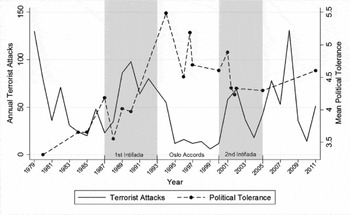
To get a preliminary sense of the sheer magnitude and fluctuation in terrorist attacks over time in Israel, and how they track with aggregate trends in political tolerance, Figure 1 charts the total number of terrorist attacks per year in Israel from 1979 to 2010 (the years prior to the first and last surveys) and the average level of political tolerance across our surveys (1980–2011). There is no question that terrorist attacks in Israel have been chronic and persistent during the three decades of our study: the number of attacks from 1979 to 2010 is huge, at 1,489, with an average of 48 attacks per year. Furthermore, the number of attacks is quite variable over time, with spikes bracketing the beginning of the series in 1979 (with 130 attacks), and near the end of the series in 2008 (with 131 attacks), and falling to a low of six attacks in 1999.
Focusing on political tolerance, short-term fluctuations in forbearance appear to coincide roughly with the number of terrorist attacks. Tolerance begins at a low level in 1980 after the spike of attacks prior to the survey and remains low through the first Intifada from 1987 to 1993, rises with the much lower numbers of attacks during the Oslo Peace Accords period from 1993 to 2000, and then falls again with the spike in terrorist attacks in the second Intifada (2000–2005). Impressionistically, then, the fluctuations in tolerance align with our first hypothesis that terrorist attacks drive tolerance down. Importantly, however, there is a clear long-term trend of rising tolerance. Even in the face of the huge spike in terrorist attacks that occurred with the onset of the second Intifada in 2000, tolerance levels are appreciably higher in 2011 than in 1980. Overall, there is preliminary evidence supporting our first two hypotheses regarding the impact of terrorist attacks and continuous democracy on political tolerance over time.
Method
A true test of our hypotheses, of course, requires estimation of a series of multilevel models, an appropriate method given the multilevel structure of our data and the goals of our analysis (Steenbergen and Jones Reference Steenbergen and Jones2002). Typically, multilevel models evaluate the effect of contextual conditions on individual-level behavior using spatial differentiation (i.e., countries, regions, and states). In this case, however, individuals are nested within surveys conducted at different points in time. Since our aim is to assess the impact of macro-level variables (e.g., terrorist attacks) and individual-level attributes (e.g., Left-Right identification) and their interaction on political tolerance that varies both within and across surveys, ignoring the multilevel nature of our data would lead to statistical and inferential errors. We therefore rely on multilevel statistical techniques that model the macro-level and individual level jointly and estimate separate variance structures to produce unbiased standard errors (Raudenbush and Bryk Reference Raudenbush and Bryk2002).Footnote 13
Multilevel models also “provide a more theoretically satisfying way of dealing with temporal heterogeneity in pooled public opinion data” (Kertzer Reference Kertzer2013, 231). Political scientists most commonly account for time by using year fixed effects for each survey (Beck et al. Reference Beck, Katz and Tucker1998), but that approach is inappropriate in this case because it treats time as problematic whereas we want to model time explicitly by including macro-level characteristics (e.g., terrorist attacks) that change over time. Thus, multilevel models are an especially appropriate and flexible method for our purposes because not only do they avoid bias, but they allow both intercepts and slopes (of individual attributes) to vary over time, and allow macro-level variables to explain why the effects of micro-level variables vary across time (Luke Reference Luke2004).Footnote 14
RESULTS
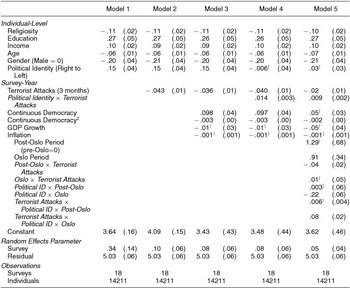
In Table 1, we estimate a series of linear multilevel models. In Model 1, we begin by estimating a “baseline” model consisting of only the effects of the individual-level predictors on tolerance. While our chief interest is in the effects of macro-level factors, the individual-level predictors constitute the primary influence on levels of tolerance and so must be accounted for in the analysis. The individual-level predictors perform as expected, with all parameter estimates achieving statistical significance. Individuals with higher levels of education and income are more tolerant and older respondents and females are less tolerant.Footnote 15 We also find that individuals with more orthodox religious views and those who identify with the political Right are less tolerant. All in all, Model 1 reveals no surprises.
Effect of Terrorism on Political Tolerance in Israel, 1980–2011

† = Coefficient is not significant at the 0.05 level. All other coefficients in the table have p < 0.05.
Note: Entries are maximum likelihood coefficients estimated with Stata 13, with standard errors in parentheses.
Higher values on the following variables indicate: greater political tolerance, orthodox religiosity, female, left political ID, number of terrorist attacks 3 months prior to the survey, continuous years of democracy, GDP growth and inflation.
In Model 2, we add our main explanatory variable to the model—terrorist attacks. Consistent with our first hypothesis (H1), on average, Israelis react to an increase in attacks by lowering political forbearance for their least-liked group. The coefficient of −.043 indicates that a single attack has a relatively small average impact on individual tolerance levels, particularly in comparison to individual-level predictors such as education, political identity, and gender. Considering that the average number of terrorist attacks three months prior to the surveys is approximately 10 and for a third of our surveys the number is close to 20, however, the overall impact of terrorist attacks is substantial.
Continuous Democracy. In Model 3, we add our nonlinear measure of continuous democracy, where we find the first-order and quadratic term coefficients to be statistically significant. In this model and those that follow, continuous democracy has a strong positive effect on tolerance over time, and does not seriously undercut the impact of terrorist attacks on political tolerance.Footnote 16
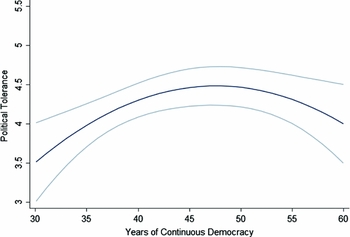
In Figure 2, we display the predicted impact of continuous democracy on individual political tolerance levels, based on the Model 3 estimates in Table 1.Footnote 17 Consistent with the quadratic specification, political tolerance increases more rapidly earlier in the time series with smaller incremental growth in tolerance later in the series, before leveling off and making a slight downward turn. The fact that overall tolerance did not return to the lower level of the early 1980s following the second Intifada is supportive of the democratic learning hypothesis (H2). At a minimum, it strongly suggests that individual tolerance is affected by more than just terrorism and is subject to countervailing macro-level factors.
Predicted Impact of Years of Continuous Democracy on Political Tolerance

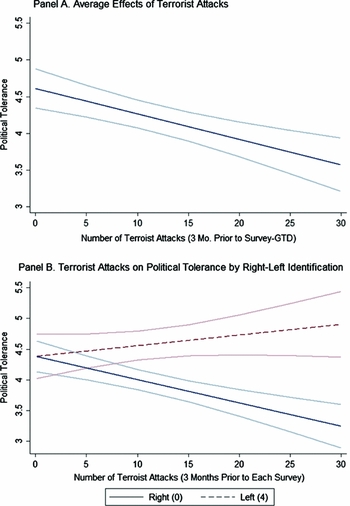
Terrorism, Additive Model. In Figure 3(A), we graph the predicted values of tolerance based on the full additive model (Model 3) across the number of attacks three months prior to the surveys. Here we see a steady decline in individual-level tolerance scores as terrorist attacks increase, resulting in an overall drop in tolerance of about one full point on a nine-point scale. Terrorism thus has a powerful impact on limiting Israelis’ forbearance. Notably, the high end of the terrorism scale is not an outlier in our surveys: fully one-third of the surveys were preceded by between 17 to 31 attacks. To summarize the macro-level results thus far, we have clear evidence for the power of terrorist attacks to increase political intolerance among Israelis in the short term, as well as an important countervailing tendency for the persistence of continuous democracy to enhance political tolerance over the long term.
Predicted Impact of Terrorist Attacks on Political Tolerance

Terrorism, Interactive Model. In Model 4 of Table 1, we add the cross-level interaction between terrorist attacks and political identity to test the two variants of Hypothesis 3. As can be seen in Table 1, the coefficient for the multiplicative term is highly significant. Figure 3(B) presents the predicted values for the effect of terrorist attacks on political tolerance among Israelis on the Right (at point 0 on the political identity scale) and the Left (at point 4), based on the results in Model 4. Their differential reactions to terrorist attacks are striking. For those on the Right, terrorist attacks drive political tolerance sharply downward. But for the most Leftist citizens, there is an opposite tendency to respond to terrorist attacks with greater political tolerance, although the effect is not statistically significant at conventional levels (p = .10, two-tailed). Berrebi and Klor (Reference Berrebi and Klor2008) found a similar tendency for terrorism to polarize the voting preferences of Israelis along ideological lines.
Our findings clearly fit the Right-wing intolerance version of Hypothesis 3 (H3a). On average, when terrorist attacks increase in Israel, the political Right has consistently taken a more hard-line position against its domestic enemies by opposing their right to basic political freedoms, such as the freedom to demonstrate or express their views in the public sphere. In fact, our analysis shows that the increased intolerance following terrorist attacks in Israel is due primarily to the reactions of those on the Right. Terrorism significantly precipitates intolerance only among Israelis who identify themselves as “Right” (p < .001, two-tailed) and “Moderate Right” (p < .001), but not the “Center” (p = .29), the “Moderate Left” (p = .57), or “Left” (p = .10). In other words, across a broad sweep of time in Israel, we find no evidence for the “Rightward shift” hypothesis (H3b); those on the Left do not appear to become less tolerant.
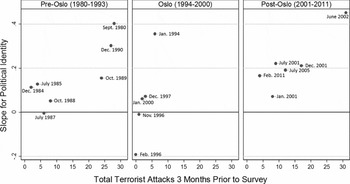
Another Test of the Rightward Shift Hypothesis. It could be argued that a better test of the Rightward shift hypothesis comes after major increases in terrorist attacks, like the upsurge in attacks during the first or second Intifadas. Hetherington and Weiler (Reference Hetherington and Weiler2009, 192), for example, refer to a “high profile terrorist attack” as the kind of circumstances more likely to result in a Rightward shift from individuals not on the Right. To examine this possibility, Figure 4 plots terrorist attacks versus the estimated slopes for political identity in the individual surveys (based on Model 4) across three distinct periods in Israel's history when the number of attacks varied substantially: the pre-Oslo period (1980–1993), when terrorist attacks ranged 4–28, the Oslo period (1994–2000), when attacks were uniformly infrequent (from 0 to 6), and the post-Oslo period (2001–2011), which resembles the pre-Oslo period in the frequency of terrorist attacks, ranging 4–31.
Estimated Slope of Political Identity by Terrorist Attacks (Three Periods)

Given the coding of political identity from Right to Left, support for the Right-wing intolerance hypothesis would be indicated by positive slopes of political identity becoming stronger after an increase in terrorist attacks. By contrast, support for the Rightward shift hypothesis—where the Left becomes more intolerant after a series of attacks—would be indicated by negative (or substantially less positive) slopes in surveys preceded by a larger number of attacks. As can be seen in Figure 4, however, in almost all the surveys, those on the Right express less tolerance than those on the Left—i.e., the slope for political identity is positive. And while the relationship is not perfect, there is a clear tendency for the positive slope of political identity to strengthen, not weaken, in surveys preceded by an upsurge of terrorist attacks in the pre-Olso period (e.g., 1980, 1989, and 1990) and the post-Oslo period (e.g., Dec. 2001 and June 2002). By contrast, in the Oslo period, with much lower variability and frequency of terrorist attacks, there is very little relationship between the number of attacks and the slope of political identity.Footnote 18
Clearly, these findings are more consistent with the Right-wing intolerance hypothesis (H3a) than the Rightward shift hypothesis (H3b).Footnote 19 Our results indicate that the ideological divergence in reactions to terrorism predates the second Intifada and has been a fixed feature of the Israeli political landscape for some time.
Terrorism over Time, across Ideology. In the last portion of the analysis, we test whether the impact of persistent terrorist attacks on political tolerance strengthens over time (H4) and across ideological groups (H5a-b). For our purposes, the most compelling over time comparison is between the pre- and post-Oslo periods. Together they constitute a long sweep of time (23 of the 30 years) that is captured by 13 of our 18 surveys. The two periods are also comparable in terms of the range and the average number of terrorist attacks occurring three months prior to the surveys (at 13.9 and 12.9 attacks, respectively), and the fact that both periods include an organized terrorist campaign, namely the first and second Intifadas.
Given the strong support for the Right-wing intolerance hypothesis in prior analyses, it makes sense to focus our attention on Hypothesis 5a, which predicts a greater over-time increase in sensitivity to terrorism among the Right wing. Accordingly, Model 5 includes three-way interactions between terrorism, political identity and two period dummies, Oslo and post-Oslo, with pre-Oslo as the excluded category, in addition to lower-order terms.Footnote 20 Although the three-way interaction, Post-Oslo × Terrorist Attacks × Political Identity, is not significant (p = .19), a more precise test of H5a finds support in the significant coefficient for Post-Oslo × Terrorist Attacks (−.04), which gives the difference in the effect of terrorist attacks across the pre- and post-Oslo periods only for those on the Right (where Political Identity = 0).
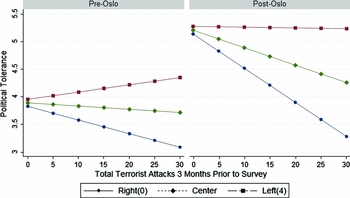
Given the difficulty of interpreting three-way-interactions, Figure 5 presents the estimated effects of terrorist attacks on political tolerance among individuals who identify with the Right (coded 0), Center (2), and Left (4) across the pre-Oslo and post-Oslo periods. Consistent with hypothesis H5a, those on the Right are much more sensitive to terrorist attacks in the post-Oslo period than the pre-Oslo period, while the over-time difference is much smaller for those in the Center and almost nonexistent for those on the Left. Another key difference across the two periods made clear from Figure 5 is the higher level of tolerance for all three groups at low levels of terrorist attacks, which is a full point higher in the post-Oslo period. The higher level of forbearance is likely attributable to two factors—democratic longevity and the relative absence of terrorist attacks during the Oslo period.Footnote 21
Impact of Terrorism among Right, Center, and Left across Pre- and Post-Oslo Periods

The slopes for terrorist attacks for each of the three groups in the figure provide a sense of the magnitude of change, or lack thereof, across the two periods. Those on the Right in the post-Oslo period show the strongest reaction at higher levels of terrorist attacks and therefore the steepest descent in forbearance. The post-Oslo slope for Right-wingers is more than twice as large as the pre-Oslo slope (b = −.057 (se = .19) versus b = −.02 (se = .01), respectively). By contrast, those on the Left do not respond strongly to high levels of terrorism in either period (neither effect is significant), while the impact of terrorist attacks among Centrists is only significant in the post-Oslo period (b = −.03) at the .10 level.
To summarize, those on the Right (and, to a much lesser extent, Centrists) are clearly more sensitive to persistent terrorist attacks in the post-Oslo period. In contrast to those on the Left, who appear to maintain the higher levels of political forbearance gained over time between the pre- and post-Oslo periods, Right-wingers exposed to high levels of attacks in the latter period appear to abandon any good will they may have acquired toward their least-liked group. Thus, as is true for the entire time series (Figure 3(B)), the greater impact of terrorism in the post-Oslo period is primarily due to reactions of individuals on the Right. On the other hand, the maintenance of higher levels of tolerance in the face of persistent terrorism in the post-Oslo period is due mostly to Leftists and, to a lesser extent, Centrists.
Perhaps the greater sensitivity of Right-wingers is due to their greater tendency to select least-liked groups they (mistakenly) associate with terrorism, i.e., Arab groups (see Note 9 and Table A3 of the Online Appendix). Further analysis (not shown) casts doubt on this explanation, however. In fact, the impact of terrorism on tolerance among the Right does not differ significantly when Right-wingers select Arab versus non-Arab (mostly Jewish Left wing) groups in either the pre-Oslo or post-Oslo period.Footnote 22 Interestingly, for Leftists and Centrists, it is only in the pre-Oslo period that the impact of terrorism on tolerance is greater when Arab versus non-Arab groups are selected as least-liked. These differences vanish in the post-Oslo period.Footnote 23
The broader implications of these results are discussed in the conclusions. For now, we underline the important finding that the impact of terrorism on tolerance in Israel is driven primarily by its Jewish citizens on the Right. Whether we focus on the average impact of terrorism across the 30 years of our study or the stronger influence of persistent terrorism in the post-Oslo period, terrorism drives down forbearance primarily among individuals who identify with the Right. Thus, the evidence tilts decidedly toward the Right-wing intolerance hypothesis.
CONCLUSIONS
Research over the past decade has made remarkable progress in elevating our understanding of how terrorism moves mass behavior in democracies. Ours is the first study to take on an important but neglected question: To what degree do persistent terrorist attacks erode public support for political tolerance—i.e., granting basic civil liberties and political freedoms to one's domestic enemies? This is a critical question for the health and the very survival of democracies because persistent attacks over time challenge the public's commitment to democratic values and institutions. Israel has proved to be an excellent case for examining this question longitudinally, with sharp ups and downs in both terrorism and forbearance for least-liked groups that have a real political presence in the country. Not only is Israel's experience relevant to the dozen or so other democracies under threat from severe terrorism around the world, it also provides one of the few cases where it is possible to evaluate the generalizability of hypotheses from tolerance studies in the U.S. in a setting of persistent terrorism.
Prior research in the U.S. clearly shows that threat from terrorism increases public support for restrictive counterterrorism policies. Our study moves beyond this research by demonstrating that fluctuations in actual terrorist attacks over a 30-year period in Israel are strongly associated with the rise and fall of political tolerance measured by the least-liked method. Persistent and chronic terrorism has a powerfully corrosive effect in undermining public support for the application of democratic norms and minority rights. This is an important result because political intolerance has profound political consequences for democracies, contributing to a culture of political conformity and the enactment of politically repressive policies toward unpopular groups (Gibson Reference Gibson2006, Reference Gibson2008). Tragically, the domestic groups that experience the greatest political discrimination and restrictions on their political freedoms tend to be “fellow travelers” who pose no real security threat to the state: Muslim Americans after 9/11 in the U.S. and Arab citizens of Israel throughout its history.
While we found the primary force of terrorism on tolerance to be relatively short-lived—captured best by a three-month lag prior to the surveys, we also found that despite decaying after three months, attacks continued to have a significant, albeit diminished, impact on tolerance for up to a year after their occurrence. In addition to these direct effects of terrorism on forbearance, more indirect and long-lasting influences are also possible, even likely. We know, for example, that terrorism encourages a Rightward shift in Israeli voting behavior (Berrebi and Klor Reference Berrebi and Klor2008; Getmansky and Zeitzoff Reference Getmansky and Zeitzoff2014), often bringing to power a Right-wing government inclined to curtail the civil liberties of its domestic enemies. Moreover, if terrorism also produces a Rightward shift in political identification, its effects could produce a more enduring shift in the balance of power in Israel. Our preliminary analysis found little evidence for such a shift (see Note 19), but a more definitive assessment requires a separate investigation. Regardless, we know from studies in the U.S. that public concern about terrorism remained high years after 9/11, and merely raising the salience of terrorism can increase support for counterterrorism policies and intolerant attitudes (e.g., Brooks and Manza Reference Brooks and Manza2013; Malhotra and Popp Reference Malhotra and Popp2012; Merolla and Zechmeister Reference Merolla and Zechmeister2009). It stands to reason that chronic terrorism likely creates a context that allows elites to stoke public fears even longer.
Beyond revealing the impact of terrorism on forbearance in the near term, our study also uncovered important evidence for the long-term resilience of democratic commitments in the face of chronic terrorism. Consistent with the democratic learning hypothesis, we found that years of continuous democracy in Israel increased the level of political tolerance over time, and even in the aftermath of the second Intifada overall tolerance did not return to the low levels of the early 1980s. Our results thus speak volumes about the ability of democracies to sustain themselves, even though chronic terrorism constitutes a real, ongoing danger to democratic quality and even survival.
To be sure, the outcome of the push of democratic forces in Israel against the strong pull of intractable conflict and threat is in no way inevitable. Although Israel as well as several other democracies beset with chronic terrorism (e.g., India, Spain, and Northern Ireland) sustained a commitment to democracy, not every democracy survives the strain of chronic threat. Among the top 25 targeted countries, a slew of emerging democracies—Peru, Pakistan, Russia, Sri Lanka, Turkey, and Thailand—suffered a democratic reversal (i.e., became nondemocratic) during the time period of our study. Of those reversals, only Peru and Turkey returned to and remained a democracy.
The democratic reversal in Peru in 1992 after only a decade of democratic government provides a useful contrast. Like Israelis, Peruvians faced pervasive terrorist threat since the start of their democracy in 1980, with violence escalating for the next 12 years when, in 1992, Peru's President Fujimori announced his autogolpe (self-coup) that suspended democratic governance and instituted authoritarian rule that lasted until 2000, a move he claimed was necessary to restore security (see Arce Reference Arce2003). By contrast, in the early 1990s, Israel had been a democracy for over 40 years and the “Constitutional Revolution” had further established the independence of its judiciary, a critical institution for democratic learning.
Additional research is necessary to identify the mechanisms that underlie democratic longevity—be they democratic socialization practices, institutions such as an independent judiciary, or historical cultural factors such as a liberal legacy. A much-needed complementary strategy to our multilevel analysis of survey data would undertake comparative studies of the dynamics of the push and pull of democratic longevity and terrorism, as well as other factors that elevate or depress political tolerance over time in resilient versus deteriorating or defunct democracies.
Another key finding of our study is that the impact of terrorism on political tolerance works primarily through the responses of those on the Right, whose forbearance in Israel was far more likely to be stymied by terrorist attacks than those on the Left. In fact, much of the downturn in tolerance occurring after an upsurge in terrorist attacks in Israel was due to the reactions of individuals on the Right—moving toward intolerance. Our investigation of change in the impact of terrorism on tolerance across the pre- and post-Oslo periods turned up similar results. Even if individuals habituate themselves to chronic terrorism in their daily lives, we found that many Israelis, particularly those on the Right, became more, not less, sensitive to terrorist attacks in the post-Oslo period, compared with the pre-Oslo period. Thus, the downturn in tolerance that occurred with the onset of the second Intifada (Figure 1) occurred primarily because Right-wingers became more intolerant toward their domestic enemies—mostly Arab and Jewish Leftist groups. Forbearance among Left-wingers, on the other hand, appeared more resilient to the attacks of the post-Oslo period.
Thus, our findings consistently line up in support of the Right-wing intolerance hypothesis (H3a, H5a) but not the Rightward shift hypothesis (H3b, H5b). The convergence between our results and those from experimental studies in the U.S. (e.g., Merolla and Zechmeister Reference Merolla and Zechmeister2009) is revealing, but further research should examine more closely the limiting conditions of the Rightward shift hypothesis in the U.S. and other countries (e.g., Malhotra and Popp Reference Malhotra and Popp2012).Footnote 24
Although the Right-wing intolerance hypothesis is based on a bedrock of cross-national research, it is also worth noting how Israeli politics influences the responses of those on the Right. As noted, terrorism in Israel is anchored in the Palestinian-Israeli conflict, as it is perpetrated mostly by Palestinians from the occupied territories. Consequently, beyond its immediate physical danger, terrorism also triggers a threat to Jewish national identity, which is valued more by the Right than the Left (Shamir and Arian Reference Shamir and Arian1994), increasing the association between terrorism and Israeli Arabs (and, thus, Arab groups as well as Jewish Left-wing groups) among individuals on the Right. As noted earlier, there is every incentive for Israeli politicians, particularly those on the Right who clearly “own” the issues of national security and terrorism, to use fear to manipulate the public for political gains and for justifying the repression of the Arab/Palestinian minority. The role of elite political rhetoric in stoking fears of terrorism and political intolerance in Israel and elsewhere clearly requires further study (see Lupia and Menning Reference Lupia and Menning2009).
While the reactions of those on the Right are consistent with the Right-wing intolerance hypothesis, the tendency for Israeli Left-wingers to become slightly more tolerant (though not significantly so) in response to terrorism (Figure 3(B)) and to maintain their higher tolerance in the post-Oslo period (Figure 5) requires further explanation. One likely reason is that Leftists in Israel have traditionally been more supportive of minority rights, particularly for Israeli Arabs, than Right-wingers (e.g., Shamir and Sullivan Reference Shamir and Sullivan1983). Another explanation focuses on the psychological orientations, such as authoritarianism and dogmatism, long found to be associated with Right-Left identification in Israel (e.g., Halperin and Bar-Tal Reference Halperin and Bar-Tal2011; Shamir and Sullivan Reference Shamir and Sullivan1983).Footnote 25 In her wide-ranging study of the “authoritarian dynamic” that includes both experimental and cross-national survey evidence, Stenner (Reference Stenner2005) repeatedly found that threat activates polarized responses, with authoritarians becoming less tolerant and nonauthoritarians (which she terms libertarians) becoming more tolerant.Footnote 26 Thus, while data limitations prevent us from pinpointing the precise micro-level mechanisms that give rise to diverging Right-Left responses to terrorism in Israel, such polarized responses are quite consistent with theory and prior research.
Our study also has important implications for the way political tolerance and other attitudes can and should be studied in the future. One limitation of an observational study like ours is that it cannot provide the kind of strong evidence of causation that experimental or true panel studies can. Yet, in order to examine the dynamics of persistent terrorism on political tolerance over a 30 year period, our use of a repeated cross-sectional design in a multilevel framework was essential for complementing and extending studies using other methods. Certainly a key advantage of our 30-year study of the effects of terrorism and democratic longevity on tolerance in Israel is that it constitutes over half of Israel's existence as a nation state.
On balance, our longitudinal case study in Israel has provided unprecedented insight into the resilience and the pliability of ordinary citizens’ application of democratic values under conditions of chronic terrorism. The most general lesson from our study is that the political tolerance of democracies under threat is the product of an ongoing struggle that takes place not only within individual citizens, but also between political groups and political institutions, where a commitment to minority rights and political freedoms for all adult citizens labors against existential fears of terrorism and security.
SUPPLEMENTARY MATERIAL
To view supplementary material for this article, please visit http://dx.doi.org/10.1017/S0003055415000441




Comments
No Comments have been published for this article.