Introduction
In mucosal chronic otitis media (COM), there is a permanent perforation of the pars tensa portion of the tympanic membrane, which requires surgical management called tympanoplasty.Reference Wallis, Atkinson and Coatesworth1 The main goals of surgery are to achieve a dry ear by eradicating middle-ear disease and improvement in hearing by closure of any tympanic membrane perforation by grafting and/or ossicular chain reconstruction.Reference Gulya, Minor and Poe2 Temporalis fascia and cartilage are the most commonly used grafts.Reference Sood, Pal and Singla3 There has been a great interest in using graft materials other than temporalis fascia.Reference Yung4 Cartilage is considered to be a better graft material than other graft materials as it can obtain essential nutrients through diffusion, which may improve graft uptake rate.Reference Ozbek, Çiftçi, Tuna, Ö and Ozdem5 Cartilage is resistant to retraction because of negative middle ear pressure leading to better outcomes.Reference Kolethekkat, Al and Al6 However, increased thickness of cartilage may negatively affect graft integration and hearing post-operatively.Reference Jalali, Motasaddi, Kouhi, Dabiri and Soleimani7 Platelet-rich plasma (PRP) acts as an immediate surgical haemostatic agent that is biocompatible, safe and effective. It improves overall graft uptake rate in myringoplasty by preventing graft shrinkage.Reference Yadav, Malik, Malik, Sehgal, Gulia and Ranga8 None of the grafts has shown a 100 per cent uptake rate. Therefore, there is always a search for newer graft materials and techniques. There has recently been great interest in using platelet-rich fibrin (PRF) as a graft in tympanoplasty. In this study, we suggest a new graft harvesting technique by combining cartilage and PRF. Using this hybrid graft technique allows controlled thinning of the cartilage and rapid recovery.Reference Kaya, Şahin, Tanrıverdi and Kirazlı9
Materials and methods
Patients
This was a prospective randomised control study of patients suffering from COM (inactive mucosal disease) who presented to the Outpatient Department of ENT & Head and Neck Surgery at Maulana Azad Medical College and the associated Lok Nayak Hospital in New Delhi. The study was conducted for one year after approval from the Institutional Ethical Committee.
Patients with COM (inactive mucosal disease) aged between 18 and 60 years having small- (occupying an area equivalent to 1 quadrant) to medium-sized (occupying an area equivalent to 2 quadrants) dry central perforation of the pars tensa and good cochlear reserve (normal bone conduction) were included in the study.
Written informed consent was obtained from all the patients. Patients were subjected to detailed history, clinical examination and routine blood investigations. All patients underwent pre-operative Pure Tone Audiometry (PTA) and air-bone gap (ABG). All the patients were then taken up for surgery under local anaesthesia.
Surgical technique
Patients were divided into two groups randomly using a computer-generated random table:
Control group – all patients underwent endoscopic tympanoplasty using tragal perichondrium graft.
Study group – all patients underwent endoscopic tympanoplasty using tragal cartilage and cubism graft.
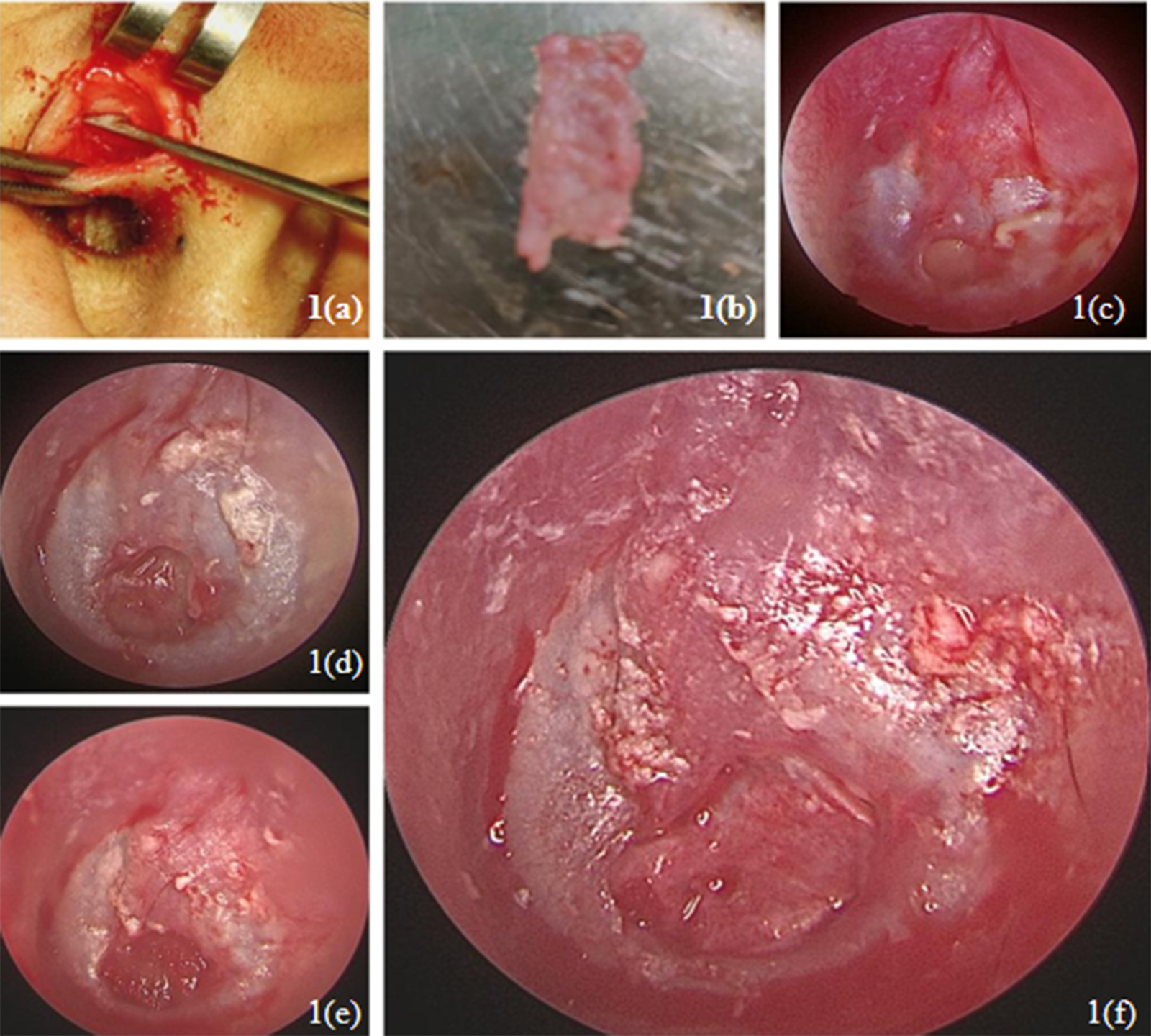
1) Surgical technique for the control group: (Figure 1: (a) to (f)).
i. The procedure was done by transcanal endoscopic approach.
ii. A tragal perichondrium graft was harvested.
iii. The margins of the tympanic membrane perforation were freshened.
iv. The middle ear was packed with gelatinous sponge soaked with an antibiotic. The graft was tucked in through the perforation using pop-in technique.
v. The external auditory canal was packed with small pieces of gelatinous sponge.
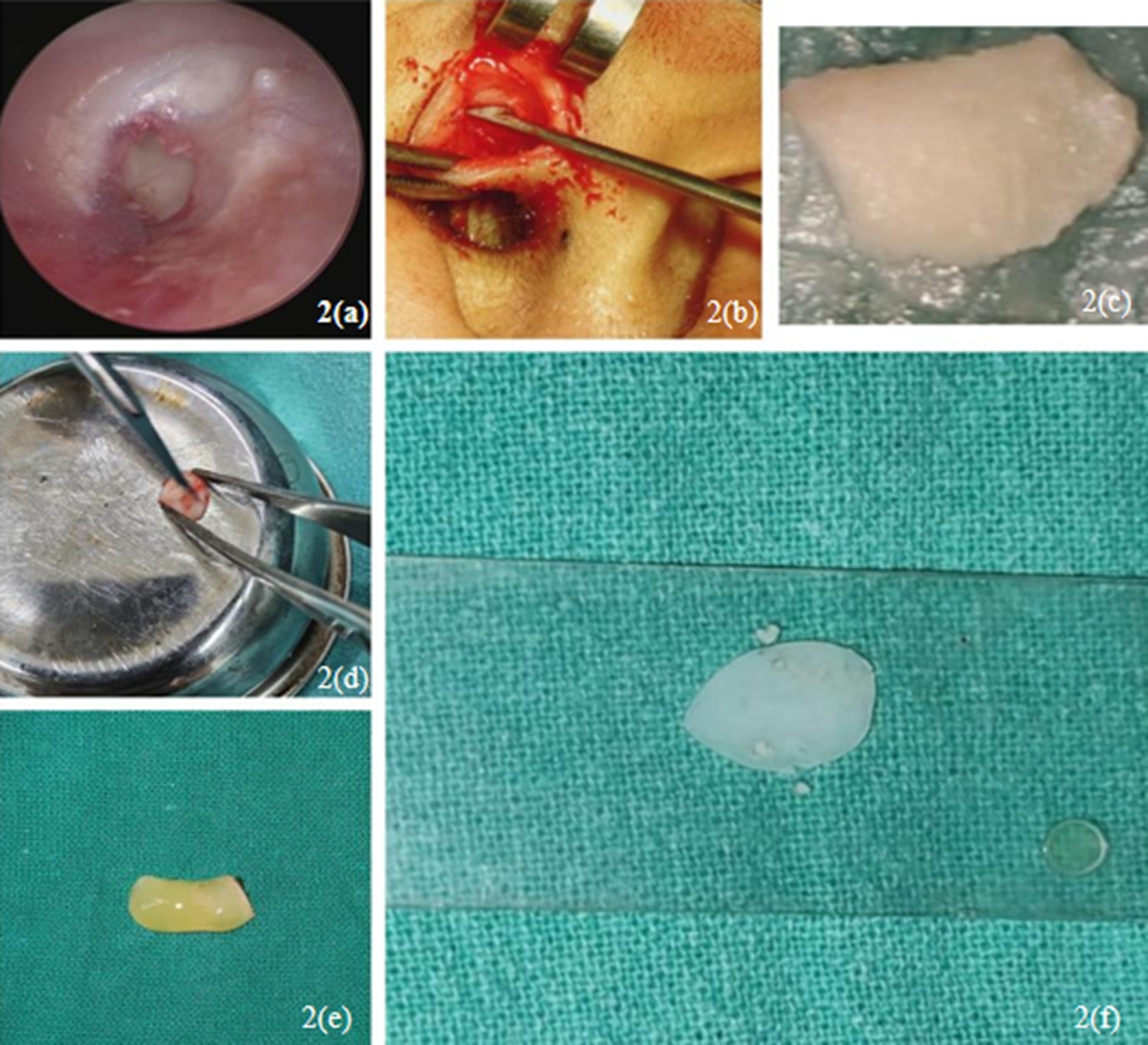
2) Surgical technique for the study group: (Figure 2).
i. The procedure was done by transcanal endoscopic approach.
ii. The perforation edges were freshened. (Figure 2a).
iii. Tragal cartilage was harvested, and perichondrium was separated from the convex surface. (Figures 2b and 2c).
iv. The perichondrium-free side of the cartilage was thinned out adequately by brushing with blade no. 11 (holding it perpendicular to the cartilage) to form a flat cartilage island graft. Meanwhile, dough-like cartilage dust, which was accumulated on the scalpel, was collected to prepare the cubism graft. (Figure 2d).
v. A venous blood sample was taken in a 10 ml sterile tube without anticoagulant. The sample was centrifuged at 3000 rpm for 10 minutes. The PRF was formed as a fibrin clot (Figure 2e) in the tube. The PRF was collected from the tube, and the collected cartilage dust was mixed with the PRF. Then, the cartilage dust-PRF mixture was pressed between two thick glass slides, thus, forming a cubism graft. (Figure 2e).
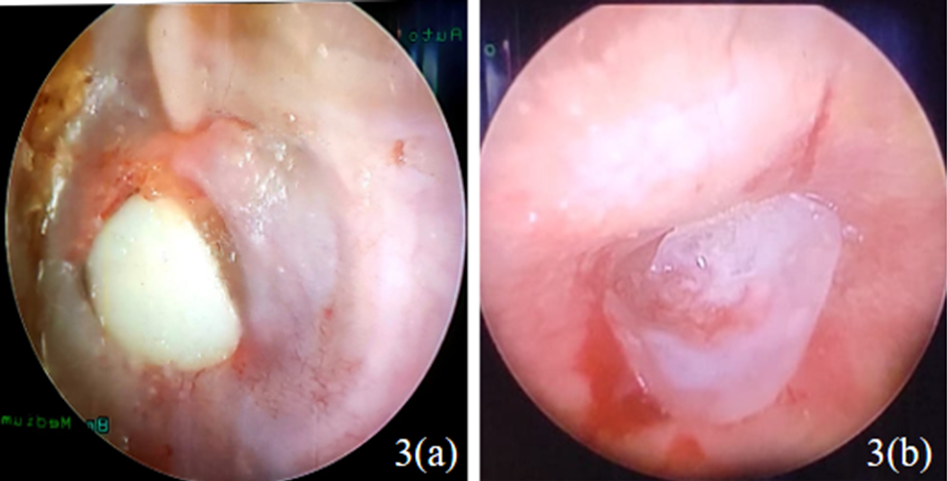
vi. The flat cartilage island graft was placed medial to the tympanic membrane perforation. (Figure 3a).
vii. After the placement of the cartilage island graft, the cubism graft was placed over the island graft as the second layer. (Fig. 3b).
viii. The external auditory canal was packed with gelatinous sponge.
Showing surgical technique of group A patients: (a) Harvesting tragal perichondrium. (b) Harvested tragal perichondrium. (c) Small central perforation. (d) Margins of perforation freshened. (e) Middle ear packed with gelfoam. (f) Tragal perichondrium placed over the perforation (pop-in technique).

Showing preparation of cubism graft: (a) Margins of perforation freshened. (b) Harvesting tragal cartilage. (c) Tragal cartilage after removal of cartilage from convex side. (d) Thinning of tragal cartilage and cartilage dust formation. (e) PRF prepared. (f) Formation of cubism graft.

(a) Placement of tragal cartilage medial to perforation. (b) Placement of cubism graft over the perforation.

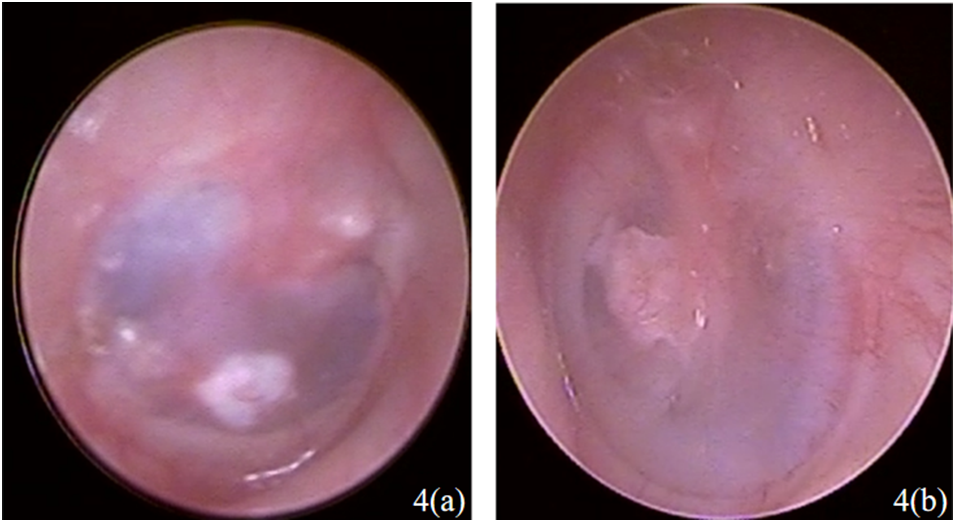
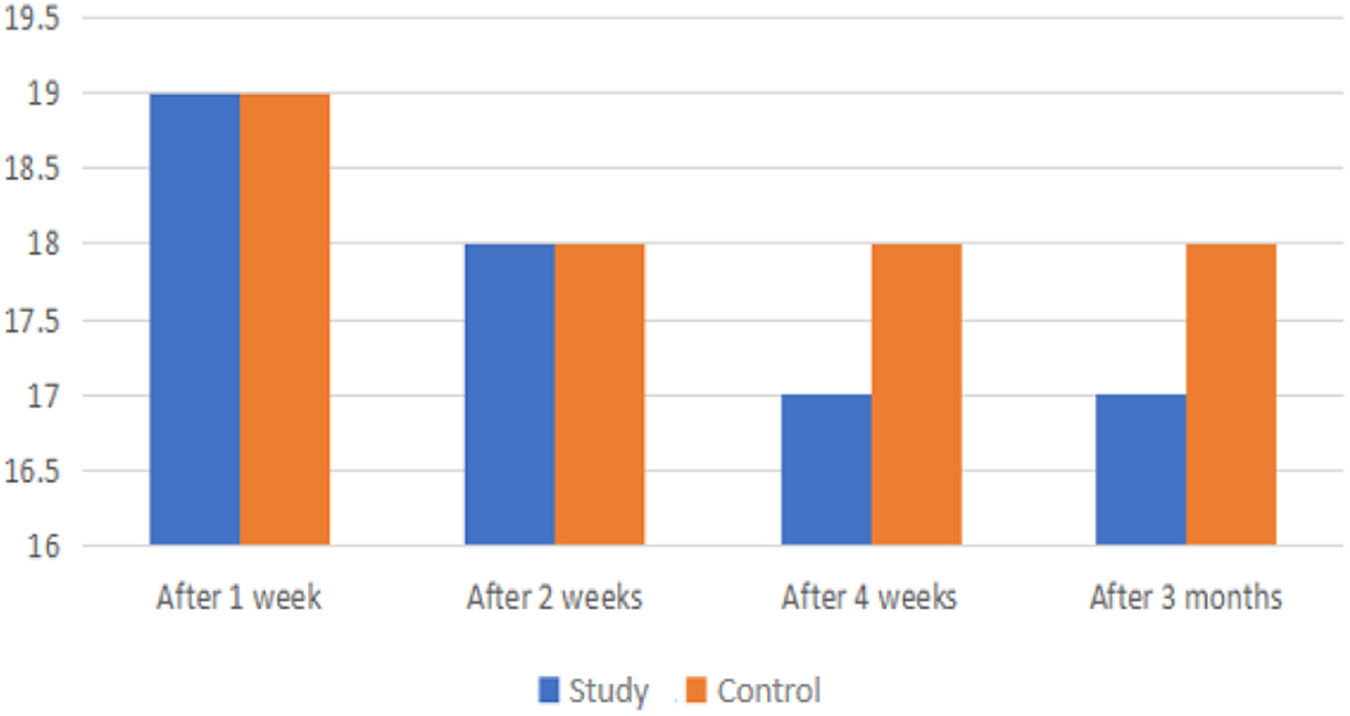
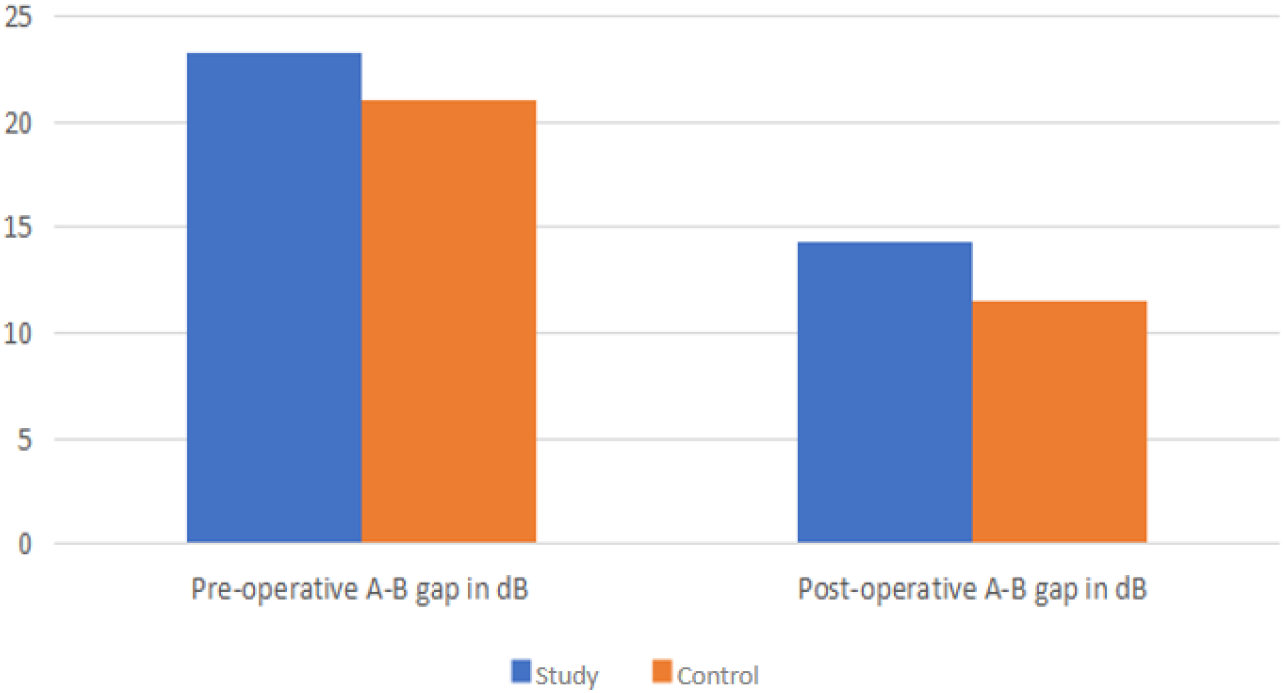
Assessment of graft uptake (Fig. 4) and follow-up PTA (Fig. 5 & 6) was done after three months from the date of surgery in both groups.
Post-operative graft uptake after three months: (a) Cubism graft with tragal cartilage. (b) Tragal perichondrium graft.

Showing the graft uptake in both the groups.

Comparing the ABG in the two groups.

Results
Both groups had 20 patients each. It was observed that the mean age of study group patients was 34 years, while for control group patients, it was 29 years. There was no statistically significant difference between the two groups in terms of age. In the study group, 15 patients were female, while in the control group, 13 patients were female. The distribution of both groups according to sex was comparable in the two groups. There was a small-sized perforation in 16 patients in the control group and in 15 patients in the study group. Fifteen patients had mild conductive hearing loss in the study group, while five patients had moderate conductive hearing loss. In the study group, 14 patients had mild hearing loss while 6 had moderate hearing loss. In both groups, graft uptake was observed in 95 per cent (19 patients) after one week. After two weeks, the rate deteriorated marginally to 90 per cent (18 patients) in both groups. The graft uptake was successful in the study group in 85 per cent (17 patients), while in the control group, it was in 90 per cent (18 patients) after one month and three months. It was observed that the difference between the two groups was not statistically significant (p = 0.6).
It was observed that the mean pre-operative ABG in the study group was 23.2 ± 6.5 dB, while for the control group, it was 21 ± 4.8 dB. The difference between both groups was not statistically significant (p = 0.2). Additionally, post-operative mean ABG in the study group was 14.2 ± 4.4 dB, while for the control group, it was 11.5 ± 4.3 dB. The reduction in ABG in the study group was 9 ± 6 dB, while for the control group, it was 9.5 ± 6 dB, not statistically significant between the two groups. (p = 0.8).
Discussion
The management of COM is mainly surgical, and there have been various advancements in surgical techniques recently. Different types of graft materials have been used by various authors for the management of inactive mucosal disease. PRF has a significant role in cell proliferation and healing.Reference Tiple, Chirila, Vesa and Stamate10 In our study, we have used a new graft material, i.e. cubism graft combined with tragal cartilage. The advantage of using cartilage is that it is resistant to resorption, retraction and atelectasis.Reference Jalali, Motasaddi, Kouhi, Dabiri and Soleimani7 Also, tragal cartilage, being rigid, is easy to manipulate. It is easily accessible and sufficient in quantity.Reference Parelkar, Thorawade, Marfatia and Shere11 Using partial-thickness cartilage is better than full-thickness cartilage for improvement of hearing.Reference Kaya, Şahin, Tanrıverdi and Kirazlı9 The thickness of tragal cartilage is less than that of conchal cartilage.Reference Rana, Sharma, Sharma, Mehrotra and Upadhyay12 Smith et al. conducted a study on the properties and clinical applications of PRP, and concluded that autologous PRP is a relatively new biotechnology that has shown promise in the stimulation and acceleration of soft tissue and bone healing. It also stimulates angiogenesis and increases collagen synthesis.Reference Smith, Gassmann and Campbell13 In the present study, only patients with small or medium central perforation were included. Tragal cartilage was put medial to the perforation and the cubism graft lateral to the perforation in the study group, whereas tragal perichondrium was put over the perforation, and its edges were tucked inside perforation margins in the control group. Shukla conducted a study in which graft placement was in two layers, i.e. the first one was an underlay and the second layer an overlay, whereas in the second group, PRF was placed overlay.Reference Shukla, Kaurav and Vatsyayan14 However, patients with thrombocytopenia or anaemia are not suitable candidates for this technique.Reference Yadav, Malik, Malik, Sehgal, Gulia and Ranga8 Kaya et al. combined cartilage thinning and cubism graft technique similar to the present study. Forty-four patients were randomly divided into two double-layer graft groups: the cartilage island graft with cubism graft (study group) and the cartilage island graft with extra perichondrium (control group). Controlled thinning of the cartilage prevents its over-curling. It was concluded that the ABG gain in the study group and in the control group after one month was statistically significant. An average ABG gain of 16.3 ± 2.9 dB (10.7–22.3 dB) was observed in the study group and 14.9 ± 3.9 dB (8.5–22.7) in the control group after six months (statistically not significant).Reference Kaya, Şahin, Tanrıverdi and Kirazlı9 The mean improvement in post-operative ABG in our study was equivalent to 9 dB, which slightly differs from the results of the study group of the above study. The study conducted by Shukla et al. achieved successful closure with intact tympanic membrane in 85.4 per cent of cases, however, post-operative discharge persisted in 12.2 per cent of cases in his study and concluded that transcanal myringoplasty with PRF can be used as an effective day-care procedure for patients presenting with chronic perforations of the tympanic membrane.Reference Shukla, Kaurav and Vatsyayan14 In our study, successful closure of tympanic membrane perforation was achieved in 90 per cent of patients in the control group and 85 per cent of patients in the study group. Statistically significant closure of ABG was achieved in both groups, Kaya achieved 100 per cent graft success in their study group and 95.5 per cent success in the control group.Reference Kaya, Şahin, Tanrıverdi and Kirazlı9 Since the tympanomeatal flap was not elevated in the present study, ossicular mobility and status could not be confirmed intra-operatively, and therefore patients with an ABG greater than 40 dB were excluded to rule out ossicular pathology. However, since double-layered tympanoplasty has been undertaken, the chances of graft uptake are higher. The chances of injury to the chorda tympani nerve and ossicles are less, as the tympanomeatal flap is not elevated. The new cubism graft offers several advantages, and it is a cost-effective technique. Thus, cubism graft is a novel graft with a promising result.
Conclusion
The present study concludes that the graft uptake rate is high after three months in cases with small- to medium-size perforation, which underwent endoscopic tympanoplasty using tragal cartilage and cubism technique. Cubism graft with tragal cartilage being a double-layered graft is better, which enhances the strength and resists further retraction, hence giving good results; however, long-term follow-up needs to be done.
Acknowledgements
None.
Financial Support
This research received no specific grant from any funding agency, commercial or not-for-profit sectors.
Competing Interests
The authors declare none.
Ethical Standards
The authors assert that all procedures contributing to this work comply with the ethical standards of our national and institutional guidelines on human experimentation and with the Helsinki Declaration of 1975, as revised in 2008. The authors assert that all procedures contributing to this work comply with our institutional and national ethical standards. The Institutional Ethical Committee has approved the study.