Traumatic brain injury (TBI) is an acquired injury caused by an external force to the head or skull (Centers for Disease Control and Prevention, 2020) that leads to trauma to one or more areas of the brain, causing a disruption in brain function (Johns Hopkins Medicine, 2020). When trauma occurs in the prefrontal cortex, areas of the limbic system and/or parietal lobe, a person’s social and emotional wellbeing may be significantly impacted due to deficits in social cognition (Adolphs, Reference Adolphs2002; McDonald & Flanagan, Reference McDonald and Flanagan2004; Milders et al., Reference Milders, Ietswaart, Crawford and Currie2008; Wauters & Marquardt, Reference Wauters and Marquardt2019). As a result of these deficits, people with TBI often demonstrate inappropriate social behaviour, have difficulty maintaining social or community participation and have reduced employment opportunities (Engberg & Teasdale, Reference Engberg and Teasdale2004; Godfrey & Shum, Reference Godfrey and Shum2000; Linden et al., Reference Linden, Crothers, O’Neill and McCann2005; McDonald, Reference McDonald2003; Milders et al., Reference Milders, Ietswaart, Crawford and Currie2008; Ponsford, Reference Ponsford2013; Stiers et al., Reference Stiers, Carlozzi, Cernich, Velozo, Pape, Hart and Whiteneck2012; Temkin et al., Reference Temkin, Corrigan, Dikmen and Machamer2009). Combined, these adverse consequences of TBI impact one’s psychological and social wellbeing (hereon in called psychosocial functioning). Deficits in social cognition post-TBI negatively impact psychosocial functioning because they can lead to inappropriate social responses and behaviour which degrade social communication and reduce social participation in the community (Godfrey & Shum, Reference Godfrey and Shum2000; Milders et al., Reference Milders, Ietswaart, Crawford and Currie2008; Neumann et al., Reference Neumann, Zupan, Eberle, Silver, McAllister and Archineigas2019; Williams et al., Reference Williams, Wood, Alderman and Worthington2020). This often results in social isolation, reduced life satisfaction and a worse quality of life (Binder et al., Reference Binder, Lancaster, Lengenfelder, Chiaravalloti and Genova2019; J. D. Corrigan et al., Reference Corrigan, Bogner, Mysiw, Clinchot and Fugate2001; Juengst et al., Reference Juengst, Arenth, Raina, McCue and Skidmore2014; May et al., Reference May, Milders, Downey, Whyte, Higgins, Wojcik and O’Rourke2017; Ponsford, Reference Ponsford2013; Temkin et al., Reference Temkin, Corrigan, Dikmen and Machamer2009).
Social cognition is comprised of three interrelated, but dissociable components – emotion perception, empathy and Theory of Mind (ToM) (Cassel et al., Reference Cassel, McDonald, Kelly and Togher2019; Cotter et al., Reference Cotter, Granger, Backx, Hobbs, Loi and Barnett2018; Williams et al., Reference Williams, Wood, Alderman and Worthington2020). Emotion perception, which includes the ability to recognise and interpret emotion using available cues (e.g., facial expressions, vocal expressions), is an important aspect of social cognition because it allows one to relate to others (Burns, Reference Burns and Pachana2017; Milders et al., Reference Milders, Ietswaart, Crawford and Currie2008) and facilitates effective communication (McDonald, Reference McDonald2012). Much of the research in emotion perception following TBI has focussed on facial emotion perception. However, another component, vocal affect recognition, is just as important in facilitating communication. The voice also plays a pivotal role in emotion recognition in everyday conversation because it carries two sources of information – verbal and nonverbal. The verbal cues within the message comprise the linguistic or semantic component and deliver the literal and symbolic information of the message (Liebenthal et al., Reference Liebenthal, Silbersweig and Stern2016; Zupan et al., Reference Zupan, Neumann, Babbage and Willer2009). The nonverbal component of the message is defined by a combination of pitch, intensity and rhythm cues (Liebenthal et al., Reference Liebenthal, Silbersweig and Stern2016). Thus, the nonverbal paralinguistic cues, known as tone of voice or prosody, carry the affective meaning of the message. The combination of verbal and nonverbal vocal cues can be manipulated to convey a specific meaning. For instance, the speaker might create incongruity between the two components of the vocal message in order to convey irony or sarcasm (Pell et al., Reference Pell, Jaywant, Monetta and Kotz2011). Therefore, the capacity to understand emotion and meaning conveyed in the voice is fundamental to successful social interactions.
Empathy, the second component of social cognition, involves the ability to recognise and understand why someone is experiencing a particular emotion, as well as the capacity to share in that emotion and respond appropriately (Khanjani et al., Reference Khanjani, Mosanezhad, Hekmati, Khalilzade, Etemade, Andalib and AShrafian2015; Williams & Wood, Reference Williams and Wood2010; Zupan et al., Reference Zupan, Neumann, Babbage and Willer2018). It has been proposed that intact emotion perception is necessary for empathy (Lawrence et al., Reference Lawrence, Shaw, Giampietro, Surguladze, Brammer and David2006). Given that lower levels of empathy have been shown to correlate with poorer social behavioural outcomes following moderate to severe TBI (Milders, Reference Milders2019), it is important to also explore whether there is a relationship between one’s emotion perception abilities and their empathy; specifically their capacity to recognise emotion conveyed through the voice. This has important implications for intervention given the need to fully understand what is contributing to poor psychosocial outcomes to properly mitigate them.
ToM, the third component of social cognition, includes the ability to make accurate inferences regarding others’ intentions including interpretation of the thoughts, beliefs, desires, and intentions of others (Wimmer & Perner, Reference Wimmer and Perner1983). Connected to this is the ability to infer a speaker’s meaning during communication exchanges, particularly when the information is ambiguous (e.g., faux pas, sarcastic remarks; MacDonald, Reference MacDonald2017; McDonald, Reference McDonald2012; McDonald et al., Reference McDonald, Saad and James2011; McDonald & Flanagan, Reference McDonald and Flanagan2004; Turkstra, Reference Turkstra2008). To do this accurately, one would need to be able to also recognise and interpret the message conveyed via vocal cues. In a recent review, Milders (Reference Milders2019) reported an overall correlation between ToM and understanding others’ intentions and social behaviour for people with moderate to severe TBI. However, this correlation was not consistently reported across the included studies, many of which used visual or text-based tasks to assess understanding of intentions and ToM. Milders (Reference Milders2019) indicated that additional factors are likely contributing to this relationship. We propose that vocal affect recognition may be one such factor.
Social cognition underpins social behaviour making the two intricately connected during social interactions. For instance, empathy needs to be accompanied by impulse control to ensure social discretion in the response. This can be demonstrated by a timely and tactful response, or in some cases, refraining from comment to avoid offence (McDonald, Reference McDonald2005). However, impulsivity is one of many externalising behaviours commonly associated with moderate to severe TBI that is known to contribute to poor psychosocial outcomes (Long et al., Reference Long, McDonald, Tate, Togher and Bornhofen2008). Other externalising behaviours known to negatively impact social communication include aggression, rule breaking and intrusive conduct (Long et al., Reference Long, McDonald, Tate, Togher and Bornhofen2008). Such changes in behaviour can be quite significant despite relatively preserved cognitive abilities (Cicerone & Tanenbaum, Reference Cicerone and Tanenbaum1997) and can be difficult for partners or carers of people with TBI to reconcile (Bodley-Scott & Riley, Reference Bodley-Scott and Riley2015). Bodley-Scott and Riley (Reference Bodley-Scott and Riley2015) investigated the impact of externalising behaviours on the partners and carers of people with TBI. Partners and carers reported reduced positive interactions and conversations with their significant other with TBI. In addition, they reported that the person with TBI showed increased egocentric behaviours, lack of warmth, affection and spontaneity and social withdrawal. The person with TBI may also experience low mood and symptoms of depression, further contributing to reduced psychosocial wellbeing (J. D. Corrigan et al., Reference Corrigan, Bogner, Mysiw, Clinchot and Fugate2001; Juengst et al., Reference Juengst, Arenth, Raina, McCue and Skidmore2014).
An association between deficits in nonverbal emotion recognition and the poor psychosocial outcomes following TBI have been noted in the literature (Milders, Reference Milders2019; Ponsford, Reference Ponsford2013; Temkin et al., Reference Temkin, Corrigan, Dikmen and Machamer2009) but studies to date have focussed on reporting the association with facial emotion recognition or recognition of combined facial and vocal cues (Binder et al., Reference Binder, Lancaster, Lengenfelder, Chiaravalloti and Genova2019; Croker & McDonald, Reference Croker and McDonald2005; Ietswaart et al., Reference Ietswaart, Milders, Crawford, Currie and Scott2008; Knox & Douglas, Reference Knox and Douglas2009; Milders et al., Reference Milders, Ietswaart, Crawford and Currie2008; Spell & Frank, Reference Spell and Frank2000; Spikman et al., Reference Spikman, Timmerman, Milders, Veenstra and van der Naalt2012; Zupan et al., Reference Zupan, Babbage, Neumann and Willer2014). Vocal affect recognition deficits occur without simultaneous deficits in facial emotion recognition in 22% of people with moderate to severe TBI (Zupan et al., Reference Zupan, Babbage, Neumann and Willer2014). Therefore, it is important to explore whether psychosocial outcomes are also associated with the capacity to recognise emotion using only vocal cues. In his recent review, Milders (Reference Milders2019) explored the association between social cognition and social behaviours following TBI, but the review did not consider relationships across the components of social cognition (e.g., association between emotion recognition and empathy), nor did it specifically address associations between vocal affect recognition and psychosocial outcomes. As outlined above, we hypothesise that deficits in vocal affect recognition, which forms part of the first component of social cognition, are a contributing factor to the social behaviour outcomes following moderate to severe TBI, with deficits negatively contributing to overall psychosocial functioning. Thus, this systematic review aims to synthesise existing literature that specifically assesses vocal affect and how it impacts aspects of social behaviour in people with TBI. The current review also aimed to extend the previous work by Milders (Reference Milders2019) by exploring the relationship between vocal affect recognition deficits and the remaining two components of social cognition – empathy and ToM (including understanding intentions). Specifically, this systematic review aims to answer the following question: What is the relationship between vocal affect recognition and psychosocial functioning for people with moderate-to-severe traumatic brain injury? This review is important because to be successful communicators and build meaningful relationships with others, people need to be able to interpret vocal cues in the context of other information so that they can respond appropriately.
Methods
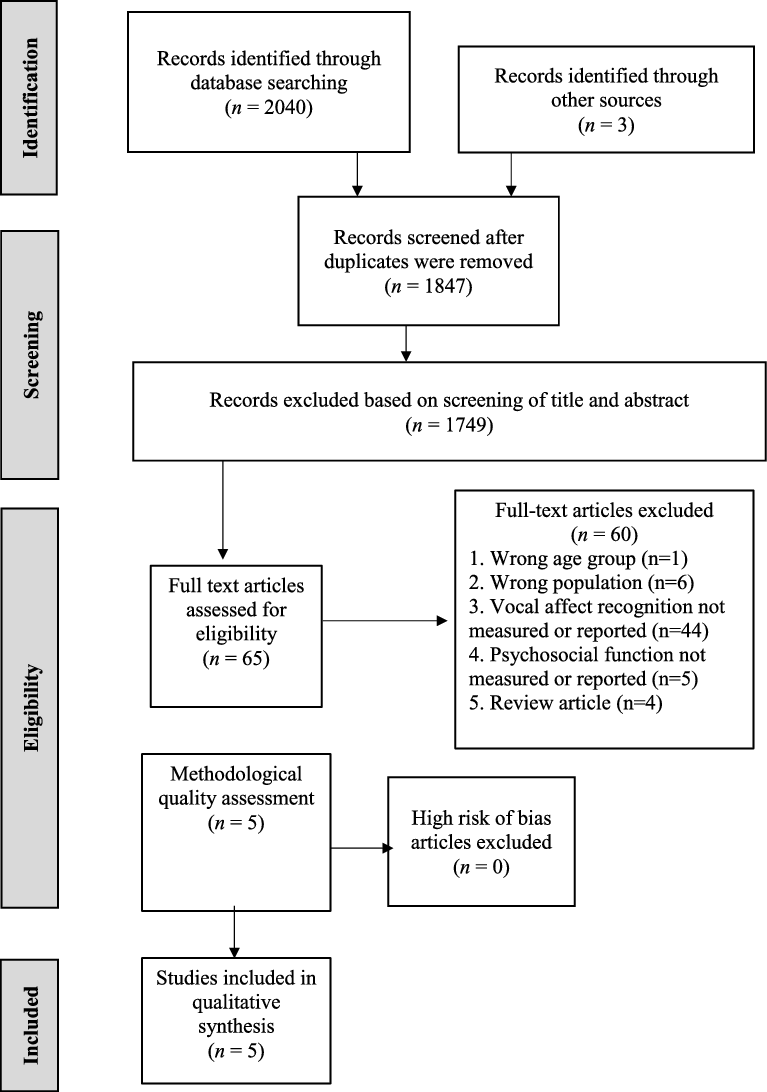
This systematic review was conducted using the Preferred Reporting Items for Systematic Review and Meta-Analyses (PRISMA) guidelines (Moher et al., Reference Moher, Liberati, Tetzlaff and Altman2009). The PRISMA flow chart is detailed in Fig. 1. The protocol for this systematic review was submitted to PROSPERO (Record number: 148162) in September 2019; the application was listed as registered on 28 April 2020.
PRISMA flow chart showing search and selection process resulting in five included studies (Moher et al., Reference Moher, Liberati, Tetzlaff and Altman2009).

Search strategy
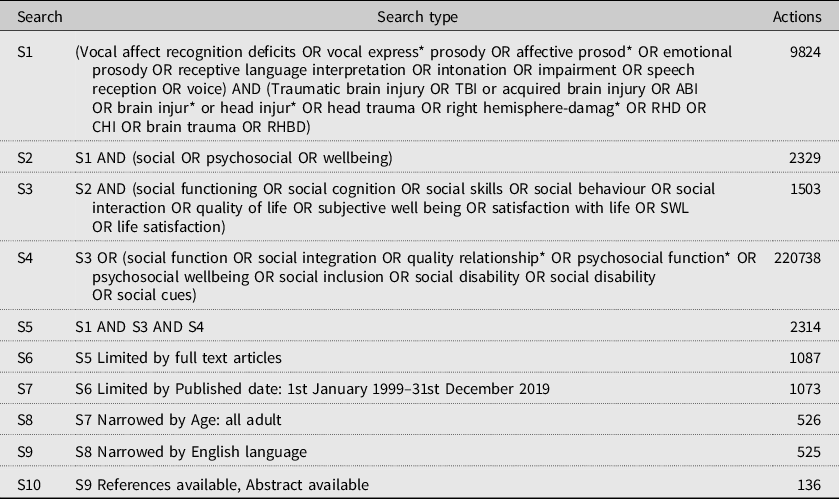
The Patient, Intervention, Comparison, Outcome (PICO) model was utilised as a search strategy with a focus on key terms primarily related to Patient and Intervention to identify pertinent studies (Eriksen & Frandsen, Reference Erikson and Frandsen2018). The search was conducted using six databases: MEDLINE (via PubMed), PsycINFO, CINAHL, SCOPUS, EMBASE and JBI between June and August 2019 to identify relevant studies. Additional hand searches of relevant article reference lists were also conducted to identify additional studies. The search strategy combined variations of terms associated with traumatic brain injury, vocal affect and psychosocial functioning. Table 1 outlines these terms within the search strategy applied to one of the databases included in the study (CINAHL).
CINAHL search terms

Study selection
Studies identified through the systematic searches of the databases were included in the review if participants were aged 18 years or older and had sustained a moderate to severe traumatic brain injury. In addition, the studies needed to report assessment results for vocal affect recognition as well as outcomes for social cognition (i.e., empathy; ToM) or social behaviour.
Studies were excluded if vocal affect recognition abilities were not independently reported from other measures. Studies that only reported outcomes for facial emotion perception and did not additionally report outcomes for empathy, ToM (including understanding others’ intentions) or social behaviour were excluded. This is because vocal and facial affect recognition falls within the same component of social cognition and our aim was to investigate the impact of vocal affect on the components separate to emotion perception. Exclusion criteria also included studies where participants had mild TBI or concussion and non-traumatic acquired brain injuries (including stroke). Studies that did not differentiate results of participants with mild traumatic brain injury from participants with moderate to severe brain injuries were also excluded. The search was limited to full-text, peer-reviewed articles published in English language between 1st January 1999 and 10th August 2019. This time frame was selected on the basis of Milders’ (Reference Milders2019) literature review, which identified no relevant studies related to vocal affect recognition prior to 2003. There were no restrictions on study design.
All records identified from the initial searches were uploaded to the systematic review web application Rayyan (Ouzzani et al., Reference Ouzzani, Hammady, Fedorowica and Elmagarmid2016) and duplicates were removed. The selection of relevant studies was conducted in three stages. During the first stage, two independent reviewers reviewed the titles and abstracts against the inclusion and exclusion criteria. Discrepancies were resolved by consultation with all four authors to achieve agreement. In the second stage of the selection process, two independent reviewers assessed the full text articles against inclusion and exclusion criteria, and consensus was achieved with a third reviewer in the case of disparities. Inclusion of the studies in this systematic review was confirmed following consultation across all four authors.
Data extraction
Three reviewers independently extracted the data from the five included studies using predefined data fields that identified the study design, study aim, participant characteristics and measures used to assess vocal affect and psychosocial outcomes, main study results and limitations. A fourth reviewer compared the consolidated table of results to the full text articles to ensure consistency. Risk of bias in regard to study design and reporting of outcomes was also analysed. Measurement bias was analysed separately and is summarised in the following results section.
Quality assessment
Two authors independently assessed the quality of all selected studies using the Mixed Methods Appraisal Tool (MMAT) Version 2018, which has improved content validity from previous versions (Hong et al., Reference Hong, Pluye, Fabregues, Bartlett, Boardman, Cargo and Vedel2019). The MMAT version 2018 is a single tool that allows for critical appraisal of selected studies through the inclusion of a set of quality criteria for different study designs. Thus, it was deemed suitable for this systematic review. Regardless of study design, the MMAT requires consideration of seven quality criteria. Criteria 1 and 2 remain the same for all studies and require raters to specify whether the research questions were clear and if the data collected allowed for the research questions to be addressed using the following rating categories: Yes, No, Can’t Tell. Criteria 3 to 7 vary depending on the classification of study design but use the same rating categories as criteria 1 and 2. Raters achieved 95% agreement across the five studies on the MMAT Version 2018. However, Cohen’s Kappa, which corrects for chance agreement, indicated a fair level of agreement between raters, K = .304. 95% CI [−.171 to.929], p = .006.
Data synthesis and analysis
Studies varied greatly in their aims and outcome measures used, thus meta-analysis was not possible. Instead, a narrative synthesis of results was conducted to answer the research question for this review. Given that components of social behaviour and social cognition are known to contribute to psychosocial function, results of the individual studies were organised according to these two overarching themes.
Results
The database searches conducted between July and August 2019 generated a total of 2040 studies. Manual searching yielded an additional three studies. In total, 1847 studies remained after the removal of duplicates. Screening of the title and abstracts reduced the total number of studies to 65. Full-text review excluded 60 further studies. Reasons for exclusion are provided in Fig. 1. It should be noted that one study (Milders et al., Reference Milders, Ietswaart, Crawford and Currie2008) was excluded because results for participants with moderate to severe TBI were not reported separately from participants with mild TBI. Another seemingly relevant study (Radice-Neumann et al., Reference Radice-Neumann, Zupan, Tomita and Willer2009) was excluded because vocal affect recognition outcomes were not sufficiently reported to allow for adequate comparisons to other studies. At the end of second stage of the selection process, the total studies deemed to meet selection criteria was five (See Table 2).
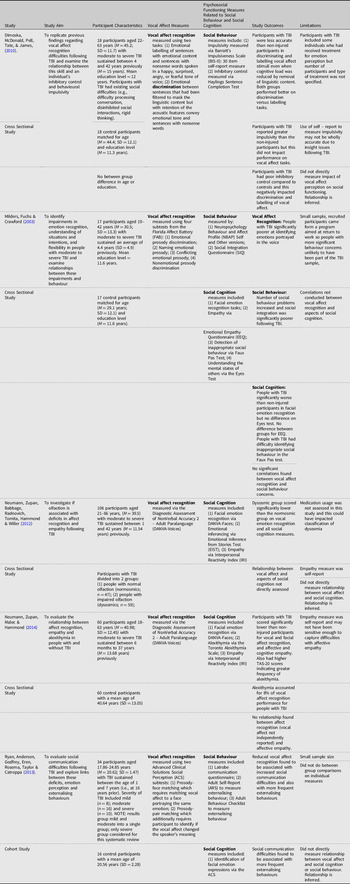
Characteristics of studies included in the review

The overall quality of evidence was determined using the modified version of Sackett’s scale used in a recent systematic review in TBI (Barnett & Reid, Reference Barnett and Reid2020). Overall, the level of evidence investigating the impact of vocal affect recognition on psychosocial functioning was low, with four of the five studies identified as Level 5. All four of these studies were cross-sectional designs (Level 5) (Dimoska et al., Reference Dimoska, McDonald, Pell, Tate and James2010; Milders et al., Reference Milders, Fuchs and Crawford2003; Neumann et al., Reference Neumann, Zupan, Babbage, Radnovich, Tomita, Hammond and Willer2012, Reference Neumann, Zupan, Malec and Hammond2014), three of which included an uninjured comparison group (Dimoska et al., Reference Dimoska, McDonald, Pell, Tate and James2010; Milders et al., Reference Milders, Fuchs and Crawford2003; Neumann et al., Reference Neumann, Zupan, Malec and Hammond2014). The remaining two studies were identified as Level 2. One study randomised participants with TBI into one of two treatment groups, comparing pre- and post-test measures for primary and secondary outcomes (Radice-Neumann et al., Reference Radice-Neumann, Zupan, Tomita and Willer2009). One study was a follow-up cohort study that included participants with TBI first identified 16 years previously, and an uninjured comparison group (Level 2) (Ryan et al., Reference Ryan, Anderson, Godfrey, Eren, Rosema, Taylor and Catroppa2013).
Two of the selected studies were conducted in Australia (Dimoska et al., Reference Dimoska, McDonald, Pell, Tate and James2010; Ryan et al., Reference Ryan, Anderson, Godfrey, Eren, Rosema, Taylor and Catroppa2013), one in the UK (Milders et al., Reference Milders, Fuchs and Crawford2003), one combined data from the US and Canada (Neumann et al., Reference Neumann, Zupan, Malec and Hammond2014), and one combined data from the US, Canada and New Zealand (Neumann et al., Reference Neumann, Zupan, Babbage, Radnovich, Tomita, Hammond and Willer2012). Four studies (Dimoska et al., Reference Dimoska, McDonald, Pell, Tate and James2010; Milders et al., Reference Milders, Fuchs and Crawford2003; Neumann et al., Reference Neumann, Zupan, Babbage, Radnovich, Tomita, Hammond and Willer2012; Ryan et al., Reference Ryan, Anderson, Godfrey, Eren, Rosema, Taylor and Catroppa2013) advised that they were the recipients of external grant funding, and the fifth study (Neumann et al., Reference Neumann, Zupan, Malec and Hammond2014) acknowledged internal funding. However, no known publication bias was identified and no studies disclosed affiliations that would suggest a susceptibility to reporting bias (see Table 3).
Risk of bias assessment for selected studies

Study characteristics
A total of 227 participants with moderate to severe TBI were included across the five selected studies, with sample size varying widely across studies, ranging from 26 in Ryan et al. (Reference Ryan, Anderson, Godfrey, Eren, Rosema, Taylor and Catroppa2013) to 106 in Neumann et al. (Reference Neumann, Zupan, Babbage, Radnovich, Tomita, Hammond and Willer2012). Each study included an independent sample of participants. Participants with TBI ranged in age from 17.86 years to 66 years, with mean age ranging from 20.62 to 45.2 years. It should be noted though that these numbers include the eight participants with mild TBI in Ryan et al. (Reference Ryan, Anderson, Godfrey, Eren, Rosema, Taylor and Catroppa2013), age data for each severity group (mild, moderate, severe) was not independently reported in that study. One participant in the study by Ryan et al. (Reference Ryan, Anderson, Godfrey, Eren, Rosema, Taylor and Catroppa2013), although aged 17.86 years, could not be separated from the sample, and was therefore included in the analysis.
Four of the five studies selected for this systematic review included an uninjured comparison group (Dimoska et al., Reference Dimoska, McDonald, Pell, Tate and James2010; Milders et al., Reference Milders, Fuchs and Crawford2003; Neumann et al., Reference Neumann, Zupan, Malec and Hammond2014; Ryan et al., Reference Ryan, Anderson, Godfrey, Eren, Rosema, Taylor and Catroppa2013), totalling 111 participants. The age range of the uninjured comparison group was not reported for all three studies, but mean age ranged from 20.56 years to 44.1 years. This aligned with the mean age range for participants with TBI in those same four studies (20.62 years to 45.2 years).
Study results
Vocal affect recognition
Pooled data were analysed and synthesised narratively to identify generalisable information. Four of the five selected studies included standardised assessment tasks to assess vocal affect recognition abilities of participants (Milders et al., Reference Milders, Fuchs and Crawford2003; Neumann et al., Reference Neumann, Zupan, Babbage, Radnovich, Tomita, Hammond and Willer2012; Neumann et al., Reference Neumann, Zupan, Malec and Hammond2014; Ryan et al., Reference Ryan, Anderson, Godfrey, Eren, Rosema, Taylor and Catroppa2013). All four studies with an uninjured comparison group reported reduced vocal affect recognition abilities in people with TBI (Dimoska et al., Reference Dimoska, McDonald, Pell, Tate and James2010; Milders et al., Reference Milders, Fuchs and Crawford2003; Neumann et al., Reference Neumann, Zupan, Malec and Hammond2014; Ryan et al., Reference Ryan, Anderson, Godfrey, Eren, Rosema, Taylor and Catroppa2013). Neumann et al. (Reference Neumann, Zupan, Babbage, Radnovich, Tomita, Hammond and Willer2012) did not compare overall group results for people with TBI to available normative data but rather only reported performance for people with TBI with and without impaired olfaction. Their results indicated that people with impaired olfaction had significantly lower vocal affect recognition scores.
Social cognition
Nine different tasks were used to measure aspects of social cognition using a combination of behavioural tasks and self- and/or proxy reports; six of these assessed empathy (Milders et al., Reference Milders, Fuchs and Crawford2003; Neumann et al., 2012; Reference Neumann, Zupan, Malec and Hammond2014). Empathy was reported to be significantly lower in people with TBI compared to the non-injured comparison group (Neumann et al., Reference Neumann, Zupan, Malec and Hammond2014), and also in people with TBI with impaired olfaction compared to those with normal olfaction (Neumann et al., Reference Neumann, Zupan, Babbage, Radnovich, Tomita, Hammond and Willer2012). Milders et al. (Reference Milders, Fuchs and Crawford2003) reported no deficits in empathy for their TBI group. It is possible that the difference in results reflects the fact that Neumann and her colleagues used a measure that assessed both affective (i.e., sharing the feelings of others) and cognitive empathy (i.e., perspective taking) in both studies (2012; 2014) whereas the measure used by Milders et al. (Reference Milders, Fuchs and Crawford2003) only evaluated affective empathy.
Two studies measured aspects related to ToM including detection of faux pas and emotional inferencing (Milders et al., Reference Milders, Fuchs and Crawford2003; Neumann et al., Reference Neumann, Zupan, Babbage, Radnovich, Tomita, Hammond and Willer2012). People with TBI had significantly more difficulty identifying examples of inappropriate social behaviour in the Faux Pas test (Milders et al., Reference Milders, Fuchs and Crawford2003) which may at least partially explain the increase in their own difficulties with social behaviour as reported by their proxies. Neumann et al. (Reference Neumann, Zupan, Babbage, Radnovich, Tomita, Hammond and Willer2012) did not provide specific results for the emotional inferencing task but did report that people with TBI with deficits in olfaction had significantly more difficulty making emotional inferences.
Social behaviour
Six different tasks were used to measure social behaviour across four studies. All three studies that measured social behaviour included a self-report measure (Dimoska et al., Reference Dimoska, McDonald, Pell, Tate and James2010; Milders et al., Reference Milders, Fuchs and Crawford2003; Ryan et al., Reference Ryan, Anderson, Godfrey, Eren, Rosema, Taylor and Catroppa2013). To support these self-report measures of social behaviour, Dimoska et al. (Reference Dimoska, McDonald, Pell, Tate and James2010) also included a standardised test, and both Milders et al. (Reference Milders, Fuchs and Crawford2003) and Ryan et al. (Reference Ryan, Anderson, Godfrey, Eren, Rosema, Taylor and Catroppa2013) included additional proxy reports. Dimoska et al., (Reference Dimoska, McDonald, Pell, Tate and James2010) reported greater impulsivity and poor inhibitory control in people with TBI compared to the uninjured comparison group. Milders et al. (Reference Milders, Fuchs and Crawford2003) compared self- and proxy-ratings for the change in social behaviour since the time of injury with both indicating increased depression, increased deficits in pragmatics and poorer social integration since time of injury. Similarly, Ryan et al. (Reference Ryan, Anderson, Godfrey, Eren, Rosema, Taylor and Catroppa2013) found that both people with TBI and their proxies reported increased difficulties with social communication and increased frequency of externalising behaviours (e.g., aggression, demanding attention) following the brain injury. The proxies in Milders et al. (Reference Milders, Fuchs and Crawford2003) additionally reported increased indifference and inappropriateness since time of injury.
The relationship between vocal affect recognition and psychosocial functioning
Neumann et al. (Reference Neumann, Zupan, Malec and Hammond2014) was the only study that specifically analysed the relationship between vocal affect recognition and other components of social cognition. They found no relationship vocal affect recognition and empathy. Milders et al. (Reference Milders, Fuchs and Crawford2003) also measured vocal affect together with aspects of social cognition, but they did not specifically examine and/or report the relationship between them. Although not statistically analysed, two studies reported reduced vocal affect in conjunction with deficits in components of social cognition (Neumann et al., 2012; Reference Neumann, Zupan, Malec and Hammond2014). Neumann et al. (Reference Neumann, Zupan, Babbage, Radnovich, Tomita, Hammond and Willer2012) reported significantly reduced vocal affect recognition, as well as reduced empathy and emotional inferencing in their participants with TBI with impaired olfaction. Neumann et al. (Reference Neumann, Zupan, Malec and Hammond2014) reported reduced vocal affect recognition and empathy in people with TBI compared to uninjured participants. Combined, these studies suggest that vocal affect recognition deficits frequently co-occur with deficits in social cognition more generally.
Three studies directly reported on the relationship between vocal affect recognition and social behaviour. Dimoska et al. (Reference Dimoska, McDonald, Pell, Tate and James2010) reported a positive association between poor inhibitory control and vocal affect recognition accuracy. Similarly, Ryan et al., (Reference Ryan, Anderson, Godfrey, Eren, Rosema, Taylor and Catroppa2013) found that people with TBI who had difficulty recognising vocal affect, also had increased difficulties in social communication and greater frequency of externalising behaviours. Milders et al. (Reference Milders, Fuchs and Crawford2003) however, found that although deficits were identified for both vocal affect recognition and social behaviour, there was no significant association between vocal affect recognition abilities and the adverse behavioural changes reported (e.g., depression, mania, pragnosia, inappropriateness).
Discussion
This systematic review explored existing literature to examine the relationship between vocal affect recognition deficits and psychosocial functioning in people with moderate to severe TBI. Only five disparate studies met the inclusion criteria to be selected for this systematic review. The studies varied widely in methodology and outcome variables used, preventing direct integration of data. Results were narratively synthesised to examine the relationship between vocal affect recognition and psychosocial functioning, specifically examining the relationship between vocal affect recognition and other components of social cognition (i.e., empathy, ToM) as well as social behaviour.
All five studies indicated reduced vocal affect recognition abilities in people with TBI. This information was based on group means, but it does suggest that recognising emotion using only vocal cues is a challenge for people with TBI. Whilst reporting on vocal affect recognition performance was not the primary aim of this review, the reported deficits have important implications for social communication. Difficulties recognising or interpreting this nonverbal component of a speaker’s message can increase processing time and reduce accuracy of perception, even when other cues (e.g., facial expressions) are present (de Gelder & Vroomen, Reference de Gelder and Vroomen2000).
Three of the five included studies assessed vocal affect recognition abilities in conjunction with empathy (Milders et al., Reference Milders, Fuchs and Crawford2003; Neumann et al., Reference Neumann, Zupan, Babbage, Radnovich, Tomita, Hammond and Willer2012; Neumann et al., Reference Neumann, Zupan, Malec and Hammond2014) but Neumann et al. (Reference Neumann, Zupan, Malec and Hammond2014) was the only study to directly compare these two aspects of social cognition; the relationship was not found to be statistically significant. Though not directly compared, Neumann et al. (Reference Neumann, Zupan, Babbage, Radnovich, Tomita, Hammond and Willer2012) reported reduced abilities in both vocal affect recognition and empathy. However, Milders et al. (Reference Milders, Fuchs and Crawford2003) reported that their participants with TBI scored similarly to uninjured participants for empathy, even though their capacity to recognise emotion using vocal cues was significantly poorer. Overall, these inconsistent findings suggest that vocal affect recognition abilities may not impact empathy. This finding was somewhat surprising. Since we need to be able to recognise emotions in others in order to appropriately respond to them, one would assume a positive relationship between vocal affect recognition and empathy. In fact, a lack of empathy is said to inhibit the development of social relationships because communication partners perceive the lack of appropriate response as someone ignoring their feelings and concerns (Elliott et al., Reference Elliott, Bohart, Watson and Greenberg2011). Empathy in both studies was measured using a questionnaire-based measure while vocal affect in both studies was measured using behavioural tasks, so it is possible that the lack of relationship was due to task-based differences. Future studies should explore the relationship between vocal affect recognition and empathy using behavioural tasks.
Only two studies assessed both vocal affect recognition and ToM in people with TBI (Milders et al., Reference Milders, Fuchs and Crawford2003; Neumann et al., Reference Neumann, Zupan, Babbage, Radnovich, Tomita, Hammond and Willer2012). The tasks used to assess ToM and understanding intentions required participants to make inferences based on written scenarios. Though neither study directly compared the relationship between these two components of social cognition, both Milders et al. (Reference Milders, Fuchs and Crawford2003) and Neumann et al. (Reference Neumann, Zupan, Babbage, Radnovich, Tomita, Hammond and Willer2012) reported reduced abilities in both vocal affect recognition and ToM tasks. However, the use of written tasks makes it difficult to ascertain how reduced vocal affect recognition abilities might impact psychosocial functioning in everyday interactions. It is possible that deficits in vocal affect recognition might have considerably greater impact on one’s ability to understand others’ intentions in verbal conversations where incongruency between nonverbal and verbal cues conveys the speaker’s underlying intentions (e.g., sarcasm; Rockwell, Reference Rockwell2000). Future research should further explore this relationship using verbal tasks.
In all three studies that measured social behaviour, people with TBI self-reported greater difficulties in social behaviour than the non-injured comparison groups, which was generally confirmed by proxy reports (Dimoska et al., Reference Dimoska, McDonald, Pell, Tate and James2010; Milders et al., Reference Milders, Fuchs and Crawford2003; Ryan et al., Reference Ryan, Anderson, Godfrey, Eren, Rosema, Taylor and Catroppa2013). The relationship between vocal affect recognition and social behaviour (as indicated via poor inhibitory control, difficulties in social communication and increased frequency of externalising behaviours) was only significant in two of these studies (Dimoska et al., Reference Dimoska, McDonald, Pell, Tate and James2010; Ryan et al., Reference Ryan, Anderson, Godfrey, Eren, Rosema, Taylor and Catroppa2013). The poor inhibitory control reported by Dimoska et al. (Reference Dimoska, McDonald, Pell, Tate and James2010) may contribute to communication breakdowns because reduced disinhibition may lead people with TBI to respond without fully considering what the other person said and/or integrating the linguistic content of the message with the vocal affect cues. Indeed, Dimoska et al. (Reference Dimoska, McDonald, Pell, Tate and James2010) report that the people with TBI relied more heavily on the semantic information provided via a sentence when interpreting its meaning. It is unclear if this tendency was due to increased frequency of impulsive responses or because the person with TBI could not accurately perceive the vocal affect cues in the message. Ryan et al.’s results (Reference Ryan, Anderson, Godfrey, Eren, Rosema, Taylor and Catroppa2013) suggest that it is likely a combination of the two. Using the LaTrobe Communication Questionnaire (LCQ; Douglas et al., Reference Douglas, O’Flaherty and Snow2000), Ryan et al. (Reference Ryan, Anderson, Godfrey, Eren, Rosema, Taylor and Catroppa2013) found an association between vocal affect recognition deficits and poor social communication. The LCQ includes a large number of items, one of which specifically measures frequency of disinhibition/impulsivity in conversation. If people with TBI are answering before considering all the available information, it is likely that their responses will appear tangential, inappropriate or off topic. All of these aspects of social communication are also measured by the LCQ.
Ryan et al. (Reference Ryan, Anderson, Godfrey, Eren, Rosema, Taylor and Catroppa2013) found that social communication difficulties found via the LCQ mediated the relationship between vocal affect recognition deficits and increased externalising behaviours. In other words, the communication breakdowns that result from poor recognition of vocal affect cues during social interactions predicted increased social rejection for people with TBI which increases externalising behaviours such as aggression or intrusive conduct. While not part of Ryan et al.’s (Reference Ryan, Anderson, Godfrey, Eren, Rosema, Taylor and Catroppa2013) study, one needs to consider opportunities to engage in social communication, and whether reduced interactions that stem from frequent communication breakdowns further intensify vocal affect recognition deficits, including the capacity to integrate vocal affect cues with the linguistic content of a message. Thus, it is possible that there is a circular impact of vocal affect recognition deficits on social communication. This requires further study but is an essential consideration given the importance of the vocal modality in face-to-face communication. There are many situations in which accurately interpreting how others are feeling requires integrating the meaning conveyed via the tone of voice with the semantic meaning of the words used in the sentence. For instance, when someone is trying to conceal their true emotion, they might say ‘I’m fine’, yet their tone of voice indicates otherwise. If people with TBI are not making use of the vocal affect cues when interpreting messages such as these, social communication is likely to be negatively impacted. This premise is supported by the reduced emotional inferencing found for people with TBI in Neumann et al. (Reference Neumann, Zupan, Babbage, Radnovich, Tomita, Hammond and Willer2012). Difficulties in emotional inferencing may be at least partially related to difficulties with executive functions. For instance, Callahan and Hinkebein (Reference Callahan and Hinkebein1999) found that people with TBI with olfaction deficits had significantly more difficulty with problem-solving, self-awareness and attention span, all of which are required for successful inferencing and communication with others.
Although four of the five selected studies for this review did not meet the criteria for providing a high level of evidence, the included studies do suggest that vocal affect recognition deficits contribute to aspects of psychosocial functioning following moderate to severe TBI. While more rigorous studies are needed to fully understand how vocal affect recognition influences social behaviour and other aspects of social cognition, results of the five studies included here suggest that many of these deficits co-occur. This has important clinical implications because it indicates that a more holistic approach to intervention is warranted rather than assessing and treating these aspects of psychosocial functioning individually.
Social behaviour theories support the inter-dependency of the constructs studied in this review indicating that deficits at any stage of the social interaction will result in problematic social behaviours (Adolphs, Reference Adolphs2009; P. Corrigan, Reference Corrigan1997; Ochsner, Reference Ochsner2008). When people with TBI misinterpret affective and social cues, fail to make the necessary inferences to accurately interpret someone’s message and/or fail to make use of the available social cues to regulate their behaviour and respond appropriately, they face social rejection and social isolation (Kelly et al., Reference Kelly, Mcdonald and Kellett2013). Thus, poor psychosocial functioning results in reduced social support, which contributes to the reduction in meaningful relationships and poor employment outcomes following TBI (Kelly et al., Reference Kelly, Mcdonald and Kellett2013; Wauters & Marquardt, Reference Wauters and Marquardt2019). As a consequence, people with moderate to severe TBI are at increased risk of depression and suicidal ideation (Douglas & Spellacy, Reference Douglas and Spellacy2000; Tsaousides et al., Reference Tsaousides, Cantor and Gordon2011). May et al. (Reference May, Milders, Downey, Whyte, Higgins, Wojcik and O’Rourke2017) found a significant relationship between facial affect recognition, social behaviour and community integration following TBI. Based on results of the current review and the proportion of people with TBI who experience deficits in vocal affect recognition, future studies in vocal affect recognition should also include measures that outline the individual’s current level of activity and participation, as well as their level of support in order to consider a more holistic picture of the individual’s psychosocial functioning.
Limitations of included studies
This review has some limitations that should be mentioned. First, whilst numerous terms and phrases related to vocal cues of emotion were included in the search terms, the phrase emotion recognition was not. The decision to not use this phrase was made to tailor the search to focus on vocal affective cues, rather than the large body of literature focus on facial emotion. However, it is possible that this decision led to excluding relevant papers that we did not otherwise identify through manual searching.
It is important to note that there is a paucity of rigorously designed studies that address the influence of vocal affect recognition on psychosocial functioning following TBI.
Only five studies were identified to meet inclusion criteria for this systematic review despite the large number of databases and search terms used and the additional inclusion of hand searching of key journals. Also, three of the five included studies had 18 or fewer participants with TBI. Such small samples may have resulted in reduced power, thus reducing the likelihood of identifying relationships between variables. The five selected studies used a large range of outcomes measures making direct comparison of results difficult. This is not unusual in studies considering aspects of psychosocial functioning (Cotter et al., Reference Cotter, Granger, Backx, Hobbs, Loi and Barnett2018) but still limits the conclusions that can be made. Moreover, few studies directly assessed the relationship between vocal affect recognition and psychosocial functioning, so many of the links needed to be inferred.
Drawing inferences about the relationship between vocal affect recognition and psychosocial functioning using the studies included in this review was challenging due to the types of tasks used. For instance, vocal affect recognition was always assessed via behavioural tasks while many aspects of psychosocial functioning were assessed via questionnaires. This difference in task type may have impacted outcomes. It should also be noted that the behavioural tasks used for vocal affect recognition lacked ecological validity because participants were asked to identify the emotion being portrayed using only a single cue (Zupan & Neumann, Reference Zupan and Neumann2014). We acknowledge that this is a direct reflection of our research question which was specific to the independent assessment of vocal affect recognition. However, stimuli of this nature makes it difficult to make inferences and generalisations regarding the ability of people with moderate to severe TBI to recognise vocal affective cues in everyday situation when they must integrate this nonverbal information with other cues (e.g., verbal content; facial expressions) all while filtering out environmental distractors and noise (Zupan & Neumann, Reference Zupan and Neumann2014). As a result, the vocal affect recognition outcomes reported here may over-estimate people’s abilities.
Finally, a number of the measures used in the five selected studies relied on self- and/or proxy-report. The use of self-report is particularly problematic for people with TBI who are known to have poor insight and awareness of their deficits (Arigo & Haggerty, Reference Arigo and Haggerty2016). As a result, self-report can potentially lead to over- or under-estimation of abilities. This was in fact the case in two of our included studies: both Milders et al. (Reference Milders, Fuchs and Crawford2003) and Ryan et al. (Reference Ryan, Anderson, Godfrey, Eren, Rosema, Taylor and Catroppa2013) found that participants with TBI over-estimated their communication deficits compared to their proxies. There is also possible bias in proxy reports due to the potential that proxies will report according to their level of expectation (Bodley-Scott & Riley, Reference Bodley-Scott and Riley2015) and/or general caregiver distress (Ietswaart et al., Reference Ietswaart, Milders, Crawford, Currie and Scott2008), However, both self- and proxy report are frequently used in studies including people with TBI. Additionally, the majority of tasks used in the included studies lacked ecological validity which is pertinent to our research question and selection criteria which were focussed on vocal affect recognition.
Conclusion
This systematic review aimed to explore the extent to which vocal affect recognition deficits impact the psychosocial functioning of people with moderate to severe TBI. The research reviewed was limited and due to inconsistent study designs and array of outcomes measures used to assess both vocal affect recognition and psychosocial functioning, findings regarding an association between these constructs were inconclusive. However, all studies selected for this review concluded that there are psychosocial consequences of TBI that specifically relate to deficits in vocal affect recognition. Both Dimoska et al. (Reference Dimoska, McDonald, Pell, Tate and James2010) and Milders et al. (Reference Milders, Fuchs and Crawford2003) suggested that limited capacity to read emotional expressions and subtle behavioural cues underlie the challenge that people with TBI experience during social interactions. Despite this, our hypothesis that vocal affect recognition is associated with other components of social cognition and social behaviour following TBI, with deficits negatively contributing to overall psychosocial functioning is not proven. Given the deficits reported across vocal affect recognition, components of social cognition and social behaviour, these studies collectively suggest a possible link between these constructs, even if direct relationships were not analysed or reported. Further investigation is warranted to better understand the degree to which these aspects of psychosocial functioning occur and how they influence one another. This will support development of interventions that are most likely to improve the quality of life for people with TBI.
Funding Statement
This research received no specific grant from any funding agency, commercial or not-for-profit sectors.
Conflicts of Interest
None.