INTRODUCTION
Confirmed records of 10 species of estuarine and marine mysids are known for the Mexican Pacific: Petalophthalmus armiger Willemoes-Suhm, 1875; Boreomysis californica Ortman, 1894; Siriella aequiremis Hansen, 1910; S. gracilis Dana, 1852; S. thompsonii (H. Milne-Edwards, 1837); Chlamydopleon banneri (Băcescu, 1968); Euchaetomera plebeja G. Sars, 1884; Mysidopsis californica W. Tattersall, 1932; Mysidium rickettsi Harrison & Bowman, Reference Harrison and Bowman1987; and Proneomysis wailesi W. Tattersall, 1933 (Price, Reference Price and Hendrickx2004; Ortega-Salas et al., Reference Ortega-Salas, Nuñez-Pasten and Camacho2008). Species of Petalophthalmus Willemoes-Suhm, 1875, and Boreomysis G.O. Sars, 1869, are mostly deep-water species, while species of Siriella occurring off western Mexico have been reported far from shore. Euchaetomera plebeja has been captured in depths of 95–110 m, and the other four (i.e. Chlamydopleon banniri, Mysidopsis californica, Mysidium rickettsi and Proneomysis wailesi) are shallow, coastal species. The genus Mysidium Dana, 1852, includes seven species that are widespread in tropical and subtropical marine habitats (Băcescu & Ortiz, Reference Băcescu and Ortiz1984; Mees & Meland, Reference Mees and Meland2012). Mysidium is morphologically characterized by the eyes well developed, a triangular rostrum, the antennal scale long with distal suture, a labrum with equal lobes, the endopod on male pleopod 4 represented by a short rounded lobe and the exopod 3–4 articulated, and the telson linguiform, covered on its distal half with closely spaced short and blunt or sharp marginal setae, and with the posterior margin entire or cleft (Mauchline, Reference Mauchline1980; Ortiz et al., Reference Ortiz, Winfield and Cházaro-Olvera2012).
Previously to this paper, six species of Mysidium have been described from the Gulf of Mexico and the Caribbean Sea: M. cubanense Băcescu & Ortiz, Reference Băcescu and Ortiz1984, M. columbiae (Zimmer, 1915), M. gracile (Dana, 1852), M. integrum W. M. Tattersall, 1951, M. rubroculatum Băcescu & Ortiz, Reference Băcescu and Ortiz1985, and Mysidium iliffei Băcescu, 1991. The only East Pacific species, M. rickettsi, was described from material collected at Point Marcial (25°31′N 111°01′W) in the Gulf of California (Harrison & Bowman, Reference Harrison and Bowman1987). The present study describes a new species of Mysidium, the second known from the East Pacific, and increases the number of known species of this genus to eight.
MATERIALS AND METHODS
During a sampling survey of Mazatlán harbour (March 2013), in the SE Gulf of California, Mexico, mysid shrimps were collected with a hand net at the pier of the RV ‘El Puma’, Universidad Nacional Autónoma de México, and fixed with a solution of 70% ethanol. Specimens were later transferred to glycerin for dissection and illustration in the Crustacean Laboratory, FES-Iztacala-UNAM. Parts and small appendages were illustrated using a MOTIC BA–210 compound-microscope, equipped with a camera lucida. Illustrations were completed using the Corel Draw V.12 program. All measurements of type material (holotype and paratypes) were made with the Motic Images Plus V.2 program. The names used for the structures, setae/spines, descriptions, remarks, and morphological comparisons were based on Băcescu & Ortiz (Reference Băcescu and Ortiz1984), and the general morphology of a mysid shrimp used in the present paper follows Meland et al. (Reference Meland, Mees, Porter and Whittmann2015). The material is deposited in the Colección Nacional de Crustáceos (CNCR-IB), Instituto de Biología, Mexico D.F., and in the Colección Regional de Invertebrados Bentónicos (ICML-EMU), Instituto de Ciencias del Mar y Limnología, Mazatlán, both at the Universidad Nacional Autónoma de México. Abbreviation used: TL, total length.
RESULTS
SYSTEMATICS
Order Mysida Boas, 1883
Family Mysidae Haworth, 1825
Subfamily Mysinae Haworth, 1825
Genus Mysidium Dana, 1852
Diagnosis. Eyes well developed; rostrum triangular; antennal scale long, tapering distally, with distal suture; labrum with equal lobes; male pleopod 4 the longest, always narrow; endopod represented by a short rounded lobe; exopod of three-four articles, article 1 the longest; telson linguiform, covered on posterior half with closely spaced marginal setae, posterior margin entire or cleft.
Mysidium pumae sp. nov.
(Figures 1–4)
Mysidium pumae sp. nov. A, dorsal view of anterior body (outer flagellum folded in back to show the appendix masculina); B, antennal scale; C, labrum; D, maxilla 1; E, maxilla 2; F, maxilliped; G, left mandible; H, right mandible; I, right penis.

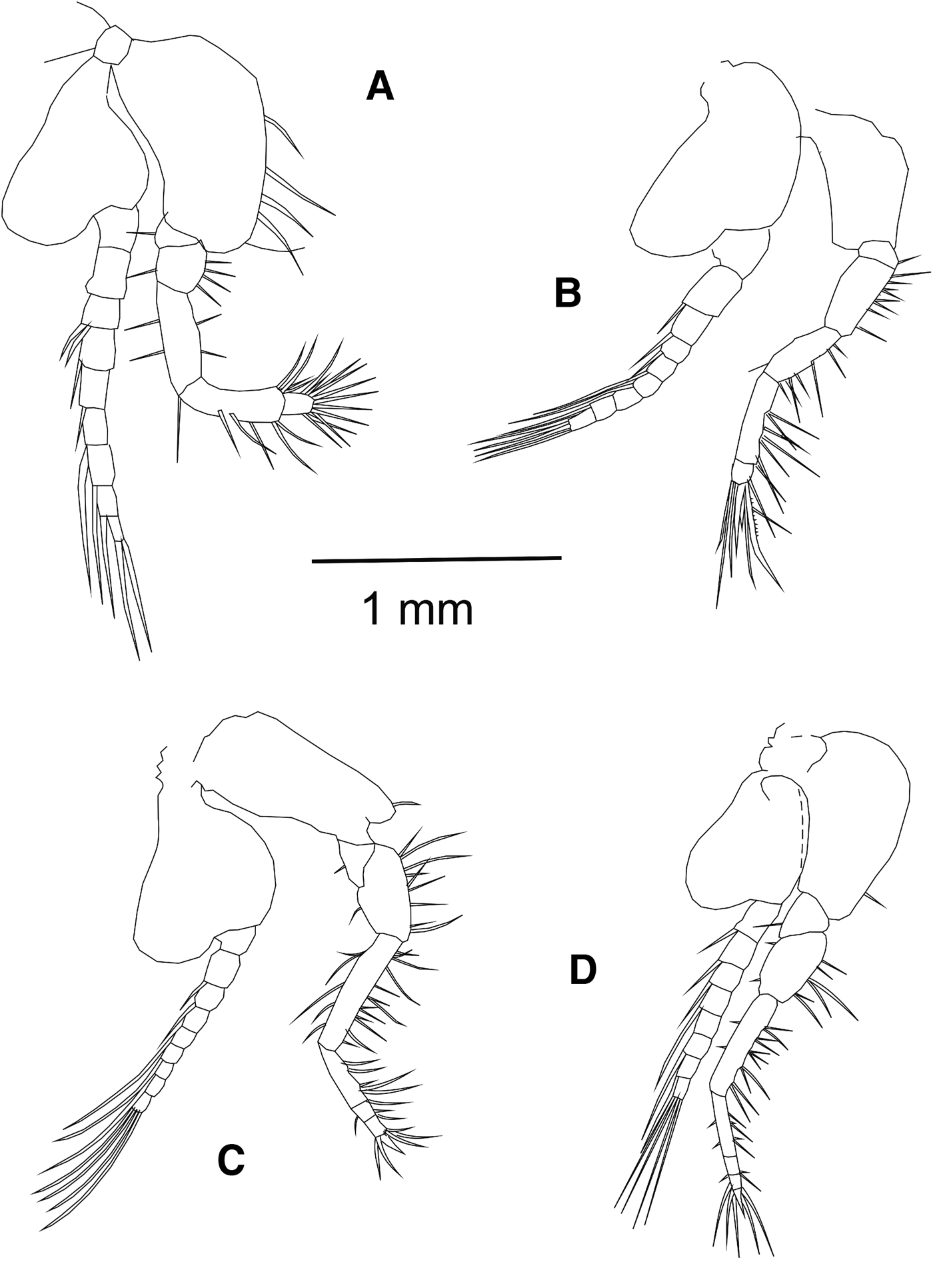
Mysidium pumae sp. nov. A, pereopod 1 (thoracopod 2); B, pereopod 2 (thoracopod 3); C, pereopod 3 (thoracopod 4); D, pereopod 4 (thoracopod 5).

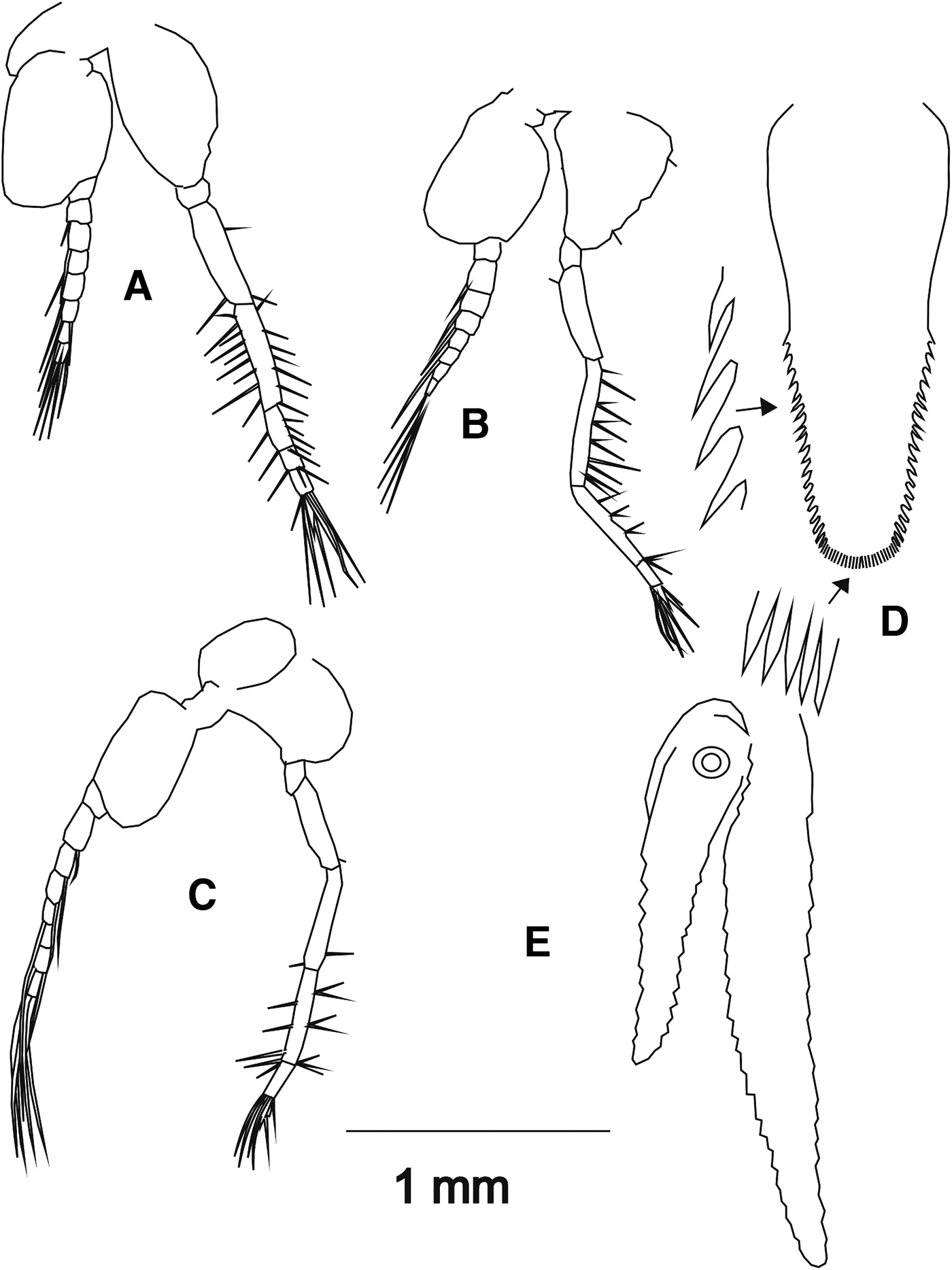
Mysidium pumae sp. nov. A, pereopod 5 (thoracopod 6); B, pereopod 6 (thoracopod 7); C, pereopod 7 (thoracopod 8); D, telson; E, uropod.

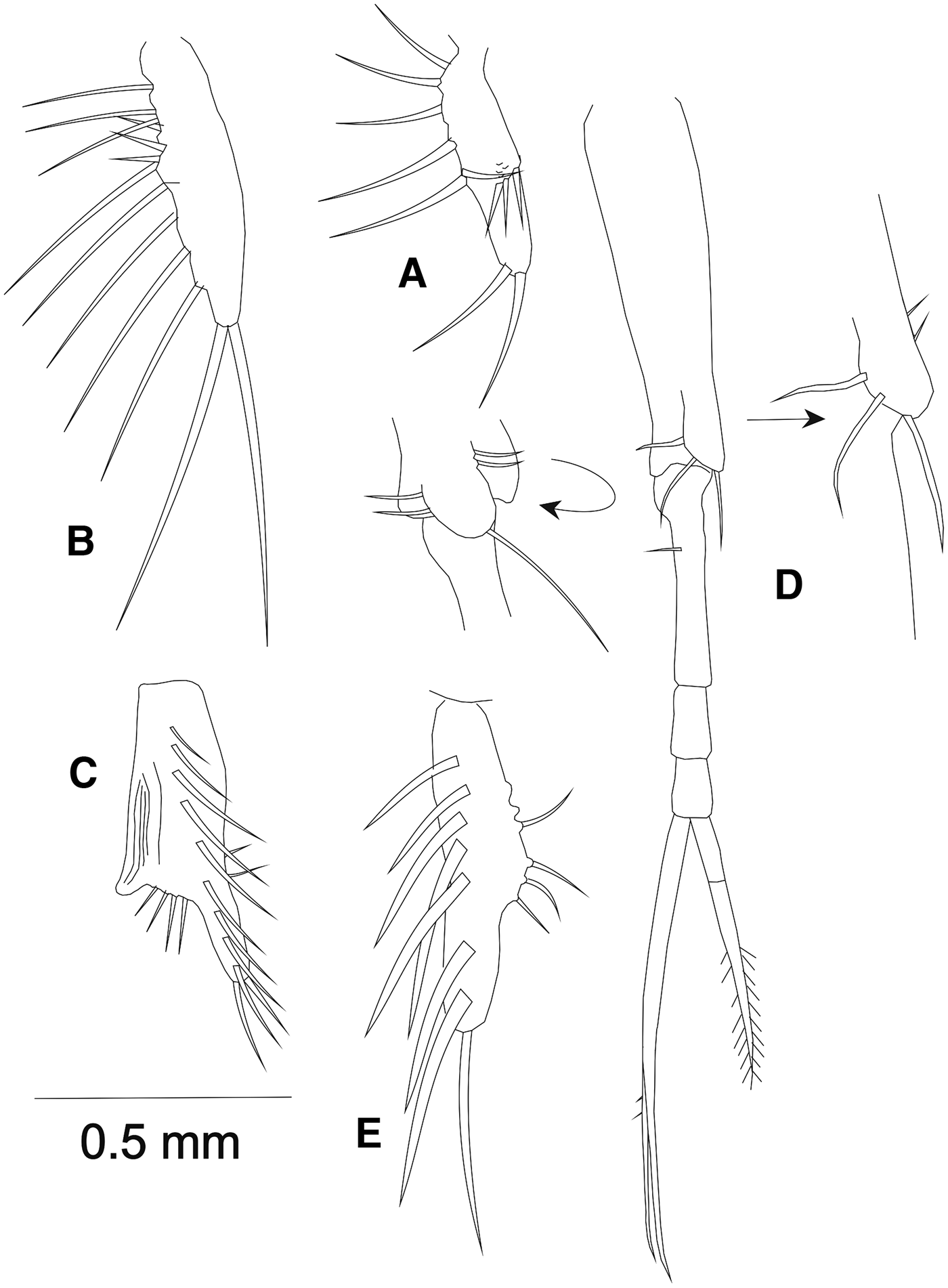
Mysidium pumae sp. nov. (holotype, CNCR-29112). A, pleopod 1 and view of the pseudobranchial lobe (arrow); B, pleopod 2; C, pleopod 3; D, pleopod 4 and view of slightly rotated tip of endopod (arrow); E, pleopod 5.

TYPE MATERIAL
Holotype: one adult male, TL 8 mm, Mazatlán harbour, pier of the R/V ‘El Puma’, Universidad Nacional Autónoma de México (23°10′53″N 106°25′27″W), Mexico, surface hand-net sample, 17 April 2013 (CNCR-29112).
Paratypes (all from same locality and date): one ovigerous female, TL 7 mm (CNCR-29113); one male, TL 7.8 mm (CNCR-29114); two males, TL 9.4 and 10.4 mm, two females, TL 8.0 and 9.4 mm, and two ovigerous females, TL 8.7 and 9.7 mm (ICML-EMU-10510); two males, TL 10.3 and 10.4 mm, two females, 8.4 and 0.6 mm, and two ovigerous females, TL 8.3 and 9.0 mm (ICML-EMU-10511).
DIAGNOSIS
Cornea wider than peduncle, crescent-like in dorsal view, about half peduncle length; posterior margin of carapace emarginated, exposing pereonites 7 and 8; article 1 of peduncle of antennula as long as article 3; antennal scale 6× as long as wide, with distal suture; appendix masculina lanceolate, 3× as long as wide, tapering distally, distal tuft of 16 setae, inner proximal tuft of more than 30 setae; male pleopod 4 long and narrow, more than 2× as long as other pleopods, peduncle shorter than combined length of articles 1–4 of exopod; article 1 of exopod longer than combined length of articles 2–3; modified seta from article 3 of the exopod bifid; endopod represented by simple rounded lobe bearing three equal setae; telson 2.3× as long as wide, slightly tapering posteriorly, posterior half of lateral margins each covered with 20–22 closely spaced, short setae, posterior margin covered with 23–25 setae.
DESCRIPTION
Holotype male. Eye cornea wider than peduncle, dark brown, crescent-like in dorsal view, about half peduncle length. Rostrum triangular (Figure 1A). Posterior margin of carapace emarginated, exposing pereonites 7 and 8. Antennula (Figure 1A) peduncle with 3 articles; article 1 as long as article 3; article 1 with 2 short setae on anterolateral margin; article 2 almost 0.5× length of article 3; article 3 quadrangular, with a tuft of short setae on the anteroinner margin; outer flagellum with proximal outer tuft of 41 long setae; both flagellae with 35–37 articles. Appendix masculina (Figure 1A) lanceolate, 3× as long as wide, tapering distally, distal tuft of 16 setae, inner proximal tuft of more than 30 setae.
Antenna peduncle with 5 articles; flagellum of 95–100 articles, surpassing base of telson. Antennal scale (Figure 1B) 6× as long as greatest width, with distal suture (Figure 1A).
Labrum (Figure 1C) symmetric, distal border thickened, with tiny setae.
Maxilla 1 (maxillula) (Figure 1D) inner lobe with distal margin bearing one long pectinate and 4 shorter setae, three setae on outer margin and two on inner; outer lobe outer margin twice as long as inner lobe, with 8 simple robust setae. Maxilla 2 (maxilla) (Figure 1E) endites well developed, heavily setose; distal segment of endopod 2.4× as long as proximal segment, with 16 long marginal setae (7 pectinate); exopod not reaching distal margin of proximal segment of endopod, with 8 plumose marginal setae.
Mandible molar process large and triturative; mandible palp article 1 short, devoid of setae, article 2 swollen at mid-length, 4× as long as article 1, twice as long as article 3; article 2 with 7 setae on outer margin and 14 on outer margin; article 3 with 2 basal and 1 distal setae on outer margin, six setae on inner margin, and a distal tuft of 7 setae; left mandible (Figure 1G) with incisor process 3-cuspate, lacinia mobilis 2-cuspate, spine row with three accessory blades; right mandible (Figure 1H) with incisor process 4-cuspate, lacinia mobilis 4-cuspate, spine row with three accessory, denticulate blades.
Penis (Figure 1I) quadrangular, 3× as long as wide, 8 setae on distal border.
Thoracopod 1 (maxilliped) (Figure 1F) with basis endite reduced, 8 marginal pectinate setae (1 robust and 5 pectinate distal setae); medial margins of articles densely setose, ischium with 5 setae (all pectinate), merus with 8 (all pectinate), carpus with 7 (2 pectinate), propodus with 7 (1 pectinate) setae; dactylus curved, 2× as long as propodus. Thoracopod 2 (Figure 2A) endopod basis with wide and curved posterior lobe, preischium short, triangular; ischium with 4 setae on anterior border, merus with 3 long setae on posterior border, and 2 long setae on anterior border, carpo-propodus with 5 anterodistal setae on posterior border; dactylus with a fan-like series of 9 setae. Thoracopod 3 (Figure 2B) endopod basis 2× as long as wide; preischium 0.2× as long as ischium; carpo-propodus divided in 2 articles, with 8 distal setae; dactylus short. Thoracopod 4 (Figure 2C) endopod basis 2× as long as wide; preischium 0.4× as long as ischium; merus 1.5× as long as ischium; carpo-propodus divided in 3 articles, dactylus short. Thoracopod 5 (Figure 2D) endopod basis with rounded posterior lobe, 2× as long as ischium; preischium triangular; merus as long as combined length of preischium and ischium; carpo-propodus divided in 3 articles; dactylus short. Thoracopod 6 (Figure 3A) endopod basis ovoidal, as long as ischium; preischium 0.2× as short as ischium; merus as long as ischium; carpo-propodus divided in 3 articles; dactylus short. Thoracopod 7 (Figure 3B) endopod basis triangular; preischium short; ischium 0.8× as long as merus; carpo-propodus, divided in 2 articles; dactylus short. Thoracopod 8 (Figure 3C) endopod basis ovoidal, as long as ischium; preischium short; merus 0.75× the length of the 2 articulated carpo-propodus; dactylus short (Figure 3C). Exopod of thoracopods 2–4 with 9 articles, setae as illustrated (Figure 2A–C); exopod of thoracopods 5–8 with 8 articles, setae as illustrated (Figures 2D & 3A–D).
Pleopod 1 (Figure 1A) the shortest, reduced to an elongate plate, with 7 marginal setae and 4 on the tiny pseudobranchial lobe (Figure 4A). Pleopod 2 (Figure 4B) a single plate, tapering distally; with 10 long setae; 3 setae on the pseudobranchial lobe. Pleopod 3 (Figure 4C) a lengthened bifid plate; with 11 setae on the longest margin; 4 setae on the pseudobranchial lobe, between bifid tips. Pleopod 4 (Figure 4D) male exopod with 4 articles, long and narrow, reaching to the base of telson, more than 2× as long as other pleopods; peduncle as long as the combined length of articles 1–3 of exopod; article 1 of exopod 1.6× the combined length of articles 2 and 3; modified seta from article 3 of exopod bifid; article 4 with modified seta as long as articles 2–4 combined; endopod represented by simple rounded lobe bearing 3 setae; pseudobranchial lobe with 2 short setae. Pleopod 5 (Figure 4E) as long as pleopod 2, a plate tapering from midway bearing 8 setae, distal seta the longest; pseudobranchial lobe with 4 setae.
Uropod (Figure 3E) devoid of robust setae; exopod 1.4× as long as endopod, tapering distally; endopod with one small seta proximal to the statocyst. Telson (Figure 3D) entire, tapering distally, 2.3× as long as wide at base; posterior of each lateral margin with 20–22 short, closely spaced, pointed robust setae, posterior margin with 23–25 more closely spaced, pointed robust setae.
Female. Ovigerous female (with oostegites and eggs) similar to male, smaller (TL 7 mm). Antennula shorter than carapace; peduncle as in male; outer flagellum with 14 setae; inner flagellum with 34 articles. Antenna flagellum with 56 articles, reaching to eighth thoracic segment.
ETYMOLOGY
The species is named after the RV ‘El Puma’ of the Universidad Nacional Autónoma de México.
REMARKS
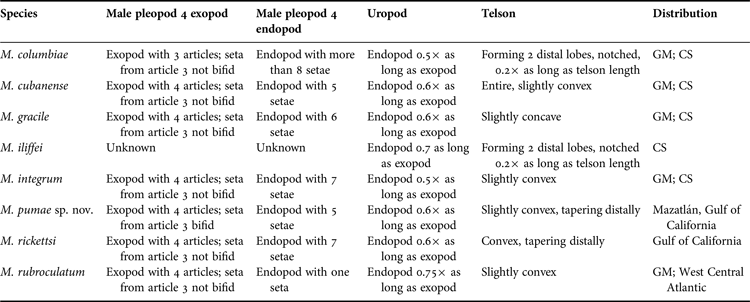
Mysidium pumae sp. nov. differs from all other known members of the genus by having the appendix masculina with one distal and one basal tuft of long setae; the male pleopod 4 exopod with 4 articles; the modified seta from article 3 of the exopod bifid; endopod with 3 small setae. Also, the combination of several diagnostic characters, including the shape of the telson, and the differences in male pleopod 4, allows separation of the different species. Mysidium pumae sp. nov. is morphologically related to M. rickettsi from the Gulf of California, yet it can be separated from the latter species based on the following characters: the appendix masculina bears two tufts of setae in M. pumae sp. nov. (setae are dispersed in M. rickettsi); article 2 on mandible palp is swollen in M. pumae sp. nov. (not swollen in M. rickettsi); there is no oblique row of setae distally on the penis in M. pumae sp. nov. (setae present in M. rickettsi); there is a set of comb-like setae in M. pumae sp. nov. pleopod 2 (no comb-like setae in M. rickettsi); and the percentage of lateral margin of telson covered by setae differs in the two species (50% in M. pumae and 30% in M. ricketsi). The major morphological characters of all species of genus Mysidium are given in Table 1.
Diagnostic characters and distribution of the known species of Mysidium (GM, Gulf of Mexico; CS, Caribbean Sea).

ACKNOWLEDGEMENTS
The material used in this contribution was collected during the workshop ‘Taxonomy, Morphology and Biogeography of Peracarid Crustacean’, carried out at Mazatlán, Sinaloa, and supported by PAPIME-PE207311 project, Universidad Nacional Autónoma de México (UNAM), by the Facultad de Ciencias del Mar, Universidad Autónoma de Sinaloa, and by the Instituto de Ciencias del Mar y Limnología, UNAM. This research was also supported by the PAPCA-FESIztacala-2013 (Num-2) project (UNAM). Thanks also to Carlos Bedia Sánchez for his advice in the fieldwork. We also thank W. Wayne Price and Sarah Gerken for their critical evaluation of the manuscript and their useful suggestions.