INTRODUCTION
Children's acquisition of phonology has been extensively described by longitudinal case studies (e.g. Smith, Reference Smith1973) and cross-sectional studies (e.g. Stoel-Gammon, Reference Stoel-Gammon1987). These studies provide data-rich descriptions allowing development of knowledge about the sequence of acquisition, linked to chronological age, in terms of different metrics and noting the extent of individual variation. More recent research has focused on factors that affect language learning. Most of these studies examine one ability in isolation, arguing for that ability's principal role in development (input processing, e.g. Curtin & Werker, Reference Curtin, Werker, Gaskell, Altman, Bloom, Caramazza and Levelt2007; phonological working memory, Adams & Gathercole, Reference Adams and Gathercole1995; motor ability, e.g. Green, Moore & Reilly, Reference Green, Moore and Reilly2002). The study reported here evaluates the relative contribution of input processing, output and the cognitive-linguistic factor of rule abstraction on the phonological acquisition of 62 children aged between 2 ; 1 and 2 ; 11.
Rule abstraction ability is often associated with generative phonology (Stampe, Reference Stampe1979), a widely criticized approach (e.g. Bernhardt & Stemberger, Reference Bernhardt and Stemberger1998). Proponents argue that children's mental representations of words closely resemble adult surface forms, in contrast to their pronunciation which is characterized by errors that are governed by rules that change during phonological acquisition, until children share the same phonological constraints as adult native speakers of their language (Broselow, Reference Broselow2009). More recently, Optimality Theory models of phonological acquisition involve ‘working out’ the correct balance between markedness and faithfulness rules to realize lexical contrasts (Kager, Pater & Zonneveld, Reference Kager, Pater and Zonneveld2004). Rule abstraction is considered implicit, involving a cluster of cognitive abilities such as ‘probabilistic learning of categories, prototype abstraction, statistical learning, and artificial grammar learning’ (Evans, Saffran & Robe-Torres, Reference Evans, Saffran and Robe-Torres2009: 321). Similarly, connectionist models of language acquisition using statistical learning methodologies rely on children's implicit ‘learning of phonological regularities’ (Redington & Chater, Reference Redington and Chater1998: 151). All these accounts rely on young children's cognitive-linguistic ability (i.e. use of cognitive abilities in the context of language acquisition) to implicitly derive ‘rules’, ‘constraints’ or ‘regularities’ to acquire spoken language.
Children usually produce their first recognizable words at around one year, their word repertoire expanding so that by 2 ; 0 most toddlers produce multiword utterances (Cattell, Reference Cattell2000). Ferguson & Farwell (Reference Ferguson and Farwell1975) suggest that children's initial phonology is whole-word based (see also Velleman & Vihman, Reference Velleman and Vihman2002). They argue that ‘a phonic core of remembered lexical items and articulations which produce them is the foundation of an individual's phonology’ (p. 437). Once children's vocabulary reaches a critical point, phonological rules occur across lexical items, suggesting reorganization from whole word to a segmental phonological system. Ingram (Reference Ingram1976) set the criterion at approximately 50 words, whereas Vogel Sosa & Stoel-Gammon (Reference Vogel Sosa and Stoel-Gammon2006) present data indicating that children's pronunciations do not become consistent until they acquire around 200 words. For most children, reorganization from whole word to phonemic segments seems to occur by their second birthday. Children's phonological development is consequently described in terms of systematic rules that are shared by most children. Ingram (Reference Ingram1976) argues that the process of reorganization occurs in a systematic order within specific time frames and without explicit instruction.
The phonology of two- to three-year-olds
McLeod & Bleile (Reference McLeod and Bleile2003) present an overview of two-year-old phonology. Many of the studies include few participants, focus on testing children at specific ages or use measures that describe a limited range of speech behaviour. There is variation in the word shapes, phonetic repertoires and rules observed, at least partly due to the use of cross-sectional and longitudinal designs, data sampling strategies, varying amounts of data and the populations being from different language learning contexts. There are also similarities, for monolingual English-speaking children, in predominant word shapes use, the phonemes absent at 3 ; 0 years (affricates) and the use of rules. For example, studies agree that while CVC syllable shape is dominant, most children produce multisyllabic words (Dyson, Reference Dyson1988) and some clusters (Kirk, Reference Kirk2008; McLeod, van Dorn & Reed, Reference McLeod, van Dorn and Reed2001; Stoel-Gammon, Reference Stoel-Gammon1987). Predominant rules are assimilation, cluster reduction, weak syllable deletion, stopping, fronting, gliding and final consonant deletion with percent consonant correct findings ranging between 43–91% (Bland-Stewart Reference Bland-Stewart2003; Dodd, Reference Dodd and Dodd1995; Watson & Scukanec, Reference Watson and Scukanec1997).
Studies of two-year-old phonology, however, describe what children do; they do not explain how or why they do it. There are three basic hypotheses about the abilities underlying phonological acquisition and each of those abilities can be measured in different ways. Some researchers argue that children gradually master the auditory ability to discriminate differences between speech sounds of their native language (e.g. Curtin & Werker, Reference Curtin, Werker, Gaskell, Altman, Bloom, Caramazza and Levelt2007). Motor theory holds that children gradually master the fine motor skills that allow the coordination and sequencing of the tongue, lips, soft palate and facial muscles to pronounce words (e.g. Green et al., Reference Green, Moore and Reilly2002; Kirk, Reference Kirk2008). Cognitive-linguistic approaches propose that children's ability to process accurately perceived speech information changes over time. Different candidate processes have been identified: phonological working memory (Adams & Gathercole, Reference Adams and Gathercole1995), lexical representation (Elbro, Reference Elbro, Joshi and Leong1993) and derivation of phonological constraints (Dodd & Gillon, Reference Dodd, Gillon, Leong and Joshi1997).
Input processing skills
Some researchers claim that the ability to discriminate speech sounds underlies phonological development (e.g. Curtin & Werker, Reference Curtin, Werker, Gaskell, Altman, Bloom, Caramazza and Levelt2007). They report that young children's ability to discriminate minimally paired words (e.g. pin vs. bin) emerges during the preschool years. Many of these studies are methodologically flawed in stimulus items or task. For example, tasks asking children to judge minimal word pairs such as rope and robe (that differ in word frequency) as same or different (at an age before the concept has emerged) do not provide reliable evidence. One methodologically sound study (Burnham, Earnshaw & Clark, Reference Burnham, Earnshaw and Clark1991) presents evidence that the development of the ability to discriminate speech sounds is ‘tuned’ post infancy. Initially, infants have the ability to discriminate contrasts not relevant to their native language (e.g. Jusczyk, Reference Jusczyk, Ferguson, Menn and Stoel-Gammon1992). For instance, infants exposed to Cantonese can discriminate /r/ and /l/ despite these two sounds not discriminating words in Cantonese. By two years of age, however, children's speech discrimination becomes increasingly more restricted to contrasts relevant to their native language. They lose the ability to discriminate between sounds that are not native language phonemes. This finding was extended by Thyer, Hickson & Dodd (Reference Thyer, Hickson and Dodd2000), who report that non-native speakers of English categorize vowel sounds differently from native speakers. That is, rather than limiting phonological acquisition, speech discrimination seems to be influenced by exposure to a specific phonological system.
Research that has examined the link between auditory discrimination and phonological ability has often overlooked compelling evidence that speech perception involves processing both auditory and visual information from infancy. Hearing infants are aware of the congruence of lip movements and speech sounds from soon after birth. From early childhood, hearing people use lip-read cues to complement heard speech perception (Burnham & Dodd, Reference Burnham and Dodd2004). Further, phonological disorders may be associated with an impaired ability to integrate auditory and visual speech information (Desjardins, Rogers & Werker, Reference Desjardins, Rogers and Werker1997; Dodd, McIntosh, Erdener & Burnham, Reference Dodd, McIntosh, Erdener and Burnham2008). Perception of the McGurk illusion (e.g. where heard /pi/ is dubbed onto the lip movements for /ki/ giving rise to the illusion of /ti/) and appropriate control stimuli allow more valid assessment of speech input processing. The task used in this study involves both speech perception modalities, is lexically constrained and involves speech processing as opposed to same–different judgments.
Oro-motor skills
Developmental errors may be linked to children's ability to plan and execute complex sequences of fine oro-motor movements required for the articulation of speech. Measurement may be instrumental (e.g. muscle activity, Green et al., Reference Green, Moore and Reilly2002) or standardized tests of oro-motor function that assesses diadochokinetic ability (rapid repetitions of /p-t-k/) as well as isolated and sequenced movements (e.g. Diagnostic Evaluation of Articulation and Phonology, Dodd, Zhu, Crosbie, Holm & Ozanne, Reference Dodd, Zhu, Crosbie, Holm and Ozanne2002). Both types of measures reveal relationships between speech disorder and oro-motor function. Some developmental phenomena, however, provide evidence that developing motor ability cannot explain typical speech development.
One common occurrence in the development of phonology is production of a word's sound sequence correctly but only when the target is another word. For example, puddle realised as [pΛɡəl] but puzzle pronounced as [pΛdəl] (Smith, Reference Smith1973). Another well-documented phenomenon is the ability of children to imitate words correctly that they produce spontaneously in error e.g. [ɡlædis] for Gladys in imitation, but [dædis] in spontaneous speech (Dodd, Reference Dodd and Dodd1995). Cross-linguistic studies provide additional counter-evidence. For example, affricate speech sounds such as [tʃ, dƷ] are thought to be acquired late by English-speaking children because of the oro-motor complexity of their articulation. However, Putonghua-speaking children acquire both sounds very early, perhaps because of their salience in Putonghua phonology (Zhu & Dodd, Reference Zhu and Dodd2000). In the current study, a standardized behavioural assessment was chosen to evaluate oro-motor function to maximize compliance of two-year-old children.
The combined role of peripheral input processing and output skills
Vihman & Velleman (Reference Vihman and Velleman1989) argue that reorganization from whole-word to segmental phonology can be attributed to development of word templates derived from implicit perceptual and motor learning. The templates are abstract phonetic production patterns that integrate the adult target with the child's most common vocal patterns and result in explicit word learning. Vihman (Reference Vihman2007) presents evidence on the emergence of phonology from cross-linguistic studies of children aged 0 ; 5 to 1 ; 9, and their attention to, and production of, babbled speech sounds, non-words and words. The findings indicated that phonological knowledge depended on lexical learning as well as input exposure and motor practice. One difficulty in interpreting these data is the age of the participants studied. The relationship between input, output and cognitive-linguistic abilities that govern the emergence of first words may change once reorganization from whole word to segmental phonology occurs.
Cognitive-linguistic learning
An alternative perspective is that children implicitly derive rules from their lexicon that reflect their constraints for word production (Duggirala & Dodd, Reference Duggirala and Dodd1991). Given that children provide evidence of syntactic (goed, sheeps) and semantic (yesternight) rule derivation, it seems worth investigating how children identify phonological constraints. Three types of evidence support the idea that phonological development is a cognitive-linguistic process rather than merely reflecting input processing and output limitations. There is evidence of a relationship between cognitive ability and language (including phonological) development (for review see Dodd & Crosbie, Reference Dodd, Crosbie and Goswamiin press). Second, behaviours consistent with emerging executive function, such as rule derivation, are evident from infancy (Jacques & Zelazo, Reference Jacques, Zelazo, Astington and Baird2005). For example, Banich's (Reference Banich2009) review identifies the deduction of rules and the cognitive flexibility to adjust rules as being ‘a cardinal characteristic of executive function’. Finally, there is evidence that children who consistently use non-developmental rules have difficulties with rule abstraction and flexibility (Crosbie, Holm & Dodd, Reference Dodd, Crosbie and Goswamiin press).
Reorganization from whole-word to segmental phonology, that occurs at around two years, may reflect children's ability to integrate information to derive phonological rules. For example, if a child's lexicon has many /C1VC1i/ words (such as mummy, daddy, baby and nanny), then the constraint might be that all disyllabic words have a C1VC1i structure (e.g. [ɡɒɡi] or [dɒdi] for doggy; [keiki] or [teiti] for Katy). The development of a strategy for word production allows more rapid acquisition of expressive vocabulary. Increased phonological variation in the lexicon would result in reorganization and the formation of new and more complex rules governing spoken phonology.
The cognitive-linguistic process of rule derivation examined in the current study is measured in two ways: non-linguistic rule derivation and the number of atypical speech errors made. Atypical errors are those not made by 90% of children in a six-month age band in a standardization sample of an assessment. The number of atypical errors is a measure of children's cognitive linguistic ability to derive phonological rules. These measures were chosen for two reasons. Experiments with older children (Crosbie et al., Reference Crosbie, Holm and Doddin press; Dodd & McIntosh, Reference Dodd and McIntosh2008) have shown a relationship between rule abstraction ability and phonological development. Further, other ways of measuring cognitive-linguistic function in this age group are difficult. Non-word repetition (phonological working memory) is confounded by the number of developmental phonological errors made and picture–word matching (intactness of phonological representation) would be difficult given two-year-olds variable and limited vocabulary.
Phonology is a code (sequences of sounds that represent objects and abstract concepts) that children must ‘crack’ to both understand what others say and express their needs and thoughts. The primary ability required to ‘crack’ the code is the ability to work out the rules that govern the phonological system being learned. Evidence supporting the hypothesis that phonological errors can be accounted for by the operation of mental processes includes:
(1) Children share phonological rules (e.g. in /s/ plus consonant clusters, the /s/ is deleted if the consonant is a plosive ([tɒp] for stop) but the other consonant is deleted if it is a continuant ([sip] for sleep)). Rules can be idiosyncratic to an individual child, although most are shared by children of a similar age learning the same language.
(2) Children learning different languages use some rules that are specific to their language, reflecting children's implicit ‘understanding’ of the nature of the phonological systems that have different constraints. As examples, a consonant cluster reduction rule in Cantonese results in /kw/ being realised as [p] as opposed to [t] in English (So & Dodd, Reference So and Dodd2007), and Maltese–English bilingual children delete some word-initial consonants in Maltese that they realize correctly in English (Grech & Dodd, Reference Dodd, Crosbie and Goswamiin press).
(3) Some children are exposed to a second language before they have completed the phonological acquisition of their first language. Holm & Dodd (Reference Holm and Dodd1999) documented the phonological development of two three-year-old children first exposed solely to Cantonese at home, then to English in childcare. While their phonological errors in Cantonese were age appropriate before exposure to English, once they were exposed to English the children's Cantonese rules changed (e.g. contrasts established were lost) and their emerging spoken English was characterized by rules atypical of monolingual English-speaking children. These data suggest that even established rules can be dislodged by exposure to another phonology with differing constraints.
Research questions and hypotheses
The contribution of input processing, output and cognitive-linguistic abilities to phonological development has not previously been compared in one group of two-year-old children. The current study addresses this gap in knowledge by measuring and comparing oro-motor, auditory-visual speech perception and rule derivation skills with spoken phonological ability. It is hypothesized that rule derivation will be the most influential ability on phonological development.
METHODOLOGY
Participants
Sixty-two children aged between 2 ; 1 and 2 ; 11 were recruited for this study. Their mean age was 29·7 (3) months. All children were monolingual in Australian-English. There were 35 girls and 27 boys. Childcare centres and catholic parishes in the Brisbane area were contacted and invited to be part of the study. Childcare centres were sent details of the project and asked to indicate if they wished their centre to participate in the study. If so, consent forms and information about the study were sent to the centre and the director distributed the forms to parents. Parish priests in the Brisbane catholic diocese were contacted by mail and asked to place a notice in their parish newsletter seeking children for the research project. Interested parents were asked to contact the researchers by telephone. The assessment procedure was explained in detail and an appointment was made to assess the child at home or at the childcare centre. Only those children with parental consent were assessed and parents were given the option of observing the assessment session. Case history information was collected concerning birth and developmental history, health and socioeconomic class by a questionnaire attached to the consent form.
Assessment
Each child was assessed individually using the Preschool Language Scale (Zimmerman, Steiner & Pond, Reference Zimmerman, Steiner and Pond2002), the Toddler Phonology Test (McIntosh & Dodd, Reference McIntosh and Dodd2008), the oro-motor assessment from the Diagnostic Evaluation of Articulation and Phonology (DEAP) (Dodd et al., Reference Dodd, Zhu, Crosbie, Holm and Ozanne2002), a speech input processing task and a non-verbal rule abstraction task. The children were assessed either at home or at their childcare centre. Testing took approximately forty-five minutes in total. All children were assessed in a quiet space that was free of distractions. No difficulties were encountered when assessing the two-year-olds. Their natural curiosity to explore picture books and toys and respond to computer images made it easy to engage them in the assessment tasks. The assessment yielded thirteen measures, listed below.
1. PLS4: Preschool Language Scale, a measure of language ability on a standardized test;
2. PCC: percent consonants correct from the Toddler Phonology Test;
3. PVC: percent vowels correct the Toddler Phonology Test;
4. PPC: percent phonemes correct the Toddler Phonology Test;
Rule abstraction:
5. AE: Number of atypical speech errors i.e. errors that could not be categorized as being an example of a phonological rule used by 89% of the standardization sample of the Toddler Phonology Test (McIntosh & Dodd, Reference McIntosh and Dodd2008), appropriate for chronological age. An example of an atypical error was substitution of affricates for fricatives;
6. ND: non-verbal rule derivation score.
Input processing skills:
7. MGC: perception of audio-visual congruent control stimuli where lip movements and speech sounds matched;
8. MGA: perception of audio-visual incongruent stimuli associated with perception of the McGurl illusion;
9. MGA: Number of auditory components identified when the illusion was not perceived;
10. MGV: Number of visual components identified when the illusion was not perceived.
Oro-motor skills:
11. DDK: diadochokinetic score including accuracy, intelligibility and fluency;
12. OMI: score for isolated oro-motor movements;
13. OMS: score for sequenced oro-motor movements.
These measures, the procedures used and the justification for their choice are now described.
Preschool Language Scale (PLS4)
This standardized individually administered assessment measured auditory comprehension and expressive communication to ensure the young children assessed were developing typically. It takes fifteen minutes to administer and consists of a picture book and manipulative toys to elicit appropriate responses to test items. Australian-language adaptations were used according to the instructions in the Examiner's Manual and a standard score derived for each child.
Toddler Phonology Test (TPT)
The TPT consists of 32 target words derived from 29 pictures of the Diagnostic Test of Articulation & Phonology (DEAP) (Dodd et al., Reference Dodd, Zhu, Crosbie, Holm and Ozanne2002). The target words were chosen according to the age of acquisition norms for object names (Morrison, Chappell & Ellis, Reference Morrison, Chappell and Ellis1997). The average age of acquisition for the target words was 23·5 months (22·1–68·5) with 82% of the target words reported to be acquired well below 36 months, for example hat (23·4) and book (22·1). Four of the target words were reported to be acquired over 36 months, for example, swing (50·5) and sheep (44·5), however very few children failed to produce the correct label. The most difficult word was biscuits (68·5). It was labelled either [biki] or ‘cookies’. Only four children, of the 62 assessed, were unable or unwilling to imitate words they did not name spontaneously.
Both single and multisyllabic words were used. There were 20 single-syllable words and twelve multisyllable words in the test. A range of syllable structures were represented. All English consonant phonemes with the exception of voiced dental fricative [ð], voiced postalveolar fricative [Ʒ] and voiced labiodental fricative [v] were present in the test items. Eleven consonant clusters were represented; eight in the initial syllable position [sp, st, br, pr, tr, fr, θr, fl] and three in the syllable final position [nt, ts, nd].
The pictures were administered one at a time and the children were given the direction ‘What is this?’ Each attempt was transcribed according to the International Phonetic Alphabet onto the test form. If the child failed to respond to the first question a repeat instruction, ‘Tell me what this is’, was given. If the child still failed to respond the examiner asked the child to imitate the word. The intermediate step of offering the child a forced choice, for example, ‘Is it a fish or a bed?’, was not used as the two-year-olds tested for the pilot study failed to respond appropriately and repeated the last word.
Speech input processing
Perception of the McGurk illusion (heard /pi/ with simultaneously lip-read /ki/ is perceived as /ti/) was used to evaluate the integrity of speech input processing (McGurk & McDonald, Reference McGurk and MacDonald1976). Previous research indicates that children are aware of the illusion (Desjardins et al., Reference Desjardins, Rogers and Werker1997). The task required children to watch a video on a Toshiba notebook 23×30 cm computer screen where a woman with an Australian accent said the names of six pictures (pea, tea, key, bow, dough, go). The children were asked to point to the picture named from one of three coloured pictures on the same 26×14 cm display card that was placed in front of the computer. One card had pictures of pea, tea and key; and the other had pictures of bow, dough and go. The tester made sure that the children were familiar with the pictures before beginning the test. There were six control trials, one for each word, where the auditory and lip-read word matched.
There were six incongruent audio-visual trials i.e. visual ‘key’ and auditory ‘pea’ were presented to produce the illusion of ‘tea’; and, visual ‘go’ and auditory ‘bow’ were presented to produce the illusion of ‘dough’. There were three trials of each illusion. All twelve trials (congruent and incongruent) were randomly presented at a rate to suit the child. One repetition was allowed if the child had not visually attended to the stimulus. Children were scored out of six for the control trials, and out of six for the number of illusions perceived. When the illusion was not perceived, children's responses were also recorded. In general they reported either the auditory (total possible 6) or the visual (total possible 6) component of the incongruent stimuli.
Oro-motor assessment
The DEAP, a standardized assessment, enables differential diagnosis between articulation and phonological disorders, using five distinct subtests: screen, articulation, oro-motor, phonology and consistency. Motor speech disorders have been shown to be associated with poor performance on the oro-motor subtest (DEAP manual, Dodd et al., Reference Dodd, Zhu, Crosbie, Holm and Ozanne2002; for an Irish clinical sample: Dodd, McIntosh, Leahy & Murphy, Reference Dodd, McIntosh, Leahy and Murphyin press). The oro-motor test has three parts. The DDK task (scored out of 9) requires children to produce repeated sequences of ‘pat-a-cake’. DDK was scored strictly according to the manual. Children were marked out of three for accuracy, intelligibility and fluency according to specific criteria (e.g. the number of trials where all three consonants are accurately pronounced and sequenced on all five repetitions of ‘pat-a-cake’, number of consonant productions that were distorted, and length and types of dysfluency). The two other tasks assessed isolated tongue and lip movements (e.g. tester says ‘Can you put your tongue up to the top of your mouth like this?’; scored out of 12) and sequences of tongue and lip movements (e.g. the tester says ‘Do what I do. Blow and put your tongue up.’; scored out of 18). Young children can sometimes refuse to participate in oro-motor testing. In the study reported, seventeen children (27%) refused to do the DDK, four children (6·5%) refused the isolated movements task, and eight children (12·9%) refused to do the sequenced movement task.
Cognitive rule abstraction tasks
Verbal rule abstraction was examined by calculating the number of speech errors that are not typically reported for English phonological development. McIntosh & Dodd (Reference Dodd and McIntosh2008) reported the phonological rules used by at least 89% of two groups of two-year-old children (aged 2 ; 1–2 ; 5 and 2 ; 6–2 ; 11). Their findings confirmed previous studies identifying rules used by children of that age (e.g. Watson & Scukanec, Reference Watson and Scukanec1997). Children who make atypical errors (i.e. derive and use speech rules not typical of the phonological acquisition of their language) have been shown to have limited phonological knowledge, e.g. ability to identify phonologically legal and illegal words (So & Dodd, Reference So and Dodd2007). Examples of non-developmental patterns for two-year-olds (McIntosh & Dodd, Reference McIntosh and Dodd2008) included preference for word-initial consonants [h] and [w] and marking of clusters by affricates. Use of atypical rules does not necessarily result in a greater number of errors, e.g. substituting alveolar sounds with velar sounds (‘backing’, an atypical rule in English) would result in the same number of errors as substituting velar sounds with alveolar sounds (‘fronting’, a typical rule in English). It is true, though, that use of atypical syllable constraints (e.g. /h/ marks all initial consonants) is more likely to be associated with increased errors, indicating the need for another cognitive rule abstraction task.
A non-verbal rule abstraction task that also assessed cognitive flexibility has been successfully used to discriminate three- to five-year-old children with speech impairments from typically developing controls (Crosbie et al., Reference Crosbie, Holm and Doddin press; Dodd & McIntosh, Reference Dodd and McIntosh2008). A new task was developed for children aged 2 ; 0. Children were presented with a set of farm animals (four small and four large horses and four small and four large pigs), a farmer and a barn. Their ability to learn four predetermined rules was tested. All children learned the rules in the same order: one type of animal (either pig or horse); the other type of animal (pig or horse), any animal of a particular size (small or big) and a specific type of animal of a specific size (e.g. small pig). The target answers required were balanced across children. The tester told the children a story about the farmer who needs help to put his animals in the barn to feed them. The children were told to choose one of the animals that they thought the farmer might want to be first. If the child chose the correct animal (predetermined by the examiner but not revealed to the child) then the tester said ‘Yes that's the right one’. If the child did not choose the correct animal then the tester gave the feedback ‘No, that's not the one the farmer wants’. Once the child had recorded three consecutive correct responses, the tester changed the rule (without telling the child) by giving the appropriate feedback. For example, the sequence of the four rules might be: (i) any horse, (ii) any pig, (iii) any small animal, (iv) big pig. The game continued until the child had successfully completed all four rules, or given three incorrect responses for any rule. The total score they could achieve was four.
RESULTS
Correlation analysis
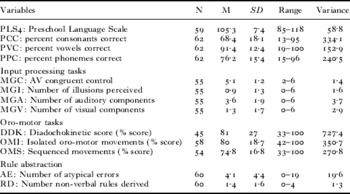
Quantitative performance data are shown in Table 1. As a first step, pairwise Pearson correlations explored outcome measures. The percent consonants correct (PCC) score correlated highly with percent vowels correct (PVC) (N=62, r=0·692, p<0·001) and percent phonemes correct (PPC) (N=62, r=0·972, p<0·001) scores. The PCC score was selected as the representative speech development measure for two reasons: the high correlations between the three measures and the previous literature's preference for reporting PCC. PCC was correlated with both chronological age (N=62, r=0·275, p=0·03) and the PLS4 language measure (N=62, r=0·494, <0·001), indicating that both these measures should be adjusted for in partial correlational analyses.
Descriptive statistics for all variables: language, speech, input processing output processing and rule use

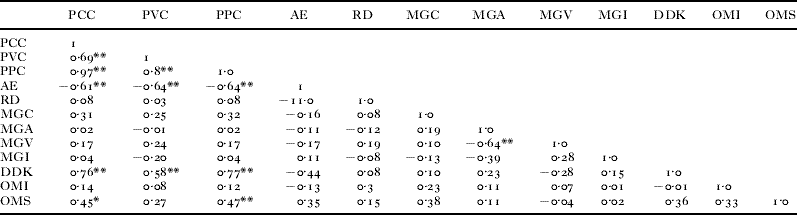
Alpha significance level was set at p=0·01 or better because of the number of comparisons. PCC was then correlated with a number of experimental measures: total number of atypical errors (AE) (N=60, r=−0·614, p<0·001), DDK (N=45, r=0·762, p<0·001) and sequenced oro-motor movements (OMS) (N=54, r=0·453, p=0·001). There was a trend for the McGurk audio-visual congruent control data from the input task (MGC) also to be correlated with PCC (N=62, r=0·309, p=0·022), There was no correlation between any of the accuracy measures (PCC, PVC and PPC) and non-verbal rule derivation (RD), other input processing tasks or isolated motor movements (OMI) (see Table 2).
Correlations for all measures
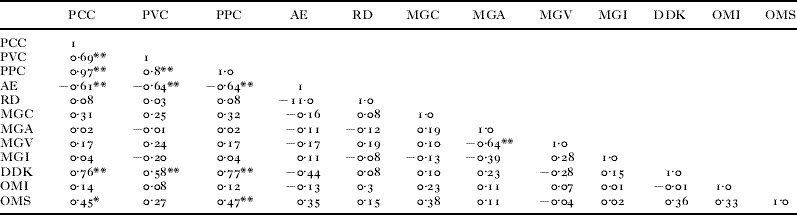
** =p=0·001; *=p=0·01. PCC=Percent Consonants Correct; PVC Percent Vowels Correct; PPC Percent Phonemes Correct; AE=atypical errors; RD=non-verbal rule derivation; MGC=congruent audio-visual stimuli; MGA=auditory McGurk stimuli; MGV=visual McGurk stimuli; MGI=McGurk illusion; DDK=diadochokinetic task; OMI=isolated oro-motor movements; OMS=sequenced oro-motor movements.
Sequenced oro-motor movement (OMS) was selected as most representative of output skill for two reasons. Isolated movements scores were not correlated with PCC, and the pattern of performance on DDK tasks suggested a phonological rather than an oro-motor difficulty. Inspection of the raw data from the whole group indicated that 72% of children who did the task and scored less than 9/9 were likely to substitute [t] for /k/ in pat-a-cake), negatively affecting their DDK accuracy scores, while their DDK intelligibility and fluency scores were high. The results of correlation analysis for all measures are shown in Table 2.
Partial correlational analyses
Age was adjusted for in an analysis that examined the correlation of scores between PCC and the selected experimental measures. PCC was correlated with the PLS4 scores (N=56, r=0·537, p<0·001), number of atypical errors (N=57, r=−0·624, p<0·001), AV congruent control (MGC) data from the input task (N=52, r=0·268, p=0·05) and sequenced oro-motor movements (OMS) (N=51, r=0·409, p=0·002). In another analyses the PLS4 standard score was used as a control variable. PCC was then correlated with number of atypical errors (N=54, r=−0·491, p<0·001), AV congruent (MGC) control data from the input task (N=49, r=0·345, p=0·013) and sequenced oro-motor movements (N=49, r=0·390, p=0·005). An analysis where both variables (chronological age and PLS4 score) were controlled resulted in correlations between PCC and number of atypical errors (N=53, r=−0·488, p<0·001), AV congruent (MGC) control data from the input task (N=52, r=0·296, p=0·037) and sequenced oro-motor movements (OMS) (N=48, r=0·316, p=0·025). These analyses revealed that the strongest relationship was between PCC and number of atypical errors, with both input and output measures showing a weaker relationship with PCC.
Linear multiple regressions for PCC
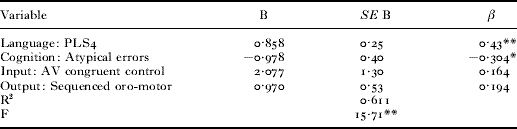
In order to compare the relative contributions of the three domains to phonological accuracy, a linear multiple regression was conducted on representative measures indicated by the correlation analyses. The first linear regression included the following explanatory variables: chronological age, PLS4, number of atypical errors, AV congruent (MGC) control data and sequenced oro-motor movements. The regression accounted for 62·7% of the variance in PCC and the overall relationship was significant (F 5,44=13·137, p<0·001). The coefficients table indicated, however, that chronological age was not significant (B=0·866, SE=0·66, p=0·197). A second analysis was done, leaving out chronological age. The results, shown in Table 3, indicated that the PLS4 and number of atypical errors reached significance. The regression accounted for 61·1% of the variance in the PCC scores and was significant (F 4,44=15·707, p<0·001).
Coefficients for multiple linear regression where the dependent variable was PCC (N=62)
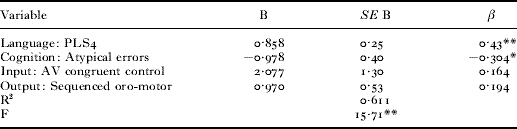
* p=0·01, ** p=0·001.
DISCUSSION
The study examined the auditory-visual speech perception, oro-motor and rule derivation abilities of 62 typically developing two-year-olds to determine the contribution of each set of skills to the accuracy of spoken phonology. Measures of all three domains (input processing, oro-motor skills and rule derivation) were correlated with PCC scores. The relationship between speech accuracy and the three domains remained when partial correlation analyses were done, adjusting for age and language score on the PLS4. Multiple linear regression showed that language and the number of atypical errors had the strongest relationship with phonological accuracy, the model accounting for 61% of the variance.
Input processing skills
PCC was correlated with performance on the auditory-visual control, auditory alone and perception of the illusion conditions. Children performed better on the control (congruent auditory and visual speech cues) than on the incongruent audio-visual stimuli, indicating that they were processing the visual stimuli and indicating that their speech perception was disadvantaged by stimuli where the auditory and visual information conflicted (see Table 1). They perceived few McGurk illusions (perception of /ti/ when exposed to heard /pi/ dubbed onto visual /ki/; McGurk & MacDonald, Reference McGurk and MacDonald1976). When the illusion was not perceived, children tended to report the auditory rather than the visual component of the illusion. The results confirm previous studies' findings of older children (Desjardins et al., Reference Desjardins, Rogers and Werker1997, Dodd et al., Reference Dodd, McIntosh, Erdener and Burnham2008).
The auditory-visual control condition was selected as the strongest representative measure of input processing because children performed best on this task. Nevertheless, the multiple linear regression indicated a non-significant finding for this measure, indicating that differences in input processing skills are not a general explanation of differences in speech accuracy performance in a typically developing population of two-year-olds. Intact input processing is necessary for phonological acquisition, with deafness and impaired auditory processing being recognized causal factors for speech difficulties. Nevertheless, intact input processing is not sufficient to explain typical phonological development. Other skills are also necessary.
Oromotor skills
There were significant positive correlations between both the DDK and sequenced movements tasks with phonological accuracy, although there was no positive correlation for isolated movements. The pattern of performance on the DDK task suggested a phonological rather than a motor difficulty. Consequently, the sequenced movements task was selected as the representative score for inclusion in the multiple linear regression. Although motor ability did not reach significance, there was a trend towards significance.
The literature evaluating the relationship between oro-motor skills and phonological acquisition is split. Some researchers report no association (e.g. Lof, Reference Lof2002), while others assign motor skills a central role in both normal acquisition and phonological disorder (Vihman & Velleman, Reference Vihman and Velleman1989). Although the two-year-old data were gathered using a limited range of oro-motor tasks, and a significant number of the children refused one or more of the tasks, there was little evidence that oro-motor ability can provide a general explanation for speech development. Intact output processing (i.e. making the phonetic gestures required for the accurate pronunciation of speech sounds in the form of overt muscular activation) is necessary for phonological acquisition, with neurological disorders, like cerebral palsy, affecting speech articulation. Nevertheless, growth in oro-motor skills was not sufficient to explain differences in typical phonological development in two-year-olds. An alternative explanation, emerging understanding of the linguistic system of phonological contrasts, will be considered in the next section.
Rule derivation
There were two rule derivation measures of cognitive development. The non-verbal rule derivation measure showed no positive correlation with PCC for the two-year-old population. This finding differs from that for children aged 3 ; 0 to 5 ; 7 (Dodd & McIntosh, Reference Dodd and McIntosh2008). In that study, children with speech disorder and controls were assessed on Flexible Item Selection Task (FIST) (Jacques & Zelazo, Reference Jacques, Zelazo, Astington and Baird2005) and another non-verbal task requiring derivation of rules involving colour and geometric shape. The controls performed better on both tasks than children with speech disorder. There are a number of possible reasons for the difference in findings, including the ages of the children tested, the nature of the tasks used in the different studies and the way in which the results were analysed (between groups testing as opposed to correlation).
The verbal rule-derivation measure, however, was correlated with PCC. The greater the number of atypical speech errors made, the lower children's PCC score. The speech errors made by children who had high numbers of atypical errors were consistent, indicating that they were able to derive and implement phonological rules. Their impairment lay in that they were deriving the ‘wrong’ rules (i.e. rules used by fewer than 11% of the normative sample of the TPT). There are a number of possible explanations for this difficulty. For example, the children may have an impaired ability to identify the salient features of their native phonology. This explanation does not necessarily implicate input processing, since there was no correlation between number of atypical errors and any of the input processing measures. Rather, the impairment is more likely to involve implicit analysis of the linguistic system. Seidl & Buckley (Reference Seidl and Buckley2005) argue that neither production nor perceptual factors can explain how very young children learn arbitrary phonological patterns. One factor that may compound the problem of abstracting inappropriate rules may be that children with phonological disorder lack cognitive flexibility. They may be unable to inhibit a rule once it has been derived (Crosbie et al., Reference Crosbie, Holm and Doddin press).
It might be argued that measuring the number of atypical errors provides data reflecting PCC. This is not necessarily true, because overall accuracy is a quantitative measure that combines both typical and atypical errors. The atypical errors measure is qualitative. That quantitative and qualitative measures can be independent was shown in a longitudinal study (McIntosh & Dodd, Reference McIntosh and Dodd2008). Ten children's phonological acquisition was assessed three times between two and three years. The results indicated that while the quantitative measures (e.g. PCC) were poor predictors of phonological performance at three years, the number of atypical errors at two years provided a reliable indication of a child's phonological development at three years, in terms of diagnosis of phonological disorder (use of atypical rules).
Nevertheless, some atypical rules that affect syllable structure (e.g. all word-initial syllables are /w/) do result in a greater number of errors.Footnote 1 In the absence of corroborating evidence from the non-verbal rule derivation task, it is informative to consider children's performance on the standardized language measure, the PLS4. There was a positive correlation between PCC and the PLS4; the multiple linear regression suggested that the relationship between the two measures was very strong. This finding is not surprising given that early language learning is often considered rule governed (e.g. Pinker, Reference Pinker, Gleitman and Liberman1995). Cognitive rule derivation skills that underpin the receptive and expressive verbal behaviours measured by the PLS4 are also likely to be important for the acquisition of phonological constraints. Consequently, it is not surprising that a high number of atypical phonological errors was negatively correlated with performance on the PLS4.
Phonological acquisition is often thought to be solely associated with peripheral mental abilities: sensation/auditory processing and articulatory-motor skill. The study reported shows that while these skills are important for phonological development, cognitive-linguistic abilities may be more important. Nevertheless, the study reported was analysed using correlational measures that do not indicate a causal relationship. Further research is needed to identify and clarify the relative importance of the mental processes contributing to phonological development.
Speech difficulties are the most common communication difficulty in childhood. So far, however, research has been limited by an emphasis on descriptive studies that have failed to differentially diagnose different deficits in speech processing (i.e. perception, representation, cognition, output). The study reported indicated that while input and output abilities were associated with phonological accuracy in two-year-olds, rule abstraction skills explained more of the variance. Consequently, assessment practice needs to evaluate the range of mental abilities that might underlie articulation and phonological impairment. The intervention approach selected for a particular child needs to reflect identification of specifically impaired mental processes.