Introduction
In Europe, feral and semi-feral animals can play an important role in the transmission of parasites to domestic animals and humans. For example, there are concerns about the role of red foxes (Vulpes vulpes) in the maintenance of the life cycle of both Echinococcus granulosus and E. multilocularis in urban areas (Deplazes et al., Reference Deplazes, Hegglin, Gloor and Romig2004; Liccioli et al., Reference Liccioli, Giraudoux, Deplazes and Massolo2015). In addition, their role for the transmission of these parasites to humans has been widely discussed (Hegglin and Deplazes, Reference Hegglin and Deplazes2013; Hegglin et al., Reference Hegglin, Bontadina and Deplazes2015). To date, Ireland is free of both E. granulosus and E. multilocularis (Beltrán-Beck and Zancanaro, Reference Beltrán-Beck and Zancanaro2017) and the only species known to occur in Ireland is E. equinus (Hatch, Reference Hatch1970). However, the increase in the number of red foxes in urban and peripheric-urban areas of Co. Dublin dictates a closer interaction with humans and companion animal's habitats with the result that red foxes could play an increasing and considerable epidemiological role in other endoparasites of human and veterinary relevance. For example, a necropsy study found that 92.2 and 37.7% of red foxes harboured Uncinaria stenocephala and Toxocara canis adult worms, respectively (Wolfe et al., Reference Wolfe, Hogan, Maguire, Fitzpatrick, Vaughan, Wall, Hayden and Mulcahy2001). Some years later, a survey conducted in Irish wild carnivores showed that red foxes and badgers harboured, amongst other parasitic agents, Eucoleus aerophilus eggs (26 and 6%, respectively) and Isospora-like oocysts (9 and 16%, respectively) (Stuart et al., Reference Stuart, Golden, Zintl, De Waal, Mulcahy, Mccarthy and Lawton2013). More recently, another study found that 39.9% of red foxes in Ireland were infected with Angiostrongylus vasorum and 1.3% with Crenosoma vulpis (McCarthy et al., Reference McCarthy, Ferrand, De Waal, Zintl, McGrath, Byrne and O'Neill2016). Notably, the percentage of foxes infected with A. vasorum in Co. Dublin was 66.7%.
Similar concerns have been raised as to the potential epidemiological impact foxes could pose with respect to feline parasites. One of the most important zoonotic agents that cats are responsible for is the spread of Toxoplasma gondii and it has been reported that one-third of the cat population in Dublin have been exposed to T. gondii (Juvet et al., Reference Juvet, Lappin, Brennan and Mooney2010). Although it is recognized that the main infective route for humans is the consumption of infected meat, infection through the ingestion of oocyst-contaminated soil and water also occurs (Elmore et al., Reference Elmore, Jones, Conrad, Patton, Lindsay and Dubey2010). In two surveys carried out in Europe, it was estimated that more than 30% of owned cats were infected with at least one parasite species (Beugnet et al., Reference Beugnet, Bourdeau, Chalvet-Monfray, Cozma, Farkas, Guillot, Halos, Joachim, Losson, Miró, Otranto, Renaud and Rinaldi2014; Giannelli et al., Reference Giannelli, Capelli, Joachim, Hinney, Losson, Kirkova, René-Martellet, Papadopoulos, Farkas, Napoli, Brianti, Tamponi, Varcasia, Margarida Alho, Madeira de Carvalho, Cardoso, Maia, Mircean, Mihalca, Miró, Schnyder, Cantacessi, Colella, Cavalera, Latrofa, Annoscia, Knaus, Halos, Beugnet and Otranto2017). In addition, Toxocara cati, another zoonotic agent, was identified in 19.7% of the cats tested (Beugnet et al., Reference Beugnet, Bourdeau, Chalvet-Monfray, Cozma, Farkas, Guillot, Halos, Joachim, Losson, Miró, Otranto, Renaud and Rinaldi2014) which was very similar to the percentage of cats infected with ascarids in a follow-up study 3 years later (Giannelli et al., Reference Giannelli, Capelli, Joachim, Hinney, Losson, Kirkova, René-Martellet, Papadopoulos, Farkas, Napoli, Brianti, Tamponi, Varcasia, Margarida Alho, Madeira de Carvalho, Cardoso, Maia, Mircean, Mihalca, Miró, Schnyder, Cantacessi, Colella, Cavalera, Latrofa, Annoscia, Knaus, Halos, Beugnet and Otranto2017). Access to outdoors was one of the risk factors associated with parasitism in cats.
All of this information raises the question of the potential role of stray dogs and cats as potential parasite reservoirs; do they have the potential to have the same impact as wild carnivores and consequently an epidemiological impact on the transmission of endoparasites to domestic animals?
The aim of this study was to screen stray dogs and cats found roaming in County Dublin, as they presented to re-homing centres, for the presence of the most common endoparasites.
Materials and methods
Source
Fecal material (20 g approximately) was collected from unowned dogs (n = 627) and cats (n = 289) as they presented to the charity centres, Dogs Trust Ireland and The Dublin Society for Prevention of Cruelty to Animals (DSPCA) between February 2016 and June 2017. Samples were collected (by handlers) just after defecation and send to UCD Parasitology laboratory. For each sample, the following information was recorded: the date of collection, species, age, body condition of the animal and any clinical signs and consistency of the fecal material. The consistency was categorized as formed, loose or diarrhoeic. From each sample, 0.1 g of fecal material was transferred to an eppendorf tube and stored at −20 °C, the rest of the sample was subjected to routine parasitological examination as outlined below.
Fecal examination
Flotation methods
Each sample was subjected to two flotation techniques: one with saturated sugar solution and the other sulphate zinc (ZnSO4) solution. These techniques were performed as previously described with only minor modifications (Euzeby, Reference Euzeby1981). Briefly, 3 g of feces were suspended in 42 mL of water, filtered and 15 mL centrifuged at 1,500 × g for 4 min. Pellets were then dissolved in either saturated sucrose solution (SG = 1.3) or ZnSO4 solution (SG = 1.18), covered with cover slip and allowed to settle for 20 min. Cover slips were applied and the material observed with an Olympus BX40FA microscope (Olympus Optical Co, Ltd. Japan) using 10 × and 40 × Ach objectives (Olympus).
Baermann method
Detection of lungworm species was performed in all specimens using a modified Baermann technique as previously described (Euzeby, Reference Euzeby1981). Ten grams of each fecal sample was wrapped into a piece of gauze and suspended over the mouth of a 250 mL conical beaker and immerse in lukewarm water overnight. The sediment was transferred into a watch glass and viewed using an Olympus SZ-ST stereoscope (Olympus). Any L1 larvae were then transferred to a microscope slide, stained with 10% Lugol's iodine and examined microscopically. Morphological identification of lungworm species was performed considering the following features: length, anterior and posterior extremities (Georgi and Georgi, Reference Georgi and Georgi1991; McGarry and Morgan, Reference McGarry and Morgan2009; Brianti et al., Reference Brianti, Giannetto, Dantas-Torres and Otranto2014).
Modified Kinyoun staining
All samples were subjected to a Modified Kinyoun staining as described (Casemore, Reference Casemore1991). Briefly, a thin fecal smear was prepared onto a microscope slide, air dried and then fixed in 100% methanol and stained with Kinyoun's carbol fuchsin for 5 min. After a brief destaining step with 1% acid alcohol, samples were counterstained with 1% acid-methylene blue for 1 min and let to air dry. Samples were then examined microscopically using the 100 × oil immersion objective (Olympus).
ELISA
One hundred and sixty-three samples from dogs and 85 samples from cats were randomly selected and subjected to the Giardia Stool Antigen Detection ELISA (IVD Research Inc., USA) following the manufacturer's instructions. Absorbance was measured at 450 nm using Ledetect 96 microplate reader (Tec GmbH, Austria). Absorbance reading of 0.08 OD and above was used as a cut-off following manufacturer's instructions.
Statistical analysis
The prevalence of each parasite was calculated as the proportion of positive animals out of the total numbers of animals examined. Animals were grouped into three age categories (younger than 3 months, between 3 months and 1 year and older than 1 year of age, respectively) determined by staff at the re-homing centre based on tooth eruption and wear (Tutt, Reference Tutt2006). The association between infection with a single parasite agent and animal age was analysed using Fisher's exact test (two-side, α = 0.05) using R version 3.4.2
Results
General condition, clinical signs and stool consistency
Overall, animals were in good body condition and did not show marked signs of dehydration. Only 7 dogs had a body condition score ⩽2. Six dogs were coughing at the time of the clinical examination. The majority of dogs (84.04%) and cats (92.01%) had formed stools, with diarrhoea or loose feces noted in <1% of samples for each species.
Gastrointestinal nematodes
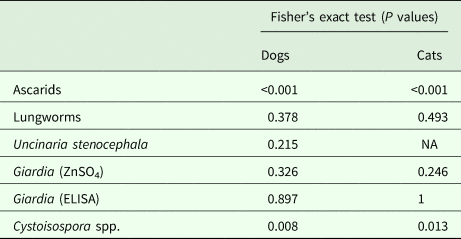
Of the 916 fecal samples, 25.8 and 36.8% were positive for the presence of endoparasites in canids and felids, respectively. The number and percentage of positive samples for each parasite are shown in Tables 1 and 2. Ascarids eggs were the most common eggs found using the saturated sugar flotation, with 15.52% of dog and 30.26% of cat samples containing eggs. Notably, 13.4% of dog feces excreted T. canis eggs and 2.12% Toxascaris leonina eggs. Only one dog was shown to be co-infected with both ascarid species. In the case of cats, only T. cati eggs were detected. As shown on Table 3, significantly higher ascarid prevalence was observed in dogs and cats younger than 3 months of age (P < 0.001 in both cases).
Numbers and percentage (%) of unowned dogs positive for endoparasites at different age groups

Numbers and percentage (%) of unowned cats positive for endoparasites at different age groups

Association of animal age and presence of endoparasites

NA, not applicable.
Uncinaria stenocephala eggs were the second most common eggs detected in 4.89% of dogs tested. Although a higher number of fecal samples (3.10%) containing U. stenocephala eggs was found in dogs older than 1 year of age, there was no significant association between age and carriage (P = 0.215). Trichuris vulpis eggs were identified in only 0.16% of dogs between 3 and 12 months of age. Neither Eucoleus spp. nor cestode eggs were identified in any of the samples examined.
Protozoan agents
Giardia spp. was the most prevalent protozoan parasite identified by ZnSO4 flotation, particularly in dogs, with 6.02% of the samples tested excreting Giardia cysts. Half of these dogs which tested positive for Giardia spp. were over 1 year of age. However, there was no association between age and the presence of Giardia cysts. In the case of cats, 1.84% of the animals were positive for Giardia spp. by ZnSO4 flotation. In parallel with the canine findings, more than half of the cats testing positive for Giardia spp. cysts were over a year old but no association between age and cyst excretion was apparent (P = 0.246). Interestingly, when the coproantigen ELISA was added to the screening profile for a sub-group of the samples (163 dogs and 85 cats) the percentage of animals testing positive for Giardia increased to 17.18% for dogs and 14.12% for cats. The number of dogs that were determined positive for Giardia by ELISA tended to increase with the age (3.07% for dogs younger than 3 months, 4.29% for dogs between 3 and 12 months and 9.20% for dogs older than 1 year). Cats younger than 3 months and older than 1 year showed the same prevalence (5.88% for each), but still there was no statistically significant association between Giardia infection and age in cats (P = 1). Looking at the fecal consistency, only nine of the dogs and two of the cats that were positive for Giardia presented diarrhoea or loose feces but no significant association between Giardia infection and consistency of fecal material was seen in either dogs or cats (P = 0.085 and P = 0.29, respectively).
Cystoisospora spp. were identified in a very similar percentage of dogs and cats (3.27 and 3.69%, respectively), younger dogs and cats having the highest prevalence for both Cystoisospora spp. (P = 0.008 and P = 0.013, respectively). Toxoplasma gondii oocysts were only detected in two cats, Sarcocystis sporocysts in only two dogs and Cryptosporidium oocysts in only one dog.
Prevalence of lungworms
Overall four dogs (0.64%) and six cats (2.07%) were positive for lungworms using the modified Baermann technique. Three out of four L1 larvae from the infected dogs were morphologically identified as A. vasorum. The other larva was identified as C. vulpis. In cats, A. abstrusus was the only species of lungworm identified. All animals identified with lungworms were older than 1 year, with the exception of two kittens younger than 3 months of age. None of these animals showed clinical signs compatible with lungworm infection such as coughing or dyspnoea at the time of examination. Positive samples were detected in late summer and winter for dogs. Cats were detected to be positive for lungworms only in the months of September 2016 and May 2017.
Co-infections
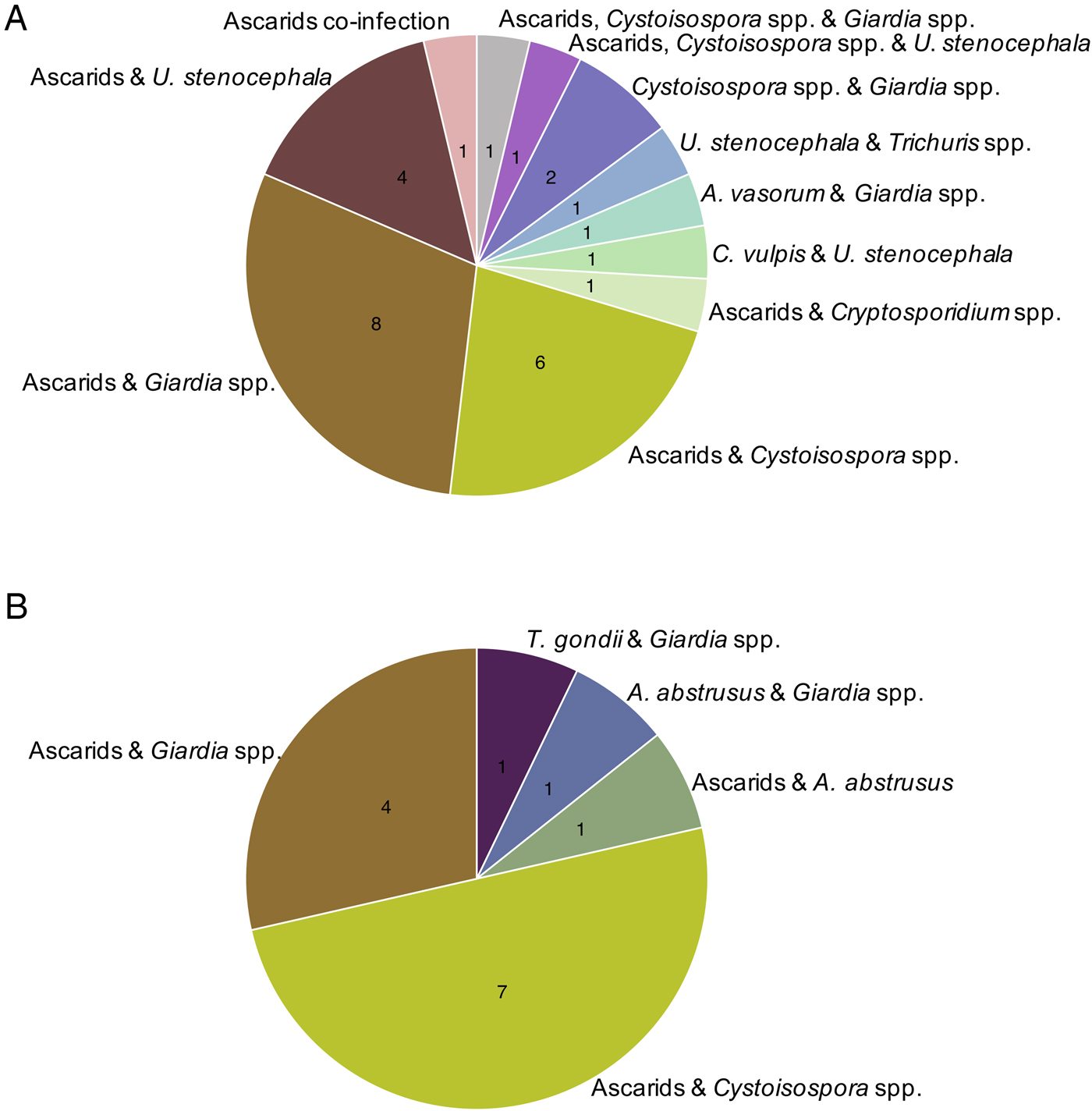
Of all the animals tested, 27 dogs (4.3%) and 13 cats (4.5%) were co-infected with two parasite agents (Fig. 1). The majority of the co-infections were a combination of ascarids (22 dogs and 12 cats) with either Cystoisospora spp. (10 dogs and seven cats) or Giardia spp. (14 dogs and five cats). The dog infected with C. vulpis was also positive to U. stenocephala. Two of the cats infected with A. abstrusus were co-infected with either T. cati or Giardia spp.
Numbers of unowned dogs (A) and cats (B) co-infected with at least two endoparasites.
Discussion
The aim of this study was to screen a representative number of unowned dogs and cats in order to establish the prevalence of endoparasites within this population in Co. Dublin. Over the period between February 2016 and June 2017, we were able to confirm the presence of ascarids, U. stenocephala, Giardia spp., Cystoisospora spp., metastrongylid parasites and occasional cases of T. gondii, Sarcocystis spp., T. vulpis and Cryptosporidium spp. In line with European reports, ascarids were the most prevalent nematodes identified in stray dogs and cats (Becker et al., Reference Becker, Rohen, Epe and Schnieder2012; Waap et al., Reference Waap, Gomes and Nunes2014; Zając et al., Reference Zając, Wójcik-Fatla, Sawczyn, Cisak, Sroka, Kloc, Zając, Buczek, Dutkiewicz and Bartosik2017) and in owned dogs and cats with regular outdoor access (Barutzki and Schaper, Reference Barutzki and Schaper2011; Beugnet et al., Reference Beugnet, Bourdeau, Chalvet-Monfray, Cozma, Farkas, Guillot, Halos, Joachim, Losson, Miró, Otranto, Renaud and Rinaldi2014; Knaus et al., Reference Knaus, Chester, Rosentel, Kühnert and Rehbein2014; Giannelli et al., Reference Giannelli, Capelli, Joachim, Hinney, Losson, Kirkova, René-Martellet, Papadopoulos, Farkas, Napoli, Brianti, Tamponi, Varcasia, Margarida Alho, Madeira de Carvalho, Cardoso, Maia, Mircean, Mihalca, Miró, Schnyder, Cantacessi, Colella, Cavalera, Latrofa, Annoscia, Knaus, Halos, Beugnet and Otranto2017). In the case of T. vulpis the prevalence was very low compared with the 8.4 and 5% of prevalence in stray dogs found in Poland and central Italy (Paoletti et al., Reference Paoletti, Traversa, Iorio, De Berardinis, Bartolini, Salini and Di Cesare2015; Zając et al., Reference Zając, Wójcik-Fatla, Sawczyn, Cisak, Sroka, Kloc, Zając, Buczek, Dutkiewicz and Bartosik2017) but in line with another study carried out in owned dogs in Great Britain 8 years before the date of this study (Batchelor et al., Reference Batchelor, Tzannes, Graham, Wastling, Pinchbeck and German2008) where only four dogs out of 4526 were positive for T. vulpis.
No cestodes were identified in the study. Ireland is regarded as free of Echinococcus spp. (Murphy et al., Reference Murphy, Wahlström, Dold, Keegan, McCann, Melville, Murphy and McAteer2012; Beltrán-Beck and Zancanaro, Reference Beltrán-Beck and Zancanaro2017) with the exception of E. equinus. Nevertheless, it should have been possible to identify other taeniid species at low prevalence rates. For example, the presence of the dog or cat flea Ctenocephalides spp., intermediate hosts of Dipylidium caninum, has been well documented in Ireland with prevalence ranging between 75 and 90% (Wall et al., Reference Wall, Shaw and Penaliggon1997). In addition, the prevalence of other taeniid species in Ireland has been detected at very low levels, below 0.1%, in intestinal contents of foxes (Wolfe et al., Reference Wolfe, Hogan, Maguire, Fitzpatrick, Vaughan, Wall, Hayden and Mulcahy2001). This could suggest the low presence of tapeworms-infected rodents or other animal species in Co. Dublin. We believe that animals from more rural areas, where the co-habitation of dogs and livestock is closer than in Co. Dublin, would be more likely to be infected with cestodes.
The different results when cysts detection and coproantigen for Giardia spp. are in line with previous studies using ELISA, IFA or PCR techniques for Giardia diagnosis (Bouzid et al., Reference Bouzid, Halai, Jeffreys and Hunter2015). Cysts are shed intermittently, and hence repeated fecal samples are required to reduce the number of false negatives gained from infected animals. In this study, only a subset of samples were used for coproantigen thus caution should be taken for this comparison. The prevalence of Giardia detected by ZnSO4 flotation dogs and cats (6.02 and 1.84%, respectively) are in line with the 5.25% of stray dogs infected in Italy (Paoletti et al., Reference Paoletti, Traversa, Iorio, De Berardinis, Bartolini, Salini and Di Cesare2015) and to the 2.9% of stray cats in Poland (Zając et al., Reference Zając, Wójcik-Fatla, Sawczyn, Cisak, Sroka, Kloc, Zając, Buczek, Dutkiewicz and Bartosik2017). When we look at the ELISA results in dogs and cats (17.18 and 14.12%, respectively) these are in line with the pool-prevalence rates calculated by a meta-analysis study worldwide (15.2% for dogs and 12% for cats) (Bouzid et al., Reference Bouzid, Halai, Jeffreys and Hunter2015). Veterinarians regard giardiasis as an important enteric pathogen in small animals as it is an agent that is not easy to cure and to eliminate for the environment (Pallant et al., Reference Pallant, Barutzki, Schaper and Thompson2015). It is also of zoonotic importance as some assemblages of Giardia can infect both pets and humans. In this study, assessment of the Giardia assemblages was not part of the study but represents important further work in order to establish whether Giardia zoonotic genotypes are found in pets.
Only two cats were found to shed T. gondii oocysts. This is interesting as this is slightly higher than the 0.1% that was found in stray cats in Germany (Becker et al., Reference Becker, Rohen, Epe and Schnieder2012) but the same percentage that was found in a 10-year study in owned cats in the same country (Raue et al., Reference Raue, Heuer, Böhm, Wolken, Epe and Strube2017). Interestingly, a previous study conducted in Ireland that was looking at T. gondii exposure or current infection by detecting T. gondii IgG and IgM, respectively, showed that 36.1% of stray cats were positive (Juvet et al., Reference Juvet, Lappin, Brennan and Mooney2010). Considering that unowned cats have more outdoor access and more chances to hunt and be in contact with intermediate hosts than indoor cats, we would have expected in the current study to identify more cats shedding T. gondii oocysts. It could be explained by the fact that cats usually are infected at young age and develop immunity and rarely shed oocysts again, even if re-infected.
In this study, <1% of dogs and slightly more than 2% of cats were infected with lungworms. It is possible that these values are underestimated in view of the fact that only one small volume of fecal sample was assessed. However, the prevalence of lungworm identified in our study is similar to the 1.2% of stray dogs infected in Italy (Paoletti et al., Reference Paoletti, Traversa, Iorio, De Berardinis, Bartolini, Salini and Di Cesare2015), the 0.97 and 0.66% of dogs positive for A. vasorum antigen and antibodies identified in samples in the UK (Schnyder et al., Reference Schnyder, Schaper, Bilbrough, Morgan and Deplazes2013) and Portugal (Alho et al., Reference Alho, Meireles, Schnyder, Cardoso, Belo, Deplazes and de Carvalho2018), respectively, and for those reported in stray cats in Germany (Becker et al., Reference Becker, Rohen, Epe and Schnieder2012) and to the domestic cats from Belgium (1.9%), Central-South Portugal (1.7%) and North Portugal (2.5%) (Giannelli et al., Reference Giannelli, Capelli, Joachim, Hinney, Losson, Kirkova, René-Martellet, Papadopoulos, Farkas, Napoli, Brianti, Tamponi, Varcasia, Margarida Alho, Madeira de Carvalho, Cardoso, Maia, Mircean, Mihalca, Miró, Schnyder, Cantacessi, Colella, Cavalera, Latrofa, Annoscia, Knaus, Halos, Beugnet and Otranto2017). It is likely that additional animals would have been identified if animals had been additionally tested using ELISA for antigen or antibody detection, capable of detecting animals in pre-patent periods (Briggs et al., Reference Briggs, Yaros, Liotta, Lucio-Forster, Lee and Bowman2013; Schnyder et al., Reference Schnyder, Jefferies, Schucan, Morgan and Deplazes2015; Zottler et al., Reference Zottler, Strube and Schnyder2017).
It was interesting to find that two out the eight cats infected with A. abstrusus were younger than 3 months of age. This finding is in line with the hypothesis of transmission of lungworms from the queen cat to suckling kittens (Brianti et al., Reference Brianti, Gaglio, Napoli, Falsone, Giannetto, Latrofa, Giannelli, Dantas-Torres and Otranto2013; Tamponi et al., Reference Tamponi, Varcasia, Brianti, Pipia, Frau, Pinna Parpaglia, Sanna, Garippa, Otranto and Scala2014) as it has been identified with Troglostrongylus brevior and A. abstrusus in 8-week-old kittens. None of the animals infected showed any of the classical clinical signs attributed to lungworms. This is very important from an epidemiological point of view as stray dogs and feral cats could become silent carriers favouring the spread of lungworms from wildlife to pets and vice versa.
In a survey by McCarthy et al. it was shown that more than 66% of red foxes in Co. Dublin were infected with A. vasorum in 2014 (McCarthy et al., Reference McCarthy, Ferrand, De Waal, Zintl, McGrath, Byrne and O'Neill2016). In view of our hypothesis that red foxes and unowned dogs share the same environment and potentially intermediate hosts, we would have expected to find a high prevalence of lungworm in this dog population. Although no further conclusions can be drawn, we think that one of the reasons that could explain this situation is the weather conditions. According to the records from the Irish meteorological agency Met Éireann, the period when the study was conducted was one of the driest and warmest periods for the previous 8 years (https://www.met.ie/climate/irish-climate-monthly-summary.asp). Although weather fluctuations have relatively minor impacts in the transmission for some parasitic agents, such as ascarids and Trichuris spp., it is likely to have impacted the transmission of A. vasorum in view of the likely impact on the important intermediate hosts, snails and slugs. This could also explain the fact that we did not see the marked seasonality of the A. vasorum diagnosis as described in other studies (Morgan et al., Reference Morgan, Jefferies, van Otterdijk, McEniry, Allen, Bakewell and Shaw2010), although only three A. vasorum cases were identified overall in this study.
The significant association of young animals (puppies and kittens) to be infected with the three ascarids species found and with Cystoisospora spp. is in line with other studies (Barutzki and Schaper, Reference Barutzki and Schaper2013; Rauscher et al., Reference Rauscher, Schäfer-Somi, Ehling-Schulz, Möstl, Handl, Hinney, Spergser, Schaper and Joachim2013). Contrary to the former parasite agents, we did not find age-specific association with the rest of the parasites targeted in this study. For A. abstrusus, there are some studies stating that there is an age–infection association (Traversa et al., Reference Traversa, Lia, Iorio, Boari, Paradies, Capelli, Avolio and Otranto2008; Mircean et al., Reference Mircean, Titilincu and Vasile2010; Capári et al., Reference Capári, Hamel, Visser, Winter, Pfister and Rehbein2013; Knaus et al., Reference Knaus, Chester, Rosentel, Kühnert and Rehbein2014) and some others where there was not an association (Beugnet et al., Reference Beugnet, Bourdeau, Chalvet-Monfray, Cozma, Farkas, Guillot, Halos, Joachim, Losson, Miró, Otranto, Renaud and Rinaldi2014; Giannelli et al., Reference Giannelli, Capelli, Joachim, Hinney, Losson, Kirkova, René-Martellet, Papadopoulos, Farkas, Napoli, Brianti, Tamponi, Varcasia, Margarida Alho, Madeira de Carvalho, Cardoso, Maia, Mircean, Mihalca, Miró, Schnyder, Cantacessi, Colella, Cavalera, Latrofa, Annoscia, Knaus, Halos, Beugnet and Otranto2017). In this study, we consider that the number of positive samples to be too low to base a conclusion on these observations.
Considering that this study focused on unowned dogs and cats with no parasite control, a high prevalence of parasitic infection would have been expected. Nevertheless, we lack valuable information such as the time that dogs and cats have been roaming in the environment and thus exposed to parasites, their previous deworming programme and the exact localization where the animals have been retrieved makes this assessment more difficult for interpretation. Regular administration of anthelmintics significantly decreases the risk of, for example, T. cati infection (Beugnet et al., Reference Beugnet, Bourdeau, Chalvet-Monfray, Cozma, Farkas, Guillot, Halos, Joachim, Losson, Miró, Otranto, Renaud and Rinaldi2014).
In conclusion, this is the first prevalence study conducted in unowned dogs and semi feral/feral cats in Ireland. The prevalence of infection with either gastrointestinal nematodes and/or protozoa agents is similar to that reported in other European countries. Considering the high prevalence of A. vasorum in foxes, we expected to detect a higher prevalence of lungworm infection in stray dogs. Limitations in the number of samples per animal, the laboratory techniques employed or the weather conditions could explain the results presented. The fact that these animals did not show symptoms enhances the importance of implementing monitoring programmes, control and prophylactic measures targeting this animal population in order to decrease the spill-over of pathogens from silent carriers to companion animals.
Acknowledgements
The authors would like to thank all the staff of DSPCA and Dogs Trust Ireland for supplying material and the care of the animals.
Author ORCIDs
A. Garcia-Campos 0000-0001-8887-1895.
Financial support
The study was funded, in part, by the European Scientific Counsel Companion Animal Parasites (ESCCAP) UK and Ireland.
Conflict of interest
None.
Ethical standards
Not applicable.