1. Introduction
The upper Silurian Bertie Group, which crops out across upper New York State, USA (Fig. 1), has been a source of remarkably preserved arthropods for nearly 200 years. The Lagerstätten within this unit are dominated by a diversity of eurypterids, but the assemblages also include xiphosurans, scorpions, crustaceans and other arthropods as well as nautiloids and early land plants (Nudds & Selden, Reference Nudds and Selden2008). Here we describe the first representative of a rare group of Palaeozoic chelicerates discovered in the Bertie Group, a chasmataspidid which we assign to a new species of Diploaspis, a genus previously unknown from North America.
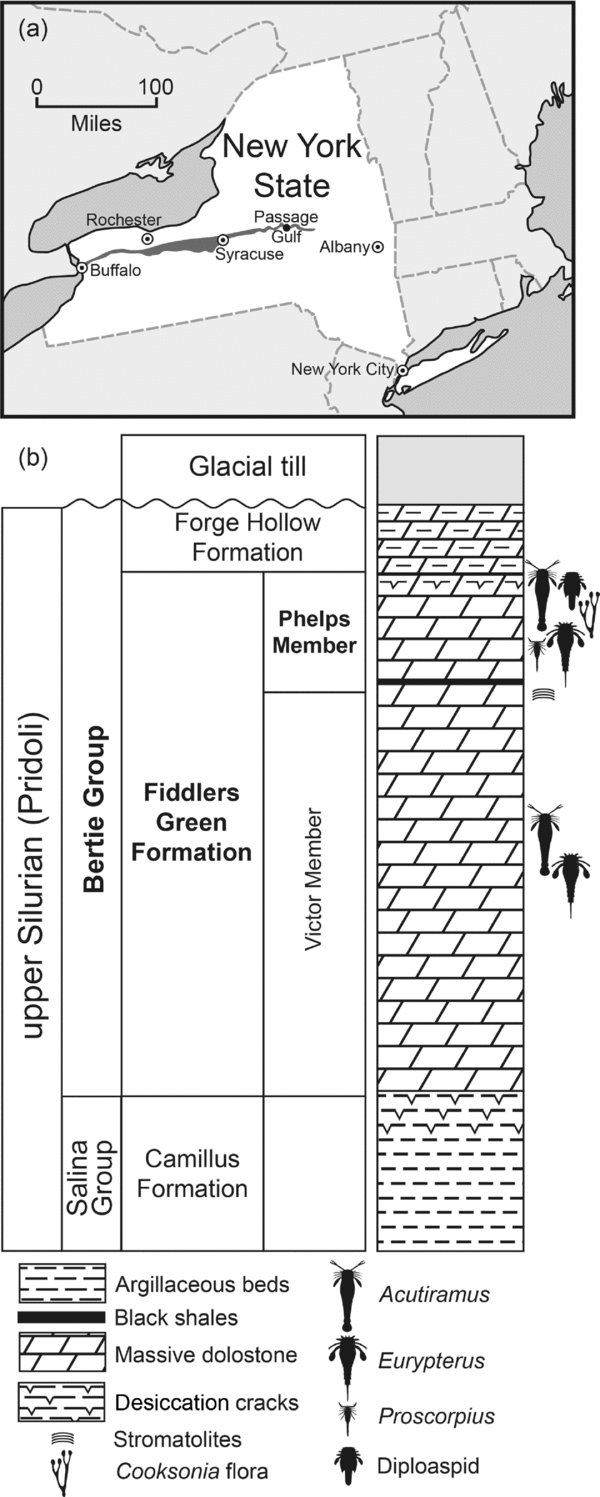
Geographical location and stratigraphic column of the Passage Gulf locality (modified from Edwards et al. Reference Edwards, Banks, Ciurca and Laub2004). (a) Map of New York State with the extent of the Bertie Group outcrop marked in grey. (b) Stratigraphic log of the exposure at Millers Mills Quadrangle, Passage Gulf.

Chasmataspidids are presently known from only 11 species assigned to ten genera (Marshall et al. Reference Marshall, Lamsdell, Shpinev and Braddy2014). Despite previous doubts as to the validity of the taxon Chasmataspidida (Bergström, Reference Bergström1980; Tetlie & Braddy, Reference Tetlie and Braddy2004), it is now considered to be a monophyletic group diagnosed by the possession of an ankylosed four-segmented ‘buckler’. This group resolves phylogenetically as sister to a clade comprising eurypterids and arachnids (Lamsdell et al. Reference Lamsdell, Briggs, Liu, Witzke and McKay2015; Selden, Lamsdell & Liu, Reference Selden, Lamsdell and Liu2015; Lamsdell, Reference Lamsdell2016). Two families of chasmataspidid are recognized: Chasmataspididae, comprising the single genus Chasmataspis from the Ordovician of Tennessee (Dunlop, Anderson & Braddy, Reference Dunlop, Anderson and Braddy2004), and Diploaspididae, comprising the remaining nine genera (Achanarraspis, Diploaspis, Dvulikiaspis, Forfarella, Heteroaspis, Loganamaraspis, Nahlyostaspis, Octoberaspis and Skrytyaspis). Diploaspidids are known from the Devonian of Germany (Dunlop, Poschmann & Anderson, Reference Dunlop, Poschmann and Anderson2001; Poschmann, Anderson & Dunlop, Reference Poschmann, Anderson and Dunlop2005), Scotland (Dunlop, Anderson & Braddy, Reference Dunlop, Anderson and Braddy1999; Anderson, Dunlop & Trewin, Reference Anderson, Dunlop and Trewin2000) and Russia (Dunlop, Reference Dunlop2002; Marshall et al. Reference Marshall, Lamsdell, Shpinev and Braddy2014), and, to date, just one Silurian occurrence has been reported, from Lesmahagow, Scotland (Tetlie & Braddy, Reference Tetlie and Braddy2004). Chasmataspididae share several similarities with xiphosurans, while Diploaspididae more closely resemble eurypterids (Tetlie & Braddy, Reference Tetlie and Braddy2004): Chasmataspis has a broad, semicircular carapace and potentially chelate prosomal appendages in contrast to diploaspidids, which have a narrower carapace with the sixth pair of prosomal appendages modified into broad ‘paddles’. The sole known exception to this is the Silurian representative, Loganamaraspis, which was described by Tetlie & Braddy (Reference Tetlie and Braddy2004) as a diploaspidid even though they interpreted it as having a sixth pair of prosomal appendages modified as walking legs. Tetlie & Braddy (Reference Tetlie and Braddy2004) considered Loganamaraspis as intermediate between Chasmataspis and the remaining diploaspidids. The only specimen, however, is not well preserved, and the morphologically similar Dvulikiaspis from the Devonian of Russia preserves clear evidence of paddles (Marshall et al. Reference Marshall, Lamsdell, Shpinev and Braddy2014). These uncertainties make a full phylogenetic treatment of the group premature, although a number of evolutionary trends within it have been hypothesized (Tetlie & Braddy, Reference Tetlie and Braddy2004; Marshall et al. Reference Marshall, Lamsdell, Shpinev and Braddy2014).
Despite a number of new chasmataspidid discoveries since the turn of the century, these chelicerates remain enigmatic and poorly understood. Resting traces exhibiting a possible chasmataspidid affinity suggest Cambrian origins (Dunlop, Anderson & Braddy, Reference Dunlop, Anderson and Braddy2004), but only two definitive pre-Devonian chasmataspidids have been described (Dunlop, Anderson & Braddy, Reference Dunlop, Anderson and Braddy2004; Tetlie & Braddy, Reference Tetlie and Braddy2004). Furthermore, while Chasmataspis is known from North America, diploaspidids were previously only known from Europe and Russia. Here, we describe a new species of Diploaspis from the late Silurian (Pridoli) Bertie Group of New York State. This is the oldest known Diploaspis, which is otherwise represented by two species from the Devonian of Germany (Dunlop, Poschmann & Anderson, Reference Dunlop, Poschmann and Anderson2001; Poschmann, Anderson & Dunlop, Reference Poschmann, Anderson and Dunlop2005), and it is the first record of Diploaspididae from North America. The new species therefore bridges the stratigraphic and geographic gap between the Ordovician, North American Chasmataspididae and the Devonian, European Diploaspididae.
2. Material and methods
The holotype and only known specimen was collected from the Phelps Member of the Fiddlers Green Formation, Bertie Group (Silurian, Pridoli), SW of Spinnersville at Millers Mills Quadrangle (Fig. 1a), in Herkimer County of New York State by Samuel J. Ciurca Jr on 27 March 1967. The specimen was originally identified as a chasmataspidid by Erik N. Kjellesvig-Waering and the counterpart sent to Kenneth E. Caster on 2 November 1967 for description; later correspondence with Leif Størmer resulted in Ciurca identifying the specimen as a new species of Borchgrevinkium (Novojilov, Reference Novojilov1959), which occurs in the Devonian of Siberia (this may be the basis for Kjellesvig-Waering's (Reference Kjellesvig-Waering1966) record of Borchgrevinkium for the upper Silurian, although he did not list a locality). No subsequent record of the counterpart is known, and it must be considered lost since Caster's death in 1992. The part was acquired by the Yale Peabody Museum (YPM) in 2005 along with the majority of Ciurca's collection. The specimen is preserved in a pale cream-grey dolostone and was immersed under ethanol during drawing and photographing in order to enhance the contrast (without this treatment the details are largely obscured). Photographs were taken using a Canon EOS 60D digital camera with a Canon EF-S 60 mm f/2.8 Macro USM lens. Terminology follows Tetlie & Braddy (Reference Tetlie and Braddy2004), who largely adopted Tollerton's (Reference Tollerton1989) terms for eurypterid morphology, with additions from Marshall et al. (Reference Marshall, Lamsdell, Shpinev and Braddy2014). Prosomal appendages are labelled with Roman numerals.
3. Stratigraphy
The Phelps Member is the upper unit of the Fiddlers Green Formation, part of the upper Silurian (Pridoli, c. 419 Ma) Bertie Group (Ciurca, Reference Ciurca1973). The Bertie Group is a 15–18 m thick sequence that outcrops in western and central New York State (Fig. 1a), and in southwestern Ontario, Canada, and is composed primarily of dolomitic limestone. The occurrence of evaporites and large halite pseudomorphs has led to suggestions that the eurypterids may have inhabited a hypersaline setting (Ciurca & Hamell, Reference Ciurca and Hamell1994), but a recent study has shown that the growth of halite structures was likely post-depositional and that the eurypterids may have lived in normal marine salinities (Vrazo, Brett & Ciurca, Reference Vrazo, Brett and Ciurca2016). The Bertie Group is well known for its numerous eurypterid-bearing horizons, and the Phelps Member at Millers Mills Quadrangle boasts a particularly diverse biota (Fig. 1b): in addition to five species of eurypterids (Eurypterus remipes, Acutiramus macrophthalmus, Dolichopterus jewetti, Pterygotus cobbi and Buffalopterus pustulosus), the locality yields Proscorpius osborni, one of the oldest scorpions (Dunlop, Tetlie & Prendini, Reference Dunlop, Tetlie and Prendini2008), and the early terrestrial plants Cooksonia and Hostinella (Edwards et al. Reference Edwards, Banks, Ciurca and Laub2004), along with the synziphosurine Pseudoniscus, phyllocarids, ostracodes, gastropods and cephalopods including Hexameroceras. The entire Bertie Group appears to be defined by a shallowing trend, culminating in the Phelps Member (Ciurca & Hamell, Reference Ciurca and Hamell1994) and the presence of desiccation cracks at the top of the succession (Ciurca & Honan, Reference Ciurca and Honan1965).
4. Systematic Palaeontology
CHELICERATA Heymons, Reference Heymons1901
EUCHELICERATA Weygoldt & Paulus, Reference Weygoldt and Paulus1979
CHASMATASPIDIDA Caster & Brooks, Reference Caster and Brooks1956
DIPLOASPIDIDAE Størmer, Reference Størmer1972
Diploaspis Størmer, Reference Størmer1972
Type species. Diploaspis casteri Størmer, Reference Størmer1972.
Included species. Diploaspis muelleri Poschmann, Anderson & Dunlop, Reference Poschmann, Anderson and Dunlop2005, Diploaspis praecursor sp. nov.
Stratigraphic range and distribution. Silurian (Pridoli) to Devonian (Emsian) of New York State and Germany.
Emended diagnosis. Diploaspidid with a subrectangular preabdomen approximately the same size as the prosoma; postabdomen short, accounting for c. 33% of the total body length, often with rows of elongate tubercles; telson broad, rounded, terminating in a medially positioned spine (emended after Dunlop, Poschmann & Anderson, Reference Dunlop, Poschmann and Anderson2001).
Remarks. Dunlop, Poschmann & Anderson (Reference Dunlop, Poschmann and Anderson2001) argued that Diploaspis casteri Størmer, Reference Størmer1972 and Heteroaspis novojilovi Størmer, Reference Størmer1972, which co-occur at Alken an der Mosel in Germany, are preservational variants of one another and therefore synonyms. Marshall et al. (Reference Marshall, Lamsdell, Shpinev and Braddy2014), however, resurrected Heteroaspis based on a Siberian species that they considered synonymous with Størmer's H. novojilovi. While Marshall et al. (Reference Marshall, Lamsdell, Shpinev and Braddy2014) identified the presence of lobate epimera on the posterior of the Heteroaspis buckler as a clear morphological difference that should not be influenced by taphonomy, they also reported the presence of a number of specimens possibly referable to Diploaspis from the same locality. A full statistical study of the available material is necessary in order to determine whether or not the two genera might be taphonomic variants. This is beyond the scope of the present study, however, and we follow Marshall et al. (Reference Marshall, Lamsdell, Shpinev and Braddy2014) in considering Heteroaspis as a separate genus in our discussion below.
Diploaspis praecursor sp. nov.
Figures 2, 3
Material. YPM IP 300790 (holotype and only known specimen).
Horizon and locality. Phelps Member of the Fiddlers Green Formation (Bertie Group; Silurian, Pridoli) of Herkimer Country, New York State, at a road cut on Spohn Road in Passage Gulf, 1.8 km SW of Spinnersville, Millers Mills Quadrangle; 0.5 km SSE of the intersection of Spohn Road and Brewer Road (42°57′28.1″N, 75°03′36.0″W).
Diagnosis. Diploaspis with posterolateral margins of buckler drawn out into angular epimera; postabdomen lacking ornamentation of elongate tubercles.
Etymology. Named praecursor, or ‘forerunner’, as this pre-dates the other species in the genus by more than 10 million years.
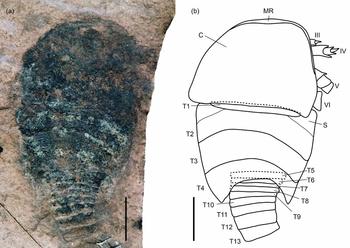
Description. The holotype and only known specimen is preserved as a dorso-ventral compression retaining some degree of three-dimensional relief (Fig. 2). The specimen is preserved at a slightly oblique angle, so that the left margin of the carapace and buckler are partially folded underneath the specimen. Cuticle is preserved as a black carbonaceous film. The specimen is 22.8 mm long, and preserves the carapace, aspects of the prosomal appendages, and the buckler and postabdomen. The carapace is subrectangular, 8.5 mm long by 12 mm wide. A marginal rim on the carapace anterior is 0.5 mm wide; it narrows along the lateral edge and is absent in the posterior third of the carapace. Small genal spines are present on the postero-lateral corners of the carapace. Lateral and median eyes are not preserved. Portions of prosomal appendages III–VI are preserved along the right side of the carapace. The appendages are robust: elongate cuticular projections extend from the distal margin of the podomeres in III–V to form fixed lateral spines. Only some of the more proximal podomeres of appendage VI are preserved; they appear more robust than the podomeres of III–V and lack fixed spines, indicating that this appendage may have been modified into a paddle. The buckler is subrectangular, 7.7 mm long, and comprises four fused tergites, the first of which is a microtergite. The microtergite is 0.7 mm long and 9 mm wide, and flanked laterally by the buckler shoulders which are triangular, 3 mm long at their outer margin and 3 mm wide across their anterior. Tergites 2–4 exhibit strong curvature, resulting in the buckler having prominent angular epimera. The left lateral margin is folded under the specimen, resulting in a reduction of the exposed tergite widths. The second tergite is 2 mm long and at least 11 mm wide, the third tergite is 2.5 mm long with an observed width of 10 mm, and the fourth tergite is 2.5 mm with a 9 mm minimum width. The postabdomen, consisting of segments 5–13, is evident in its entirety and measures 6.6 mm in length. The first three segments are telescoped into the buckler. The first postabdominal segment is 5 mm wide; subsequent segments narrow evenly to the pretelson (the 13th segment) which is 3.6 mm wide. Segments 5–10 are each 0.6 mm long, with segments 11–13 increasing to 1 mm. Epimera are absent on the postabdominal segments. The telson is not preserved. The postabdomen is devoid of tubercle rows.
Holotype of Diploaspis praecursor sp. nov., YPM IP 300790. (a) Photograph. (b) Interpretive drawing. Dashed lines indicate the outline of structures obscured by overlying features. Abbreviations: C, carapace; MR, marginal rim; S, shoulder; T1–T13, tergites 1–13; III–VI, prosomal appendages III–VI. Scale bars represent 5 mm.

5. Discussion
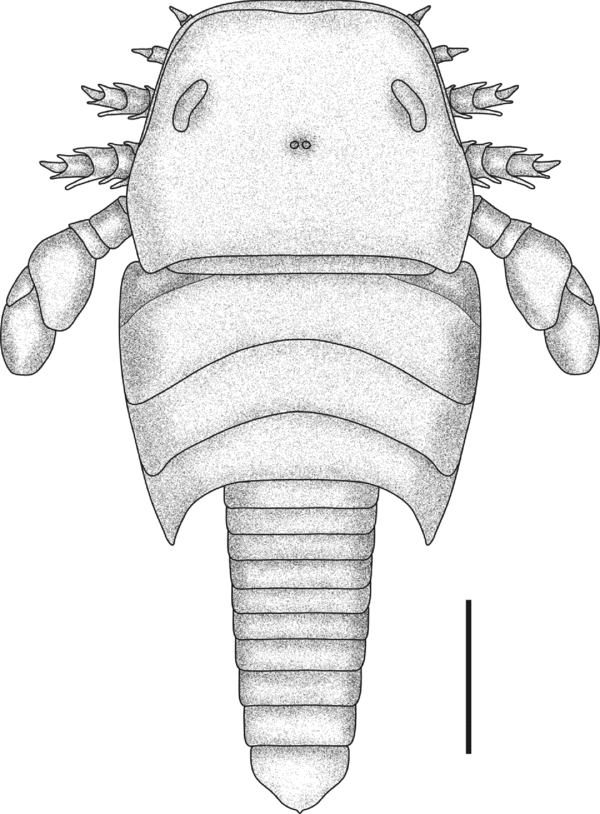
Diploaspis praecursor sp. nov. (Fig. 2, reconstructed in Fig. 3) exhibits a number of synapomorphies that align it with the genus. The preabdominal buckler is subrectangular (cf. Dunlop, Poschmann & Anderson, Reference Dunlop, Poschmann and Anderson2001) whereas the buckler is trapezoidal in Forfarella (Dunlop, Anderson & Braddy, Reference Dunlop, Anderson and Braddy1999) and rectangular in Heteroaspis (Marshall et al. Reference Marshall, Lamsdell, Shpinev and Braddy2014). The buckler is approximately of equal size to the carapace (Poschmann, Anderson & Dunlop, Reference Poschmann, Anderson and Dunlop2005), and the postabdomen accounts for only c. 33% of the total body length as opposed to approximately half in other chasmataspidids. D. praecursor differs from other Diploaspis species in lacking rows of elongate tubercles on the postabdominal segments. The general outline is intermediate between that of Diploaspis casteri (Dunlop, Poschmann & Anderson, Reference Dunlop, Poschmann and Anderson2001) and Diploaspis muelleri (Poschmann, Anderson & Dunlop, Reference Poschmann, Anderson and Dunlop2005). The carapace is less rounded and exhibits a slight flare in the posterior half similar to that of D. casteri. The buckler of D. praecursor extends into angular posterolateral epimera, and the degree of postabdominal narrowing is less extreme than in D. muelleri. The appendages show similarities to D. casteri: robust limbs with fixed lateral spines formed from extensions of the podomere cuticle, although these spines appear larger than those in D. casteri.
Diploaspis praecursor sp. nov. Reconstruction. The shape and position of the lateral and median eyes, swimming paddle and telson are inferred from the other Diploaspis species. Scale bar = 5 mm.

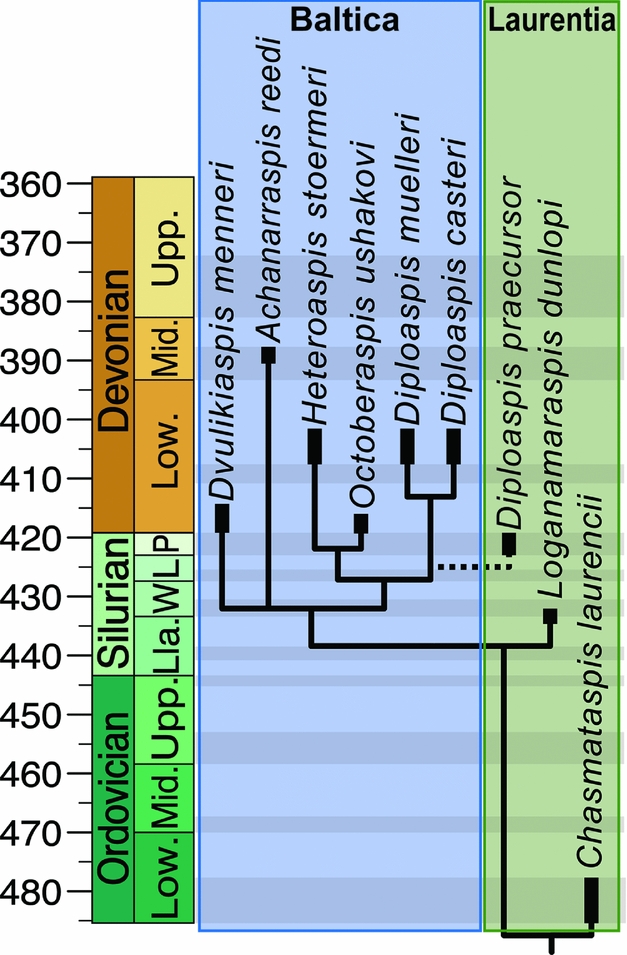
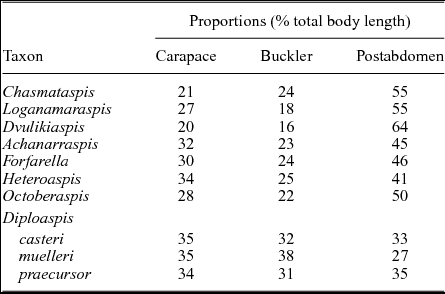
The geographic and temporal occurrence of Diploaspis praecursor fills a gap in the chasmataspidid fossil record, linking the Ordovician–Silurian Chasmataspis and Loganamaraspis in Laurentia with the Devonian Diploaspididae in Baltica (Fig. 4). The new species shows that the typical diploaspidid morphology evolved by the Silurian prior to its apparent proliferation in the Devonian. The wide distribution of diploaspidids in the Devonian of Baltica may reflect a biological invasion from Laurentia after its collision with Baltica during the Silurian (Torsvik et al. Reference Torsvik, Smethurst, Meert, Van der Voo, McKerrow, Brasier, Sturt and Walderhaug1996; Gee et al. Reference Gee, Janák, Majka, Robinson and van Roermund2012) and subsequent radiation, but the chasmataspidid fossil record is too scattered to provide a basis for any biogeographical framework. The morphology of most diploaspidids is eurypterid-like, with a buckler less than 25% of the total body length and a postabdomen comprising 45–55% (Table 1). The buckler in Diploaspis, in contrast, is almost equal in size to the carapace, and the postabdomen accounts for close to 33% of the total body length. This morphology is almost certainly the derived condition, as a long postabdomen is present in the older more xiphosurid-like Ordovician Chasmataspis (Dunlop, Anderson & Braddy, Reference Dunlop, Anderson and Braddy2004). Phylogenetic analyses (summarized in Fig. 4) retrieve the Diploaspis clade nested deep within Chasmataspidida, with the more eurypterid-like diploaspidids Loganamaraspis, Dvulikiaspis and Achanarraspis forming part of a grade between the basal Chasmataspis and Diploaspis (Lamsdell et al. Reference Lamsdell, Briggs, Liu, Witzke and McKay2015; Selden, Lamsdell & Liu, Reference Selden, Lamsdell and Liu2015). Our discovery of a Silurian Diploaspis implies ghost ranges for eurypterid-like chasmataspidids such as Forfarella and Achanarraspis that are closer morphologically to Diploaspis than to Loganamaraspis. The palaeoecology of Diploaspis praecursor suggests that early diploaspidids occupied normal marine salinities as did Chasmataspis, and that the lacustrine Devonian chasmataspidids Achanarraspis and Forfarella (Dunlop, Anderson & Braddy, Reference Dunlop, Anderson and Braddy1999; Anderson, Dunlop & Trewin, Reference Anderson, Dunlop and Trewin2000) subsequently invaded fresh water. Both eurypterids (Lamsdell & Braddy, Reference Lamsdell and Braddy2010) and xiphosurids (Lamsdell, Reference Lamsdell2016) invaded non-marine environments several times during the Devonian. These ecological shifts may have been a response to the late Devonian biotic crisis (McGhee, Reference McGhee1988; Racki, Reference Racki, Over, Morrow and Wignall2005; Stigall, Reference Stigall2012) but determining how this occurred will require more discoveries like that reported here, together with a better understanding of the late Devonian extinction and relationships within the chasmataspidids.
Phylogeny of Chasmataspidida as presented in Selden, Lamsdell & Liu (Reference Selden, Lamsdell and Liu2015) with ranges correlated to the geologic timescale. The hypothesized phylogenetic position of Diploaspis praecursor is indicated with a dashed line. Taxa from Laurentia and Baltica are shown within boxes highlighting their geographic provenance. The horizontal stripes represent stage divisions. Taxon ranges are constrained by stage level or substage level where stratigraphic resolution allows. The branching points on the tree are not stratigraphically constrained. A number of Devonian taxa from Baltica (Forfarella, Nahlyostaspis and Skrytyaspis) are omitted as they have not been included in any phylogenetic analysis.

Average body proportions of chasmataspidid species.

Acknowledgements
This work would not have been possible without the dedication of Sam Ciurca, who discovered the specimen as part of over 40 years of work on the Palaeozoic strata of New York State. The efforts of Susan Butts (YPM) and Jessica Bazeley-Utrup (YPM) were invaluable in tracking down the history of the specimen. J.C.L. was supported by postdoctoral funding from Yale University and from a Lerner-Gray Postdoctoral Fellowship from the American Museum of Natural History to research macroevolutionary and macroecological trends among Palaeozoic arthropods.