

Introduction
When Covid-19 arrived in Europe in early 2020, it resulted in a health, social, economic and existential crisis compelling governments to intervene extensively, which has led to changes in individual behaviour and the social organisation of society. This, of course, has called on scientists to reflect on the consequences of Covid-19. A high proportion of these studies have been preoccupied with assessing the short- and long-term physical and mental health effects, both as an outcome of the infection itself and as a consequence of the lockdowns aimed at containing the spread of the virus, but leading to social isolation, loneliness and sadness, and even post-traumatic stress disorder (eg. Bonsaksen et al., Reference Bonsaksen, Heir, Schou-Bredal, Ekeberg, Skogstad and Grimholt2020; Brodeur et al., Reference Brodeur, Clark, Flèche and Powdthavee2020; Fiorillo et al., Reference Fiorillo, Sampogna, Giallonardo, Del Vecchio, Luciano, Albert, Carmassi, Carrà, Cirulli, Dell’Osso, Nanni, Pompili, Sani, Tortorella and Volpe2020; Iqbal et al., Reference Iqbal, Li, Onigu-Otito, Naqvi and Shah2020; Pfefferbaum & North, Reference Pfefferbaum and North2020; Rajkumar, Reference Rajkumar2020; Torales et al., Reference Torales, O’Higgins, Castaldelli-Maia and Ventriglio2020; Vindegaard & Benros, Reference Vindegaard and Benros2020). Other studies have analysed how interventions have affected infection rates and gender relations (Cook & Grimshaw, Reference Cook and Grimshaw2020), gender inequality at work (Reichelt, Makovi, & Sargsyan, Reference Reichelt, Makovi and Sargsyan2021), lay-off and furlough decisions at the company level (Bennedsen et al., Reference Bennedsen, Larsen, SchmutteIan, Schmutte and Scur2020), changes in the organisation of work at the workplace (Bredgaard et al., Reference Bredgaard, Hansen, Larsen, Kylling, Hørby Jørgensen and Ibsgaard2021; Ipsen, Kirchner, & Hansen, Reference Ipsen, Kirchner and Hansen2020; Kniffin et al., Reference Kniffin, Narayanan, Anseel, Antonakis, Ashford, Bakker, Bamberger, Bapuji, Bhave, Choi, Creary, Demerouti, Flynn, Gelfand, Greer, Johns, Kesebir, Klein, Lee, Ozcelik, Petriglieri, Rothbard, Rudolph, Shaw, Sirola, Wanberg, Whillans, Wilmot and Vugt van2021), and how interventions have had consequences for the economy as a whole (Cross, Ng, & Scuffham, Reference Cross, Ng and Scuffham2020). Additional studies have compared the strength of the welfare states with the type of intervention and individual risk perception (Breznau, Reference Breznau2021), analysed social policy reforms with respect to the financial crisis (Moreira & Hick, Reference Moreira and Hick2021) or compared countries’ reactions from a welfare regime perspective (Béland et al., Reference Béland, Dinan, Rocco and Waddan2021; Cantillon, Seeleib-Kaiser, & van der Veen, Reference Cantillon, Seeleib-Kaiser and van der Veen2021; Greve et al., Reference Greve, Blomquist, Hvinden and van Gerven2021).
As indicated, governments all over Europe have made use of all instruments in the toolbox in handling this exogenous shock (Capano et al., Reference Capano, Howlett, Jarvis, Ramesh and Goyal2020), leading – at least provisionally – to new types of relationships between the individual and the democratic state. Still, data from July to August 2020 clearly shows that there are huge cross-national differences as to the extent to which populations are satisfied with the way in which governments have handled Covid-19 during the first wave. For instance, in 2020, 65 per cent of the Danish population were “very satisfied” with the measures taken to fight the Coronavirus outbreak by the Danish government, while in Austria, only 30 per cent of the population indicated such a high level of satisfaction (Standard Eurobarometer, 2020, p. 64). It comes as a surprise that the satisfaction with governments’ handling the Covid-19 is so divergent in highly developed European welfare states, which leads us to the following research question: why are populations in Denmark and Austria satisfied with the measures taken to fight Covid-19 during the first phase of the outbreak to such different degrees?
In answering this research question, theoretically, we take our point of departure in the concept of citizenship, as the granting of citizenship, ideally enables citizens to live a decent life as civilised beings (Marshall, Reference Marshall1950). This problematic has been highly topical during the Covid-19 outbreak. Furthermore, as the concept of citizenship is multidimensional – it includes a communicative, civil, political and social dimension – it can comprehensively be used “as an ideal against which the achievement of governments in meeting their obligations to their citizens can be assessed” (Stokes, Reference Stokes, Carter and Stokes2002, p. 36). As such, we use the concept of citizenship as a benchmark tool to comprehensively assess how governments have handled the Covid-19 outbreak.
Scholars engaged in the study of citizenship often claim that a reciprocal relationship (or feed-back or loop-mechanism) exists between the individual and the state (Citrin & Stoker, Reference Citrin and Stoker2018; Esping-Andersen, Reference Esping-Andersen1990; Fukuyama, Reference Fukuyama1995; Korpi, Reference Korpi1983; Marshall, Reference Marshall1950; Rothstein & Teorell, Reference Rothstein and Teorell2008; Rudolph, Reference Rudolph, Zmerli and van der Meer2017; Skocpol, Reference Skocpol, Evans, Rueschemeyer and Skocpol1985). This means that governments’ actions or regulations not only help to structure preferences and identities, but also populations’ support and attitudes towards governments. Accordingly, this paper is based on the assumption that differences in populations’ satisfaction with measures taken to fight Covid-19 in Austria and Denmark are conditioned by how citizenship in terms of rights and obligations has been re-orchestrated by governments in the two countries during the coronavirus outbreak.
We have chosen to compare Denmark and Austria because all major contextual factors are rather similar in the two countries. Despite some initial hesitation in Denmark, both governments followed a strategy of suppressing the virus and both countries have had some success in their implementation of extensive regulations to handle the crisis (Migone, Reference Migone2020). Unemployment only increased slightly and both countries scored highly on indexes of well-being, life satisfaction, optimism about one’s future, and in both countries, the population have maintained trust in the healthcare system during the first lockdown period (The Employment Committee, n.d.; Eurofound, 2020). Even overall trust in government (refers to the share of people who report having confidence in the national government) was fairly similar in Denmark and Austria in 2020 (OECD, 2021).
Thus, this paper is specifically preoccupied with studying how governments’ measures have met the challenges derived from Covid-19 during the first lockdown from a citizenship perspective. The paper presents the concept of citizenship and analyses major dimensions of citizenship empirically. Before the final conclusion, we address the limitations of our study and how and why the populations’ perception of how governments have handled the Covid-19 crisis has changed between 2020 and 2021.
Concept of citizenship
During Covid-19, governments have introduced new forms of regulations changing citizens’ rights and obligations, meaning that citizenship has changed. In the scholarly tradition of citizenship studies, citizenship is considered to be a normative ideal guiding (some) politicians in the Western world. Citizenship studies thus argue that state regulations and the build-up of a welfare state strengthening rights and obligations of citizens lead to emancipation and high levels of self-esteem, enabling all members of society (horizontally) to see themselves as equals (Janoski, Reference Janoski1998; Lister, Reference Lister, Andersen and Jensen2002, Reference Lister, Nash and Scott2004; Sweetman, Rowlands, & Abou-Habib, Reference Sweetman, Rowlands and Abou-Habib2011). This leads to all citizens having the feeling of truly being part of a collective or community (Chan & Chan, Reference Chan and Chan2006), which supports civic engagement. By contrast, a government’s ignorance or neglect of vulnerable groups (immigrants, homeless, etc.) leads to a loss of citizenship, ie. deepens social inequalities and exclusionary trajectories, leading to subordination and low levels of self-esteem in this segment of the population.
According to Marshall (Reference Marshall1950), full citizenship requires that inequalities in living conditions are not significant. In effect, living conditions must be evened out, ie. citizens must be offered resources following prevailing standards in society. This may be achieved by (a vertical state–citizens relationship) providing citizens with rights and obligations in different arenas of society (Edmiston, Reference Edmiston, Ellison and Haux2020). Rights give access to resources such as freedom of speech, ie. civil rights, entitlement to the franchise, ie. political rights and reasonable material life conditions, ie. social rights.
Historically, civil citizenship and civil rights emerged in tandem with the formation of the market economic system, liberty, freedom of movement and freedom from arbitrary detention. Legally, civil citizenship embodies protection of privacy, private property rights, freedom of speech, freedom of assembly and freedom of association and the right to work. That is, civil citizenship allows for participation in primary, secondary and tertiary groups, meaning that civil citizenship allows for inclusion in social entities and communities (Andersen, Reference Andersen, Andersen, Guillemard, Jensen and Pfau-Effinger2005). As a duty, civil citizenship obliges citizens to follow the rules.
Political citizenship not only entails entitlement to franchise and eligibility, it also refers to the right to political expression (eg. freedom of speech and to demonstrate) and political participation as well as to citizens’ orientations towards the political system. This typically includes “political culture,” such as interest in politics, trust in politicians and institutions, as well as efficacy. Internal efficacy (ie. the subjective feeling that politics is not too complicated for one to understand) is usually distinguished from external efficacy (ie. whether political actors are perceived as being responsive to one’s demands; Almond & Verba, Reference Almond and Verba1963; Westholm, Montero, & van Deth, Reference Westholm, Montero, van Deth, van Deth, Montero and Westholm2007). Moreover, political citizenship and trust in politicians and institutions are preconditioned by the functioning of the political system, eg. that political decision-making does not violate constitutional rights, that there is a clear demarcation between the political and administrative system, that the bureaucracy acts predictably and its decision-making is grounded in codified rules and precedents. In some countries, political rights are mirrored by an obligation to vote in elections (eg. in Belgium), while this obligation is mainly moral as in Austria and Denmark.
To act as a citizen is preconditioned by access to basic resources and means of life. As such, social citizenship is associated with a right to live the life of a civilised being (Isin & Turner, Reference Isin and Turner2007) free from unfavourable material living conditions (Powell, Reference Powell2002; Taylor-Gooby, Reference Taylor-Gooby2008), guaranteed by the welfare state. A distinction, however, must be made between welfare programmes in cash and kind. Cash transfers alleviating income deficits refer to cash benefits, such as unemployment benefits, pensions and so on, as well as different kinds of subsidies (eg. to companies), while transfers in kind refer to the provision of services safeguarding health and care. Of course, social citizenship is preconditioned by redistributive efforts. Therefore, social citizenship includes the obligation of the able-bodied to work and to pay taxes.
Citizenship and its different dimensions are anchored in “hard” law, ie. universalised rules codified by law as rights and obligations. Civic engagement, however, is a central ingredient of being a citizen, as it enables deliberation and re-negotiation of citizenship (Edmiston, Reference Edmiston, Ellison and Haux2020; Somers, Reference Somers1993). Civic engagement may equally be nurtured by “soft” regulations such as political communication and culture steering, making people do what they otherwise could or would not have done (Bang, Reference Bang2004). However, to employ connective or communicative public administration requires that political authority has a minimum of trust in those to be governed, indicating that the government’s trust in its citizens frames political communication and discursive practices.
A strong trust relationship allows the political authority to enhance civic engagement and peoples’ self-governance by employing communicative truth-telling. This would mean to “tell people the truth about what has to be done and to direct and guide them to do this through their exercise of their common political capacities” (Bang, Reference Bang2015, p. 302). Conversely, a distrusting relationship makes political authority rely on authoritarian communicative strategies, calling for obedience and surveillance of people (Bang, Reference Bang2015). Discursively, the authoritarian form marks a shift towards paternalism and forms of communication that provoke fear, often based on a Manichean ideology (Offe, Reference Offe2001; Wodak, Reference Wodak2015, Reference Wodak2017).
Data and method
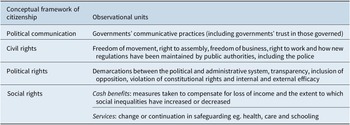
The point of departure of this paper is based on the presupposition that populations’ satisfaction with the measures taken to fight the Coronavirus depends on how citizenship has changed during the Covid outbreak. This would mean that satisfaction with measures taken is conditional on the extent to which civil citizenship (eg. freedom of assembly) has been challenged, political citizenship (eg. clear demarcation between the political and administrative system) undermined, social citizenship (eg. cash transfers to those suffering from unemployment) re-balanced, and how political authority has communicated with its population. As such, the different dimensions of citizenship guide data selection in our qualitative (or case-oriented) comparative approach. Table 1 shows how the conceptual framework has guided the collection of data or our selection of observational units.
Citizenship and data collected.

As we have embarked on a case-oriented approach, we are not searching for mono-causality. Rather, we are searching for “mechanisms” (Yin, Reference Yin1989), or what John Stuart Mill described as “chemical” causality. In this perspective, Ragin (Reference Ragin1987) has argued that differences in social phenomenon (eg. satisfaction with measures taken during Covid-19) is an outcome of different combinations of conditions. Therefore, qualitatively oriented comparatists should study “how different conditions or causes fit together in one setting and contrast that with how they fit together in another setting” (Ragin, Reference Ragin1987, p. 13), meaning that causation is understood conjuncturally.
Using the qualitative (or case-oriented) comparative method suggested by Ragin (Reference Ragin1987), this paper aims at analysing the extent to which different combinations of conditions have produced low versus high levels of satisfaction with government measures in the fight against Covid-19 in Denmark and Austria. In order to identify different combinations of conditions producing different outcomes, Ragin (Reference Ragin1987, p. 87) suggests that data are organised in a matrix or “truth table.” Here, the observational units are presented as presence or absence; high or low; true or false and so on. In the conclusion, we will sum up our results in a truth table as a concluding device.
Changing citizenship
In this section, the aim is to investigate the underlying features behind differences in populations’ perception of how governments have performed in Austria and Denmark. That is, we will analyse how citizenship and communicative practices have changed during the first wave of the Covid-19 crisis. We will show how citizenship has been strengthened in some areas while weakened in others. First, we map a government’s political communication and culture steering in the two countries. Second, we show how peoples’ lives have been regulated from a civil rights perspective. Third, from a political rights perspective, we analyse transparency of the political processes and the structuring of internal and external political efficacy. Fourth, we show how social citizenship has changed in the area of cash benefits as well with regard to social services.
Governments’ communicative practices
Some studies have indicated that communication of political authority during the Covid-19 crisis has had a huge impact on populations’ support towards governments’ measures fighting Covid-19 (Petersen et al., Reference Petersen, Bor, Jørgensen and Lindholdt Fly2021; Petersen & Bor, Reference Petersen and Bor2021). As such, it is worth noting that in both countries, the central government kept a comprehensive control of all communication to the media and the public, and a long range of well-orchestrated press conferences were organised with the appearance of the head of governments, ministers of interior and health, as well as leading figures of public authorities. However, the communication differed strikingly between the two countries.
In Austria, the government made use of a fear inducing authoritarian communicative approach. The Austrian chancellor, Sebastian Kurz, backed a stay-at-home strategy warning that “up to 100,000 deaths” were to be feared and “soon everybody will get to know somebody who died of Corona.” In this rhetoric or politics of threat, the Chancellor was backed by the Minister of the Interior, arguing that those obeying to the rules “will be a lifesaver. All others who fail to do so are posing a threat to life” (Yeoh, Matzenberger, & Kienzl, Reference Yeoh, Matzenberger and Kienzl2020, translated by the authors). The media supported and repeated the government’s messages (Ehs, Reference Ehs2020). This discourse established the head of government as a “strict father” as Wodak (Reference Wodak2020) concludes. The frame also depicted the chancellor as the saviour in a crisis and relied on a large body of staff, coordinating media representations and triggering interventions at the offices of the editors-in-chief in case of negative depictions.
In Denmark, the prime minister, Mette Frederiksen, was staged as the “mater patriae,” and the basic strategy – backed by health authorities’ scientific evidence– was to keep the number of seriously infected below the capacity of the healthcare system. In this endeavour, the Prime Minister called for civic engagement and peoples’ self-governance, encouraged by the slogan:“unite (literally stand together) by keeping distance” (“Stå sammen ved at holde afstand”), which was a slogan that was repeated again and again. Even the queen gave a speech to the public on the 17th March 2021, where she admonished the population to follow the “keep distance” recommendations. Different behavioural strategies (“stay at home” vs. “keep distance”) and different rhetorical foundations (“fear” vs. “civic engagement”) were interlinked with different changes in civil citizenship in the two countries.
Civil rights
In both countries, measures were taken to reduce activities in society to the extent possible with the purpose of suppressing the virus, leading to major restrictions in civil citizenship, eg. freedom of movements and personal freedom. Borders were closed and the right to work restricted. Shops, hairdressing salons, pubs, restaurants and so on were shut, depriving employers and workers in these establishments the right to work (see section social rights below). Furthermore, governments urged private employers to ask their employees to work from home, and in the public sector, employees not handling critical operations were sent into home office as well. Even the courts were locked down and the rights of the accused and convicted restricted. As to public welfare services, students, pupils and children in day care were sent home, and in elderly care homes and hospitals, visits were off-limits or severely constrained.
In both countries, mobile phones were employed to track the spreading of the virus. In Denmark, an app was introduced, but installation remained voluntary. By contrast, in Austria, the government used aggregated data on movements based on mobile phones controlling the adherence to the stay-at-home order and wanted to enforce a compulsory installation of the mobile tracing app. However, due to strong opposition and negative polling, the government backed out of that plan.Footnote 1
As to the freedom of assembly, major differences can be found between Austria and Denmark. In Denmark, gatherings with more than 10 participants were prohibited, meaning that weddings, confirmations and so on were cancelled. Violations of this rule would result in a fine. However, very few individuals were charged. In public spaces, the police acted as supervisors rather than punishing those in violation of the rules. It was thus expected that conscientious citizens would not violate the recommendations and regulations. Demonstrations were allowed.
In Austria, however, the government declared a strict stay-at-home order. This order stated that one was only allowed to leave one’s home due to imminent danger, to assist others in need of help, to shop for indispensable items, to work and to spend time outside.Footnote 2 Visibly, playgrounds, public gardens and rural hiking trails were closed for weeks. Footnote 3 Thus, the government announced that visits to friends or relatives in private homes was prohibited, and authorised the police to search private homes (Ehs, Reference Ehs2020; Wodak, Reference Wodak2020).
This is important to observe, since the police enforced strict adherence to the rules. In order to enforce this, the police cancelled holidays and clocked overtime amounting to 27.4 Mio Euro in costs. To support the police, the military conscripted part of the reserve and extended mandatory military service.Footnote 4 More than 24,000 charges were pressed, which resulted in nearly 20,000 fines that totalled up to 5.9 Mio Euros.Footnote 5 In April, demonstrations were prohibited and the right to demonstrate was only upheld again later on.Footnote 6 Thus, in Austria, the restrictions were heavily policed, drew on a discourse of national emergency.
Both countries re-opened gradually as of mid-May, and a Eurobarometer survey conducted in July to August 2020 measured whether populations of Europe was of the opinion that “limitations to public liberties were absolutely justified.” In Denmark, 65 per cent of the population agreed, while the figure was only 31 per cent in Austria, with an EU average of 44 per cent (Standard Eurobarometer, 2020, p. 68), mirroring the harshness of the lockdown and differences in ways of upholding regulations. Similarly, only 31 per cent of the Danish population thought that “(t)hese measures focus too much on health to the detriment of the economy” (Standard Eurobarometer, 2020, p. 67), while this figure was 46 per cent in Austria and the EU-27 average was 32 per cent.
Political rights
Although the Covid crisis represents an extraordinary situation, political decision-making processes still have to adhere to a minimum of democratic and constitutional requirements. However, the political processes deviated from everyday procedures in both countries. Almost all regulations (epidemic legislation, aid packages, etc.) concerning Covid-19 were unanimously decided in both parliaments early on. Nonetheless, parliamentarians were only marginally included in the legislative processes, as new legislation was subject to fast-track processes. Due to the fast-track procedures, it was difficult for members of parliament to become fully informed and make an assessment of governments’ proposals and societal consequences.
In Austria, the opposition initially agreed to all legislations. However, from mid-April on, the government had to put smaller subject-oriented legislations on the floor. The opposition threatened to delay the parliamentary process by 8 weeks. As a consequence, certain amendments were rejected by one or more of the oppositional parties.
The closing of ranks in parliament, however, also led to oppositional neglect of control and facilitated governmental communication (Ehs, Reference Ehs2020). It was only from May onwards that the opposition criticised the non-transparent processes and inquired about internal documents. For example, the parliament was only able to access the protocols of the emergency task force of the Ministry of Health at the end of May, whereas the Minister of Interior still upheld the opacity of its crisis task force.
As to external “efficacy” it can be argued that both governments, eg. in the case of aid packages, were responsive to economic as well as individual needs and demands. Furthermore, it is noteworthy that some of the aid packages were an outcome of a corporate arrangement initiated by the government. Negotiations between the governments, employers and labour organisations resulted in generous schemes to compensate wage earners subject to furlough. Overall, 92 per cent of the Danish respondents “totally” or at least “tended to agree” that their “voice counts” in contrast to 77 per cent of the Austrian respondents and 57 per cent of the EU-27 average (Standard Eurobarometer, 2020, p. 174).
As to internal “efficacy,” data show, that in July to August 2020, the proportion of the population that responded either “totally agree” or “tend to agree” that they understand well what is going on in today’s world’ 87 per cent in Denmark and 67 per cent in Austria, while the EU-27 average was 72 per cent (Standard Eurobarometer, 2020, p. 140), meaning that internal “efficacy” was higher in Denmark when compared to Austria.
Social rights
The lockdown of businesses and services lead to an economic downturn and increased economic insecurity for employees and employers alike. In both countries, a wide range of aid packages was established to alleviate the risk of bankruptcy among firms and social suffering due to loss of income among employees. Furthermore, access to social services such as hospitals, nurseries, kindergartens, schools and care services was restricted.
Cash benefits
Covid-19 posed a threat to the economic system. In effect, governments in Austria and Denmark introduced an unprecedented range of measures with the purpose of counteracting the closure of business and services. These schemes distinguished between large and small companies.
In both countries, schemes were established to support self-employed, freelancers and smaller companies. The quality of the schemes, however, differed somewhat between the two countries. The hardship fund in Austria entitled anybody with a low income to 500 Euros and a middle income to 1,000 Euros per month. These benefits were eventually increased to up to 2,000 Euros and covered nearly 170,000 people up to the end of May.Footnote 7 If a self-employed person or a freelancer in Denmark experienced a drop in income of at least 30 per cent, they could be compensated for up to 90 per cent of the income loss, though with a ceiling of about 2,700 Euros per month. However, self-employed and freelancers had to refund the subsidy if their total personal income in 2020 amounted to more than about EURO 107,000. Additional measures targeting small and medium-sized companies (in Denmark defined as companies with 25 or fewer employees) were introduced such as compensation in connection with cancellations, state-guaranteed loans, and that companies could postpone payments of value-added tax.
In Austria, larger companies could benefit from tax and social insurance deferrals, credit lines and overhead payments, which provided less extensive support but gave hard-hit companies some compensation of up to 120 million until September 2020 following their loss in revenue. Companies in Denmark that experienced a drop in turnover of at least 35 per cent could be compensated for their fixed expenses. The compensation for fixed expenses was 25–80 per cent, dependent on the scale of the drop in turnover. A single company could not receive more than a total amount of about 15 million Euros in the period from 9th March to 8th July.
In order to avoid subsidies to companies causing major public resentment, supported companies in Austria were not allowed to pay more than half of last year’s bonuses to the board and had to abstain from paying dividends (Czypionka, Kocher, & Schnabl, Reference Czypionka, Kocher and Schnabl2020). As a declaration of intent, the Danish government announced that companies in tax-heavens were not eligible for subsidisation, just as larger companies receiving aid were not allowed to pay a dividend to their shareholders in 2020 and 2021. In practice, the ban on tax-heaven companies could not be implemented, but it represented a strong symbolic message to the population. Measures safeguarding companies seem to have worked. The number of firms that went bankrupt during Covid-19 has been much lower than normal in both countries. In Denmark, small and large companies had VAT-payments postponed, and in Austria, the bankruptcy law enables enterprises to postpone filing for bankruptcy in case of losses due to Covid-19.
Although few companies went bankrupt, many companies had a surplus of staff employed, and two options were open to them. The first was to make the surplus staff redundant, or to make use of the extensive furlough schemes operating in both Austria and Denmark. In Austria, the furlough scheme prescribed that employees were entitled from 80 per cent up to 90 per cent of their previous net wages and had to work at least 10 per cent of their working time. Initially set for 3 months, the furlough period was set to end with slightly tighter eligibility regulations in March 2021 (Czypionka, Kocher, & Schnabl, Reference Czypionka, Kocher and Schnabl2020). A total of 1.3 million employees were supported in mid-May – a staggering third of all employed people (Bock-Schappelwein, Huemer, & Hyll, Reference Bock-Schappelwein, Huemer and Hyll2020). In Denmark, the wage compensation paid to employers amounted to 75 per cent of the wage of the employees, though with a ceiling of about 3,000 Euros per month. For employees paid by the hour, the compensation was 90 per cent with a ceiling of about 3,500 Euros per month. By the beginning of May, about 25,000 companies had applied for these subsidies, and a total of about 150,000 employees were sent home but fully wage compensated (author2).
The number of jobs safeguarded by the furlough scheme was far from negligible (Bennedsen et al., Reference Bennedsen, Larsen, SchmutteIan, Schmutte and Scur2020). Still, the furlough scheme could not prevent growth in unemployment. In Denmark, people who became unemployed due to Covid-19 were enrolled in the ordinary unemployment and welfare benefit schemes. Similarly, in Austria, the unemployment benefit scheme remained unchanged, but it provides a far lower protection of 55 per cent of the previous wages for the more than half a million of registered unemployed in April 2020. The government later introduced lump sum payments for the unemployed and their families after a fierce debate on deservingness in parliament; however, some of them were tied to a job loss during the pandemic, excluding long-term unemployed.Footnote 8
Although measures were extensive in both countries, the ambition to contain the social consequences of Covid-19 differed between Austria and Denmark. Thus, the proportion of the population that agreed that the “coronavirus outbreak will have serious financial consequences for you personally” was 18 per cent in Denmark and 51 per cent in Austria with an EU average of 46 per cent (Standard Eurobarometer, 2020, p. 72).
Services
Although Covid-19 patients did not flood the hospitals, the capacity to meet the social right to a swift diagnosis and freedom of choice of hospital was restricted for non-Covid-19 patients. The number of patients diagnosed with cancer or heart deceases has dropped in both countries. In Austria, psychiatric and children’s services suffered particularly hard (Eglau, Reference Eglau2020, Schaffert et al., Reference Schaffert, Zimmermann, Bauer, Kastner, Schwarz, Strenger, Metzger, Thun-Hohenstein, Sperl, Weghuber and Wortmann2020).
Most elderly care facilities in Austria were unprepared to provide safe services for their clients, as they lacked personal protective equipment and additional carers. In Austria, elderly day care facilities closed down and clients were scared to use domiciliary services (Leichsenring, Schmidt, & Staflinger, Reference Leichsenring, Schmidt and Staflinger2020; Volksanwaltschaft, 2020). So-called 24 h carers, live-in carers who are self-employed and work for 2 weeks and then travel to their country of origin, could not return to or leave Austria. Eastern European women were stuck for weeks (Leichsenring, Schmidt, & Staflinger, Reference Leichsenring, Schmidt and Staflinger2020). Treatment of frail elderly citizens was not affected by Covid-19 in Denmark. However, older frail elderly people suffered from a lack of contact with friends or relatives, as visits were prohibited in elderly care institutions.
Parallel to this, nurseries and schools were locked down. In Denmark, however, emergency preparedness was established targeting children 0–9 years of age if their parents were privately employed (and not subject to furlough) or were engaged in critical functions. In Austria, only children with parents in frontline jobs were allowed to go to childcare or schools.
In both countries, parents had to work and take care of their children’s educational and social needs at the same time. In Austria, parents were only able to access a short period of leave at the employer’s goodwill but that did not cover the whole lockdown period. After shops reopened, schools stayed closed, which increased pressure on parents (Berghammer & Beham-Rabenser, Reference Berghammer and Beham-Rabenser2020; Kittler, Pollak, & Partheymüller, Reference Kittler, Pollak and Partheymüller2020). In Denmark, schools and day care started to open earlier on (Bariola & Collins, Reference Bariola and Collins2021).
Of course, the closings also raised the issue of educational inequality. In a publication published in April 2020, the Danish Health Authority (Sundhedsstyrelsen, 2020) made clear that the lockdown of nurseries and school was associated with social and learning challenges, especially for children in vulnerable families. An Austrian study concluded that more than 10 per cent of all pupils did not participate in online teaching, and that one-third of pupils from disadvantaged background did not cope with distance learning (Steiner & Kocher, Reference Steiner and Kocher2020).
Discussion
In this study, we have analysed populations’ satisfaction with measures taken to fight Covid-19 from a citizenship perspective. One major limitation of the study is that it is based on cross-sectional data and delimited to the initial phase of Covid-19. Eurobarometer data thus indicate that a change in satisfaction has occurred in both countries between 2020 and 2021. In Denmark, those reporting “very satisfied” with measures taken has dropped from 65 to 37 per cent, and in Austria, the same figure has plunged from 30 to 11 per cent (Standard Eurobarometer, 2021, p. 52). Most probably, these changes are associated with a transition from a locked-down society to a reopening society in July and August 2020, when the 2020 Eurobarometer data was collected, in comparison to a society grappling with a long lockdown in January and February 2021, when the later survey was conducted.
In the initial phase in Austria and Denmark, there was hardly any opposition to the action of the governments, and governments gained legitimacy by including social partners in the design of measures to combat Covid-19. In this phase, a critique of the absolute power of governments was already looming in the background, which was reinforced as the pandemic went on. In Denmark, for instance, an expert committee to the Parliament found that government actions had not always been clearly legal (Folketinget, 2021), undermining political citizenship. In Austria, the communication of the government about regulation of the strict stay at home order were in clear violation of citizens’ civil rights. The police were not actually allowed to check in private spaces without a warrant or imminent danger (Yeoh, Matzenberger, & Kienzl, Reference Yeoh, Matzenberger and Kienzl2020).
As the aim is to explain the overall different level of satisfaction, we did not focus on the specific vulnerabilities of groups like undocumented migrants, immigrant workers or homeless, who faced even harsher conditions and higher vulnerability (Capano et al., Reference Capano, Howlett, Jarvis, Ramesh and Goyal2020). Clearly, one has to reflect about the results in respect to previous inequalities within each country case. In Austria, unemployment benefits do not sufficiently protect most people from poverty and gender inequalities were larger before, which lead women with children being exhausted after the first lockdown (Steiber, Reference Steiber2021). In Denmark, however, both groups fared better (Bariola & Collins, Reference Bariola and Collins2021).
Conclusion
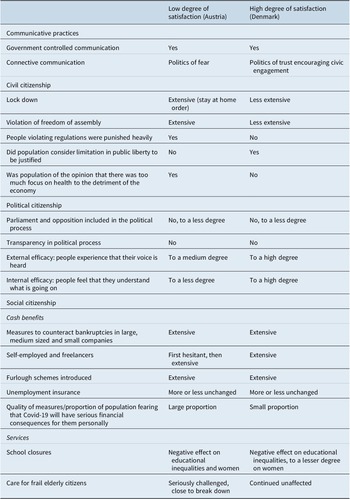
In this paper, the aim has been to analyse why populations in two countries have been satisfied to different degrees with measures taken by their governments from a citizenship perspective. We have analysed four dimensions of citizenship, and the findings on different factors are summarised in Table 2.
Factors conditioning satisfaction with government measures.

As can be seen, deviations can be found in some dimensions of citizenship (eg. care of frail elderly citizens), while in others similarities can be found (eg. furlough schemes introduced). As we presuppose that a unique combination of differences in citizenship condition different outcomes in satisfaction with government measures, the two countries allow us to detect the following characteristic patterns:
A low degree of satisfaction with government measures (in Austria) is framed by politics of fear as discursive practice orchestrated by the “strict father,” which logically in a civil citizenship dimension, ties in with an extensive lock down, extensive violation of freedom of assembly and the police penalising violations. Furthermore, the population did not consider limitations in public liberty to be justified and was of the opinion that measures were focusing too much on health to the detriment of the economy. Accordingly, from a political citizenship perspective, internal and external efficacy was threatened, and even social citizenship was – despite extensive social policy regulations – crippled: a large proportion of the population feared serious financial consequences for them personally, while care for frail elder citizens was close to break down and schools were closed for extended periods, which put the burden on women.
A high degree of satisfaction with government measures (in Denmark) is embedded in a discursive practice, where the government as a “nurturing parent” expresses trust in its citizens, while encouraging civic engagement. From a civil citizenship perspective, this corresponds to a less extensive lockdown, a less extensive violation of the freedom of assembly and citizen were not punished for violating the regulations. Accordingly, the population considered limitations in public liberty to be justified, and the population was not of the opinion that there was too much focus on health to the detriment of the economy. Additionally, from a political citizenship perspective, internal and external efficacy was maintained, to a high degree ie. citizens felt that they understood what was going on and that their voices were heard, which was paralleled with the maintenance of social citizenship. From a social citizenship perspective, a small proportion of the population feared that Covid-19 would have serious financial consequences for them personally, just as the daily routines in the large public eldercare sector continued unaffected.
In summary, during Covid-19 different dimensions of citizenship have moved in different directions in Austria and Denmark, leading to a different degree of satisfaction with government measures. In Austria, low levels of satisfaction are an outcome of the combined effect of politics of fear, extensive and authoritarian regulations of civil citizenship, and that political citizenship has been challenged and social citizenship for larger groups undermined. In Denmark, high levels of satisfaction can be seen as an outcome of the combined effect of politics of freedom, less extensive and non-authoritarian regulations of civil citizenship, and that political as well as social citizenship were maintained to a large extent.
Disclosure statement
none.