Identification of risk factors for psychopathology is essential for prevention efforts (e.g. defining the group to receive preventive intervention) and etiological models (e.g. providing insights about the processes leading toward psychopathology). The search for risk factors for mental disorders has identified numerous predictors but has generally assumed that risk is static, in that risk factors are typically assessed only once, rather than considering how risk changes with time (Fusar-Poli et al., Reference Fusar-Poli, Borgwardt, Bechdolf, Addington, Riecher-Rössler, Schultze-Lutter and Valmaggia2013; Hankin, Reference Hankin2012; Klein, Kotov, & Bufferd, Reference Klein, Kotov and Bufferd2011; Nelson, McGorry, Wichers, Wigman, & Hartmann, Reference Nelson, McGorry, Wichers, Wigman and Hartmann2017). However, many risk factors have been shown to change substantially over time (e.g. Roberts, Walton, & Viechtbauer, Reference Roberts, Walton and Viechtbauer2006). It is largely unknown what pattern of change indicates risk for psychopathology. At least two basic types of dynamic relationship are possible between risk factors and onset of psychopathology. The ‘Risk Escalation hypothesis’ posits that worsening of risk levels predicts disorder onset above the average level of the risk factor. In other words, among people with the same level of risk currently, those who were previously at low risk but worsened are more likely to experience onset than those who were at elevated risk all along. Alternatively, the ‘Chronic Risk hypothesis’ posits that average risk over time predicts DD onset, and fluctuations around the average are not informative for prediction. These hypotheses have not been systematically compared for any mental disorders. In this study, we seek to demonstrate a strategy for testing these hypotheses on a number of risk factors for adolescent-onset depressive disorders (DD; i.e. major depressive disorder, dysthymic disorder, and depressive disorder not otherwise specified).
Many risk factors have been identified for DD, including malleable vulnerabilities such as symptoms of anxiety and subclinical depression (Klein et al., Reference Klein, Glenn, Kosty, Seeley, Rohde and Lewinsohn2013; Wang et al., Reference Wang, Sareen, Patten, Bolton, Schmitz and Birney2014), certain personality traits (Bagby, Quilty, & Ryder, Reference Bagby, Quilty and Ryder2008; Jeronimus, Kotov, Riese, & Ormel, Reference Jeronimus, Kotov, Riese and Ormel2016), and social risk factors (Stice, Ragan, & Randall, Reference Stice, Ragan and Randall2004). Indeed, these characteristics have been found to change substantially over time (e.g. Roberts et al., Reference Roberts, Walton and Viechtbauer2006; Hankin, Reference Hankin2008; Nocentini, Menesini, & Salmivalli, Reference Nocentini, Menesini and Salmivalli2013; Yaroslavsky, Pettit, Lewinsohn, Seeley, & Roberts, Reference Yaroslavsky, Pettit, Lewinsohn, Seeley and Roberts2013; Nelemans, Hale, Branje, Hawk, & Meeus, Reference Nelemans, Hale, Branje, Hawk and Meeus2014; Kopala-Sibley, Zuroff, Hankin, & Abela, Reference Kopala-Sibley, Zuroff, Hankin and Abela2015; Kendler & Aggen, Reference Kendler and Aggen2017; Bleys, Soenens, Claes, Vliegen, & Luyten, Reference Bleys, Soenens, Claes, Vliegen and Luyten2018; Fernandes, Davidson, & Guthrie, Reference Fernandes, Davidson and Guthrie2018), especially during adolescence (e.g. Klimstra, Hale, Raaijmakers, Branje, & Meeus, Reference Klimstra, Hale, Raaijmakers, Branje and Meeus2010). Hence, it is important to consider how change in risk factors predicts DD onset.
The ‘Risk Escalation hypothesis’ has received support in several longitudinal studies of depression. These studies found that increases in risk levels predict subsequent increases in depression symptoms (Mu, Luo, Rieger, Trautwein, & Roberts, Reference Mu, Luo, Rieger, Trautwein and Roberts2019; Steiger, Allemand, Robins, & Fend, Reference Steiger, Allemand, Robins and Fend2014) or DD onset (e.g. Laceulle, Ormel, Vollebergh, Van Aken, & Nederhof, Reference Laceulle, Ormel, Vollebergh, Van Aken and Nederhof2014). However, these and most other studies tested escalation by analyzing baseline level and subsequent change in risk. This analytic approach cannot compare the two competing hypotheses, because high proximal risk should positively predict depression onset under both Risk Escalation and Chronic Risk scenarios. It would be more informative to compare the change in risk to the risk level most proximal to onset rather than to the distal baseline. The proximal assessment conveys more information about risk than the baseline assessment, which is often years before the proximal assessment. Indeed, past research has shown that the most recent assessment is most predictive of onset when multiple timepoints are available for a risk measure (e.g. Shanahan, Copeland, Costello, & Angold, Reference Shanahan, Copeland, Costello and Angold2011). In addition, modeling change while controlling for the proximal level of the risk factor is not only a sound analytic practice, but also aligns with clinical decision-making. When forecasting prognosis, clinicians first consider present illness and then its history, a practice best captured in models that include both the proximal assessment and change since baseline.
The alternative ‘Chronic Risk hypothesis’ has been tested only indirectly. First, research has consistently shown that chronic stressors (e.g. chronic marital stress, chronic illness) are potent predictors of subsequent depression onset (e.g. Bey, Waring, Jesdale, & Person, Reference Bey, Waring, Jesdale and Person2018; Cuijpers, Van Straten, & Smit, Reference Cuijpers, Van Straten and Smit2005; Hammen, Hazel, Brennan, & Najman, Reference Hammen, Hazel, Brennan and Najman2012). Also, one study reported that adolescents with subclinical depressive symptoms at multiple waves are more likely to develop DD than adolescents with subclinical depressive symptoms at only one assessment (Klein, Shankman, Lewinsohn, & Seeley, Reference Klein, Shankman, Lewinsohn and Seeley2009). Moreover, some studies have separated the stable portion of risk from temporary fluctuations around it and found that the stable fraction predicted subsequent change in depression (Naragon-Gainey, Gallagher, & Brown, Reference Naragon-Gainey, Gallagher and Brown2013; Kendall, & Langer, Reference Kendall and Langer2015) and suicidality (Young et al., Reference Young, Fogg, Scheftner, Fawcett, Akiskal and Maser1996). However, these studies did not directly compare the Chronic Risk v. Risk Escalation hypotheses. Moreover, most previous studies included only a small number of follow-ups, or failed to distinguish first onsets of depression from recurrent episodes, which confounds vulnerabilities to developing depression with processes that maintain depression after onset (Wilson, Vaidyanathan, Miller, McGue, & Iacono, Reference Wilson, Vaidyanathan, Miller, McGue and Iacono2014).
The current study aimed to provide the first direct test of these competing hypotheses – Risk Escalation and Chronic Risk – to predict the first onset of DD, addressing the aforementioned methodological limitations. We utilized data from a richly characterized sample of adolescent girls from the community who underwent five waves of assessment. We did not consider fixed and relatively fixed risk factors, such as childhood maltreatment and parental psychopathology, respectively, and discrete experiences (e.g. life events) which, by definition, cannot evolve. Indeed, most parents who are ever going to develop depression have already done so as most parents were in their 40s when they entered the study. We focused on well-established malleable risk factors for adolescent depression: symptoms of anxiety and subclinical depression (Klein et al., Reference Klein, Glenn, Kosty, Seeley, Rohde and Lewinsohn2013; Wang et al., Reference Wang, Sareen, Patten, Bolton, Schmitz and Birney2014), three personality traits (neuroticism, conscientiousness, and extraversion; Jeronimus et al., Reference Jeronimus, Kotov, Riese and Ormel2016; Mu, Luo, Nickel, & Roberts, Reference Mu, Luo, Nickel and Roberts2016), three clinical traits indexing depressogenic cognitive or interpersonal styles (rumination, self-criticism, and dependency; Klein et al., Reference Klein, Kotov and Bufferd2011; Mahaffey, Watson, Clark, & Kotov, Reference Mahaffey, Watson, Clark and Kotov2016), and four social risk factors (social support, school engagement, being bullied, and parental criticism; Burkhouse, Uhrlass, Stone, Knopik, & Gibb, Reference Burkhouse, Uhrlass, Stone, Knopik and Gibb2012; Sachs-Ericsson, Verona, Joiner, & Preacher, Reference Sachs-Ericsson, Verona, Joiner and Preacher2006; Starr & Davila, Reference Starr and Davila2008; Stice et al., Reference Stice, Ragan and Randall2004; Swearer, Song, Cary, Eagle, & Mickelson, Reference Swearer, Song, Cary, Eagle and Mickelson2001; Van Voorhees et al., Reference Van Voorhees, Paunesku, Kuwabara, Basu, Gollan, Hankin and Reinecke2008; Wilson et al., Reference Wilson, Vaidyanathan, Miller, McGue and Iacono2014).
Method
Participants
Data were collected as part of the Adolescent Development of Emotions and Personality Traits (ADEPT) project. Participants were 550 females aged 13.5–15.5 years at enrollment. This age range was targeted because of the sharp increase in DD incidence in girls during this period (Hankin et al., Reference Hankin, Abramson, Moffitt, Silva, McGee and Angell1998). The sample was predominantly non-Hispanic White European (80.5%) and socioeconomically diverse (42.2% of families had neither parent with a bachelor's or higher degree). Exclusion criteria were intellectual disability and history of major depressive disorder or dysthymic disorder before enrollment. For the current analyses, we also excluded 44 participants because they developed DD before the second assessment wave and 10 because they were lost to follow-up before that wave; thus, 496 were included in the present analyses. Parents provided permission and adolescents provided assent. The study was approved by the Stony Brook University Institutional Review Board. Further details about the sample and recruitment can be found in Nelson, Perlman, Klein, Kotov, and Hajcak (Reference Nelson, Perlman, Klein, Kotov and Hajcak2016).
Assessments
Participants completed five assessments of DD and risk factors every 9 months for 3 years.
Adolescent depression diagnosis
The Kiddie Schedule for Affective Disorders and Schizophrenia for School Aged Children (K-SADS-PL; Kaufman et al., Reference Kaufman, Birmaher, Brent, Rao, Flynn, Moreci and Ryan1997) was used to assess DD based on the Diagnostic and Statistical Manual of Mental Disorders, fourth edition (DSM-IV; American Psychiatric Association, 2020) in the interval since the previous assessment. DD included major depressive disorder, dysthymic disorder, and depressive disorder not otherwise specified. Of note, diagnosis of DD not otherwise specified required clinically significant distress or impairment. K-SADS interviews were conducted by staff trained and supervised by clinical psychologists (GP, DK, and RK). Interrater reliability was assessed through an independent rater deriving diagnoses from videotapes of 48 K-SADS interviews and was excellent (κ = 0.81 for any DD, 0.85 for DYS, 0.62 for DEPNOS, and 0.73 for MDD).
Depression and anxiety symptoms were measured using the expanded version of the Inventory of Depression and Anxiety Symptoms (IDAS-II; Watson et al., Reference Watson, O'Hara, Naragon-Gainey, Koffel, Chmielewski, Kotov and Ruggero2012). The IDAS-II contains 18 specific scales and a General Depression composite of items from the six depression symptom scales. We selected General Depression and another five scales that were most relevant to risk for DD onset: ill temper, panic, social anxiety, traumatic intrusions, and traumatic avoidance. We did not include the seven specific depression scales as they are redundant with General Depression, the claustrophobia scale because it did not predict DD onset, and the two mania and three obsessive-compulsive scales as these symptoms were rare in our sample.
Personality was assessed with the Big Five Inventory (BFI; John & Srivastava, Reference John and Srivastava1999), specifically the neuroticism, conscientiousness, and extraversion scales.
Rumination was assessed with the Ruminative Responses Scale (RRS) of the Response Styles Questionnaire (Nolen-Hoeksema, Reference Nolen-Hoeksema1987, Reference Nolen-Hoeksema1991).
Self-criticism was assessed with Bagby, Parker, Joffe, & Buis's (Reference Bagby, Parker, Joffe and Buis1994) revised self-criticism subscale of the Depressive Experiences Questionnaire (DEQ; Blatt, D'Affitti, & Quinlan, Reference Blatt, Afflitti and Quinlan1976).
Dependency was measured using the emotional reliance subscale of the Interpersonal Dependency Inventory (IDI; Hirschfeld et al., Reference Hirschfeld, Klerman, Gouch, Barrett, Korchin and Chodoff1977).
Social support was measured using total score on the Multidimensional Scale of Perceived Social Support (MSPSS; Zimet, Dahlem, Zimet, & Farley, Reference Zimet, Dahlem, Zimet and Farley1988). Participants rated their perceptions of the general adequacy of social support received from family, friends, and a significant other.
School engagement was measured with three subscales of the School Attitude Assessment Survey – Revised (SAAS-R; McCoach & Siegle, Reference McCoach and Siegle2003). The total score indicated school engagement in terms of attitudes toward school, attitudes toward teachers, and self-motivation/regulation.
Bullying was measured with the total of three victim subscales of the Revised Peer Experiences Questionnaire (RPEQ; De Los Reyes & Prinstein, Reference De Los Reyes and Prinstein2004): overt, relational, and reputational.
Parental criticism was measured with the criticism subscale of the Network of Relationships Inventory (NRI, Furman & Buhrmester, Reference Furman and Buhrmester2009). Participants answered three items each about their mother figure and father figure; the mean of ratings across the two figures was used to index parental criticism. Items were rated for how much each behavior occurred in each relationship.
Specifics of the measures (i.e. rating scale, sample items, number of items, rating time frame, Cronbach's α, and stability coefficients) are presented in online Supplementary Tables S1 and S2.
Statistical analyses
Outcomes were whether or not DD onset occurred in the interval. After first onset, outcomes were censored. We labeled the wave when DD was diagnosed for the first time as Waven, and analyses tested whether first-onset DD occurred between Waven −1 and Waven. We refer to Waven −1 as the ‘proximal wave’, as it is closest to onset, and Waven −2 as the ‘baseline wave’, as it is the baseline used to calculate the change score. Change was operationalized as proximal minus baseline score. We also calculated the mean score, averaging across all waves preceding the proximal wave. For example, if Waven was Wave 5, the model tested whether first onset occurred between Waves 4 and 5, the proximal wave was Wave 4, the baseline wave was Wave 3, and the mean score was based on Wave 1 to Wave 3.
Next, we conducted three sets of Cox regression analyses with time-varying covariates to predict DD onset. Analysis 1 tested the Risk Escalation hypothesis; Analysis 2 tested the Chronic Risk hypothesis; and Analysis 3 tested both hypotheses in the same model. In Analysis 1, we examined the effect of change by entering the change score alongside the proximal score as time-varying predictors. This was needed because change is often confounded with level, in that people with high levels of scores tend to show greater levels of change. However, unlike prior research that invariably controlled for baseline assessment (e.g. Laceulle et al., Reference Laceulle, Ormel, Vollebergh, Van Aken and Nederhof2014), we controlled for the proximal score, as the proximal score is the most informative single indicator of risk and therefore controlling for the proximal assessment provides the most rigorous test of dynamic effects. The Risk Escalation hypothesis would be supported by a positive relationship between the change score and first DD onset. In Analysis 2, we entered the mean and proximal scores as time-varying predictors. The Chronic Risk hypothesis would be supported by a positive relationship between the mean score and DD onset. In Analysis 3, we entered change and mean scores simultaneously as time-varying predictors. The change score positively predicting DD onset would support the Risk Escalation hypothesis, whereas the mean score positively predicting onset would support the Chronic Risk hypothesis. These analyses were conducted for each risk factor separately. We calculated the C-statistic for each model, which equals the area under the curve of receiver operating characteristics and indicates the predictive accuracy of the model.
Before completing the Cox regression analyses, we examined the correlations among the predictors (proximal, change, mean) for each risk factor to identify any multicollinearity. We found no substantial multicollinearity, as correlations across risk factors ranged 0.34 to 0.51 for proximal with change, 0.44 to 0.80 for proximal with mean, and −0.42 to −0.03 for change with mean (see Table S4), so in all models tolerance was >0.35, which is well within the acceptable range (Belsley, Kuh, & Welsch, Reference Belsley, Kuh and Welsch2005). Moreover, although absolute change is the most interpretable index of change (Rogosa, Reference Rogosa and Gottman1995), some applications use residual scores to represent change. Accordingly, we performed sensitivity analyses, repeating Analysis 1 with the residual score (the baseline score regressed on the proximal score) instead of the change score, and Analysis 3 with the residual score (the proximal score regressed on the mean score) instead of the change score. To confirm that the performance of the mean score is not due to adjustment for other predictors, we also performed analyses with the mean score as the only predictor.
Analyses were carried out using the R 3.5.0 package ‘Survival’ (2.42-3). We used grand mean standardization – standardizing each variable across subjects and across time – to improve interpretability; thus, the hazards ratio (HR) reflected the difference in risk per standard deviation.
Missing data
For each scale, if fewer than 25% of the items were missing, we used ipsative mean imputation (Schafer & Graham, Reference Schafer and Graham2002) to replace the missing data before computing the scale total; otherwise the score was considered missing. Survival analyses used all available data.
Results
Adolescent depression
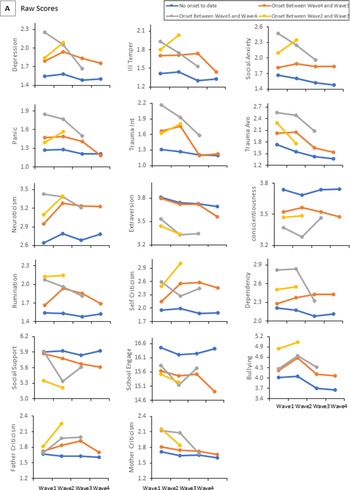
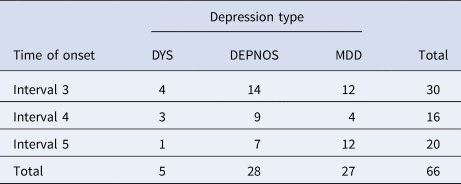
Sixty-six participants had first onset of DD after Wave 2 (Table 1). The descriptive statistics for each risk factor at each wave are presented in online Supplementary Table S3. The scores of each risk factor from Wave 1 to Wave 4 for participants who had onsets at different waves are presented in Fig. 1. The no-onset group showed low or decreasing levels of risk throughout the interval. In the other groups, the ranking of initial levels of risk generally followed the order of onset, with higher risk in groups that had an earlier onset. However, the trajectories within these groups did not show a clear pattern, increasing in some cases and decreasing in others before onset.
Raw scores of each risk marker from wave 1 to wave 4 by onset group at different waves.
Note. Trauma Int = TraumaticIntrusion;TraumaAvo = TraumaticAvoidance;

Number of first onset of depressive disorders

Note. DYS = Dysthymia; DEPNOS = Major Depressive Not Otherwise Specified; MDDs = Major Depressive Disorder; Interval 3 = Between Waves 2 & 3; Interval 4 = Between Waves 3 & 4; Interval 5 = Between Waves 4 & 5).
Effect of change while controlling for proximal assessment (Analysis 1)
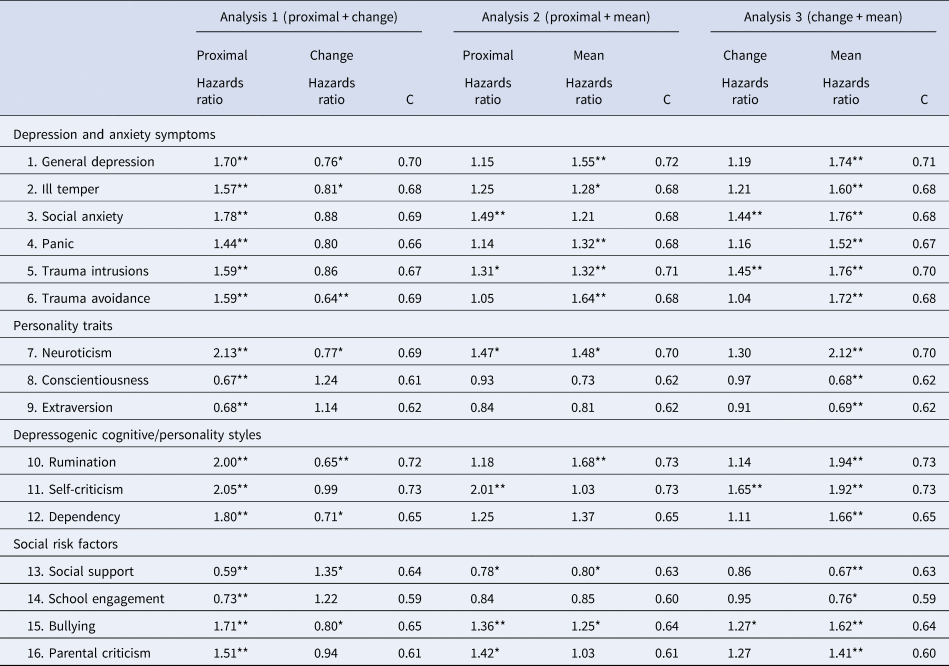
For all risk factors, the proximal score significantly and positively predicted first-onset DD (Table 2). For eight of 16 risk factors, a decrease or smaller increase in risk from baseline to proximal assessment significantly predicted onset after controlling for the proximal score. Non-significant HRs for the other variables were in the same direction. These findings are inconsistent with the Risk Escalation hypothesis as it posits that a larger increase in risk predicts onset. Predictive accuracy (C-statistic) of models ranged from 0.53 to 0.73, which is low to moderate.
Hazards ratio of risk factors for first DD onset using three prediction models

IDAS-II, Expanded Inventory of Depression and Anxiety Symptoms; C, Concordance Index. Two-sided statistical tests were performed at a level of significance of 5%.
*p < 0.05; **p < 0.01.
Effect of mean while controlling for proximal assessment (Analysis 2)
For nine of 16 risk factors, the mean value significantly predicted first DD onset in the expected direction, even controlling for the proximal score (Table 2). Thus, looking back from the pre-onset wave, participants who developed DD had higher risk scores throughout the entire course of the study, consistent with the Chronic Risk hypothesis. When the mean was controlled, the proximal score did not predict onset for the majority (nine of 16) of risk factors. Predictive accuracy (C-statistic) of models ranged from 0.60 to 0.77, which is low to moderate.
Direct comparison of risk escalation and chronic risk hypotheses (Analysis 3)
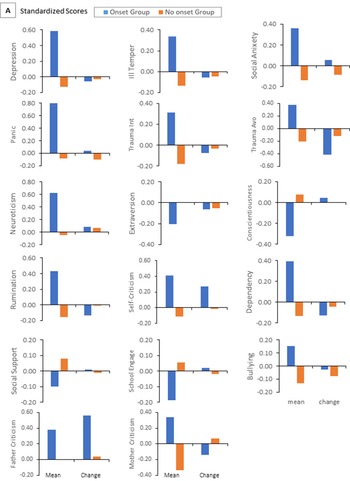
When mean risk and change in risk were both included in the model, the mean significantly predicted first DD onset for all risk factors (Table 2). In contrast, an increase in risk significantly predicted onset for only four out of 16 risk factors: social anxiety, traumatic intrusions, self-criticism, and bullying. These findings provide consistent support for the Chronic Risk hypothesis for all risk factors, and support for the Risk Escalation hypothesis for only a limited set (25%) of risk factors. Differences in mean and change plotted as a function of subsequent onset status showed the same pattern (Fig. 2). Predictive accuracy (C-statistic) of models ranged from 0.59 to 0.76, which is low to moderate.
Standardized mean an change scores of each risk marker by onset group across waves.
Note. The Scores were aggregated over multiple outcome waves (weighted by the number of people in the corresponding group at that time) and were standardized based on the first observation (wave 1). Trauma Int = Traumatic Intrusion; Trauma Avo = Traumatic Avoidance;

Sensitivity analyses
To evaluate the robustness of the findings, we repeated Analysis 1 using the residual score instead of the difference score, and the pattern of significant effects was unchanged (Table S6). We also repeated Analysis 3 with the residual rather than difference score. It produced four additional significant effects for the residual, for a total of eight effects, and all 16 effects for mean risk remained significant (Table S7). Overall, analyses that operationalized change using residual scores were consistent with analyses of change scores and both supported the Chronic Risk hypothesis. Moreover, when change was removed from the model, mean risk continued to predict DD in all 16 models (Table S8).
Discussion
The current study is the first direct and rigorous test of the Risk Escalation and Chronic Risk hypotheses. We demonstrated a general approach to evaluating these hypotheses using a number of malleable risk factors for first DD onset. We found that chronically elevated risk (i.e. the mean across multiple waves up to, but not including, the most proximal assessment) predicted first-onset DD, even when recent escalation (from the next-to-most to the most proximal assessment) was included in the model. This pattern, predicted by the Chronic Risk hypothesis, held across all risk factors examined: prior anxiety and subclinical depression symptoms, personality traits (neuroticism, conscientiousness, extraversion), clinical traits (rumination, dependency, and self-criticism), and social factors (social support, school engagement, bullying, parental criticism). In contrast, the Risk Escalation hypothesis was not supported for the majority (75%) of risk factors, as change in risk from baseline to proximal assessment (a) rarely predicted DD onset above mean risk level and (b) predicted in the opposite direction (i.e. less change was associated with increased likelihood of first onset) when proximal risk was controlled.
Our findings shed light on the nature and developmental course of risk for first DD onset. The Risk Escalation hypothesis has intuitive appeal, yet we found minimal support among the risk markers examined; instead the Chronic Risk hypothesis received consistent support. It appears that the likelihood of DD onset reflects the mean level of the risk factor over years, rather than change in the months before onset. This aligns with prior research that found stable levels of a risk factor to be highly predictive (Kendall, & Langer, Reference Kendall and Langer2015; Klein et al., Reference Klein, Shankman, Lewinsohn and Seeley2009; Naragon-Gainey et al., Reference Naragon-Gainey, Gallagher and Brown2013). Overall, these findings suggest that risk tends to be present years before onset, and short-term alterations often reflect transient fluctuations rather than a lasting change. This pattern raises the question of why DD onset had not happened earlier. One possibility is that long-standing risk might make individuals especially vulnerable to precipitating factors, such as a major life event or maturation, and when those occur, DD is triggered (Slavich & Irwin, Reference Slavich and Irwin2014). It is also possible that long-standing risk factors, especially those related to personality, symptoms, and clinical traits, evoke stress, as a result of a complex interaction between these risk factors and enduring environmental contexts (Kushner, Bagby, & Harkness, Reference Kushner, Bagby and Harkness2017; Liu & Alloy, Reference Liu and Alloy2010). Future research should examine the interplay of chronic and discrete risk factors (e.g. negative life events) in eliciting first DD onset (Hammen, Kim, Eberhart, & Brennan, Reference Hammen, Kim, Eberhart and Brennan2009). Last but not least, one other possibility is that the impact of a risk factor needs to accumulate until it passes a threshold before first onset is triggered. In other words, people with higher means will have onsets when they are younger than people with lower but still elevated means. In fact, we see this pattern in Fig. 1. Unfortunately, we cannot test it formally in the current study due to lack of enough data points. Studies with more frequent assessments over a longer time span would be ideal to explore this possibility.
Further support for the Chronic Risk hypothesis stems from our findings that change in risk factors from the baseline to proximal risk assessment significantly and negatively predicted first-onset DD when the proximal assessment was controlled, which is in the opposite direction than when the baseline score was controlled (Table S5). In other words, for two people with a given proximal score, the person who had high baseline but de-escalated was at greater risk than the person who had low baseline but escalated. This suggests that participants reverted back to their mean risk levels after the change observed in the proximal assessment (e.g. the person who experienced a recent decrease in the risk factor then returned to high mean level).
Our findings are inconsistent with past evidence supporting the Risk Escalation hypothesis (e.g. Laceulle et al., Reference Laceulle, Ormel, Vollebergh, Van Aken and Nederhof2014), possibly due to several factors. First, prior studies controlled for baseline rather than proximal assessment. A model that controls for baseline cannot compare Risk Escalation and Chronic Risk scenarios, because both imply that increase from baseline predicts onset. Indeed, increase from baseline may indicate either a persisting new increase in risk or a return to a high mean risk after a transient improvement.
Second, prior studies assessed risk change over a lengthy period (e.g. 5 years; Laceulle et al., Reference Laceulle, Ormel, Vollebergh, Van Aken and Nederhof2014) when more consistent change in risk has accumulated than change during the 9-month intervals examined here. Future studies may clarify the optimal schedule of follow-up assessment intervals to maximize the predictive power of change. That said, we did find some support for the Risk Escalation hypothesis. For four risk factors – social anxiety, traumatic intrusions, self-criticism, and bullying – both change and mean scores independently predicted first-onset DD, providing evidence for both the Chronic Risk and Risk Escalation hypotheses. However, evidence for escalation was inconsistent. Change in three of these four risk factors (i.e. social anxiety, traumatic intrusions, self-criticism) was not significant when the proximal assessment was controlled, and change in bullying changed sign, indicating lower likelihood of DD onset. Therefore, the dynamic effects in these variables require further study.
Of note, for the majority of risk factors, the proximal risk score did not predict DD onset above the mean of previous timepoints. Given that these risk factors are all well-established in the literature, this finding underscores the limitations of cross-sectional risk assessments and suggests that the aggregation of risk over multiple time points can improve prediction (e.g. Fusar-Poli et al., Reference Fusar-Poli, Borgwardt, Bechdolf, Addington, Riecher-Rössler, Schultze-Lutter and Valmaggia2013). Echoing calls for dynamic prediction models in psychopathology research (Klein et al., Reference Klein, Kotov and Bufferd2011; Nelson et al., Reference Nelson, McGorry, Wichers, Wigman and Hartmann2017), our findings suggest that chronic vulnerability is important to examine in such studies.
Our findings have implications for efforts to screen high-risk populations to prevent depression. Clinicians have been encouraged to consider recent escalation in risk factors for DD (e.g. Steiger et al., Reference Steiger, Allemand, Robins and Fend2014). However, we found little support for this recommendation. Instead, prevention efforts should prioritize individuals who have elevated levels of risk on repeated assessments. In clinical practice, clinicians should pay close attention to history of risk and anticipate that recent changes in risk may revert to the baseline. However, some changes require attention even if they are likely to be transient, such as the emergence of acute stress (e.g. major life events) or those with a high probability of negative consequences (e.g. self-injury).
Our study had several limitations. First, the sample was limited to adolescent girls from the community, so the results may not generalize to males, younger children, adults, or clinical populations. Moreover, 80% of our sample are European White, and future studies should explore if the current findings hold among other populations such as but not limited to Asian Americans, African Americans, etc. Second, similar to most of the literature, when assessing vulnerability, we relied exclusively on self-report inventories. Indeed, self-report provides reasonably accurate assessments of psychopathology (e.g. Babor, Brown, & Del Boca, Reference Babor, Brown and Del Boca1990) and other informants have limited insight into the emotional states of participants. Nevertheless, future studies should improve vulnerability assessment by employing multiple methods (e.g. informant reports, behavioral observations, laboratory measures). Third, some of our risk measures may be assessing the depression prodrome, thereby confounding the risk factor and the outcome. However, we ruled out this confounding effect by controlling for proximal risk, which would have captured any effects of the prodrome on the risk measure. Fourth, we have not examined negative life events, which are a major risk factor for DD, but events are discrete rather than developing over years and require a different analytic approach. Future research should consider the interplay between life events and trajectories of risk factors. Fifth, we operationalized change as a difference score, which can be noisy. Difference scores were used in prior dynamic research (Jacobson & Truax, Reference Jacobson and Truax1991; Laceulle et al., Reference Laceulle, Ormel, Vollebergh, Van Aken and Nederhof2014) and we followed this practice. However, we also repeated analyses with change operationalized as residual scores and obtained very similar results. Other operationalizations of change were not feasible with just five assessment waves, given that onsets could occur during any interval and analyses that use more intervals for modeling dynamic risk would leave only a small window to observe onsets. Future studies should collect more time points and explore more sophisticated analytic methods. Finally, the change rate of risk factors may vary depending upon age. However, we only examined three and a half years of life development, limiting our ability to examine how age interacts with risk factors to predict depression onset. Future studies should include a longer age span to allow for more sophisticated analytical approaches to examine the influence of age on our proposed models.
Our findings indicate that alternative models of dynamic risk are testable and are important targets for research. Across multiple well-established risk factors for DD, chronically elevated levels of risk, rather than recent escalation in vulnerability, best predicted first onsets. Longitudinal studies should consider mean and proximal scores as alternatives to distal baseline and change designs when predicting future outcomes. Our findings suggest that chronicity of risk should be a particular focus in screening high-risk populations to prevent the onset of DDs. In particular, regular monitoring of risk factors in school settings would be highly informative.
Supplementary material
The supplementary material for this article can be found at https://doi.org/10.1017/S0033291721004190.
Financial support
This work was supported by the National Institute of Mental Health of the National Institutes of Health (R01MH093479 to RK).
Conflict of interest
None.