Introduction
The failure, and the achievements, of the plans for the reconstruction of post-war Britain have a well-established historiography.Footnote 1 Yet, there are few accounts of how the grand designs were deployed within the planning system for specific developments. The 1943 County of London Plan envisaged redevelopment of war-damaged London on a modern, rational and visionary basis. It has been described as a plan of ‘pervasive national importance’; as part of the golden age of urban planning; or more prosaically as ‘honest, pragmatic and logical’.Footnote 2 The Plan proposed the deindustrialization of the South Bank of the Thames.Footnote 3 Meanwhile, in response to the pressing need for electricity, plans were made to extend and rebuild Bankside power station opposite the City of London. The tension and conflict between these plans – the battle for Bankside – entailed a web of interactions, first in private then in the public realm over the period 1945–47, supporting the contention that the infrastructure state ‘inevitably pits interests against one another’.Footnote 4
This article has four aims. First, to examine the two plans and argue that the issues raised – rational, long-term urban planning, and the more immediate needs of post-war reconstruction – were of such importance that the decision on how to implement them escalated to a debate of national significance with the decision taken at the highest level of government. Second, to explore the workings of local and central government in the planning process, including the influence of ministers and statutory bodies, and the political manoeuverings to develop and shift the arguments and influence the decision-making process. The article argues that the planning decision was resolved in favour of the electricity industry through the contingency of the ‘bleak midwinter’ of 1947 which turned an energy shortage into a crisis. Third, the article sets the decision-making process and its outcomes in a wider context: the battle for Bankside is contrasted with the controversy around plans for Battersea power station in the late 1920s, and with the simplified planning system following legislative changes in 1947 including later consents for nuclear power stations. Finally, the article addresses the legacies of the battle: the fate of the South Bank now transformed into a popular cultural quarter and Bankside power station reborn as Tate Modern.
Planning the built environment: the County of London Plan
In the 1940s, the replanning of British cities had long been an unachieved aspiration. The Barlow Commission's report of 1940 identified that haphazard urban development had led people to suffer from inter alia poor housing, difficulties of transport, congestion, smoke, dirt, fog and noise.Footnote 5 The report recommended ‘continued and further redevelopment of congested urban areas, where necessary [and] decentralisation or dispersal, both of industries and industrial populations, from such areas’.Footnote 6 Lord Reith, the wartime minister of works and buildings, asked the London County Council (LCC) to develop a reconstruction plan for London. An outcome was the 1943 County of London Plan by the LCC architect John Forshaw and Patrick Abercrombie. The Plan recognized that the war had provided an opportunity to rebuild London in a rational manner: bomb-damage had offered London a ‘unique stimulus to better planning’.Footnote 7 One concern was the indeterminate zoning or mixed-use land, which comprised a ‘jumble of houses and industry’ (see Figure 1).Footnote 8
A ‘dreary industrial scene’: Bankside power station, South Bank, c. 1933

The Plan attacked this ‘veritable peppering of whole districts with factories, in which the domestic and industrial were unhealthily intermixed’. It argued that relocation of industry from central areas would remove pollution and congestion.Footnote 9 The plan identified two specific locations for renewal: the West End and the South Bank where the ‘dreary industrial scene, with its many damaged buildings, calls for drastic action’.Footnote 10 The Plan envisaged that the South Bank would be redeveloped with a riverside boulevard and a continuous strip of public gardens; behind this would be blocks of offices, flats, and cultural institutions, backed by commercial and light industrial buildings (see Figure 2).
The proposed redevelopment of the South Bank

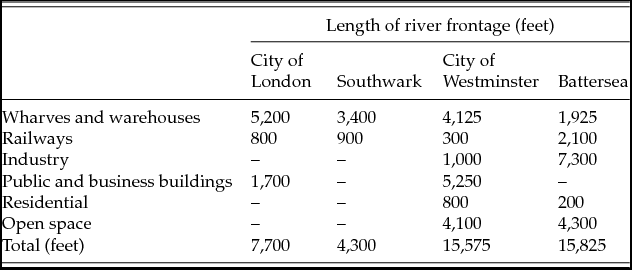
Improved access to the riverfront was seen as essential.Footnote 11 The scale of the issue is demonstrated in an analysis of riverfront usage in Table 1. Neither the City of London nor the Borough of Southwark had any open space on the riverside. In July 1945, the LCC adopted a resolution that ‘there should be greater access to the river front’ and noted that ‘the removal of a certain amount of riverside industry including the Bankside Generating Station would undoubtedly be necessary’.Footnote 12 The LCC indicated that access to the river would permit development opposite St Paul's cathedral ‘appropriate to the importance of the historic site’; it was hoped that the vista from St Paul's across the river to the South Bank could be terminated in ‘an important edifice of appropriate character and design, as, for instance, King's College’.Footnote 13
Riverfront use for some London local authorities

Source: County of London Plan, 177.
As Gordon Cherry has remarked, there was a gap between the strategic thinking of the few academic planners, such as Abercrombie exemplified by the Plan, and the practical capabilities of local government.Footnote 14 This point echoes contemporary commentators who noted that the ‘administrative jungle’ of local government structures prevented effective planning.Footnote 15 Ken Young and Patricia Garside identify that this was partly due to the failure of central government to resolve the question of whether planning should be locally or nationally directed.Footnote 16 The Ministry of Town and Country Planning was established in March 1943 to provide consistency in planning and development. The Ministry pressed for the earliest possible consultation on proposals for new power stations.Footnote 17 The redevelopment of Bankside became entangled in the administrative jungle, and escalated from local authorities, through statutory bodies to central government.
Planning London's electricity
Towards the end of the war the need for electricity in London was crucial and urgent. The use of electricity had grown significantly since the 1930s, yet the British electricity supply industry was poorly placed to meet the projected increase in demand and the expectations of industry, commerce and the public for a secure and plentiful supply. A government report in 1942 identified that ‘the public have increasingly come to regard electricity as a necessity and not a mere luxury’.Footnote 18 Demand for electricity was rising and was expected to continue to increase.Footnote 19
Prior to nationalization in 1948 the planning of electricity supplies was the responsibility of the Central Electricity Board (CEB). In 1939, the CEB identified that additional plant would be required at Bankside power station by 1943 and discussions were held with the owners, the City of London Electric Lighting Company Ltd (CLELCo).Footnote 20 However, long-term planning was suspended during the war and construction of new electricity plant was restricted to the minimum necessary to support the war effort.Footnote 21 To maintain electricity supplies, older plant was kept in service beyond its planned retiral date; by the end of the war, the equipment at many power stations was old and in poor condition, leading to a shortfall in generating capability. In the winter of 1945–46, demand in London had exceeded the available supply resulting in power cuts. The CEB estimated that demand in the London area would increase by 67 per cent between 1944/45 and 1950/51 (see Figure 3).Footnote 22
Actual and projected electricity demand in London, 1938–50

The CEB asked the CLELCo to produce plans for a new power station, Bankside B, and to submit these to the planning authority, the LCC. The urgency is evident in the CEB's comment that the ‘board was anxious that all this should be done as soon as practicable’.Footnote 23 The CLELCo submitted its plans in February 1945 with a formal request for planning consent.Footnote 24 The LCC responded that the plans could not be accepted because they would ‘have a very harmful effect’ on proposals for the redevelopment of the South Bank envisaged in the Plan. The forces were now set for the battle for Bankside: the LCC's vision for redevelopment of the South Bank and the removal of the existing power station, and the electricity industry that planned to rebuild it.
Battle joined: discussion and compromise
In September 1945, the LCC notified the Ministry of Town and Country Planning that the CLELCo's proposals for Bankside B had been reviewed. The Ministry had recently been involved in two controversial proposals for power stations at Lincoln and Durham which, like Bankside, entailed issues around industrialization and views of, or from, cathedrals.Footnote 25 The LCC considered that apart from any question of amenity the power station would ‘completely spoil the County of London Plan proposals for the South Bank’.Footnote 26 In the context of this battle, ‘amenity’ refers to the local visual and physical impact of the power station on its surroundings. The LCC proposed a compromise to relocate the power station to a site in Rotherhithe about four miles down-river. The Electricity Commission – responsible for co-ordinating electricity supplies – also had an interest since it would have to grant formal consent for the power station. The Ministry and the Commission held three meetings with the interested parties between September 1945 and July 1946.
At the first meetings, the Ministry said that prima facie it was desirable that the power station should be built elsewhere. The LCC was prepared to buy the Rotherhithe site and exchange it for Bankside. The commissioners emphasized the importance of ensuring that the cost of electricity was not increased, and the time for getting a power station commissioned should not be affected: the Rotherhithe proposal was more expensive and new plans would have to be drawn up. The CEB foresaw technical problems in routing cables from the site through docks and across swing bridges together with the additional cost of installing cables from Rotherhithe to the electricity distribution sub-station at Bankside. The CEB's position was that further power stations would be needed to meet the projected electricity demand; the Rotherhithe site might therefore be in addition, rather than an alternative, to Bankside. The CLELCo's architect, Sir Giles Gilbert Scott, insisted Bankside was a ‘grand opportunity for fine architectural treatment’ and suggested that continuous gardens along the riverside could be dull and a coal wharf would add interest to the scene.Footnote 27
Despite its insistence that Bankside was required to address critical electricity shortages, the CEB did not press for further discussion but rather, in view of the contested nature of the proposal, deferred Bankside in the power station programme. Discussions reconvened in July 1946. The CEB estimated the additional cost of the Rotherhithe site was £662,000 and was therefore financially unattractive.Footnote 28 The CLELCo offered to compromise by setting back the power station by 180 feet to allow the riverside public gardens to be developed. The question of air pollution from Bankside was raised by the Corporation of London: the issue was the damage caused by corrosive fumes and the repair cost of the stonework of buildings in the City of London down-wind of Bankside – estimated to be about £300,000 per annum.Footnote 29 This secondary concern about material damage contrasts with the controversy over Battersea power station in the late 1920s which was principally framed around the material and health effects of air pollution.
Planning Battersea power station, 1927–29
The London Power Company (LPC) planned to build a new power station at Battersea in 1927. Unlike Bankside, the concern was not about the location: Battersea was an industrial area (see Table 1). The principal objections were to the effects of air pollution. Bill Luckin claims the controversy involved a debate not just about the damaging effects of fumes and dust on health but that the power station would harm buildings, works of art and parks and gardens, and hence damage part of the social fabric of London.Footnote 30 The LPC sought consent from the electricity commissioners in February 1927 which was granted in October subject to the provision of means to consume smoke, to prevent corrosive and toxic sulphur dioxide emissions and to prevent any nuisance.Footnote 31 In February 1928, the Royal Borough of Kensington appealed to the minister of health, Neville Chamberlain, to ‘secure abandonment of a scheme. . .so detrimental to the health of those living in central and West London’. Ministers, briefed by the electricity commissioners, argued that the new power station would allow older stations to be closed, and the wider availability of electricity would reduce domestic coal consumption and hence local air pollution, as consumers switched from coal to electric fires.Footnote 32 The issue entered the public realm on 9 April 1929 in a letter to The Times from several concerned organizations.Footnote 33 They claimed that prevailing winds would blow fumes from Battersea over a large area of Westminster and the West End. The cabinet discussed the matter and was assured that the conditions imposed by the commissioners would prevent the emission of harmful vapours. Furthermore, an Act of Parliament would be needed to deprive the LPC of its legal right to build Battersea.Footnote 34 Like Bankside, an alternative location had been proposed: a power station in the East Kent coalfield could provide electricity. However, this was considered impracticable because of cost and the adverse impact of transmission lines.Footnote 35 The commissioners held an informal inquiry which was ‘a tepid affair’ with just three objectors, although protests and public debate continued until the end of October 1929.Footnote 36 To meet the consent conditions to remove smoke and fumes, the LPC installed a flue-gas washing plant at a capital cost of £250,000.Footnote 37 During the Bankside public inquiry in 1947, it was claimed that since commissioning in 1933 there had only been six complaints about vapour from Battersea's chimneys.Footnote 38 However, formal complaints are likely to have been a fraction of actual nuisances caused by the power station.
Public inquiry and escalation
For Bankside power station, the Ministry of Town and Country Planning indicated that, in recognition of the importance of the issues raised, it would be necessary to hold a public inquiry before any decision was made. The power station required consent from both the Ministry and the Electricity Commission; they took the pragmatic approach of holding a five-day joint inquiry in January 1947.Footnote 39 Despite the important planning principles involved and the significant local impact, the inquiry, like Battersea, ‘was remarkable on account of the small number of objectors’.Footnote 40 Only three written protests were made, and no members of the public nor any learned societies or institutions made representations.Footnote 41 The inquiry discussed three factors that militated against the generating station. First, the visual effect on St Paul's cathedral; second, the power station would prevent the realization of the South Bank redevelopment; and finally, amenity issues. The threat to St Paul's was significant: the cathedral had acquired an important symbolic status since the Blitz when it became ‘the pre-eminent symbol of national resistance and sacrifice’.Footnote 42 The inquiry considered the riverside boulevard and the practical consideration of attracting other developments to the area if the power station was built.Footnote 43 Patrick Abercrombie, appearing as an expert witness for the LCC, was asked whether it would be possible to ‘attract good class businesses and commercial premises and institutions’. He replied that the power station ‘would have a damaging effect on any attempt to attract that type of development’ and said it would be appropriate to keep the Bankside area free from major industry.Footnote 44 An amenity objection was to the handling and storage of large quantities of coal at the power station. Despite Scott's claims for an ‘interesting’ coal wharf, there were concerns about coal dust and the view from neighbouring properties. The inquiry report noted that these objections would be obviated if oil were used instead of coal, although the inspector stated that ‘the extra cost of burning oil would be considerable; indeed it would probably be prohibitive’.Footnote 45 Bankside was later specified for oil-firing although the extra cost was not initially considered. For the promoters, the chief engineer of the CEB, John Hacking, argued that the ‘Bankside site is technically one of the best for electricity generation in the London area.’Footnote 46 The site was adjacent to the river which facilitated the supply of cooling water and fuel, and was in the middle of a large consumer area. The suitability of the site was unsurprising: the CLELCo had selected Bankside in 1891 as the optimal location for generating electricity for the City; these factors still pertained in 1947.Footnote 47
The inquiry identified that although the implementation of the two proposals were mutually exclusive in space, it did not follow that they were in time. The need for electricity was more immediate than the long-term redevelopment and deindustrialization of the South Bank. Counsel for the LCC argued that the minister of town and country planning was the ‘Minister of Posterity’ and should take a longer view.Footnote 48 The inquiry inspector proposed a compromise solution and recommended that the application should be rejected, and a temporary power station with a life of 15 or 20 years should be constructed. Although this was a pragmatic proposal the inquiry had not resolved the essential conflict between rational urban planning and the crucial need for electricity. The Electricity Commission noted that ‘it was not disputed and cannot be disputed that there is urgent need for a substantial and rapid expansion of the generating plant. . .especially in the area of Greater London’.Footnote 49 The commissioners saw ‘no sufficient ground for withholding their consent’ for the new power station. The proposal then escalated as ministers became directly involved.
The inquiry report was submitted to the minister of town and country planning, Lewis Silkin. Between 1940 and 1945, Silkin had been chairman of the LCC Town Planning Committee that had sponsored the County of London Plan; he was therefore not disinterested in the affair. He set out his position in a memorandum where he reiterated the arguments about the interference with the Plan, and the ‘thoroughly inappropriate neighbour’ for St Paul's. He attached ‘by far the strongest objection to the first point’ and was concerned about the continued industrialization of the area. He claimed the Rotherhithe site was ‘a perfectly good alternative’ and argued the delay in completing Rotherhithe was not significant, although the additional capital cost was then £907,000.Footnote 50 He overruled his inspector's compromise proposal for a temporary building, disregarded the commissioner's opinion and urged his ministerial colleagues ‘to concur in my proposal to refuse permission for a new power station on Bankside’.Footnote 51
Another actor, the Ministry of Fuel and Power, now joined the battle for Bankside and, with the random contingency of the weather, played a decisive role in the decision-making process. The Ministry was established in 1942 to plan and co-ordinate strategic energy matters. Prior to March 1947, the Ministry had not contributed to the Bankside discussions since electricity policy was the responsibility of the Commission. In early 1947, the country was suffering the worst peace-time fuel crisis of the twentieth century. This was the consequence of exceptionally bad weather together with the delayed recovery of the coal industry following the war. There were severe shortages of domestic and industrial coal and power cuts for five hours every day.Footnote 52 This was embarrassing for the government and the minister, Emanuel Shinwell, was perceived to have mismanaged the situation.Footnote 53 The approval of Bankside would have helped Shinwell's position: he could demonstrate that new power stations were being authorized. He did not comment directly on the Bankside matter but sent the commissioners’ statement in support of Bankside ‘for information’ to the lord president's committee.Footnote 54 This was a counter position to Silkin's paper proposing refusal. A meeting of the committee, including Shinwell and Silkin, discussed the matter but there was no consensus. Hugh Dalton, the acting lord president, noted that ‘ministers being somewhat divided’ proposed that the issue should go to the cabinet for colleagues ‘to decide one way or the other’.Footnote 55
Meanwhile, another significant issue was raised; the prime minister, Clement Attlee, saw Shinwell's letter and, in a characteristically terse personal note, asked Shinwell ‘should not the new Station be designed for oil fuel?’Footnote 56 Attlee's question was in reference to the visual screening of Bankside's coal store: oil-firing would eliminate this unsightly feature. Attlee's thinking was influenced by the ongoing fuel crisis: an oil-fired power station could continue to operate during a coal shortage.Footnote 57 His comment was therefore not solely about visual amenity but also the diversity and availability of fuel supplies.
Approval and aftermath
The cabinet met on 1 April 1947; Silkin argued that two winters' delay for the Rotherhithe site was a small price to pay for preserving the South Bank redevelopment plan.Footnote 58 Shinwell countered that his efforts to expedite the provision of new generating capacity – already in a critical position because of the fuel crisis – would be frustrated if he constantly faced objections on the grounds of amenity.Footnote 59 The cabinet resolved that the new station should be erected at Bankside, conditional on the electricity being generated by oil and that the building should be set back from the river (see Figure 4). The decision to make Bankside oil-fired was therefore imposed on the developers without consultation or a technical or financial evaluation of the implications. The intent was to improve the visual amenity by removing the coal store, but the decision was to have an impact on the design and the economic operation of the power station.
Perspective of the oil-fired Bankside power station, May 1947

Up to April 1947, the battle for Bankside had only concerned a limited number of individuals and organizations. In view of the possible objections, no announcement of the cabinet's decision was made. The matter was first raised in the House of Commons on 22 April when Silkin was asked whether he was aware of the threat to the dominance of St Paul's from the power station. Silkin, bound by collective cabinet responsibility, was in the position of having to defend the approval of the power station against which he had consistently argued. He maintained that the future of the South Bank would not be prejudiced and that the government ‘gave long and careful thought to the matter’.Footnote 60 This was reported in the press: a hostile leader in The Times spoke of a ‘hasty opportunism, grasping for brief temporary advantage at the expense of the future, which makes havoc of ordered planning’.Footnote 61 The developers defended the decision by pointing to the crucial need for electricity.Footnote 62 There were also private letters of protest to Silkin from several organizations and notable architects and planners.Footnote 63 The Royal Institute of British Architects’ comments are typical: ‘this scheme would not be in the truest and most lasting interests of the public. . .it would seriously prejudice the South Bank scheme of the County of London Plan as cultural institutions, university authorities or business firms would not wish to take adjoining sites and the area would have to be zoned for industrial purposes’.Footnote 64
In the face of public criticism, the government held a press conference at the old Bankside A power station on 6 May 1947. On the relationship with St Paul's, Silkin observed that the two buildings were half a mile apart and there were few places where both could be seen. As one correspondent noted, ‘he convinced everyone that whatever was done with the site it could hardly be used for an uglier building than the one now on it’ (Figure 1).Footnote 65 Silkin's efforts in support of Bankside were then countered by former colleagues at the LCC in an attempt to change the government's decision. John Forshaw, the LCC planner and co-author of the County of London Plan, was ‘extremely concerned’ about the damage which the decision would cause to the Plan and met with Lord Latham the leader of the LCC.Footnote 66 Latham wrote to the lord president of the Council, Herbert Morrison, and said ‘we here are very disturbed at the prospect of a new and larger power station’ which would ‘strike at the very heart of good planning’.Footnote 67
Silkin's discomfort at his enforced volte-face is revealed in a letter to Morrison; he said reopening the Bankside question would ‘place me personally in a somewhat embarrassing position’ and made the point that ‘not only I myself but the Government as a whole, I feel, [would] be discredited if we were to deviate from that position now’.Footnote 68 In the face of hostile reactions, ministers were concerned about the decision and the cabinet returned to the matter on 15 May.Footnote 69 Latham was to raise a motion in the House of Lords to call attention to the Bankside proposal in which he would feel bound to express the objections of the LCC. The cabinet noted that it would be important for the lord chancellor, Viscount Jowitt, in defending the government's position, to know whether there was any prospect for the decision being reconsidered. The cabinet invited Morrison and other interested ministers to reconsider the issue. In the Lords, Jowitt emphasized the critical need for electricity and dismissed the concern about the domination of St Paul's by echoing Silkin's comment about the distance between the buildings.Footnote 70 The debate demonstrates that the key arguments around Bankside – planning versus power – had not changed in the two years since the LCC first objected to the proposal.
The implications of oil-firing became apparent. The CEB noted that the change enabled substantial capital economies to be made, but would entail an increase in running costs since oil was more expensive than coal.Footnote 71 A financial and amenity advantage was that coal handling equipment was no longer required, which enabled the height of the building to be lowered from 140 to 85 feet, reducing its visual profile (Figure 4). However, since oil contained up to 4 per cent sulphur (coal contains 1.0–1.5 per cent) a cleaning plant was required to remove sulphur from the flue-gases. The plant added to the capital and running costs, estimated to be about £450,000 per annum.Footnote 72 Morrison, Silkin, Shinwell and George Isaacs discussed the matter.Footnote 73 They noted that on this occasion the visual amenity advantage of oil-firing, by eliminating the coal store, would warrant the additional expense but this cost should not be over-looked in future decisions. This was reported to the cabinet on 22 May 1947. A virtue was made of the decision by noting that there were advantages in having at least one oil-fired power station on the Thames to provide a diversity of supply. The decision to proceed with the new power station was affirmed.Footnote 74
With cabinet approval, the Electricity Commission issued its formal consent. The decision was announced in the Commons on 23 May and there was a lengthy debate, again largely hostile to the proposal. In defending the decision, Silkin noted that democracy ‘is a very complex system’ and that he had been called upon ‘to make a decision on this most difficult matter after having heard all the evidence’; and, as demonstrated, against his personal views.Footnote 75 In public, the controversy was relatively short-lived: leaders and letters appeared in the press from 23 April until mid-June 1947, but there were few comments thereafter. The fait accompli may have led to the lack of public interest in the Bankside controversy; this is broadly comparable with the public debate over Battersea. Construction of the new Bankside B power station commenced in late 1947 to the designs of Sir Giles Scott (Figure 4) and was commissioned in December 1952. Stephen Heathorn observes that both Battersea and Bankside ‘were erected with the aesthetic considerations of London's cityscape firmly in mind. In both cases, it was expected that good design – of the buildings themselves and of the technology developed to mitigate their pollution – would minimize their negative impact on the city.’Footnote 76
Legacies of the battle
The grand plans for the post-war planning and rebuilding of London were relatively short-lived. The County of London Plan was never formally adopted by the LCC, which developed a new plan in 1951 under the framework of the Town and Country Planning Act 1947.Footnote 77 The construction and extension of power stations was covered by Section 35 of the Act whereby bodies seeking authorization from a government department were ‘deemed to have secured planning consent as part of that authority’.Footnote 78 Thus, the electricity authority – the British Electricity Authority (BEA) from 1948 – required sole approval from the Ministry of Fuel and Power to construct or extend a power station. This arrangement eliminated the Bankside issue whereby ministries took opposing positions on developments. Furthermore, the Ministry of Fuel and Power with its strategic overview of energy supplies was likely to be more sympathetic to power station developments than the Ministry of Town and Country Planning. The battle for Bankside can be contrasted with the remarkably uncontroversial development of two of Britain's first nuclear power stations at Bradwell in Essex and Berkeley in Gloucestershire in 1956. The local member of parliament for the Bradwell area said there were ‘no real objections’ and the proposed power station was of ‘national importance’.Footnote 79 Consent was granted in July 1956 after a four-and-a-half-day public inquiry. Since the local authority at Berkeley had not raised objections, no inquiry was held and planning consent was granted a week after Bradwell.
Electricity nationalization in 1948 abolished several protagonists of the battle for Bankside, thus further clearing the administrative jungle.Footnote 80 The simplified planning process is demonstrated in the application by the Central Electricity Generating Board (CEGB) for permission to build the second, eastern, half of Bankside B power station.Footnote 81 The LCC only required that the materials used should match the existing station.Footnote 82 No other bodies or individuals raised objections to the development. The speed of the process is evident: the CEGB submitted its application on 18 April and on 7 August 1958 the Ministry of Power granted consent.Footnote 83 Bankside B power station was completed in 1963 (see Figure 4). It was used extensively to take advantage of relatively cheap fuel oil during the 1950s and 1960s. The station occasionally caused a local nuisance; the flue-gas washing plant cooled the gases which, under certain atmospheric conditions, ‘drooped’ from the chimney to ground level.Footnote 84 A turning point for Bankside was 1973 when oil price increases made oil-fired generation expensive. The power station became increasingly uneconomic and was closed in October 1981. The derelict power station became a ‘gloomy presence’ on the South Bank and there were proposals for it to be redeveloped for other uses, or to be demolished.Footnote 85
The South Bank underwent a gradual evolution. In November 1947, the LCC zoned the Bankside area for business; riverfront open space; residential areas; offices and ‘technical institutions, including the Bankside Generating Station’. Footnote 86 The term ‘industry’ was not used but the reality was that the power station was located in the midst of residential and commercial premises against the principles of the Plan. The County of London Development Plan was adopted in 1955, which proposed the development of the South Bank with priority given to new government offices. Several large office blocks – reputedly the largest in the country – were built in the Bankside area during the following decade.Footnote 87 The South Bank also became deindustrialized; this was not a result of strategic planning but was part of the wider narrative of ‘unplanned London’.Footnote 88 Deindustrialization was principally driven by the loss of riverside commerce and industry associated with the decline of wharfage and the eastward shift of the Port of London. In the early 1980s, the Borough of Southwark developed a regeneration policy and zoned the Bankside area for housing in response to a chronic shortage and a waiting list of 4,000 families in north Southwark.Footnote 89
By the late 1970s, there was a growing interest in the preservation of Britain's industrial architectural heritage, with both professional and public appeals to save Battersea and Bankside power stations.Footnote 90 Battersea was heritage ‘listed’ in 1980. However, in the run-up to privatization of the electricity industry in 1990, formal listing of Bankside was refused: it was seen by the government as an asset to exploit, listing would have constrained potential redevelopment. The Tate Gallery, looking for a new space to house its modern art collection, purchased the building in 1995 and transformed it to Tate Modern which opened in 2000. This has engendered a renaissance of the area, bringing in new jobs, commerce, residents and tourists.Footnote 91 The South Bank of the 2010s, with its riverside walk, public spaces, office and residential buildings, shops, cultural institutions including Shakespeare's Globe, closely resembles the 1943 vision of the County of London Plan (Figure 2).
Conclusion
The proposal to redevelop Bankside power station from 1945 placed it at the nexus of a conflict – the battle for Bankside – between two plans for the post-war recovery, renewal and modernization of London: the County of London Plan, and the electricity industry's aspiration to meet the rising demand for electricity. This article has argued that the issues raised – rational, long-term urban planning, and the immediate needs of commerce and industry to aid post-war recovery – were of such importance that the Bankside proposal became an issue of national significance with the decision escalated to the highest level of government. The turns within the administrative jungle of the electricity industry and government have been explored; reflecting the notion that there are ‘few aspects of the built environment that have not been shaped by government’.Footnote 92 This included the actions of individuals and organizations to deploy, develop and shift the arguments and influence the decision-making process. The planning decision was resolved in favour of the electricity industry through these political manoeuverings and the contingency of the ‘bleak midwinter’ of 1947 which had turned a fuel and energy shortage into a crisis. The cabinet's condition for oil-firing – ostensibly for amenity benefits but in the context of a coal shortage – did not address the financial costs and was imposed on the developer without consultation about its implications. The complexity and length of the process, over two years, was a product of the planning system and the electricity industry as they were then constituted; planning was simplified under the provisions of the Town and Country Planning Act 1947 and by the nationalization of the electricity industry in 1948. This introduced ‘deemed planning consent’ and reduced the number of protagonists involved in such proposals. The battle for Bankside in its urban setting contrasts with the relatively uncontroversial approval of the hazardous, but rural, nuclear power stations at Berkeley and Bradwell in 1956.
Battersea and Bankside power stations were controversial additions to London's cityscape, although the objections were framed around different issues. For Battersea, upwind of Westminster, the concerns were the material and health effects of air pollution, whereas for Bankside they centred on the continued industrialization of the South Bank and the visual affront to St Paul's cathedral. The legacies of the battle for Bankside: the unplanned deindustrialization of the South Bank, an appreciation of the architectural merits of industrial infrastructure and the transformation of Bankside power station into Tate Modern have fashioned a locality which now resembles that in the County of London Plan.