This article explores the subtle interpretive knowledge of English sentences containing numeral quantifiers, as exemplified in (1), by two populations of English language learners—hearing learners of English as a second language (L2) and deaf learners of English, both at the college level.
(1) a. Three guys are carrying a box.
b. A mother is bathing three babies.
Despite superficial distinctions between these two learner populations, both are acquiring English under conditions of restricted access to the target language input. A consequence of this restricted input access, along with other shared cognitive constraints on acquisition, is parallel interlanguage development in specific domains of the target language (Berent, Reference Berent, Ritchie and Bhatia2009).Footnote 1 These parallels provide valuable insight into the mechanisms of L2 acquisition, because they arise in spite of the fact that hearing L2 English learners have an intact first language (L1), whereas deaf learners of English may not. This study aims to identify and provide principled explanations for L2 and deaf learner parallels.
The study’s targeted sentence types, as shown in (1), each contain a numeral quantifier phrase (Num QP), three guys in (1a) and three babies in (1b), and an indefinite noun phrase (NP), a box in (1a) and a mother in (1b). Among other distinctions, these sentences differ in that (1a) is ambiguous and could be either a collective interpretation in which three guys are carrying one and the same box together or a distributive interpretation in which three guys are each carrying a distinct box. In contrast, (1b) permits only a collective interpretation; that is, one mother is bathing a group of three babies. The interpretive options in (1) differ from parallel sentences that contain a universal quantifier (e.g., each, every, all) and an indefinite NP as shown in (2). Both (2a) and (2b) are ambiguous and could represent either a collective or a distributive interpretation.
(2) a. Every boy is climbing a tree.
b. A woman is smelling every flower.
In their collective meanings, every member of a set of boys is climbing one and the same tree in (2a) and every member of a set of flowers is being smelled by one and the same woman in (2b). In their distributive meanings, each member of a set of boys is climbing a (potentially) distinct tree in (2a) and each member of a set of flowers is being smelled by a (potentially) distinct woman in (2b).
Berent, Kelly, and Schueler-Choukairi (Reference Berent, Kelly and Schueler-Choukairi2009) investigated L2 and deaf learners’ interpretive knowledge of the universally quantified sentence types in (2) and uncovered parallels between the two learner groups in their relative acceptance of available interpretations of those sentence types. They argued that these parallels result from minimalist pressures associated with derivational economy, which constrain language acquisition under conditions of restricted access to the target language input. The present study continues the search for L2 learner–deaf learner interlanguage parallels, focusing this time on the numerically quantified sentence types in (1). The results of this study, complemented by the results of Berent et al.’s universal quantifier study, provide new insights into the syntactic, semantic, and pragmatic factors that influence L2 and deaf learners’ English acquisition.
Who Is a Deaf Learner of English?
It is often assumed that a deaf person’s L1 is American Sign Language (ASL). ASL is estimated to be the “primary” language of between 100,000 and 300,000 deaf individuals in the United States and English-speaking parts of Canada (see Padden & Humphries, Reference Padden and Humphries2005). For deaf persons exposed to ASL, it is a natural and accessible visual-spatial language, and it is an icon of Deaf cultural identity.Footnote 2 Therefore, it is often assumed that, with respect to language acquisition, a deaf person’s L1 is in fact ASL. In actuality, the learning of ASL may occur at various points in a deaf person’s lifetime, if at all, but rarely as early as a L1 in the conventional sense. Only between 5% and 10% of deaf children are born to two deaf parents for whom ASL might be their L1, in which case the child’s L1 would be ASL. Otherwise, the vast majority (more than 90%) of deaf children are born to two hearing parents who do not know ASL (Marschark, Lang, & Albertini, Reference Marschark, Lang and Albertini2002). If hearing parents learn to sign, the reality is that any early signed input to the child would likely be fragmentary, inconsistent, and not at all nativelike. For deaf individuals who learn ASL later, ASL can become their preferred or better language (relative to English), given its natural access in the visual-spatial modality. Depending on age of exposure and other personal and situational factors, ASL proficiency will vary, often up to nativelike proficiency. The number of actual L1 signers of ASL is nevertheless proportionately very small within the deaf population.
English is also not the L1, as conventionally conceived, of the majority of deaf individuals in the United States and English-speaking Canada. Depending on the deaf child’s degree of hearing loss (Levitt, Reference Levitt, Wang, Reynolds and Walberg1989), access to English language input is typically delayed for months and sometimes years, as auditory access to the input is severely or totally restricted.Footnote 3 Compensatory visual access to English input can occur through face-to-face communication but only to the extent that the learner is able to lip-read and capitalize on facial expression, gesture, and other contextual cues. If sign language skills are acquired, then the deaf learner will eventually be able to access signed representations of English input, including finger spelling. As literacy skills develop, reading serves as a vital source of supplementary (and lifelong) English input; however, reading does not serve as a naturalistic source of primary English input for deaf children (Bochner & Bochner, Reference Bochner and Bochner2009). Thus, English acquisition by deaf learners (a) is typically delayed in onset, (b) proceeds under conditions of severely restricted access to the input, (c) is protracted and gradual over their lifespan, (d) is highly variable, and (e) rarely reaches the ultimate attainment as that of hearing L1 English speakers (with many exceptions, however; see Toscano, McKee, & Lepoutre, Reference Toscano, McKee and Lepoutre2002).
Given all these factors, English acquisition for a large majority of deaf learners is, in essence, L2 acquisition in the absence of an (intact) L1 (Berent & Kelly, Reference Berent, Kelly and Han2008). Moreover, because deaf learners’ English acquisition proceeds over the course of many years, it is recognizably influenced by the same factors that otherwise guide hearing learners’ L2 acquisition—maturational constraints, memory limitations, processing capacity, implicit and explicit learning procedures as well as sociolinguistic and cultural factors, and so on (see Doughty & Long, Reference Doughty and Long2003; Ritchie & Bhatia, Reference Ritchie and Bhatia2009). It is this later language learning under conditions of restricted input access and intake (whether the restriction is cognitive or auditory) that presumably yields so many L2 learner–deaf learner interlanguage parallels. As argued in Berent (Reference Berent, Ritchie and Bhatia2009) and Berent et al. (Reference Berent, Kelly and Schueler-Choukairi2009), it is the restricted input access that renders L2 and deaf learners more vulnerable (than L1 speakers) to the pressures of derivational economy and that shapes the acquisitional parallels.
One fundamental distinction to note in this study of hearing and deaf learners is that, with respect to deaf learners, speaking skills can be factored out of the discussion of internalized English acquisition. Whether a deaf person learns and uses speech (e.g., via speech therapy) depends on early parental decisions, individual preferences and inclinations, educational environment, and social or cultural factors. English language acquisition and knowledge for a deaf learner refers to the learner’s knowledge of the lexical, morphosyntactic, syntactic, semantic, and other properties of English (i.e., the mental lexicon and grammar) as communicated or revealed through any medium—reading, writing, signing, finger spelling, and so forth—irrespective of whether that person has learned and uses speech (for further details on deaf learners’ acquisition of English language and literacy, see Marschark et al., Reference Marschark, Lang and Albertini2002; Paul, Reference Paul2001; and Strong, Reference Strong1988).
Theoretical Context
Much of the extant research on quantifier knowledge and acquisition has been conducted within the context of generative theories such as the theory of principles and parameters (P&P; Chomsky, Reference Chomsky1981, Reference Chomsky1986) and its successor framework, the minimalist program (MP; Chomsky, Reference Chomsky1995, Reference Chomsky, Martin, Michaels and Uriagereka2000). These theories assume the existence of universal grammar (UG), or an innate human language faculty, which includes tacit knowledge of universal principles and parametric options that constrain language acquisition.Footnote 4 Prior to and within P&P theory, quantifier raising (QR; May, Reference May1977, Reference May1985) was proposed as the fundamental operation provided by UG by which scope relations among elements in quantificational sentences are established. Because of the theoretical centrality of QR in accounting for quantifier interpretation, the present research is conducted within the P&P and MP context. This context provides explicit constructs and processes for assessing learnability factors that may constrain acquisition amid restricted input access.Footnote 5
Quantifier raising has been challenged within the MP because it differs from other widely employed movement operations that combine lexical entries and check agreement features. Various proposals within the MP have thus attempted to eliminate or reduce the need for QR (e.g., Fox, Reference Fox2000). To the extent that QR must be retained as an explanatory construct, it has been shown to impose a heavy burden on the computational system for human language (Reinhart, Reference Reinhart2006). Given that computational burden, the present study explores the extent to which QR imposes an even higher computational burden on L2 and deaf learners of English.
L2 and Deaf Learners’ Universal Quantifier Knowledge
This study builds on the results of Berent et al. (Reference Berent, Kelly and Schueler-Choukairi2009), which explored L2 and deaf learners’ English universal quantifier knowledge. A summary of those results provides appropriate background for the present study’s focus on Num QP knowledge. The research employed a multiple-picture sentence interpretation task, the English Sentence Picture Task–Quantifiers (ESPT-Q; Berent, Kelly, Porter, & Fonzi, Reference Berent, Kelly, Porter and Fonzi2008), described in the Method section. Both Berent et al. (Reference Berent, Kelly and Schueler-Choukairi2009) and the present study employed the ESPT-Q.
The ambiguity of universally quantified sentences as in (2) has long been explained as a result of the manner in which QR adjusts relative scope relations at the syntactic-semantic interface level of logical form (LF). For example, the collective and distributive LF derivations of sentence (2a), Every boy is climbing a tree, can be represented as in (3).
(3) a. [[a treej [every boyi] [ti is climbing tj]]].
b. [[every boyi [a treej] [ti is climbing tj]]].
In (3a), the collective derivation, the NP—a tree—raises via QR (leaving a trace, t) to a position from which it takes scope over the universal quantifier phrase (QP) every boy; thus, its interpretation is the logical equivalent of there is a tree, j, such that every boy, i, is climbing it (i.e., one specific tree). In the distributive derivation (3b), in which every boy takes scope over a tree, the sentence means that for every boy, i, there is some tree, j, such that i is climbing j (i.e., the members of the set of boys are climbing different trees).
As noted, the reduction of the role of QR is theoretically desirable. Two proposals, Reinhart’s (Reference Reinhart1997) choice function analysis and Schwarzschild’s (Reference Schwarzschild2002) theory of singleton indefinites, provide semantic-based mechanisms that reduce the need for QR by restricting the scope of singular indefinite NPs, such as a tree in (3), in their surface positions, without the need to adjust such scope relations via movement. These proposals capitalize on the flexibility with which the domain of an indefinite NP is reducible to a one-member set, free from the scope effects of other quantifiers. For example, when a speaker freely restricts the domain of a tree in (4a) to a singleton indefinite (the set of trees, |T|, has one member), a collective interpretation results.
(4) a. Every boy is climbing a tree |T| = 1.
b. Every boy is climbing a treex.
In contrast, when a tree does not receive a singleton indefinite restriction, as in (4b), the NP receives its restriction as a variable (a treex) within the scope of every boy, yielding a distributive interpretation. In this case, a tree is morphologically singular but semantically plural (designating a multimember set of trees), unlike a tree in (4a), which is singular both morphologically and semantically.
In the case of a universally quantified sentence in which a singular indefinite NP precedes the universal QP, as in (2b) (A woman is smelling every flower), a singleton indefinite restriction of the NP, as in (5a), again yields a collective interpretation: one specific woman smelling all members of a set of flowers. However, despite the interpretive flexibility of indefinite NPs, the only means of deriving a distributive interpretation of (2b) is via QR, as in (5b), where every flower must raise to a position from which it takes scope over a woman.
(5) a. A woman |W| = 1is smelling every flower.
b. Every floweri [a womanx is smelling ti].
Within the scope of the universal QP every flower, a woman now denotes a multimember set of women who, cumulatively, are smelling all the members of the set of flowers. Thus, a woman in (5b) is morphologically singular but semantically plural. Where QR is forced as the only derivational alternative for obtaining a required contextual meaning, it is viewed as a high-cost, last resort operation. Reinhart (Reference Reinhart2006) argued that QR extends the options permitted by the human computational system to yield derivations that are “harder to obtain,” even by L1 speakers (p. 105). Among such derivations is the distributive interpretation illustrated in (5b).
Assuming these derivational processes, Berent et al. (Reference Berent, Kelly and Schueler-Choukairi2009) predicted that learners who acquire English under conditions of restricted input access (i.e., L2 learners and deaf learners) would exhibit interlanguage knowledge that results from the relative degrees of acquisitional pressure tied to derivational economy and complexity (see Yusa, Reference Yusa, Flynn, Martohardjono and O’Neil1998). Thus, the learners’ predicted order of success would be as shown in (6), where the label QP-NP refers to universally quantified sentences in which the QP precedes the singular indefinite NP and NP-QP refers to the opposite order.
(6) a. QP-NP collective = NP-QP collective
b. QP-NP distributive
c. NP-QP distributive
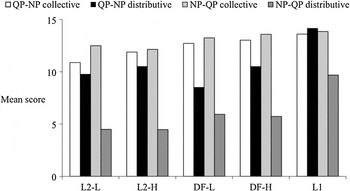
There were four learner groups in Berent et al. (Reference Berent, Kelly and Schueler-Choukairi2009) and one control group of hearing L1 speakers of English (L1). There were two participant groups of hearing L2 learners: the L2-L group with lower overall English proficiency and the L2-H group with higher overall English proficiency. Parallel to these groups were two groups of deaf learners (DF) with lower and higher overall English proficiency: the DF-L group and the DF-H group, respectively. Results of the study confirmed the predicted success order in (6); this is illustrated in Figure 1. The figure also shows that even the L1 group accepted fewer NP-QP distributive interpretations of sentences like (2b) in view of the computational cost associated with derivations involving QR (Reinhart, Reference Reinhart2006).
Acceptance of collective and distributive depictions of universal quantifier sentence types by group, based on the results of Berent et al. (Reference Berent, Kelly and Schueler-Choukairi2009).

In addition to assessing semantic knowledge of universally quantified English sentences, the ESPT-Q was designed to assess pragmatic factors that affect sentence-picture matching when a sentence is underinformative relative to its depicted discourse context. In the child L1 acquisition literature, children have long been observed to reject a universally quantified sentence as a match to a depiction containing an extraneous uninvolved entity. For example, children often reject a sentence like (2a), Every boy is climbing a tree, as a match to a distributive depiction showing all members of a set of boys (e.g., four boys), each climbing a distinct tree, when there is an additional fifth tree not being climbed. Despite the presence of the extra tree, the sentence is still true in that context, because every boy is, in fact, climbing a tree. The claim has been that children, unlike adults, require exhaustive pairing between the members of the agent set and the members of the object set, also described as a symmetry preference (argued to involve quantifier spreading; Philip, Reference Philip1995). The study of this phenomenon has resulted in diverse explanations implicating methodological, maturational, cognitive, or linguistic factors (see summary discussions in Berent et al., Reference Berent, Kelly, Porter and Fonzi2008; Berent et al., Reference Berent, Kelly and Schueler-Choukairi2009; Rakhlin, Reference Rakhlin, Takita and Fuji2007).
More recent research has established that a symmetry preference is not limited to child L1 acquisition but is observed in picture tasks that assess knowledge of universally quantified English sentences by both deaf and hearing students at the middle school, high school, and college levels (Berent et al., Reference Berent, Kelly, Porter and Fonzi2008) as well as by adult L2 learners and L1 speakers (Berent et al., Reference Berent, Kelly and Schueler-Choukairi2009; Brooks & Sekerina, 2005/2006; DelliCarpini, Reference DelliCarpini, Liceras, Zobl and Goodluck2003). The explanation of the observed symmetry preference in Berent et al. (Reference Berent, Kelly and Schueler-Choukairi2009) expanded on Rakhlin’s (Reference Rakhlin, Takita and Fuji2007) analysis of the same effect in her studies of young children. Rakhlin’s novel explanation drew on Schwarzschild’s (Reference Schwarzschild2002) semantic theory of singleton indefinites. As noted, any singular indefinite NP may be freely restricted to a singleton set, where the NP denotes one specific entity. Rakhlin argued that the symmetry preference appeared under pragmatic pressures when a child’s visual attention was diverted to a depicted extra entity (e.g., an extra tree) and thus prompted the child to interpret the singular indefinite NP in the target sentence—for example, a tree in sentence (2a)—as a singleton indefinite referring to the extra tree itself. In such a case, every boy is not climbing a specific tree, and the sentence-picture match is legitimately rejected. Rakhlin attributed this phenomenon to a lack of pragmatic flexibility in managing contextual information in discourse.
Berent et al. (Reference Berent, Kelly and Schueler-Choukairi2009) argued that older learners whose course of English acquisition has been constrained by restricted input access are also challenged in their management of discourse-pragmatic factors such that they too sometimes prefer exhaustive pairing between members of the agent and object sets. This can now be understood on principled grounds as resulting from a singleton effect. The present study further explores and explains the symmetry preference in adult learners’ and L1 speakers’ interpretations of numerically quantified sentences.
Properties of Numerically Quantified Sentences
English Numeral Quantifier Sentences. Like the analogous QP-NP sentences in Berent et al. (Reference Berent, Kelly and Schueler-Choukairi2009), Num-NP sentences like (1a), containing a Num QP followed by a singular indefinite NP, also typically permit a collective and a distributive interpretation as in (7).
(7) a. Three guys |G| = 3are carrying a box |B| = 1.
b. Three guys |G| = 3are carrying a boxx.
Following the same minimalist assumptions as in the universal quantifier study, including Schwarzschild’s (Reference Schwarzschild2002) singleton indefinites analysis, when a box is restricted to a singleton set as in derivation (7a), it is free from the scope effects of the Num QP three guys. Accordingly, (7a) is the collective derivation, indicating that three guys are carrying one specific box. When a box is not restricted to a singleton set, as in derivation (7b), a box is a variable within the scope of three guys and therefore provides the distributive interpretation in which three guys are carrying different boxes.
Unlike universally quantified NP-QP sentences, NP-Num sentences like (1b) permit a collective derivation as in (8a) but not a distributive derivation as in (8b).
(8) a. A mother |M| = 1is bathing three babies |B| = 3.
b. *[[three babies|B| = 3]i [a motherx] is bathing ti].
Collective derivation (8a), in which a mother is a singleton indefinite, is interpreted to mean that one specific mother is bathing all three members of a set of three babies. In view of the lexical-semantic properties of Num QPs, the distributive derivation of sentence (1b) is not available. If it were, it would require QR as shown in (8b), resulting in a mother being within the scope of three babies. Such a derivation would be interpreted to mean that three mothers are each bathing one member of a set of three babies.
Numeral Quantifier Sentences in Other Languages. Numeral quantifiers have different properties across languages, but in a given language there are typically ambiguous and unambiguous Num QP sentence types. Like English, ASL has such options. However, because ASL is a visual-spatial language, it employs many morphosyntactic processes that appear to have no correlates in spoken languages. For example, ASL marks agreement through the manual movement of a sign toward or from referents set up in the signing space or through the use of indexical pointing or eye gaze toward spatially designated referents (Fischer & van der Hulst, Reference Fischer, van der Hulst, Marschark and Spencer2003). Additionally, ASL uses nonmanual grammatical mechanisms involving head position, body position, eyebrow and forehead position, eye gaze, nose position, and the mouth, tongue, and cheek. These mechanisms are layered in that they sometimes co-occur simultaneously or overlap (Wilbur, Reference Wilbur, Emmorey and Lane2000).
The ASL sentence in (9a) from Petronio (Reference Petronio, Bach, Jelinek, Kratzer and Partee1995) can have a collective interpretation as in (9b) or a distributive interpretation as in (9c). The capitalized words in (9a), and henceforth, represent manual ASL signs, and the line above CAR and the letter t indicate eyebrow raising during the signing of CAR, grammatically marking CAR as the sentence topic (t).
(9) a.
 TWO STUDENT BUY.
b. Two students together bought a car.
c. Two students each bought a car.
 TWO STUDENT BUY.
As with an English sentence like (1a), Three guys are carrying a box, the intended interpretation is determined by discourse context. As the translations illustrate, languages can specify an explicit meaning through the use of adverbials (e.g., together in 9b) or floating quantifiers (e.g., each in 9c), or by other means. For example, ASL can also disambiguate Num QP sentences through the employment of its modality-specific morphological marking, as in sentence (10a), also from Petronio (Reference Petronio, Bach, Jelinek, Kratzer and Partee1995). The subscript a—marking both aSTUDENT and SHOWa—indicates morphological agreement between the verb and its (indirect) object.
a.
PICTURE ANN SHOWa – [AGR exhaustive].b. Ann showed each student the picture(s).
(10)
 PICTURE ANN SHOWa – [AGR exhaustive].
It is the exhaustive morpheme articulated in the signing of SHOW that unambiguously establishes a distributive interpretation for the sentence, as indicated in translation (10b). In (10a), the sign SHOW is articulated in the direction in which STUDENT has been set up in the signing space and with repeated and slightly sweeping movements, as if counting out the members of the set of students.
With regard to other spoken languages, Japanese, like English, is a language that has numeral phrases in which the numeral occurs within the Num QP, as in (11). Japanese, however, can also license floating numerals, which behave like floating quantifiers, as in (12), based on Kobuchi-Philip (Reference Kobuchi-Philip2007).Footnote 6
(11) a. San-nin-no gakusei-ga peepaa-o kaita.
3.cl.gen student.nom paper.acc wrote
b. [Three students] wrote a paper.
(12) a. Gakusei-ga san-nin peepaa-o kaita.
Student.nom 3.cl paper.acc wrote
b. *Students [three wrote a paper].
Sentence (11a), like its English analogue (11b), can receive either a collective or a distributive interpretation. However, sentence (12a), in which the floating numeral is actually within the scopal domain of the verb phrase (ungrammatical in English as in 12b), typically receives a distributive interpretation.
Issues of L1 Transfer
Despite any crosslinguistic typological variation, the present study was not designed as an investigation of the role of L1 transfer in the L2 acquisition of numerically quantified English sentences. It is, rather, an investigation of whether—and, if so, the extent to which—issues of derivational economy and complexity impose observable pressures on the computational system of human language under the constraints of non-L1 acquisition. The target structures are simple subject-verb-object (SVO) sentences, for which both a collective and a distributive derivation are anticipated. However, as noted for a NP-Num sentence like (1b), its distributive derivation is illicit, as indicated in (8b). Because the L2 learners and DF learners who participated in this study, given their proficiency levels, know that English has SVO word order, this study simply assesses their interpretive knowledge of syntactically unexceptional sentences containing Num QPs and indefinite NPs in subject and object positions (relative to the interpretations of hearing L1 English speakers).
Even so, transfer effects can show up in subtle ways in almost any domain of the L2 (Odlin, Reference Odlin, Doughty and Long2003). Therefore, this study includes a crosscheck of L2 learner performance by L1 background to see if there are any striking group differences suggestive of a subtle transfer effect. With respect to ASL, however, finding transfer effects among any deaf participants who might have native or nativelike ASL proficiency is confounded by two factors. First, the type of ASL a given individual uses will vary in the extent to which it reflects native ASL properties (e.g., it could be more English-driven signing or could be contact signing, which is a bilingual blend of ASL and English often used by deaf adults; see Lucas & Valli, Reference Lucas and Valli1992). Second, with regard to modality-specific morphological processes of native ASL, such as the articulation of the exhaustive morpheme on the verb in sentence (10a), it is simply not known how such properties would be transferred and in what form they may manifest themselves in an auditory-spoken language.Footnote 7
METHOD
Participant Groups
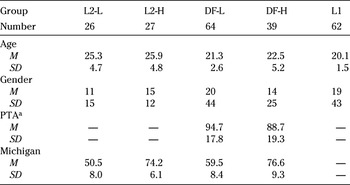
The present study involved five participant groups of students (the same participants whose performance was reported in Berent et al., Reference Berent, Kelly and Schueler-Choukairi2009) at the Rochester Institute of Technology (RIT) in Rochester, New York. There were two groups of hearing L2 learners taking English courses in RIT’s English Language Center, two groups of DF RIT students, and one control group of hearing RIT students who were L1 speakers of English. The L2 and DF learner groups were distinguished according to overall English language proficiency (L = lower, H = higher) as assessed by the Michigan Test of English Language Proficiency (2003). The L2-L and L2-H groups’ mean Michigan test scores (and standard deviations) were 50.5 (8.0) and 74.2 (6.1), respectively. The DF-L and DF-H groups’ Michigan test scores were 59.5 (8.4) and 76.6 (9.3), respectively. The DF-L group included students enrolled in—no higher than—associate’s degree programs at the National Technical Institute for the Deaf (NTID), one of RIT’s eight colleges. The DF-H group included NTID students enrolled in bachelor’s degree programs in RIT’s other seven colleges. The hearing L1 group included students also enrolled in bachelor’s degree programs at RIT.
A total of 53 L2 learners of English represented 12 different L1 backgrounds. There were 12 native speakers of Korean, 8 native speakers of Arabic, 7 native speakers of Turkish, 7 native speakers of Japanese, 5 native speakers of Chinese, 5 native speakers of Spanish, 5 bilingual speakers of Kazakh and Russian, 1 bilingual speaker of Tibetan and Chinese, and 1 native speaker of each of the following languages: German, Italian, and Tamil. Table 1 provides available demographic information for the five participant groups, including number of participants per group, mean age, and gender distribution. For the DF participant groups, the table also provides the mean pure tone average (PTA) hearing loss in the better ear in decibels (dB) measured at 500, 1,000, and 2,000 Hz (Levitt, Reference Levitt, Wang, Reynolds and Walberg1989). Of the four standard categories of hearing loss (mild, moderate, severe, profound), the mean PTA values reported in Table 1 reflect severe to profound deafness. Severely and profoundly deaf individuals rely largely on vision for language processing and thus represent learners who are more likely to have experienced the greatest acquisitional restriction on access to English spoken-language input.
Demographic information on participant groups

Note
PTA = pure tone average; Michigan = Michigan Test of English Language Proficiency (2003).
a Hearing loss measured in the better ear at 500, 1,000, and 2,000 Hz (Levitt, Reference Levitt, Wang, Reynolds and Walberg1989).
English Sentence Picture Task–Quantifiers
The ESPT-Q (Berent et al., Reference Berent, Kelly, Porter and Fonzi2008) was developed to assess students’ knowledge of English quantifier sentences containing the universal quantifiers each, every, and all (10 items each) as well as sentences containing Num QP (10 items). There were an additional 10 filler items that contained only NPs and no universal or Num QPs. The picture task contained a total of 50 items and 250 depictions. Four randomized versions of the task were developed to address any potential order effects among task items. The present study reports and analyzes participants’ performance on the 10 Num QP items. Half of these items target Num-NP sentences and half target NP-Num sentences.
Each item on the ESPT-Q consists of a target sentence accompanied by five pictures that either do or do not represent a possible depicted discourse compatible with the meaning of the sentence. Each of the five pictures within an item requires a separate judgment. Participants received simplified instructions that explained the task format and procedures. They were instructed to read an item’s target sentence, study the five accompanying pictures, and circle either no under any picture that they felt did not represent a possible meaning of the target sentence or yes under any picture they felt did represent a possible meaning of the sentence.
The Appendix contains ESPT-Q items targeting the Num-NP sentence type (as in [1a]) and the NP-Num sentence type (as in [1b]), along with their associated picture sets. These items and sentence types are referred to by Roman numeral designations listed in the Appendix. Specific depictions in an item will be referred to by the Roman numeral and letter designation of the picture (picture I.C, picture II.E, etc.). It is important to note that the words no and yes that appear vertically under each picture on the ESPT-Q are not shown in the Appendix. Because the results of this study are discussed in conjunction with some of the results of Berent et al. (Reference Berent, Kelly and Schueler-Choukairi2009), items targeting QP-NP and NP-QP sentences in that study are also included in the Appendix as item types III and IV, respectively.
Num-NP Depictions. With respect to item type I in the Appendix, the five depiction types to be considered as possible matches to the meaning of the target Num-NP sentence are listed in (13). The response no or yes, to the right of each depiction type, indicates the correct response; that is, whether or not that depiction is a possible match to the target sentence.
(13) I.A Distributive Yes
I.B Insufficient No
I.C No object No
I.D Extra object Yes
I.E Collective Yes
The no-object depiction, as in I.C, is not a possible match to the target sentence because there are three guys but no boxes. A participant’s no response to this match indicates fundamental knowledge of the semantics of Num-NP sentences—namely, the requirement that the depicted discourse must contain members of both the agent set and the object set. The insufficient depiction I.B, showing two guys carrying a box and a third guy not carrying a box, further tests semantic knowledge of the target sentences in that, specifically, no fewer than the number of agents designated by the Num QP must participate in the event described by the sentence. The collective depiction I.E shows three guys carrying one unique box, an acceptable interpretation of the sentence. The distributive depiction I.A, which shows three guys, each carrying his own separate box, is also an acceptable interpretation. Finally, the extra-object depiction I.D also represents an acceptable distributive interpretation, but there is an additional member of the object set, in this case a fourth box.
NP-Num Depictions. The five depiction types for NP-Num item type II in the Appendix are listed in (14).
(14) II.A Superfluous Yes
II.B Collective Yes
II.C No object No
II.D Extra object Yes
II.E Distributive No
The different semantic properties of NP-Num sentences, relative to Num-NP sentences, motivate a somewhat different set of depiction types. The no-object depiction II.C shows no members of the object set of babies and thus is not an acceptable match. Unlike the Num-NP distributive interpretation, the NP-Num distributive interpretation is underivable for ESPT-Q items, such that II.E—showing three mother-baby pairs—is not a possible match. The acceptable collective depiction II.B shows one mother bathing three babies. The extra-object depiction II.D is also a collective depiction but includes an extra member of the object set, a baby, not being bathed. A yes response is permitted because the uninvolved extra object does not affect the truth value of the sentence-picture match. Finally, the superfluous depiction II.A shows one mother bathing three babies but also an additional mother-baby pair. Inclusion of this depiction type provided balance between Num-NP and NP-Num items in that all item sets allow two no responses and three yes responses, and it assumes the possibility of a yes response on the basis of the compatible portion of a superfluous depiction (e.g., the one mother–three baby pairing in II.A).
Hypotheses
The same factors that contribute to relative derivational economy and learnability predictions for universally quantified sentences in English, as in (6), similarly define learnability predictions for Num QP sentences as well. With respect to collective and distributive derivations, the Num-NP collective derivation (7a) and the NP-Num collective derivation (8a) involve singleton indefinites, interpreted in their surface position, and Num QPs of fixed cardinality. In contrast, in the Num-NP distributive derivation (7b), the indefinite singular NP is not a singleton indefinite and accordingly receives its plural set restriction within the scope of the Num QP. This introduces added derivational complexity. Consequently, learner judgments should conform to a learnability order parallel to that of universally quantified sentences: Num-NP collective = NP-Num collective > Num-NP distributive (see (6a)–(6b)). The semantic properties of Num QPs are such that a distributive derivation of an NP-Num sentence is underivable.
In addition to hypotheses related to derivational economy, it is argued that participants’ performance on extra-object depictions will activate discourse-pragmatic factors. With respect to universally quantified sentences, the results of Berent et al. (Reference Berent, Kelly and Schueler-Choukairi2009) revealed that the four learner groups (and to some extent the L1 English group) accepted fewer distributive depictions containing extra entities than distributive depictions with no extra entities. Specifically, they accepted fewer extra-object depictions like III.D than depictions like III.B and fewer extra-agent depictions like IV.E than depictions like IV.D. The authors attributed this performance pattern to the singleton effect. When attention is diverted to the extra entity, the extra object in III.D and the extra agent in IV.E, the singular indefinite NP in the sentence is interpreted as a singleton indefinite referring to that extra entity. The sentence-picture match thus receives a no response.
With respect to Num QP sentences, the singleton effect can explain any observed higher rejection of Num-NP extra object depictions, because the distributive extra-object depiction I.D contains an extra box, whereas the basic distributive depiction I.A does not. However, the singleton effect cannot be invoked to explain any observed greater rejection of a NP-Num extra-object depiction such as II.D. The reason for this is that the NP-Num extra-object depiction is associated with the collective depiction of sentence type II rather than a distributive depiction; that is, the extra baby in picture II.D is an entity associated with the members of the set of three babies that a mother is bathing. Because three babies in the target sentence is a plural phrase and not a singular indefinite NP, there is no option for a singleton restriction referring to the extra object.
The assumptions guiding the hypotheses are that, relative to learners, hearing native speakers of English will (a) exhibit greater overall knowledge of numerically quantified English sentences, (b) be less influenced by the pressures of derivational economy on sentence interpretation, and (c) be less derailed by the influences of discourse-pragmatic factors that presumably suppress the acceptance of extra-entity depictions. In the context of these assumptions, the study predicts the following:
1. The L1 group will outperform the L2 and DF learner groups in the overall interpretation of English Num QP sentences.
2. The L2-H group will outperform the L2-L group and the DF-H group will outperform the DF-L group in the overall interpretation of English Num QP sentences.
3. All participant groups will reject sentence-picture matches with (a) Num-NP and NP-Num no-object depictions and (b) Num-NP insufficient depictions.
4. In association with relative derivational economy, (a) the learner groups will accept more Num-NP and NP-Num collective interpretations than Num-NP distributive interpretations, (b) the L2-H and DF-H groups will accept relatively more Num-NP distributive interpretations than the L2-L and DF-L groups, respectively, and (c) the L1 group will be less influenced by these economy pressures than the L2 and deaf learner groups.
5. All participant groups will fully reject the underivable NP-Num distributive interpretations.
6. With the discourse-pragmatic resources available to hearing speakers of English, the L1 group will accept more extra object depictions than the L2 and DF learner groups. However, each of the learner groups (a) will accept more Num-NP basic distributive depictions than extra-object (distributive) depictions, which are vulnerable to the singleton effect, but (b) will exhibit equal acceptance of NP-Num basic collective depictions and extra-object (collective) depictions, to which the singleton effect is irrelevant.
7. The L1 group will accept more NP-Num superfluous depictions than the L2 and DF learner groups. However, to whatever extent NP-Num extra-object depictions are accepted, the learner groups will accept more extra-object depictions than superfluous depictions, which have contextual elements confounding truth value judgments for matching these depictions to target sentences.
ANALYSES AND RESULTS
Knowledge of Fundamental Semantic Properties and Economy Pressures
Fundamental Properties. Hypotheses 1 and 2 were tested using a one-way ANOVA to compare each participant group’s total score on the Num QP items on the ESPT-Q. The results of the total score ANOVA yielded a significant main effect for group, F(4, 213) = 16.52, p < .0001. The total mean scores (and standard deviations) of the five participant groups were as follows, out of a maximum total score of 50: L2-L, 38.7 (6.1); L2-H, 39.0 (6.2); DF-L, 36.0 (6.3); DF-H, 39.3 (6.2); L1, 44.3 (5.0). Results from post hoc pair-wise comparisons using Scheffé’s F (Scheffé, Reference Scheffé1953) fully supported the first hypothesis and revealed that the L1 group outperformed the L2 and DF learner groups (all p < .01). Hypothesis 2, based on the learners’ relative English language proficiency, was not supported (just as it was not in Berent et al., Reference Berent, Kelly and Schueler-Choukairi2009). The post hoc comparisons showed no difference in performance on the basis of overall English proficiency in the L2 and the DF participant groups and are indicative of statistically equivalent performance across all four learner groups. Thus, at the proficiency levels assessed, higher overall English proficiency did not provide an advantage in overall success in the interpretation of the targeted Num QP sentences. The total scores compared in this ANOVA reflected the extent to which participants accepted all possible interpretations of each target sentence and rejected all unavailable interpretations [see (13) and (14)].
Hypothesis 3 was addressed in two one-way ANOVAs: one that targeted performance by group on the no-object depictions—Group (5) × No Object (10 depictions)—and the other for performance by group on Num-NP insufficient depictions—Group (5) × Insufficient (5 depictions). As predicted, the no-object ANOVA revealed no significant differences between groups, F(4, 213) = 0.61, p = .659. The mean score of each group was either exactly or rounded to the maximum score of 10. In a similar manner, the insufficient ANOVA revealed no significant differences between groups, F(4, 213) = 1.80, p = .130. The mean score of each group was either exactly or rounded to the maximum score of 5. Thus, in rejecting no-object and insufficient depictions, participants affirmed their fundamental knowledge that the interpretation of the targeted Num QP sentences requires the involvement of the agents and objects mentioned and must involve no fewer members of the agent set than designated by the cardinality of the Num QP.
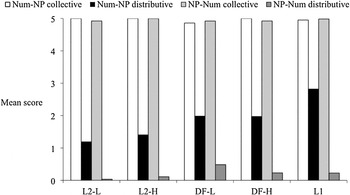
Economy Pressures. Hypotheses 4 and 5 were assessed with an ANOVA with repeated measures on the four dependent variables comparing group performance on the basic collective and distributive depictions (i.e., no extra-entity depictions) of the two sentence types: Group (5) × Interpretation (Num-NP collective, Num-NP distributive, NP-Num collective, NP-Num distributive). Even though this collective-distributive repeated measures ANOVA yielded significant main effects for both group and interpretation, a significant interaction for Group × Interpretation, F(12, 639) = 4.33, p < .0001, indicates that the groups performed differentially on the interpretation of the four depictions. The results must therefore be discussed within the context of this interaction. The means associated with the interaction are plotted in Figure 2. As illustrated, the L2 and DF learner groups accepted more Num-NP and NP-Num collective depictions than Num-NP distributive interpretations in support of hypothesis 4(a). However, hypothesis 4(b) was not supported: Higher overall English proficiency among the learners did not facilitate acceptance of the less economical Num-NP distributive interpretations. Regarding hypothesis 4(c), the L1 group was less influenced by economy pressures than the learners, as predicted. However, it is clear that economy pressures also influenced the L1 group, as apparent in their low preference for the Num-NP distributive interpretations.
Acceptance of collective and distributive depictions of Num-NP and NP-Num sentence types by group.

Figure 2 also reveals that hypothesis 5 was fully supported. All participant groups appropriately exhibited a virtual total rejection of the NP-Num distributive interpretations, which, if derivable, would require computationally costly QR. Such robust rejection of this derivation is a strong indication that learners come to the task with knowledge of the universal properties of Num QP sentences, including the properties that typically bar derivations like (8b).
Management of Depicted Discourses with Extraneous Entities
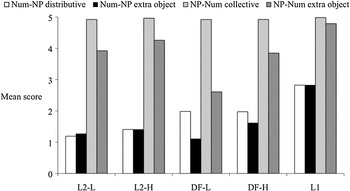
Extra-Object Depictions. Hypothesis 6, pertaining to the relative acceptance of basic and extra-object depictions, was tested using a Group (5) × Extra Object (Num-NP distributive, Num-NP extra object, NP-Num collective, NP-Num extra object) ANOVA with repeated measures on the four extra-object dependent measures. The repeated measures ANOVA showed significant main effects for both group and extra object; however, a significant interaction for Group × Extra Object, F(12, 213) = 7.26, p < .0001, requires that the findings be discussed within the context of that interaction, which is plotted in Figure 3. The second and fourth bars in each group cluster in the figure reveal that, cumulatively, the L1 group accepted more extra-object depictions overall than the L2 and DF learner groups in support of the first prediction of hypothesis 6. With respect to hypotheses 6(a) and 6(b), the results were unexpected. With the exception of the DF learner groups—but most notably the DF-L group—participants did not accept more basic than extra-object distributive depictions. Most unanticipated is the fact that each learner group, again most notably the DF-L group, accepted more basic than extra-object collective depictions, a disparity that the singleton effect cannot explain. These results are examined in the Discussion section.
Acceptance of basic and extra-object depictions of Num-NP and NP-Num sentence types by group.

Superfluous Depictions. Finally, in testing hypothesis 7, a Group × Entity (extra object, superfluous) ANOVA with repeated measures produced significant main effects for both group and entity, but the findings have to focus on the significant interaction for Group × Entity, F(4, 213) = 6.31, p < .0001. The following mean scores (maximum score = 5) reflect the participant groups’ acceptance of NP-Num extra-object depictions: L2-L, 3.9; L2-H, 4.3; DF-L, 2.6; DF-H, 3.8; L1, 4.8. The following mean scores reflect their acceptance of superfluous depictions: L2-L, 2.4; L2-H, 2.2; DF-L, 1.1; DF-H, 2.2; L1, 4.3. These mean scores indicate a confirmation of hypothesis 7. First, it is easy to see from these group means that, overall, the L1 group accepted many more superfluous depictions than the L2 and DF learner groups did. Second, the means show that, in each learner group, participants accepted many more extra-object depictions than superfluous depictions. What is also noteworthy is the fact that the L2-L, L2-H, and DF-H groups were roughly equivalent in their relative acceptance of the extra-object and superfluous depictions. Once again, the DF-L group stands out with its much lower relative acceptance of the two depiction types.
DISCUSSION
Fundamental Knowledge and Economy Pressures
With respect to overall performance on the ESPT-Q, the results revealed that the L1 group, as hearing L1 speakers of English, exhibited greater knowledge of numerically quantified English sentences and interpretive flexibility, as predicted, compared to the hearing L2 learner and DF learner groups. Nevertheless, with group mean Michigan test scores ranging from 50.5 to 76.6, the four learner groups demonstrated relatively high and statistically equivalent interpretive knowledge of the targeted sentence types. As with their knowledge of universally quantified English sentences (Berent et al., Reference Berent, Kelly and Schueler-Choukairi2009), the L2 and DF learner groups demonstrated firm knowledge of the semantic properties of Num QP English sentences, irrespective of English proficiency. All participant groups appropriately rejected sentence depictions that do not include both the agent and object sets referred to in the target sentences and depictions that show fewer set members than denoted by the cardinality of the Num QP.
With respect to relative performance on collective and distributive interpretations (Figure 2), all participant groups fully accepted the collective interpretations of Num-NP and NP-Num sentences. As predicted, these interpretations were readily obtainable because they exhibit the greatest economy of the four relevant derivations. Also as predicted, the Num-NP distributive interpretation was more difficult to obtain by virtue of its greater derivational complexity. Finally, all groups appropriately rejected the most derivationally costly (requiring QR) and typically unavailable NP-Num distributive interpretation. The L2 and DF learner groups’ wholesale rejection of this interpretation reflects full knowledge of the universal lexical and semantic properties that set the NP-Num distributive derivation apart from the others.
These results provide clear evidence that hearing L2 learners and DF learners, despite their restricted access to the target language input, come to the acquisition task with knowledge of the universal constraints on target language interpretive options, in this case constraints on the interpretation of English sentences containing a Num QP and a singular indefinite NP. Such subtle grammatical knowledge could not have been learned from accessible input alone or from classroom instruction. The fact that higher overall English proficiency did not provide learners with an advantage in the interpretation of less economical sentence derivations indicates that hearing L2 learners and DF learners within the assessed proficiency level ranges bring equivalent UG knowledge to the acquisition task but possess interlanguage grammars still similarly constrained by economy pressures at these levels. Thus, along with the results of Berent et al. (Reference Berent, Kelly and Schueler-Choukairi2009), the results of this study further explain the striking parallels observed in the interlanguage development of two—otherwise seemingly different—learner populations (Berent, Reference Berent, Ritchie and Bhatia2009). Despite the different circumstances that contribute to the input restriction, Figures 1 and 2 clearly illustrate the acquisitional parallels that emerge in these learners from the interaction of UG, specific lexical knowledge, and economy pressures.
Performance by L1 Background
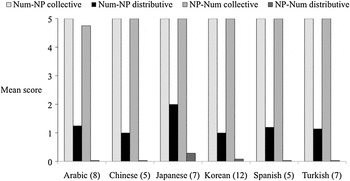
Although this study was not intended to assess L1 transfer effects, it is informative to note the performance results of the hearing L2 learners clustered by L1. There are insufficient numbers of subjects per L1 group for statistical group comparisons. Nevertheless, the descriptive results illustrated in Figure 4 reveal parallel performance across all L1 groups. Mean acceptance of the four targeted derivations of Num-NP and NP-Num sentences are illustrated for each L1 group that consisted of five or more participants. These acceptance patterns reveal full acceptance by each group of the most economical collective derivations, low acceptance of the less economical Num-NP distributive derivations, and full rejection of the illicit NP-Num distributive derivation. These patterns thus match the patterns exhibited by the L2-L and L2-H groups as a whole and provide no rationale for suspecting differentiating L1 effects.
Descriptive data by L1 background on the acceptance of collective and distributive depictions of Num-NP and NP-Num sentence types.

Sentence Interpretation and Depicted Extraneous Entities
In the present study, overall performance on extra-entity depictions was similar to performance on extra-entity depictions in Berent et al. (Reference Berent, Kelly and Schueler-Choukairi2009). In both studies, the L1 group demonstrated a greater ability than the learner groups to manage the pragmatic factors that depicted extraneous entities introduce. The L1 group was better able to suppress the undermining influence of the extraneous entities that more frequently led learners to reject otherwise semantically acceptable sentence-picture matches. As noted in the universal quantifier study, the higher rejection of extra-object than basic distributive QP-NP depictions and the higher rejection of extra-agent than basic distributive NP-QP depictions were attributed to the singleton effect. If attention is drawn to a salient uninvolved extra member of a depicted set, a participant can freely relate the single indefinite NP in the target sentence to the extra set member and thus interpret the NP as a singleton indefinite (Rakhlin, Reference Rakhlin, Takita and Fuji2007; Schwarzschild, Reference Schwarzschild2002).
In the present study, lower acceptance of Num-NP extra-object depictions than Num-NP basic distributive depictions can also be attributed to the singleton effect. However, the significant Group × Extra Object interaction—illustrated in Figure 3—revealed that, in addition to the L1 groups’ higher performance, the L2 groups accepted equivalent numbers of the two depiction types. In contrast, the DF learner groups, most notably the DF-L group, did in fact accept relatively fewer Num-NP extra-object than basic distributive depictions. An examination of Figure 3 shows that the differential performance in the DF-L group resulted from their higher acceptance (relative to the L2 groups) of the basic distributive depictions. Thus, it is likely that the pressures of derivational economy and the strength of the singleton effect converged for the L2 groups in view of the general difficulty of obtaining a Num-NP distributive interpretation (even for the L1 group) but that the performance pattern of the DF-L group verifies that both factors are still operative in the interpretation of Num-NP sentences. The singleton indefinites account provides not only a principled explanation for L2 and DF learners’ interpretations of sentences that become underinformative in certain discourse contexts but also a unified explanation for the phenomenon now observed across ages and among different types of learners including, on occasion, L1 speakers.Footnote 8
What still requires an explanation is the L2 and DF learner groups’ lack of equivalent acceptance of NP-Num basic collective and extra-object depictions, contra the predictions of hypothesis 6. Furthermore, Figure 3 reveals that the DF-L group stood out from the other learner groups in its acceptance of only half as many of the extra-object depictions as basic collective depictions. Because the extra-object depiction shows an uninvolved member of the set described by the plural Num phrase, the singleton effect cannot explain this phenomenon.
Other Discourse-Pragmatic Factors
Scalar Implicatures. With respect to the communicative principles of rational discourse, all ESPT-Q target sentences are underinformative in their extra-entity contexts; that is, they all violate Grice’s (Reference Grice, Cole and Morgan1975, Reference Grice1989) maxim of quantity (or neo-Gricean alternatives, as in Carston, Reference Carston and Kempson1988; Horn, Reference Horn and Shiffrin1984). In accordance with the maxim of quantity, a communicator expects an utterance to be neither underinformative nor overinformative relative to the purposes of its discourse. ESPT-Q sentences are underinformative in their extra-entity contexts, because they make no reference at all to the salient extra entity. Relative to depiction II.D, for example, an appropriately informative sentence would be, A mother is bathing three of four babies. Directly associated with the maxim of quantity are scalar implicatures (Gazdar, Reference Gazdar1979; Horn, Reference Horn and Shiffrin1984; Levinson, Reference Levinson2000), which are inferences derived from the literal meaning of an utterance in the determination of the implicated meaning of that utterance—that is, the individual’s intended meaning. Scalar implicatures are formed on the basis of the relative informational strength of lexical items that form natural implicational scales, such as certain quantifiers and cardinal numerals (the very focus of the present study and the associated universal quantifier study).
For example, 〈all, most, many, some〉 consists of scalar quantifiers that range in informational strength from strongest (all) to weakest (some). Each quantifier on the scale entails all those to its right. The use of a weaker scale item, in accordance with the maxim of quantity, implies that the speaker-writer was not in a position to use a stronger, more informative scale item or else would have done so. Thus, most of the boys are climbing a tree induces the scalar implicature that not all of the boys are climbing a tree. Because, however, scalar implicatures reflect not the semantic meaning of a sentence but rather its pragmatically implicated meaning, they can be canceled (or defeated) as the facts of a discourse warrant. The extension in sentence (15a) illustrates the cancellation of the implicature not all of the boys are climbing a tree.
(15) a. Most of the boys are climbing a tree; in fact, all of the boys are climbing a tree.
b. Most of the boys are climbing a tree; *in fact, some of the boys are climbing a tree.
Comparison of (15a) and (15b) illustrates that the cancellation of a scalar implicature occurs in the direction of greater, not weaker, informational strength.
The scalar properties of numerals introduce different factors that are directly relevant to the lower acceptance of NP-Num extra-object depictions than basic collective depictions. Numerals obviously form a natural scale, 〈. . . four, three, two . . .〉, in which four entails three and is therefore informationally stronger than three, and so on. Under the Gricean view of scalar implicatures associated with numerals (e.g., Levinson, Reference Levinson2000), a numeral has a lower bound at least n semantic interpretation that pragmatically induces an upper bound at most n scalar implicature. The at least n semantic meaning together with the at most n scalar implicature is what provides the exactly n interpretation of the Num phrase. Thus, type II sentence (16a) literally means, as indicated by the bracketed content, that a mother is bathing at least three babies. Because this sentence is normally perceived as the speaker’s strongest utterance consistent with the facts of the discourse, it induces a scalar implicature expressible as in (16b) or (16c). The result is an exactly n (i.e., exactly three babies) interpretation of the sentence.
(16) a. A mother is bathing [at least] three babies.
b. A mother is bathing at most three babies.
c. A mother is not bathing four babies.
d. A mother is bathing three babies; in fact, she is bathing four (*two).
However, because scalar implicatures are cancellable, the extension to the sentence in (16d) cancels the at most implicature and yields an informationally stronger utterance (three → four). The salience of the fourth baby in II.D understandably motivates this cancellation on pragmatic grounds, leading to inferred interpretations such as in (17).
(17) a. A mother is bathing four babies but hasn’t gotten to the fourth baby yet.
b. A mother is going to bathe [a total of] four babies.
This discourse-pragmatic phenomenon yields inferences that render a type II sentence false in its extra-object context, resulting in a no response to the sentence-picture match.
Although the rejection of type I, III, and IV sentences in their extra-entity contexts and the rejection of type II sentences in their extra-entity contexts may appear to be guided by different pragmatic influences, they actually derive from the same pragmatic source—a sentence that is underinformative in its discourse context. With sentence types I, III, and IV, a participant who rejects the sentence-picture match inferentially makes the sentence more informative in its extra-entity context by referentially incorporating the extraneous entity into the discourse through a singleton indefinite restriction of the indefinite NP. With sentence type II, the participant likewise makes the sentence more informative by referentially incorporating the extraneous entity into the discourse, although in this case, via the cancellation of a scalar implicature. The greater activation of these processes in the L2 and DF learner groups suggests that they are much more swayed by discourse-pragmatic influences, hence their greater propensity to accept less plausible interpretations relative to hearing native speakers.
Relevance of Superfluous Depictions.With respect to the learners’ greater acceptance of NP-Num collective depictions than extra-object depictions and greater acceptance of extra-object depictions than superfluous depictions (hypothesis 7), both the extra-object and superfluous depictions render the target sentences underinformative in their contexts. The superfluous depictions, however, do so in a manner that produces contradictory truth values for the target sentences. Whereas a mother as shown in depiction II.A (bottom right) is indeed bathing three babies, a mother (top left) is not bathing three babies, by virtue of bathing only one baby. Although space limitations preclude a detailed overview of relevance theory (Sperber & Wilson, Reference Sperber and Wilson1995; Wilson & Sperber, Reference Wilson and Sperber2002), this approach to rational discourse provides insight into this performance pattern.
Relevance theory maintains that the greater the positive cognitive effects an utterance and its context yield, the greater the relevance of the input. Additionally, the greater the processing effort expended, the lower the relevance of the input. From this perspective, to interpret sentence II in context II.B (collective) without any extraneous elements would produce greater cognitive effects with less processing effort than in context II.D (extra object), which contains an extraneous element. Yet interpretation of the sentence in context II.D requires less processing effort than in context II.A (superfluous), with its cognitively heavier extraneous elements and contradictions. The means reported for the Group × Entity interaction revealed that the L1 group had sufficient resources to manage these kinds of discourse-pragmatic demands and that the DF-L group was the least equipped to manage such demands.
Deference to Pragmatic Pressures. It might be assumed that the L2 and DF learners’ lower performance related to extra-entity and superfluous contexts and the DF-L group’s even lower performance are evidence of undeveloped or underdeveloped English pragmatic knowledge. This is in fact not the case. The learner groups, including the DF-L group, demonstrated the ability to form and cancel scalar implicatures associated with Num QPs. What their performance reveals, however, is that they have a lesser ability than hearing L1 speakers of English to manage discourse-pragmatic factors that affect sentence interpretations. The learners demonstrated a lower ability to suppress responses to intrusive pragmatic factors when a sentence is underinformative in its depicted discourse context.
Whereas the four learner groups exhibited equivalent semantic knowledge of the targeted Num QP sentences, the groups diverged in their management of pragmatic factors. The two L2 learner groups and the DF-H group were roughly equivalent in their acceptance of extra-object and superfluous depictions; however, the DF-L group accepted many fewer. For both Num-NP and NP-Num sentences, the DF-L group accepted only half as many extra-object depictions as the corresponding basic depictions. The numerical difference was much greater in the case of the NP-Num depictions. This performance pattern therefore suggests that the DF-L group was even more pressured than the other learner groups to cancel scalar implicatures associated with numerals, and thus inferred informationally stronger sentence meanings.
From an acquisitional perspective, the lower ability of the DF-L group to manage the discourse-pragmatic factors relevant to this study is curious. Although the two L2 groups’ equivalent performance on extra-entity depictions might be argued to result from the transfer of pragmatic knowledge from their L1s (see Kasper & Roever, Reference Kasper, Roever and Hinkel2005), the differential performance of the two DF learner groups cannot appeal to any relative facilitation of L1 pragmatic transfer. Additionally, if discourse-pragmatic knowledge is provided by UG, as suggested by Slabakova (Reference Slabakova2010), then the DF learner groups would be expected to exhibit equivalent performance on this basis as well.
This suggests that the DF-L group’s lower performance on extra-entity depictions may be attributable to nonlinguistic factors. In this regard, many of the same causes of deafness can also cause learning disabilities such as developmental dyslexia. In estimating the incidence of dyslexia in the deaf population to be as high as 17.5%, Samar, Parasnis, and Berent (Reference Samar, Parasnis and Berent2002) speculated that NTID deaf students at the lowest assessed reading levels may, in fact, be among those deaf students who also have dyslexia. Samar et al. confirmed this speculation in their assessment of deaf students’ visual system processing and their identification of visual system deficits associated with dyslexia in many of these low readers. Because the DF-L group in the present study will have included individuals at the lowest NTID reading levels, these individuals would have a greater likelihood than the DF-H participants of having dyslexia. It is therefore interesting to note that one of the characteristics of developmental dyslexia is a deficiency in executive functioning related to the inhibition of environmental distractors (Brosnan et al., Reference Brosnan, Demetre, Hamill, Robson, Shepherd and Cody2002). This prominent characteristic can explain an individual’s difficulty in suppressing distractors such as depicted extra objects during sentence comprehension, which thereby more readily activate discourse-pragmatic responses. The DF-L group’s lower acceptance of extra-object depictions in the present study may very well be linked to such neurobiological factors as these. This possible explanation has a principled basis but of course would need direct verification in future research.
CONCLUSION
The results of this study further support the conclusion (Berent, Reference Berent, Ritchie and Bhatia2009; Berent et al., Reference Berent, Kelly and Schueler-Choukairi2009) that the parallels observed between hearing L2 learners and deaf learners of English are a consequence of restricted access to input during acquisition, whether the cause is cognitive or auditory. Specifically, within the theoretical framework of the present study, parallels in the interpretation of Num QP English sentences were shown to arise from acquisitional pressures imposed by derivational economy on UG-guided semantic interpretation. Although the learners in this study were equally influenced by economy pressures irrespective of overall English proficiency, differences between the two DF learner groups in association with discourse-pragmatic factors suggested a potential neurobiological basis for this distinction. Research that pursues this possibility may lead to a better understanding of the wide gap between deaf students at the college level who enjoy a high level of academic success and those who do not (Cuculick & Kelly, Reference Cuculick and Kelly2003). The distinction may relate to how successfully a student is able to manage the pragmatic forces that influence the interpretation of academic discourse.
It is also important to note that this research was not designed to assess transfer effects and that, even if it were, the question of ASL-to-English transfer is confounded by factors associated with identifying a deaf learner’s L1 and understanding how transfer may occur cross-modally. Nevertheless, L1 transfer remains a prominent focus of L2 acquisition research. The multiple-picture sentence interpretation methodology employed in the present study (the ESPT-Q; Berent et al., Reference Berent, Kelly, Porter and Fonzi2008), in addition to its demonstrated value in verifying knowledge of universal constraints on acquisition, would also be expected to be a reliable tool to uncover L1 transfer effects in L2 acquisition. Learners’ patterns of relative acceptance of multiple interpretations for a given target sentence provide insights that one sentence–one picture designs are unable to provide. Wider use of this methodology in future research may provide a broader, more detailed, and more accurate picture of learners’ interlanguage development.Footnote 9
APPENDIX TARGETED SENTENCE TYPES AND PICTURE SETS ON THE ENGLISH SENTENCE PICTURE TASK–QUANTIFIERS
Sample Numeral Quantifier Items from the Present Study
I. Three guys are carrying a box.
II. A mother is bathing three babies.


Sample Universal Quantifier Items from Berent et al. (Reference Berent, Kelly and Schueler-Choukairi2009)
III. Every boy is climbing a tree.
IV. A woman is smelling every flower.