Clinical Implications
∙ There are important differences in the prevalence between males and females, with a significantly higher percentage of risk seen for several addiction tendencies among males.
∙ Significant correlations emerge between some personality determinants and certain addictive behaviors.
∙ Some forms of addiction are cumulative while others are mutually exclusive, with a gradual progression toward an “independent” psychopathological manifestation.
Introduction
Behavioral addiction refers to an intense desire to carry out an action perceived to increase well-being or, more often, one that alleviates internal distress, despite the individual’s awareness that such an action carries negative consequences. Psychologically, neurochemically, and socially, the repeated pattern of events characterizing addiction behaviors successfully mimics drug addiction and alcoholism.Reference Grant, Potenza, Weinstein and Gorelick1–Reference Griffiths3
Some authorsReference Blaszczynski and Nower4 have advocated classifying behavioral addictions as impulse control disorders (eg, pathological gambling), while othersReference El-Guebaly, Patten and Currie5 view them as a consequence of previous or co-existing disorders. In the new Diagnostic and Statistical Manual of Mental Disorders, Fifth Edition (DSM-5), gambling disorder has been included in the “Substance-Related and Addictive Disorders” chapter because of the increasing evidence that some behaviors activate the brain reward system with effects similar to those of drugs of abuse.Reference Davis and Loxton6 Moreover, in the chapter “Conditions for Further Study,” the American Psychiatric Association proposed diagnostic criteria for Internet gaming disorder for its significant public health importance, but additional research is needed to confirm them.
While behavioral addiction affects all age groups, adolescents are the most vulnerable population segment. Adolescence is a stage when teens are particularly susceptible to addiction. According to Erikson’s stage of psychosocial development,Reference Erikson7 effectively, during this period there is the need to acquire a sense of self and autonomy, accompanied by a lower capability of self-control and a heightened need for arousal to attain gratification, which helps to account for a greater propensity for risk-taking in adolescents than in adults.Reference Steinberg8 Neuroscientific hypotheses to explain the adolescent’s propensity to risk behaviors have focused on the different trajectories of development of the prefrontal and striatal areas.Reference Casey and Jones9, Reference Cservenka, Herting, Seghete, Hudson and Nagel10 The differences found in insular and prefrontal cortex activity between low “sensation seekers” (LSS) and high “sensation seekers” (HSS) during a “wins” and “no wins” test may suggest, among the HSS, fewer attentional resources to negative outcomes, with a greater likelihood of maladaptive choices when the consequences are not considered.
Furthermore, various studies on the association between behavioral addictions and personality traits have noted in individuals with addictive behavior higher levels of impulsivityReference Shenassa, Paradis, Dolan, Wilhelm and Buka11, Reference Walther, Morgenstern and Hanewinkel12 and sensation seeking, more emotional lability,Reference Brezing, Derevensky and Potenza13 and lower levels of harm avoidance,Reference Lejoyeux, Tassain, Solomon and Adès14, Reference Kim and Grant15 self-esteem, and loneliness.Reference Walther, Morgenstern and Hanewinkel12 However, most studies to date have investigated adults, while far fewer have focused on adolescents.
The aim of this study was to collect data on behavioral addiction in adolescents and to explore the relationships between addiction personality variables in order to determine which of these could be considered risk factors and which constitute protective factors against the development of behavioral addiction.
Methods
Participants
The study population was 109 high school students, age range 15–18 years. The collection sites were various types of high schools (artistic, classical, scientific, technical, and vocational) in Turin, Italy. Research assistants were present in the classroom to monitor participants’ progress and to provide assistance as needed. Thirteen participants were dropped because of missing data or data inconsistent with the Multidimensional Questionnaire for Adolescents (QMA) validity scales. The final sample size was 96 participants (44 males and 52 females). The overall mean age was 17.47 years (S.D.=1.31); the mean age for the males was 17.39±1.42, and the mean age for the females was 17.54±1.23. Before beginning, all participants were provided a verbal and written explanation of the study, their confidentiality was assured by using number-coded questionnaires, and their written consent was obtained. For participants under the age of 18, informed consent was obtained from a parent.
Measures
Data on demographics and family socioeconomic status were collected on a separate form. The assessment included three self-report questionnaires: the Shorter PROMIS Questionnaire (SPQ), the Internet Addiction Test (IAT), and the Multidimensional Questionnaire for Adolescents (QMA). The SPQ is a multiple choice, 16-scale, self-report instrument that assesses an individual’s level of addictive tendency in a range of addictive areas,Reference Christo, Jones, Haylett, Stephenson, Lefever and Lefever16 each of which contains 10 items presented in random order. Questions are answered on a scale of 0–5, where 0=never and 5=very/often. The categories measured by the SPQ are as follows: Alcohol, Gambling, Shopping, Food Starving, Food Bingeing, Recreational Drugs, Prescription Drugs, Tobacco, Sex, Caffeine, Exercise, Work, Compulsive Helping Dominant, Compulsive Helping Submissive, Relationship Dominant, Relationship Submissive. This survey did not use the measures “Prescription Drugs” (anxiolytics, antidepressants) or “Work” because it was assumed that very few participants used prescription drugs and that even fewer had a steady job. For each category, the cut-off scores using the 90th percentile of the normative group were used. These cut-offs correctly identify 78–100% of the cases within clinical criterion groups of specific disorders.Reference Walther, Morgenstern and Hanewinkel12 They were used to identify the presence of a risk of addiction in the participants. Using Cronbach’s Coefficient Alpha, a measure of internal consistency, the median reliability coefficient was .89.
The Internet Addiction Test (IAT) is a 20-item, self-report instrument that investigates 6 factorsReference Young17: salience, excess use, neglecting work, anticipation, lack of self-control, and neglecting social life. Answers to the items are marked on a Likert scale from 1 (never) to 5 (always), with 20 being the minimum score and 100 being the maximum score. A score from 50 to 79 indicates problematic Internet use; a score ≥80 denotes Internet addiction.Reference Ferraro, Caci, D’Amico and Di Blasi18, Reference Milani, Osualdella and Di Blasio19 These cut-offs were used to discriminate between users with problematic use and those with Internet addiction. The IAT has demonstrated good internal consistency and concurrent validity (the median reliability coefficient was .91).Reference Widyanto and McMurran20 It was translated and validated in Italian.Reference Ferraro, Caci, D’Amico and Di Blasi18
The Multidimensional Questionnaire for Adolescents (QMA),Reference Baiocco and Couyoumdjian21, Reference Couyoumdjian, Baiocco and Del Miglio22 designed specifically for clinical and research use in adolescents, assesses personality traits, cognitive variables, and attachment representations associated with risky behaviors. The QMA has demonstrated internal reliability, good convergent validity, and a factorial structure coherent with psychological interpretation. The median reliability coefficient was .73.Reference Couyoumdjian, Baiocco and Del Miglio22
The QMA comprises 11 scales, 9 of which investigate the following:
1. Aggressiveness: High scores indicate that the individual reacts aggressively and manifests hostility when under stress.
2. Alexithymia: High scores indicate difficulty in recognizing and expressing emotions.
3. Social introversion: High scores indicate that the individual is socially introverted and unable to interact in social settings.
4. Impulsiveness: High scores indicate an inability to delay gratification.
5. Gregariousness: This measure assesses the individual’s tendency to move in or form groups with others of the same kind.
6. Sensation seeking: This dimension is subdivided into 4 subscales (Disinhibition, Adventure Seeking, Experience Seeking, and Boredom Susceptibility); it assesses the individual’s tendency to seek intense emotions and new experiences and to show disinhibited behavior and reduced intolerance for boredom.
7. Emotional stability. High scores indicate stable mood, capability to control emotions, and a positive perception of self-body image.
8. Attachment: High scores indicate a good perception of emotional and practical support and family support in attaining autonomy. It is subdivided into 3 subscales (Drive for Autonomy, Emotional Support, Practical Support).
9. Metacognitive capabilities: High scores indicate an automatic awareness of self knowledge and ability to understand and control one’s actions.
The instrument also has 2 control scales (Social Desirability and Incoherence).Reference Baiocco and Couyoumdjian21 It consists of 129 items. Questions are answered on a 5-point Likert scale from 1 (not like me at all) to 5 (like me).
Statistical analysis
The data were analyzed using the Statistical Package for the Social Sciences (SPSS ver. 21.0).Reference Giorgetti and Massaro23 Two-tailed tests were applied. Statistical significance was set at 0.05 for all test results. Univariate analysis of variance (ANOVA) was used to compare QMA, SPQ, and IAT scores between males and females. Linear regression was used to analyze the relationship between SPQ and IAT scores (dependent variable) and QMA scores (independent variable).
To compare the mean scores among the males and among the females, and in the linear regression analyses, we used nonparametric tests, ANOVA, and linear regression. Because both methods yielded similar results, we report only the results of the parametric tests. To further verify the assumption of data normality, we applied the bootstrap method, which confirmed the parametric analysis.
Findings
Shorter PROMIS Questionnaire and Internet Addiction Test
Figure 1 illustrates the relative percent frequencies of cut-off scores using the 90th percentile from the normative group that identified a subject at risk for a specific addiction. Only one subject scored above the cut-off score of 80 on the IAT, which indicated an Internet addiction, whereas 17.7% of the sample scored over 50, signaling problematic Internet use.
Percentages of “at-risk” subjects on SPQ subscales.

Gender differences
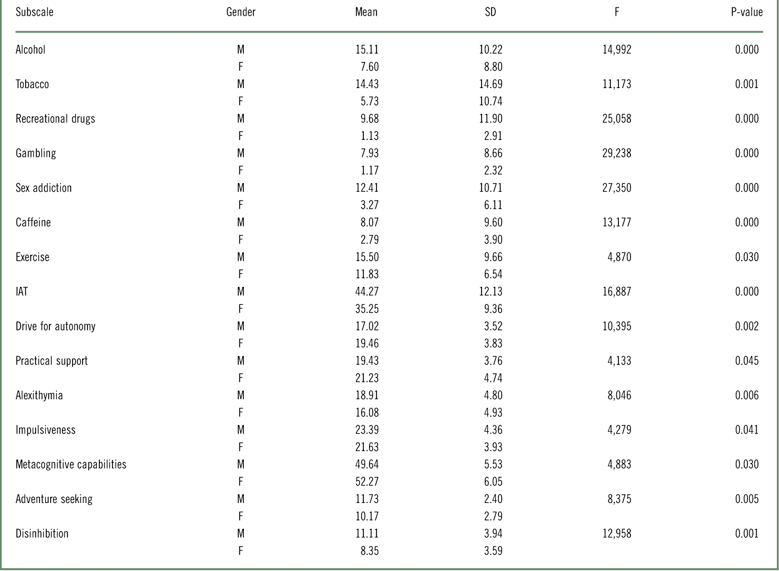
As shown in Table 1, the male subgroup scored significantly higher on the subscales for the following SPQ categories: alcohol, nicotine, pathological gambling, recreational drugs, sex, caffeine, and exercise. There was a significant gender-related difference in the IAT scores, with the male subset scoring higher than the females. The males scored significantly higher on the QMA subscales impulsiveness, adventure seeking, disinhibition, and alexithymia but lower on the subscales drive for autonomy, practical support, and metacognitive capabilities.
One-Wway ANOVA: statistically significant differences between males and females in addictive behaviors identified by SPQ, QMA, and IAT.
Linear regression
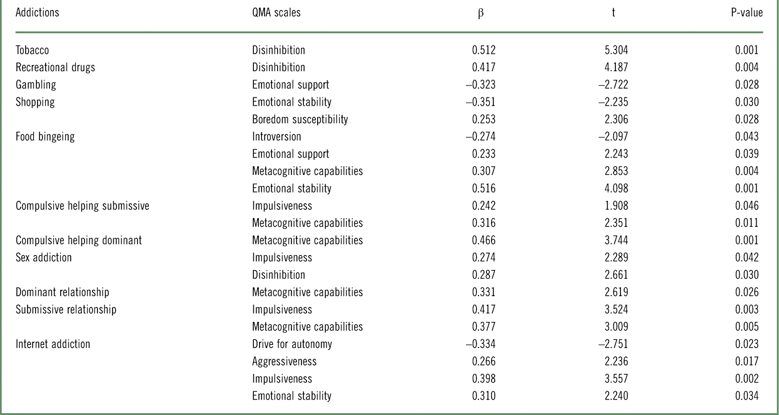
Table 2 reports the statistically significant data about the relationship between the IAT and SPQ subscale scores and the QMA scores. In particular, we found an association between nicotine, recreational drugs, and disinhibition; gambling and low emotional support; shopping, emotional stability, and boredom susceptibility; food bingeing and introversion; low emotional support and emotional stability; sex addiction, impulsiveness, and disinhibition; Internet addiction and impulsiveness; and aggressiveness and low drive for autonomy.
Linear Regression between QMA scales (independent variables) and SPQ subscales and IAT scores (dependent variables).
Discussion
An initial data analysis was carried out to determine whether the sample population presented problem areas associated with behavioral addictions. In particular, nearly one-fifth (17.7%) of the sample showed a significant problem on the subscale for pathological gambling. This percentage is higher than that recently reported,Reference Caillon, Grall-Bronnec, Bouju, Lagadec and Vénisse24 but it could have derived from differences in socioeconomic status and age between previously surveyed samples and ours. Similarly high percentages noted for sex (17.7%), exercise (16.7%), and caffeine (19.8%) addiction were in line with an earlier study on Italian students.Reference Pallanti and Bernardi25 The percentage of subjects with relational problems was identical (13.5%) for the relationship-dominant and the relationship-submissive subscales. The percentage of those with shopping problems and food starving was slightly lower and higher (10.4% and 14.6%, respectively). Much lower percentages were noted for other behavioral and substance addiction tendencies as measured by the SPQ (Figure 1).
Only one subject scored above the cut-off score of 80 on the IAT, signaling an Internet addiction disorder, while 17.7% were noted to have problematic Internet use, which might eventually lead to Internet addiction. This finding agrees with previous observations from school-based surveys of adolescentsReference Pallanti and Bernardi25, Reference Villella, Martinotti and Di Nicola26 who make increasing use of the Internet for school and networking activities, but, because of their more fragile identity, are also vulnerable to engaging in risky behavior (cybersex, cyberbullying) and apt to isolate themselves when interacting with a virtual world (video gaming and chatting).Reference Vegetti Finzi and Battistin27
Comparison of gender-related differences between the SPQ and IAT scores showed statistically significant differences between the male and female subgroups: the males had higher mean scores for the categories alcohol, nicotine, gambling, sex, caffeine, exercise, and Internet addiction. This observation is shared by previous findings that males are more predisposed to developing such addiction behaviors.Reference Bonino and Cattellino28 The higher predisposition may be due to genetic or hormonal factors, or a combination of other aspects including emotional and psychological needs, perception of self image, and environmental and sociocultural factors.Reference Fattore, Melis, Fadda and Fratta29 Further confirmation comes from the comparison of personality traits: the females appeared to be less vulnerable to dependence because they were less impulsive, disinhibited, and alexithymic than the males and more protected by positive metacognitive capabilities and better family support in attaining autonomy. Contrary to previous observations,Reference Black30 we found no statistically significant differences between the sexes with regard to compulsive shopping, which is reportedly more prevalent among females. This discrepancy may be explained by differences in product categories and shopping behavior between men and women, with recent trends indicating male predominance in both Internet use and online shopping. Our findings also diverge from earlier studies on food addiction (food bingeing and food starving) and showed no differences between the sexes.Reference Nasser, Bradley and Leitzsch31, 32
Analysis of the scores obtained on the various QMA subscales, which correlated with the SPQ and IAT scores, revealed intriguing differences between some of these and addictive behaviors. Hence, the question arises whether such patterns could pinpoint protective factors against the development of addiction. In detail, the first dimension the QMA investigates is attachment, which is subdivided into 3 subscales: drive for autonomy, emotional support, and practical support. The IAT score showed a statistically significant link with one of these dimensions (less drive for autonomy), just as happened for gambling addiction and for food bingeing (less emotional support).
This pattern appears consistent with elements of the attachment theory33, Reference Coan34 and the construct of internal operative models, according to which insecure attachment and abuse or neglect in early childhood may impede the child from activating appropriate strategies for emotional self-control and from developing capabilities of mental representation of the self and others. Later, in adolescence and adulthood, this could lead to psychopathological syndromes characterized by an internal dimension of emotional emptiness, fragile self-esteem, and fear of judgment by others, which may impel the individual to seek an “object-drug” (substance or behavior) believed to alleviate, albeit temporarily, psychological pain and fragmentation anxiety.Reference Caretti and La Barbera35
Also, scores for emotional stability, a personal resource that enables an individual to control his or her emotions, had a strongly negative association with compulsive shopping and food bingeing. The inability to control affectivity and emotion may lead to impulsive-compulsive behavior toward food (bingeing) and buying. In contrast with previous reports,Reference Reid, Carpenter, Spackman and Willes36 we found no significant correlation between low emotional stability and sex addiction. What our findings do suggest is that secure attachment, which comprises good emotional and practical support and a positive drive for autonomy sustained by the family, when coupled with emotional stability, defined as the individual’s capacity to control his or her emotions, may be considered factors that protect against pathological addictions.
Analysis of the sensation-seeking subscales showed a positive association between disinhibition scores and propensity for drugs, nicotine, and sex addiction, and between the boredom susceptibility subscale and sex addiction. This finding holds importance, as it is hypothesized that, in general, seeking out new experiences and the instant gratification they offer are more highly valued by adolescents than by adults, as borne out by the higher mean scores for sensation-seeking and novelty-seeking.
Sex addiction appears to attract disinhibited individuals seeking novelty; what also seems to guide the risky behavior in subjects at risk for sex addiction is their inability to tolerate boredom, which could impel the adolescent to seek new, highly stimulating experiences, including sexual ones, that break the routine and monotony of daily living. Our data show that sex addiction is correlated with higher levels of impulsiveness. This observation is shared by previous studiesReference Grant and Chamberlain37, Reference Irvine, Worbe, Bolton, Harrison, Bullmore and Voon38 that found an association between addictive behaviors (gambling disorder, compulsive buying, Internet addiction) and alterations in 2 cognitive domains: deficient response inhibition (impulsive action), ie, the inability to inhibit motor responses, and deficient deferment of gratification (impulsive choice), ie, the preference for quick gratifications; hence, impulsiveness could constitute a marker of addiction vulnerability.
Significantly higher mean scores on impulsiveness and aggressiveness subscales were seen in subjects with problematic Internet use. This finding is in line with previous observationsReference Ko, Yen, Liu, Huang and Yen39; online gambling, gaming, and chatting are all associated with aggressive behavior that translates into violent reactions to stressful conditions.
This preliminary observational study involved a small sample of adolescents, and the data were collected through questionnaires administered during school site visits. The small sample size constitutes a limitation of the study. Nonetheless, it serves as an initial step in exploring the prevalence of addiction behaviors in adolescents and in collecting information that can further research in this area. Moreover, such information is key to inquiry into the sociocultural and psychological implications of new technologies such as the Internet. Detailed investigation through large-scale studies is therefore desirable. Other problems in this complex area of inquiry are the variety of questionnaires and the lack of universally recognized and validated diagnostic criteria. The socioeconomic and sociocultural characteristics of our study sample reflect the local context, which may be another reason why our results differ from previous studies. We did not intend to explore this aspect but rather to focus on personality aspects. This is a further limitation of the study and merits greater attention. Further research is planned using a larger scale survey to explore personality traits and clinical aspects in various sociocultural contexts and different age groups.
Conclusion
The present study identified epidemiological indicators that reflect the entity of new addictions in adolescents. It highlights important differences in the prevalence between males and females. The study also assembled data that may inform strategies for identifying protection factors and risk factors (familial, social, personal) for the development of such addictions and other associated mental disorders. From this basis, we may suggest that behavioral addictions constitute an element that may contribute to the manifestation of Axis I and Axis II disorders, specifically depressive disorders, eating disorders, and borderline personality disorder.
Awareness of behavioral addictions, while still in the early phase, could, through targeted intervention, help to prevent worsening of circumstances and repercussions on other aspects of an adolescent’s life. In this context, school-based primary prevention could be highly effective, given the school’s key function to provide a place for socialization and learning and to reason through and express one’s own thoughts.
Another interesting finding was the lower risk of substance/alcohol addiction as compared to behavioral addictions. This suggests that some forms of addiction are cumulative while others are mutually exclusive, with a gradual progression toward an “independent” psychopathological manifestation. The rapid evolution of technology and cultural factors may influence the onset and clinical expression of new disorders, as mentioned in the DSM-5 in the context of conditions for further study.
Disclosures
The authors do not have anything to disclose.