Introduction
Hoverflies (Diptera: Syrphidae), with over 6000 described species, are found in almost all geographic regions and habitats, where they fulfil important ecological roles such as pollination and predation of pest insects (Rotheray and Gilbert Reference Rotheray and Gilbert2011). Within Syrphidae, the genus Xanthogramma Schiner, Reference Schiner1861 comprises large flies (Van Veen Reference Van Veen2004) preferring grasslands and woodlands (Speight Reference Speight2017). Larvae are Aphididae (Hemiptera) predators in ant (Hymenoptera: Formicidae) nests (Hölldobler Reference Hölldobler1929; Rotheray Reference Rotheray1994; Speight Reference Speight2017); nonetheless early stages are unknown for most Xanthogramma species. This genus belongs to the tribe Syrphini sensu stricto and is related phylogenetically to Chrysotoxum Meigen, 1803, Epistrophe Walker, 1852, and Epistrophella Dušek and Láska, Reference Dušek and Láska1967 (Mengual et al. Reference Mengual, Ståhls and Rojo2008). Xanthogramma is present in the Palaearctic, Nearctic, and Oriental regions (Pape and Thompson Reference Pape and Thompson2013a), with 19 species recorded from the Palaearctic (Peck Reference Peck1988). Violovitsh (Reference Violovitsh1975) provided a diagnosis of the genus. Taxonomy within Xanthogramma remains in flux with the validity of several species still uncertain (Speight Reference Speight2017). Speight and Sommaggio (Reference Speight and Sommaggio2010) provided the first key to all known European species of Xanthogramma, which was reedited by Speight and Sarthou (Reference Speight and Sarthou2017) with modifications to better separate females of X. dives (Rondani, Reference Rondani1857), X. pedissequum (Harris, Reference Harris1776), and X. stackelbergi Violovitsh, Reference Violovitsh1975.
Classical taxonomy is not always conclusive for species delimitation. Additional data sources, such as DNA, can help with this purpose. Mitochondrial DNA (mtDNA) cytochrome c oxidase I (COI) is frequently used as a molecular marker in taxonomic studies and has proven highly informative in elucidating relationships at the species level in Syrphidae (e.g., Ståhls et al. Reference Ståhls, Vujić, Pérez-Bañón, Radenković, Rojo and Petanidou2009; Marcos-García et al. Reference Marcos-García, Vujić, Ricarte and Ståhls2011; Radenković et al. Reference Radenković, Vujić, Ståhls, Pérez-Bañón, Petanidou and Šimić2011; Vujić et al. Reference Vujić, Ståhls, Ačanski, Bartsch, Bygebjerg and Stefanović2013; Grković et al. Reference Grković, Vujić, Radenković, Chroni and Petanidou2015; Nedeljković et al. Reference Nedeljković, Ačanski, Đan, Obreht-Vidaković, Ricarte and Vujić2015; Popović et al. Reference Popović, Ačanski, Djan, Obreht, Vujić and Radenković2015; Ačanski et al. Reference Ačanski, Vujić, Đan, Obreht Vidaković, Ståhls and Radenković2016; Šašić et al. Reference Šašić, Ačanski, Vujić, Ståhls, Radenković and Milić2016; Chroni et al. Reference Chroni, Djan, Obreht Vidaković, Petanidou and Vujić2017). In addition, registered COI bar codes are useful for molecular identification of species (e.g., Andrić et al. Reference Andrić, Šikoparija, Obreht, Đan, Preradović and Radenković2014). In Syrphinae taxonomy, the nuclear internal transcribed spacer 2 region (ITS2) is also useful for delimiting species borders, for example in the Chrysotoxum festivum Linnaeus, 1758 species group (Nedeljković et al. Reference Nedeljković, Ačanski, Vujić, Obreht, Đan, Ståhls and Radenković2013) and in the genus Melanostoma Schiner, Reference Schiner1860 (Haarto and Ståhls Reference Haarto and Ståhls2014).
The main aim of the present study is to provide new insights into the systematics of Xanthogramma by integrating species morphology and DNA. Two new species from Greece are described and new distributional data – mainly from southeastern Europe – are provided for six other species.
Material and methods
Taxonomic study. A total of 122 specimens from Croatia, Czech Republic, Greece, Italy, Macedonia, Montenegro, Serbia, Spain, The Netherlands, and Turkey were studied. To describe and diagnose species, characters were studied with both Ceti (Medline Scientific, Oxfordshire, United Kingdom) and Nikon SMZ 745T (Nikon Corporation, Tokyo, Japan) binocular microscopes. Colour characters always refer to dry specimens. Body size was measured as the length from the tip of the frontal prominence (excluding antenna) to the tip of the abdomen. Wing length was measured from the insertion point on the thorax to the tip of the wing. Antennal size was measured as a relation between the distance from the apex of the basoflagellomere and the most prominent point of the pedicel and the width of the basoflagellomere at the level of the arista base. Measurements were made using an eye-piece micrometer. Morphological terminology follows Thompson (Reference Thompson1999), except for the term “proepimeron”, which follows Speight and Sarthou (Reference Speight and Sarthou2017). Examined material was identified with Speight and Sommaggio (Reference Speight and Sommaggio2010) and Bartsch et al. (Reference Bartsch, Binkiewicz, Klintbjer, Rådén and Nasibov2009). A distribution map was created using the software GenGIS (version 2.1.1) (Parks et al. Reference Parks, Mankowski, Zangooei, Porter, Armanini and Baird2013). For type specimens, the symbol “/” separates data from different labels on the same pin. The numbers in the Examined material sections are part of unique identification labels of the specimens, while numbers with the abbreviation MS refer to the unique identification labels of the specimens used for the molecular analyses.
Examined material belongs to the following collections:
AVE – André Van Eck private collection, Tilburg, The Netherlands
FSUNS – Department of Biology and Ecology, Faculty of Sciences, University of Novi Sad, Serbia
HNHM – Hungarian Natural History Museum, Budapest, Hungary (Dr. Soltész Zoltán)
LSF – Museo Zoologico La Specola, Firenze, Italy (Dr. Luca Bartolozzi)
MAUA – The Melissotheque of the Aegean, University of the Aegean, Mytilene, Greece (Dr. Theodora Petanidou)
MB – Miroslav Barták private collection, Prague, Czech Republic
MCDS – Michael de Courcy Williams private collection, Alexandroupoli, Greece
MNHN – Muséum national d’Histoire naturelle, Paris, France (Dr. Simon Chagnoux)
MZH – Zoological Museum, Finnish Museum of Natural History, Helsinki, Finland (Dr. Gunilla Ståhls)
MZLU – Museum of Zoology, Lund, Sweden (Dr. Rune Bygebjerg)
NHM – Natural History Museum, London, United Kingdom (Dr. Nigel Wyatt)
NHMW – Naturhistorishes Museum Wien, Wien, Austria (Dr. Sehnal Peter)
NMBA – Naturhistorisches Museum der Benediktiner-Abtei, Admont, Austria (Dr. Petr Heřman)
WSB – Wouter Van Steenis, Breukelen, The Netherlands
ZISP – Zoological Museum, Academy of Sciences, Russian Academy of Sciences, St. Petersburg, Russia (Dr. Olga Ovtshinnikova)
ZMHB – Zoologishes Museum of Humbolt University, Berlin, Germany (Dr. Sven Marotzke)
ZMUC – Zoologisk Museum, Copenhagen, Denmark (Dr. Thomas Pape)
Molecular study. DNA was extracted from two to three legs of 50 Xanthogramma specimens of the eight studied species (see Supplementary Material Table 1) using the SDS extraction protocol (Chen et al. Reference Chen, Rangasamy, Tan, Wang and Siegfried2010). Sequences of two gene regions (3' ends of COI and ITS2) were used to confirm species boundaries. Polymerase chain reaction amplifications were done using the COI primer pair C1-J-2183 (alias Jerry) and TL2-N-3014 (alias Pat) (Simon et al. Reference Simon, Frati, Beckenbach, Crespi, Liu and Flook1994), while the ITS2 were amplified using primer pair ITS2A and ITS2B (Beebe and Saul Reference Beebe and Saul1995).
Polymerase chain reactions were carried out in 25 μL reaction volumes. The reaction mixture contained 1× Taq Buffer without MgCl2 (ThermoScientific, Vilnius, Lithuania), 2 mM MgCl2, 0.1 mM of each nucleotide, 1.25 U Taq polymerase (ThermoScientific), 5 pmol of each primer, and ~50 ng template DNA. Amplifications were performed under the following polymerase chain reaction conditions: initial denaturation at 95 °C for two minutes; 29 cycles of denaturation at 94°C for 30 seconds each; 30 seconds annealing at 49 °C; two minute extension at 72 °C; followed by a final extension of eight minutes at 72 °C. Polymerase chain reaction products were enzymatically purified using Exonuclease I and Shrimp Alkaline Phosphatase enzymes (ThermoScientific) according to the instructions of the manufacturer. Sequencing was performed in both directions using the BigDye Terminator v.3.1 cycle sequencing kit (Applied Biosystems, Waltham, Massachusetts, United States of America) at the Sequencing Service Laboratory of the Finnish Institute for Molecular Medicine, Helsinki, Finland.
The resulting DNA sequences were edited for base-calling errors using BioEdit version 7.2.5. (Hall Reference Hall1999). The alignment of COI sequences was performed manually, while the alignment of the ITS2 fragment was carried out using the L-INS-I strategy as implemented in MAFFT (Katoh and Standley Reference Katoh and Standley2013) available on European Bioinformatics Institute bioinformatics framework (McWilliam et al. Reference McWilliam, Li, Uludag, Squizzato, Park and Buso2013). Sequences were deposited in GenBank (www.ncbi.nlm.nih.gov/genbank) and their accession numbers are listed in Supplementary Material Table 1. All analyses were rooted on Melanostoma mellinum (Linnaeus, 1758) (accession numbers: KJ848101 for COI, KJ848059 for ITS2), which was used as the outgroup. Variable positions were estimated using DnaSP version 5 (Librado and Rozas Reference Librado and Rozas2009). Maximum parsimony analyses were performed using the parsimony ratchet analysis (Nixon Reference Nixon1999) as implemented in TNT (Goloboff et al. Reference Goloboff, Farris and Nixon2008; generated from Winclada ASADO (Nixon Reference Nixon2008)), with 2000 iterations per replication and the rest parametres set by default. The bootstrap nodal support values were calculated using non-parametric bootstrapping with 1000 replicates in NONA (Goloboff Reference Goloboff1999) spawned with the aid of Winclada ASADO (Nixon Reference Nixon2008).
Results
Two new species of the genus Xanthogramma are described. New distributional data, mainly from southeastern Europe, are provided for the other six studied species. An identification key to all the known European species of Xanthogramma is presented. Relationships among the studied taxa are analysed based on molecular characters of COI and ITS2 sequences.
Xanthogramma Schiner, Reference Schiner1861
Xanthogramma Schiner, Reference Schiner1861: 318. Type species Xanthogramma ornatum (Meigen, Reference Meigen1822), now regarded as a synonym of Xanthogramma pedissequum (Harris, 1776). Gender: neuter.
Olbiosyrphus Mik, Reference Mik1897: 66. Type species Syrphus laetus Fabricius, Reference Fabricius1794, now Xanthogramma laetum (Fabricius, Reference Fabricius1794).
Philhelius Coquillett, Reference Coquillett1910: 378. Type species Musca citrofasciata De Geer, Reference De Geer1776, now Xanthogramma citrofasciatum (De Geer, Reference De Geer1776).
Taxonomic notes. The name Xanthogramma was erected without included nominal species and instead representing just a group of flies differing from Doros profuges (Harris, Reference Harris1780) (originally as Doros conopseus (Fabricius, 1775)) in the shape of the ventral part of face and abdomen (Schiner Reference Schiner1860). According to Article 12 of the International Commission on Zoological Nomenclature (1999), the name Xanthogramma was unavailable until a description of this taxon was provided by Schiner (Reference Schiner1861). Thus, the genus dates from 1861 and not 1860, as erroneously assigned by authors such as Pape and Thompson (Reference Pape and Thompson2013b). Schiner (Reference Schiner1861) also included, for the first time, three species in the genus: X. citrofasciatum, X. ornatum, and X. marginale (Loew, Reference Loew1854). According to Article 67.2.2 of the International Commission on Zoological Nomenclature (1999), these three became the only originally included nominal species in the genus Xanthogramma and were therefore elegible for type fixation. According to Article 69.1 of the International Commission on Zoological Nomenclature (1999), Williston (Reference Williston1887) was the first author who subsequently and validly designated one of the originally included nominal species (X. ornatum) as the type species of Xanthogramma, by stating “Type of genus X. ornata Meigen”.
Olbiosyrphus Mik, Reference Mik1897, was previously considered an independent but related genus (Dušek and Láska Reference Dušek and Láska1967), but is now considered a synonym of Xanthogramma (Vockeroth Reference Vockeroth1969).
Diagnosis. Xanthogramma adults are relatively large flies with the following charaters. Head: short antenna and oval basoflagellomere; thorax: with sharply defined, bright yellow markings on the scutum laterally and katepisternum; postpronotum bare, anterior anepisternum bare, metapleuron bare ventral to spiracle, scutellum black basally (yellow apically), extensively microtrichose wing, with vein R4+5 straight or nearly so, calypter bare; abdomen: never distinctly petiolate, nearly flat, black and with yellow markings, emarginate at least on tergum 4 and tergum 5 (Thompson and Rotheray Reference Thompson and Rotheray1998).
Xanthogramma flies resemble those of the genera Sphaerophoria LePeletier and Serville, 1828; Doros Meigen, 1803; Epistrophe Walker, 1852; and Chrysotoxum Meigen, 1803. From Sphaerophoria, Xanthogramma can be distinguished by a strongly emarginate abdomen (at least on tergum 4 and tergum 5) (Thompson and Rotheray Reference Thompson and Rotheray1998); from Doros, by the absence of an abdominal waist (Van Veen Reference Van Veen2004) and vein A1 dipped into the anal cell before tip (this vein is almost straight before apex in Doros) (Láska et al. Reference Láska, Mazánek and Bičík2013); from Epistrophe, by the presence of yellow maculae on the thoracic pleuron, which are absent in Epistrophe; and finally, from Chrysotoxum, by the length of the antennae, which are much shorter in Xanthogramma (Van Veen Reference Van Veen2004).
Morphologically, the most similar genus to Xanthogramma is Citrogramma Vockeroth, Reference Vockeroth1969, but in Xanthogramma the subscutellar fringe is absent, the metasternum is bare, the antennal base is more promanent than the oral apex and the lateral yellow vitta of the scutum does not reach the scutellum (Mengual Reference Mengual2012).
European Xanthogramma species
Xanthogramma aeginae Ricarte, Nedeljković, and Vujić, new species
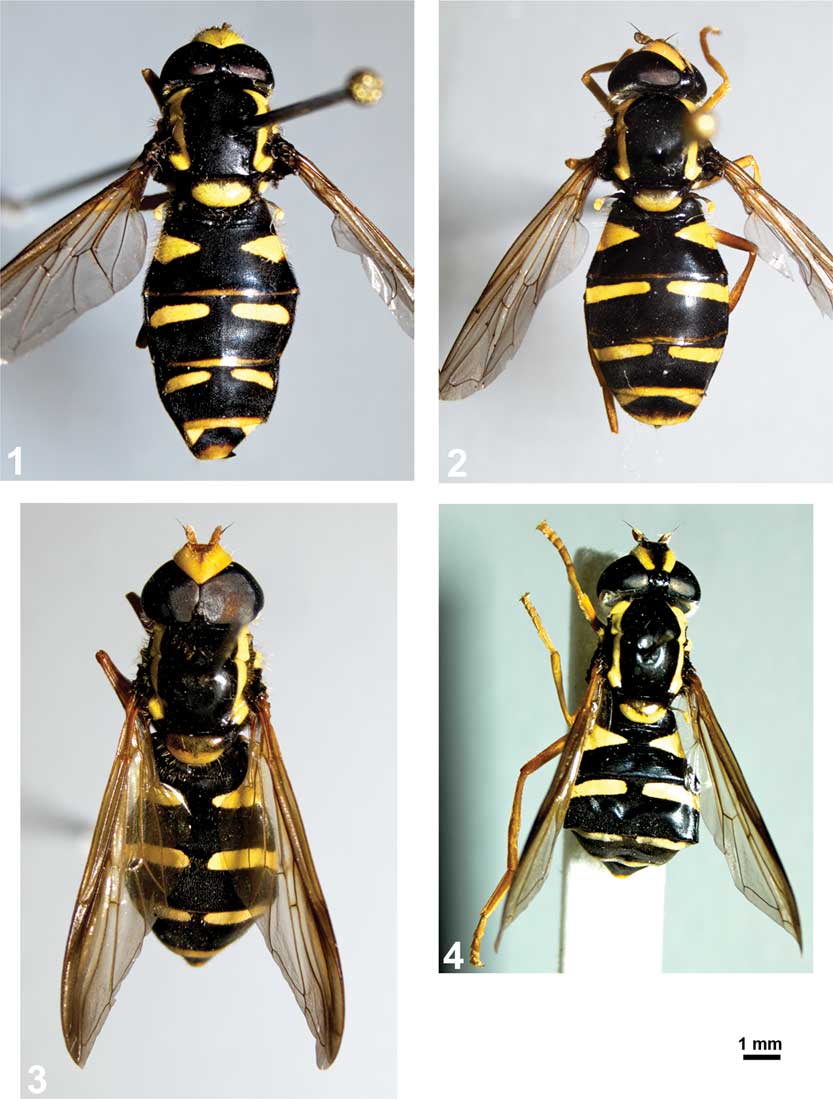
Xanthogramma species, overall appearance, dorsal view. 1, Xanthogramma aeginae, male holotype; 2, Xanthogramma aeginae, female paratype; 3, Xanthogramma pilosum, male holotype; 4, Xanthogramma pilosum, female paratype.

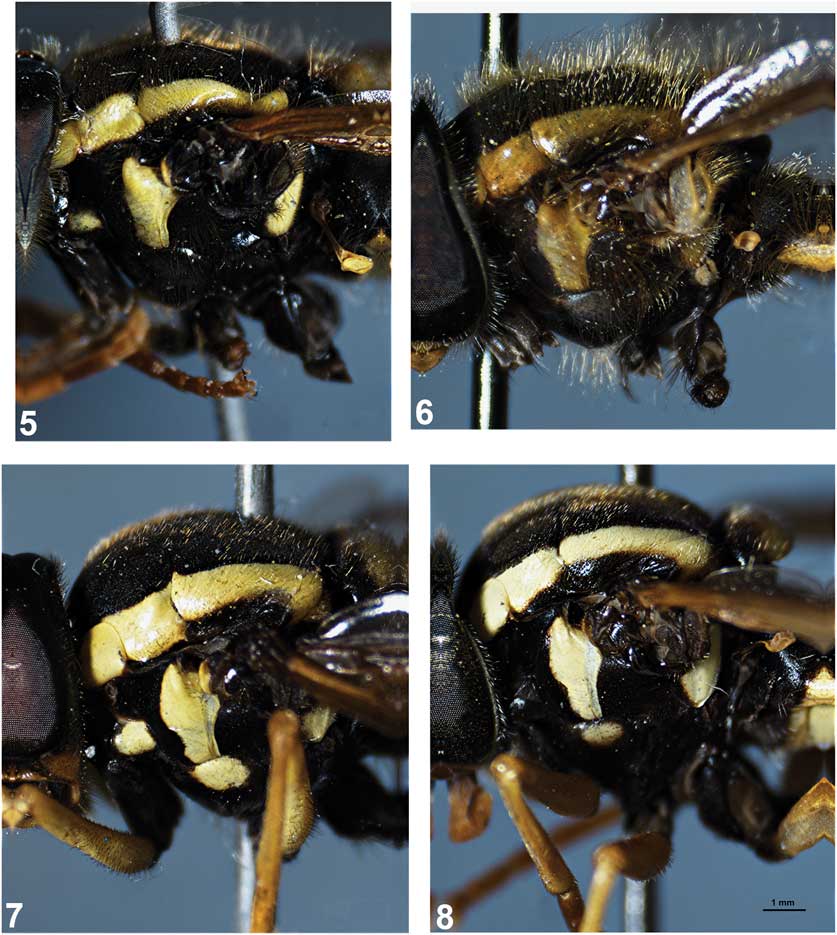
Xanthogramma species, thorax, lateral view. 5, Xanthogramma pilosum, male holotype; 6, Xanthogramma laetum, male; 7, Xanthogramma aeginae, male holotype; 8, Xanthogramma citrofasciatum, male.

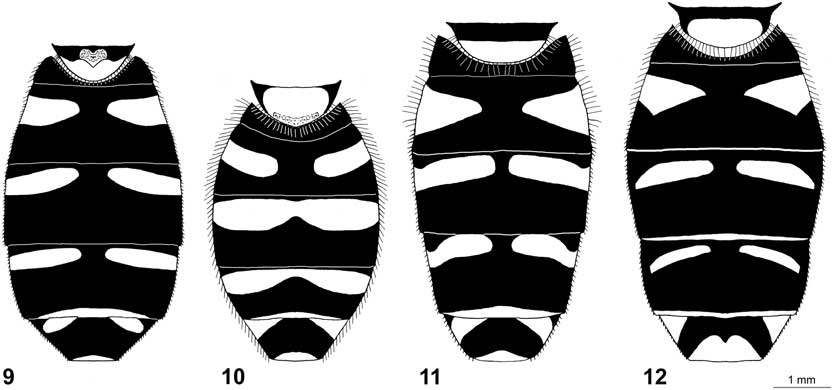
Xanthogramma species, abdomen, dorsal view. 9, Xanthogramma citrofasciatum; 10, Xanthogramma laetum; 11, Xanthogramma pilosum, male holotype; 12, Xanthogramma aeginae, male holotype.

Type material. Holotype: ♂, “Greece, Chios, Palios Katarraktis, 8–10.iv.2012, leg. M. Taylor, 38.254°N, 26.086°E, UOTA-MEL, 028881, (MS104)” (deposited in FSUNS).
Paratypes: Greece, 1♂, Lesvos, 2.2 km SE Mystegna, 10 m, 39.204°N, 26.485°E, Phrygana Simple (Aegean University 0037398) (MS83) (MAUA); 1♂, 2♀, Chios, Ermioni-Thymiana, 5–7.iv.2012, Taylor, 38.309°N, 26.141°E, 2525 (1♂), UOTA-MEL 028941 (MS105), 2521 (1♀), 7.iv.2012, Taylor, 3971, UOTA-MEL 038479 (1♀) (MS108) (MAUA); 1♂, Chios, Palinaeon II, 30.iv–2.v.2012, Taylor, 38.575°N, 26.004°E, 2673, UOTA-MEL 027833 (MS106) (MAUA); 1♂, 3♀, Chios, Managros, 29–30.v.2012 (1♂), Poutziakas, 38.4638°N, 25.937°E, 2928, UOTA-MEL 026609, 29.iii.2012 (1♀), Toutziarakis, 29–30.iii.2012, Toutziarakis, UOTA-MEL 026610 (1♀), UOTA-MEL 026621 (1♀) (MAUA); 1♂, 1♀, Chios, Gridia, 8–10.iv.2012, Taylor, 38.216°N, 26.102°E, 2413, UOTA-MEL 027050 (1♂), UOTA-MEL 027051 (MS110) (1♀) (MAUA); 1♀, Chios, Armolia, 3–5.iv.2012, Taylor, 38.272°N, 26.044°E, UOTA-MEL 026894 (MS107) (MAUA); 1♂, 3♀, Chios, Palios Katarraktis, 8–10.iv.2012, Taylor, 38.254°N, 26.086°E, 2517, UOTA-MEL 028890 (1♂), 2514, UOTA-MEL 028906 (1♀), 2510, UOTA-MEL 029138 (1♀), 2511, UOTA-MEL 028916 (1♀) (MAUA); 1♀, Chios, Kampia Castle, 29–30.iii.2012, Toutziarakis, 38.581°N, 25.981°E, 2948, UOTA-MEL 026830, (MS109) (MAUA).
Diagnosis. Length=12.2–12.3 mm; eyes with very short, sparse, yellow pile; frontal triangle with black pile; scutellum with long, yellow pile; notopleuron yellow, at most narrowly black near the anterior anepistenum; posterior anepisternum with a yellow macula in the posterior part; katepisternum, katatergum, proepimeron with a small, yellow macula each; posterior anepisternum with yellow macula in the posterior part; scutellum yellow, only black at the posterior corners and transparent yellow at the anterior part, mainly with long, black pile anteriorly and yellow pile posteriorly; wing cell R1 brown pigmented; terga 2–4 each with a pair of yellow fasciae reaching the lateral margins; tergum 2 fasciae triangular with a low rounded median projection.
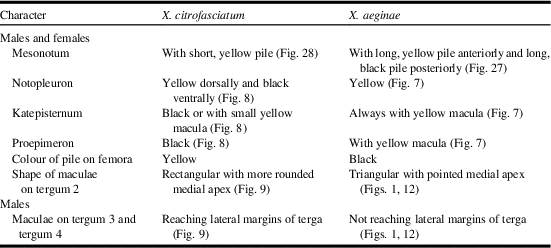
Xanthogramma aeginae can be distinguished from the similar X. citrofasciatum by the presence of a yellow macula on the proepimeron, which is completely black in X. citrofasciatum (Table 1). The pile of the posterior anepisternum are all black in X. aeginae, but mainly yellow in X. citrofasciatum.
Diagnostic morphological differences between Xanthogramma citrofasciatum and Xanthogramma aeginae.

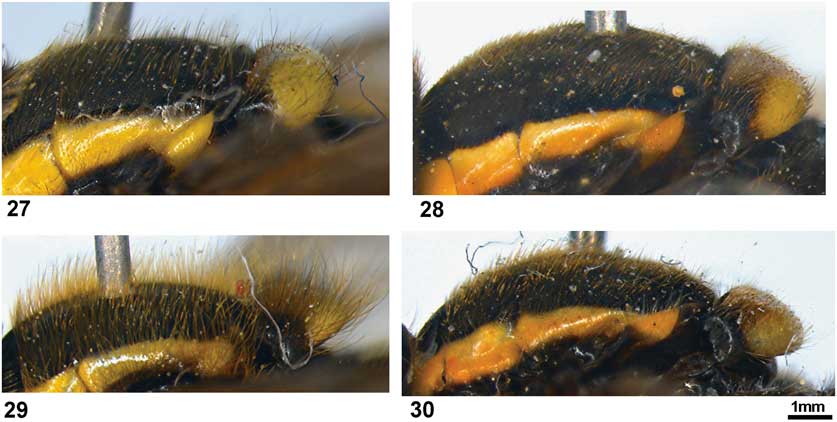
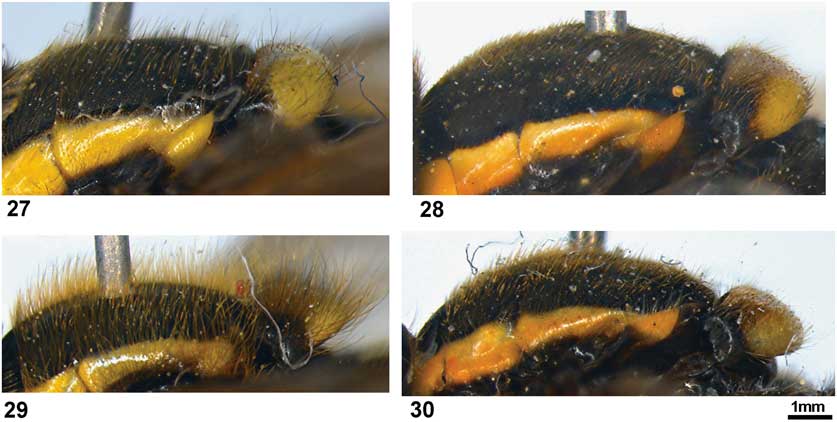
Description. Male (Figs. 1, 7, 12). Length=12.2–12.3 mm, Wing length=8.2 mm. Head. Eyes with very short, sparse, yellow pile; frontal triangle yellow with black pile; vertical triangle black with black pollinosity and black pile; ocellar triangle nearly equilateral; occiput black pollinose along eye margin, with long black pile in dorsal part and yellow pile in ventral part; lunule dark yellow and transparent; antenna yellow to dark orange, scape and pedicel yellow with short, black pile; basoflagellomere oval, dark orange, black in dorsal part; arista yellow with short pile (length of cross-section of apical part of arista); face yellow with black pile in dorsal and ventral parts and with yellow pile in medial part; ventral part of gena yellow (only black at lateral corners) with black pile; occiput white pollinose, with long, black pile in dorsal part and yellow pile in medial and ventral parts. Thorax (Figs. 7, 27). Scutum black with two faint silverish-pollinose vittae extending for anterior two-thirds of scutum length; scutum with long, yellow pile in anterior half and intermixed yellow and black pile in posterior half; notopleuron yellow, at most narrowly black near anterior anepistenum, lateral margin of scutum black posteriorly to transverse suture; notopleuron with intermixed long black and yellow pile; anterior anepisternum with small, yellow macula ventrally; posterior anepisternum with yellow macula in posterior part, anterior anepisternum with long, black pile in dorsal part and yellow pile in ventral part; proepimeron, katepisternum, katatergum with small, yellow macula (Fig. 7); legs completely yellow; femora with black pile; tibiae and tarsi with yellow pile; scutellum yellow, only black at posterior corners and transparent yellow in anterior part, scutellum mainly with long, black pile anteriorly and yellow pile posteriorly; wing membrane extensively microtrichose, wing cell R1 brown pigmented.
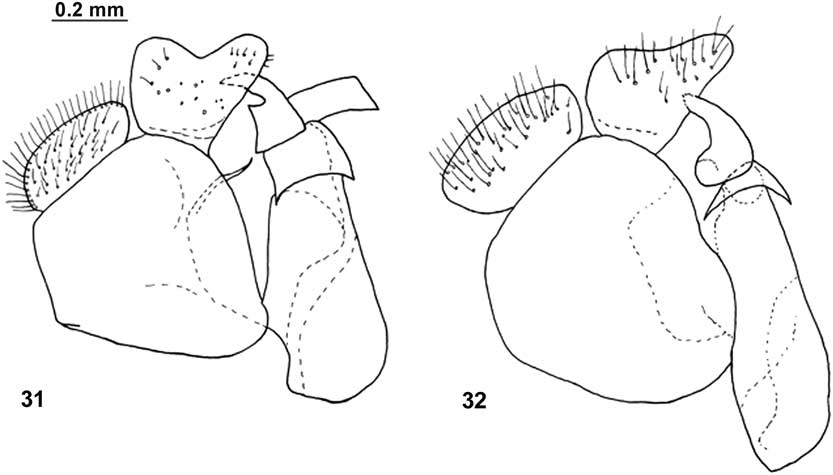
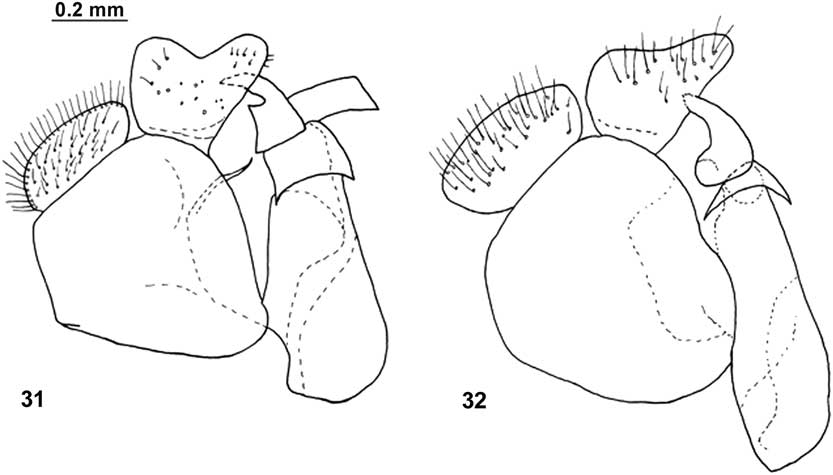
Abdomen (Figs. 1, 12). Black with short, black pile, except tergum 1, anterior part of tergum 2 and yellow fasciae of all terga yellow pilose; sternum 1 black with narrow yellow fascia in posterior part; sternum 1 with long, yellow pile; sternum 2 black; anterior part of sternum 2 with two yellow, triangular maculae covered with yellow pile; posterior part of sternum 2 with narrow, yellow maculae covered with black pile; medial part of sternum 2 with yellow pile; sternum 3 with two yellow, rectangular fasciae connected in the middle with yellow pile and yellow fasciae in the posterior part with black pile, medial part of sternum 3 covered with black pile; sternum 4 black with two yellow maculae in the anterior part, connected in the middle, covered with black pile; medial and posterior parts of sternum 4 black pilose; sternum 5 black, with yellow fasciae in the anterior and posterior parts, sternum 5 with black pile; sterna completely surrounded by membrane. Male genitalia (Fig. 31). Surstylus square shaped, with “V” notch in upper part. Hypandrium 2 times longer than wide.
Female (Fig. 2). Length=12.3 mm. Similar to male except for the following characters: black vitta extending from ocellar triangle to lunule; face yellow with long, black pile medially and yellow pile laterally; frons with long, black pile; ocellar triangle black with long, black pile.
Etymology. The name “aeginae” refers to Aegina (Αἴγινα, in Greek), wife of Zeus (Ζεύς, in Greek) in Greek mythology, because the type locality is in Greece.
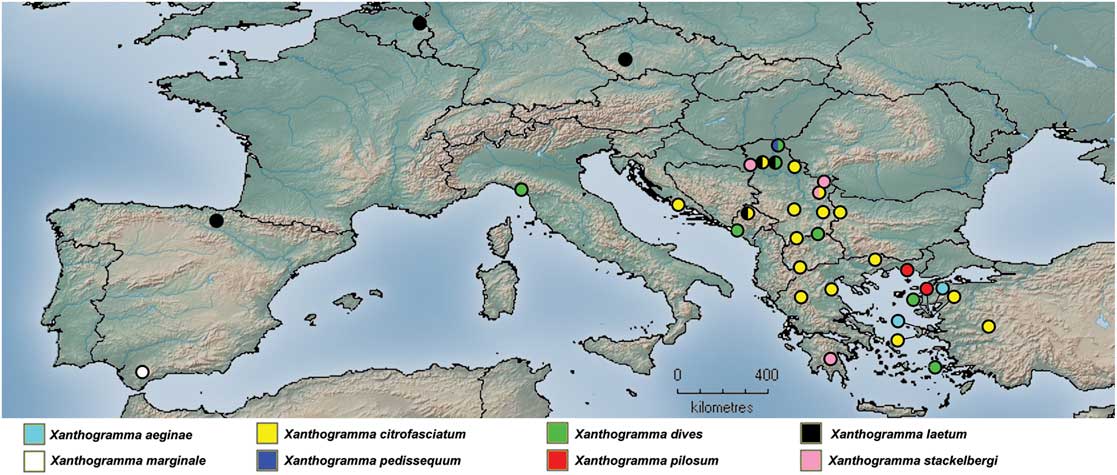
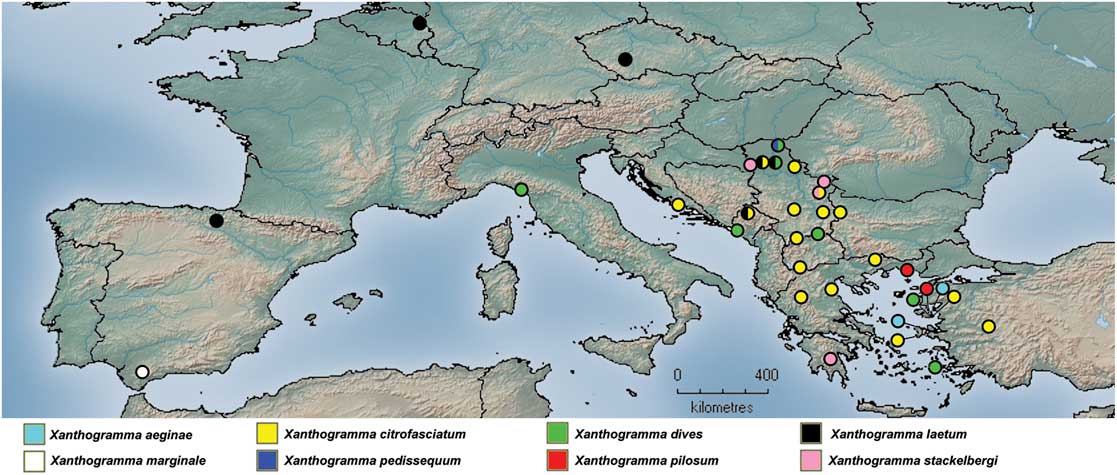
Distribution and habitat (Fig. 38). Greece (the Aegean islands of Lesvos and Chios). This species inhabits Mediterranean forest and shrub areas.
Natural history. Adults fly from the end of March to the beginning of May. Larvae are unknown.
Xanthogramma citrofasciatum (De Geer, Reference De Geer1776)
Musca citrofasciata De Geer, Reference De Geer1776: 118.
Musca anteambulo Harris, Reference Harris1776: 60. Junior synonym.
Syrphus philanthinum Illiger in Rossi, Reference Rossi1807: 450. Junior synonym.
Material examined. The invalid lectotype of Musca festiva Linnaeus, 1758 (this lectotype was invalidated by International Commission on Zoological Nomenclature (2001)): 1 male labelled as “festiva 33” [red label], “LECTOTYPE/Musca festiva Linné/Design. Thompson 1981” [yellow label] (The Linnaean Collections, London, United Kingdom). Croatia: 1♂, Primorje, Trogir, 7.iv.1978, 43.517°N, 16.249°E (FSUNS); Greece: 1♂, Trigono, 11.v.1990, 40.738°N, 21.204°E (FSUNS); 1♂, Pieria, Mount Olympus, Stragos, 7–14.vi.2014, M. Minachilis, 40.105°N, 22.412°E (MAUA); 1♀, Pindos, Katara Pass, 15.v.2011, 39.796°N 21.229°E, Vujić (MS80) (FSUNS); 1♀, Mount Olympus, Litochotas-Prionia, 18.v.2011, 40.11°N 22.46°E, Vujić (MS79) (FSUNS); 1♀, Drama, Sidironero, 18.v.2011, 41.312°N 24.220°E, Vujić (MS78) (FSUNS); 1♂, Aegean islands, Lesvos, Ag. Marina, 1.iv.2015, J. Devalez, 39.063°N, 26.576°E (MAUA); 1♂, Chios, Palios Katarraktis, 12–14.iv.2013, G. Nakas, 38.255°N, 26.086°E (MAUA); Macedonia: 2♂, Baba Mountain, 20.iv.1990, 41.0032°N, 21.185°E (FSUNS); Montenegro: 1♀, Durmitor, Komarnica-Nevidio, 3.v.2009, Vujić, 42.98°N 19.068°E (MS77) (FSUNS); 1♀, Durmitor, Sušičko jezero, 31.v.2011, Vujić, 43.14°N 18.99°E (MS40) (FSUNS); Serbia: 1♂, Fruška gora, Glavica, 25.iv.1989, 45.153°N, 19.834°E (FSUNS) (published in Vujić and Glumac Reference Vujić and Glumac1994); 1♂, Fruška gora, Stražilovo, 25.iv.2009, 45.17°N 19.97°E, Nedeljković (MS103) (FSUNS); 2♂, Stara planina, Dojkinačka reka, 6.v.1988 (1♂), 29–30.v.1988 (1♂), 43.220°N, 22.809°E (FSUNS); 2♂, Topli Do-Pilj, 28.v.1987, 43.352°N, 22.681°E (FSUNS); 1♂, Dubašnica, Mikuljska reka, 4.vi.1993, Radišić, 44.018°N, 21.906°E (FSUNS); 4♂, Lunga, 15.v.1994, Radenković, 44.014°N, 21.894°E (FSUNS); 9♂, 4♀, Demizlok, 30.iv.1995 (1♂, 2♀), 4.vi.1995 (1♂), 14.v.1994 (4♂, 1♀), 20.v.1996 (3♂, 1♀), 44.018448°N, 21.889°E (FSUNS); 1♂, 1♀, Dubašnica, Klisura Lazareve reke, 5.v.2012, Vujić (MS33, MS37) (FSUNS); 2♂, 2♀, Malinik, prema Vidikovcu, 3.v.2012, Vujić, 44.001°N 21.902°E (MS34, MS35, MS36, MS38) (FSUNS); 1♂, Beljavina, 6.vi.1993, 44.085104°N, 21.939197° E (FSUNS); 1♂, 1♀, Manastirište, 29.iv.1995 (1♂), 3.v.2012 (1♀) (MS39), 44.018°N, 21.961°E, leg. Vujić (FSUNS); 4♂, Malinik, 13.v.1994 (1♂), 1.v.1995 (2♂), 3.v.1996 (1♂), 44.001057° N, 21.902°E (FSUNS); 2♂, Malinik, ka Vidikovcu, 3.v.1996, 44.001°N, 21.902°E (FSUNS); 2♂, 1♀, Seličevica, 16.iv.1989, 43.238°N, 21.927°E (FSUNS); 2♂, Šar planina, Brezovica, 14.v.1997, Vujić and Radenković, 42.183165°N, 21.050°E (FSUNS); 1♂, Deliblatska peščara, Tilva, 25.iv.1998, Radišić, 44.947°N, 20.965°E (FSUNS); 1♂, Alibunar-slatina, 22.iv.1988, 45.055°N, 20.969°E (FSUNS); 1♂, 1♀, Kopaonik, Vujkovci, 1.v.1992, 43.338°N, 20.947°E (FSUNS); 1♂, Samokovska reka, 24.v.1992, 43.331°N, 20.739°E (FSUNS); 1♂, Kokorovac, 26.v.1987; 1♀, Radošice, 30.iv.1992, 43.274°N, 20.797°E (FSUNS); 1♂, Suva planina, Bojanine vode, 2.v.1988, 43.225°N, 22.117°E (FSUNS); Turkey: 1♀, Manisa, Kula, 18.iii.2014, J. Devalez, 38.607°N, 28.801°E (MAUA); 4♂, 1♀, 11 km E of Mugla, 1310 m, 1.v.2013, Barták and Kubik (MB).
Remarks. The holotype of Xanthogramma anteambulo (Harris, Reference Harris1776) has not been checked because the Harris collection is probably lost (N. Wyatt, The Natural History Museum, London, United Kingdom, personal communication). The original description of Xanthogramma anteambulo matches X. citrofasciatum based on examination of the original publication (Harris 1776–Reference Harris1780: 60, fig. 17). The original type material of Xanthogramma citrofasciatum described by De Geer (Reference De Geer1776) has presumably been lost or destroyed (N. Wyatt, personal communication). Xanthogramma philanthinum (Illiger in Rossi, Reference Rossi1807) was described under the genus Syrphus, later transferred to Xanthogramma by Bezzi and Stein (Reference Bezzi and Stein1907). We have searched for this type specimen in many collections (ZMHB, ZFMK=Zoologishes Forschungsmuseum Alexander Koenig, Germany, SNMB=Staatlishes Naturhistorisches Museum Braunschweig, Germany, LSF, MNM=Museo Civico di Storia Naturale di Milano, Italy) and we could not find it. According to Article 75.3 of the International Commission on Zoological Nomenclature (1999), a neotype is validly designated when there is an exceptional need. At the moment, X. citrofasciatum is not involved in any complex zoological problem and there is no doubt about its identity. Xanthogramma aeginae is similar to X. citrofasciatum but they can be easily separated by traditional morphology (see under diagnosis of X. aeginae), since they are not cryptic or sibling species. Comparisons, figures and keys provided in the present paper serve to fix the concept of X. citrofasciatum without need of a neotype designation.
Distribution. From southern Norway south to the Iberian Peninsula; from Ireland eastwards through central and southern Europe into European Russia and the former Yugoslavia; the Caucasus; western Siberia (Speight Reference Speight2017).
Natural history. Adults fly from March to June. Larva undescribed but known to prey on aphids (Hemiptera: Aphididae) living in Lasius Fabricius, 1804 (Hymenoptera: Formicidae) nests (Speight Reference Speight2017).
Xanthogramma dives (Rondani, Reference Rondani1857)
Syrphus dives Rondani, Reference Rondani1857: 136.
Material examined. Greece: 2♂, Lesvos, Agiassos, Sanatorio, 13.iv.2013, 39.07°N, 26.386°E (MS70, MS74), (FSUNS); 1♂, Samos, Neochori, 16.iv.2011, Vujić and Radenković, 37.70°N 26.76°E (MS67), (FSUNS); Italy: 1♀, Toscana, Caniparola, 15.v.2012, 44.112°N, 10.011°E, Vujić and Likov (MS54); Montenegro: 1♀, Orjen, 1.vi.2011, Vujić (MS48) (FSUNS); 1♂, Boka Kotorska, Morinj, 8–10.v.2010, 42.49°N, 18.64°E, Vujić (MS52) (FSUNS); Serbia: 1♂, Mokrin, Pašnjaci velike droplje, 7.vi.2016, 45.925°N, 20.298°E, Nedeljković and Tot (MS144) (FSUNS); 1♂, Fruška gora, Šakotinac, vii.2010, Vujić (MS62) (FSUNS); 1♂, Kovilj, Blizu manastira, 4.vii.2011, 45.213°N, 20.0370°E, Vujić (MS56) (FSUNS); 1♂, Pčinja, Vogance, 18.vi.2012, 42.351°N, 21.913°E, Vujić (MS61) (FSUNS).
Distribution. Uncertain due to confusion between X. pedissequum and X. stackelbergi. This species has been confirmed from Spain, France, The Netherlands, Germany, Switzerland, Italy, and Norway (Speight Reference Speight2017).
Natural history. Adults fly from May to mid-June and from July to the beginning of September. The larva is not described (Speight Reference Speight2017).
Remarks. The lectotype of X. dives, confirmed and designated by Speight and Sommaggio (Reference Speight and Sommaggio2010), was examined from high-resolution photographs of the head, thorax, and abdomen (dorsal and lateral views). Label data: “Lectotypus/ Syrphus dives Rondani/design. C. Kassebeer 1992” (LSF).
Xanthogramma laetum (Fabricius, Reference Fabricius1794)
Syrphus laetus Fabricius, Reference Fabricius1794: 301.
Lasiophthicus novus Rondani, Reference Rondani1857: 140. Junior synonym.
Material examined. Published material: Serbia: 1♀, Fruška Gora, Stari Ledinci, 10.v.1957, 45.196°N, 19.787°E (FSUNS); 1♀, Fruška Gora, Stražilovo, 16.v.1982, 45.176°N, 19.971°E (FSUNS) (published in Vujić and Glumac Reference Vujić and Glumac1994); 1♂, Serbia, Obedska bara, Kupinovo, 23.iv.1986, 44.714°N, 20.048°E (FSUNS) (published in Vujić et al. Reference Vujić, Šimić, Milankov, Radović, Radišić and Radnović1998). Montenegro: 1♂, Durmitor, Sušičko jezero, 16–17.v.2001, Vujić, 43.140°N, 18.999°E (FSUNS). New material: Czech Republic: 2♂, Vráž near Pisek, 400 m, near brook, Malaise trap, 10.v–4.vi.2011, M. Barták, 49.399°N, 14.133°E (MB); 2♀, Vráž near Pisek, 400 m, Pyramidal trapwood, 11.iii–11.iv.2014 (1♀), 6.vi–25.viii.2012. (1♀), 49.399°N, 14.133°E, M. Barták (MB); The Netherlands: 1♂, Li Savelsbos, 19.v.2012, Van Eck (AVE); 1♀, Valkenburg, Schaelsberg, 26.iv.2007, 50.861°N, 5.831°E, W. Van Steenis (MS149) (WSB); Spain: 1♂, Alava, Delika, 29.iv.2016, 42.967°N, 2.988°W, Van Eck (MS148) (AVE).
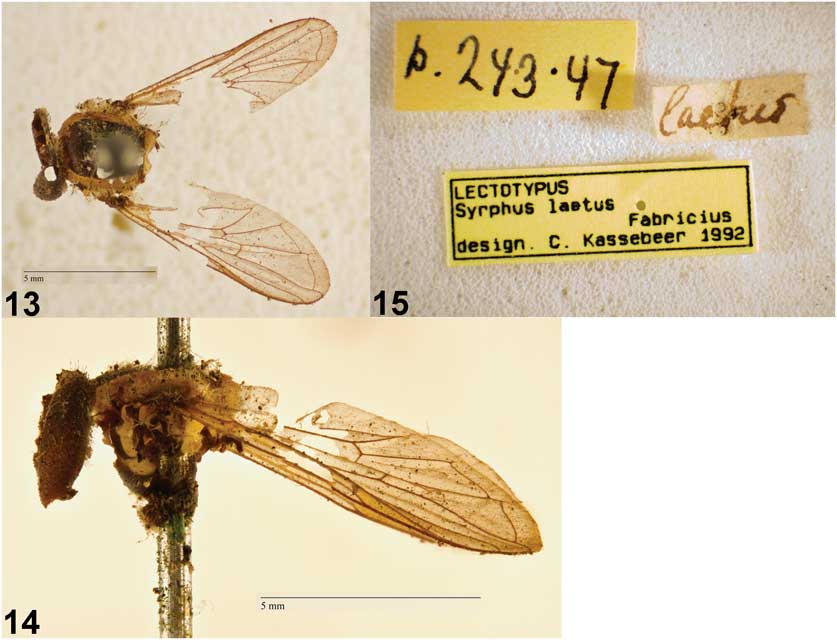
Type material examined. Lectotype (here designated in order to fix identity of the species) of Xanthogramma laetum (Fabricius, Reference Fabricius1794) – “p. 243 47” [yellow label]/“laetus” (handwritten)/“LECTOTYPUS Syrphus laetus Fabricius design. C. Kassebeer 1992” [yellow label] (ZMUC) (Figs. 13–15).
Syrphus laetus (=Xanthogramma laetum), lectotype. 13, dorsal view; 14, lateral view; 15, labels.

Lectotype (here designated in order to fix identity of the species) of Xanthogramma novum (Rondani, Reference Rondani1857) – “Museo “La Specola””/“Coll. Rondani”/“SYNTYPUS” [red label], “LECTOTYPUS/Lasiopthicus novus Rondani/design C. Kassebeer 1992” [yellow label], “228” [white label] (LSF) (Figs. 16–18).
Lasiophthicus novus (=Xanthogramma novum), lectotype. 16, dorsal view; 17, lateral view; 18, labels.

Remarks. The lectotype of X. laetum was examined from high-resolution photographs of the head and thorax (dorsal and lateral views). The lectotype is in very poor condition, lacking legs and abdomen. Although the lectotype of X. laetum was labelled as such by Kassebeer, this designation was never published. We confirm Kassebeer’s identification and herein formally designate this specimen as lectotype in order to fix identity of the species. This specimen belongs to the type series of X. laetum designated by Fabricius (Reference Fabricius1794).
Photographs (dorsal and lateral views) were also examined of the lectotype of X. novum. The lectotype of X. novum labelled by Kassebeer in LSF was never published. We confirm Kassebeer’s identification and herein formally designate this specimen as lectotype in order to fix identity of the species. This specimen belongs to the type series of X. novum designated by Rondani (Reference Rondani1857).
Distribution. From northern Germany south to southwestern France (Pyrenées-Atlantiques); from Belgium eastwards through central and southern Europe (Italy, former Yugoslavia) to Romania and European parts of Russia (Speight Reference Speight2017).
Natural history. Adult fly from March to September. The larvae are undescribed (Speight Reference Speight2017).
Xanthogramma marginale (Loew, Reference Loew1854)
Doros marginale Loew, Reference Loew1854: 18.
Xanthogramma morenae Strobl, Reference Strobl1899: 144. Junior synonym.
Material examined. Spain: 3♀, Grazalema, Cadiz, 14.vi.2014, 36.757°N, 5.365°W, Vujić (FSUNS).
Remarks. A female specimen of X. marginale labelled as “neotype” was examined from high-resolution photographs of the head, thorax, and abdomen (dorsal and lateral views). Label data: “Andalusia” (handwritten)/“3773”/“marginalis Loew” (handwritten)/“Zool.Mus.Berlin”/“NEOTYPUS Doros marginalis Loew, design. C. Kassebeer 1992” [yellow label] (ZMHB). The designation of this specimen as neotype was never published. According to the International Commission on Zoological Nomenclature (1999) a neotype is validly designated when there is an exceptional need to fix a species concept in the framework of a complex taxonomic problem. The concept of X. marginale is not in question, as it is clearly different to all other European species (see diagnostic characters in the key provided in the present paper). Thus, a neotype designation is unnecesary at this moment and the specimen labelled by C. Kassebeer is confirmed to not have any neotype status. The holotype of Xanthogramma morenae (which was originally described as a variety of X. marginale) was examined by A. Vujić in NMBA. Label data:“Xanth. marginale Lw. var. Morenae m. Span: Cardenas Strobl ♂”.
Distribution. Portugal, central and southern Spain, southern France, Italy and North Africa (Morocco, Algeria) (Speight Reference Speight2017).
Natural history. Adults fly from April to mid of June. The larvae are undescribed (Speight Reference Speight2017).
Xanthogramma pedissequum (Harris, Reference Harris1776)
Musca pedissequus Harris, Reference Harris1776: 61.
Syrphus ornatus Meigen, Reference Meigen1822: 298. Junior synonym.
Syrphus pulchrum Meigen, Reference Meigen1835: 69. Junior synonym.
Doros decoratum Zetterstedt, Reference Zetterstedt1843: 694. Junior synonym.
Xanthogramma bilobatum Szilády, Reference Szilády1940: 64. Junior synonym.
Xanthogramma flavifrons Szilády, Reference Szilády1940: 64. Junior synonym.
Xanthogramma nigripes Szilády, Reference Szilády1940: 64. Junior synonym.
Xanthogramma nobilitatum Frey, Reference Frey1946: 162. Junior synonym.
Xanthogramma flavipleura Coe, Reference Coe1957: 62. Junior synonym.
Material examined. Serbia: 2♂, Pašnjaci velike droplje, 7.vi.2016, 45.925°N 20.298°E, Tot, Nedeljković, and Markov (MS125, MS126) (FSUNS); 1♂, Slano Kopovo, 6.vii.2013, 45.631°N, 20.196°E, Stepanov (MS63) (FSUNS).
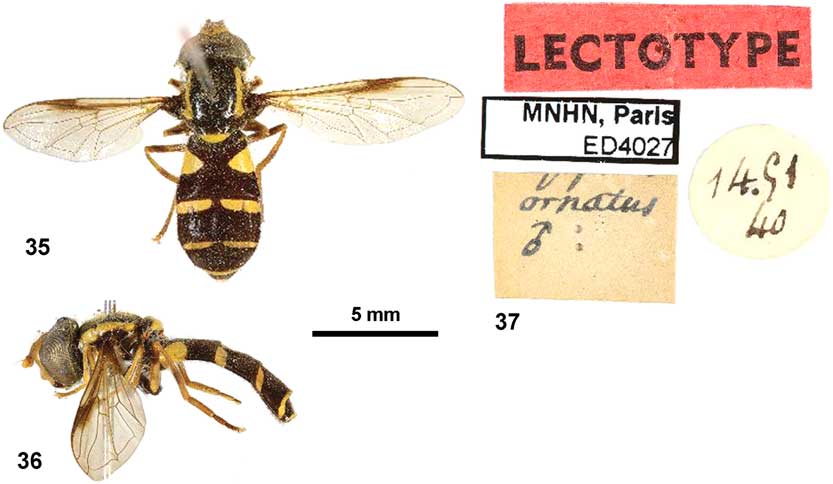
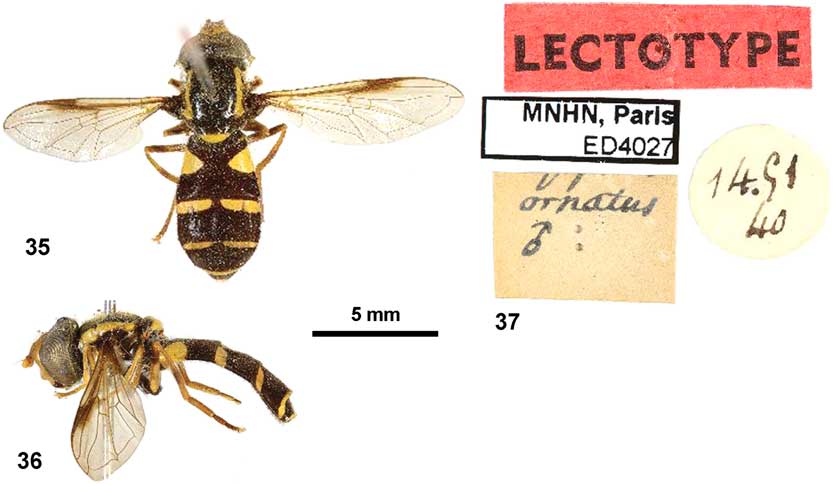
Remarks. The holotype of Xanthogramma pedissequum is lost (Pape and Thompson Reference Pape and Thompson2013a). We examined one male and one female from Bristol, United Kingdom – near the type locality – collected by E.A. Fonseca (NHM). The lectotype of X. ornatum was examined with high-resolution photographs of the dorsal and lateral habitus of the specimen. The lectotype (here designated in order to fix identity of the species) is labelled as follows: “LECTOTYPE”/“S. ornatus ♂” (hand written)/“14S1 40” (handwritten)/“MNHN Paris ED4027”. We have searched for the type specimen of X. pulchum (Meigen, Reference Meigen1835) in the MNHN and NHMW collection, but we could not find it.
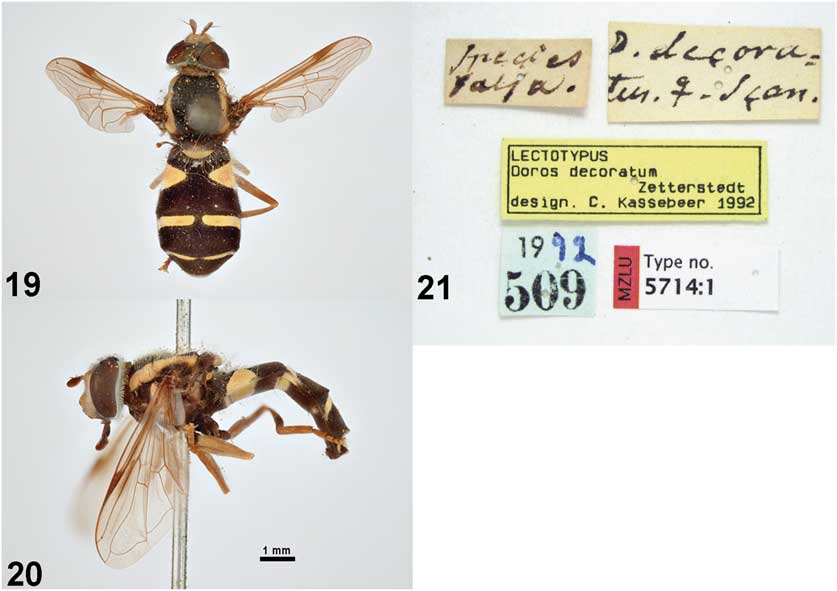
The lectotype of Xanthogramma decoratum (Zetterstedt, Reference Zetterstedt1843) was examined with high-resolution photographs of the dorsal and lateral habitus of the specimen (MZLU). The lectotype (here designated in order to fix identity of the species) is labelled as follows: “D. decoratum. ♀. Scan.” (handwritten)/“Lectotypus Doros decoratum Zetterstedt design. C. Kassebeer 1992/1992 509” (blue label)/“MZLU Type no. 5714:1” (MZLU) (Figs. 19–21). The lectotype of X. decoratum labelled by Kassebeer was never published. We confirm Kassebeer’s identification and herein formally designate this specimen as lectotype in order to fix identity of the species. This specimen belongs to the type series of X. decoratum designated by Zetterstedt (Reference Zetterstedt1843).
Doros decoratus (=Xanthogramma decoratum), lectotype. 19, dorsal view; 20, lateral view; 21, labels.

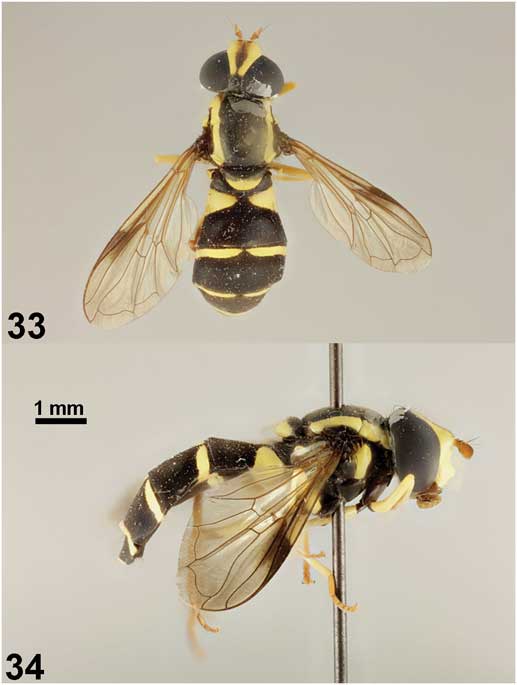
The type series of Xanthogramma bilobatum Szilády, Reference Szilády1940, Xanthogramma flavifrons Szilády, Reference Szilády1940, and Xanthogramma nigripes Szilády, Reference Szilády1940 were destroyed in a fire (Soltész Zoltán, HNHM, personal communication). The lectotype and paralectotype (one male and one female, respectively) of Xanthogramma nobilitatum (described originally as a variety of X. ornatum) were examined with high-resolution photographs of the dorsal and lateral habitus of the specimen (MZH) (Figs. 33–34). We designate the male as lectotype (here designated) in order to fix identity of the species. This specimen belongs to the type series of X. nobilitatum designated by Frey (Reference Frey1946).
The type of Xanthogramma flavipleura Coe, Reference Coe1957 is lost (N. Wyatt, personal communication). After the examination of the type specimens of all taxa considered as synonyms of X. pedissequum, we confirm their status as synonyms.
Distribution. Uncertain, due to confusion with both X. dives and X. stackelbergi. Known from United Kingdom and European Atlantic seaboard countries south to southern France and into central Europe to the Alps (France, Switzerland) (Speight Reference Speight2017).
Natural history. Adults fly from May to September, with a peak in July. The larvae are predators of root aphids tended by Lasius Fabricius, 1804 (Hymenoptera: Formicidae) (Speight Reference Speight2017).
Xanthogramma pilosum Nedeljković, Ricarte, and Vujić, new species
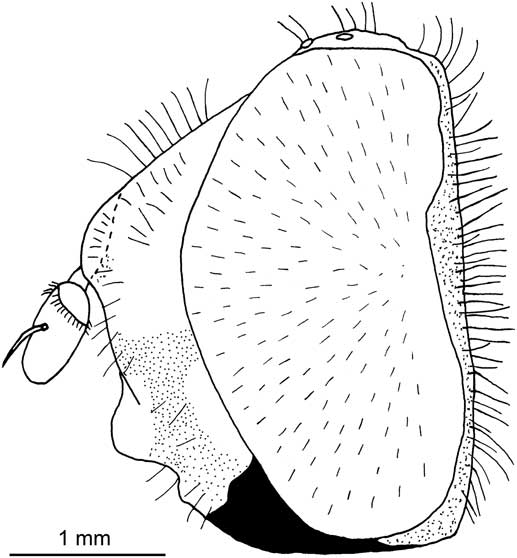
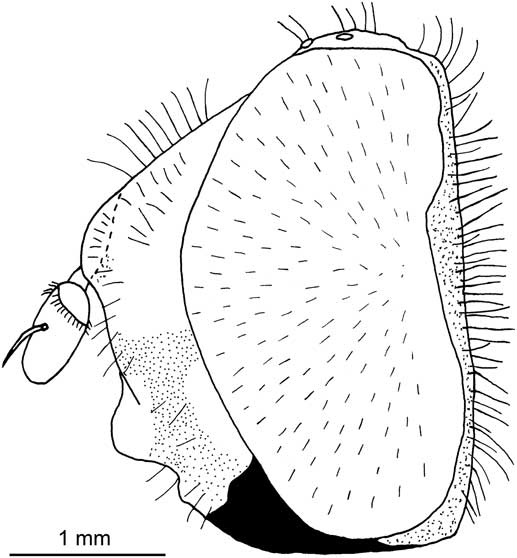
Xanthogramma pilosum male holotype, head, lateral view.
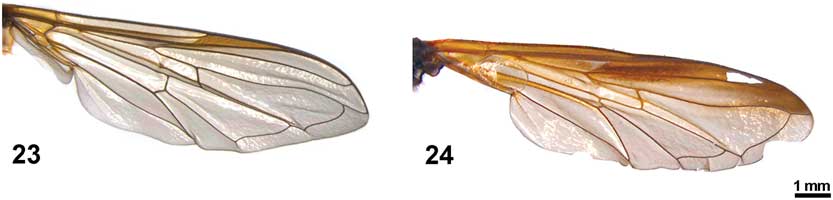
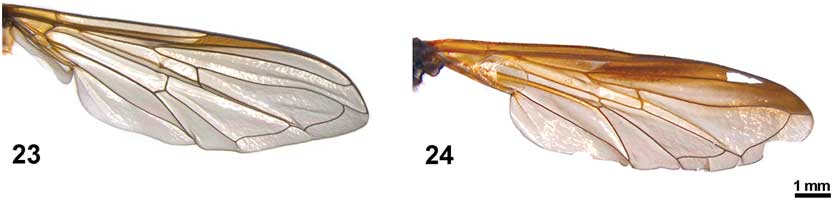
Xanthogramma species, right wing, dorsal view. 23, Xanthogramma laetum; 24, Xanthogramma. pilosum, holotype.
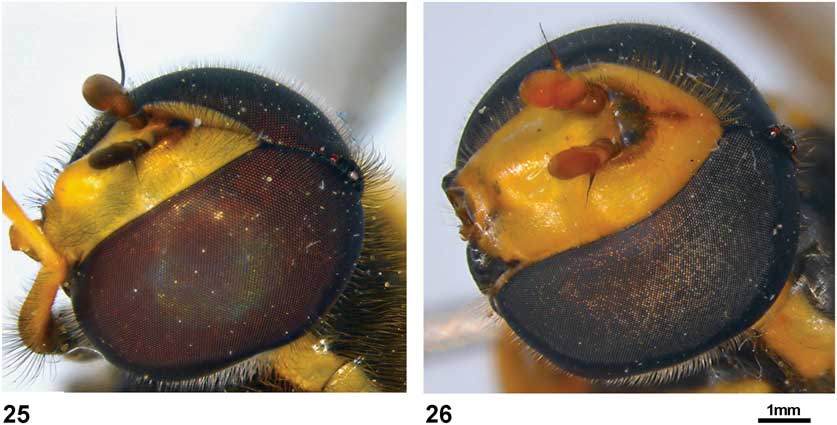
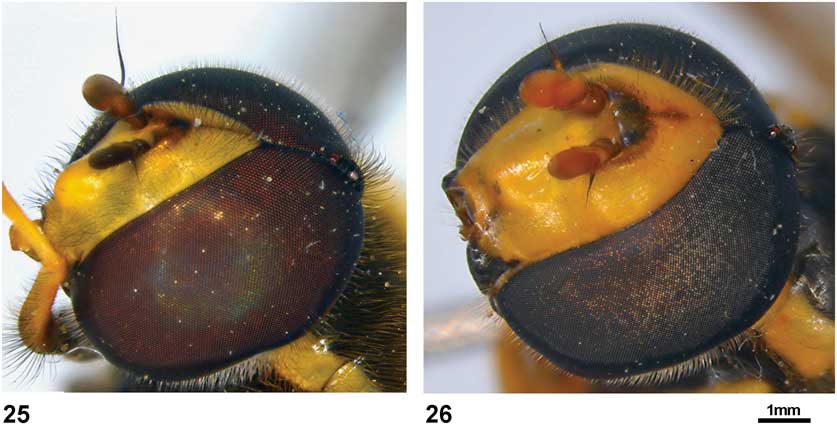
Xanthogramma species, male, head, anterolateral view. 25, Xanthogramma laetum; 26, Xanthogramma pilosum, holotype.
Xanthogramma species, male, mesonotum, lateral view. 27, Xanthogramma aeginae, holotype; 28, Xanthogramma citrofasciatum; 29, Xanthogramma laetum; 30, Xanthogramma pilosum, holotype.
Xanthogramma species, male genitalia, lateral view. 31, Xanthogramma aeginae, holotype; 32, Xanthogramma pilosum, holotype.
Xanthogramma nobilitatum, lectotype. 33, dorsal view; 34, lateral view.

Syrphus ornatus (=Xanthogramma ornatum), lectotype. 35, dorsal view; 36, lateral view; 37, labels.
Map of population sampling locations of the examined species.
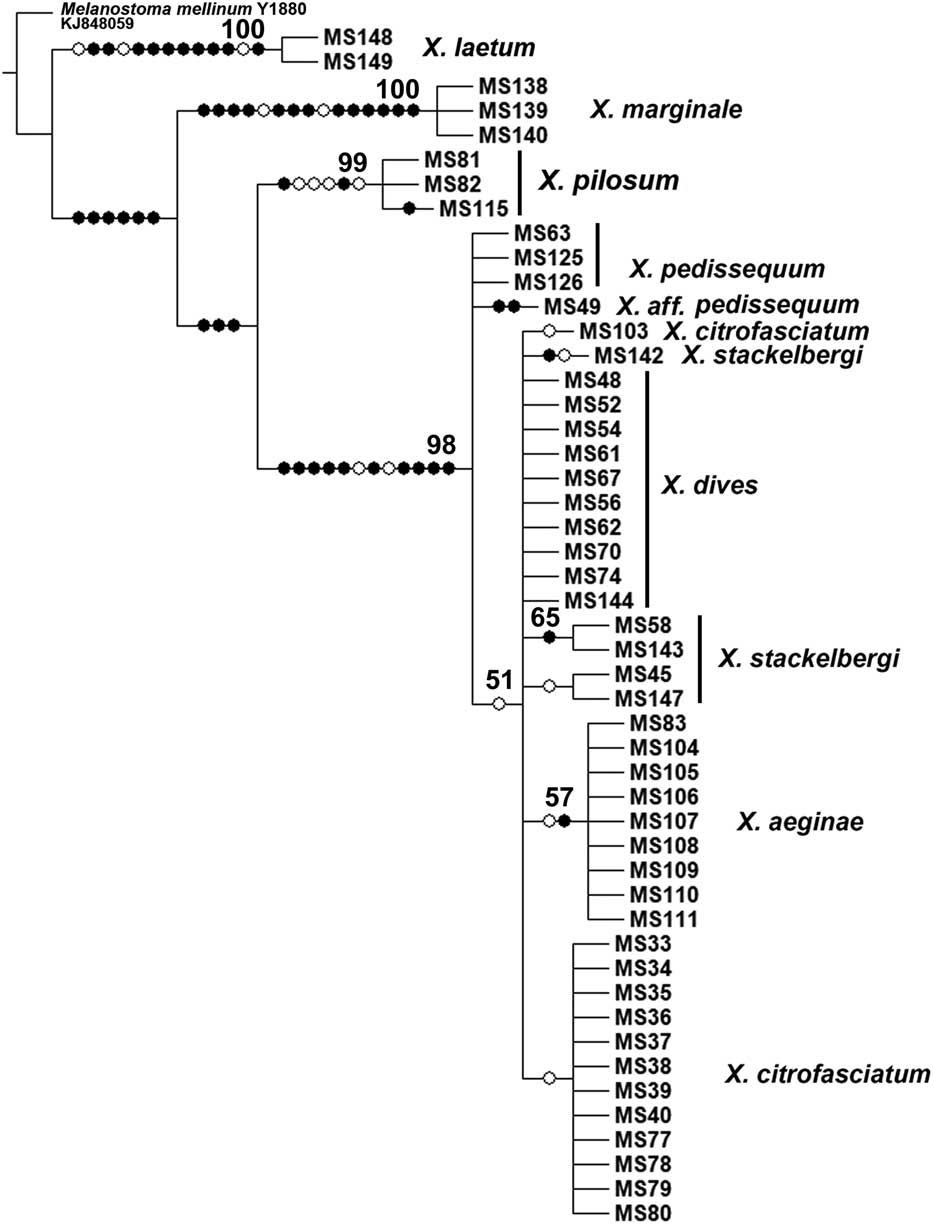
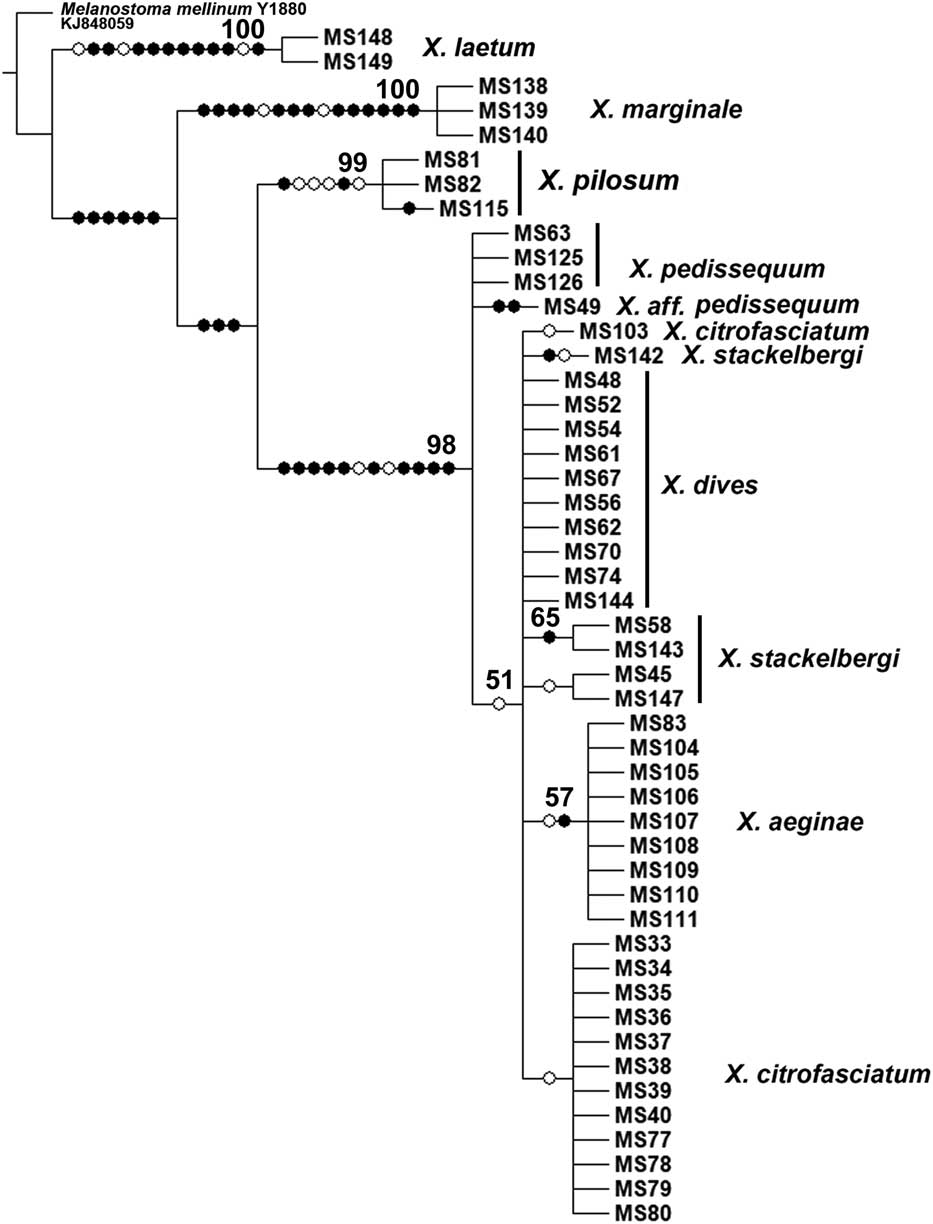
ITS2 strict consensus tree of four equally parsimonious trees. Length=225 steps; consistency index (ci)=89; retention index (RI)=90. Bootstrap values higher than 50 are indicated near nodes. Filled circles indicate non-homoplasious changes and open circles homoplasious changes. aff., species affinis.
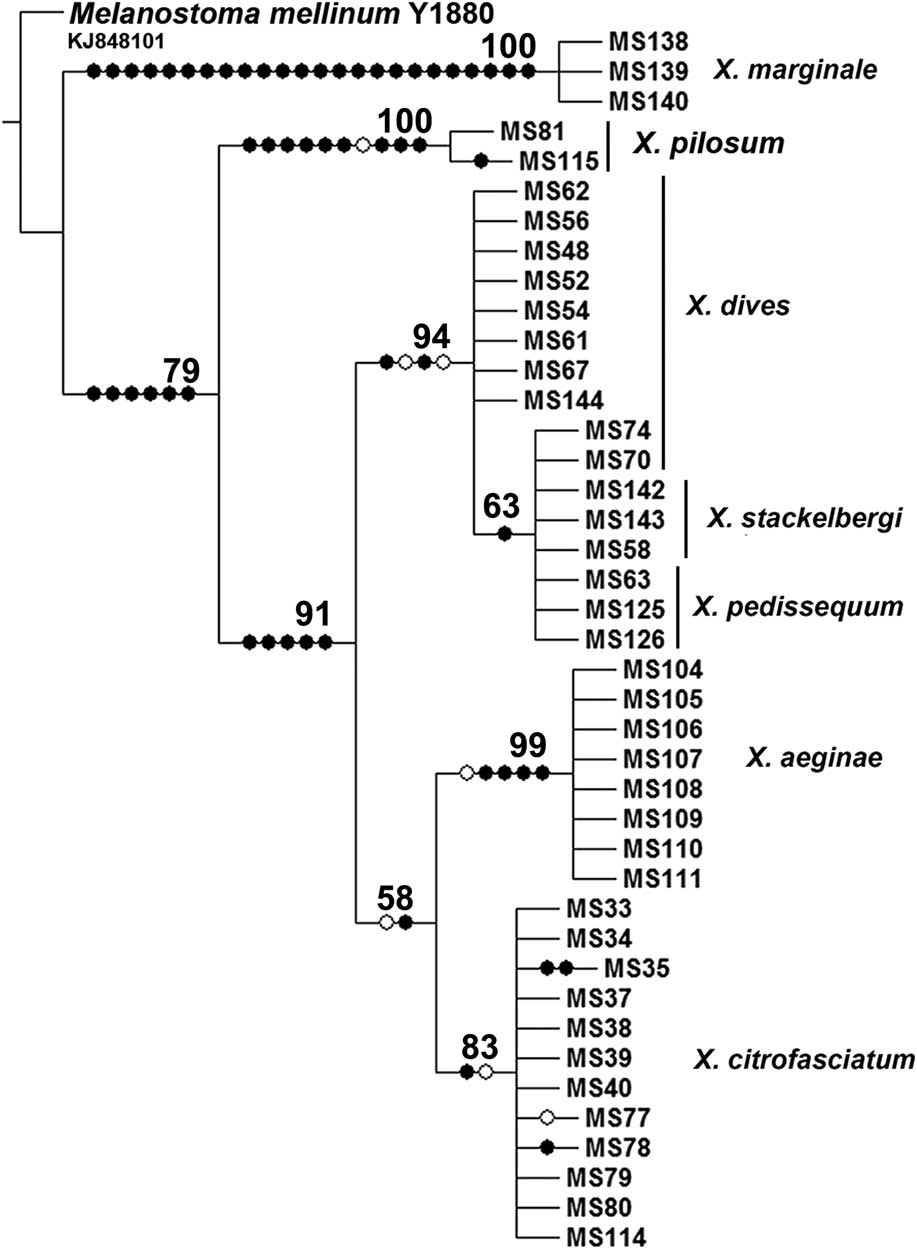
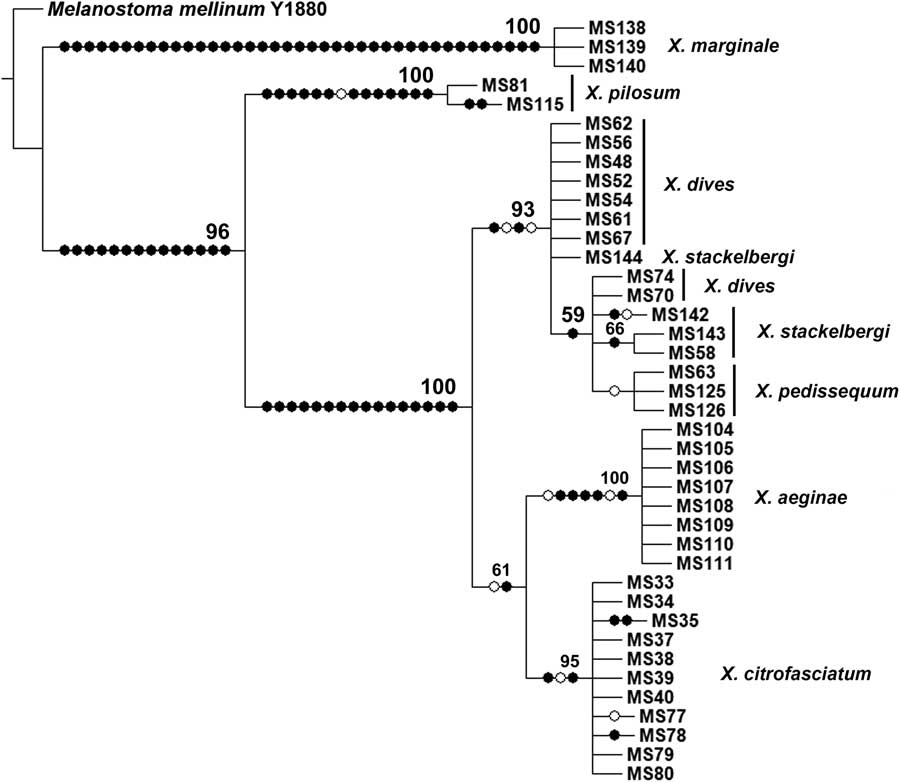
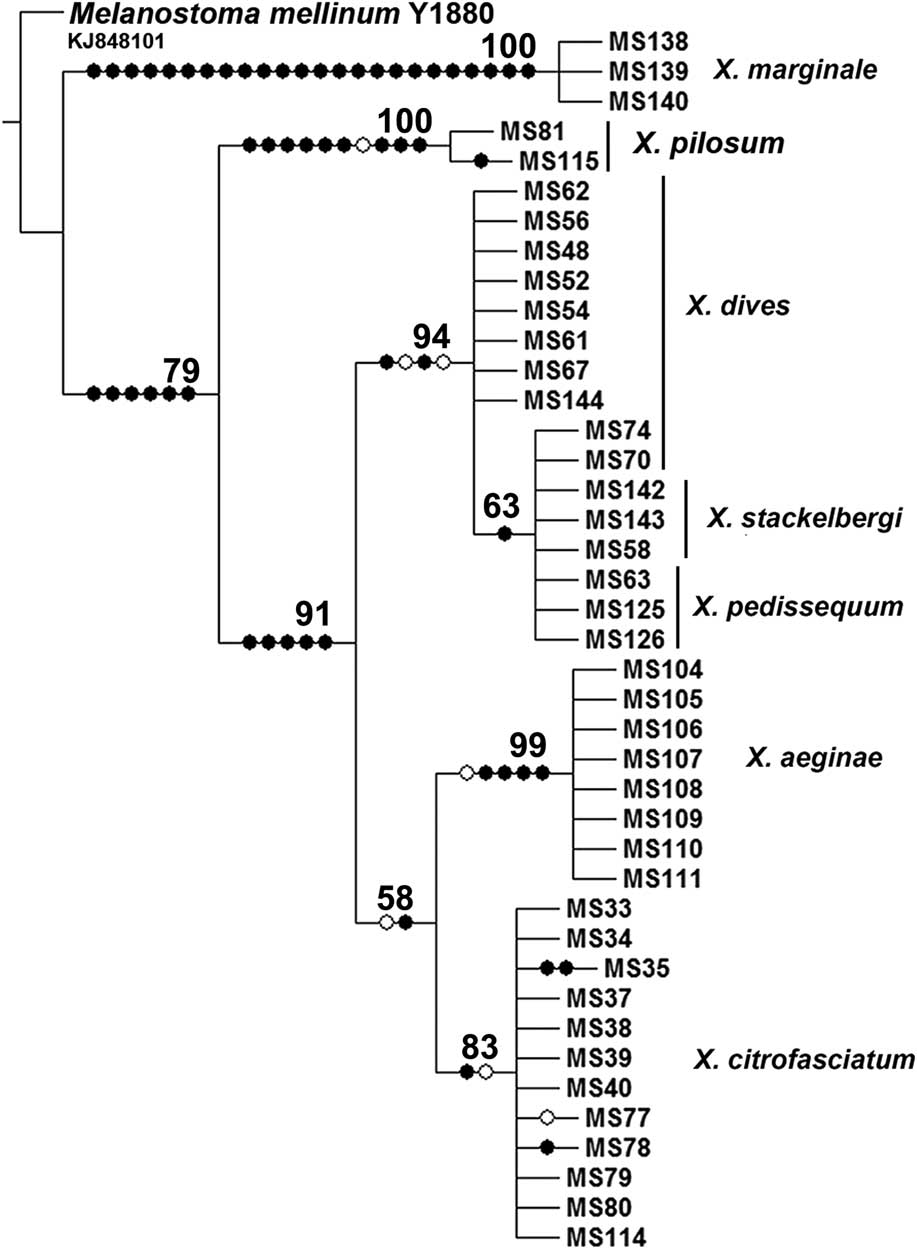
COI tree based on maximum parsimony approach. Length=130 steps; consistency index (ci)=91; retention index (RI)=96. Bootstrap values higher than 50 are indicated near nodes. Filled circles represent non-homoplasious changes and open circles homoplasious changes.
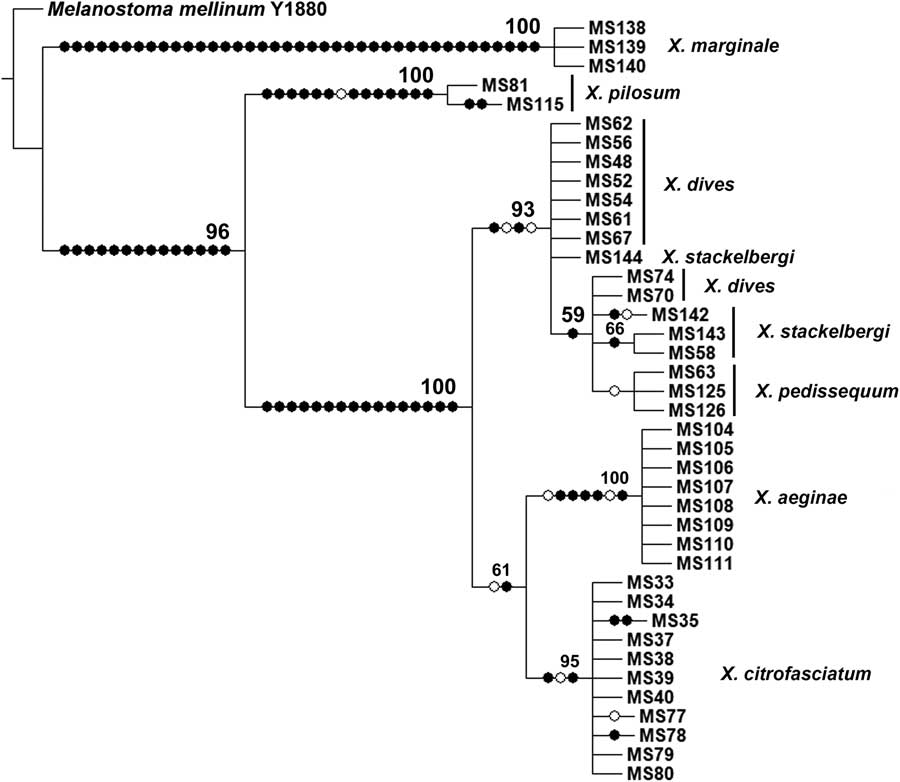
Combined analysis of COI and ITS2 sequences. Strict consensus of two equally parsimonious trees. Length=363 steps; consistency index=88; retention index=92. Bootstrap values higher than 50 are indicated near nodes. Filled circles denote non-homoplasious changes and open circles homoplasious changes.
Type material. HOLOTYPE: ♂, Greece: Lesvos, Plomari, Agios Issidoros, 13.iv.2011, Vujić and Radenković, 38.971°N, 26.387°E, (MS81) (FSUNS). PARATYPES: Greece: 1♂, Lesvos, Plomari, Agios Issidoros, 13.iv.2011, Vujić and Radenković, 38.971°N, 26.387°E (MS82) (FSUNS); 1♀, Rhodope, Maroneia, 21.iv.2014, de Courcy Williams M., 40.893°N, 25.515°E (MS115) (MCDS).
Diagnosis. Eyes long and densely pilose; frontal triangle with yellow pile; lateral parts of gena black, median part of face yellow with yellow pile; scutum with two pollinose vittae; scutellum with long, yellow pile; notopleuron yellow, at most narrowly black near the anterior anepisternum; proepimeron with small, yellow macula; posterior anepisternum with yellow macula in the posterior part; katepisternum with faint yellow macula; katatergum with yellow macula; wing cell R1 with brown pigment; anterior and apical part of cell R2+3 with brown pigment.
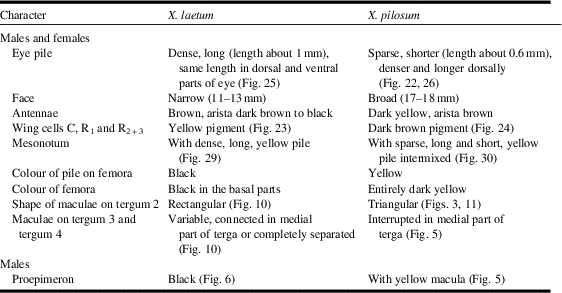
Xanthogramma pilosum can be separated from Xanthogramma laetum (Fabricius, Reference Fabricius1794) by the colour of the gena laterally, which is black in X. pilosum (Fig. 22) and mainly yellow in X. laetum (in some specimens partly black) (Table 2). Other differences separating these two species are the colour of the proepimeron in males, which is yellow in X. pilosum (Fig. 5) and black in X. laetum (Fig. 6). Pile on the frontal triangle and face are mainly black in X. laetum, but yellow in X. pilosum. Wing cells R1, C, and R2+3 have brown pigment in X. pilosum (Fig. 24), while yellow in X. laetum (Fig. 23).
Diagnostic morphological differences between Xanthogramma laetum and Xanthogramma pilosum.

Description. Male (Figs. 3, 5, 11, 22, 32). Length=9.2 mm; Wing length=8.5 mm. Head (Fig. 22). Eye conspicuously pilose (longest pile about 1.1×longer than diameter of posterior ocelli), with bare areas near eye contiguity and near posterior eye margin; eye pile straight and yellow, denser and longer dorsally; vertical triangle black with black pollinosity and yellow pile; ocellar triangle nearly isosceles; occiput grey pollinose along eye margin, with long, yellow pile; frontal triangle yellow with yellow pile dorsally and some short, black pile ventrally (near lunule); lunule transparent black; antenna yellow, scape and pedicel with short yellow pile; basoflagellomere oval, basoflagellomere at the level of the arista base=1.25 mm; arista with short, sparse pile; face yellow with yellow pile; lateral parts of gena black, median part of gena yellow with yellow pile. Thorax (Fig. 5). Scutum black with two white pollinose vittae extending for anterior two-thirds of scutum length, scutum with long yellow pile; notopleuron yellow, at most narrowly black near anterior anepisternum; proepimeron with small yellow macula; posterior anepisternum with yellow macula on posterior part; katepisternum with faint yellow macula; metaepisternum with yellow macula; scutellum transparent black in anterior part, clearly black at lateral corners and yellow in posterior part, with long, yellow pile; all legs yellow with yellow pile; wing membrane entirely microtrichose; wing cell R1 and anterior part of cell R2+3 with brown pigment; stigma dark brown to black. Abdomen (Figs. 3, 11). Shiny black with short, black pile, except tergum 1, anterior part of tergum 2, and yellow fasciae on terga with yellow pile; yellow fasciae reaching lateral margins of terga; sternum 1 completely black, covered with long, yellow pile; sterna 2–4 black with yellow fascia on anterior margin, fasciae reaching lateral margins; sternum 2 with long, yellow pile; sterna 3 and 4 with yellow pile anteriorly (including fasciae) and black pile posteriorly. Sterna 2–4 completely surrounded by membrane. Male genitalia (Fig. 32). Surstylus triangular with rounded apex. Hypandrium 2.5×longer than wide.
Female (Fig. 4). Length=12 mm. Similar to male except for following characters: face yellow with yellow pile; black vitta extending from ocellar triangle to lunule with yellow and black pile intermixed; ocellar triangle black with long, yellow pile.
Etymology. The specific epithet “pilosum” is derived from the Latin adjective pilosum meaning pilose, referring to the pilose eyes of this species.
Distribution and habitat (Fig. 38). Greece, both mainland (Rhodopes Mountains in the Thrace region) and insular (Lesvos Island). This species inhabits Mediterranean forest and shrub regions.
Natural history. Adults fly from mid to end of April. Larvae are unknown.
Xanthogramma stackelbergi Violovitsh, Reference Violovitsh1975
Xanthogramma stackelbergi Violovitsh, Reference Violovitsh1975: 99.
Material examined. Greece: 2♂, Peloponnese, Karyes, 25 km N from Sparta, 22.v.2016, 37.304°N 22.421°E, Vujić, Nedeljković, Ačanski, Likov, and Miličić (MS142, MS143) (FSUNS); Serbia: 1♀, Fruška gora, Papratski Do, 10.viii.2013, 45.137°N, 19.673°E, Nedeljković (MS147) (FSUNS); 1♂, Malinik, Manastirište, 22.vi.2012, 44.019°N 21.960°E, Vujić (MS58) (FSUNS); 1♀, Đerdap, Donji Milanovac, 7.v.2010, 44.460°N 22.155°E, Vujić (MS45) (FSUNS).
Remarks. The holotype of X. stackelbergi was examined with high-resolution photographs of the dorsal and lateral habitus of the specimen (ZISP).
Distribution. Uncertain, due to confusion between X. dives and X. pedissequum. Known from Norway, Sweden, Finland, parts of European Russia, United Kingdom, Denmark, The Netherlands, southern Germany, Switzerland, France, Italy (Speight Reference Speight2017), and Spain (Ricarte and Marcos García Reference Ricarte and Marcos García2017).
Natural history. Adults fly from mid-May to mid-August. Larvae are not described (Speight Reference Speight2017).

Molecular analyses of Xanthogramma species
A 700-base-pair fragment of the 3'-end of the COI gene was obtained for 41 specimens of Xanthogramma. ITS2 sequences varying in length from 351 base pairs to 372 base pairs were obtained for 49 specimens. The alignment of in-group ITS2 sequences resulted in a data set of 391 characters, while with the added outgroup sequence the alignment yielded 415 characters when insertion/deletion events were considered. The length of ITS2 sequence of the outgroup taxa (Melanostoma mellinum) used in alignment was 390 base pairs. The final COI data set of the in-group taxa had 66 variable positions, 61 of which were parsimony informative. The ITS2 data set had 59 variable positions and 56 were parsimony informative.
COI and ITS2 sequences were analysed separately but also as a combined data set under the maximum parsimony approach. The parsimony analysis of ITS2 sequences resulted in four equally parsimonious trees with 223 steps of length (consistency index=90, retention index=91). The strict consensus tree (length=225) resolved the species X. laetum and X. marginale, as well as the two new species, X. pilosum and X. aeginae , as monophyletic clades. Xanthogramma aeginae clade and X. citrofasciatum were resolved in a polytomy with the sequences of X. dives and X. stackelbergi. Xanthogramma citrofasciatum clade has low bootstrap support value, with one sample outside the clade (MS103). Xanthogramma pedissequum was resolved as a paraphyletic, and the cluster X. dives, X. stackelbergi, X. citrofasciatum, and X. aeginae was nested within it. In addition, Xanthogramma laetum was resolved as the sister species to remaining Xanthogramma species (Fig. 39).
The parsimony tree of COI sequences (length=130 steps, consistency index=91, retention index=96) resolved four clades, which corresponded to X. marginale, X. pilosum, X. citrofasciatum, and X. aeginae, as well as a clade that comprised sequences of three different species (X. pedissequum, X. dives, and X. stackelbergi). Within the last clade, X. pedissequum sequences form a nested clade with low bootstrap support. Xanthogramma citrofasciatum and X. aeginae were resolved as sister species. Xanthogramma laetum was not included in this analysis as we were not able to produce COI sequences for this species (Fig. 40).
Maximum parsimony analysis of the combined COI and ITS2 sequences resulted in two equally parsimonious trees (length=354 steps, consistency index=90, retention index=94). The topology of the strict consensus tree (length=363) was similar to that of COI tree (Fig. 41).
Discussion
This study integrates information from different sources, including both morphological and molecular data, to establish species limits within the European Xanthogramma species. Species boundaries, first established according to adult morphological characters, were treated as hypotheses and tested using a parsimony analysis of COI and ITS2 sequences. The results of this analysis clearly confirmed the presence of two Xanthogramma species new to science: X. aeginae and X. pilosum. In addition, the new data on the other six European species of Xanthogramma contribute to a greater understanding of the distribution and phenology of these species.
Xanthogramma aeginae can be distinguished from the similar X. citrofasciatum by the presence of a yellow macula on the proepimeron (Fig. 7), which is completely black in X. citrofasciatum (Fig. 8). The pile of the posterior anepisternum are all black in X. aeginae, but mainly yellow in X. citrofasciatum. Xanthogramma pilosum can be separated from the similar Xanthogramma laetum by the colour of the gena laterally, which is black in X. pilosum (Fig. 22) and mainly yellow in X. laetum. Other differences separating these two species are the colour of the proepimeron in males, which is yellow in X. pilosum (Fig. 5) and black in X. laetum (Fig. 6).
Xanthogramma pilosum and X. aeginae were confirmed as new species based on molecular data analyses. Both species form monophyletic clades on maximum-parsimony trees of COI, ITS2 (Figs. 36–37), and combined 3ʼCOI and ITS2 (Fig. 41). Xanthogramma aeginae is morphologically similar and closely related to X. citrofasciatum. Xanthogramma pilosum is morphologically similar to X. laetum from which differs based on ITS2 sequences. These two species form clearly separated monophyletic clades on ITS2 tree (Fig. 39).
Regarding other Xanthogramma species, molecular markers failed to separate X. dives and X. stackelbergi, in accordance with the fact that many of the morphological characters used to identify them are variable (Speight and Sommaggio Reference Speight and Sommaggio2010). However, Xanthogramma pedissequum, which has the closest morphology to X. dives and X. stackelbergi, is resolved as separate species based on ITS2 sequences, even though these three species are indistinguishable based on COI sequences. In addition, a specimen of X. pedissequum (MS49) from Montenegro (Durmitor Mountain) differs from the other three specimens of the same species (MS63 – Serbia, Novi Bečej; MS125, MS126 – Serbia, Mokrin) by two non-homoplasious characters on ITS2 tree (Fig. 39). In addition, subtle morphological differences of this outlier (MS49) were detected in comparison with the other analysed X. pedissequum specimens. Thus, further studies are required to resolve the taxonomy of the X. pedissequum species group.
Southeastern Europe, which includes the Balkan Peninsula and Aegean Islands, is one of the most important regions of biodiversity within Europe. This diversity results from the fact that this peninsula serves as a crossroads for European, Mediterranean, and Asian faunas (Crnobrnja-Isailović Reference Crnobrnja-Isailović2007; Savić Reference Savić2008; Poulakakis et al. Reference Poulakakis, Kapli, Lymberakis, Trichas, Vardinoyiannis, Sfenthourakis and Mylonas2015). For hoverflies, species diversity in the Balkan Peninsula is among the highest in Europe, with many endemic and relict species (Vujić et al. Reference Vujić, Šimić and Radenković2001), as well as cryptic taxa (Nedeljković et al. Reference Nedeljković, Ačanski, Vujić, Obreht, Đan, Ståhls and Radenković2013, Reference Nedeljković, Ačanski, Đan, Obreht-Vidaković, Ricarte and Vujić2015; Popović et al. Reference Popović, Ačanski, Djan, Obreht, Vujić and Radenković2015; Vujić et al. Reference Vujić, Ståhls, Ačanski, Bartsch, Bygebjerg and Stefanović2013, Reference Vujić, Radenković, Ačanski, Grković, Taylor, Gökhan and Hayat2015; Ačanski et al. Reference Ačanski, Vujić, Đan, Obreht Vidaković, Ståhls and Radenković2016; Šašić et al. Reference Šašić, Ačanski, Vujić, Ståhls, Radenković and Milić2016). Our research confirms that the Balkan Peninsula and Aegean Islands are important reservoirs of hoverfly diversity in Europe.
Acknowledgements
The authors thank Dr. Theodora Petanidou (MAUA), Dr. Miroslav Barták (MB), Michael de Courcy Williams (MCDS), André Van Eck (AVE), and Wouter Van Steenis (WSB) for enabling access to part of the examined material. They thank Dr. Miguel Ángel Alonso Zarazaga (Museo Nacional de Ciencias Naturales, Madrid, Spain) and Neal Evenhuis (Bernice Pauahi Bishop Museum, Honolulu, Hawaii, United States of America) for nomenclatural advice. The authors also thank Dieter Doczkal (Germany) and Dr. Martin C.D. Speight (Ireland) for taxonomic advice. Thanks to Dr. Gunilla Ståhls (University of Helsinki, Finland) for advice on molecular analyses. Thanks to Dr. Nigel Wyatt (NHM, London, United Kingdom) for information about the Harris and De Geer type specimens and photographs of Xanthogramma pedissequum. Thanks to Dr. Luca Bartolozzi (LSF), Dr. Thomas Pape (ZMUC), Dr. Sven Marotzke (ZMHB), and Dr. Olga Ovtshinnikova (ZISP) for photographs of type specimens. Thanks to Dr. Petr Heřman (NMBA, Austria) for information about the Strobl type specimens. Thanks to André Van Eck and Wouter Van Steenis for providing fresh specimens of X. laetum. Thanks to the members of the Palynology Laboratory, University of Novi Sad (Serbia) for allowing the authors use their technological facilities. The authors thank Laura Likov (Novi Sad, Serbia) for helping in preparing the figures and for producing the map. Thanks to Tamara Tot for taxonomic advice. Authors are grateful to John O’Brien for English proofreading.
Financial Support
Financial support was provided by the Serbian Ministry of Education and Science (projects OI173002 and III43002), the Provincial Secretariat for Science and Technological Development (project “Genetic resources of agro-ecosystems in Vojvodina and sustainable agriculture”), the FP7 EU project, Innosense, and the H2020 project “ANTARES” (664387), Antonio Ricarte’s position at the University of Alicante is funded by the Vicerrectorado de Investigación y Transferencia de Conocimiento).
Supplementary Material
To view supplementary material for this article, please visit https://doi.org/10.4039/tce.2018.21