The social psychological study of intergroup conflict, has, for much of this and the last century, been focused on finding ways to reduce and resolve conflict between people with well-established social identities, including ethnic, religious, political and sexual identities. A range of conflict-reduction solutions and clearly articulated theories of how these solutions exert their effects have been put forward.Footnote 2
Though theories such as realistic group conflict theoryFootnote 3 emphasize the role played by competing interests in intergroup relations, we know little about the factors that lead social actors to negotiate their differences in a way that allows them to coexist in relative peace and harmony, as indeed happens in many societies across the world.Footnote 4 Understanding the content of disagreement between social actors and how they deal with these differences (through conflict, compromise or consensus-building) is a vital area of research in pluralistic and democratic societies, such as the United Kingdom.
In such pluralistic contexts, consensus-building is likely to be a fraught and possibly unachievable goal. It may even be an undesirable one, if we heed the research that shows us that diversity can, with nuanced application, lead to greater creativity and problem-solving capabilities,Footnote 5 and that if it is experienced in a way that challenges stereotypical expectations, can lead to greater intergroup tolerance and enhanced cognitive functioning over multiple domains.Footnote 6 Thus, rather than creating an artificial consensus, what is needed is a model that allows people to engage with members of diverse groups who may have divergent ideas and interests, and to reach some form of agreement – even though it does not represent the totality of any party's interests and preferences. By accepting and valuing the plurality of society, compromise constitutes such a model,Footnote 7 and it is the linchpin of decision-making and harmonious coexistence in diverse settings.Footnote 8
In this article, we are interested in determining some of the factors that predict willingness to compromise over contentious social issues. Given the well-validated findings on the role of intergroup contact in reducing prejudice and improving intergroup relations (discussed below), we expand the remit of intergroup contact to articulate some of the ways in which it can lead groups to reach compromise over difficult issues. We start by discussing what compromise is in an intergroup context and suggest some of the factors that might promote it. In particular, we are interested in the mediating role that variables such as empathy, trust and threat play in explaining the effect of intergroup contact on willingness to compromise. We present an empirical study in which we show how compromise is reached across two different social issues about which people have differing sets of norms and expectations. We believe that our empirically driven, social psychological approach to the study of intergroup compromise provides a unique and valuable perspective to this special issue on Politics as Compromise: by establishing some of the factors that facilitate compromise in pluralistic contexts, we hope to provide some practical guidance on how individuals and organizations can deal with the diversity of norms and views that they often have to accommodate and negotiate in everyday life.
INTERGROUP COMPROMISE
All of the articles in this special issue take as their starting point a definition of the notion of compromise, which is nuanced and can differ between disciplines and sub-disciplines. To our knowledge, little social psychological research has dealt directly with the question of intergroup compromise, although an enormous amount of research has been devoted to the topic of conflict resolution. Much of this research, however, has been focused on a specific manifestation of conflict, i.e. prejudice, and the ways in which it can be reduced. While prejudice is the indisputable root of many of the problems that face diverse societies, little attention has been paid to the often-competing interests that ingroup actors have with outgroup actors,Footnote 9 and the ways in which such interests can be reconciled. In fact, it has been argued that a focus on prejudice reduction can result in intergroup actors getting to know and like one another rather than taking action to safeguard their group interests.Footnote 10 We believe that it is essential to develop a better understanding of intergroup compromise, particularly when societies around the world are getting more diverse, and some have even entered the era of what Vertovec calls ‘super-diversity’.Footnote 11 In such situations, prejudice reduction must take a back seat, because social cohesion is better served when diverse social actors feel that their views have been heard, and that they can play a role in shaping public discourse.
When members of different groups have divergent collective goals and live within a liberal democratic context that embraces ideological pluralism, they have a number of possible choices through which to achieve their outcomes. They can hold, unyieldingly, to their preferences, and find themselves at an impasse or in direct conflict with the outgroup. Or, they can capitulate completely, conceding their ground in the interest of the greater good (or perhaps motivated by cost–benefit analyses), which is likely to be an aversive and short-lived strategy. Alternatively, and perhaps most desirably, they can work out what the essence of their beliefs is, and yield the rest of it up to negotiation in an effort to conform to the multicultural zeitgeist that promotes intergroup cooperation and harmony, while still retaining that part of their ideas/preferences of greatest value to them. Thus, intergroup compromise involves adapting the ingroup's position to align it more closely with that of the outgroup and, in so doing, sacrificing some of one's own preferences (e.g. granting an outgroup rights that one would rather withhold, or accepting an outcome that is less than one would ideally like) in order that a course of action can be determined. This is what we submit to be intergroup compromise, and we believe it stems, in part at least, from the aversion of social actors to the transgression of social norms which promote intergroup cooperation and harmony. Work in the United States on aversive racism has shown that appearing racist has become aversive to many White Americans in terms not only of their public image but also in terms of their private self-concept.Footnote 12 People seek to adhere to social norms while still maintaining and protecting their own beliefs, values and interests. Thus they are able to align their intra- and intergroup selves with the social norms of the day, staving off the cognitive dissonance that would arise from a lack of such alignment.Footnote 13 We believe that when ingroup members perceive that outgroup members are willing to compromise and give up on some of their preferences in order to get closer to ingroup preferences, this should lead ingroup members to view the outgroup more favourably and prevent, or reduce the escalation of, conflict with them. Because it is very difficult to measure actual intergroup compromise directly (which would involve participant observations, ideally repeatedly, in intergroup settings), in this article we focus on willingness to compromise as an attitudinal proxy.
ALTRUSITIC AND EGOISTIC MOTIVATIONS OF WILLINGNESS TO COMPROMISE
Social actions can be driven by an altruistic orientation, an egoistic one, or a combination of the two. Altruism refers to a motivational state, with the ultimate goal of increasing another's welfare; egoism refers to a motivational state with the ultimate goal of increasing one's own welfare.Footnote 14 In this section we will consider how both altruistic and egoistic motivations promote willingness to compromise.
Compromise, as we have defined it, involves some degree of sacrifice of one's own preferences in order to promote the welfare of another, but promoting the welfare of another does not require that one's own welfare must necessarily be forfeited. While compromise may involve some short- to medium-term sacrifice of one's preferences (such as giving up a valued moral position), it may also result in longer-term gain. Social actors may have various intermediate goals for their actions, but whether compromise is driven by altruistic or egoistic motivations depends entirely on what the ultimate goal of the compromise is. If the ultimate goal is to increase the welfare of the outgroup (by, for example, allowing them certain rights that have typically been the preserve of the ingroup), then the ingroup member's willingness to compromise can be fairly assumed to be altruistically motivated. If, instead, the ultimate goal is to increase the welfare of the ingroup (by, for example, conceding on a particular issue to the outgroup so that they will in turn concede on another issue of greater importance to the ingroup), then the ingroup member's willingness to compromise can be fairly assumed to be egoistically motivated. What of a third option, which is of particular pertinence in an intergroup context? What if the ultimate goal of ingroup members is to prevent intergroup conflict or reduceintergroup animosity? This can, arguably, be said to be an ultimate goal that increases both ingroup and outgroup welfare, and thus may perhaps have both altruistic and egoistic motivations.
While Batson and his colleagues have provided extensive evidence of the ways in which one's motivations drive prosocial behaviour, and developed paradigms for isolating which form of motivation is most likely active,Footnote 15 we believe that intergroup compromise represents an instance of behaviour that most probably involves both altruistic and egoistic motivations. In particular, the benefit derived by the ingroup, such as the prevention of intergroup conflict, is such an important and salient outcome of intergroup compromise that its egoistic motivation cannot be ignored, even if the initial willingness to compromise arose from more altruistic motivations to improve the welfare of the outgroup.
INTERGROUP CONTACT
An enormous amount of research and a rigorous meta-analytic review of itFootnote 16 has pointed to the role that positive intergroup contact can play in reducing conflict.Footnote 17 This research demonstrates that people who have more positive intergroup contact perceive the outgroup to be less threatening,Footnote 18 have greater empathy and are better able to take the perspective of the outgroup,Footnote 19 have greater trust towards them,Footnote 20 and are less anxious about interacting with them.Footnote 21 These factors, in turn, predict lower levels of outgroup prejudice. This literature has only recently begun to deal with the impact of negative intergroup contact on intergroup relations,Footnote 22 and we believe that this is an important dimension to consider in the present research. As we will discuss below, social actors interact repeatedly and build or lose trust over time, and thus the experience of repeated negative intergroup contact can have a significant impact on how social actors view one another. In contrast, research has shown that ‘controlled communicative contact’, in the form of structured meetings between Israeli Jews and Palestinians, is associated with Israeli Jews' increased willingness to support peaceful conflict resolution, including ‘integrative compromise solutions’, and is mediated by increased outgroup trust.Footnote 23 Thus, intergroup contact is a powerful predictor of altruistic and egoistic motivations to compromise.
PRESENT RESEARCH
In the present research, we present a framework for understanding compromise and the factors that motivate it. Compromise is an important component in negotiating and settling differences in a range of social spheres, including those involving political actors. We seek to outline a model involving proximal and distal predictors that will give social actors and facilitators a means by which to create settings in which people show a greater willingness to compromise. Proximal predictors are those that we believe to be intimately connected with willingness to compromise, while distal predictors are thought to have a more distant, and possibly mediated, impact on willingness to compromise. In our proposed model, we position altruistic and egoistic motivations as proximal predictors of compromise, and intergroup contact as a distal predictor of compromise, but as a proximal predictor of the motivations to compromise.
Starting with altrusitic motivations, Batson has argued that the most likely source of altruistic motivation is empathic concern.Footnote 24 Empathic concern is described as an other-oriented emotional response, involving feelings such as sympathy and compassion, which arise when we witness someone in need. There is extensive evidence that empathic concern motivates prosocial behaviour,Footnote 25 and some evidence that feelings of sympathy are associated with positive attitudes towards compromise.Footnote 26 In terms of conflict resolution, empathy has been seen as a means to overcome distrust between conflict protagonists, and as an essential element of reconciliation.Footnote 27
Moving on to egoistic motivations, the greatest source of these is likely to be concern for the ingroup's well-being, in the form of threats to the ingroup. This concern can have multiple dimensions – for instance, concern for the ingroup's advancement, concern for the ingroup's safety and concern for the ingroup's rights. In the intergroup literature, this concern is often expressed in the form of perceived threats that the outgroup poses to the ingroup, whether those threats are realistic or symbolic in nature. In integrated threat theory, Stephan and Stephan's conception of realistic threat refers to perceived threats to the ingroup's material and physical well-being, such as having access to political and economic capital and feeling physically safe in the presence of outgroup members.Footnote 28 Symbolic threat arises because ingroup members see intergroup differences in respect of norms and values, and believe that their way of life is superior to that of the outgroup, and under threat by them. Some previous research has indicated a link between some forms of threat (i.e. zero-sum threat perceptions) and negative attitudes toward compromise,Footnote 29 and reported that the more threatened people feel, the more their policy choices tend to maintain or intensify conflict, rather than becoming oriented to compromise.Footnote 30
The present research considers the role that perceptions of symbolic threat and empathic concern for the outgroup play in promoting willingness to compromise (we focus on symbolic threat because of the nature of our target outgroups, which differ in terms of values, rather than posing realistic threats to power and status). We believe that people who perceive the outgroup as less symbolically threatening to them (in terms of their cultural preservation) are more likely to want to compromise with the outgroup on a contentious topic. For example, if the issue over which compromise is sought is whether homosexual couples should be permitted to adopt children,Footnote 31 then heterosexuals who may not feel entirely comfortable with such adoption may be willing to compromise on this issue if they feel that homosexual people do not in general threaten heterosexuals' way of life or values. Thus, in this instance, willingness to compromise depends on ingroup actors feeling that their welfare has been taken care of. On the other hand, if heterosexuals feel empathy for homosexuals in general, then this may drive their willingness to compromise over this issue, and this would be an instance of other-regarding motivation for compromise.
Another, perhaps less obvious, dimension of egoistic motivation in the context of intergroup compromise is intergroup trust.Footnote 32 Trust can be seen as a psychological means to overcome uncertainty by making benign assumptions about other people's behaviour,Footnote 33 and it can be very broadly defined as a positive bias in the processing of imperfect information.Footnote 34 If ingroup members trust the outgroup not to take advantage of them, or trust them to be fair to the ingroup, then they may be willing to compromise with them on issues of importance to the outgroup, because this bodes well for future intergroup transactions and negotiations, where the ingroup may depend on the goodwill of the outgroup. Thus trust is a key aspect of social decision-making in the real world, where there are repeated intergroup interactions, and where the ingroup and the outgroup may take turns in being the party that needs to compromise over a variety of issues. Trust is, moreover, associated with a more inclusive sense of ingroup identity (e.g. categorizing ingroup and outgroup as similar at the superordinate level) and a higher readiness to resolve conflict through compromise.Footnote 35
In addition to these two types of motivation, as discussed above, positive intergroup contact can play a vital role in reducing conflict,Footnote 36 and is a powerful predictor of the types of altruistic and egoistic motivations that we have argued proximally predict willingness to compromise. Given the diversity of many societies around the world, we believe that greater contact with the outgroup will affect ingroup social actors' sense of empathy towards the outgroup, feelings of outgroup trust and perceptions of symbolic threat from them, which in turn should shape their willingness to compromise on issues of importance to the outgroup – a topic that has largely been overlooked in social psychological research on intergroup relations. Our research sought to measure the extent to which altruistic and egoistic motivations simultaneously play a role in predicting willingness to compromise, and the extent to which the motivations are associated with greater positive intergroup contact. This study, set in the UK, focused on compromise with two outgroups (Muslims and homosexuals) over some contentious social, religious and educational issues.
Contemporary Britain is a diverse and pluralistic society in which peoples of various ideological, political, ethnic, religious and sexual persuasions, among others, are given a voice and the right to fair and equal treatment under the law (an approach endorsed by the ‘Life in the UK’ test that has to be passed by all those seeking naturalisation as a British citizenFootnote 37 ). Recently, there has been intense debate about what constitutes fair treatment for various groups in society,Footnote 38 most prominently Muslims: for example in terms of their right to broadcast their call to prayer, the rights of Muslim women to wear the burqa and the operation of Muslim faith schools.Footnote 39 We consider the willingness of people to compromise over some of these issues, and also over issues of great symbolic and practical significance to another long-standing minority social group that is also often in the media – homosexuals.Footnote 40 The concessions or sacrifices involved in compromise over these issues involve non-Muslims and heterosexuals possibly giving up deeply held moral preferences and granting Muslims and homosexuals the rights that have traditionally been preserved for members of the ingroup.
Hypothesis 1: The effect of positive contact experiences on willingness to compromise is mediated by trust, symbolic threat and empathy.
In other words, positive contact should be associated with more empathy and trust, and less perceived symbolic threat. Greater trust and empathy should, in turn, be associated with greater willingness to compromise, while greater symbolic threat should be associated with less willingness to compromise.
Hypothesis 2: The effect of negative contact experiences on willingness to compromise is mediated by trust, empathy and symbolic threat.
In other words, negative contact should be associated with more threat, and less trust and empathy. In turn, threat should be associated with less, and trust and empathy with more, willingness to compromise.
In all analyses we investigated the willingness to compromise over Muslim/homosexual issues while controlling for general willingness to compromise, measured as an individual-difference variable.
STUDY METHOD
Participants
This study was conducted in the UK using a sample of university students (N = 70, male = 21; female = 49; mean age = 18.54; SD = 0.74). When asked about sexual orientation and religion, none of the participants stated that they were homosexual or Muslim.
Measures
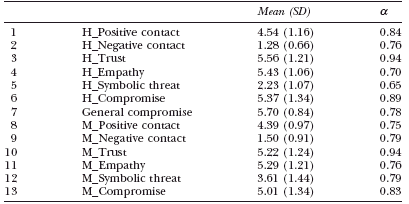
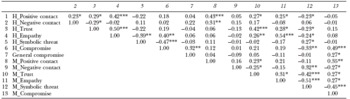
All items were measured on a seven-point scale. The means and Cronbach's alphas (reliability scores) for each variable are reported in Table 1, and inter-item correlations are reported in Table 2. The contact questions were adapted from Islam and Hewstone.Footnote 41 All participants were asked about their perceptions of and inclinations towards both homosexuals and Muslims, and order of rating the two groups was counterbalanced across participants (there were no order effects).
Means, Standard Deviations (SD) and Cronbach's Alpha

Note: H_ refers to the constructs related to homosexuals; M_ refers to those related to Muslims.
Inter-Construct Correlations (r)

Notes: H_ refers to the constructs related to homosexuals; M_ refers to those related to Muslims.
***p < 0.001; **p < 0.01; *p < 0.05; †p < 0.10.
Positive contact was composed of five items that measured: (a) quantity of contact (three items); and (b) quality of contact (two items). Participants were asked about the amount of contact they had with homosexuals/Muslims (in their home towns or at university) ‘at meetings or events’, ‘just chatting’, and in ‘general social situations’, and the extent to which they found their contact experiences with homosexuals/Muslims to be ‘pleasant’, and ‘voluntary’.
Negative contact was measured by two items: ‘Have you had any bad experiences with homosexuals/Muslims?’, and ‘Have you been hurt (physically/verbally) by homosexuals/Muslims?’
Trust was measured by two items: ‘Do you trust homosexuals/Muslims to treat you well?’, and ‘Do you trust homosexuals/Muslims to be fair to you?’ These questions were based on Brehm and Rahn's measure of trust,Footnote 42 worded to measure outgroup trust.
Empathy was measured by two items: ‘How much do you care about the problems of homosexuals/Muslims?’, and ‘Do you feel pity for homosexuals/Muslims when you see them being treated unfairly?’ These questions were adapted from Batson et al. and Davis.Footnote 43
Symbolic threat was measured by the items: ‘Many homosexual/Muslim people are beginning to assert their identity in a way that I find threatening’, ‘Many homosexual/Muslim people think that their way of life is better than my group's way of life’ and ‘Most homosexual/Muslim people have values that don't fit with the values of most people from my group’.
Willingness to compromise was assessed by providing participants with short passages in which they read about some controversial issues to do with the rights of homosexuals and Muslims (these passages are available from the first author on request). Specifically, participants were asked about four issues: broadcasting the Muslim call to prayer; Muslim women in the UK wearing the burqa; permitting homosexual couples to adopt children; and teaching about homosexuality in schools. In each instance, willingness to compromise was measured by two items: ‘I would support homosexuals'/Muslims' right to do X (depending on the issue at hand), even if it is something I am not personally comfortable with’, and ‘Sometimes it is better to compromise and get along with homosexuals/Muslims than to always get our way’.
Finally, general tendency to compromise was measured by asking participants the extent to which they agreed/disagreed with the following four statements: ‘Sometimes it is better to compromise and get along with people from other groups than to always get our way’, ‘Members of my group should make sacrifices to resolve an intergroup conflict, if members of other groups also make sacrifices’, ‘Compromise is a good thing because it means that each group sacrifices in order to reach a mutually advantageous goal’ and ‘When we live in diverse societies it is important to find a middle ground; we can't always get everything we want’.
RESULTS
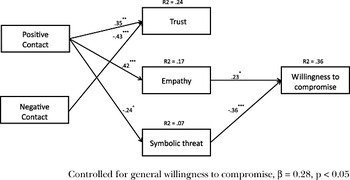
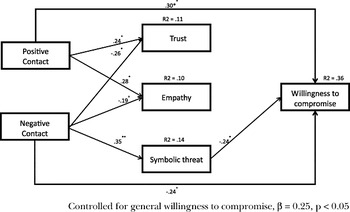
We conducted saturated path analyses in MPlus (version 6.0), in which positive and negative contact were treated as predictor variables, trust, symbolic threat and empathy as mediator variables, and willingness to compromise on Muslim/homosexual issues as the dependent variable. We also controlled for the effect of the individual-difference variable, general willingness to compromise, on willingness to compromise over specific issues. As all participants were asked about their perceptions of and inclinations towards both homosexuals and Muslims, analyses were conducted simultaneously for compromise on homosexual issues and compromise on Muslim issues, though for ease of visualization, separate path diagrams are reported for each target group (Figures 1 and 2). Standardized beta paths are reported here.
Factors Predicting Willingness to Compromise on Homosexual Issues

Notes: ***p < 0.001; **p < 0.01; *p < 0.05; +p < 0.10.
Factors Predicting Willingness to Compromise on Muslim Issues

Notes: ***p < 0.001; **p < 0.01; *p < 0.05; +p < 0.10.
As can be seen in Figure 1, positive contact with homosexuals was associated with greater trust (β = 0.35, p < 0.01) and empathy towards homosexuals (β = 0.42, p < 0.001), and less perceived threat from them (β = −0.24, p < 0.10). Negative contact was associated with reduced trust (β = −0.43, p < 0.001). Empathy was associated with greater willingness to compromise on homosexual issues (β = 0.23, p < 0.05), while threat was associated with reduced willingness to compromise (β = −0.36, p < 0.001). Further, one's general tendency to compromise was associated with greater willingness to compromise on homosexual issues (β = 0.28, p < 0.05).
We conducted a bootstrap analysis in order to determine indirect effects. As predicted, the effect of positive contact on willingness to compromise on homosexual issues was mediated by empathy (β = 0.10; 95% CI: (0.018, 0.176)) and by symbolic threat (β = 0.09; 95% CI: (0.006, 0.171)). However, the effect of positive contact on willingness to compromise on homosexual issues was not mediated by trust, nor did we find the effect of negative contact on willingness to compromise on homosexual issues to be mediated by threat. Overall, the predictor and mediator variables accounted for 36 per cent of the variance in willingness to compromise over homosexual issues.
As can be seen in Figure 2, positive contact with Muslims was associated with greater trust (β = 0.24, p < 0.05) and empathy (β = 0.28, p < 0.05) towards them, and directly with greater willingness to compromise on Muslim issues (β = 0.30, p < 0.01). Negative contact was associated with reduced trust (β = −0.26, p < 0.05), empathy (β = −0.19, p < 0.10), and greater perceptions of threat (β = 0.35, p < 0.01). Threat was associated with reduced willingness to compromise (β = −0.24, p < 0.05). Further, one's general tendency to compromise was associated with greater willingness to compromise on Muslim issues (β = 0.25, p < 0.05). Willingness to compromise on Muslim issues and homosexual issues were positively correlated (β = 0.55, p < 0.001).
As predicted, the effect of negative contact on willingness to compromise on Muslim issues was mediated by symbolic threat (β = −0.08; 95% CI: (−0.165, −0.004)). However, we did not find that the effect of positive contact on willingness to compromise on Muslim issues was mediated by trust, empathy or threat. Overall, the predictor and mediator variables accounted for 36 per cent of the variance in willingness to compromise over Muslim issues.
DISCUSSION
Consensus may not be an achievable or desirable goal in all diverse contexts. As the results from this study demonstrate, compromise may be a more appropriate goal, and one which can arise from positive intergroup interactions. We first summarize our results, and then interpret them in the context of the literature and of contemporary intergroup relations in the United Kingdom. We then discuss the implications of our findings for decision-making and harmonious coexistence in pluralistic societies, and end by discussing some limitations of our study and offering suggestions for future research.
Summary of Results
We found that positive contact with homosexuals and Muslims was associated with greater trust and empathy towards them. In addition, positive contact was associated with a reduction in perceived symbolic threat from homosexuals, while negative contact was associated with an increase in perceived symbolic threat from Muslims. Negative contact was also associated with a decrease in trust towards both homosexuals and Muslims, and a reduction in empathy towards Muslims.
We found that empathy and symbolic threat acted as mediators of the relationship between positive contact and willingness to compromise. In other words, those who had more positive contact with homosexuals perceived them to be less threatening, and felt more empathy towards them, and in turn, were more likely to compromise on issues of importance to them. In the case of the Muslim outgroup, we found that symbolic threat acted as a mediator of the relationship between negative contact and willingness to compromise. In other words, those who had more negative contact with Muslims perceived them to be more threatening, and in turn, were less likely to compromise on issues of importance to them.
In the case of the Muslim target group, while negative intergroup contact partially exerted its effect on willingness to compromise through an increase in symbolic threat, it was also directly associated with less willingness to compromise, while positive intergroup contact with Muslims was directly associated with a greater willingness to compromise, and did not seem to operate through any of the mediating variables in our model.
Interpretation and Implications of Results
These results, and the substantial amount of variation explained in willingness to compromise with both target groups, demonstrate the explanatory power of both altruistic and egoistic motivations when predicting willingness to compromise. These results illuminate the ways in which both these motivators act as mechanisms through which positive and negative contact experiences exert their effects. While the egoistic motivation of symbolic threat and the altruistic motivation of empathy are powerful predictors of willingness to compromise, we did not find, in the context of the present sample, that intergroup trust played a role in explaining why people compromise.
Interestingly, in the case of compromise with homosexuals, it was only positive, and not negative, contact which was implicated. In the case of compromise with Muslims, it was negative contact which played a more powerful role, although positive contact was also directly associated with greater willingness to compromise. This is an unexpected result, especially when looking at the mean level of negative intergroup contact with both target groups, which is low and not significantly different between groups. Why, then, does negative intergroup contact with Muslims have an impact on willingness to compromise, while seemingly equivalent negative intergroup contact with homosexuals does not? When interacting with Muslims, it seems that negative interactions can trigger the perception that Muslims threaten the symbolic well-being of the participants. This may be because people attribute the negative interactions that they have with Muslims to the inherent differences in culture and values that Muslims and non-Muslims have, and thus negative interactions trigger a heightened sense of such threats. This does not appear to happen when people have negative interactions with homosexuals, which may have something to do with the fact that, on average, people perceive homosexuals to be less different to themselves than they way they see Muslims to be. This difference in the effects of negative contact between the target groups may also arise from an inflated sense of these differences (and the threats that they pose to the ingroup) fuelled by the media and public discourse surrounding issues of Muslim non-integration into British society.Footnote 44 As such a discourse is not as prominent in the United Kingdom surrounding issues to do with homosexual rights, it is possible that people attribute negative intergroup encounters with homosexuals to individual-level situational and dispositional factors, rather than to perceived group differences.
What are the implications of these findings? To begin with, they provide support for the effectiveness of intergroup contact, which past research has shown to reduce prejudiceFootnote 45 and symbolic threat,Footnote 46 and to increase empathyFootnote 47 and trust.Footnote 48 We have shown that contact is associated with greater willingness to compromise with an outgroup on contentious social issues. This first evidence of the effect that positive intergroup contact can have on promoting willingness to compromise has critical implications for the way in which policymakers deal with the increasing diversity of the societies that they oversee.
The coexistence of peoples of different faiths, and ideological and sexual orientations, can be expected to give rise to intergroup tensions, at times, as individuals find that they have to navigate their way in an increasingly complex social world, governed by a set of norms and behaviours that they may not normally think about or endorse. The results of our research suggest that if people from different groups can be encouraged and facilitated to engage in positive intergroup contact, then some of the intergroup tensions that arise from living in a pluralistic setting may be mitigated when people show willingness to compromise over contentious issues.
Some past research has shown that positive intergroup contact between majority group and minority group members can lead minority group members to reduce identification with their ingroup,Footnote 49 and to be disinclined to take action that improves the standing of their ingroup, because they have now established positive attitudes towards the majority group, and are thus unwilling to take action that may appear to threaten the status of the majority group.Footnote 50 This prior research also shows that majority group members in such situations will be disinclined to do anything to alter the status quo because it benefits them, and also because they have not been confronted with agitation by minority group members. In contrast, our research, which is based on the responses of heterosexual and predominantly White Christian/atheist participants (who are, in both cases, effectively members of the majority group in relation to homosexuals and Muslims), shows that majority group members who have positive intergroup contact experiences are more likely to compromise on issues of practical and symbolic significance to the minority group. While our results are not necessarily at odds with those of Wright and Lubensky and Saguy, they do suggest that intergroup contact can do more than allow majority group members to improve their attitudes towards the outgroup: in fact, it can result in them yielding some ground to the minority groups. It is, however, entirely possible that, from an egoistic motivational perspective, majority group members may feel that compromising over some issues is inevitable in a pluralistic context such as the United Kingdom, but may be less willing to concede on issues of greater symbolic and practical significance to their ingroup, thus doing little to alter the status differentials between them and the minority group.
While we agree with research that argues that agitation against the status quo is something that ought to come from disadvantaged and minority group members,Footnote 51 we do not believe that this is a one-way street with no active role for majority group members. Even if the impetus for change does come from the minority group, the majority need to show an openness for change and a willingness to shift their position. We believe that our results show that positive intergroup contact can promote such an openness, in the form of willingness to compromise.
Our research is also part of a small but growing literature that attempts to show the effects of negative contact experiences on intergroup relations.Footnote 52 The implication of our results is that while positive intergroup contact can be hugely beneficial in preventing or resolving intergroup tensions, negative intergroup contact can have the opposite effect, and thus interventions designed to increase the amount of intergroup contact need to ensure that the contact is of the right sort, just as Allport cautioned decades ago.Footnote 53 What is particularly striking about our results is that negative contact experiences with Muslims seemed to have an impact on willingness to compromise with them in a way that negative contact experiences with homosexuals did not. Thus negative contact with members of different groups exerts differential effects on intergroup relations, such that with some outgroups (e.g. those vilified in the media), negative intergroup contact can be more detrimental than negative contact with members of other outgroups. That this should be the case with the Muslim outgroup rather than with homosexuals is perhaps unsurprising in the context of political debate and public discourse in the United Kingdom, as discussed above. Thus, interventions that seek to improve the willingness to compromise need to be mindful of the role that negative contact experiences can play, particularly in the case of particular target groups.
Limitations and Directions for Future Research
While we believe that the present research has identified new ways in which intergroup contact can affect intergroup relations, it is not without its limitations. The study we described focused on situations in which one group demonstrates its willingness to compromise on particular issues to do with the outgroup, without taking into account the extent to which the outgroup would be willing to compromise on the same issues. Reciprocity is a key component in willingness to compromise, particularly in situations where social actors interact in a repeated manner, as they do in the real world, with reciprocity and trust being built up over time. Trust is associated with the development of positive affect from repeated successful exchanges.Footnote 54 Yet it involves taking steps into the unknown, or risks; as Kramer and Carnevale pointed out, ‘People must engage in appropriate interpersonal “experiments” if they are to generate the diagnostic data necessary to learn who among them can be trusted and how much.’Footnote 55 Similarly, compromise requires both sides to yield some ground voluntarily; it would be important to examine the extent to which one group's willingness to compromise is related to the other group's willingness to do the same, and this is an important area for future research.
We have used a convenience sample of university students for our study, and thus we cannot take their responses to be representative of the population. This is typical of social-psychological research, which seeks, primarily, to identify underlying processes and test theoretical models, rather than to generalize findings to population samples. Future work should, however, seek to replicate and extend this research using a much larger and more diverse sample. Notwithstanding, this study provides vital information about how young, educated people – who are likely to go on to take up various positions of responsibility and power in society – think about contentious social issues, and it elucidates some of the factors that may predict their willingness to reach a compromise with people who have different values and customs to their own.
Our data are cross-sectional, which allows us to report only associations between variables, but a true test of the predictors of compromise necessitates longitudinal or experimental data. Through such data, we would be able to say with greater certainty that it is contact that leads to compromise rather than vice versa. Having said that, the growing body of longitudinal research on the effects of intergroup contact has shown that while intergroup contact and prejudice have reciprocal effects on one another, there is clear evidence that more intergroup contact leads to less prejudice.Footnote 56
Finally, future research would benefit from the inclusion of other mediators of the effect of contact on compromise. We believe that the altruistic–egoistic motivations framework we have presented offers promise for thinking about what other factors may act as key mechanisms through which contact exerts its effects. Further, in light of research that shows that people who value diversity are more willing to have intergroup contact,Footnote 57 future studies on willingness to compromise would benefit from explicitly modelling the moderating role that an endorsement of diversity and multiculturalism may play in strengthening the effects of contact of compromise.
CONCLUSION
Our research has elucidated some of the predictors of willingness to compromise over two topical and contentious social issues involving two very different types of target groups. We have found that intergroup contact is an important predictor of willingness to compromise, and that positive and negative contact experiences have differential effects. Interventions and policies (at both an educational and political level) that seek to manage and harness the diversity of societies would do well to create intergroup situations in which people were able to have positive contact experiences that are empathy-promoting and do not pose symbolic threat, in order to make individuals more likely to be willing to compromise over otherwise divisive issues.