INTRODUCTION
Studies of the effects of forest disturbances, especially logging, have revealed incidental impacts such as damage to seedlings, saplings and the canopy (Pereira et al. Reference PEREIRA, ZWEEDE, ASNER and KELLER2002, White Reference WHITE1994). However, it is also recognised that the secondary effects of logging may in some cases outweigh the initial damage done by logging. For instance, logging is often accompanied by an increased incidence of hunting, fire and human occupation (Laurance et al. Reference LAURANCE, ALONSO, LEE and CAMPBELL2006). The chain of damaging consequences of these exploitations is believed to lead to loss of ecological services and loss of timber and non-timber forest products (Bawa & Seidler Reference BAWA and SEIDLER1998). This reduces the conservation value of remnant forests which in turn undermines their survival.
With the increasing demand for timber and other forest products triggered by growing human populations in developing countries where these forests are located, it is certain that sustainable management of these remnant forests will be a major challenge (Wright & Muller-Landau Reference WRIGHT and MULLER-LANDAU2006). Thus there is a need to understand the dynamics of plant and animal populations in secondary tropical forest landscapes. Perhaps of most importance is understanding the ecological processes that are vital for maintenance of viable tree and animal populations. Seed dispersal is one of the key ecological processes affected by forest disturbances and is very influential in plant community dynamics (Barlow & Peres Reference BARLOW and PERES2006, Howe & Miriti Reference HOWE and MIRITI2000). Seed dispersal is crucial for reducing distance- or density-dependent mortality of trees (Hardesty et al. Reference HARDESTY, HUBBELL and BERMINGHAM2006). In addition, within a forest landscape there are sites, such as gaps, that are more favourable for juvenile establishment than others. Consequently, the more widely the seeds of a species are dispersed, the greater the chances that offspring will reach such favourable sites. In tropical rain forests, > 70% of tree species are dispersed by animals (Corlett Reference CORLETT1996, da Silva & Tabarelli Reference DA SILVA and TABARELLI2000, Gautier-Hion et al. Reference GAUTIER-HION, DUPLANTIER, QURIS, FEER, SOURD, DECOUX, DUBOST, EMMONS, ERARD, HECKETSWEILER, MOUNGAZI, ROUSSILHON and THIOLLAY1985). Seed-dispersing animals are believed to influence tree spatial distribution through the seed dispersal kernel they create (Stoner et al. Reference STONER, RIBA-HERNANDEZ, VULINEC and LAMBERT2007). A seed dispersal kernel is the post-dispersal spatial pattern of seed deposition for a particular fruit-producing species. The shape of the seed dispersal kernel is defined by the dispersal and predation processes that produce it, namely, what proportion of seeds are removed from parent tree crowns (visitation and seed removal), how far those seeds are moved from the parent (dispersal distances), the locations and density at which seeds are deposited (dispersal sites and seed densities), and the seed and seedlings predation patterns (Dirzo et al. Reference DIRZO, MENDOZA and ORTIZ2007). Due to the diversity in behavioural ecology among seed-dispersing animals, the resulting seed dispersal kernels are similarly diverse (Balcomb & Chapman Reference BALCOMB and CHAPMAN2003, Kaplin & Moermond Reference KAPLIN and MOERMOND1998, Lambert Reference LAMBERT2000, McConkey Reference MCCONKEY2000, Wrangham et al. Reference WRANGHAM, CHAPMAN and CHAPMAN1994). Consequently, it is plausible that frugivore diversity in tropical forests may have a strong influence on tree recruitment and spatial distribution (Terborgh et al. Reference TERBORGH, PITMAN, SILMAN, SCHICHTER, NUNEZ, Levey, Silva and Galetti2002). Thus, implying that spatial recruitment of tree species in a forest landscape is altered following loss of some frugivore species.
This study examined recruitment and spatial distribution of juveniles of selected tree species in three tropical forests where vertebrate populations have been altered differently over the past few decades. The aim was to determine whether the spatial distribution of juveniles around adult trees was correlated with the dispersal potential of the vertebrate disperser community. We also assessed whether dispersal limitations, arising from loss of animal dispersers, could affect the long-term survival of tree species. Five tree species were selected on the basis of their fruit/seed sizes and occurrence in the study forests. The rationale for using fruit/seed size is because this sets the limits for the range of frugivores that are capable of dispersal. Only large-bodied animals have the capacity to swallow or carry large seeds intact (Githiru et al. Reference GITHIRU, LENS, BENNUR and OGOL2002). Consequently, this provides a basis for determining tree species most vulnerable to the loss of animal seed dispersers given that forest disturbances have disproportionate effects on animals with different body sizes (Aratrakorn et al. Reference ARATRAKORN, THUNHIKORN and DONALD2006, Peres Reference PERES2001).
METHODS
Study sites
The comparison of juvenile spatial distribution around adult trees was conducted in three tropical rain forests in Uganda, namely Mabira, Budongo and Kibale Forests. Although these three forests had a similar faunal and floristic composition less than a century ago (Hamilton Reference HAMILTON1991, Howard Reference HOWARD1991), they now represent varying disturbance regimes. Mabira is a highly disturbed and fragmented forest whereas Kibale and Budongo Forests are moderately disturbed. Mabira Forest Reserve is a medium-altitude moist semi-deciduous forest in Central Uganda (32°52′–33°07′E, 0°24′–0°35′N), covering an area of 306 km2. The forest has been subjected to intense anthropogenic disturbances such as logging and hunting which have led to loss of most of its animal populations (Howard Reference HOWARD1991). In addition, vast areas of formerly forested land have been converted to agricultural land. For example, over a period of 15 y (1973–1988) it is estimated that 29% of the forest cover was lost and the total forest edge-to-area ratio increased by 29% over the same period (Westman et al. Reference WESTMAN, STRONG and WILCO1989). This resulted in severe forest fragmentation with an estimated 50 000 people living in the associated enclaves. Budongo Forest Reserve is also a medium-altitude moist semi-deciduous forest in western Uganda (31°22′–31°46′E, 1°37′–2°03′N), covering an area of 853 km2. Although Budongo has been selectively logged since the 1920s, it remains relatively intact with a large population of diurnal primates (Plumptre & Cox Reference PLUMPTRE and COX2006). Mabira and Budongo Forest Reserves supported large vertebrates such as elephant (Loxodonta africana) and leopard (Panthera pardus) in the past but these were driven to extinction between 1950 and 1980 (Howard Reference HOWARD1991). As forest reserves, logging is still permitted in Mabira and Budongo. On the other hand, the 506-km2 Kibale Forest National Park (30°19′–30°32′E, 0°13′–0°41′N) is a moist evergreen forest, transitional between lowland rain forest and montane forest (Howard Reference HOWARD1991). Kibale is habitat to approximately 280 elephants and has a higher primate biomass than Mabira and Budongo (Plumptre & Cox Reference PLUMPTRE and COX2006). As a national park, Kibale is granted better protection status than Budongo and Mabira and neither logging nor hunting is permitted. However, logging in Kibale was conducted in the past and as recently as 1993 (Struhsaker Reference STRUHSAKER, Wrangham and Ross2008).
Study species
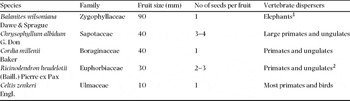
Five tree species namely Balanites wilsoniana, Celtis zenkeri, Chrysophyllum albidum, Cordia millenii and Ricinodendron heudelotii were selected on the basis of their fruit/seed size and the occurrence of mature fruiting trees in the three study sites. All five trees species occur in the three forests except for Ricinodendron heudelotii that does not grow in Kibale Forest. A brief description of each species is presented in Table 1.
A description of the study tree species.

1(Babweteera et al. Reference BABWETEERA, SAVILL and BROWN2007, Chapman et al. Reference CHAPMAN, CHAPMAN and WRANGHAM1992); 2(Feer Reference FEER1995, Plumptre et al. Reference PLUMPTRE, REYNOLDS and BAKUNEETA1994).
Vertebrate disperser community
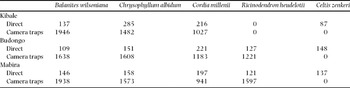
We recorded vertebrates feeding on the five tree species in each of the three forests. Three mature fruiting individuals (hereafter referred to as ‘focal trees’) of each species per forest were identified and observed from time to time between March 2004 and December 2005. The focal trees of the five species were selected to be at least 1 km apart and each one was observed at the peak of its fruit ripening for 45–75 h. We made the observations between 06h00–12h00 and 15h00–18h00, recording all individual vertebrates visiting the focal trees and observed to be eating the fruits and/or seeds. In addition to the direct observations, camera traps (DSC-P32 Digital Camtrakkers) were mounted beneath the fruiting trees to record animals feeding on fallen fruits. Camera traps have been used successfully to study animal populations (Carbone et al. Reference CARBONE, CHRISTIE, CONFORTI, COULSON, FRANKLIN, GINSBERG, GRIFFITHS, HOLDEN, KAWANISHI, KINNAIRD, LAIDLAW, LYNAM, MACDONALD, MARTYR, MCDOUGAL, NATH, O'BRIEN, SEIDENSTICKER, SMITH, SUNQUIST, TILSON and SHAHRUDDIN2001, Silveira et al. Reference SILVEIRA, JACOMO and DINIZ-FILHO2003) and their use is thought to overcome some of the limitations of direct observation such as failure to observe nocturnal feeders or shy frugivores. The camera traps were not mounted to make observations on Celtis zenkeri trees because of the difficulty in ascertaining whether the photographed animals were feeding on the tiny C. zenkeri fruits. The camera traps were set to make observations during both day and night. The fruiting trees on which they were placed were different from the set used for direct observation. This was done in order to maximize the total observation period for each species, given that the fruiting season for some trees is of short duration. The direct and camera trap observation period for each tree in each forest is summarized in Table 2. Frugivore visitation rates and number of frugivore species visiting each tree species in the three forests were computed as implicit measures of rate of seed dispersal. The number of individual frugivores visiting each tree species per hour was computed in each forest and ANOVA (SPSS v12) used to test for differences in visitation rate between forests. The hourly visitation-rate data for individual conspecific focal trees in each forest was pooled because there was no significant difference in visitation rates among them for all species.
Total number of direct and camera trap observation hours for frugivory activities on selected tree species in Kibale, Budongo and Mabira Forests. No observations were made on Ricinodendron heudelotii trees in Kibale because they do not grow in this forest.

Regeneration and juvenile spatial distribution
Juvenile spatial distribution was assessed in square 1-ha plots established around adult conspecific trees of each of the study species (Hamill & Wright Reference HAMILL and WRIGHT1986). The selected adult trees were known to be mature fruiting individuals (above 50 cm dbh for B. wilsoniana, C. albidum, C. millenii and R. heudelotii, and above 30 cm dbh for C. zenkeri). Three plots were established in each of the three forests for each species. The plots located around B. wilsoniana, C. albidum, C. millenii and R. heudelotii had 1–2 adult trees each whereas the plots around C. zenkeri had 3–4 adult trees each. In each plot, we made an intensive search for all juveniles (seedlings 0–50 cm in height; saplings 51–400 cm; and poles > 400 cm in height but <10 cm dbh) of the corresponding tree species and we measured the distance to the nearest adult tree. Juveniles that were closer to an adult tree outside the plot were omitted. Balanites wilsoniana propagates both sexually and vegetatively, so we attempted to determine whether juveniles originated from root sprouts or seed. Individuals confirmed to be developing from sprouts were omitted from the analysis. For each species in each forest, the cumulative distributions of distances from juveniles to their nearest adult tree were computed (Hamill & Wright Reference HAMILL and WRIGHT1986) to compare the relative dispersion of juveniles between forests. In this study we compared observed cumulative distribution curves between plots rather than comparing observed distribution with a null distribution generated from the coordinates of the adult trees and plot dimensions as proposed by Hamill & Wright (Reference HAMILL and WRIGHT1986). A direct comparison of observed spatial distributions of juveniles between sites provides a pragmatic assessment given that in this study we selected plots with equal numbers of adult conspecific trees. Pairwise Kolmogorov–Smirnov tests were conducted between conspecific plots within each forest to determine whether there were significant differences in the spatial distributions of juveniles among plots within each forest. Thereafter, the spatial distribution data were pooled for the three plots in each forest to obtain a single distribution curve to enable comparisons between forests using Kolmogorov–Smirnov tests.
We compared the observed cumulative distributions of distances from seedlings and saplings/poles to the respective nearest adults in order to examine the effect of dispersal on juvenile survival. Sapling and pole categories were pooled to provide sufficient individuals (n > 50) for cumulative distribution analysis. The underlying assumption is that if mortality rate is independent of the distance from adult trees, then the cumulative distributions of seedlings and saplings/poles should be similar. This analysis was conducted on data from those plots in which we had evidence that animal dispersal vectors were still present and could therefore provide a basis for determining the probability of survival with and without dispersal.
RESULTS
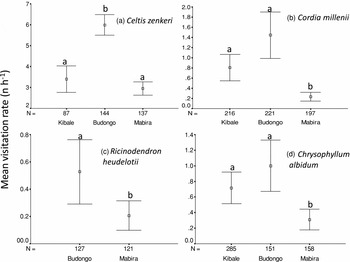
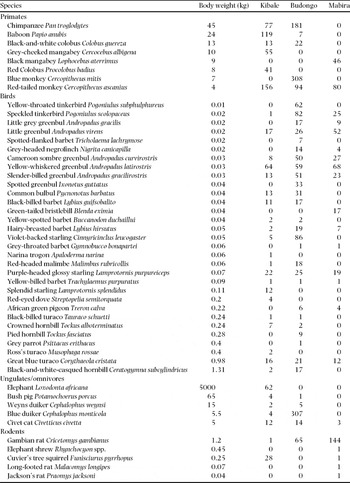
Frugivore visitation rates were significantly different between the forests (ANOVA F = 65, df = 2, P < 0.001). The mean hourly visitation rate was higher in Budongo (2.2 individuals h−1) than in Kibale (1.6 individuals h−1) and Mabira (0.9 individuals h−1). The high visitation rate in Budongo was due to the high frequencies of blue monkey Cercopithecus mitis and blue duiker Cephalophus monticola, which accounted for over 30% of the observed individual visitors in this forest (Appendix 1). The low frugivore visitation rate in Mabira could be an indicator of low vertebrate densities.
Pairwise comparisons of visitation rates to conspecific trees show significant differences between Budongo and Mabira for all tree species whereas in Budongo and Kibale visitation rates were not different except for C. zenkeri (Figure 1). Balanites wilsoniana was not included in the pairwise comparisons of frugivore visitation rates because the only observations of frugivores feeding on this species were made by camera traps for which we could not determine the hourly visitation rate.
Frugivore visitation rates to selected tree species in Kibale, Budongo and Mabira Forests. Bars represent 95% confidence interval and the bars labelled with different letters represent significantly different mean hourly visitation rates (Tukey HSD) at P < 0.01 (ANOVA). The tree species were Celtis zenkeri (a); Cordia millenii (b); Ricinodendron heudelotii (c); and Chrysophyllum albidum (d). There were no Ricinodendron heudelotii trees growing in Kibale.

Birds were frequent visitors to C. zenkeri fruiting trees and were abundant in all three forests although Budongo had a higher visitation rate (Figure 1, Appendix 1). Primates were abundant in both Budongo and Kibale but were rare in Mabira. Primates frequented Cordia millenii and Chrysophyllum albidum fruiting trees, and they occasionally ate C. zenkeri and Ricinodendron heudelotii fruits (Appendix 1). Similarly, ungulates were most frequent in Budongo and Kibale and none was observed in Mabira. In contrast, rodent seed predators were particularly abundant in Mabira and least abundant in Kibale (Appendix 1).
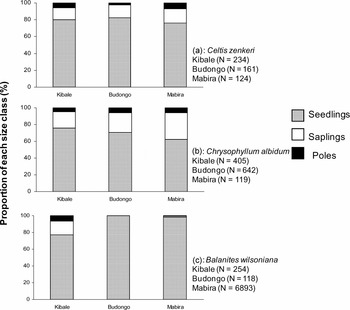
Juveniles of C. millenii and R. heudelotii were not found in any of the plots established in the three forests. An analysis of the juvenile age/size classes shows that juveniles of B. wilsoniana in Budongo and Mabira were mainly seedlings. In Budongo, all juveniles were in the seedling size class and none in the sapling and pole size classes. In Mabira only 1.4% and 0.3% of juveniles were in the sapling and pole size classes respectively (Figure 2). In contrast, over 20% of B. wilsoniana juveniles in Kibale were saplings and poles. Analysis of the age/size class of juveniles of C. zenkeri and C. albidum shows that over 20% of juveniles of these species are in the seedling and sapling size class in all three forests (Figure 2).
Distribution by size class of juvenile cohorts of tree species growing in Kibale, Budongo and Mabira Forests. In parentheses is the number of individuals for each forest. The tree species were Celtis zenkeri (a); Chrysophyllum albidum (b); and Balanites wilsoniana (c).

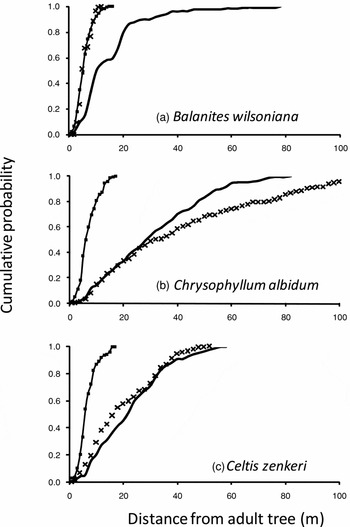
Pairwise comparison of the pooled data of spatial distributions for conspecific tree plots in each forest shows that the proportions of C. zenkeri and C. albidum juveniles established beneath adult conspecifics in Kibale and Budongo were not significantly different (Kolmogorov–Smirnov test, P > 0.05). However, a larger proportion of juveniles of C. zenkeri were established beneath adult conspecifics in Mabira than in Budongo (Kolmogorov–Smirnov test Z = 1.8, P < 0.005) and Kibale (Z = 2.4, P < 0.001). Similarly, a larger proportion of juveniles of C. albidum were established beneath adult conspecifics in Mabira than in Budongo (Z = 5.2, P < 0.001) and Kibale (Z = 3.6, P < 0.001). Apart from the differences in the proportion of juveniles established beneath adult conspecifics, the maximum recruitment distance from the mother trees for C. zenkeri and C. albidum was lower in Mabira than in Budongo and Kibale (Figure 3). For the large-fruited B. wilsoniana the distribution was similar in Mabira and Budongo (Kolmogorov–Smirnov test Z = 0.6, P > 0.05) where over 90% of juveniles were established beneath adult trees (Figure 3). Although most B. wilsoniana juveniles in Kibale also established beneath adult trees, the spatial distribution was significantly different from that observed in Budongo (Z = 4.5, P < 0.001) and Mabira (Z = 4.2, P < 0.001) because of the further maximum distances over which some juveniles were found (Figure 3).
Observed spatial distribution of juveniles around adult tree conspecifics in Kibale (―), Budongo (xxx) and Mabira (■■■) Forests. The tree species were Balanites wilsoniana (a); Chrysophyllum albidum (b) and Celtis zenkeri (c).

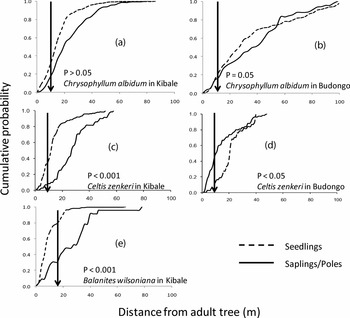
Analysis to determine whether dispersal affected juvenile survival to later life stages was conducted for C. zenkeri and C. albidum plots in Budongo and Kibale, and B. wilsoniana in Kibale. These plots were selected because juveniles in them were relatively well dispersed from the adult trees (Figure 3) and could therefore provide a basis for determining the probability of survival with and without dispersal. The spatial distributions of juvenile cohorts showed that there was no significant difference between the dispersion patterns of seedlings and saplings/poles of C. albidum in either Budongo or Kibale Forests (Kolmogorov–Smirnov test, P > 0.05; Figure 4). This suggests that the distance from the adult tree does not affect the survival probability of C. albidum seedlings. As a result dispersed and non-dispersed juveniles may have equal probabilities for survival. Although more than half of all seedlings of C. zenkeri and B. wilsoniana were found beneath their adult tree canopies, very few saplings/poles of these species were found there. This implies a disproportionately high seedling mortality rate beneath the adults of both species (Figure 4).
Observed spatial distribution of juvenile cohorts around adult tree conspecifics. Vertical arrows indicate the mean radius of adult tree canopies. Probability results from Kolmogorov–Smirnov test comparing the spatial distribution of seedlings and saplings/poles. The tree species were Chrysophyllum albidum in Kibale (a); Chrysophyllum albidum in Budongo (b); Celtis zenkeri in Kibale (c); Celtis zenkeri in Budongo (d); and Balanites wilsoniana in Kibale (e).

DISCUSSION
Rate of seed dispersal
The frugivore visitation rate and hence rate of seed dispersal was lowest in the heavily disturbed Mabira Forest compared with the moderately disturbed Kibale and Budongo Forests. The low visitation rate in Mabira is an indicator of low frugivore densities. Low densities of frugivores results in satiation of the disperser community and many mature fruits remain unconsumed (Bas et al. Reference BAS, PONS and GOMEZ2006). Although many frugivores were observed in Mabira most were small birds and primates. The loss of large-bodied vertebrates may result in reduced seed dispersal and probably limit the distance over which seeds are moved. Body size is a strong correlate of quantity of seed dispersed and distance over which seeds are moved. The predominantly small frugivores in Mabira imply that frugivore-generated seed dispersal kernels are likely to be small and homogeneous. A diversity of frugivore-generated seed dispersal kernels may be an important means of enhancing the probability of successful tree regeneration through delivery of seed to a variety of safe sites or escaping density dependent mortality. Consequently recruitment of trees in Mabira will not only be impaired by the effects of reduced dispersal rate but also the characteristic short-distance dispersal by remnant small-bodied frugivores.
In addition to absence of large vertebrates in Mabira, the forest was characterised by a high abundance of rodent seed predators compared with Kibale and Budongo. This finding is similar to that of Basuta & Kasenene (Reference BASUTA and KASENENE1987), and Stanford (Reference STANFORD2000) who found that rodent diversity and abundance increased with logging intensity. Rodent populations are thought to increase in heavily disturbed landscapes due to dense undergrowth in secondary forests that provide safe cover against predators. The increased rodent population in disturbed forests could significantly lower the seed survival probability by increasing seed predation. The high density of undispersed seeds underneath fruiting trees may exacerbate predator losses. Trees are known to survive seed predation effects through seed-predator satiation mechanisms (Fenner & Thompson Reference FENNER and THOMPSON2005). It is possible that the rodents may disperse some seeds in the process of scatter hoarding (Forget Reference FORGET1990). The significance of seed dispersal by scatter-hoarding rodents is not well understood and is an important research subject in heavily disturbed forest landscapes.
Spatial distribution
The pattern of establishment of juveniles around an adult of animal-dispersed trees will depend on the interactions between frugivore type and behaviour, and the requirements of the seed for successful germination. The pattern of survival will depend on the spatial variation in the risk of predation or pathogen attack.
In this study we found no C. millenii or R. heudelotii juveniles in our 1-ha sample plots in any of the three forests. The two species are light demanders (Synnott Reference SYNNOTT1985, Taylor Reference TAYLOR1960). Our sample plots on this occasion were in the shaded understorey and we conclude that recruitment of C. millenii and R. heudelotii was limited by the low light regimes. The absence of their juveniles in closed-canopy forest underscores the inability of light demanders to maintain a seedling bank outside forest gaps. Strongly light-demanding species such as these require dispersal to enhance their chance of reaching a gap. In Mabira Forest the seeds of C. millenii are dispersed by two small-bodied primates; red-tailed monkey Cercopithecus ascanius and black mangabey Lophocebus aterrimus, while R. heudelotii was visited by rodent seed predators and no frugivores (Appendix 1). The small-bodied vertebrates are likely to disperse the seeds over short distances, thus limiting the probability of seeds reaching open habitats, ultimately leading to lowered recruitment of C. millenii and R. heudelotii.
With the exception of B. wilsoniana in Budongo and Mabira, a significant proportion of C. albidum and C. zenkeri juveniles are represented in the sapling and pole size/age classes. This could imply that more seedlings of C. albidum and C. zenkeri are surviving to later life stages. A decrease in number of individuals with increasing age or size is expected for most plant populations (Peet & Christensen Reference PEET and CHRISTENSEN1987). However, the proportion of B. wilsoniana juveniles progressing from seedling to pole stage in Mabira (less than 2%) and Budongo (0%) may be insufficient to maintain stable populations in the long term because in the event of stochastic mortality, smaller populations are more vulnerable than large populations. In Budongo, although animals capable of dispersing B. wilsoniana have been lost, the seed and seedling predator populations are intact (Babweteera et al. Reference BABWETEERA, SAVILL and BROWN2007). This exposes seeds and seedlings to density- and/or distance-driven mortality factors. Similarly, in Mabira there are no elephants to disperse B. wilsoniana seeds. However, the survival of a few individuals could be attributed to a lack of seed and seedling predators (Babweteera et al. Reference BABWETEERA, SAVILL and BROWN2007).
The spatial distribution of juveniles was strongly correlated to the frugivory patterns. The study did not establish the exact parentage of juveniles. Instead we assumed that the observed juveniles were the offspring of the nearest adult tree. There is evidence that seeds can be dispersed hundreds of metres from the mother tree and that germinated seedlings may not be produced by the nearest reproductive adult (Hardesty et al. Reference HARDESTY, HUBBELL and BERMINGHAM2006). However, in this study most juveniles were observed recruiting beneath adult conspecifics in the frugivore-impoverished Mabira Forest. This denotes lack of dispersal away from the parent tree. Frugivore species in Mabira were mainly small-bodied individuals that often spat seeds beneath or near fruiting trees. Consequently, juveniles of the three tree species were clumped underneath or a few metres from the adult trees in Mabira. Moreover, clumped distributions are more prominent among the large-fruited trees. For instance B. wilsoniana is exclusively dispersed by elephants because the fruits and seeds are too large for other frugivores to eat them. The loss of elephants in Budongo and Mabira has obviously left no substitute disperser. Ultimately, the recruitment is restricted to an area immediately beneath adult trees in the two forests. However, even in Kibale where elephants are still present, the spatial distribution of B. wilsoniana is clumped. This could be due to disperser satiation as a result of mast fruiting and the dependence of the species on a single frugivore (Cochrane Reference COCHRANE2003). The observation of clumped distribution patterns in forests with and without animal seed dispersers of B. wilsoniana suggests that studies of seed dispersal should not focus exclusively on the level of juvenile aggregation but instead incorporate a measure of the maximum dispersal distances. In Budongo and Kibale where the large-bodied frugivore community is still intact, juveniles of trees that are dispersed further away may have a higher chance of establishment than those dispersed near parent trees or those not dispersed at all. However, lack of dispersal may not equally affect all tree species. Recruitment of shade-tolerant species such as C. albidum appears to be independent of dispersal whereas the recruitment of shade-intolerant species such as B. wilsoniana and C. zenkeri is enhanced by dispersal away from parent trees.
In conclusion, this study demonstrates the link between loss of vertebrate seed dispersers and subsequent patterns of juvenile spatial distribution around adult trees. The results illustrate the dangers of generalizing the resilience of tree species to forest disturbances. It is apparent that light-demanding species are most vulnerable to the loss of vertebrate seed dispersers given that they are not capable of establishing in closed-canopy forest and have reduced means of dispersing into microsites suitable for recruitment where their important agents of dispersal are absent or reduced. The vulnerability of shade-tolerant species is dependent on the fruit and/or seed size and dispersal kernel produced by the remnant frugivores. In forests where large frugivores are extinct or their populations reduced, it is plausible that continuous short-distance dispersal will lead to spatially clumped tree populations. The long-term population viability of large fruited/seeded tropical tree species that have clumped distributions resulting from restricted recruitment beneath adult conspecifics is not well understood and could be an important research subject in the future.
ACKNOWLEDGEMENTS
This research was supported by grants from the International Foundation for Science (IFS) and SIDA/SAREC Makerere University. We are grateful to G. Erickson and E. Orijabo who assisted with the field work. We thank Budongo Conservation Field Station and Royal Zoological Society of Scotland for the support towards this study. Permission to conduct this research was kindly granted by Uganda National Council for Science and Technology, Uganda Wildlife Authority and National Forestry Authority.
Observed abundances (direct plus camera trap), body weights of vertebrates feeding on Balanites wilsoniana, Chrysophyllum albidum, Cordia millenii, Ricinodendron heudelotii and Celtis zenkeri fruits and seeds in Kibale, Budongo and Mabira Forests. Primate, ungulate and rodent body weights and nomenclature after Kingdon (Reference KINGDON1997) and bird body size and nomenclature after Fry et al. (Reference FRY, KEITH and URBAN1988, Reference FRY, KEITH and URBAN2000), Fry & Keith (Reference FRY and KEITH2004), Urban et al. (Reference URBAN, FRY and KEITH1986, Reference URBAN, FRY and KEITH1997) and Keith et al. (Reference KEITH, URBAN and FRY1992).