INTRODUCTION
Currently, immigrants make up 13.1 percent of the total U.S. population, and together with their U.S.-born children, they constitute a full quarter of the U.S. population (NASEM Reference Waters and Gerstein Pineau2015). This notable rise in immigration over the last half century, coupled with its diversity and geographic dispersion into new communities across the United States (Massey Reference Massey2008), has fueled contact among a wider set of individuals and groups than ever before. Yet a key conundrum plaguing social science research is how to understand the consequences of intergroup contact in multi-ethnic contexts, where immigrants are not simply meeting one receiving U.S.-born group, and host society members are not interacting with only one immigrant group, but both are potentially in contact with multiple sets of U.S.-born and immigrant groups simultaneously (Bobo and Johnson Reference Bobo, Johnson, Bobo, Oliver, Johnson and Valenzuela2000; Kasinitz et al. Reference Kasinitz, Mollenkopf, Waters and Holdaway2008; Portes and Rumbaut Reference Portes and Rumbaut2014; Portes and Zhou Reference Portes and Zhou1993).
While intergroup research in social psychology has helped to clarify how contact between two groups shapes their attitudes and behaviors toward each other (Pettigrew and Tropp Reference Pettigrew and Tropp2011), we still know far less about how relations between two groups might also shape their respective attitudes and behaviors toward other groups in multi-ethnic societies (see Abascal Reference Abascal2015; Pettigrew Reference Pettigrew2009). In the present research, we ask: How do ongoing relations between U.S.-born Whites and Blacks shape their receptivity toward differentially positioned immigrant groups? This question is crucial because Whites have long served as the numerical majority as well as the dominant economic and sociopolitical group in U.S. society (Massey Reference Massey2007; Masuoka and Junn Reference Masuoka and Junn2013). Blacks, on the other hand, are a numerical minority in the United States, but given the nation’s fraught history of slavery, segregation, and exclusion, are also typically positioned as its quintessential subordinate “Other” (Jung Reference Jung2009; Telles et al. Reference Telles, Sawyer and Rivera-Salgado2011; Wilkinson Reference Wilkinson2015). To understand dynamics between immigrants and the U.S.-born, then, we must consider not only the role of direct relations between immigrant and U.S-born communities, but also relations among U.S.-born communities whose contact experiences have long been framed by a context of unequal status and power.
Typically, quantitative studies focus on Whites’ and Blacks’ demographic and economic characteristics to investigate how such factors shape host attitudes toward different immigration levels, immigrant groups, or immigration policy preferences (see Fussell Reference Fussell2014 and Hainmueller and Hopkins 2014 for two recent reviews; also Citrin et al. Reference Citrin, Green, Muste and Wong1997; Espenshade and Hempstead, Reference Espenshade and Hempstead1996; Fetzer Reference Fetzer2000; Hood and Morris 1998; Scheve and Slaughter Reference Scheve and Slaughter2001; Suro Reference Suro2009). Some of these same studies have also included context-level estimates of Whites’ or Blacks’ exposure to immigrant outgroups, based on percentages of foreign born where they live or work. However, context-level estimates of exposure are not equivalent to indicators of contact with immigrant groups at the individual level, and they are very rarely, if ever, combined with measures of Whites’ and Blacks’ contact with each other. So while such studies offer important findings, we agree with Elizabeth Fussell (Reference Fussell2014) that sociologists and political scientists can benefit from reintegrating key insights from the intergroup contact literature into their research. The extensive literature on contact suggests that relational dynamics between Whites and Blacks might be an overlooked but vital element in shaping how both groups think about not only each other, but also about new immigrants. In the language of work on immigrant incorporation, White-Black relational dynamics are likely an integral part of the “contexts of reception” (Portes and Rumbaut Reference Portes and Rumbaut2014) that immigrant groups encounter in their host communities.
Additionally, most empirical studies of attitudes toward immigrants, both in the United States and elsewhere, have focused on exclusionary attitudes toward immigrants (e.g., Browne et al. Reference Browne, Reingold and Kronberg2018; Ceobanu and Escandell 2008; Hainmueller and Hiscox Reference Hainmueller and Hiscox2010; Hopkins Reference Hopkins2010; Quillian Reference Quillian1995; Valentino et al. Reference Valentino, Brader and Jardina2013). We extend this prior work by examining the other side of the spectrum—inclusionary attitudes that receiving communities may also have toward newcomers (Haubert and Fussell Reference Haubert and Fussell2006), which can bolster immigrants’ incorporation outcomes, both symbolically and materially. While broader policies and institutions have been shown to signal inclusion as well as exclusion (Bloemraad Reference Bloemraad2006; de Graauw Reference de Graauw2016; Fisher Williamson Reference Fisher Williamson2018; Huo et al. Reference Huo, Dovidio, Jiménez and Schildkraut2018), in line with our call to pay more attention to relational dynamics taking place in such contexts or elsewhere in everyday life, we focus here on host society members’ receptivity toward immigrants at the individual level.
To more fully capture how intra-group dynamics between Blacks and Whites might contribute to their attitudes toward immigrants, we analyze new representative survey data from the Study of Immigrants and Non-Immigrants in Atlanta and Philadelphia (SINAP), which includes members of two immigrant and two U.S.-born groups across two highly racially-segregated U.S. metropolitan areas that are both rapidly diversifying due to immigration. This work offers novel and important contributions to a literature on host attitudes toward immigrants, which has tended not only to overlook the role of interracial relations among host communities, but also to focus primarily on the attitudes of Whites (Fussell Reference Fussell2014; also see Hainmueller and Hopkins 2014). Finally, the data set include assessments of U.S.-born attitudes toward two immigrant groups, first-generation Mexicans and Indians, who are regarded as having relatively low and high economic statuses, respectively—a vital contribution to literature that often examines attitudes about immigration generally, or toward all immigrants as a single group (Ben-Nun Bloom et al. Reference Ben-Nun Bloom, Arikan and Lahav2015).
LITERATURE REVIEW AND THEORETICAL FRAMEWORK
A long and rich tradition on immigrant incorporation in sociology seeks to model how immigrants and their descendants fare once they arrive in the United States (Alba and Nee Reference Alba and Nee2003; Bean et al. Reference Bean, Brown and Bachmeier2015; Kasinitz et al. Reference Kasinitz, Mollenkopf, Waters and Holdaway2008; Portes and Rumbaut Reference Portes and Rumbaut2001; Zhou et al. Reference Zhou, Lee, Vallejo, Tafoya-Estrada and Xiong2008). Considerable work in this area has focused broadly on the “contexts of reception” greeting immigrants, such as the ways in which governmental policies, labor markets, and social reception by either co-ethnic or mainstream host communities influence how immigrants eventually become incorporated into American society over time (Portes and Rumbaut Reference Portes and Rumbaut2014). Much of this literature now recognizes that receptivity toward immigrants largely depends on existing racialized dynamics in the host society; moreover, it readily acknowledges that anti-Black racism is a central factor shaping U.S. policies and institutions, which in turn shapes opportunities and obstacles new immigrants encounter when they arrive (Foner and Alba Reference Foner and Alba2010; Kasinitz et al. Reference Kasinitz, Mollenkopf, Waters and Holdaway2008; Waters and Kasinitz Reference Waters, Kasinitz, Foner and Simon2015). This legacy of racial inequality intersects with geography and economy to stratify and segregate communities and neighborhoods, giving immigrants different “segments” of Americans with whom to live and interact (Masuoka and Junn Reference Masuoka and Junn2013; Portes and Rumbaut Reference Portes and Rumbaut2001, Reference Portes and Rumbaut2014).
This conceptualization situates public opinion toward immigrants as one among several key factors shaping processes of immigrant incorporation. Numerous studies have examined public opinion toward immigrants and immigration in the U.S. context (e.g., Fetzer Reference Fetzer2000; Muste Reference Muste2013; NASEM Reference Waters and Gerstein Pineau2015; Segovia and Defever Reference Segovia and Defever2010; Suro Reference Suro2009). This research has focused primarily on Whites’ attitudes, and suggests that their exclusionary attitudes toward immigrants can be explained in large part by dominant group concerns about the potential negative impacts of rising immigration (e.g., Ayers et al. Reference Ayers, Richard Hofstetter, Schnakenberg and Kolody2009; Ben-Nun Bloom et al. Reference Ben-Nun Bloom, Arikan and Lahav2015; Burns and Gimpel Reference Burns and Gimpel2000; Citrin et al. Reference Citrin, Green, Muste and Wong1997; Fussell Reference Fussell2014; Hainmueller and Hopkins 2014; Haynes et al. Reference Haynes, Merolla and Karthick Ramakrishnan2016; Hood and Morris Reference Hood and Morris2000; Hopkins Reference Hopkins2010; Huber and Espenshade Reference Huber and Espenshade1997; Masuoka and Junn Reference Masuoka and Junn2013; Newman et al. Reference Newman, Hartman and Taber2012; Scheve and Slaughter Reference Scheve and Slaughter2001; Stein et al. Reference Stein, Shirley Post and Rinden2000).
Fewer studies have examined attitudes toward immigrants among more than one U.S.- born racial group, but those that do suggest it is important to evaluate U.S.-born attitudes toward immigrants in light of the long history of White racial domination over African Americans (Bonilla-Silva Reference Bonilla-Silva1997; Desmond and Emirbayer, Reference Desmond and Emirbayer2009; Golash-Boza Reference Golash-Boza2016; Jung Reference Jung2009). For example, Lawrence D. Bobo and Vincent L. Hutchings (Reference Bobo and Hutchings1996) emphasize that the attitudes of one racial group toward another are fundamentally shaped by its own historical treatment and current positioning within White-dominated U.S. society (also see Gay Reference Gay2006; Hutchings and Wong 2004; Oliver and Wong Reference Oliver and Wong2003; Wilkinson Reference Wilkinson2015). Using survey data from Los Angeles in the 1990s, Bobo and Hutchings (Reference Bobo and Hutchings1996) found that Blacks were most likely (and Whites least likely) to see other groups as competitive threats, and that racial alienation—the feeling that one’s racial group is powerless and disenfranchised—was a key predictor of perceiving other groups as threats. Similarly, with national survey data from the 2000s, Natalie Masuoka and Jane Junn (Reference Masuoka and Junn2013) demonstrate how different status positions of Whites, Blacks, Asians, and Latinos in the U.S. racial hierarchy act like a “dispersive prism,” refracting public opinion to produce distinct views of immigrants and preferences for immigration policy among each one. They found that a strong sense of linked fate to one’s racial group was associated with more restrictive attitudes toward immigration among Whites, but less restrictive attitudes among racial minorities; these authors conclude that Whites attempt to preserve their status at the top of the U.S. racial hierarchy when evaluating immigration, whereas minority groups are more attuned to their own marginalization. Fussell (Reference Fussell2014) agrees, arguing that Blacks’ unique historical experience vis-à-vis Whites shapes their opinions toward immigration in ways that are distinct from White public opinion (also see Browne et al. Reference Browne, Deckard and Rodriguez2016; Browne et al. Reference Browne, Reingold and Kronberg2018; Diamond Reference Diamond1998; Nteta Reference Nteta2013; Wilkinson and Bingham Reference Wilkinson and Bingham2016; Williams Reference Williams2016; Williams and Hannon Reference Williams and Hannon2016). At the same time, other research shows that, like Whites, Blacks may still feel economically threatened when immigrant newcomers in their local environment show greater economic advancement and/or substantial increase in size (Browne et al. Reference Browne, Reingold and Kronberg2018; Fussell Reference Fussell2014; Gay Reference Gay2006; McClain et al. Reference McClain, Lyle, Carter, De Francesco Soto, Lackey, Cotton, Nunnally, Scotto, Grynasviski and Alan Kendrick2007; Telles et al. Reference Telles, Sawyer and Rivera-Salgado2011).
Qualitative scholars also find evidence that racial inequality reinforces ongoing racial tensions among Blacks and Whites, which can produce different sentiments and responses toward immigrant newcomers among the two host groups (Fennelly Reference Fennelly and Massey2008; Jiménez Reference Jiménez2016; Marrow Reference Marrow2011; McDermott Reference McDermott, Telles, Sawyer and Rivera-Salgado2011; Waters Reference Waters1999). Overall, this literature largely agrees with its quantitative counterpart that Whites often resist immigrants out of a sense of racialized group position and entitlement, whereas Blacks’ resistance to immigrants, when it arises, comes out of an “historical context of racial exclusion and exploitation” vis-à-vis Whites (Smith Reference Smith, Ansley and Shefner2009; see also Ribas Reference Ribas2016; Stuesse Reference Stuesse, Odem and Lacy2009). Thus, differences in status between U.S.-born Whites and Blacks, which are derived from past and present patterns of economic and political inequality, should be taken into account when interpreting attitudes among the U.S.-born toward immigrants (Brown and Jones Reference Brown and Jones2015; Jung Reference Jung2009; Kasinitz et al. Reference Kasinitz, Mollenkopf, Waters and Holdaway2008).
Receptivity toward immigrants among the U.S.-born is also likely to depend on the status positions that distinct immigrant groups typically occupy within the U.S. economic and racial hierarchy. More often than not, Mexican immigrants in the United States today are perceived as a “low economic status” group (Massey Reference Massey2007; Perlmann 2005; Bean et al. Reference Bean, Brown and Bachmeier2015; Telles and Ortiz Reference Telles and Ortiz2008), and American public opinion on immigration has focused “squarely on the plight of poor, unauthorized Mexican migrants” (Jiménez Reference Jiménez2010, p. 51). By contrast, South Asian Indians are viewed as a “high economic status” group, joining other East Asian immigrant groups who are often perceived as straddling the line between “model minorities” and “perpetual outsiders” in U.S. society (Dhingra Reference Dhingra2012; Mishra Reference Mishra2016; Nee and Holbrow Reference Nee and Holbrow2013; Tuan Reference Tuan1998; Zhou and Lee 2015; also see Chou and Feagin Reference Chou and Feagin2008; Kim Reference Kim1999; Xiu and Lee Reference Xu and Lee2013 on the racial triangulation of Asian Americans). Corresponding to common conceptions of these differential status positions, Indian immigrants are the most highly educated and one of the most professionally-employed of all immigrant groups in the United States today, whereas Mexicans are among the least educated and lowest-earning ones (Chakravorty et al. Reference Chakravorty, Kapur and Singh2017; Garip Reference Garip2017; NASEM Reference Waters and Gerstein Pineau2015; Portes and Rumbaut Reference Portes and Rumbaut2014). It is therefore reasonable to expect that Whites and Blacks, who occupy the traditional dominant and subordinate status positions in the U.S. racial hierarchy respectively, might likewise vary in receptivity toward such differentially-positioned immigrant groups.
RELATIONAL DYNAMICS BETWEEN THE U.S.-BORN AND IMMIGRANTS
While the extant scholarship on U.S. public opinion usefully clarifies how attitudes about immigration depend on the status positions different racial groups hold in society, it does so in a relatively abstract way. Still missing is greater insight into how relational intra-group dynamics between U.S.-born racial groups—how Whites and Blacks come into contact and interact with one another on a day-to-day basis—help shape each group’s receptivity toward immigrants. Our view is complementary to that of Ryan D. Enos (Reference Enos2017) who distinguishes between the perceptual level of how groups perceive and rank each other in space and status, and the experiential level of how groups interpret the contact they do have with one another within that larger context. Indeed, prior work in a range of settings has revealed multiple ways that contact between racial groups in daily interactions can shape and reshape people’s attitudes not only toward each other, but also toward other groups. Monica McDermott (Reference McDermott, Telles, Sawyer and Rivera-Salgado2011), for example, documents how strained interactions between upper-middle-class Blacks and Whites for control and visibility in cultural institutions in Greenville, South Carolina, help explain part of the former’s negative orientations toward Latino newcomers (also see Deeb-Sossa Reference Deeb-Sossa2013 for similar findings in a community health clinic setting in North Carolina). Conversely, Vanesa Ribas (Reference Ribas2016) demonstrates how workplace relations with White employers and supervisors whom Blacks may perceive as exploitative contribute to Blacks’ positioning of undocumented Latino coworkers as also (or even more) marginalized in a food processing plant employing low-skilled laborers. Among Whites, Helen B. Marrow (Reference Marrow2011), Roger Waldinger (Reference Waldinger1997), and Mary C. Waters (Reference Waters1999) all show that interpretations of strained or uncomfortable interactions with U.S.-born Blacks are connected to Whites’ explicit preferences for immigrants, both Latino and Black Caribbean, thereby upholding racial inequality.
As in studies of public opinion, many of these empirical studies of relational dynamics involving immigrants focus more strongly on tensions and hostility, than on cooperation or friendliness (Jones-Correa Reference Jones-Correa, Telles, Sawyer and Rivera-Salgado2011a; Lee 2001). This is somewhat surprising, as governmental and institutional policies can signal inclusion and receptivity, not merely exclusion and hostility, at a broader level (Bloemraad Reference Bloemraad2006; de Graauw Reference de Graauw2016; Fisher Williamson 2018; Huang and Liu Reference Huang and Liu2017; Huo et al. Reference Huo, Dovidio, Jiménez and Schildkraut2018; Williams Reference Williams2015). Emerging research is also increasingly granting attention to immigrants’ relational experiences of inclusion, and not just exclusion, with the U.S.-born within such institutions, which range from nonprofit organizations to law enforcement to healthcare clinics to social services offices (e.g., Calvo et al. Reference Calvo, Jablonska-Bayro and Waters2017; Gast and Okamoto 2014; Horton Reference Horton2004; Marrow Reference Marrow2011, Reference Marrow2012). Moreover, research in social psychology is also increasingly exploring ways in which members of dominant groups might be receptive to difference and willing to foster inclusion (Tropp and Mallett Reference Tropp and Mallett2011; Vollhardt et al. Reference Vollhardt, Migacheva, Tropp and de Rivera2009). But because few research studies have adopted this kind of relational lens to study the topic of immigration attitudes, we still have limited knowledge about how ongoing relations between racial groups in the host society may inform either inclusionary or exclusionary attitudes toward new immigrant arrivals. In the present research, we seek to pay greater attention to the influence of interracial contact between U.S.-born Whites and Blacks on both groups’ receptivity toward different immigrant groups residing in their metropolitan areas.
INTERGROUP CONTACT AND SECONDARY TRANSFER EFFECTS
In so doing, we draw on social psychological perspectives on intergroup contact, which, in our view, has not been fully conversant with the scholarship on immigrant incorporation, group position, and racial triangulation cited above. Traditionally, contact studies in psychology have examined the effects of direct contact, or how individuals’ face-to-face interactions with members of other racial and ethnic groups can produce more inclusive attitudes toward those groups (see Pettigrew and Tropp Reference Pettigrew and Tropp2011; Tropp and Page-Gould Reference Tropp, Page-Gould, Mikulincer, Shaver, Dovidio and Simpson2015 for reviews).Footnote 1 Yet new generations of contact research have also begun to focus on indirect contact effects—that is, how contact between members of two groups can have farther-reaching effects, beyond merely affecting each group’s attitudes toward the other. A growing body of work in this area focuses on what is known as the secondary transfer effect (STE). Whereas direct contact with a member of an outgroup shapes attitudes toward members of that same outgroup, a secondary transfer effect (STE) occurs when contact with a member of one outgroup shapes attitudes toward members of an outgroup not directly involved in the contact interaction (Pettigrew Reference Pettigrew2009).
While much of this research on secondary transfer effects, like our own, is cross-sectional, other longitudinal and experimental studies have now demonstrated that having individual-level contact with a member of one outgroup—whether ethnic, racial, or religious—can indeed have a range of consequences for one’s attitudes toward members of other, uninvolved groups (Hindriks et al. Reference Hindriks, Verkuyten and Coenders2014; Lolliot et al. Reference Lolliot, Schmid, Hewstone, Ramiah, Tausch, Swart, Hodson and Hewstone2013; Schmid et al. Reference Schmid, Hewstone, Küpper, Zick and Wagner2012; Schmid et al. Reference Schmid, Hewstone and Tausch2014; Shook et al. Reference Shook, Hopkins and Koech2016). Further, the longitudinal studies among them confirm that STEs cannot be fully explained by participant selection into contact with outgroups (see Tausch et al. Reference Tausch, Hewstone, Kenworthy, Psaltis, Schmid, Popan, Cairns and Hughes2010), which helps to allay one of the key criticisms leveled at cross-sectional analyses of contact effects (Enos Reference Enos2017; Powers and Ellison Reference Powers and Ellison1995). Thus, existing social psychological research bolsters confidence that secondary transfer effects can provide a useful framework with which to address the present study’s central question of how U.S.-born Whites’ and Blacks’ contact with one another might correspond with their attitudes toward new immigrants, even after controlling for Whites’ and Blacks’ direct contact with immigrants themselves.
Although most STE research has focused on arenas other than immigration, studies in Europe have begun to explore their effects in this area. For example, Paul Hindriks and colleagues (2014) show that when Turks and Moroccans in the Netherlands have more frequent contact with each other, they report less social distance toward Surinamese and Antilleans as well (see also Brylkaa et al. Reference Brylkaa, Jasinskaja-Lahti and Mähönen2016). Only a handful of studies have focused on secondary transfer effects related to immigration in the United States, and those that do typically examine STEs only with undergraduate student samples, or without differentiating by the economic status of immigrant outgroup to whom the STEs are theorized to extend, even as they have made strides in including respondents of different racial and ethnic backgrounds (e.g., Bowman and Griffin Reference Bowman and Griffin2012; Tausch et al. Reference Tausch, Hewstone, Kenworthy, Psaltis, Schmid, Popan, Cairns and Hughes2010; Van Laar et al. 2005).
Most relevant to the present research, Nicole Tausch and colleagues (2010, Study 3), asked 199 White and 76 Black U.S. college students to report their friendships with and attitudes toward Hispanics (the primary outgroup), and they were also randomly assigned to report their attitudes toward either Vietnamese or Indians as recent immigrant arrivals (two secondary outgroups). The authors observed significant STE effects, showing that students who reported greater numbers of Hispanic friends also reported more positive attitudes toward a secondary immigrant outgroup (Vietnamese or Indian), even when controlling for direct contact with the secondary outgroup (as measured by the numbers of Vietnamese or Indian immigrant friends they had). Moreover, comparable STE effects were observed among White and Black students in relation to Vietnamese and Indian immigrants, and even after controlling for the tendency to respond in socially desirable ways. However, we note that the Tausch et al. study took place in just one U.S. setting (Texas) drawing only on a college student sample. Further, it only investigated the relationship between Whites’ and Blacks’ contact with Hispanics and their attitudes toward two different groups of Asian immigrants, not also on how Whites’ and Blacks’ contact with each other might yield unique insights. On the whole, how STE dynamics might play out in field settings, with samples of adults and closely specified U.S.-born and immigrant groups, has yet to be explored.
SECONDARY TRANSFER EFFECTS IN RELATION TO GROUP POSITION
It is somewhat surprising that Tausch et al. (Reference Tausch, Hewstone, Kenworthy, Psaltis, Schmid, Popan, Cairns and Hughes2010) did not observe significant differences in STE effects among White and Black students, given other research in social psychology showing that contact effects are often stronger among members of dominant racial groups (e.g., Whites) and weaker among members of historically disadvantaged racial groups (e.g., Blacks) (Tropp and Pettigrew Reference Tropp and Pettigrew2005a; also see Binder et al. Reference Binder, Zagefka, Brown, Funke, Kessler, Mummendey, Maquil, Demoulin and Leyens2009). Here too, the results could be due to the authors’ use of a college student sample whose overall similarities may have masked possible differences associated with racial status. A larger study drawing on representative samples of respondents who vary in racial status and on a range of demographic characteristics would offer the opportunity to conduct a more robust analysis of STE effects among U.S.-born racial groups in relation to immigrants.
In sum, the existing literature on secondary transfer effects provides a useful foundation for extending prior research in sociology and political science that examines U.S.-born groups’ attitudes toward immigrants in other ways. This approach offers a novel way for immigration and race researchers to model and analyze how Whites’ and Blacks’ contact experiences with each other, in addition to each’s own demographic characteristics or perceptions of threat from immigrants, may shape their attitudes toward immigrants. While studies of secondary transfer effects have yet to be integrated into mainstream research on immigrant incorporation, this approach easily complements other novel work in sociology and political science, which has begun to explore how the familial, friendship, coworker, neighbor, and/or acquaintance contact networks Whites and Blacks directly have with immigrants predicts the former’s immigration attitudes, via primary transfer effects (e.g., Berg Reference Berg2009; Pearson-Merkowitz et al. Reference Pearson-Merkowitz, Filindra and Dyck2016; Wilkinson Reference Wilkinson2015). Merging the approaches in these literatures will enhance our understanding of how interracial contact among the U.S.-born helps shape White and Black attitudes toward immigrants in the contemporary multi-ethnic context of the United States.
HYPOTHESES
This study’s central question, then, is how contact between U.S.-born Whites and Blacks is meaningfully associated with each group’s receptivity toward immigrant newcomers. In line with the extensive literature on intergroup contact, we generally expect that greater contact between Whites and Blacks should correspond with more positive intergroup attitudes among both groups toward each other. Moreover, drawing upon the extant literature on secondary transfer effects, we expect that greater contact between Whites and Blacks should also correspond with greater receptivity toward immigrant groups, even after controlling for Whites’ and Blacks’ direct contact experiences with the immigrant groups themselves [H1].
At the same time, given that contact between U.S.-born Whites and Blacks still occurs within a context of high racial and economic segregation and inequality, we expect that STE processes will likely function differently for members of the two U.S.-born groups. As a numerical minority group in the United States, Blacks tend to have greater contact with Whites than vice versa (Butler and Wilson Reference Butler and Wilson1978; Sigelman and Welch Reference Sigelman and Welch1993). Additionally, as an historically disadvantaged group, Blacks are also more likely to report having negative contact experiences with Whites, as compared to the contact experiences that Whites report having with Blacks (Pew Research Center 2016; Stephan et al. Reference Stephan, Boniecki, Ybarra, Bettencourt, Ervin, Jackson, McNatt and Lausanne Renfro2002), and such negative intergroup experiences have the potential to hinder the positive effects of contact on Blacks’ racial attitudes toward other groups (Tropp Reference Tropp2007). These patterns may help to explain why contact effects are often less pronounced among subordinate racial groups relative to the effects typically observed among dominant racial groups (Binder et al. Reference Binder, Zagefka, Brown, Funke, Kessler, Mummendey, Maquil, Demoulin and Leyens2009; Tropp and Pettigrew Reference Tropp and Pettigrew2005a). Correspondingly, we expect that secondary transfer effects growing from group members’ contact experiences will be less pronounced among U.S.-born Blacks than among U.S.-born Whites [H2].
Though existing contact research provides less guidance about how contact between U.S.-born Blacks and Whites might shape receptivity toward immigrants who are differentially positioned in American society, there is some reason to believe that such secondary transfer effects may correspond with where immigrant groups are perceived to fall within existing U.S. racial and economic hierarchies. For instance, some scholars have proposed that secondary transfer effects should be particularly likely when the uninvolved outgroup is somehow perceived to be similar to the outgroup with whom direct contact is taking place (see Harwood et al. Reference Harwood, Paolini, Joyce, Rubin and Arroyo2011; Pettigrew Reference Pettigrew2009; Tausch et al. Reference Tausch, Hewstone, Kenworthy, Psaltis, Schmid, Popan, Cairns and Hughes2010). Following a similar line of reasoning, we might predict that contact between U.S.-born Whites and Blacks will be especially likely to transfer out toward immigrant groups when there is some correspondence between the racial and economic positioning of an immigrant outgroup and the U.S.-born outgroup with whom contact is taking place. More specifically, then, we expect that among U.S.-born Whites, greater contact with U.S.-born Blacks should be more likely to transfer out to attitudes toward immigrant outgroups that are perceived to be lower in socioeconomic status and positioned as nearer to Blacks (e.g., Mexican immigrants; see Masuoka and Junn Reference Masuoka and Junn2013; Portes and Rumbaut Reference Portes and Rumbaut2014) [H3a]; by contrast, we expect that among U.S.-born Blacks, greater contact with U.S.-born Whites should be more likely to transfer out to attitudes toward immigrant outgroups that are perceived to be higher in socioeconomic status and positioned as nearer to Whites (e.g., Indian immigrants; also see Bonilla Silva 1997; Lee and Fiske Reference Lee and Fiske2006; Lee and Zhou Reference Lee and Zhou2015; Nee and Holbrow Reference Nee and Holbrow2013) [H3b].
DATA AND METHODS
To test these hypotheses, we draw on the Study of Immigrants and Non-Immigrants in Atlanta and Philadelphia (SINAP), an original representative survey conducted in 2013 that includes responses from 503 U.S-born Whites and 502 U.S.-born Blacks living in metropolitan Philadelphia and Atlanta. We selected these locations and groups for both theoretical and demographic reasons. Since Black-White relations have figured prominently in the literature on intergroup contact (Pettigrew and Tropp Reference Pettigrew and Tropp2011), we sought to carry out our research in places with a significant presence and history of Black-White contact and relations, as well as large contemporary immigrant populations. Using population estimates from the 2008 and 2010 American Community Survey (ACS), we selected the Philadelphia and Atlanta metropolitan areas as our two research sites because they are (a) comparable to each other in population size; (b) both have long-standing histories of White-Black relations that have profoundly shaped their regional politics and social interactions, and that now serve as context into which new immigrants from around the world arrive; and (c) both have over 50,000 immigrant arrivals who hail from Mexico and India, the top two sending countries to the United States (Chakravorty et al. Reference Chakravorty, Kapur and Singh2017; Portes and Rumbaut Reference Portes and Rumbaut2014; Zong and Batalova Reference Zong and Batalova2016, Reference Zong and Batalova2017).Footnote 2
In addition, we sampled U.S.-born Whites and Blacks because they represent key populations in these metropolitan areas and vary on racial and socioeconomic dimensions that typically grant them higher and lower status, respectively, in U.S. society. Relatedly, we asked U.S.-born Whites and Blacks about their contact with and attitudes toward Mexican and Indian immigrants because these groups vary on status markers that exemplify the bifurcation in skill levels among post-1965 immigrants to the United States, which lead them to be perceived, respectively, as quintessential “low economic status” and “high economic status” immigrant groups (Portes and Rumbaut Reference Portes and Rumbaut2014).Footnote 3 On average, foreign-born Mexicans have low levels of education and higher levels of employment in lower-skilled sectors of the economy; they also register low levels of English language proficiency and, following decades of intensifying border and interior immigration enforcement, high levels of undocumented status (Bean et al. Reference Bean, Brown and Bachmeier2015; Garip Reference Garip2017; NASEM Reference Waters and Gerstein Pineau2015; Telles and Ortiz Reference Telles and Ortiz2008). In contrast, foreign-born Indians are among the most highly educated and residentially dispersed immigrant groups; they are often employed in higher-skilled sectors of the economy, have considerable fluency in English, and register low rates of undocumented status, despite exhibiting strong internal variation (Chakravorty et al. Reference Chakravorty, Kapur and Singh2017; Leonard Reference Leonard, Waters and Ueda2007; Mishra Reference Mishra2016; Portes and Rumbaut Reference Portes and Rumbaut2014; Sandhu Reference Sandhu2012).Footnote 4 Such pointed differences in the two groups’ socioeconomic positioning also correspond to different host reactions. Americans today are more likely to perceive Mexicans to be poorly educated, to worry they may never assimilate, and to racialize them as illegal or even inhuman (Chavez Reference Chavez2008; Huntington Reference Huntington2004; Jiménez Reference Jiménez2010; Lee and Fiske Reference Lee and Fiske2006), whereas Americans often view Indians as well educated, smart, and talented (Lee and Zhou Reference Lee and Zhou2015), even as Americans may feel some competition with Indian immigrants (Jiménez and Horowitz Reference Jiménez and Horowitz2013; Lee and Fiske Reference Lee and Fiske2006; Samson Reference Samson2013) or see them as non-White. Indeed, Asian immigrants are viewed more positively than Latin American immigrants in public opinion (Pew Research Center 2015), which may have implications for their contact experiences with the U.S.-born in everyday life.
Overall, the SINAP dataset is uniquely suited to address the present research goals as it includes assessments of intergroup contact experiences and intergroup attitudes among members of both U.S.-born groups who were representatively sampled from a general population in two different metropolitan areas, and who completed surveys in relation to two immigrant groups who are differentially positioned in terms of social and economic status. (For more detail about the full samples and procedures included in the SINAP dataset, which also queried foreign-born Mexican and Indian immigrants, see Appendix A.)
Dependent Variables: Receptivity toward Immigrants
Just as racial attitudes can be assessed in a variety of ways (see Tropp and Pettigrew Reference Tropp and Pettigrew2005b), different measures can be employed to capture receptivity toward immigrants among the U.S.-born. In the present research, we used two measures to assess different dimensions of receptivity toward Mexican and Indian immigrants among U.S.-born Whites and Blacks.
Welcoming immigrants. One receptivity measure was inspired by the growing research literature on welcoming. Though most of this literature has focused on welcoming at the level of law and policy (e.g., Fisher Williamson 2018; Huang and Liu Reference Huang and Liu2017; Huo et al. Reference Huo, Dovidio, Jiménez and Schildkraut2018; Williams Reference Williams2015), it increasingly refers to welcoming relations that take place between individuals within such institutions or in other routine daily encounters (see Calvo et al. Reference Calvo, Jablonska-Bayro and Waters2017; Fussell Reference Fussell2014; Jones-Correa et al. Reference Jones-Correa, Marrow, Okamoto and Tropp2018; Marrow Reference Marrow2012; Tropp et al. Reference Tropp, Okamoto, Marrow and Jones-Correa2018). The concept of welcoming signifies an openness to greeting and including members of other groups within a community, with the expectation that all groups in a given context will be accepted and treated with respect (Jones-Correa Reference Jones-Correa2011b; Livert Reference Livert2017; Welcoming America 2017; Williams Reference Williams2015). For this study, we asked U.S.-born Whites and Blacks from each metropolitan area to report how welcoming they are toward the two immigrant groups. Specifically, in separate items referring to Mexican and Indian immigrants, Black and White respondents were asked: “Overall, when you think about immigrants from [Mexico/India] in greater [Philadelphia/Atlanta], how often do you attempt to welcome them into your community?” Responses to these items ranged from 0 (Never) to 3 (Often).
Interest in knowing immigrants. A second receptivity measure tapped our respondents’ actual interest in developing deeper relations with immigrants, beyond their general inclinations to welcome immigrants and treat them with respect. The concept of interest connotes a greater level of personal motivation and investment than welcoming, in that individuals with interest in knowing other groups likely seek to engage with and learn more about them (Brannon and Walton Reference Brannon and Walton2013; Mallett and Tropp 2011; Ron et al. Reference Ron, Solomon, Halperin and Saguy2017). Thus, we asked U.S.-born Whites and Blacks from each metropolitan area to report how interested they are in getting to know members of the two immigrant groups. Using separate items in reference to Mexican and Indian immigrants, respondents were asked: “Thinking about [immigrants from Mexico/immigrants from India] who live in [greater Philadelphia/ greater Atlanta], to what extent are you interested in getting to know them better?” Responses were scored on a scale ranging from -2 (not interested at all) to 2 (very interested).
Independent Variables: Frequency and Quality of Contact
We use measures of U.S.-born respondents’ intergroup contact experiences in relation to the other U.S.-born group and in relation to each immigrant group directly as independent variables in our multivariate regression models. Three separate items assessed respondents’ frequency of contact in relation to each of the other groups, by asking respondents how often they “interact with [Whites/Blacks/immigrants from Mexico/immigrants from India]” across three social spaces, including “at your job” (workplace), “around your home or in your neighborhood” (neighborhood), and “outside of your neighborhood” such as “at restaurants, stores, and malls” (public spaces). Responses to these items were scored on a scale ranging from 0 (never) to 3 (often). We averaged responses to the three items to create an overall measure of composite contact frequency across all three social spaces for respondents from each group in relation to each of the other U.S.-born or immigrant groups.
Additionally, to assess quality of contact, respondents who reported some degree of contact with each specified group were then asked to respond to three separate items regarding the friendliness of the contact across the same three social spaces. Specifically, respondents were asked: “when you interact with [Whites/Blacks/ immigrants from Mexico/immigrants from India] [at work/around your home or in your neighborhood/at restaurants, stores, and malls], does the contact with them generally feel…” with responses ranging from -2 (very unfriendly) to +2 (very friendly). We also averaged responses to the three contact quality items to create a composite measure of contact quality across social spaces for respondents from each group in relation to each of the other U.S.-born or immigrant groups.
Internal consistency for the composite contact frequency and quality measures was evaluated using the congeneric CFA-based model of scale reliability. The values of the estimates for contact frequency are higher than those for contact quality, and some are below the typical cut-off point for reliability estimates (.70).Footnote 5 Nonetheless, all are in the same direction, indicating that the composite measures of contact frequency and quality are moderately reliable across the three distinct institutional arenas and across all four target groups (see Tropp et al. Reference Tropp, Okamoto, Marrow and Jones-Correa2018 for similar procedures).
Finally, we use a variety of individual-level demographic, socioeconomic, and political characteristics as statistical controls in our models. These include age, gender, metro area, socioeconomic status (level of education, employment status, and homeownership),Footnote 6 political ideology,Footnote 7 and an individual-level measure of perceived economic threat posed by the immigrant outgroup in question. Economic threat was assessed by asking White and Black respondents about the degree to which Mexican and Indian immigrants appear to threaten access to employment opportunities (i.e., “The more jobs that go to immigrants from [Mexico/India], the fewer good jobs there will be for people like me”). Responses to these items ranged from -2 (disagree strongly) to +2 (agree strongly), such that higher scores correspond with greater perceived economic threat.
RESULTS
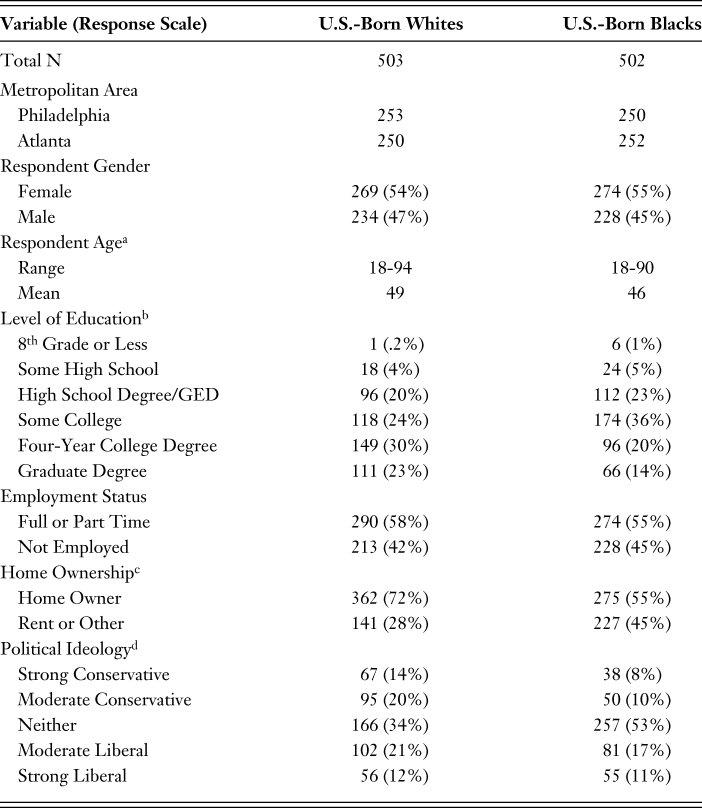
We first present mean comparisons and correlations to examine Whites’ and Blacks’ contact with each of the immigrant groups. These descriptive analyses are followed by a series of sequential OLS regression models to test for secondary transfer effects of Whites’ and Blacks’ contact with one another on their receptivity toward Mexican and Indian immigrants. Instead of using dummy variables to represent racial/ethnic background and nativity, we estimated separate models predicting U.S.-born (Whites’ and Blacks’) views of each foreign-born immigrant outgroup (Mexicans and Indians). Sample characteristics for each U.S.-born group in the SINAP data set are summarized in Table 1.
Sample Characteristics

Note: All percentages are reported as valid percentages—in other words, dropping any missing data.
a A total of 12 Whites and 11 Blacks did not report their age. One-way analyses of variance show that on average, White respondents are significantly older than Black respondents.
b A total of 10 Whites and 24 Blacks did not report level of education.
c One-way analyses of variance show that Black respondents were significantly less likely to own their homes than Whites.
d A total of 17 Whites and 21 Blacks did not report political ideology. “Neither” includes both those who reported “neither conservative or liberal” and “don’t think of myself in these terms”.
Bivariate Analyses
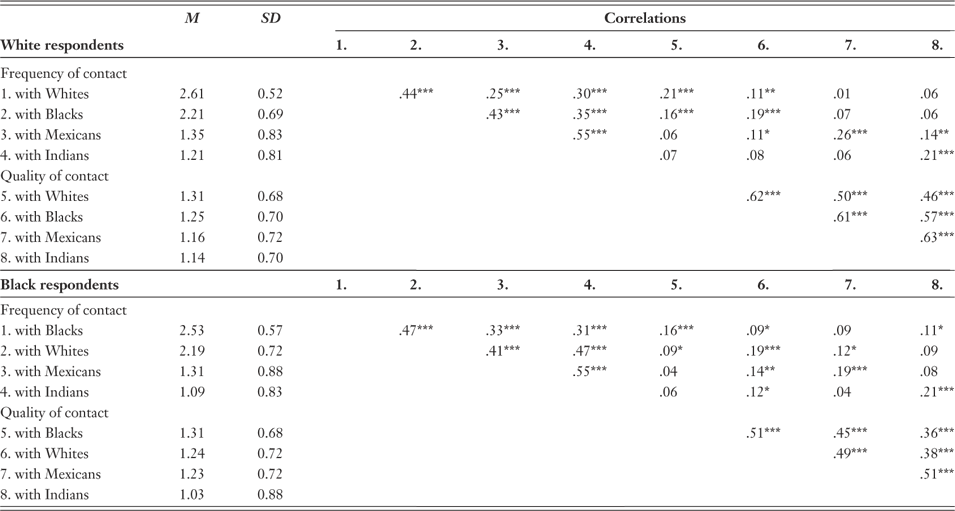
Following separate repeated measures analyses of variance conducted for U.S.-born Whites (F(3,496) = 539.99, p < .001), and Blacks (F(3,494) = 547.03, p < .001), Bonferroni post-hoc comparisons show that both U.S.-born Whites and Blacks reported most frequently engaging in contact with their own group (M = 2.61 and 2.53, respectively), and then with each other (M = 2.21 and 2.19, respectively), relative to the frequency of contact they reported having with either of the two immigrant outgroups (p < .001). Independent t-tests further reveal that Whites and Blacks do not significantly differ in their reported levels of contact frequency with Mexican immigrants (M = 1.35 and 1.31, respectively, t(997) = .84, p = .40). However, Blacks did report having slightly less frequent contact with Indian immigrants (M = 1.09) than Whites reported having with Indian immigrants (M = 1.21, t(998) = 2.25, p = .02).
Table 2 shows that there were small to moderate correlations between Whites’ and Blacks’ frequency of contact with each other, and with each of the immigrant groups, suggesting that greater interracial contact among the U.S.-born does not necessarily entail having less contact with immigrants, nor that greater contact with immigrants necessarily entails having less interracial contact with the other U.S.-born group. Rather, the patterns of correlations suggest that the more (or less) Whites and Blacks interact with each other, the more (or less) likely they also are to interact with Mexican and Indian immigrants.
Means, Standard Deviations, and Correlations Between Composite Frequency and Composite Quality of Contact for U.S.-Born White and Black Respondents

* p < .05. ** p < .01. *** p < .001.
Additionally, independent t-tests showed that Whites and Blacks do not significantly differ from each other in their welcoming attitudes toward Mexican immigrants (M = 2.03 and 1.97, respectively, t(942) = .87, p = .39), or in their desire to know Mexican immigrants (M = .44 and .50, respectively, t(963) = -.87, p = .39). At the same time, preliminary correlations revealed that responses to the welcoming and interest variables were only moderately correlated in relation to each immigrant group among Whites (r mexicans = .37, r indians = .36, p < .001) and Blacks (r mexicans = .32, r indians = .33, p < .001). As such, we treat them as separate outcomes in our analysis.
Multivariate Analyses
A series of multivariate regression models were conducted to model receptivity toward each immigrant group, and predictor variables were entered into these models at five steps.Footnote 8 At Step 1, we included only the demographic control variables as predictors for each outcome. At Step 2, we added composite contact frequency with the target immigrant outgroup, since controlling for the direct contact the U.S.-born have with each immigrant outgroup is an important requisite for testing for STEs (see Pettigrew and Tropp Reference Pettigrew and Tropp2011; Tausch et al. Reference Tausch, Hewstone, Kenworthy, Psaltis, Schmid, Popan, Cairns and Hughes2010). At Step 3, we then added the composite contact frequency with the other U.S.-born group (Whites for Black respondents, Blacks for White respondents) to test for STEs in terms of contact frequency. Finally, we added our two composite measures of contact quality—first, contact quality in relation to contact with the target immigrant outgroup at Step 4, and second, contact quality in relation to the other U.S.-born group (Whites for Blacks, Blacks for Whites) at Step 5—to test for STEs in terms of contact quality. For parsimony in the presentation of our results, we discuss findings from the full five-step model, after which we present supplementary analyses to test for the robustness of our results.
U.S.-Born Whites
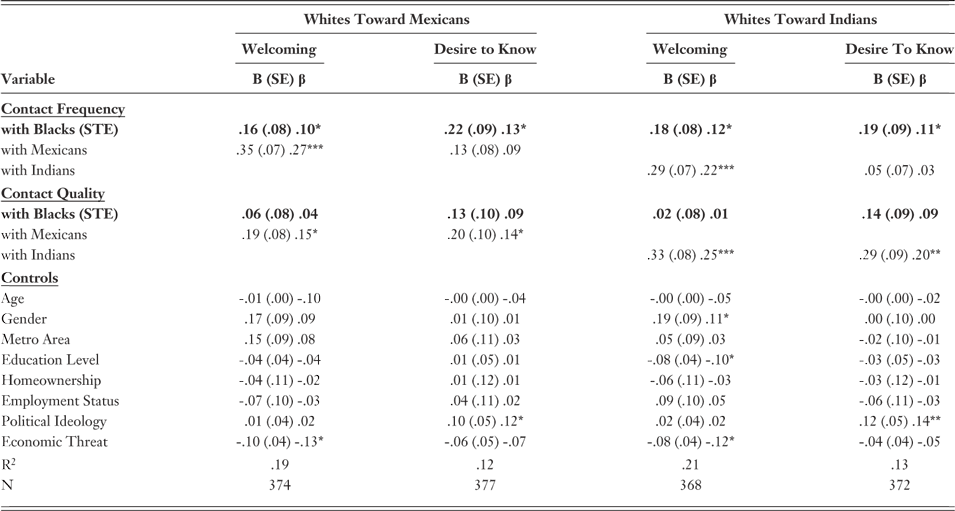
In the full regression models predicting welcoming attitudes among Whites (see Table 3), we find that greater contact frequency with Blacks is associated with significantly more welcoming attitudes toward both Mexican immigrants (β = .10, p < .05) and Indian immigrants (β = .12, p < .01), even after controlling for the amount of direct contact Whites have with these immigrant groups and our other controls. Additionally, these results indicate that the quality of Whites’ contact with Blacks does not significantly contribute to predicting Whites’ welcoming attitudes toward either Mexican or Indian immigrants beyond what can already be accounted for by all other variables in the model. In sum, Whites’ welcoming attitudes toward Mexican and Indian immigrants are uniquely associated with the greater frequency of contact they have with Blacks, providing support for H1. The coefficients representing these STEs are roughly equivalent in size and direction in relation to both Mexicans and Indians.
OLS Regressions Summarizing Secondary Transfer Effects Among Whites

Note: B(SE) = unstandardized coefficient and standard error; β = standardized coefficient. *p < .05. **p < .01. ***p < .001.
Turning to the models predicting interest in knowing immigrants among Whites, we find that greater contact frequency with Blacks also uniquely contributes to predicting greater interest in knowing both Mexicans (β = .13, p < .05) and Indians (β = .11, p < .05), once again after controlling for Whites’ direct contact experiences with these immigrant groups as well as the demographic controls. As was the case for welcoming attitudes, the full regression models suggest that the quality of Whites’ contact with Blacks does not significantly contribute to predicting their interest in getting to know either Mexican or Indian immigrants beyond the variables already included in the model. Thus, similar to what we observed for welcoming attitudes, Whites’ interest in knowing Mexican and Indian immigrants is uniquely predicted by having more frequent contact with Blacks. Once again, among Whites, the coefficients representing STEs are roughly equivalent in size and direction in relation to both Mexicans and Indians, and across both measures of receptivity, providing support for H1.
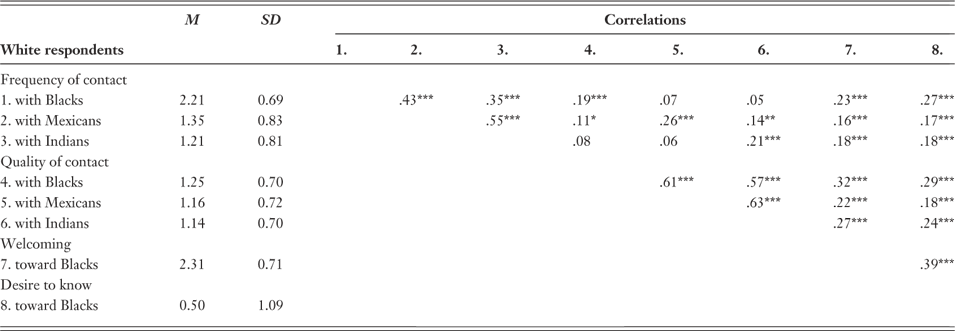
One possible interpretation for why we uncover these STEs among Whites is that Whites might be engaging in a process of “social comparison” (Fox Reference Fox2004) between U.S.-born Blacks and the two immigrant groups. In other words, the more frequent contact Whites have with U.S.-born Blacks, perhaps the more Whites come to welcome, want to know, or somehow “prefer” members of the two immigrant groups instead. While some sociological literature does support this possibility (e.g., Marrow Reference Marrow2011; Waldinger Reference Waldinger1997; Waters Reference Waters1999), we note that it does not appear to square well with the STE results presented here. As discussed above, Whites’ and Blacks’ levels of contact with both immigrant groups are positively (rather than negatively) associated with their levels of contact with each other (see Table 2), which does not support a pattern of Whites pulling back from contact with Blacks as their contact with Mexicans or Indians increases. Additional bivariate analyses also show that Whites’ contact frequency and contact quality with Mexicans and Indians is positively (rather than negatively) correlated with both their welcoming toward and desire to know U.S.-born Blacks (see Table 4, Columns 7 and 8), which again does not support a pattern of Whites becoming less welcoming to Blacks as their contact with Mexicans and Indians increases or becomes friendlier. Finally, in other multivariate analyses, we have found that more frequent contact with Blacks improves (rather than worsens) Whites’ welcoming attitudes toward, and feeling of being welcomed by, Blacks (Tropp et al. Reference Tropp, Okamoto, Marrow and Jones-Correa2018).Footnote 9 Taken together, these patterns give us greater confidence that the STEs for contact frequency we observe among U.S.-born Whites in our SINAP sample are positive, rather than negative.
Means, Standard Deviations, and Correlations Between Composite Frequency and Composite Quality of Contact between U.S.-Born White and Black Respondents and Both Immigrant Groups and Receptivity Toward U.S.-Born Black Respondents

* p < .05. ** p < .01. *** p < .001.
U.S.-Born Blacks
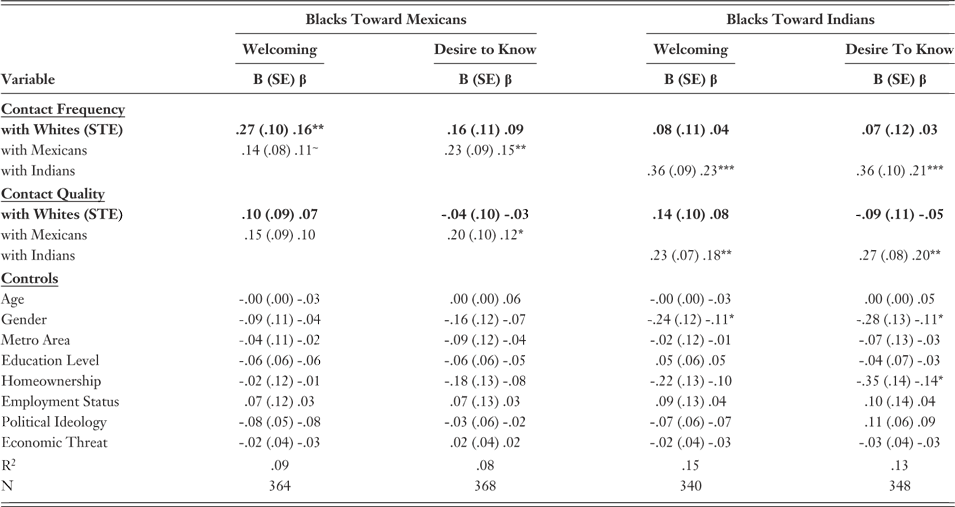
Parallel regression models predicting welcoming attitudes among Blacks (see Table 5) show that greater contact frequency with Whites is associated with greater welcoming attitudes toward Mexican immigrants (β = .16, p < .01) but not toward Indian immigrants (β = .04, ns). Here, we observe that Blacks’ welcoming attitudes toward Indian immigrants are predicted mostly by the frequency and quality of their direct contact with Indians themselves, and not by their contact with Whites. Among Blacks, then, welcoming attitudes toward Mexican immigrants are uniquely associated with the greater frequency of contact they have with Whites, whereas welcoming attitudes toward Indian immigrants are not.
OLS Regressions Summarizing Secondary Transfer Effects Among Blacks

Note: B(SE) = unstandardized coefficient and standard error; β = standardized coefficient. ∼p = .06 *p < .05. **p < .01. ***p < .001.
Our results also indicate that Blacks’ greater contact frequency with Whites is not significantly associated with Blacks’ interest in knowing either Mexican or Indian immigrants, once other factors are controlled. These results contrast with those observed among Whites. Blacks’ interest in getting to know Mexican and Indian immigrants is mainly predicted by the frequency and quality of the direct contact they have with Mexican and Indian immigrants themselves.
Overall, the fact that we see STEs emerge consistently across both measures of receptivity for Whites but less consistently for Blacks supports H1 and H2, suggesting that STEs are less likely to operate among members of a U.S.-born racial minority group than they are among members of the dominant U.S.-born racial group. Further, the fact that we find similar STEs among Whites in relation to both immigrant groups, and among Blacks only in relation to a lower-status, as opposed to a higher-status, immigrant outgroup (i.e., Mexican immigrants) does not provide support for H3a or H3b. We discuss the implications of these findings below, but first we turn to our supplemental analyses.
Supplemental Analyses
We ran several additional analyses to confirm the robustness of our results. Given that our data are cross-sectional, we cannot definitively rule out the issue of selection. For example, respondents in our sample could choose to live in different intergroup contexts, which could in turn shape their attitudes toward immigrants. Alternatively, it could be that respondents living in more stable neighborhoods might include more U.S.-born Whites and Blacks and/or fewer new immigrant arrivals, compared to their counterparts living in neighborhoods with higher residential turnover. Relatedly, the percentage of foreign-born residents in respondents’ census tracts could influence opportunities for direct contact with immigrants (Quillian Reference Quillian1995), which might indirectly affect our ability to observe secondary transfer effects.
To address these issues, we re-estimated our models including a measure of neighborhood stability (the percentage of neighborhood residents living in the same house over the past five years; see Browning et al. 2004) and the percentage of foreign-born residents in respondents’ census tracts. We asked survey respondents to report the cross streets closely to where they live and, from this information, we were able to geocode contextual information for 84% of White respondents and 78% of Black respondents.Footnote 10 In the models including neighborhood stability and percent foreign-born, along with all other predictor and control variables, we still observe meaningful STEs among Whites in relation to both Mexicans (β welcoming = .15, p = .01; β desire to know = .15, p = .01) and Indians (β welcoming = .12, p < .05; β desire to know = .11, p = .06), and among Blacks only in relation to welcoming Mexicans (β welcoming = .13, p < .05).
Next, we explored the possibility that Whites’ and Blacks’ preferences for homophily—that is, a preference for associating with people who are similar to oneself (McPherson et al. Reference McPherson, Smith-Lovin and Cook2001)—could vary across respondents and shape patterns of contact and attitudes toward the two immigrant groups. To address this possibility, we re-estimated our regression models, this time also controlling for the frequency and quality of Whites’ and Blacks’ contact with members of their own racial group along with the predictor and control variables from our original models. The results of these analyses continue to show significant STEs among Whites in relation to both Mexicans (β welcoming = .13, p < .05; β desire to know = .15, p = .01) and Indians (β welcoming = .11, p < .05; β desire to know = .17, p < .01), and among Blacks only in relation to welcoming Mexicans (β welcoming = .16, p = .01).
Taken together, the results from these additional analyses suggest that the STEs we have observed cannot be explained away by respondents’ selection into particular neighborhood contexts or variations in preferences for homophily. While we do not have longitudinal or experimental data, which could address issues of selection like these more fully, these supplementary analyses increase our confidence about the robustness of our results.
DISCUSSION AND CONCLUSION
How do we understand patterns of contact between the U.S.-born and immigrants within twenty-first century America, where these groups do not interact with one another in an isolated, binary fashion, but rather interact and respond to each other in multi-ethnic settings, which are shaped by the weight of a long and unequal historical past? Little research has endeavored to model the effects of such contact. We move beyond simply examining Blacks’ and Whites’ attitudes toward immigrants—a key element of the “context of reception” that influences immigrant incorporation (Portes and Rumbaut Reference Portes and Rumbaut2014)—to examine how these attitudes are influenced by Whites’ and Blacks’ direct contact experiences with each other, and with immigrants themselves. Using original representative survey data from U.S.-born Whites and Blacks living in metropolitan Atlanta and Philadelphia, we focus on how Blacks’ and Whites’ interracial contact with one another, even controlling for their direct contact with immigrants, contributes to their receptivity toward immigrants. This approach usefully adds to existing research on STEs by (1) focusing on these effects within the highly racially stratified U.S. context, (2) drawing on representative samples of adults across two metropolitan areas, (3) attending carefully to group status in relations between U.S.-born and immigrant groups, and (4) highlighting ways in which contact relations can foster inclusionary and positive attitudes toward immigrants, not merely those that are exclusionary and hostile.Footnote 11 Consistently for Whites, and in some cases for Blacks, we find that more frequent contact with the other U.S.-born group meaningfully contributes to greater receptivity toward immigrants. Such associations remain significant when controlling for the effects of both groups’ direct contact experiences with immigrants themselves, and when taking into account other possible explanatory or confounding factors.
The analyses presented here confirm the importance of secondary transfer effects in shaping attitudes toward immigrants, beyond the effects stemming from direct contact between U.S.-born and foreign-born individuals [H1].Footnote 12 The findings also confirm that secondary transfer effects are less pronounced among U.S.-born Blacks than among U.S.-born Whites [H2]. However, our results did not support our third hypothesis—that Whites’ contact with Blacks might be more closely linked to receptivity toward lower-status immigrant groups, whereas Blacks’ contact with Whites might be more closely linked to receptivity toward higher-status immigrant groups. Instead, Whites’ contact with Blacks corresponded with greater receptivity toward both immigrant groups, while Blacks’ contact with Whites only corresponded with greater welcoming toward a lower-status immigrant group (Mexicans) than toward a higher-status immigrant group (Indians).
Cross-sectional data alone cannot fully explain the processes or mechanisms driving these patterns of results. However, they may help to rule out a few alternatives. First, it bears re-emphasizing that across all our analyses the STEs for contact frequency are uniformly positive; when and where STEs emerge in our data, more frequent contact with the other U.S.-born group is always associated with greater (not less) receptivity toward immigrants. As discussed above, this shows that the STEs uncovered here are not driven by a negative process of Whites engaging in social comparison between Blacks and the two immigrant groups.Footnote 13
Second, the present analysis also shows that the STEs uncovered here are not driven by large disparities in the reported quality of Whites’ or Blacks’ contact with each other or in their attitudes toward the two immigrant groups. We showed earlier that, overall, U.S.-born Whites and Blacks do not differ significantly in terms of how much contact they report having with each other or with Mexicans or Indians. Nor do they differ significantly in terms of how much they welcome or desire to know Mexicans or Indians. Thus, we cannot argue that Whites’ attitudes somehow have greater room to shift by virtue of Whites having more contact with immigrants than Blacks do, or because Blacks are generally more receptive to immigrants than Whites are.
Finally, the present analysis suggests that the STEs indicated by the models are not driven by the differential economic positioning of the two immigrant outgroups. Instead, we argue that the shared racial positioning of the two immigrant outgroups likely provides a better account for why we find roughly equal evidence of STEs toward Mexicans and Indians among U.S.-born Whites, and perhaps also greater evidence of STEs among Whites than among Blacks. Perhaps U.S.-born Whites, given their dominant status in the American racial hierarchy, perceive both Mexican and Indian immigrants collectively as “non-Whites,” which could help to explain why Whites’ more frequent contact with Blacks contributes to greater White receptivity toward both groups of immigrants, regardless of the latter’s very different economic positioning. Some U.S.-born Blacks, given their subordinate status in the U.S. racial hierarchy, may instead perceive greater affinity with various racialized immigrant-origin groups, especially those who are strongly vilified, as Mexicans are in the present moment (e.g., Williams and Hannon Reference Williams and Hannon2016). Correspondingly, Blacks’ attitudes toward immigrants may be driven more by the salience of long-standing racial divides (see Bobo and Hutchings Reference Bobo and Hutchings1996; Wilkinson Reference Wilkinson2015) than by perceived similarities in economic status between Whites and higher-status immigrants, or between Blacks and lower-status immigrants. Of course, it is also possible that Blacks’ more frequent contact with Whites could intensify feelings of competition with and resentment of immigrants, and reduce Blacks’ receptivity toward all immigrant groups. However, this possibility does not appear to be supported by our analyses; the mean scores for welcoming and interest in knowing suggest neutral to positive attitudes toward immigrants, and the coefficients we uncover in modeling for STEs suggest only positive associations between U.S.-born Blacks’ contact experiences and receptivity toward immigrants, even after controlling for their perceptions of economic threat.
Thus, in our view the present findings uphold the central role of contact frequency in secondary transfer effects, even when controlling for contact quality and economic threat. Footnote 14 But they also highlight a need for more research to better understand the range of plausible processes and mechanisms that might underlie STEs, especially as they may operate in relation to different host and immigrant outgroups. Using the SINAP dataset, we are not able to test directly the role that perceived similarity between outgroups may play in facilitating STEs (see Pettigrew Reference Pettigrew2009; Tausch et al. Reference Tausch, Hewstone, Kenworthy, Psaltis, Schmid, Popan, Cairns and Hughes2010), so one fruitful step would be to include more direct measures of Whites’ and Blacks’ perceptions of similarity (economic, racial, and cultural) between various immigrant outgroups. This would allow for more direct examination of the dimensions of intergroup similarity that are deemed most predictive of STEs in contexts where recent immigrant streams introduce new dimensions of intergroup differences, while aligning this work more closely with existing STE studies on intergroup contact. A second fruitful approach, since experimental contact studies already provide convincing evidence that more frequent contact leads to improved attitudinal outcomes rather than vice versa (e.g., Binder et al. Reference Binder, Zagefka, Brown, Funke, Kessler, Mummendey, Maquil, Demoulin and Leyens2009; Tausch et al. Reference Tausch, Hewstone, Kenworthy, Psaltis, Schmid, Popan, Cairns and Hughes2010; see also Pettigrew and Tropp Reference Pettigrew and Tropp2011), would be to collect longitudinal data on STEs. This would allow for the testing of multiple mediating mechanisms at once, over several points in time. Finally, a third fruitful approach would be to test for secondary transfer effects in other locations (either within the United States or abroad), using other host and/or immigrant groups, or using other status characteristics that shape group positioning, to see if the conclusions presented here are generalizable to other settings and groups. For instance, one could imagine applying our model to other contexts with multiple, highly-stratified host groups, such as Cataluña, Belgium, Australia, South Africa, Canada, or beyond. Given the rise of prejudice toward Muslim migrant communities in Europe and increasingly in the United States (Bail Reference Bail2015; Bozorgmehr and Bakalian Reference Bozorgmehr and Bakalian2009; Cainkar Reference Cainkar2009; Selod Reference Selod2018; Zolberg and Long 1999), it could be especially fruitful to incorporate an analysis of other status characteristics, such as religion or language, alongside race and economic status to disentangle which ones in particular are most important for observed STEs.Footnote 15
The findings of the research here, however, provide an essential starting point. They represent a novel extension of STE research including new groups in new contexts, as well as a novel linking of that literature with immigration and race/ethnicity scholarship. Engagement, for example, with immigrant incorporation, group position, or even racial triangulation theories (see Kim Reference Kim1999; Xu and Lee Reference Xu and Lee2013) is not typical in STE research, yet the present study’s findings provide theoretical support for a common argument that runs across all three of those literatures, which is that the U.S. racial hierarchy shapes new immigrants’ reception and incorporation. Further, our results suggest the utility of integrating relational measures of contact and attending to economic as well as racial dimensions of stratification into such an interdisciplinary endeavor. Our findings suggest that Whites may be forming attitudes toward immigrants based largely on perceptions of the latter’s non-White racial—and less so economic—status, yet Whites and Blacks are not interpreting their encounters with one another in negative ways. Rather, we observe positive connections between interracial contact and immigration attitudes among the U.S.-born, and we do so in two metropolitan areas that were purposefully selected for their long histories of White-Black inequality and their high levels of ongoing White-Black segregation (Logan and Stults Reference Logan and Stults2011), which should create a more conservative test of how interracial contact, if and when it occurs, might translate into other positive outcomes.
ACKNOWLEDGMENTS
Support for this article was provided by grants from the Russell Sage Foundation, Carnegie Corporation of New York, University of California Center for New Racial Studies, and Cornell University Population Center. Special thanks to Bart Bonikowski, Natasha Kumar Warikoo, Silvia Dominguez, Bram Spruyt, Karen Phalet, Van Tran, and two anonymous reviewers at Du Bois Review for helpful feedback. We also thank participants of the Migration and Immigrant Incorporation Workshop at Harvard University, the National Immigrant Integration Conference, the Eastern Sociological Society, the Belgian-Dutch Political Science Conference, the International Migration, Integration, and Social Cohesion (IMISCOE) Network, and the UCLA Center for the Study of International Migration for feedback.
APPENDIX A: SAMPLE AND PROCEDURES
Prospective survey respondents were contacted by phone between May and July 2013. U.S.-born White and Black samples were drawn through random digit dialing (RDD) of landlines and cellphone numbers to randomize selection of respondents and minimize selection bias, in conjunction with an oversampling of high-density census tracts, based on American Community Survey (ACS) block-group level estimates of where Blacks live. The survey employed a stratified sampling design for the Mexican and Indian foreign-born samples, drawing a random sample from cell phone lists as well as surname dictionaries, in conjunction with an oversampling of high-density census tracts based on ACS block group-level estimates of where Mexican and Indian immigrants live, as well as some face-to-face survey administration to subsamples of Mexican and Indian immigrants. We also employed quotas by age and gender to ensure that our samples would not be heavily skewed on these dimensions across groups.Footnote 16
Through these procedures, we obtained largely representative samples of respondents from the four groups, including 503 U.S.-born Whites, 502 U.S.-born Blacks, 500 Mexican immigrants, and 501 Indian immigrants, with half of each sample coming from each of the two metropolitan areas. To be eligible for participation in the survey, respondents had to be at least eighteen years old and residing in one of ten counties in either of the Philadelphia (e.g., Bucks, Chester, Delaware, Montgomery, Philadelphia) or Atlanta (e.g., Clayton, Cobb, DeKalb, Fulton, Gwinnett) metropolitan areas at the time of the telephone call. Survey respondents who identified as White or Black had to indicate that they were born in the United States, while survey respondents who identified as Mexican or Indian had to indicate that they were born in Mexico or India, respectively. After these initial screening questions, the remainder of the forty-minute survey queried respondents about respondents’ intergroup contact (including its frequency, quality, relative status, and location); levels of intergroup friendships, trust, empathy, and apathy; perceptions of discrimination (including its type, location, and source); perceptions of economic and cultural threat (including its location and source); receptivity toward, plus sense of reception by, other groups; strength of national attachment as American; (for the two U.S.-born groups only) attitudes toward immigrants and immigration policy; and levels of civic and political engagement (including its type and depth). These were followed by a battery of questions that queried respondents about their demographic characteristics (and, for the two immigrant groups only, immigration backgrounds).
Using calculation procedures provided by the American Association for Public Opinion Research (AAPOR 2008), the survey achieved a response rate of 20% for all households with whom contact was made and a cooperation rate of 90% for all respondents contacted who also met our eligibility criteria. Telephone interviews were conducted in English and Spanish for Mexican respondents and in English for respondents from the other three groups.Footnote 17