1 Introduction
English has at least five different ways of expressing futurity: shall/will, be going to, be to, the simple present and the present progressive (see Nehls Reference Nehls1978). All of these are characterised by specific and complex co- and contextual configurations in which they occur, as well as sometimes very subtle differences in meaning. Moreover, there is of course the long-standing debate about whether contemporary English actually has a future tense or not (see Wekker Reference Wekker1976; Comrie Reference Comrie1985: 24, 43–8; Huddleston & Pullum et al. Reference Huddleston and Pullum2002: 208–12; Declerck et al. Reference Declerck2006: 102–6; Salkie, this issue).
In this theoretical, programmatic article it will be suggested that all of these expressions can be successfully described in a Construction Grammar (CxG) framework (as outlined, e.g., in Goldberg Reference Goldberg1995, Reference Goldberg2003, Reference Goldberg2006; Fried & Östman Reference Fried, Östman, Fried and Östman2004). In practice, this means that expressions of futurity can be regarded as constructions (conventionalised form–meaning pairings), and that these constructions in turn form a so-called construction family, which, in this case, is onomasiologically motivated – in contrast to previous work (e.g. on the perfect, see Michaelis Reference Michaelis1998; on the resultative, see Goldberg & Jackendoff Reference Goldberg and Jackendoff2004), which mainly investigates formal relationships and similarities, and thus concentrates on semasiological aspects. Onomasiology begins with concepts and investigates the possible linguistic realisations of these concepts; semasiology, in contrast, begins with forms and investigates what kind of concepts can be associated with these forms. Thus, the investigation of formal relationships and similarities is often a semasiological enterprise. The present article looks at the question of relationships in language from a different angle. One of the central problems in describing and discussing expressions of futurity in contemporary English from a traditional point of view is the fact that there is no single ‘future’ morpheme, as in Latin (-b-) or Turkish (-eceg-). Instead, futurity in English is signalled by complex combinations of different elements and extralinguistic (pragmatic, contextual) factors. There are numerous examples of these combinations that could be listed here:
• it is usually claimed in traditional, pedagogical grammars that shall is the correct form for the first person to signal futurity, whereas all other persons require will (see Huddleston & Pullum et al. Reference Huddleston and Pullum2002: 195; Bergs Reference Bergs, Trousdale and Gisbourne2008);
• the present forms, both simple and progressive, usually require adverbials with future time relevance in their textual vicinity. These, however, need not be in the same sentence, but could also be in a previous paragraph, for example. Sometimes extralinguistic factors such as register or context are also sufficient (see Wekker Reference Wekker1976 for an extensive discussion);
• while the simple present is available for all types of subjects and predicators, the progressive is incompatible with many inanimate subjects and non-agentive verbs (*The tulips are growing quickly next summer, but cf. also the office equipment is being moved next week);
• be to does not seem to be equally common in all styles and registers (Close Reference Close1970: 44–5; see also Declerck, this issue);
• be going to is more common in informal styles, will in formal ones (Wekker Reference Wekker1976; Close Reference Close and Bald1988; Mair Reference Mair, Hickey and Puppel1997; Berglund Reference Berglund1999, Reference Berglund, Mair and Hundt2000a, Reference Berglund, Lewandowska-Tomaszcyk and Melia2000b; Szmrecsanyi Reference Szmrecsanyi2003: 296).
Another important aspect to be considered here is that, while all forms are united by a semantic core, each of the different forms highlights some other aspects of futurity: shall/will express ‘mild’ or ‘general’ prediction; be going to has a stronger focus on matrix time, i.e. the time when the utterance is supposed to be valid, and often implies plans underway; be to generally conveys strong prediction in more formal contexts; the simple present expresses fixed, scheduled events; and the present progressive is one of the strongest forms of prediction and also involves an element of planning (see Wekker Reference Wekker1976; Huddleston & Pullum et al. Reference Huddleston and Pullum2002: 208–12). By definition, constructions in the technical sense include both co- and contextual information, ranging from pragmatic factors to style, register and genre (see the papers in Bergs & Diewald Reference Bergs and Diewald2008). Thus, the problems of co- and context as important elements in the grammar are easily accommodated in a CxG approach. In this article it will be argued that constructions have a facultative ‘context slot’ in which relevant information is stored and whose values need to be compatible (‘unifiable’) with the general meaning of the construction as a whole. Last but not least, CxG does not distinguish between grammar and the lexicon. All elements, no matter whether lexical items, idioms, or schematic, syntactic patterns are treated as constructions and are described and analysed in the same kind of way (for a schematic representation, see Croft Reference Croft2001). Tense is traditionally defined as the ‘grammaticalised expression of location in time’ (Comrie Reference Comrie1985: 9). Eliminating the grammar–lexis distinction means that the question of a future tense in English at least needs to be rephrased, or perhaps could even become irrelevant.
This article is organised as follows: first, some basic ideas and principles of Construction Grammar(s) will be described and discussed. In the second section, some ways of expressing futurity in English as well as their specific co- and contextual occurrence patterns and their functional nuances will be outlined. In particular, we will focus on will and be going to. This forms the basis for the third section of this article, a detailed discussion of these patterns and their structural arrangement in a Construction Grammar perspective. The final section discusses the question whether English actually has a future tense, or tenses at all, in CxG and outlines some possible future research programme, including implications for the study of the phylogenetic and ontogenetic development of future expressions, i.e. for grammaticalisation and language acquisition.
2 Construction grammar
‘Construction Grammar is a non-modular, generative, non-derivational, monostratal, unification-based grammatical approach, which aims at full coverage of the facts of any language under study without loss of linguistic generalisations, within and across languages’ (Kay Reference Kay1997: 123). While there are quite a few different strands of constructional approaches to language on the market today, most of these share a number of common assumptions regarding the linguistic system and its organisation (cf. Goldberg Reference Goldberg2006: 205–26; Schönefeld Reference Schönefeld2007). One of the most central assumptions is that language as such, and therefore also linguistic knowledge, does not consist of items-and-rules, as in traditional generative approaches, but rather of constructions. These are defined as conventionalised form–meaning pairings at various levels of abstraction and complexity. Usually, CxG distinguishes between specific and abstract constructions on the one hand, i.e. those which are lexically specified and those which are rather abstract, and atomic versus complex on the other hand, i.e. simple, usually one-word constructions, versus more complex, multiple-word constructions. Note that there are certain constructions which are a hybrid of specific and abstract, such as the WHAT IS X DOING Y construction, where much of the construction is specified, but there are still two abstract slots, X and Y. Eventually we arrive at a very general two-by-two matrix in which the four different theoretically possible types of constructions can be arranged:

Constructions are usually required to have some sort of non-compositional meaning aspect, i.e. their specific meaning or function must not be entirely derivable from their individual components. However, some recent studies (e.g. Goldberg & Jackendoff Reference Goldberg and Jackendoff2004: 533, n.1; Goldberg Reference Goldberg2006: 5, chapter 3) also point out that ‘patterns are stored as constructions even if they are fully predictable as long as they occur with sufficient frequency’ (Goldberg Reference Goldberg2006: 5).
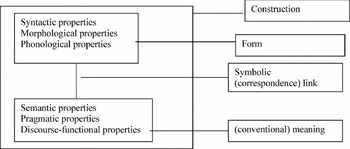
All constructions essentially share the same general make-up. They have a form side, which can include information on their syntax, morphology and phonology, and a function side, which can include information on their semantics, pragmatics and discourse-functional properties. This basic design is also illustrated in figure 1.
The symbolic structure of constructions (Croft & Cruse Reference Croft and Cruse2004: 258)

Constructions are not monolithic, unconnected entities, but are arranged in a structured inventory. This inventory, while usually organised according to structural features, is based on and motivated by family resemblances, gestalt theory, and principles such as metaphor and metonymy, among others. The inventory, or at least parts of it, constitutes the linguistic knowledge of speakers.
‘Non-modular’ in the definition of CxG mentioned above means that CxG does not distinguish systematically between the different levels of linguistic structure, such as phonology, morphology, syntax, semantics, pragmatics. In other words, all levels can be equally represented in constructions without any logical or systematic priorities. Most CxG approaches even stress the importance of not distinguishing between lexicon and grammar, semantics and pragmatics, for example (see, e.g., Croft Reference Croft2001; Fried & Östman Reference Fried, Östman, Fried and Östman2004; Goldberg Reference Goldberg2006). CxG is generative insofar as it tries to capture linguistic facts and realities using the broadest possible generalisations. Instead of positing an infinite number of big and small constructions, the use of the criterion of compositionality leads to interesting generalisations across individual concrete structures (see Goldberg Reference Goldberg2006 for an extensive discussion). CxG is also non-derivational and mono-stratal, since it essentially follows a ‘what you see is what you get’ approach to syntax (Goldberg Reference Goldberg2006: 10). This means that there are no rules that derive one structure from another, and that there is no invisible deep structure from which concrete surface realisations are derived. Active and passive sentences, for example, which are traditionally connected somehow through derivational processes, or at least are derived from one single (abstract) underlying structure through well-defined derivational rules (see, e.g., Jackendoff Reference Jackendoff2002: 47, 50, 178), are usually regarded as different constructions in CxG, since they show both distinct forms and functions (e.g. in terms of information structure and their genre specificity). However, this does not mean that constructions are entirely independent. On the one hand, they are linked and connected in the structured inventory that has been mentioned before. On the other hand, many (though not all) CxG frameworks use the mechanism of unification in order to explain the interplay of certain constructions. Unification in this case means that the individual features of the constructions in question need to be compatible, unifiable, in order for the constructions to form an acceptable whole. This can be easily exemplified by using the Progressive Construction and individual verbs. The former is an abstract, complex construction, the latter are more concrete and simple ones. The two can be combined only in certain cases. The progressive usually combines with verbs that express current, concrete action, such as walk, talk, eat, kick: She is walking down the street, eating a hamburger, but less frequently with verbs that express states, feelings, possession, such as be, believe, belong, hate, hear, like, love, mean, prefer, remain, realise, see, seem, smell, think, understand, want, wish: *The car is belonging to me. In CxG terms we might want to say that the progressive construction usually unifies with verb constructions of the former type, since they have unifiable, compatible features, but not with verb constructions of the latter type, since their semantico-pragmatic features usually clash with that of the progressive construction:
i. The situation is presented as in progress, ongoing, at or throughout T(r).
ii. The situation is viewed imperfectively.
iii. T(r) is a mid-interval within T(sit). [implicature]
iv. The situation is presented as durative.
v. The situation is presented as dynamic.
vi. The situation is presented as having limited duration. [implicature]
(cf. Quirk et al. Reference Quirk, Greenbaum, Svartvik and Leech1985: 197–210; Huddleston & Pullum et al. Reference Huddleston and Pullum2002: 163)
However, in certain cases, we do find verbs of the latter type embedded (‘unified’) in progressive constructions: I'm loving it, I'm having a beer, I was thinking. . ., I am not believing this. . . In these cases, the unification of the two constructions does not necessarily lead to nonsensical utterances, but rather coerces a new meaning out of the verb construction. Coercion may thus be seen as a process by which the unification of two hitherto incompatible constructions may lead to new, sometimes metaphorical, extensions of meaning (see, e.g., de Swart Reference De Swart1998, Reference De Swart, Butt and King2000; Michaelis Reference Michaelis1998, Reference Michaelis, Östman and Fried2005; Traugott Reference Traugott2006; Ziegeler Reference Ziegeler2006).
There are only very few problems in CxG in modelling the form side of constructions, as similar unification-based approaches have also been developed and tested in Head Driven Phrase Structure Grammar, for example. However, CxG still seems to have some problems when it comes to the function side of constructions, and, in particular, the discourse-functional properties of constructions. These are, obviously, very hard to capture in a strict, unification-based framework (see Bergs & Diewald Reference Bergs and Diewald2008). How, for example, are genre distinctions or subtle pragmatic differences in the use of two superficially similar constructions to be captured in a unification framework? What features can be assumed, for instance? Many, if not most, studies have used prose descriptions of constructional ‘soft’ features, such as discourse-functional properties. Some approaches (e.g. Fried Reference Fried, Bergs and Diewald2008) have stressed the usefulness and compatibility of Frame Semantics (see, e.g., Fillmore & Atkins Reference Fillmore, Atkins, Lehrer and Kittay1992; Petruck Reference Petruck, Verschueren, Östman, Blommaert and Bulcaen1996) as a more rigid and formal model. Since both approaches, i.e. formal features in the unification-based framework and soft features in prose-based descriptions, apparently have their advantages and neither of them has ripened to full maturity and been accepted by the CxG community, the present approach can be found somewhere in between, making use of the best of both worlds, wherever possible.
3 Expressions of futurity in CxG
3.1 Expressions of futurity
As mentioned before, present-day English has at least five different ways of expressing futurity: will, be going to, praesens pro futuro, i.e. simple present, present progressive, and be to. Note that there are, of course, more subtle distinctions, such as the one between will plus infinitive versus will plus infinitive plus present participle (as made in Wekker Reference Wekker1976, for example; also see Celle & Smith, this issue), or the avertive/proximative as in John was/is about to eat a pecan cookie. For present purposes, however, and for the sake of clarity, only five main exponents will be assumed. All five share some core semantic meaning in a formula similar to those by Reichenbach: Futurity  (S_R ∨ S, R) ∧ (E_R ∨ E, R). This means that Futurity essentially conveys a message that invokes a reference point (R) which is simultaneous with or later than a situation (S) at which the utterance is made, and an event (E) which is simultaneous with or earlier than this reference point.Footnote 1 Apart from that, all five expressions of futurity differ in their form and in their function, i.e. in the way futurity as such is presented. Note that this perspective does not differ dramatically from the one we should assume for expressions of pastness. Here we also find different expressions, such as the simple past, the past progressive, the used to past, the historical present, etc. which all share one core meaning but differ in their form and detailed, specific function. Note also that the regular morphological expression of the preterite in English, {-ed}, does not necessarily always refer to the past but could also signal modal remoteness (cf. Bergs & Heine, to appear). It thus seems somewhat infelicitous to assume (or rather demand) an isomorphic relationship for the future, as has sometimes been done in traditional approaches, and to use this as an argument against a ‘future tense’ in English. On similar grounds, and with respect to the same criteria, English would not have a past tense either. But this is not the right place to enter into this discussion. Rather, in the following, some of the subtle differences between the individual expressions will be discussed.
Will
Will (and shall, at least to some extent) is usually regarded as one of the most controversial markers of futurity, in particular since the distinction between modal and tense uses is very difficult to make. Jespersen (Reference Jespersen1949: 253) shows that volitional will often cannot be distinguished from ‘neutral’ futurity will; Joos (Reference Joos1968: 159) argues that will as a modal auxiliary may have the connotation of futurity in some uses, but not the denotation. Palmer (Reference Palmer1991: 160–1) points out that in terms of form, will clearly belongs to the group of modals. Huddleston & Pullum et al. (Reference Huddleston and Pullum2002: 209) combine both Joos’ and Palmer's viewpoints and argue against will as a tense marker. Wekker (Reference Wekker1976: 39, 67–8), Comrie (Reference Comrie1985: 44) and also Declerck et al. (Reference Declerck2006: 103), on the other hand, claim that in some cases will undoubtedly refers neutrally to future events. In an utterance such as It will rain tomorrow we find a neutral statement about some future state of affairs which can be checked at the designated point in time. Either it rains the day after the utterance was made, or it doesn't. In utterances with unambiguous modals (It may rain tomorrow) this is not the case. Also note that in this utterance, i.e. it RAIN tomorrow, the simple present may not be used felicitously with future time reference: *it rains tomorrow. Footnote 2
All this points to the fact that will certainly enjoys a very special status in the verbal paradigm (see Salkie, this issue, for a full discussion). Larreya (Reference Larreya, van der Auwera and Dendale2000: 127) argues that will ‘fundamentally expresses implicative necessity’. Of course it can also express what he terms absolute and relative futurity, but these, Larreya claims, are conceptually linked to implicative necessity. In any case it may be claimed that will expresses rather ‘mild’ and ‘general’ predictions, which are usually interwoven with some degree of modality. Huddleston & Pullum et al. (Reference Huddleston and Pullum2002: 211) point out that will, in contrast to be going to, has less focus on matrix time, i.e. it shows a lesser degree of immediacy.
Will as a marker of futurity is subject to some interesting co- and contextual constraints. One of the intralinguistic constraints is exemplified by the traditional, prescriptive rules concerning the use of shall and will. Many prescriptive grammar books used to postulate that first-person subjects require shall, while second- and third-person subjects require will in order to achieve a future reading. First-person subjects with will should be interpreted as volitional, while second- and third-person subjects with shall should be interpreted as signalling obligation (see Huddleston & Pullum et al. Reference Huddleston and Pullum2002: 195). These prescriptive rules are not fully operational today (see Tieken-Boon van Ostade Reference Tieken-Boon van Ostade1985; Arnovick Reference Arnovick1990; Szmrecsanyi Reference Szmrecsanyi2003; Nesselhauf Reference Nesselhauf, Hundt, Nesselhauf and Biewer2007; Bergs Reference Bergs, Trousdale and Gisbourne2008), but in Standard English they are still visible in conjunction with interrogatives, for example. Yes-No interrogatives with first-person subjects and will (e.g. Will I do that now?) seem somewhat infelicitous. However, in certain other contexts, e.g. in wh-interrogatives, this effect seems to disappear: When will I see you again? seems perfectly fine. This distinction is not easy to capture in traditional frameworks. It is perhaps also interesting to point out that will often, but not always, combines with time adverbials in adjacent parts of the discourse. These may support the interpretation of will as ‘future’ rather than ‘epistemic modal’, but they certainly do not carry the reading ‘futurity’ alone, as will be shown below.
be going to
Be going to, in contrast to will, does not have very many co-textual constraints. It can usually combine with almost all subject types and is relatively free in its co-occurrence with temporal adverbials. From this perspective, it appears to be the most independent marker of futurity compared to the others. In terms of function, however, it is usually associated with intentionality and (objective) prediction deriving from present circumstances. In the latter case it differs from will, for example (cf. Huddleston & Pullum et al. Reference Huddleston and Pullum2002: 211–12). Note that be going to in its future sense in present-day spoken English is usually phonetically contracted and univerbated into gonna (e.g. I'm gonna go to London vs. *I'm gonna London).
praesens pro futuro
Both the simple present and present progressive share the fact that they usually combine with future time adverbials in order to signal futurity. Wekker (Reference Wekker1976: 80), for example, shows that in his database the majority of simple present future forms occur in independent main clauses, and that about 75 per cent of these also contain a temporal adverbial. It has sometimes been suggested that in these cases of praesens pro futuro the future meaning is only conveyed lexically, e.g. through the temporal adverbial. It can be shown that this is not the case. First, in some contexts, a future adverbial is basically incompatible with the present tense. This means that there is at least some complex interplay between the verb and the adverbial. If it were only the adverbial that was relevant this interplay would not be noticeable. Second, in quite a few cases, these two present tense forms combine either with future time adverbials in a discourse-distant position, e.g. uttered by an interlocutor, or with a future time reference that can only be inferred through context in the stricter sense, i.e. through extra-linguistic clues. These two principles are exemplified in the following two examples.
(1) Witness – please! ‘The Water Engine’, which premieres on cable's TNT channel tonight at 8, followed immediately by two repeated shows. (Frown Corpus, text a)
(2) A new study shows that only one in 20 women undergoes an annual mammogram as recommended by doctors. We look at that and other health stories with our medical contributor . . . (WTTW11 Chicago, 22 June 2004, www.wttw.com/chicagotonight/archive/thisweek062104.html)
(1) is an example of an announcement about a forthcoming TV programme; in (2), a typical beginning for a TV or radio show, the host announces what will happen in the following show. Note that in (2) there are no temporal adverbials, but that the utterance we look at that still clearly refers to future events. Here it may be argued that this future reference of the simple present has to do with genre-specific conventions and phrases. These are not part of traditional syntactic analyses and are often treated as extra-linguistic, hence irrelevant, factors. This shows that, at least with some occurrences, the future meaning cannot be based on syntax alone, but that further pragmatic, co- and contextual features need to be considered. Also, the fact that the simple present usually – but not always – combines with temporal markers in order to signal a special kind of futurity is of importance here. As will be shown in the following, the simple present usually signals a very high degree of fixedness and certainty regarding the future event. This special notion, however, clearly cannot lie solely in the tense marker, since this usually has a different function, nor in the temporal adverbial, since this does not have this lexical meaning and can also combine with ‘weaker’ future markers. This means that the special aspect of futurity in this case can only arise from a combination of tense marker and temporal marker in a certain context. Moreover, the simple combination cannot explain this effect. Rather, it can be assumed that this is a holistic effect and that the construction as such shows a high degree of non-compositionality of function.
What, then, is the difference between the simple present and the present progressive? The simple present usually signals a fairly high degree of certainty regarding the future events. It is very common with timetables, fixed plans, premeditation etc. In that respect it differs clearly from the will future, for example. This is underlined by the fact that the simple present sounds awkward, even in combination with a future time adverbial, when the action expressed with the main verb is something that cannot be planned, controlled or precisely determined. Hence, (3–5) are fine both with will and the simple present, since they all are or can be planned (3), or are precisely predictable, (4) and (5), whereas (6) and (7) are only good with will since rainfall and sickness cannot be predicted with a great deal of precision and/or control. Thus, in (3) the will future expresses a ‘mild’ future, i.e. an expectation rather than a precise prediction, in (4) and (5) it focuses on the future event rather than stating its factual, scientifically established prediction. This can be interpreted as a difference in emphasis.Footnote 3
(3)

(4)
(5)
(6)
(7)
Leech (Reference Leech2004: 65) also remarks that an utterance like (8) below essentially only allows for an ironic or sarcastic reading, since such an event is also usually not predictable.
(8) Next week John fails his driving test.
Note, of course, that there are certain contexts in which the situation can override this reading, e.g. if John has actually planned to fail the test, for whatever reason, or if this were a synopsis about future episodes in a soap opera. Williams (p.c.) again points out the narrativising function of the present in this case.
be to
Be to is undoubtedly one of the most complex expressions to be discussed here. Like will, it borders on both deontic and epistemic reality in that it can signify both a simple statement about the future as in (9), but also command, orders, expectations as in (10).
(9) It was announced today that Prince Charles is to marry Camilla Parker Bowles on 8 April, and she is to be called Princess Consort, says Clarence House.
(10) If you want to continue with Spanish it means that you are to take two more semesters of Spanish. (Micase ADV700JU023))
Quirk et al. (Reference Quirk, Greenbaum, Svartvik and Leech1985: 137, 143, 217–18; cf. Palmer Reference Palmer1974: 154–5) also describe be to as a ‘modal idiom’, expressing futurity, with various connotations of ‘compulsion’, ‘plan’, ‘destiny’, etc., according to context. While comprehensive studies on be to are still lacking (but see Declerck, this issue), it may be assumed that today be to is fairly restricted in its use, and that the futurity reading is often associated with newspaper headlines, TV news and the like (cf. Close Reference Close1970: 44–5). Note that in headlines it is also often abbreviated to simple ‘to’ as in Blair to give a speech tomorrow: many occurrences of be to appear in online headlines and search engine entries such as Google, but not in the full text. One such example is (11).
(11) The Prince of Wales is to marry long-term partner Camilla Parker Bowles. (BBC News, 11 May 2005, http://news.bbc.co.uk/1/hi/uk/4252795)
The headline, presented in (11) contains the be to construction. The full text, however, switches to will, as shown in (12):
(12) Prince Charles will marry his long-term partner Camilla Parker Bowles on 8 April, Clarence House says. (BBC News, 11 May 2005, http://news.bbc.co.uk/1/hi/uk/4252795)
This suggests that will and be to in their future reading may be almost identical in meaning, but are differentiated through intra-genre factors such as headlines versus text body.
3.2 Expressions of futurity: a CxG perspective
As has been said in the previous sections, all expressions of futurity share the fact that they somehow refer to the future in Reichenbachian terms. However, they all differ in their sometimes very subtle semantico-pragmatic differences regarding their future time reference and/or their interplay with co- and contextual factors. Since all these facts are currently hard to capture in traditional frameworks, the present article argues in favour of an analysis in constructional terms. The major advantages seem to be that
• the different expressions of futurity may keep their independence as individual constructions (defined as conventionalised form-function pairings);
• their specific co- and context dependence can be recognised and described on their form side in a non-technical way,Footnote 4 based on actual language use; and
• their individual semantico-pragmatic functions can be described in detail on their function side.
In CxG terms, a construction is defined as the conventionalised combination of form and function. The latter usually needs to be holistic, i.e. non-compositional, but sufficiently freqduent combinations can also be recognised as constructions and stored individually in the mental lexicon. Apart from constructions as such, some frameworks (e.g. Fried & Östman Reference Fried, Östman, Fried and Östman2004) invoke yet another concept, namely ‘constructs’. Constructs are regarded as concrete realisations of a (more abstract) construction. This means, in other words, that some constructions may be realised by more than one form. This is fairly easy to see in the case of abstract constructions like the subject-predicate or the passive construction which are obviously realised by a number of different, concrete realisations. However, in the case of phenomena like the verb-particle construction there are some disputes whether the structures with and without adjacent particle are actually constructs of one single construction, or in fact two (see Gries Reference Gries2003; Cappelle Reference Cappelle2006, Reference Cappelle, Bergs and Diewald2009). Note also that recently a number of proposals have emerged (e.g. Cappelle Reference Cappelle2006, Reference Cappelle, Bergs and Diewald2009; Traugott Reference Traugott, Bergs and Diewald2008) which point out that there might be a level between constructions and constructs. Cappelle calls these allostructions. These are variants of some particular constructions, but still abstract in the sense that they have not yet unified with concrete lexical constructions and thus become concrete. Theoretically at least, there are three different possibilities of how the expressions of futurity mentioned above can be treated. All (or some of them) could be allostructions of one single construction, all (or some of them) could be individual constructions, or all (or some of them) could be neither of the two, i.e. they could be compositional complex structures without constructional status. The latter, however, is very unlikely, since none of the expressions is actually compositional. All expressions of futurity signal their temporal meaning through complex, non-compositional configurations. As regards the former two options, the present article argues that all expressions of futurity, including will, be going to, the simple present, the present progressive, and be to are in fact constructions in their own right. All of these expressions have a core meaning plus subtle differentiations (which warrants the existence of different expressions, with respect to the principle of isomorphism) and they have very complex, conventionalised co-textual and contextual constraints on their use. Treating them as allostructions of one single construction would require an enormous amount of detailed specification on both the form and the function side, with little or no gain through any generalisation that could be achieved this way.
Capturing and describing co- and contextual features is, of course, very difficult in many frameworks. CxG, with its explicit inclusion of these two factors, offers some advantages here. This means that in CxG each individual expression can be defined in terms of form by the constraints of its occurrence and in terms of function by the core meaning plus subtle distinctions that are made. This in turn means that there is not one single will construction which is somehow differentiated between modal and future uses, e.g. through polysemic links, but that there are two constructions which are independent (and defined through their complex configurations), but maybe somehow related through family relations (which may, of course, historically go back to polysemic links). The same, in a way, also applies to be going to which can be used either as a full verb in its progressive form or as a future auxiliary. This means that while the present article is mostly concerned with the five constructions which share the expression of futurity as their common functional denominator, there are of course a number of other constructions which are structurally similar or even identical, but which have different functions and – usually – also different co- and contextual constraints.
The definition through complex configurations and the inclusion of particular co- and contextual factors makes certain theoretical assumptions necessary. One of these seems to be that constructions have what may be called a ‘context slot’. This context slot contains information on the contextual use of the construction in question. For example, it lists the fact that the simple present is fine in the context of news headlines or sports commentaries. And it lists genre facts, such as the use of be going to in more informal contexts in contrast to will (Huddleston & Pullum et al. Reference Huddleston and Pullum2002: 211). And it also opens up the chance of including dynamic contexts as long as they can somehow be conventionalised in a frame semantic or functional sense. So, for example, there must be one intuitive linguistic rule (hitherto more or less uncovered, apparently) which guides speakers and hearers in gauging whether some time adverbial is still close enough, discourse-wise, to warrant the unmodified use of the simple present or present progressive, or whether these either need to be accompanied by some clarifying adverbial, or perhaps need to be replaced by some more explicit expression such as will or be going to.
But the context slot needs to do more than that. It also needs to encompass extralinguistic context, i.e. it needs to make sure that certain situations – not unlike genres – make sure that certain expressions can be understood in the right way. So, for example, given some shared, more or less salient, background knowledge that John will go to New York City at some point in the future, a question like John is connecting through London, right? is usually interpretable as referring to future events, not something going on right at the moment the utterance was made. The context slot needs to be semantico-pragmatically compatible, or, in some frameworks, ‘unifiable’, with the rest of the construction. An utterance with a preterite form (John connected through London?) in the context just mentioned would be very unusual and difficult to interpret, unless there is some other contextual evidence for hearers to construct their interpretation. So we can assume that constructions can have a hitherto unspecified context slot which contains information on both co-textual features (at least if they are not rooted within the same sentence or clause) and contextual information (including, for example, the Hymesian SPEAKING coordinates: Situation Participants Ends (goals) Act Sequence Key Instrumentalities (channels, forms of speech) Norms Genres; see Hymes Reference Hymes1974). The context slot creates something not unlike the felicity conditions in traditional pragmatics. Felicity conditions usually ensure that a given speech act will function properly. The context slot in a construction essentially does the same. If it is compatible with some of the construction's features it will strengthen certain interpretations and block others. However, just like felicity conditions, the context slot and its features may be overridden by other factors (e.g. coercion), so that the principle of unifiability can only give us a rough idea of what is usually, but not necessarily, the case.
3.3 The future as a family of constructions
It has been pointed out above that each of the individual expressions of futurity can be treated as a construction in its own right since each of them has very specific constraints in terms of form, and each of them has very specific, albeit sometimes very subtle, differences in function. Nevertheless, all of these constructions somehow express futurity. So, intuitively it appears to be very desirable to capture this fact in some sort of way. The present article therefore suggests that the constructional inventory – and language as such – is structured not only on the basis of form (an approach taken by Michaelis Reference Michaelis1998, for example), but also by function. This means that the constructional inventory could be organised (and should be accessible for the speaker/hearer) from both a semasiological and an onomasiological point of view. Most work in linguistics has focused very productively on the semasiological perspective and has explored the extremely complex network of structural relations between items, rules and constructions on the basis of form. And most of the time researchers have shown that ‘family relations’ (in the widest possible sense) are governed first and foremost by structural relations. In other words, if things look similar, there is good reason to believe they are somehow related. This article suggests that in addition to constructional networks based on structure we also find networks based on function. This goes back to the somewhat neglected fact that in a construction, as in any other linguistic sign in the Saussurean sense, form and function are inextricably entwined and on a par. So at first sight there is no obvious justification for giving form any priority over function, though, of course, many previous studies have shown that such a focus can lead to very productive and interesting results. Nevertheless, if form and function in a construction are treated as equal, then this is some justification for the hypothesis that constructions that function similarly may be somehow related. This is, then, the onomasiological point of view. It is very important to stress here that this is not necessarily a question of either/or. Both onomasiological and semasiological networks might well coexist. It is the task of future research to investigate whether this is actually the case, and why and how one network seems more important than the other at a given time for a given speaker.
Grondelaers & Geeraerts (Reference Grondelaers, Geeraerts, Cuyckens, Dirven and Taylor2003) have stressed the importance and potential of reintroducing the onomasiological perspective to cognitive studies. They show that in addition to previous work on semasiological processes, current (cognitive) linguistics might profit from a new focus on questions dealing with lexical selections and related factors or constraints. For them, a whole new set of methods and theoretical expansions seems necessary, since the cognitive processing of data from an onomasiological point of view usually involves pragmatic and sociolinguistic factors, neither of which took centre stage in previous work. All this is perfectly compatible with the ideas presented in this article. While Grondelaers & Geeraerts focus on lexical selection, the present article takes a first look at the possibilities of handling syntactic patterns (as constructions) in a similar way. Since constructions are essentially like lexical items, this analogy seems quite plausible.
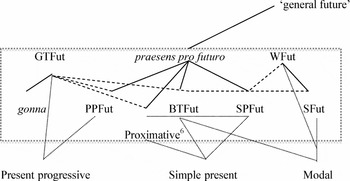
If we assume an onomasiological perspective on expressions of futurity, a family network of independent constructions, mostly based on function rather than form, becomes apparent. This is shown in figure 2,Footnote 5 where a number of constructions expressing futurity are listed within a box. The box itself – representing the abstract (possibly even non-linguistic) concept of futurity – has been labelled ‘general future’. The three major – i.e. most common – constructions inside the box are the be going to future, the praesens pro futuro and the will future. These sister constructions have a number of individual, but possibly interrelated, constructional ‘children’. The relationships between these can be based on form, meaning, or both. The be going to future, for example, has links to the present progressive (through both form – verbal {-ing} – and function, i.e. a certain likeness between John is going to spend the summer in New York and John is spending the summer in New York), to gonna (mostly through function: gonna is of course the morphonologically fused form of going to), and also to the proximative construction be to (again, both through function and form, e.g. the to complement). The will future, on the other hand, has links to shall, for obvious reasons, but also to the simple present future, as it is formally a present tense form and shares similar functions. Note that in figure 2 the individual relationships are classified as either strong and direct (solid lines) or rather associative (broken lines). Strong, direct links can be described in quite concrete terms, for example through identifiable formal or functional relationships (e.g. both will and shall are usually seen as members of one paradigm; gonna is directly derived, historically, from be going to). Associative links are rather based on softer ‘gestalt’ principles, such as the fact that both be to and be going to share the purposive marker to. Another feature in figure 2 is the inclusion of constructions which are not part of the ‘futurity family’. These are the present progressive, the simple present, and the modal uses of will and shall. These obviously share their form with the corresponding future constructions, but can fulfill completely different functions. The simple present can, for example, express general truths, the present progressive ongoing action, will can have a strong epistemic reading (That will be John, upon hearing the doorbell), both shall and will also have deontic functions You will/shall (= have to, are advised to) see a doctor about that. The future constructions are linked to these constructions through formal, structural links (represented as dotted lines in figure 2). However, it should be clear by now that even though future will may share its morphological form with modal will, the two differ in the co- and contextual features of their constructional frames. Epistemic, future will, for example, very often occurs with non-referential subjects (there), progressive constructions (will be having), perfective aspect (will have heard), stative verbs (will have, will be), passive constructions (will be sung) and quasi-modals (will have to see); cf. Coates (Reference Coates1983: 181).
The general future ‘construction’ and the family of future constructions (GTFut: be going to future; WFut: will future; BTFut: be to future; PPFut: present progressive future; SPFut: simple present future; SFut: shall future)

The same applies to the simple present and present progressive. In treating future constructions this way, we are able to capture both the fact that they somehow belong together as they essentially do the same job and that every individual construction can be described in its own right. Any relationships within the family and beyond can be treated as such without the necessity of deciding between modal or future tense marker, as both are included and stored separately, but linked through structural similarity.
Note that the arrangement of constructions expressing futurity (and other related constructions), in combination with the features of future constructions discussed above, is perfectly in line with some of the general principles of language organisation as outlined in Goldberg (Reference Goldberg1995: 67). It is in congruence with the Principle of Maximised Motivation as some elements, even when they are not immediately and obviously related (such as the be going to future and the proximative), can still have an influence on each other and can interact. The arrangement and discussion also follow the Principle of No Synonymy and show that constructions which are syntactically different are indeed either semantically or pragmatically different (will versus be going to versus simple present, etc.). To what extent the differences between the individual future constructions are a question of semantics or pragmatics is another matter.
3.4 Is there a future tense in CxG?
It has been pointed out in section 3.2 above that looking at the future from a CxG perspective might help to solve the age-old problem of whether the future in English is actually a tense or not. Construction Grammar does not systematically distinguish between grammar (rules) and lexicon (items) as such, as language in CxG consists of the structured inventory of constructions, i.e. basically only items as such. As was observed earlier, tense in traditional grammar is usually defined as the ‘grammaticalised expression of location in time’ (Comrie Reference Comrie1985). ‘Grammaticalised’ is usually taken to mean that the expression in question is not part of the lexicon, e.g. an adverbial, but rather part of the (prototypically) morphosyntactic system of the language. According to this strict definition, inflectional morphemes are the best exemplars of tense markers, free (grammatical) morphemes less so, free lexical morphemes definitely not at all. This raises the question of how will, be going to, etc. should be treated, since English does not have any inflectional markers for the future, unlike Turkish or Latin. One answer would be – obviously – that it does not have a future tense, then. Another answer would be that it may have a future tense, but not a very prototypical one, and that this is expressed by free grammatical morphemes. If we take seriously the CxG claim that lexicon and grammar should not be systematically differentiated, then this question obviously becomes somewhat vacuous. In CxG there is no straightforward way to say that one construction is ‘more grammatical’ than another. This in turn would mean that ‘tense’ in the traditional sense would not be captured in a simple way in CxG. The question remains, however, whether we find some sort of correlate to the traditional grammatical–lexical dichotomy in CxG. One possible candidate for the distinction might be the dichotomy between abstract and concrete constructions. One plausible hypothesis might be that abstract constructions are somehow more grammatical than concrete ones. However, it can be shown that this is not necessarily the case. The plural of English nouns, for example, might be such an example. The function or meaning side of the construction is, of course, grammatical in the traditional sense. In most cases, however, the associated form is very fixed and concrete, namely the morpheme {-s}. If one does not wish to assume an abstract construction with several realisations (allostructions), one is forced to say that grammatical meaning is expressed by a concrete construction. On the other hand, very abstract constructions, like <Noun>, do not necessarily imply grammatical meaning as such. In other words, there is little evidence in favour of the idea that lexical and grammatical somehow correspond to another dichotomy in Construction Grammar. But this also means that there is no immediate and obvious reason why Tense as such should be a central concept in this new framework. One might consider leaving Tense as a grammatical category aside and looking at Time as a universal (non-linguistic) category instead. The expression of time in its different shapes and forms is, then, of central concern to the Construction Grammarian. Instead of classifying languages into those that have a preterite, a pluperfect, or a future, one might assume that all languages have certain constructions to express these and other temporal concepts. The only question is what these constructions are. Some languages only have one specific construction for a given temporal concept, others have two, yet others may have six or more. Some languages use constructions which have to unify with others in order to be useable (what have been called inflectional morphemes, for example), yet others may rather use concrete, complex constructions such as be going to. This is not the right place to enter into a full discussion of how this approach and Construction Grammar in general relates to the evolution of language. Suffice it to say at this point that, apparently, languages tend towards condensation, i.e. they often seem to develop smaller, but dependent, constructions for frequently used functions – e.g. gonna instead of be going to. But this needs some further exploration in the future.
Treating expressions of futurity in CxG offers at least one more interesting point. So far, we know quite a lot about the historical development (in phylogenetic terms) of the different expressions of futurity. Be going to is an old textbook example for grammaticalisation (see, e.g., Hopper & Traugott Reference Hopper and Traugott2003) and studies such as Fleischman (Reference Fleischman1982) or Bybee, Perkins & Pagliuca (Reference Bybee, Perkins and Pagliuca1994) are true classics on the development of many of the forms discussed here. On the other hand, we know very little about the ontogenetic development of the different expressions, i.e. on their evolution in first (and also second!) language acquisition (some studies are Gerhardt Reference Gerhardt1985; Gee & Savasir Reference Gee and Savasir1985; Gerhardt & Savasir Reference Gerhardt and Savasir1986; Shatz & Wilcox Reference Shatz, Wilcox, Gelman and Byrnes1991; O'Neill & Atance Reference O'Neill and Atance2000; on second language acquisition, see Bardovi-Harlig Reference Bardovi-Harlig2000: 416–17). Most of these studies reveal something quite illuminating. The development of ‘futurity’ in first language acquisition does not happen instantaneously and for all of its expressions. Rather, we find a gradual development here. According to Shatz & Wilcox (Reference Shatz, Wilcox, Gelman and Byrnes1991) the first use of modals in English occurs between the ages 1;10 and 2;6. The first modals to be used are can and will, usually in simple declaratives and in conjunction with negatives, i.e. can't. The first uses are usually non-epistemic and rather express ability/permission or intention/volition. It is only when new auxiliaries like gonna are acquired that true predictability can be found. The acquisition of gonna also leads to an interesting differentiation of the inventory: gonna often expresses temporally or spatially close things which can be or are controlled. These findings are corroborated by Gerhardt (Reference Gerhardt1985), who investigated modals in natural conversation between children of the ages 3;2 to 4;2. Most of the time, will is associated with interpersonal negotiations, while gonna has to do with independent plans. Curiously, about 90 per cent of the predictions with will actually take place, but not more than 45 per cent for those with gonna. In sum, one could say that expressions for futurity are acquired gradually, bit by bit, and use by use. This is in line with studies on language development and acquisition in CxG (e.g. Tomasello Reference Tomasello2003; Goldberg Reference Goldberg2006: chapter 4) which stress that language learning is essentially item-and-exemplar based. Also, we see the functional differentiation of the inventory here. Moreover, the way in which these constructions develop in ontogeny seems to parallel the way they developed phylogenetically. In other words, language acquisition more or less mirrors grammaticalisation. But again, these are only preliminary results and ideas and more empirical research on the acquisition of the future will have to show if this is actually the case.
4 Conclusion
This article has tried to describe five major expressions of futurity in present-day English, i.e. will, be going to, simple present, present progressive and be to, from a constructional point of view. It was argued that the explicit integration of co- and contextual information and constraints into constructions as linguistic units offers new and promising ways of handling some hitherto very problematic facts of language use.
To that end, it was claimed that constructions can have a so-called context slot into which co- and, more importantly perhaps, contextual information and constraints can be entered, possibly in Frame Semantic terms. These facts need to be unifiable with the rest of the construction in order for the construction as a whole to be acceptable and interpretable. Coercion effects may explain certain exceptions to this rule and can offer entry points for language change. Moreover, it was claimed that all expressions of futurity in English can be described as independent constructions, but that these constructions belong to a constructional language family which is united by a common function, namely the expression of futurity. This does not per se preclude any additional ways of arranging the constructional inventory, e.g. on the basis of form or structure, but it offers one additional viewpoint on how this could be done. At the same time, constructions in the family may thus also have relationships with constructions outside the family, e.g. on the basis of formal instead of functional similarity. Such an onomasiological viewpoint is not new in linguistics, but it has been neglected in many studies. Recent research (e.g. Grondelaers & Geeraerts Reference Grondelaers, Geeraerts, Cuyckens, Dirven and Taylor2003) has shown that a fresh look at this perspective might be very fruitful.
In a final section, it was shown that the age-old discussion about whether English has a future tense or not is rather futile from a constructional perspective. As CxG does not recognise grammatical versus lexical as such, classifying certain structures as ‘grammaticalised expressions of location in time’ seems to be problematic. As an alternative, it was suggested one might ignore Tense for a moment and take a fresh look at Time as a concept, and analyse and classify the different ways and constructions a given language has to locate events in time, without necessarily invoking traditional tense as such. Finally, it was argued that the way CxG sees language acquisition processes, namely as item-based, is corroborated by the few available studies on the development of the future in first language acquisition. At the same time, these studies also show that the development of the different expressions of futurity in first language acquisition mirrors what we find in most studies on the historical grammaticalisation of the very same forms. If this is actually true this would mean that – at least in this case – ontogeny mirrors phylogeny, that language acquisition is to some extent very similar to grammaticalisation, and that the two are quite compatible with constructional approaches.