Introduction
Body size (i.e., mass) is one of the most important life history traits in animals, affecting life span, time of maturation, and fecundity (Sauer and Slade Reference Sauer and Slade1988). Parasitism by internal and external parasites of vertebrates may impact body size and hence have important consequences for host life histories. Host body size also affects their ectoparasites; large hosts tend to have more species and more individuals of ectoparasites than smaller host species (Rózsa Reference Rózsa1997a, Reference Rózsa1997b). For example, Cotgreave and Clayton (Reference Cotgreave and Clayton1994) found that larger host species tend to have more species of ectoparasites than smaller hosts. Rózsa (Reference Rózsa1997b) found that the overall abundance of chewing lice on 36 species of birds increased with the mass of the host species. Moreover, in some species, larger individuals tend to have larger populations of ectoparasites than smaller ones (Lee and Clayton Reference Lee and Clayton1995; Durkin et al. Reference Durkin, Luong and Bird2015).
Rózsa (Reference Rózsa1997a) offered three hypotheses to explain these relationships. Larger hosts have greater surface area and resources to support a larger diversity and number of ectoparasites. This larger habitat may also provide a greater opportunity for escape from grooming activity by the host. Within one host species, body size may also be correlated with age; larger hosts may be older and depending on the age at which infestation by ectoparasites occurred, there may be more time for ectoparasite populations to increase. Furthermore, larger species tend to have longer life spans (Sauer and Slade Reference Sauer and Slade1988) and therefore more time on average to accumulate ectoparasites.
Woodpeckers and sapsuckers (Piciformes: Picidae) are widespread and familiar birds, 14 species of which have been recorded in Canada (Godfrey Reference Godfrey1986), with 10 species occurring in Manitoba (Manitoba Avian Research Committee 2003). Because there is a considerable range in body mass among these species of woodpeckers (13–34 g for downy woodpecker, Picoides pubescens (Linnaeus) to 180–355 g for pileated woodpecker, Dryocopus pileatus (Linnaeus)), they offer an ideal group of related species for which to test the importance of body size in relation to ectoparasite infestation. We expected that infestation would increase with host mass as observed by Rózsa (Reference Rózsa1997b) for a diverse set of data on bird lice taken from the literature (no woodpeckers were included). The woodpecker lice provided the opportunity for an additional and perhaps more rigorous test of the hypothesis because in the study described below, sampling of lice was exhaustive and consistent for all host specimens. A comparison of louse infestation among woodpeckers is particularly relevant because there is a diversity of lice that commonly infest woodpeckers and sapsuckers, including four genera: Menacanthus Neumann (Amblycera) revised by Price and Emerson (Reference Price and Emerson1975): Picicola Clay and Meinertzhagen and Penenirmus Clay and Meinertzhagen (both Ischnocera) revised by Dalgleish (Reference Dalgleish1969, Reference Dalgleish1972), respectively; Brueelia straminea (Denny) (Ischnocera), which is found on many species of Piciformes in Manitoba (Price et al. Reference Price, Hellenthal and Palma2003; Galloway and Lamb Reference Galloway and Lamb2016). These taxa of lice provide an opportunity to investigate differences in the host mass and infestation parameters for lice with distinct life histories (Lamb and Galloway Reference Lamb and Galloway2016). Seven species of lice infest the eight species of woodpeckers that typically nest in Manitoba: Menacanthus pici (Denny) (Amblycera), Brueelia straminea, Penenirmus auritus (Scopoli), Penenirmus jungens (Jungens), Picicola marginatulus (Harrison), Picicola porisma Dalgleish, and Picicola snodgrassi (Kellogg). Picicola marginatulus and P. porisma are monoxenous (restricted to one host), while the rest are oligoxenous (occurring on several host species in the same family) (Galloway and Lamb Reference Galloway and Lamb2016).
We have had the opportunity to examine relatively large numbers of lice from five species of woodpeckers in Manitoba over a span of 20 years (downy woodpecker; hairy woodpecker, Picoides villosus (Linnaeus); yellow-bellied sapsucker, Sphyrapicus varius (Linnaeus); northern flicker, Colaptes auratus (Linnaeus); and pileated woodpecker). Previously we described infestation parameters for lice among these hosts (Galloway and Lamb Reference Galloway and Lamb2016) and seasonal patterns of infestation (Lamb and Galloway Reference Lamb and Galloway2016). In the study reported here, our objective was to test the hypothesis that louse abundance increases with the body size of the host species. When that hypothesis was confirmed, we investigated possible explanations for the relationship based on the infestation parameters (prevalence, mean intensity, and abundance) for the seven species of lice collected on these five species of birds.
Materials and methods
Woodpeckers and sapsuckers were mostly salvaged from rehabilitation hospitals at the Wildlife Haven (Manitoba Wildlife Rehabilitation Organization, Île des Chênes, Manitoba, Canada) and Prairie Wildlife Rehabilitation Centre (Winnipeg, Manitoba, Canada). A small number were salvaged following fatal collisions with windows. With the exception of pileated woodpeckers, most birds came from Winnipeg, but all birds were from Manitoba. Birds were handled and processed in the hospitals and laboratory as described by Galloway and Lamb (Reference Galloway and Lamb2014). Lice were collected by washing birds twice in warm soapy water and once in clean water (Mironov and Galloway Reference Mironov and Galloway2002), a method that removes nearly the entire infrapopulation of lice infesting the host (Clayton and Drown Reference Clayton and Drown2001; T.D.G., personal observation). Voucher specimens of lice were processed onto microscope slides (Richards Reference Richards1964) or preserved in ethanol and deposited in the J.B. Wallis/R.E. Roughley Museum of Entomology, University of Manitoba (Winnipeg, Manitoba, Canada). Terms for infestation parameters follow those recommended by Bush et al. (Reference Bush, Lafferty, Lotz and Shostak1997). Our data are presented with the caveat that we assume, but cannot prove, that the hosts represent a random sample in relation to the mass of the host and to the abundance of lice in the wild population. Birds submitted to rehabilitation hospitals are often dehydrated and their body mass may be reduced as a result. This effect should be consistent among species and no compensation has been made for possible dehydration in our analyses.
The number of specimens available for each host species varied widely because of the method used to obtain specimens, from 12 pileated woodpeckers to 315 yellow-bellied sapsuckers (Galloway and Lamb Reference Galloway and Lamb2016). Therefore, some methods of analyses were restricted to woodpecker species where large samples of birds were available. The following data were recorded for each individual bird: number of lice of each species, number of adult females and males, and number of nymphs. Only birds that were weighed are included in the following analyses. Chicks were collected infrequently and had few if any lice, and so were excluded. Young juveniles without full subadult plumage were also excluded.
Linear regression was used to quantify the relationship between mean abundance of all lice for each woodpecker host and the mean mass of that host (SYSTAT Software 2009). The regression coefficients were compared with those obtained for 36 bird species by Rózsa (Reference Rózsa1997b). The contribution of mean intensity and prevalence to mean abundance and their relationship to host body size was assessed using Pearson’s product moment correlations (SYSTAT Software 2009). Next, linear regression analyses were used to determine whether the relationship between louse abundance and host mass applied to all four genera of lice that infest the five hosts. Then we examined the possibility that host life span, which often increases with host body size, might explain the relationship between louse abundance and host body size. Finally, the relative effect on louse intensity (the number of lice on an infested bird) of the mass of individual host specimens was investigated by linear regression separately for two host species with adequate samples of individual birds.
Results
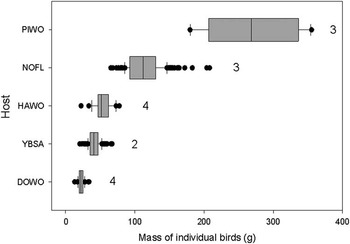
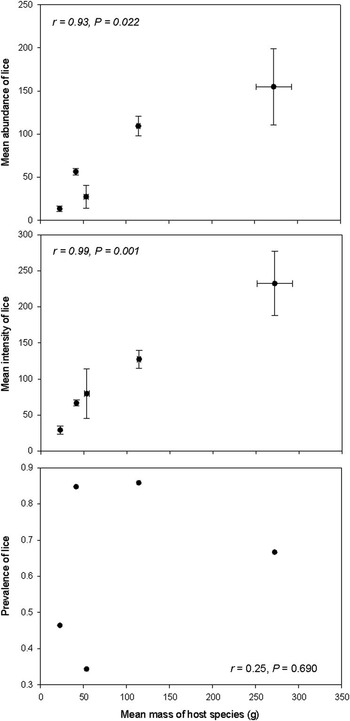
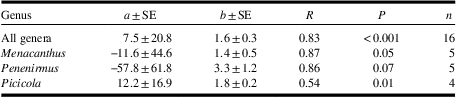
The number of species of lice inhabiting each of five host species varied from two to four and was not related to the mean body mass of the host (Fig. 1). The mean abundance of all lice on the woodpeckers increased with the mean mass of the host (Fig. 2). The relationship was approximately linear for untransformed and for log-transformed means, with an intercept that did not differ significantly from 0 (Table 1). The slope of the regression line for the woodpeckers was numerically higher, but less than one standard error higher, than the slope Rózsa (Reference Rózsa1997b) estimated for mean louse abundance and body mass of 36 other species of birds (Table 1).
The distribution of mass for five species of woodpeckers (downy woodpecker (DOWO), yellow-bellied sapsucker (YBSA), hairy woodpecker (HAWO), northern flicker (NOFL), and pileated woodpecker (PIWO)) and the numbers of species of lice occurring on these woodpeckers.

The relationships between the mean mass of five woodpecker species and the mean abundance, mean intensity, and prevalence of the lice on those five species. Standard errors for means and correlation coefficients (r) for the relationships are provided.

Linear regression (Y=a+bX) of mean louse abundance (Y) and mean host mass (X) for five woodpecker species (without and with log transformation), in comparison with that for 36 bird species (Rózsa Reference Rózsa1997b).

SE, standard error.
Mean abundance equals mean intensity multiplied by prevalence (Bush et al. Reference Bush, Lafferty, Lotz and Shostak1997), and so mean abundance can be partitioned into these two components. For woodpeckers, the relationship between mean abundance and mean body mass was due primarily to the relationship between mean intensity and mean body mass (Fig. 2). Mean intensity had a higher correlation with mean body mass, explaining 98% of the variation, than mean abundance (86% of variation). No relationship was evident between louse prevalence and mean body mass, although the particularly low prevalence of lice on hairy woodpeckers, and to a lesser extent on downy woodpeckers, caused mean abundance for these species to drop below the linear trend for the other three species (Fig. 2). Based on the importance of mean intensity to the relationship between mean abundance and host body mass, further analyses focussed on the relationship between mean intensity and host body size.
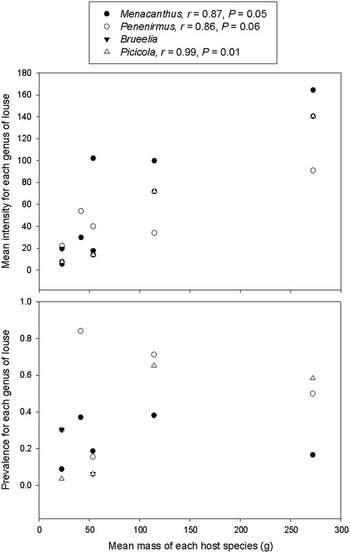
The relationship between mean intensity of lice and mean host body mass was the result of the contribution of seven different species from four genera to the overall number of lice (Fig. 3). There was a positive slope in the linear regression analyses of the mean intensities of the four genera of lice on the mean body masses of the five hosts (Table 2). Only Brueelia Kéler on two species of Picoides Lacépède did not show a positive trend with host mass (Fig. 3), and in both cases, the sample sizes of lice and birds were small. The positive slopes of the relationship were similar for Menacanthus and Picicola, but higher for Penenirmus, based on the standard errors of the coefficients (Table 2). In all cases, the intercepts (a) did not differ from 0 (Table 2).
The relationships between the mean mass of five woodpecker species and the mean intensity and prevalence of four genera of lice on those woodpecker species. The correlation coefficients (r) for the relationship between mass and mean intensity are provided.

Linear regression (Y=a+bX) of mean intensity of lice (Y) on mean body mass of their hosts (X) for all four genera of lice and three genera that occurred on four or five woodpecker hosts.
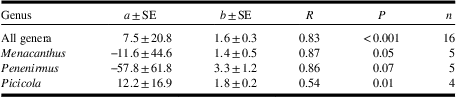
SE, standard error.
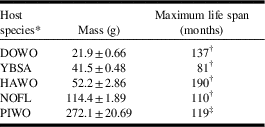
If average life span of a host species increased with body size, the apparent effect of mean body size on louse abundance might be due to the accumulation of lice on hosts as they aged. However, this explanation for the abundance of lice on different woodpecker species was not supported because the life expectancy among the five species is not related to their average mass (Table 3).
The relationship between mean body mass (±standard error) and maximum life span for five species of woodpeckers (ranked from smallest to largest) examined for infestations of chewing lice in Manitoba, Canada.
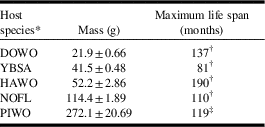
* Smallest to largest: downy woodpecker (DOWO), yellow-bellied sapsucker (YBSA), hairy woodpecker (HAWO), northern flicker (NOFL), pileated woodpecker (PIWO).
† Clapp et al. (Reference Clapp, Klimkiewicz and Futcher1983).
‡ Klimkiewicz and Futcher (Reference Klimkiewicz and Futcher1989).
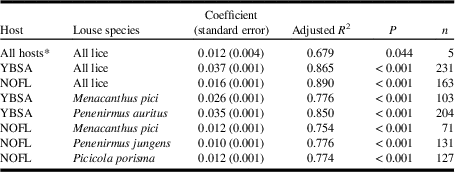
The mass of individual birds ranged from 13 g for the smallest downy woodpecker to 355 g for the largest pileated woodpecker. The effect of host mass on louse intensity for individual birds within species was investigated for yellow-bellied sapsuckers and northern flickers where sample sizes were adequate. Louse intensity on individual birds was log-transformed to normalise residuals and regressed against the mass of an individual bird, assuming that the intercept of the relationship was zero (SYSTAT Software 2009). The relationships described above for mean abundance or mean intensity and mean mass had 0-intercepts. For both hosts, the number of lice increased with the mass of the individual birds, explaining over 85% of the variation (Table 4). The slope of the relationship for northern flickers was similar to the slope of means for five host species, but the slope for yellow-bellied sapsuckers was significantly higher than for northern flickers and all hosts (based on the standard errors for the coefficients) (Table 4). The individual species of lice on both hosts also showed positive relationships between louse intensity and the mass of individual birds, explaining at least 75% of the variation (Table 4). On yellow-bellied sapsuckers, M. pici intensity was less affected by host mass than was the case for P. auritus, but both these louse species had higher slopes than the three species on northern flickers (Table 4). The mass of an individual bird affects the abundance of lice on that bird, but the effect depends not only on mass but also the host species and the louse species, at least for the lice that infest yellow-bellied sapsuckers.
Linear regression (with intercept of 0) of louse intensity (log-transformed) on the mass of individual birds for yellow-bellied sapsuckers (YBSA) and northern flickers (NOFL) (eliminating birds with no lice).
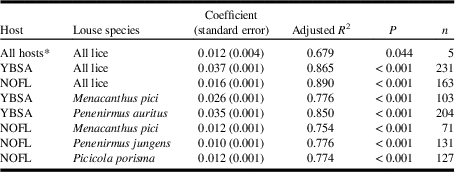
* Mean intensity (log-transformed) versus mean mass, for comparison with relationships for individual birds.
Discussion
The relationship between abundance of ectoparasite infestation and host body size has been documented in a number of studies. Cotgreave and Clayton (Reference Cotgreave and Clayton1994) found that larger host species tend to have more species of ectoparasites than smaller hosts. Rózsa (Reference Rózsa1997a) found that the abundances of feather mites infesting 17 species of passerine birds were positively correlated with host body mass, irrespective of phylogenetic relationships among species of hosts. Rózsa (Reference Rózsa1997b) found a similar relationship for mean abundance of chewing lice infesting 36 species (five orders) of birds, again controlling for phylogenetic relationships and giving consideration to degree of coloniality among hosts. Clayton and Walther (Reference Clayton and Walther2001) sampled 52 species (nine orders) of birds in Peru and found that mean abundance of chewing lice was positively correlated with host body mass, even when separated from the effect of species richness. However, when Gómez-Díaz et al. (Reference Gómez-Díaz, Vavarro and González-Solís2008) examined the relationship between host size and body condition with ectoparasite abundance for three closely related Calonectris Mathews and Iredale species (Procellariiformes: Hydrobatidae) during the breeding season, they found no correlation. These three taxa of hosts were all infested by the same species of ectoparasites, i.e., three species of chewing lice and one species of flea.
We also found a positive relationship between host body mass and mean abundance of the lice on five species of woodpeckers. The relationship for these species was remarkably clear, based as it was on the same efficient method for extracting lice from all hosts, and relatively large samples of host specimens that were weighed before they were sampled. The total number of lice might be high on large species of hosts because more species of lice occur on those hosts (Cotgreave and Clayton Reference Cotgreave and Clayton1994). That explanation did not apply to the five woodpecker species, however, because the number of species of lice varied little among hosts and the smallest host, downy woodpecker, had four louse species compared with the largest species, pileated woodpecker, with three louse species. A high abundance of lice on large hosts might occur because large host species are more likely to be infested than small host species. That is not the case for these woodpeckers, because host mass explained only 6% of the variation in louse prevalence. Furthermore, host mass explained more of the variation of mean intensity (98%) than of mean abundance (86%). Of the four genera of lice, three showed the same pattern with mean intensity increasing with the size of the host. Brueelia species occurred on only two of the hosts and in such low numbers on one of these, that no conclusion could be drawn on the effect of host size on this genus. Thus, the higher abundance of lice on the larger woodpecker species was due to a higher mean intensity (larger populations) of lice. We conclude that larger woodpecker species support larger populations of at least six of the seven louse species that infest them than do smaller species.
Rózsa (Reference Rózsa1997a, Reference Rózsa1997b) hypothesised that larger host species provide more surface area for occupation than smaller species, resulting in larger louse populations in the larger habitat with more resources. This hypothesis is consistent with the differences in louse mean intensity among woodpeckers with relatively large differences in mass among species. It is also consistent with the trends in louse intensity with mass for individual birds within species, although the ranges for mass within species are small compared with the range among species. A larger host with more surface area might also be expected to support more species of lice (Cotgreave and Clayton Reference Cotgreave and Clayton1994), although in the case of the five woodpeckers investigated here, no differences in species diversity was associated with host body size. Rózsa (Reference Rózsa1997a, Reference Rózsa1997b) also hypothesised that a larger host body size would lead to a greater surface area and perhaps a more complex surface architecture within which to escape host-grooming activities. Certainly, a large woodpecker species has a larger surface area than a small species, but it remains to be determined whether or not the architecture of this surface is more complex in a way that provides escape from mortality caused by grooming. Rózsa (Reference Rózsa1997a, Reference Rózsa1997b) also suggested larger hosts generally live longer and may allow for more sustained probability of becoming infested and for larger ectoparasite infrapopulations to become established. Among woodpeckers we examined in Manitoba, and drawing on information from the literature, larger species do not necessarily have longer life spans. In fact, life span may be shorter in sapsuckers and flickers because these two species of the five we studied are migratory. Because life span is not correlated with body size, it cannot explain the strong relationship between host body size and the mean intensity of lice.
The increase in louse mean intensity that occurs as host size increases suggests louse populations are limited by the extent of habitat available to them. If so, intraspecific and interspecific competition would be expected to be higher on smaller hosts. In fact, no interspecific competition has been detected among species of lice on these woodpecker hosts (Galloway and Lamb Reference Galloway and Lamb2016). Small body size may increase intraspecific competition.
These data demonstrate a close relationship between the body size of a woodpecker host species and the mean intensity of lice on the host, consistent with the hypothesis that louse populations increase with the size of their habitat, the body of their host. The effect of body size on mean intensity is evident for the three genera of lice with sufficient data to assess this phenomenon, including one of the genera which is mono-specific on these woodpeckers and present on the five species. The one species, M. pici, a blood feeder that occurs on all the hosts, showed a similar increase in mean intensity as the feather-feeding genera that infest a smaller range of hosts. Thus, this relationship holds within species as well as among genera, as well as for louse species that adopted different feeding strategies. Note, however, that one of us (T.D.G.) has preliminary evidence that lice in the genus Menacanthus on some of the different hosts may be different species. Host body size, per se, is probably not the whole explanation for the louse abundance on different host species, however. Louse populations on some hosts and some louse species respond more to body size than others. For example, the two louse species and particularly P. auritus on yellow-bellied sapsuckers were more sensitive to host mass than lice on other hosts. Host body size matters, but the adaptations that occur on the different hosts that allow the lice to exploit the size of their host remain to be determined.
Acknowledgements
The authors thank the staff at the rehabilitation hospitals of the Wildlife Haven and the Prairie Wildlife Rehabilitation Centre for the care with which they handled the birds for this study before they reached the laboratory. Paula Grieff kindly allowed the authors to examine piciforms submitted at the Oak Hammock Marsh Interpretive Centre. Special thanks go to Dave Holder, Lisa Babey, and the many students who helped by washing birds. The authors thank the Canadian Wildlife Service for issuing scientific permits to carry out this study. This research was funded in part by Discovery Grants to T.D.G. from the National Sciences and Engineering Council of Canada and by Manitoba Conservation (Sustainable Development Initiatives Fund). The continued support of the Department of Entomology and the Faculty of Agricultural and Food Sciences at the University of Manitoba is greatly appreciated.