It was Saturday, February 8, 1964. Furious efforts were still underway to kill or, at the very least, weaken the bill that would eventually become the Civil Rights Act of 1964. Southern Democrats were driving the opposition effort primarily by way of introducing floor amendments to clutter up the bill. Their efforts would ultimately fail, and the bill would be signed into law just a few short months later. But they did not know this at the time, so on they fought that cold Saturday. Congressman Howard W. Smith of Virginia—Judge Smith as some called him—was a staunch supporter of segregation and one of the main leaders of those opposition efforts. He was also the chairman of the House Rules Committee and had made previous failed attempts, in that capacity, to prevent the bill from moving forward.Footnote 1 This was his last stand, of sorts. Nineteen floor amendments were offered that day including a one-word amendment offered by Smith.Footnote 2 The “Smith Amendment,” as it would come to be called, proposed adding “sex” to Title VII, the section of the bill that prohibited employment discrimination for a number of protected classes such as race, religion, and national origin.Footnote 3 He cynically introduced the amendment in an effort to make the bill so objectionable to some legislators that they would ultimately vote against the bill in its entirety. Or so the story goes. The introduction of the amendment, and Smith’s comments directly afterward, are said to have resulted in an uproar of laughter that rang throughout the chamber, undoubtedly a sign that Smith had no intention of the amendment’s actually making it into the final version. It was surely surprising, then, to all in attendance—perhaps Smith most among them—when the amendment ultimately passed the House by a vote of 168 to 133.Footnote 4 Of all the amendments voted on that day, the “Smith Amendment” received the most votes. Surely it was a fluke. For why would so many legislators vote for an amendment that was merely a joke, a calculated attempt to derail the whole proceeding? A cruel twist of fate, indeed, that this political antic would ultimately lead to one of the most consequential pieces of legislation for women workers ever passed in the United States.
So how did this accident of history occur? How had Smith miscalculated so badly that his attempt to clutter up the bill with something so unpalatable as providing women protections against employment discrimination had completely backfired? The answer is that it was no accident at all. The story of how “sex” was added to Title VII of the Civil Rights bill has become a piece of folklore passed down from one generation of politically interested people to the next. It is true that Smith wanted to stop the bill. It is also true that when he introduced the amendment, some of his comments were delivered in such a way as to provoke laughter from his colleagues in the chamber. But this particular narrative does what a lot of narratives about politics tend to do: It focuses on the intrigue of a particular moment, it reduces the actors involved to one-dimensional characters with singular interests and beliefs, and it treats ideas as if they suddenly appear out of thin air. And in doing so, such narratives allow us to ignore everything that came before in return for a good story, an easy-to-understand explanation. It was all just an accident! Isn’t history funny that way?
But history is never that simple, least of all the history of the policy process. Policies, and the ideas they contain, must instead be recognized as the end products of long, contested battles among a diverse array of competing interpretations: interpretations of the world and what we should do with it. They are simply the collection of interpretations that won out. Policy ideas have histories. So do the people that carry them. And people often carry around an idea for a while, trying it on for size, seeing what it can do. In the case of “sex” and Title VII, Smith had been carrying around the idea of adding sex to civil rights legislation for quite a while, and in quite a serious manner. In 1956, he had agreed to introduce an amendment that would add sex discrimination to the proposed Civil Rights Commission, although another congressman ultimately offered the amendment instead.Footnote 5 Eight years later, and a month or so before the “accident” occurred, Smith had publicly discussed the idea of specifically adding sex to the civil rights bill on multiple occasions: once during hearings held by the Rules Committee, again during floor debate on January 9th, and again later that month on an appearance of “Meet the Press.”Footnote 6 These public pronouncements were wholly consistent with the fact that Smith had long been a supporter of women’s rights and had made it clear that if the civil rights bill were to pass, he preferred that it pass with a ban on sex discrimination.Footnote 7
It is clear that Smith, as a proponent of women’s employment rights, had been carrying around the idea for quite some time. But he was not the only one and most certainly not the first. As I said before, ideas have histories, and this one certainly did. As far back as 1945, the category of sex was included alongside other protected classes including race, religion, and national origin in a bill introduced twice by a Republican Congressman from Pennsylvania called Carl Henry Hoffman.Footnote 8 And less than a year before Smith introduced the “accidental” amendment, the category of sex was again combined with other protected classes in a bill targeting employment and membership discrimination among DC labor unions.Footnote 9 Although none of those efforts were ultimately successful, they demonstrate that this particular policy idea existed and was taken seriously enough to make it into multiple bills and be introduced by multiple legislators. Women’s groups such as the National Women’s Party (NWP) had also been lobbying with gusto to add sex discrimination to civil rights legislation and had been part of discussions to do just that with the Kennedy Administration and the Women’s Bureau, among others.Footnote 10 Given the history of this particular idea, then, the real mystery may be why sex discrimination was not included in the civil rights bill from the outset. But that is a story for another time.Footnote 11
The mystery I examine in this article is how new ideas, and new combinations of ideas, come to be instantiated in policy proposals. Given that there is a diverse universe of policy ideas, this article attempts to understand why legislators chose to incorporate some possibilities but not others at particular times. Ultimately, sex discrimination in employment was added at nearly the last second to the bill that would eventually be signed into law. But as I have discussed, this policy idea was not new and already had a history within congressional bills and policy discussions. Although the “Smith amendment” was no accident, it was unusual. I find that ideas do not tend to show up at the last minute, right before a piece of legislation is passed. Instead, new sets of ideas appear suddenly—during moments I call policy innovation junctures—and come to dominate and crowd out all other ideas for relatively long periods.
In this article, I focus on the case of federal gendered pay inequity policy proposals. I find that gendered pay inequity policy content is characterized by relatively long periods of ideational stability, punctuated by moments of sudden changes in policy ideas. These moments of sudden change I refer to as policy innovation junctures. Since 1945, there have been four policy innovation junctures: Equal Pay Inception of the 79th Congress (1945–1946); Married Mothers’ Benefits of the 90th Congress (1967–1968); Professional Women and Training Programs of the 101st Congress (1989–1990); and Policy Synthesis of the 105th Congress (1997–1998). The policy ideas generated during these junctures come to dominate policy efforts pursued during the long periods of stability, very often comprising any legislation that is ultimately passed years, if not decades, down the road. Drawing on the work of Baumgartner and Jones, I call this model of policy idea change punctuated policy innovation. Footnote 12
Policy Development in the US Congress
At the heart of this article is the question of why policies contain the contents that they do. Why does a policy to address climate change include a tax deduction for solar panels but not a carbon tax on corporate emissions? Why does a health care policy cap the price of insulin but do nothing to curb defensive medicine? There is a vast body of literature explaining the conditions under which policy change is more or less likely to occur but relatively little on why some policy ideas fail and others succeed. By this I mean that we don’t have a good grasp on why particular policy ideas are incorporated into policy proposals and why others do not. As I have mentioned before, I conceive of policies as collections of ideas that have won out in a long process of contested meaning making. Policy making is simply one of the final stages in the broader social problems process, a process through which various individuals, groups, and organizations competitively make claims about why some social conditions are troubling and just how we should go about trying to remedy them.Footnote 13
Understanding Policy Formation: A Social Problems Perspective
In this approach to social problems and policy making, interpretation and meaning making take center stage. Social problems are not “out there” waiting to be discovered.Footnote 14 There are nearly infinite ways to understand and represent a particular social condition. John Kingdon captured this dynamic well when he distinguished between “social conditions” and “policy problems.”Footnote 15 Social conditions—like growing old, or differences in men’s and women’s wages—simply exist. But they only become problems when political actors decide that something should be done about them. Those decisions, according to Kingdon, are normative and based on value judgements. There is no single, inherent, true way to think about and represent a particular social condition. Instead, social problems and social policies are products of continually shifting arguments and interpretations among individuals and groups competing to convince others that their particular interpretation and argument is correct.
Yet despite a nearly infinite range of possible interpretations, policy makers do not consider all available perspectives when addressing social problems. For example, as Baumgartner and Jones observe, developments in the policy-making process such as issue expansion and surges in information increase “the problem of setting priorities or maintaining control.”Footnote 16 Institutions, faced with this complexity, manage it not by processing all information equally but by selectively emphasizing certain aspects of a problem while downplaying others. These acts of selection shape which solutions appear viable, which interpretations gain legitimacy, and which groups are granted political recognition. This institutional filtering process aligns with what scholars have called the “short list model”: rather than weighing all conceivable policy alternatives, political actors work from a relatively limited set of ideas already circulating and available at any given moment.Footnote 17 The question becomes not how all possible ideas are generated and considered but how certain interpretations become institutionally available and politically viable while others remain invisible or unthinkable.
This transformation from a nearly unlimited set of possible interpretations down to just a few is far from neutral or inconsequential. As Burstein and Bricher observe, the very act of defining a problem is inherently political—it involves choices about what aspects of a condition deserve attention, whose experiences count as evidence, and what kinds of solutions seem reasonable or feasible.Footnote 18 Mindful historical and cultural observers will, of course, note that context creates boundaries around what kinds of representations are plausible at any given time and place. Yet even within those constraints, the decision to frame a problem one way rather than another carries what Kingdon called “great political stakes in problem definition”: winners and losers are created not only by policies but by the very way an issue is framed.Footnote 19 As Anne Schneider and Helen Ingram show, these stakes are especially important—and foundational to the policy construction process—for the very people being represented, as the social construction of target populations (as deserving or undeserving; competent or dependent) becomes embedded in the policy instruments themselves.Footnote 20
The social problems process is thus ultimately a process centered on choices: choices about how to understand a social condition and choices about which troubling conditions most deserve our time and attention.Footnote 21 In each stage of this process, choices are made that winnow down the possibilities. Individuals must decide which aspects of their lives are most unpleasant and in need of addressing. Organizations and claims makers must decide which troubling conditions they should organize around. Members of the media must decide which claims they should amplify. And policy makers must decide which social problems and what aspects of those social problems they should take up and work to remedy. The ways in which targets and beneficiaries are framed become ingrained in policy language and institutional practice, shaping not only what gets done but who gets helped, who gets blamed, and what kinds of solutions seem possible or unthinkable. In this way, the contest over meaning is not just academic—it is a struggle over the distribution of resources, recognition, and power. And at each stage, the nearly infinite ways to represent and understand social conditions become more finite—and the outcomes more consequential.
Bill Introductions as Policy Idea Instantiation
Bill introductions represent a crucial moment in this winnowing process of contested meaning making. They are critical moments when a particular interpretation of how to think about a social condition—and what, if anything, should be done about it—moves from the realm of competing claims into concrete legislative form, instantiated by a group with the power to pass it into law. As Padamsee and others have argued, “specific ideas, proposals, and practices are instantiations of broader discourses that draw on underlying elements of cultural meaning to define and delimit the lines along which actors think, speak, and act in the policy arena.” Footnote 22 In this way, bills—as sets of ideas—introduced in Congress act as the vehicle for instantiation: that interpretation is no longer just one of many possibilities swirling in the broader contest over meaning; it is now the interpretation chosen by a policy maker and entered into the official record as an alternative to the status quo.Footnote 23
Of course, ideas that are incorporated into a bill will not necessarily become law. As we saw with the fight over civil rights legislation, the contents of bills can change during the policy process in the form of floor amendments, committee amendments, and the like. However, there are good reasons to believe that the ideas that make it into policy proposals—the specific interpretations chosen among a range of possibilities—will have a high likelihood of being included in final versions that are ultimately adopted. For one, the same exact proposal is often introduced multiple times by multiple legislators. Why reinvent the wheel when you have a perfectly good proposal already written that you can reintroduce?
Burstein tests this proposition directly with a sample of 60 policy proposals—which he defines as sets of policy elements, or options, manifested in identical or nearly identical bills—introduced in the US Congress and finds that on average, each policy proposal is manifested in roughly seven bills. Footnote 24 Of the 60 policy proposals he analyzes, one-third were eventually enacted into law. This suggests that new policy proposals and the policy ideas they contain carry more weight than perhaps previously thought in the sense that they will tend to show up in multiple bills and, as a policy set, have a relatively high likelihood of becoming law.
But policy ideas that are incorporated into bills matter beyond their combination within a fixed set. Legislators often borrow policy elements from other legislators, so much so that bills are often a tapestry of many bills “woven together in a single thread.”Footnote 25 Consequently, a particular policy idea may be enacted into law via a policy proposal in which it did not originate. This means that policy ideas, once introduced into a bill, may have a higher chance of enactment than even Burstein was able to observe.
Tracing changes in policy ideas within the set of bills that have been introduced is important for understanding and possibly being able to predict what kinds of policies might get passed if and when policy change occurs. But such changes can have other important consequences as well. As Baumgartner and Jones note, major shifts in policy ideas can have consequential effects on the overall issue agenda, existing institutional structures, and, ultimately then, policy outcomes.Footnote 26 These effects might include more attention to a social problem that has been reinterpreted, the mobilization of new claimant groups and experts, or changes to policy coalitions within Congress itself. Looking at these potential consequences of changes to policy understandings, Baumgartner and Jones find that US policy making is characterized by long periods of relative stability followed by moments of rapid disruption and change. Overall, they describe this pattern as punctuated equilibrium. I find that the changes to policy ideas themselves occur in much the same way—not only is there a limited set of ideas incorporated into bills at any given moment, as the short-list model would suggest, but that set changes in the punctuated pattern of long stability interrupted by rapid shifts.
Gendered Pay Inequity Legislation in the United States
Measuring changes in policy ideas over time requires a very clearly defined policy problem that has sustained legislative attention for an extended period to capture the dynamics of how interpretations shift and evolve. Although Burstein, Bricher, and Einwohner’s analysis of work, family, and gender on the congressional agenda provides important insights into how policy alternatives emerge and stabilize, their broad focus necessarily encompasses a wide range of issues—from family leave policies to employment discrimination to tax policy—that may touch only tangentially on any specific social problem.Footnote 27 By focusing more narrowly on a single, well-defined issue area, we can trace with greater precision how particular interpretations of a social problem have competed for attention, gained institutional traction, and shifted over time.
Perhaps no issue better fits these requirements than gendered pay inequity. It has been an enduring source of political contention with sustained congressional attention spanning nearly 8 decades. Public discussion of the issue began at least 140 years ago, with congressional attention to the issue extending nearly as long. One of the first known public articulations of the issue of gendered pay inequity came in 1887 when Suffragist and reformer Lillie Devereux Blake penned an article entitled, “Are Women Fairly Paid?”Footnote 28 However, it was not until after World War II that gendered pay inequity became a consistent legislative focus in the US Congress. Starting in 1944, there has been at least one bill introduced in every Congress that has sought to remedy the issue, with over 760 bills introduced since that year.
Congressional interest in gender and employment, as Burstein documented in his comprehensive analysis of equal employment opportunity legislation, reflects both institutional and ideational patterns that shape how policy ideas are formulated, compete, and evolve. Legislative attention to gendered pay inequity continued to grow in the decades after World War II, with attention peaking in the 94th Congress (1975–1976). Male legislators have sponsored roughly 70% of all gendered pay inequity bills. However, considering that, historically, women have comprised only a small percentage of all members in Congress (with a peak of 25% in the most recent Congress), women legislators have, unsurprisingly, disproportionately introduced gendered pay inequity bills. Democratic legislators sponsored just shy of 70% of all bills.Footnote 29
This sustained effort to address gendered pay inequity policy over the last century has involved diverse policy approaches. Equal pay legislation is perhaps the best known approach to gendered pay inequity but is one approach—and possible representation of the problem—among many. For our purposes here, gendered pay inequity legislation refers to policy proposals addressing the salary and/or benefits of US women workers in relation to their past, current, or future employment, particularly when it is in direct comparison to the salary or benefits of male workers. Thus, “pay” captures all the ways that a worker may be compensated for employment. This can include wages, retirement benefits, housing allowances, paid time off, use of facilities, and more.
Policy Innovation Junctures
Within this sustained legislative engagement with gendered pay inequity, there are particular moments when policy ideas, manifested in bills as policy options, suddenly careen in a new direction. Such instances I refer to as policy innovation junctures: moments when new options arise, reappear, or realign with other options. I borrow the term junctures—often referred to more fully as critical junctures—from comparative historical researchers and historical institutionalists to capture several features of these moments.Footnote 30 First, policy innovation junctures represent moments of greater openness. By this I mean that they represent times when things are less “sticky,” policy options more diverse, and change more possible. Second, they are also moments when something else could have happened or some other ideas, now in the form of options, could have won out.
For example, in 1945, when the bill to prohibit employment discrimination on the basis of sex and other protected classes such as race and national origin was introduced, it could have become the leading policy proposal to address gendered pay inequity. The policy was written and the bill introduced twice by Congressman from Pennsylvania Carl Henry Hoffman, and public attention was tuned to employment discrimination. But instead, it was equal pay for women that came to dominate the issue agenda for the next 2 decades. Thus, these moments also represent turning points in the policy process when previous ideas and efforts are abandoned (or completed) and new ideas or new combinations of ideas are embraced and come to dominate.
To identify these turning points and trace how new combinations of ideas emerge over time, I conducted an analysis of all gendered pay inequity legislation introduced in the US Congress between 1945 and 2019. More information about the original corpus, design, and analysis can be found in the Appendix. Using a topic modeling algorithm, I was able to identify 24 unique policy ideas manifested in the legislative proposals. These policy options vary in terms of the general type of policy element they represent including how the problem is defined, how the problem will be remedied, who will be in charge of administering and enforcing the policy, and how the efficacy of the policy will be evaluated. Table 1 provides a list of the 24 policy options, the most common words associated with each, and a measure of how often those terms tend to co-occur in the same bill sections.Footnote 31 I then describe the patterns that emerge over time from these policy options and detail four moments over the last century in which there has been a sudden and noticeable shift in how the issue has been interpreted and represented within these legislative efforts—that is, four policy innovation junctures that reveal how the contest over meaning has evolved. I finish by discussing the implications for the policy process and our ability to tackle troubling problems.
Twenty-four policy options: Interpreted name, top words, and coherence scores (0–1, 1 being the most coherent)

Table 1. Long description
The table consists of three columns: Policy option name, Top 10 words, and Coherence score. The data is presented in descending order of coherence scores.
* Widower Benefits: benefit, entitl, widow, insur, individu, divorc, husband, lieu, surviv, age. Score: 0.83.
* Employment Discrim, Multiple: employ, origin, race, nation, religion, individu, sex, color, discrimin, labor. Score: 0.79.
* Determining Benefit Amounts: insur, amount, individu, determin, benefit, primari, spous, monthli, wage, entitl. Score: 0.76.
* Equal Pay: commerc, wage, labor, equal, standard, women, pay, sex, fair, work. Score: 0.76.
* Wage Discrimination, Sex: employe, wage, employ, work, rate, sex, discrimin, job, pay, compar. Score: 0.72.
* Pay Discrimination Study: employ, pay, inform, labor, elimin, discrimin, studi, commiss, promot, assist. Score: 0.71.
* Labor Administration: labor, organ, industri, servic, agenc, council, nation, affect, engag, mean. Score: 0.71.
* Shared Spousal Income: benefit, individu, incom, employ, self, period, spous, wage, credit, end. Score: 0.71.
* Investigatory Powers: person, evid, investig, court, wit, requir, hear, matter, power, attend. Score: 0.68.
* Civil Action—Judicial Oversight: court, commiss, file, person, practic, find, proceed, employ, evid, modifi. Score: 0.68.
* Employer Violations and Damages: action, court, case, judg, violat, attorney, employe, district, civil, proceed. Score: 0.67.
* Small Business: busi, small, contract, concern, person, own, agenc, women, control, econom. Score: 0.66.
* Tax Rules: amount, taxabl, individu, respect, paid, year, tax, employ, incom, calendar. Score: 0.65.
* Commission Reporting: report, servic, appropri, commiss, health, equal, carri, opportun, studi, submit. Score: 0.65.
* Advancement Programs: women, program, train, grant, assist, educ, provid, employ, fund, work. Score: 0.62.
* Spousal Annuities Plans: annuiti, spous, member, employe, servic, former, retir, provid, survivor, elect. Score: 0.60.
* Defining Stakeholders: employ, employe, mean, commerc, term, labor, person, district, organ, columbia. Score: 0.55.
* Civil Rights Procedures: sex, right, discrimin, sexual, person, civil, law, procedur, purpos, gender. Score: 0.55.
* Gender Inequities in S S: lieu, appear, place, spous, code, surviv, widow, person, stat, parent. Score: 0.54.
* Administrative Enforcement: employ, commiss, provis, regul, labor, agenc, law, requir, inform, record. Score: 0.52.
* Child Support: child, support, parent, payment, provid, children, establish, requir, secur, way. Score: 0.49.
* Award Boards: member, board, appoint, offic, counsel, busi, determin, govern, entiti, code. Score: 0.49.
* E E O C Creation and Oversight: commiss, effect, member, attorney, appoint, gener, employ, offic, civil, take. Score: 0.48.
* Benefit Plans, General: plan, servic, provid, respect, requir, elect, benefit, employe, coverag, appli. Score: 0.44.
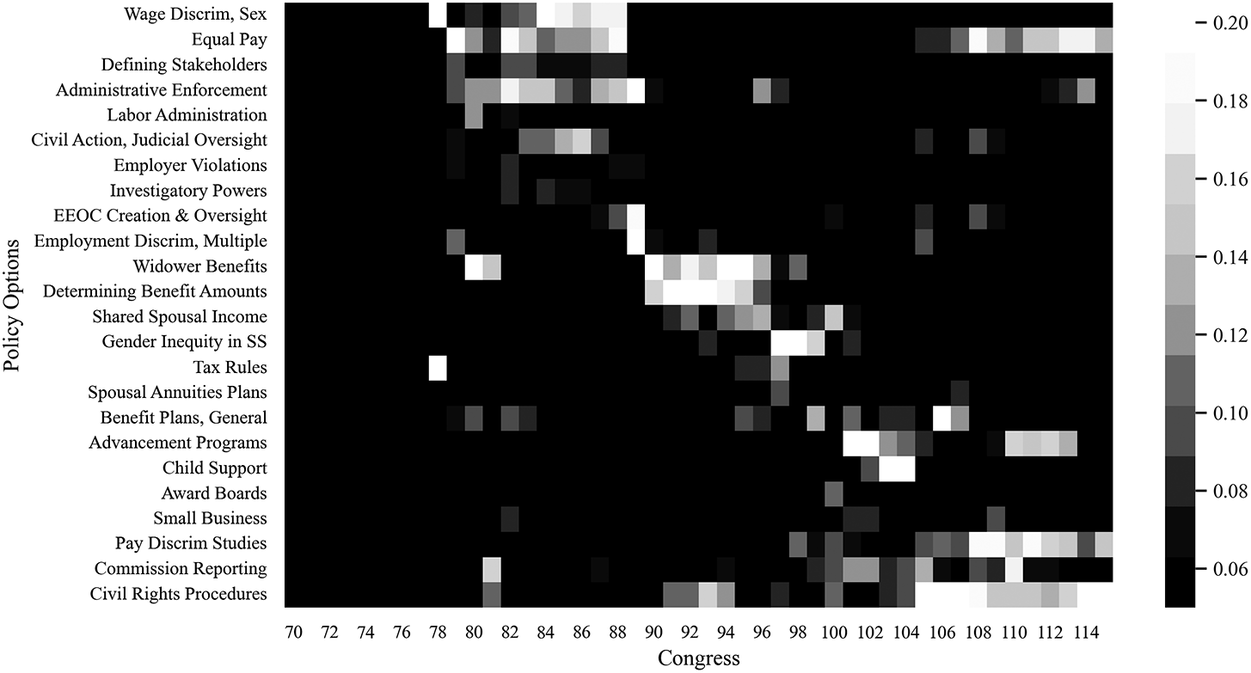
Since 1945, the year when a sustained legislative effort to remedy gendered pay inequity began in the US Congress, there have been four policy innovation junctures: Equal Pay Inception of the 79th Congress (1945–1946), Married Mothers’ Benefits of the 90th Congress (1967–1968), Professional Women & Training Programs of the 101st Congress (1989–1990), and Policy Synthesis of the 105th Congress (1997–1998). Each of these junctures represents a clear turning point in how legislators approached the issue of gendered pay inequity. Figure 1 provides a visual representation of the policy options that came to dominate legislative approaches to the issue of gendered pay inequity following each juncture. Prevalence values, depicted by different shades of white, gray, and black, simply represent how important that policy option was relative to other options included in policy proposals during that same period. Of particular interest when interpreting the trends is the combination of policy ideas within a given period and how that set of policy ideas represent a particular understanding of and approach to the issue of gendered pay inequity.
Policy Option Heatmap, 70th to 114th Congress.

Figure 1. Long description
The heatmap uses a vertical Y axis labeled Policy Options and a horizontal X axis labeled Congress. The X axis ranges from 70 to 114 in increments of 2. The Y axis lists 23 categories including Wage Discrim, Sex, Equal Pay, E E O C Creation and Oversight, and Civil Rights Procedures. A grayscale legend on the right indicates values from 0.06 (black) to 0.20 (white).
* The data shows a distinct temporal shift. Early policy options like Wage Discrim, Sex and Equal Pay show high intensity (white and light gray blocks) between the 78th and 90th Congress.
* Middle-period policies such as Widower Benefits and Shared Spousal Income peak between the 88th and 100th Congress.
* Later policies including Advancement Programs, Pay Discrim Studies, and Civil Rights Procedures show higher intensity from the 100th to the 114th Congress.
* Most of the grid remains black, indicating low or zero frequency for specific policy options outside of their primary active eras, creating a diagonal band of activity moving from the top-left toward the bottom-right of the plot.
To determine junctures, I first relied on a visual interpretation of the prevalence trends in policy options presented in Figure 1. Moving from left to right, we can see four distinct clusters of highly prevalent policy options. I used the visual interpretation to then manually inspect sections of the policy proposals identified by the topic-modeling algorithm to have a high probability of containing that policy option. I also compared those policy proposals that were introduced right before the beginning of each cluster—when the policy innovation juncture occurred—and at the outset of each cluster. For instance, the third cluster, which I have interpreted to be the beginning of the Professional Women and Training period, began in 1989, at the beginning of the 101st Congress. Although the cluster visually consists of only three highly prevalent policy options—Advancement Programs (e.g., training programs for women), Child Support (efforts to ensure working women with children receive child support to aid in their economic self-sufficiency as workers), and Award Boards (boards created to select businesses deserving of pay equity awards)—a closer inspection of the bills introduced immediately before and at the beginning of the juncture reveals a sudden shift in focus to multiple policy ideas focused on supporting women workers in professional employment. For example, several bills at the very start of the juncture focus on supporting existing and potential women business owners, creating new training programs to help women enter nontraditional jobs, and removing barriers preventing women from pursuing careers in science and technology. Thus, my interpretation of policy innovation junctures and the policy periods that followed were based on the topics-over-time analysis and manual inspection of topical sections and the bills they were a part of. In this way, the computational component of this analysis gave me a global view of changes over time—particularly those moments where a substantial shift in the content of the bills occurred—allowing me to focus my manual interpretation of bill content on specific time slices.
I coded a bill as juncture focused if that bill’s contents were indicative of the dominant policy ideas of the period. For example, in 1971, during the Married Mothers’ Benefits period, Rep. Donald Fraser introduced H.R. 4955, which sought to equalize work insuring compensation and other benefits for “married women Federal employees.” This bill was coded as juncture focused because it clearly sought to equalize benefits for married women.
In 1983, during that same period, Rep. Pat Schroeder introduced H.R. 3117, which sought to require a review of sex-based distinctions in federal agencies, including those used in hiring practices. This bill was coded as not juncture focused because it deals with general sex discrimination in employment rather than inequities in benefits for either married women workers and/or working mothers.
Although the contents of legislative efforts change from one policy period—the time slice beginning with a policy juncture and ending immediately before the start of the next juncture—to the next, all periods share several important features that help define the punctuated policy innovation pattern that I have uncovered (see Table 2 for specific information relating to these characteristics). First, each period is dominated by a set of policy ideas that represents a coherent approach to gendered pay inequity. We see that the dominant ideas are the focus of the lion’s share of gendered pay inequity bills introduced during that period. At least 70% of all bills introduced in three of the four periods are focused on the new approach: more than half in the fourth. Second, this new approach comes to dominate for a relatively long period: more than 18 years on average. Third, the new approach is taken up by a large and diverse set of legislators. This is not a story of a couple rogue legislators monopolizing the policy field with their ideas and bill introductions. On the contrary. During each period, more than two-thirds of all involved legislators adopted the new approach in at least one of their gendered pay inequity bills. Policy innovation junctures, then, represent moments of sudden, coherent, long-lasting, and widely adopted policy idea change. Below, I describe in more detail the particular ideational change precipitated by each juncture.
Four Policy Innovation Junctures

Table 2. Long description
The table consists of nine columns: Juncture, Start, Duration in years, All bills (Bills and Legislators), Juncture focused (Bills and Legislators), and Percentage focused (Bills and Legislators).
* Equal Pay Inception: Started in the 79th Congress (1945). Duration: 22 years. All bills: 188 bills, 88 legislators. Juncture focused: 132 bills, 63 legislators. Percentage focused: 70 percent bills, 72 percent legislators.
* Married Mothers’ Benefits: Started in the 90th Congress (1967). Duration: 22 years. All bills: 365 bills, 131 legislators. Juncture focused: 262 bills, 95 legislators. Percentage focused: 72 percent bills, 73 percent legislators.
* Professional Women and Training: Started in the 101st Congress (1989). Duration: 8 years. All bills: 55 bills, 27 legislators. Juncture focused: 29 bills, 14 legislators. Percentage focused: 53 percent bills, 52 percent legislators.
* Policy Synthesis: Started in the 105th Congress (1997). Duration: at least 22 years (data extends to 2019). All bills: 114 bills, 38 legislators. Juncture focused: 86 bills, 24 legislators. Percentage focused: 75 percent bills, 63 percent legislators.
* This period lasts at least 22 years; data only extend to 2019.
The Equal Pay Inception juncture of the 79th Congress marks the start of a nearly 2-decade effort to “ban sex discrimination in the payment of wages” for public and private employees alike. Policy proposals during this period included policy ideas focusing on equal pay, wage discrimination, administrative enforcement, and civil action and judicial oversight, among others. Between 1945 and 1963, more than 70% of gendered pay inequity bills (132 out of 188) introduced in Congress focused specifically on this effort to enact equal pay legislation and included policy instruments that laid out how and by whom the ban on sex discrimination in employment would be enforced.
It is not just the overall approach—to conceive of gendered pay inequity as a problem of equal pay—which remains stable during this period. Within early bills of the period, legislators began incorporating specific policy ideas that would be hallmarks of the equal pay bills introduced over the next 18 years and would ultimately comprise the Equal Pay Act (EPA) of 1963. For instance, early bills included provisions that spelled out exceptions to pay disparities among male and female employees within a firm, such as seniority, merit, and productivity. Such exceptions were included in the EPA and Title VII of the Civil Rights Act, passed the next year.
Following the passage of the EPA, policy efforts shifted away from wage disparities and toward benefit disparities. The Married Mothers’ Benefits juncture of the 90th Congress (1967–1968) marked the beginning of a more than 2-decade period during which legislators focused primarily on equalizing benefits specifically for women workers who are either married or have children. For example, many bills during this period sought to remedy inequities in social security benefits and spousal annuities as well as find more equitable ways to calculate the shared income of spouses. Most policy ideas pursued in this period focused explicitly or implicitly on challenging the male breadwinner model. For example, the working spouse’s benefits policy option was eventually passed as part of the Social Security Amendments Act of 1983 and was viewed by many as helping to expand the vision of a breadwinner to women by ensuring that male widows received their working wife’s social security benefits. There were quite a few bills introduced prior to this juncture that concentrated on equalizing benefits for working women in relation to working men. However, most focused solely on federal employees. Beginning with the Married Mothers’ Benefits juncture, the target population widened to all married women workers and the more general issue of whether men and children could, and should, be dependents of women workers. A vast majority of bills focused specifically on public benefits, although private, employer-based benefits plans were also targeted.
The Professional Women and Training Programs juncture of the 101st Congress (1989–1990) marked the beginning of an emphasis on the types of jobs women held rather than the wages or benefits they received. Most bills introduced during this period concentrated on helping women obtain professional, nontraditional, and high-paying jobs such as those in science and engineering, management, and business. And part of what seems to have changed in this period is the acknowledgment of the role of job segregation and the “glass ceiling” played in what some have called the “feminization of poverty”—or the tendency for women to comprise the majority of the poor in the country. Relatedly, there seems to be an increasing acknowledgment of women’s economic independence and the need to promote women’s employment in jobs that allowed for that independence. For example, in a bill characteristic of the period, it is argued that
(1) over 7,000,000 families in the United States live in poverty, and over half of those families are single parent households headed by women; (2) women stand to improve their economic security and independence through the training and other services offered under the Job Training Partnership Act …, (5) employment in traditionally male occupations leads to higher wages, improved job security, and better long-range opportunities than employment in traditionally female-dominated fields; (6) the long-term economic security of women is served by increasing nontraditional employment opportunities for women.Footnote 32
This is perhaps why we see particular policy instruments like training programs, grants, and business loans, alongside efforts to improve the enforcement of child support to address single mothers’ economic security and ability to pursue and maintain full-time professional employment. And finally, the Policy Synthesis juncture of the 105th Congress (1997–1998) marked the beginning of a more synthesized approach that incorporated new and old ideas. For example, we see the reemergence of abandoned or thought to be settled ideas such as equal pay, a continuing focus on advancement programs from the previous period, and a new concentration on studying pay inequity and discrimination. The recombination of old ideas and incorporation of new ideas is indicative of the synthesis approach and is best characterized by a 1997 bill proposing to enact the “Paycheck Fairness Act.” The bill sought to provide better remedies for direct wage discrimination, reinforce the equal pay for equal work principle, stipulate civil liabilities for employers who violate pay discrimination statutes, provide training programs to be administered by the EEOC, commission studies regarding the elimination of pay disparities, and establish a national award for pay equity in the workplace.
Overall, the junctures represent departures from approaches to the issue of gendered pay inequity with respect to a number of policy elements. We can conceive of policies as sets of options that address how the problem is understood and described—what Carol Bacchi and others refer to as problem representations—the instruments to be used to solve the problem, the proposed administration of the policy instruments, enforcement, measures to evaluate efficacy, and even the values and moral principles used to justify action.Footnote 33 Although the policy ideas I identified cover a range of different option types, it is clear that the most significant way that policy ideas changed following these critical moments lies in how the problem of gendered pay inequity was represented—particularly in how, as Schneider and Ingram point out, the target population, women, is socially constructed through the policy ideas themselves.Footnote 34
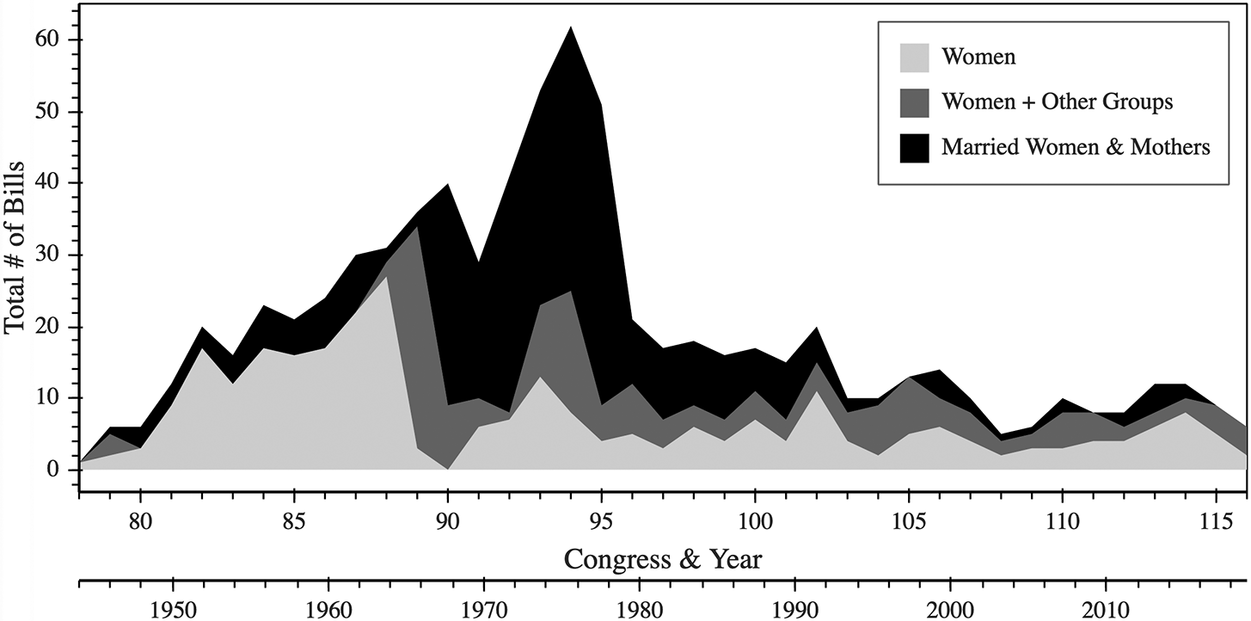
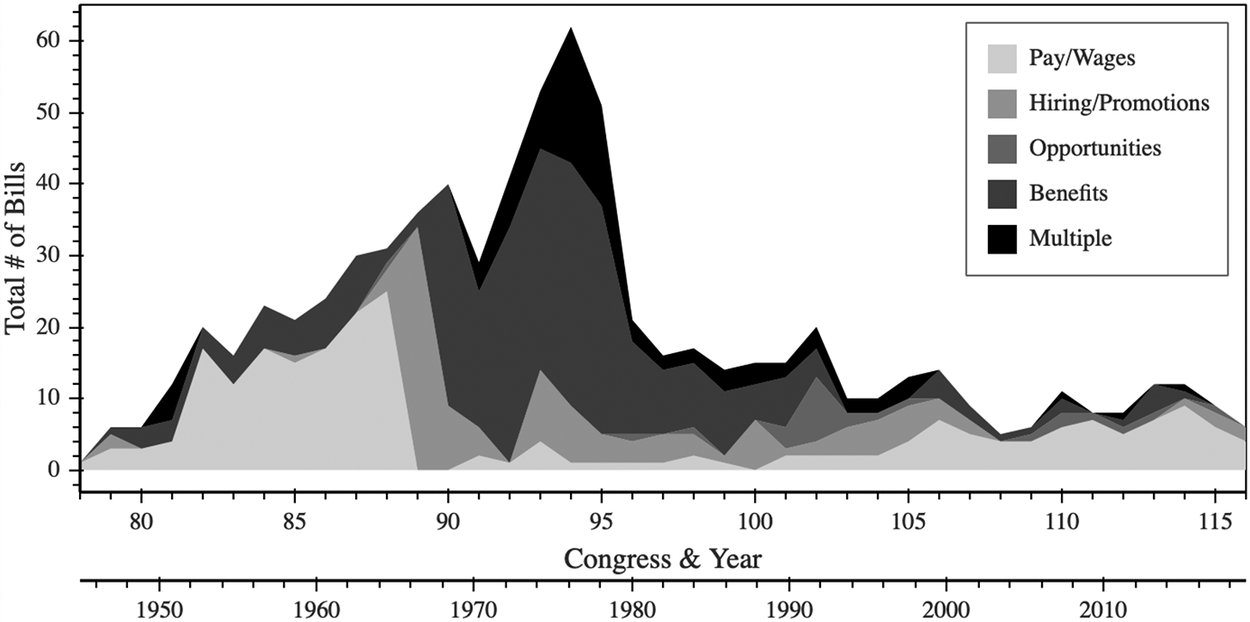
Of the 24 policy options identified, roughly half address either the type of inequity occurring—for example, wage discrimination—who is being affected by the inequity—that is, married women—or some combination of both—for example, widower benefits. Figures 2 and 3 present this point even more clearly. I coded each of the 760 bills introduced between 1945 and 2019 according to the subset of women being considered (Figure 2) and the aspect of employment seen as contributing to pay inequity for women (Figure 3).Footnote 35 Pay/wages refers to the direct income or salary workers receive for their employment. Hiring/promotions refers to the process by which workers are hired for employment or chosen for promotion. The category of employment opportunities captures programs that might provide workers with more equal opportunities for employment, such as training programs, as well as more general issues related to the employment opportunities available to them that are not specifically targeted at pay/wages or hiring/promotions. Benefits refers to compensation that is not direct pay/wages. And the category of multiple captures bills that target more than one of the above. Figure 2 demonstrates how policy efforts shifted from considering all women employees; to combining women with other disadvantaged groups; to focusing specifically on married women and mothers; and finally, in the last two periods, to identifying the targets of pay inequity in all three ways. These shifts also align with similarly timed changes in what aspect of employment was seen as most inequitable. Figure 3 demonstrates that a focus on wages and hiring/promotion gave way to the focus on benefits and eventually a mixed target approach.
Bill frequency by policy target per congress: Unequal for whom?

Figure 2. Long description
The X axis represents Congress and Year, ranging from the 78th Congress (1940s) to the 116th Congress (2010s). The Y axis represents the Total number of Bills, ranging from 0 to 60. The data is presented in three stacked categories.
* Women (light gray): This base layer shows a steady increase from the 80th Congress, peaking at nearly 30 bills around the 88th Congress, followed by a sharp drop to near zero at the 90th Congress. It then fluctuates between 5 and 15 bills through the 115th Congress.
* Women plus Other Groups (medium gray): This middle layer is thin until the 90th Congress, where it expands significantly as the light gray layer drops. It maintains a consistent presence of roughly 5 to 10 bills through the remainder of the timeline.
* Married Women and Mothers (black): This top layer begins to grow significantly after the 85th Congress. It reaches a massive peak at the 94th Congress (mid-1970s), where the total bill count hits its maximum of over 60. After this peak, it declines sharply and remains a smaller, consistent portion of the total bill count from the 100th Congress onward.
Overall, the chart shows a major surge in legislative activity targeting married women and mothers in the 1970s, with a more distributed focus across all three categories in the decades following.
Bill frequency by policy target per congress: Unequal what?

Figure 3. Long description
The y-axis represents the Total number of Bills ranging from 0 to 60. The x-axis has two scales: the top scale shows Congress numbers from 78 to 115, and the bottom scale shows years from 1950 to 2010.
The data is categorized into five stacked layers, from bottom to top:
1. Pay forward slash Wages (lightest gray)
2. Hiring forward slash Promotions (medium-light gray)
3. Opportunities (medium-dark gray)
4. Benefits (dark gray)
5. Multiple (black)
Trends over time:
- From the 78th to 88th Congress (late 1940s to mid-1960s), the total bill count rises steadily from near zero to approximately 35, dominated by Pay forward slash Wages.
- A significant peak occurs between the 90th and 95th Congress (1970s), reaching a maximum of over 60 bills. During this peak, the Opportunities category becomes the largest component, while Pay forward slash Wages sharply declines.
- After the 95th Congress (late 1970s), there is a sharp drop-off. From the 100th Congress (late 1980s) through the 115th Congress (2017), the total number of bills remains relatively low, fluctuating between 5 and 20. In this later period, Pay forward slash Wages and Opportunities remain the most visible categories, while Hiring forward slash Promotions and Benefits appear in very small proportions.
Conclusion
Although previous scholarship has identified broad patterns in policy development—such as Burstein, Bricher, and Einwohner’s analysis of work, family, and gender on the congressional agenda or Burstein’s comprehensive examination of equal employment opportunity legislation—these studies necessarily cast a wide net across diverse policy areas. Their approach, often relying on bill summaries rather than full legislative texts, provides valuable insights into general trends but can obscure the more granular shifts in how specific problems are represented and addressed. By focusing on a single, well-defined policy problem over an extended period and analyzing (with the help of new computational tools) the complete text of legislative proposals, this study reveals how different combinations of policy ideas emerge, compete, and evolve in ways that broader analyses might miss. This methodological approach allows us to pinpoint not just whether attention to an issue increases or decreases, but precisely which interpretive frameworks gain traction and how exactly new configurations of ideas reshape the policy landscape.
The pattern of punctuated policy innovation that emerges from this approach to analyzing gendered pay inequity proposals is characterized by long periods of ideational stability during which a broad group of legislators adopts a similar approach to a policy issue. These stable periods are interrupted by moments of sudden policy change, particularly in how the problem is framed and understood. The ideas generated during these junctures often dominate policy debates during the subsequent periods of stability, shaping the legislation that is ultimately passed, often years or even decades later. A central implication of this pattern is that the ideas embedded in new legislation tend to reflect past rather than current conditions. For example, by the time the Equal Pay Act of 1963 was passed, many of the ideas within it had been developing for decades, reflecting postwar rather than 1960s-era shifts in gender norms and women’s employment patterns.
The early 1960s, however, provided a crucial policy window for change, as described by John Kingdon and others.Footnote 36 Although much attention is paid to periods of upheaval—such as when new political parties take power, economic crises arise, or major events like mass shootings or public health emergencies prompt policy reevaluation—my model of punctuated policy innovation suggests that we must also focus on the quieter moments. During these times, while public attention may wane, significant shifts in policy content can be occurring, as an initially small group of legislators reimagines and recalibrates the approach to pressing social issues.
Understanding the causes and timing of these policy innovation junctures is critical, especially given the infrequency of actual policy change. Baumgartner and Jones’s seminal concept of “punctuated equilibrium” aptly describes this pattern, a name I draw on to describe my own findings. Because policy change is rare and tends to incorporate existing ideas, social movement scholars and advocacy groups should recognize that by the time a policy window opens, it may be too late to fundamentally alter the content of legislation. The bar for influencing policy at this stage is high, and as Kingdon suggests, preexisting ideas are the most likely to be incorporated.
If we look at the policy change record for gendered pay inequity, it is precisely these vetted, recurring ideas—those which came to dominate bill introductions for each period—that were incorporated into successful policy alternatives when a policy window opened. In 1963, with an increased mandate following the 1962 midterm elections and unemployment rising President Kennedy set his sights on multiple employment bills. In his first 2 years, he had formed the President’s Commission on the Status of Women, which had concluded with several employment proposals including equalizing the government’s health benefit contributions for married women workers; increasing educational and employment training for women, particularly older women; and equal pay legislation.Footnote 37 And it was equal pay, the dominant policy idea for nearly 2 decades, that was pushed by the president and ultimately passed. In 1977 and 1978, following the election of Jimmy Carter, ensuring Democrats’ full control over the legislative process, a whole slew of bills was passed that, among other things, established fathers’ insurance benefits (Pub. L. 95-216), outlawed discrimination in the civil service (Pub. L. 95-454), and prohibited employment discrimination on the basis of pregnancy (Pub. L. 95-555), all core policy ideas of the Married Mothers’ Benefits period. In 1993, when, again, Democrats regained full legislative control following the election of Bill Clinton, the Family and Medical Leave Act was finally passed, following more than a decade of effort by Pat Schroeder and others. And in 2009, under very similar political conditions, this time with the election of Barack Obama, the Paycheck Fairness Act finally passed the House (but failed in committee), and the Lilly Ledbetter Fair Pay Act, a bill that provides greater protections for equal pay discrimination, a key policy idea of the entire Policy Synthesis period, was signed into law. These are but a few examples but some of the most substantial gendered pay inequity policy changes to date. Each time Democrats have gained full control of the legislative and executive branches, they have reached into that bag of existing, vetted policy ideas and enacted those ideas that have dominated the period.
In the end, then, the ideas that come to dominate a given period are often those most likely to succeed when a policy window opens. This highlights the critical importance of policy innovation junctures in shaping policy outcomes, as the ideas generated during these junctures largely determine the direction and substance of policy change. For activists and scholars alike, the key to influencing long-term policy shifts lies in identifying and engaging with these pivotal moments. Successfully convincing legislators to adopt new ideas during these junctures can lead to their dominance in policy debates for years, if not decades. Therefore, the most effective strategy for driving change is not simply to wait for a policy window to open but to focus on shaping the ideas that will define it once it does.
Appendix: Methodology
Creating the Gendered Pay Inequity Bill Corpus
The following sections outline the data collection process, preprocessing steps, and analysis of gendered pay inequity bills that led to the findings discussed in this article. My first task was to identify the population of bill introductions that focused on the issue of gendered pay inequity. I define gendered pay inequity legislation in the United States as proposals addressing the salary and/or benefits of US women workers in relation to their past, current, or future employment, particularly when it is in direct comparison to the salary or benefits of male workers. Thus, for instance, a bill proposing to mandate maternity leave for female government employees would be included, as it is a benefit directly tied to their employment and is specific to women workers (e.g., S. 1332 of 1945). Alternatively, a bill directing that money be given to US states to provide free childcare for women would not be included, as it would be a benefit provided to all women regardless of employment status (e.g., H.R. 4025 of 1963).
Using this specific definition of gendered pay inequity, I then used two strategies to construct a list of all possibly relevant bills introduced in the US Congress. For the first strategy, I used a defined set of Boolean search terms to locate relevant bills in ProQuest Congressional. ProQuest Congressional is a database that indexes various publications of the US Congress as far back as 1789. Such publications include committee hearing transcripts, Congressional Research Service Reports, and, of course, legislative bills. I used the following search terms to create the initial list of bill introductions such that a bill was returned only if it included at least one term/phrase from each set of terms/phrases within parentheses (e.g., a bill containing the term women AND employment AND equal):
(women, gender, sex, or female)
AND
(“employment,” “pay,” “paycheck,” “work,” or wage)
AND
(“equal,” “inequity,” “comparable,” “comparison,” “relative,” “affirmative action,” “investigate,” “investigation,” “commission,” “maternity,” “pregnancy,” “fair,” or discrimination)
For terms/phrases in quotation marks, identical terms/phrases must be found. For terms/phrases not in quotation marks, variations can be found (e.g., for “wage” either wage or wages is deemed an acceptable match).
As a second strategy, I used the Congressional Bills Project (CBP) database to verify the list collected from ProQuest Congressional and find bills missed by the search terms. The CBP database, compiled by E. Scott Adler and John Wilkerson, is a nearly exhaustive list of the more than 400,000 bills introduced in Congress between 1947 and 2016. To filter out irrelevant bills, I used a combination of subtopic coding (e.g., “Energy: Natural Gas and Oil”) and term searches (e.g., “gender,” “women,” and “equal,”). I then manually inspected each bill, removing those that did not meet my criteria. The combined searches using ProQuest Congressional and the CBP database resulted in 776 bills. The earliest bill was introduced in 1893, the latest in 2019. I then used ProQuest Congressional and congress.gov to locate digital copies of each bill. Most of the bills were only available in PDF format. When available, however, I collected rich-text versions to avoid as many text conversion errors as possible. I was able to locate and collect the full text of 767 out of 776 bills I had previously identified as addressing the issue of gendered pay inequity. Of the 767 bills, seven were introduced between the years 1893 and 1943, which I removed from the formal text analysis. In the end, the final corpus used for text analysis consists of 760 congressional bills introduced between the years 1945 and 2019.
The next step was to prepare the documents for text analysis. To do this, I converted all documents to plain text format and manually fixed errors produced by the Optical Character Recognition (OCR) software I employed to convert PDF documents to plain text. I then split all 760 “cleaned” plain text files into separate documents based on topical sections. The more common document splitting method is to break up documents by paragraphs, using the carriage returns present in the text to automatically split files.Footnote 38 However, because of the format of the bills, this approach would have resulted in the creation of hundreds of documents with little meaningful content (e.g., a document consisting only of the text “Sec. 100 Short Title” or “(f) Notwithstanding any of the preceding provisions of this section-”). Additionally, by splitting each bill into existing sections, I retain more of the “natural” topical separation within each original document. In the end, this approach created more comparable documents considering there was a great deal of heterogeneity in the length of the documents collected (the shortest bill is a single page, while the longest bill is 592 pages). For those sections that were clearly demarcated by “SEC.” or “Sec.” I applied a text splitting algorithm to automatically create the new documents. Otherwise, I manually created separate documents based on section headings (e.g., “Enforcement”, or “Records and Reporting”). On average, 10 documents were created for each bill. The shortest bills produced only two documents, whereas the longest produced 266 documents. Longer bills tended to be those that addressed multiple aspects of the gendered pay inequity issue within one bill. For example, S. 2677 of the 102nd Congress is 138 pages long and proposes to create apprenticeship programs for women, create a commission for the advancement of women in science and engineering, provide microenterprise loans for women business owners, study pay equity in the US legislature, and change earnings calculations for married couples, among other things. After splitting all bills into topical documents, I then converted the text to lower case, removed all numbers, stemmed each word into its root form (e.g., “discrimination” and “discriminate” were converted to “discrimin”), and removed a list of “stop words” to reduce nonmeaningful noise within the data set. The resulting corpus consists of 7,952 topical documents and 3,092 unique tokens.
Identifying Junctures Using Topics over Time Analysis
Following the creation of the original corpus, I then constructed a model that could identify the temporal dynamics of policy ideas within and across the resulting documents. I achieved this in two steps. First, I identified unique policy topics using latent Dirichlet allocation (LDA), a semi-supervised machine-learning algorithm used to uncover latent topics over a corpus of text documents. Second, using document-level timestamps, I computed time-sensitive weights for each topic to pinpoint moments of policy innovation—when new topics emerged, disappeared, or reappeared.
LDA is a probabilistic generative topic modeling algorithm based on the assumption that documents are made up of a combination of topics and topics are meaningful combinations of co-occurring words.Footnote 39 LDA generates latent topics using the co-occurrence of words for each document to infer probability distributions over words for each topic and probability distributions over topics for each document. For example, a news article may be represented by the following “topic mixture”: topic1 0.6, topic 2 0.3, and topic 3 0.1; the topic 1 might be represented by the following multinomial distribution of word probabilities: “ball” 0.3, “life” 0.02, “win” 0.2, “cat” 0.001, “team” 0.2, and so on. Topics are interpreted by taking into consideration the combination of “high-probability” words. Thus, topic 1 (with the high-probability words “ball,” “win,” and “team”) may be interpreted as a topic about sports.
LDA further assumes the number of topics to be fixed and known. To determine the number of topics for my corpus, I used a combination of coherence scores, which measure intratopic distance; multidimensional scaling, which measures intertopic distance; and manual review of interpretability. Coherence is a measure of the conditional likelihood of words occurring together and has a range of 0 to 1. A higher coherence score is better, as it indicates high-probability words within the topics will have higher rates of co-occurrence across documents. I calculated coherence scores for models ranging in size from two to 50 topics.
Twenty-four topics produce the highest combined coherence, on average (coherence scores for each topic can also be calculated and are presented in Table 1 in the main document). I performed an additional test on the 24-topic representation by inspecting intertopic distance using multidimensional scaling. This method uses principal coordinates analysis to reduce the dimensions of the data set from 3,092 (the number of total tokens) to two; the LDA topics are then plotted within the two-dimensional space.Footnote 40 Good topic models have non-overlapping topics that span a large portion of the two-dimensional space.Footnote 41
After I found the 24-topic representation of proposed policies to contain coherent and semantically distinct topics, I then converted “topic mixtures” of each document into two types of temporally sensitive weights: (1) topic prevalence averaged per congress and (2) probability averages per congress.Footnote 42 I used congresses, rather than year, as the timestamp for each document to capture the “naturally” occurring temporal demarcation of bill introduction. This also helped to smooth out longitudinal patterns because nearly 80% (595 out of 760) of the bills in the corpus were introduced in the first session (i.e., year) of Congress. The first weighting type only considers the highest probabilities for each document per congress. Thus, for document i, which was originally represented as a mixture of topic probabilities, topic t, which was weighted as the most probable topic for that document, was converted to “1” for that document. Sums across topics for each congress were then calculated and divided by the total number of documents for that congress. For instance, if topic t was the most probable topic for 10 documents out of 200 documents during congress c, the temporally sensitive weight for that congress would be 0.05. Thus, 5% of documents for congress c had the highest probability of containing topic t. This weighting method ensured that temporal weights were regularized such that all weights for that year summed to 1. Although this method successfully captured topic prevalence in relation to that specific time, it is biased toward congressional periods with a smaller number of bill introductions. For example, during the 78th Congress (spanning January 6, 1943, to December 19, 1944) only one gendered pay inequity policy was proposed in Congress, and it was only one page long (two split documents in total). The probability of topics was such that only two topics even registered during this period, so each had a temporally sensitive weight of 0.5, which is high given there are 24 topics. I made sure to take this into account when interpreting longitudinal trends and focused less on congressional periods with very few documents.
The second temporally sensitive weight I calculated was a probability average for each topic per congress. Instead of taking into consideration only the highest topic probability for a single document, all probabilities were summed and then averaged across all documents for that congress. For example, if only two documents were produced for congress c and topic 1 had a 34.5% probability of being present in the first document and a 28.5% probability of being in the second document, then the average probability for topic 1 during the that congress was 31.5%. Although overall patterns were much the same across both weighting types, averaged probabilities provide a better representation of policy content within a given congress (i.e., which topics are more likely to be present within a given period), whereas topic prevalence provides a better representation of the longitudinal prominence for each topic (i.e., when each topic is more or less important). Because my main interest is in change over time, all results presented use prevalence weights rather than average probabilities.
Coding Bill Type: “Unequal for Whom?” and “Unequal What?”
The following table provides example bills for each combination of the two main coding types—“Unequal for Whom?” which captures the target population for each bill and has three possible categories: Women = targets women generally, Women+ = targets women and other disadvantaged categories such as race and nationality, and Married Women and Mothers = targets women who are married and/or are working mothers), and “Unequal What?” which captures the types of gendered pay inequity targeted for remedy and has five possible categories: Pay/Wages, Hiring/Promotion, Opportunities, Benefits, and Multiple = captures bills that focus on multiple inequities. For the target population, 11 bills were excluded from the graph; those bills had target populations that did not fit into one of the three main categories. For example, three bills focused on low-income women specifically so could not be categorized as targeting women, generally. The full list of bills including metadata and type coding can be found on github.com. See Endnote 35.
Type Coding, Bill Examples

Table 3. Long description
The table is organized into two primary sections: Unequal for Whom? and Unequal What?.
Header Columns:
1. Bill Info: Year and bill number.
2. Bill Summary: Brief description of the bill’s purpose.
3. Unequal for Whom? categories: W (Women), W plus (Women plus other disadvantaged groups), and M W plus M (Married Women and Mothers).
4. Unequal What? categories: P forward slash W (Pay or Wages), H forward slash P (Hiring or Promotions), Opp. (Opportunities), Ben. (Benefits), and Multi. (Multiple).
Data Rows:
- 1997 H R 2023: Amends Equal Pay Act; coded for W and P forward slash W.
- 1973 H R 9833: Enlistment in armed forces; coded for W and H forward slash P.
- 1989 H R 2351: Women business enterprises; coded for W and Opp.
- 2002 S 2707: Pension protection for women; coded for W and Ben.
- 1975 S 2463: Presidential Task Force recommendations; coded for W and Multi.
- 2001 S 684: Prohibits wage discrimination on sex, race, or national origin; coded for W plus and P forward slash W.
- 1988 H R 4821: Prohibits employment discrimination in legislative branch; coded for W plus and H forward slash P.
- 1979 S 1469: Equal employment opportunities; coded for W plus and Opp.
- 1979 H R 100: Prohibits insurance discrimination; coded for W plus and Ben.
- 1997 H R 61: Forest Service operations; coded for W plus and Multi.
- Three rows labeled None in corpus are coded for M W plus M under P forward slash W, H forward slash P, and Opp. respectively.
- 1972 H R 15527: Social Security dependency requirements; coded for M W plus M and Ben.
- 1994 S 2514: Economic equity for women and families; coded for M W plus M and Multi.
Note: W = Women; W+ = Women plus other disadvantaged groups; MW + M = Married Women and Mothers; P/W = Pay/Wages; H/P = Hiring/Promotions; Opp. = Opportunities; Ben. = Benefits; Multi. = Multiple.