Implications
The natural vegetation on semi-arid highland pastures is an important source of fodder for grazing goats despite its low energy and nutrient concentrations. Homestead feeding of individual animals that considers their specific production requirements and the seasonal and site-specific variations in the nutritional quality of the pasture vegetation is necessary to compensate for these nutritional imbalances. Offering cultivated green fodder reduces goats’ feed intake on pasture and thereby eases the grazing pressure exerted on the fragile rangeland vegetation. Such strategies are therefore valuable alternatives to the introduction of zero-grazing systems that rely on the purchase of expensive concentrate feeds.
Introduction
In semi-arid, subtropical highland regions, traditional livestock husbandry strongly relies on the fodder supplied by the natural rangeland vegetation. In particular goats are able to efficiently exploit these resources (Papachristou et al., Reference Papachristou, Dziba and Provenza2005). However, goat grazing has largely depleted the natural fodder resources in many regions, including the highlands of Oman (Dickhoefer et al., Reference Dickhoefer, Buerkert, Brinkmann and Schlecht2010), the central mountains in Yemen (Kessler, Reference Kessler1995) or the Middle Awash Valley in Ethiopia (Abule et al., Reference Abule, Smit and Snyman2005). Moreover, nutrient and energy requirements of animals grazing on semi-arid highland pastures are high, because they walk long distances searching for fodder (Lachica and Aguilera, Reference Lachica and Aguilera2005; Schlecht et al., Reference Schlecht, Dickhoefer, Gumpertsberger and Buerkert2009). The low nutritive value of most pasture plants as well as seasonal changes in the biomass yields and in the nutritional quality of the rangeland vegetation can therefore strongly limit the growth and production of grazing livestock (Ramírez et al., Reference Ramírez, González-Rodríguez, Ramírez-Ordũna, Cerrillo-Soto and Juárez-Reyes2006; Dickhoefer et al., Reference Dickhoefer, Buerkert, Brinkmann and Schlecht2010). Hence, many authors have recommended the conversion of pastoral systems to zero-grazing systems in order to improve animal production and to conserve the natural rangeland vegetation (Zaibet et al., Reference Zaibet, Dharmapala, Boughanmi, Mahgoub and Al-Marshudi2004; Mahgoub et al., Reference Mahgoub, Kadim, Al-Saqry and Al-Busaidi2005). However, recent studies in the oases of the Al Jabal al Akhdar Mountains in Northern Oman have shown that the use of natural fodder resources largely contributes to the profitability of the local goat husbandry (Dickhoefer, Reference Dickhoefer2009), while farmers appear to use purchased concentrate feeds rather inefficiently (Zaibet et al., Reference Zaibet, Dharmapala, Boughanmi, Mahgoub and Al-Marshudi2004). Hence, this study analyzed the extent to which a strategic supplement feeding with locally produced feedstuffs can improve the nutritional situation of grazing goats. Furthermore, it investigated if and how different rations offered at the homestead affect the animals’ feed intake during grazing and thereby contribute to the conservation of the natural pasture vegetation in semi-arid, subtropical highlands such as Al Jabal al Akhdar. Based on the results, it is discussed whether such strategies offer a valuable alternative to an intensive concentrate feeding to grazing livestock or the introduction of zero-grazing systems.
Material and methods
Study location and agricultural system
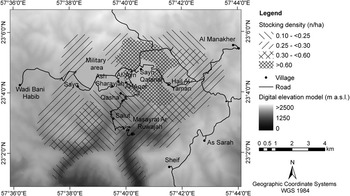
The study was carried out in the central Al Jabal al Akhdar region of the Al Hajar range in Northern Oman, where the deeply dissected limestone mountains reach elevations of about 3000 m a.s.l. (Ghazanfar, Reference Ghazanfar1991). The mean annual rainfall of 318 mm measured at 1900 m a.s.l. is substantially higher than in most of the country’s lowlands, where precipitation is <100 mm per year (Fisher, Reference Fisher1994). Most of this rainfall occurs during February to March as well as during July to September, when mean monthly temperatures reach 25°C (warm, rainy months), while probability of rainfall and mean temperatures decrease during November to January (cold, dry months; Department of Civil Aviation and Meteorology, Muscat, Oman). The traditional oasis agriculture in villages near Sayh Qatanah (57°40′35″E, 23°04′51″N, 2050 m a.s.l.; Figure 1), the main settlement on Al Jabal al Akhdar, combines irrigated terrace agriculture and livestock husbandry. The date palm (Phoenix dactylifera L.) is an important perennial crop cultivated in gardens below 1500 m a.s.l. and is replaced by the pomegranate (Punica granatum L.) in villages at higher altitudes. Several fodder plants such as maize (Zea mays L.), barley (Hordeum vulgare L.), oat (Avena sativa L.), alfalfa (Medicago sativa L.) and sorghum (Sorghum bicolor (L.) Moench) are grown under the cover of these trees. Goats (Capra hircus) of the local Jabal Akhdar breed are the most numerous species in the oases. All of the goat-keeping households regularly slaughter animals, and farmers consume the surplus milk after the offspring has suckled. Owners of larger herds even sell animals and since the prices for Jabal Akhdar goats on local markets are high (approximately €200 for a 2-year-old buck), goat husbandry can largely contribute to household income (Dickhoefer, Reference Dickhoefer2009). The animals stay in the barn over night and their manure is used as fertilizer in crop cultivation. During evening feeding, farmers offer dates, dried sardines, cultivated green fodder or collected tree foliage as supplement feeds. In the morning, the goats are taken out to the mountain pastures, where they are left to graze until the late afternoon. Each day, the animals cover distances of 12 to 20 km during grazing in the mountainous terrain (Schlecht et al., Reference Schlecht, Dickhoefer, Gumpertsberger and Buerkert2009). The natural vegetation on Al Jabal al Akhdar is characterized by open shrublands. Pastures of villages at 2000 m a.s.l. mainly comprise plateau areas with trees and shrubs such as Sideroxylon mascatense Footnote 1, Olea europaea ssp. cuspidata and Dodonaea viscosa (Dickhoefer et al., Reference Dickhoefer, Buerkert, Brinkmann and Schlecht2010). Acacia gerrardii, Grewia erythraea and Sageretia thea are abundant browse species on the mountain slopes and in the shallow gullies. They are replaced by Ziziphus spina-christi, Capparis spinosa and Pteropyrum scoparium in the valleys below 1350 m a.s.l. (Schlecht et al., Reference Schlecht, Dickhoefer, Gumpertsberger and Buerkert2009; Dickhoefer et al., Reference Dickhoefer, Buerkert, Brinkmann and Schlecht2010). Goats in oases at lower altitudes grazing these areas spend most of their feeding time browsing the ligneous foliage (Schlecht et al., Reference Schlecht, Dickhoefer, Gumpertsberger and Buerkert2009; Dickhoefer et al., Reference Dickhoefer, Buerkert, Brinkmann and Schlecht2010). In contrast thereto, tree and shrub density is lower on the plateau areas and animals grazing these pastures spend more time feeding on the herbaceous vegetation. Ligneous biomass yields reach ⩽41 t dry mass/ha on the mountain slopes and in the shallow valleys (Dickhoefer et al., Reference Dickhoefer, Buerkert, Brinkmann and Schlecht2010). However, since stocking rates on pastures in the vicinity of settlements are very high (Figure 1), the year-round grazing by goats, sheep and feral donkeys has severely degraded the natural vegetation. Hence, unpalatable plant species are abundant and herbaceous mass is much lower at grazed than at ungrazed sites despite similar altitude and geographical setting (19 v. 840 kg dry mass/ha in August 2006; Dickhoefer et al., Reference Dickhoefer, Buerkert, Brinkmann and Schlecht2010). Our study was conducted in the oasis of Qasha’ (57°39′50″E, 23°04′00″N, 1700 m a.s.l.). Six of the ten households in this village keep a total of 107 goats (Dickhoefer, Reference Dickhoefer2009) that graze the natural vegetation within an area of 11 km2 on the surrounding plateau areas, mountain slopes and valleys (Dickhoefer et al., Reference Dickhoefer, Buerkert, Brinkmann and Schlecht2010).
Stocking rates on pastures grazed by goats and sheep of nine villages on Al Jabal al Akhdar in Northern Oman as determined during key informant interviews (n = 10) conducted in winter 2007/2008.

Experimental design
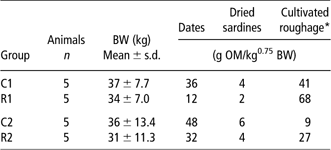
To determine feed intake of goats during grazing in response to different rations offered at the homestead, two feeding experiments were conducted in Qasha’ in October 2006 and February 2008, each time after four weeks with less than 5 mm of total rainfall. In both experiments, two rations very similar in metabolizable energy (ME) and crude protein (CP) concentrations were offered to six male goats each. They covered the animals’ energy and protein requirements for maintenance, activity and a daily gain of 50 g body weight (BW; National Research Council (NRC), 1981). A daily organic matter (OM) intake of 90 g/kg0.75 BW per animal and a minimum OM intake on pasture of 10% and 30% of the total OM intake were assumed in the first and second experiment, respectively, in order to calculate the amount of feed that was offered at the homestead. In October 2006, six animals were offered the roughage-based ration R1 (on OM basis: 18% dates; 2% dried sardines; 70% pre-bloom maize plants; 10% were assumed to come from pasture) and six animals the concentrate-rich ration C1 (on OM basis: 40% dates; 4% dried sardines; 45% pre-bloom maize plants; 11% were assumed to come from pasture; Table 1). In February 2008, one group of goats (n = 6) was fed ration C2 with 53% dates, 7% dried sardines and 10% Rhodes grass hay (on OM basis; 30% were assumed to come from pasture), whereas the second group (R2; n = 6) received 36% dates, 4% dried sardines and 30% green pre-bloom oat (on OM basis; 30% were assumed to come from pasture). While dates and dried sardines were fed in two equal portions at 6:30 h and 16:30 h before and after grazing, green fodder and Rhodes grass hay were only offered during evening feeding. The quantity of feed ingested by each animal at the homestead was measured during a 9-day adaptation and a 7-day experimental period in the first and an 18-day adaptation and a 7-day experimental period in the second feeding trial. The animals were weighed in the beginning and at the end of each trial as well as prior to the experimental periods using a tripod-based suspension balance (range 0 to 100 kg, accuracy 500 g). The mean BW of each animal was calculated.
Daily rations offered to goats of two feeding groups (Roughage-based = R; Concentrate-rich = C) during two feeding trials on Al Jabal al Akhdar in October 2006 (1) and February 2008 (2)

*Roughage consisted of pre-bloom maize in R1 and C1, of pre-bloom oat in R2, and of Rhodes grass hay in C2.
BW = bodyweight; s.d. = standard deviation; OM = organic matter.
Determination of feed, nutrient and energy intake
Total fecal excretion of animals was determined using the external fecal marker titanium dioxide (TiO2). Starting five days prior to each experimental period, gelatine capsules containing 3 ± 0.03 g of TiO2 were daily administered with a bolus gun during evening feeding. The total amount of feces excreted over night was collected in a cotton bag fitted to each goat at evening feeding. The following morning, the collected feces were weighed and homogenized. A representative sample of approximately 100 g fresh matter (FM) was taken from each animal and deep-frozen. At the end of each experimental period, fecal samples were pooled into three frozen samples per animal for the analysis of fecal dry matter (DM) and nitrogen (N) concentrations according to Naumann et al. (Reference Naumann, Bassler, Seibold and Barth2004). Fecal TiO2 concentrations were determined according to Wang et al. (Reference Wang, Tas, Glindemann, Mueller, Schiborra, Schoenbach, Gierus, Taube and Susenbeth2009). In addition, one composite fecal sample per animal was air-dried, ground to pass a 1-mm mesh and analyzed for OM and phosphorus (P) concentrations (Naumann et al., Reference Naumann, Bassler, Seibold and Barth2004). Samples of the feeds offered and refused were taken daily, were weighed, air-dried and weighed again to determine air-dry matter. Subsequently, three composite samples of each fodder type were ground to pass a 1-mm mesh and analyzed for DM, OM, neutral detergent fiber (NDF), acid detergent fiber (ADF), N and P following procedures described by Van Soest et al. (Reference Van Soest, Roberston and Lewis1991) and Naumann et al. (Reference Naumann, Bassler, Seibold and Barth2004). ME and digestible organic matter (DOM) concentrations were estimated by the Hohenheim Gas Test according to Close and Menke (Reference Close and Menke1986).
Total fecal excretion was calculated from the administered amount of TiO2, the TiO2 concentration in fecal OM (Lippke, Reference Lippke2002) and the recovery rate of TiO2 for ruminants of 0.93 (Titgemeyer et al., Reference Titgemeyer, Armendariz, Bindel, Greenwood and Loeest2001). The CP (=N × 6.25) concentration in fecal OM was used to estimate diet OM digestibility (Lukas et al., Reference Lukas, Suedekum, Rave, Friedel and Susenbeth2005). Based on total fecal OM excretion and the diet OM digestibility, total OM intake was calculated according to Gordon (Reference Gordon1995). OM intake on pasture was defined as the difference between total OM intake and the measured OM intake at the homestead. ME, CP and P intakes of goats on pasture were calculated from their OM intake during grazing multiplied by the average nutrient and energy concentrations of the pasture vegetation (see section ‘Quality of the pasture vegetation’). ME concentrations similar to dark fish meal (Close and Menke, Reference Close and Menke1986) were assumed for the dried sardines to be able to estimate daily ME intake of the animals. Intake data were compared to those obtained by Schlecht et al. (Reference Schlecht, Dickhoefer, Predotova and Buerkert2008) in spring and autumn 2005 who used goats of the same village that were fed by farmers in a traditional way.
Determination of the quality of the pasture vegetation
To determine the nutritional quality of the main fodder plants identified by Schlecht et al. (Reference Schlecht, Dickhoefer, Gumpertsberger and Buerkert2009) and Dickhoefer et al. (Reference Dickhoefer, Buerkert, Brinkmann and Schlecht2010), samples of the foliage of ligneous (n = 17), dicotyledonous (n = 7) and monocotyledonous (n = 9) herbaceous species were collected on the grazed plateau areas, the mountain slopes and valleys near Sayh Qatanah during August to September 2006. The samples (approximately 50 g FM) were weighed, air-dried, weighed again, ground to pass a 1-mm mesh and analyzed for DM, OM, DOM, NDF, ADF, ME, N, P, potassium (K) and sodium (Na) concentrations following standard procedures (Close and Menke, Reference Close and Menke1986; Van Soest et al., Reference Van Soest, Roberston and Lewis1991; Naumann et al., Reference Naumann, Bassler, Seibold and Barth2004). To determine seasonal changes in the N, P, calcium (Ca) and magnesium (Mg) concentrations of important browse species, one individual each of the ten most abundant ligneous species on the plateau areas, the mountain slopes and in the valleys was selected and marked. Samples of the foliage at browsing height (⩽188 cm; Dickhoefer et al., Reference Dickhoefer, Buerkert, Brinkmann and Schlecht2010) were collected every three months during May 2007 to April 2008. Leaves and twigs of each sample were separated and the leaves were analyzed for DM, OM, N, P, Ca and Mg concentrations according to Naumann et al. (Reference Naumann, Bassler, Seibold and Barth2004).
Statistical analysis
Means and standard deviations of the NDF, ADF, CP, P, K, Na, Ca, Mg, DOM and ME concentration of plants of different plant groups (ligneous, dicotyledonous and monocotyledonous herbaceous species) and pasture sites (plateau areas, mountain slopes and valleys; Table 2) and of the OM, CP, P and ME intake of goats of the four treatment groups were calculated. Data were analyzed for significant (P < 0.05) differences using SPSS 12.0 for Windows XP (SPSS Inc., Chicago, USA) and applying the independent t-test for normally distributed and the Mann–Whitney U-Test for not normally distributed sample sets (Zöfel, Reference Zöfel1992). Linear and logarithmic regressions between the metabolic BW (kg0.75), the intake of concentrate or of roughage feed at the homestead (independent variables), and the total OM intake as well as the OM intake of goats on pasture (dependent variables) were tested for significant effects. For each treatment group, data of one goat had to be omitted from the calculations, because the animals did not return from pasture (n = 1), fell sick (n = 1) or refused their rations (n = 2).
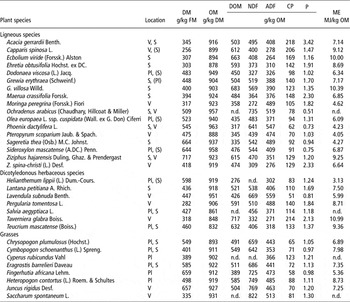
Dry matter (DM), organic matter (OM), digestible organic matter (DOM), neutral detergent fiber (NDF), acid detergent fiber (ADF), crude protein (CP), phosphorus (P), and metabolizable energy (ME) concentrations of a sample of ligneous and herbaceous plants collected on the mountain pastures on Al Jabal al Akhdar in autumn 2006

V = valley; S = slope; Pl = plateau; FM = fresh matter; n.d. = not determined.
Results
Quality of the pasture vegetation
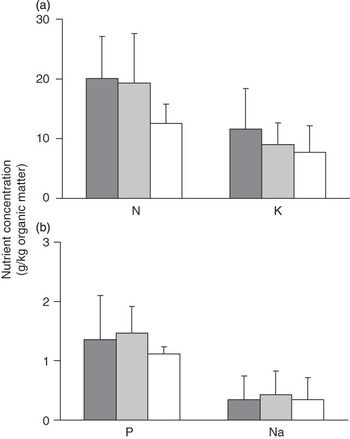
The nutritional quality of the plant species collected on mountain pastures varied between different plant groups, between plant species growing at different sites and between seasons. NDF and ADF concentrations ranged between 272 to 769 g NDF and 264 to 559 g ADF/kg OM (Table 3). While ADF concentrations were similar across all plant groups, NDF concentrations were highest in grass species (727 ± 59.2 g). However, the proportion of hemi-cellulose in NDF was lower in the foliage of the tree and shrub species (0.19 ± 0.12) than in grasses (0.38 ± 0.04). DOM and ME concentrations ranged from 0.676 to 0.753 and 4.1 to 11.0 MJ/kg OM, respectively. N, P, K and Na concentrations (g/kg OM) were between 8 to 35 g N, 0.5 to 3.4 g P, 3 to 28 g K and 0.04 to 10.22 g Na. Average ME and Na concentrations were similar between plant groups, while N, K and P concentrations were lower in grasses than in ligneous browse and dicotyledonous herbaceous species (Figure 2).
Dry matter (DM), organic matter (OM), digestible organic matter (DOM), neutral detergent fiber (NDF), acid detergent fiber (ADF), and metabolizable energy (ME) concentrations of samples of ligneous and herbaceous plants collected on the mountain pastures on Al Jabal al Akhdar in autumn 2006 (means ± s.d.)

*For plants included in the three groups see Table 2.
FM = fresh matter.
Nitrogen (N) and potassium (K) concentrations (a) and phosphorus (P) and sodium (Na) concentrations (b) of samples of ligneous foliage (dark gray), dicotyledonous herbaceous (light gray) and grass species (white) collected on the mountain pastures on Al Jabal al Akhdar in autumn 2006. Bars indicate one standard deviation. For plants included in the three groups see Table 2. Note the different scales of the y-axes.

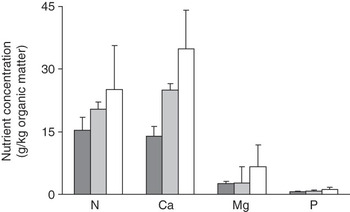
Nutrient and mineral concentrations of the leaves of the most abundant browse species sampled every three months differed between species growing on the mountain slopes and in the valleys and those characterizing the vegetation on plateau areas at 2000 m a.s.l. (Figure 3). N and P concentrations (g/kg OM) were high in the leaves of Acacia gerrardii (29 ± 4.0 g N; 1.5 ± 0.58 g P) and Ziziphus spina-christi (23 ± 3.1 g N; 1.6 ± 0.28 g P), typical plant species of the mountain slopes and valleys. Similarly, Ca concentrations (g/kg OM) were higher in the leaves of browse species growing in the valleys (35 ± 9.2 g) than of those found on the plateau areas (14 ± 2.4 g) and on the mountain slopes (25 ± 1.5 g). Given the low P concentrations, Ca : P ratios varied between 17 : 1 and 37 : 1. At 46 ± 2.1 g Ca/kg OM and 0.7 ± 0.07 g P/kg OM, the widest Ca : P ratio was determined in the leaves of Pteropyrum scoparium (67 : 1), an abundant shrub in the valleys at 1000 m a.s.l. Average Mg concentration (g/kg OM) in the foliage of ligneous species of the valleys (6.6 ± 4.0 g) was more than twice as high as in the foliage found on the plateau areas (2.6 ± 0.5 g) and the slopes (2.7 ± 0.9 g). It was highest in the leaves of Capparis spinosa (11.3 ± 1.2 g/kg OM), a small shrub species that was found in the mountain valleys.
Average nitrogen (N), calcium (Ca), magnesium (Mg) and phosphorus (P) concentrations of the foliage of the most abundant ligneous browse species growing on the plateau (dark gray), the mountain slopes (light gray) and in the valleys (white) on Al Jabal al Akhdar collected every three months during May 2007 to April 2008. Plateau: Dodonaea viscosa (L.), Olea europaea L. ssp. cuspidata (Wall. ex G. Don) Ciferri and Sideroxylon mascatense (A.DC.) Penn.; Slopes: Acacia gerrardii Benth., Sageretia thea (Osb.) M.C. Johnst. and Grewia erythraea (Schweinf.); Valleys: Capparis spinosa L., Pteropyrum scoparium Jaub. & Spach., Ziziphus hajarensis Duling, Ghaz. & Prendergast and Z. spina-christi (L.) Desf.

In seven of the ten sampled ligneous species, foliage N concentration was higher after several rainfall events in May and September 2007 than in February 2008, when temperatures were low as well as in April 2008 after five months with less than a total of 5 mm of rainfall. In contrast thereto, Ca concentrations and Ca : P ratios in the ligneous foliage of five species were lower in the warm and rainy season than in the cold and dry season.
Feed intake of goats
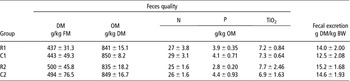
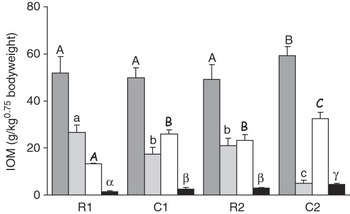
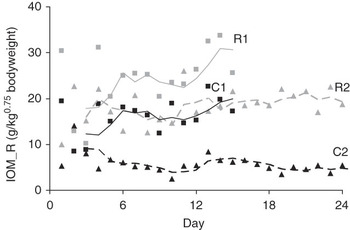
Calculated from fecal N concentrations (average 26.8 ± 2.83 g/kg OM), OM digestibilities were 0.711 ± 0.029, 0.729 ± 0.021, 0.691 ± 0.014 and 0.705 ± 0.012 of the entire diets consumed by R1, C1, R2 and C2 goats, respectively. OM digestibility was significantly lower in group R2 than in group C1 (P = 0.009). Goats excreted between 9 and 18 g DM/kg BW of feces per day (P = 0.114; Table 4). Their daily OM intake ranged from 87 to 107 g/kg0.75 BW and was significantly higher in group C2 than in group R1 (P = 0.030; Figure 4). Dates accounted for 0.14 ± 0.008, 0.27 ± 0.006, 0.24 ± 0.017 and 0.32 ± 0.021 of the daily OM intake of R1, C1, R2, and C2 goats, respectively. The animals daily ingested 1.1 to 4.8 g OM/kg0.75 BW of dried sardines, the intake being highest in group C2 (P = 0.001). In contrast thereto, daily intake from roughage (g OM/kg0.75 BW) was much lower in animals of this group (5 ± 1.5 g) than in goats fed rations R2 (21 ± 3.2 g), C1 (17 ± 3.0 g) and R1 (27 ± 3.2 g; P = 0.001; Figure 5). Although animals of groups C1 and R1 only consumed 0.63 ± 0.130 of the total amount of pre-bloom maize offered, intake from green fodder was significantly different between both groups (P = 0.002).
Fecal concentration of dry matter (DM), organic matter (OM), nitrogen (N), phosphorus (P) and titanium dioxide (TiO2) and daily fecal excretion of goats fed roughage-based (R) and concentrate-rich (C) diets during two feeding trials conducted on Al Jabal al Akhdar in October 2006 (1) and February 2008 (2) (means ± s.d.)

FM = fresh matter; BW = bodyweight.
Daily organic matter intake (IOM) from different feedstuffs of goats offered roughage-based (R) and concentrate-rich (C) rations during two feeding trials on Al Jabal al Akhdar in October 2006 (1) and February 2008 (2). Pasture vegetation=dark gray; cultivated roughage = light gray; dates = white; dried sardines = black. Bars indicate one standard deviation from the mean. Different letters mark significant treatment differences (P < 0.05) in the intake from pasture vegetation (A, B), cultivated roughage (a, b, c), dates (A, B, C) and dried sardines, respectively.

Daily cultivated roughage intake (IOM_R) of goats fed roughage-based (R, gray) and concentrate-rich (C, black) diets during adaptation and experimental periods of two feeding trials on Al Jabal al Akhdar in October 2006 (1; squares and solid lines) and February 2008 (2; triangles and dashed lines). Points indicate daily means per treatment and lines show 3-day moving averages.

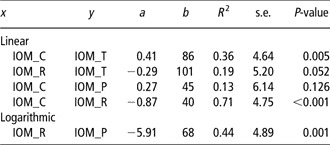
OM intake of goats on pasture was 0.46 to 0.65 of their total OM intake and tended to be higher in heavier animals (R 2 = 0.14; P = 0.100). While daily OM intake on pasture (g/kg0.75 BW) was similar in groups R1 (52 ± 6.8 g), C1 (50 ± 4.3 g) and R2 (49 ± 5.5 g; P > 0.686), goats offered ration C2 consumed significantly more OM during grazing (59 ± 3.8 g) than the animals of all other groups (P = 0.003). OM intake from roughages at the homestead (cultivated green fodder or Rhodes grass hay) significantly reduced OM intake of goats on pasture (R 2 = 0.44; P = 0.001; Table 5). In contrast thereto, OM intake from concentrate feeds (dates and dried sardines) significantly increased total OM intake of goats (R 2 = 0.36; P = 0.005) and tended to increase their OM intake during grazing (R 2 = 0.13; P = 0.126).
Parameters of linear (y = ax + b) or logarithmic (y = a ln (x) + b) regressions between the daily organic matter intake (IOM; g/kg0.75 body weight) from concentrate feeds (IOM_C), the IOM from cultivated roughage (IOM_R), the IOM on pasture (IOM_P) and the total IOM (IOM_T) of goats (n = 20) during two feeding trials conducted in a mountain oasis on Al Jabal al Akhdar in October 2006 and February 2008

Concentrate feeds were dates and dried sardines; cultivated roughage were pre-bloom maize and barley plants and roughage hay.
Nutrient, mineral and energy intake
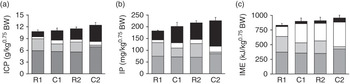
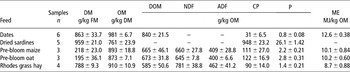
At average nutrient concentrations (g/kg OM) of the pasture plants of 114 ± 44.8 g CP and 1.4 ± 0.61 g P, daily CP and P intake (g/kg0.75 BW) of goats ranged between 10 to 13 g CP and 0.18 to 0.24 g P (Figure 6). Given the high OM intake of goats during grazing, the natural vegetation supplied 0.43 to 0.61 of their CP and 0.28 to 0.46 of their P intake despite its low nutrient concentrations (see section ‘Quality of the pasture vegetation’). Instead, dried sardines were rich in CP and P (Table 6). Although the animals only consumed small amounts of fish, it accounted for 0.09 to 0.37 and 0.17 to 0.51 of their total CP and P intake. Hence, total CP and P intake was higher in animals receiving rations R2 and C2 than those offered rations R1 and C1 containing less dried sardines. At an average fecal P concentration of 3.8 ± 0.80 g/kg OM, 0.33 to 0.70 of the ingested P were excreted via the feces. The proportion was lower in R2 goats than in any of the other three treatment groups (P = 0.010).
Daily crude protein (ICP; a), phosphorus (IP; b) and metabolizable energy (IME; c) intake of goats fed roughage-based (R) and concentrate-rich (C) rations during two feeding trials on Al Jabal al Akhdar in October 2006 (1) and February 2008 (2). Nutrients and energy supplied by pasture vegetation (dark gray), cultivated roughage (light gray), dates (white) and dried sardines (black); bars indicate one standard deviation from the mean total nutrient and energy intake per day. Note the different scales of the y-axes.

Dry matter (DM), organic matter (OM), digestible organic matter intake (DOM), neutral detergent fiber (NDF), acid detergent fiber (ADF), metabolizable energy (ME), crude protein (CP), and phosphorus (P) concentration of feed stuffs offered to goats during two feeding trials conducted on Al Jabal al Akhdar in October 2006 and February 2008 (means ± s.d.)

FM = fresh matter.
At average ME concentration of the pasture plants of 7.2 ± 2.15 MJ/kg OM, goats’ daily ME intake was 798 to 1023 kJ/kg0.75 BW. It was similar in groups C1, R2 and C2 (P > 0.118), but was significantly lower in goats offered ration R1 (P < 0.047), since they did not consume all the pre-bloom maize they were offered. Due to the low ME concentration of the pasture plants, ME was mainly supplied by the feed consumed at the homestead. While in groups C1 and C2, dates supplied 0.36 ± 0.007 and 0.44 ± 0.023 of the total ME intake, they only provided 0.20 ± 0.008 and 0.33 ± 0.018 of the total ME intake to R1 and R2 goats. Instead, these groups received 0.32 ± 0.043 and 0.23 ± 0.030 of their daily ME intake from cultivated green fodder.
Discussion
Nutritional quality of the pasture vegetation
The low nutritional quality of the natural vegetation on arid and semi-arid mountain ranges is widely limiting the productivity of grazing livestock (Ramírez et al., Reference Ramírez, González-Rodríguez, Ramírez-Ordũna, Cerrillo-Soto and Juárez-Reyes2006; Ben Salem and Smith, Reference Ben Salem and Smith2008) and much research was therefore dedicated to improve the animals’ nutrition by an adequate energy and nutrient supply. Low CP concentrations of the rangeland vegetation may reduce the digestibilities of diets consumed by grazing ruminants and the supply of a protein-rich concentrate mixture can therefore increase total DM intakes of animals (Ben Salem and Smith, Reference Ben Salem and Smith2008). N concentrations of the ligneous and herbaceous species on Al Jabal al Akhdar were only slightly lower or similar to those of browse plants grazed by sheep in the Tigray region of Northern Ethiopia, which were sufficient to cover the rumen microbial N requirements even during dry seasons (Yayneshet et al., Reference Yayneshet, Eik and Moe2009). However, ME concentrations in the natural vegetation of the Ethiopian pastures were much higher than those of the browse foliage, herbs and grasses sampled in our study. Moreover, P concentrations and Ca : P ratios of >20 : 1 of the foliage of the most browse species were within the range of values determined for tree and shrub foliage on semi-arid, calcareous rangelands in Northeastern Mexico, where P supply to goats was deficient in all seasons of the year (Ramírez et al., Reference Ramírez, González-Rodríguez, Ramírez-Ordũna, Cerrillo-Soto and Juárez-Reyes2006).
N and P concentrations were highest in the ligneous fodder species and were together with the ME concentrations higher in species growing on the mountain slopes and in the valleys than in fodder species growing on the plateau areas at 2000 m a.s.l.. Moreover, yields of ligneous biomass are high at these sites, since they benefit from the run-off water of the upper plateau areas (Dickhoefer et al., Reference Dickhoefer, Buerkert, Brinkmann and Schlecht2010). Hence, the present results underline the importance of the browse foliage in particular of the mountain slopes and valleys for livestock nutrition on Al Jabal al Akhdar and in similar regions. N and Ca concentrations in the foliage of the main browse species in the study region varied between seasons. While N concentrations were highest in the rainy season (July to September), Ca concentrations and Ca : P ratios of the foliage increased in February and April 2008 after three to five months with less than 5 mm of rainfall. Similar changes in the nutritional quality in response to rainfall were also reported by Ramírez et al. (Reference Ramírez, González-Rodríguez, Ramírez-Ordũna, Cerrillo-Soto and Juárez-Reyes2006) for ligneous plants on Mexican limestone pastures. In combination with the low ME and P concentrations as well as the wide Ca : P ratios of the fodder consumed by goats on pasture, the seasonal changes in the available herbaceous biomass (Dickhoefer et al., Reference Dickhoefer, Buerkert, Brinkmann and Schlecht2010) and the nutritional quality of ligneous foliage might thus limit animal growth and production.
Determination of feed intake
While the number of animals (data of five animals per treatment were analyzed) as well as the length of the sampling period (7 days) in our study were similar to those in other grazing experiments (García et al., Reference García, Aguilera and Molina Alcaide1995; Molina Alcaide et al., Reference Molina Alcaide, García and Aguilera1997; Glindemann et al., Reference Glindemann, Wang, Tas, Schiborra, Gierus, Taube and Susenbeth2009), adaptation to experimental diets, in particular in the first feeding trial, was shorter than in these studies. Nevertheless, our study was based upon on-farm trials. Since animals of the two cooperating farmers were used, they were already adapted to management and environmental conditions. Moreover, experimental rations were similar to those commonly offered to goats at the homestead (Schlecht et al., Reference Schlecht, Dickhoefer, Predotova and Buerkert2008; Dickhoefer, Reference Dickhoefer2009) and the animals grazed the same pasture areas as they did before the trials. Hence, the shorter adaptation periods in our study compared to other grazing experiments do not appear to limit the validity of our results. Moreover, the frequencies of marker application and/or of feces collection largely determine the accuracy of fecal excretion estimates. Hence, Myers et al. (Reference Myers, Ludden, Nayigihugu and Hess2006) assumed that a frequent marker administration reduces variation in fecal marker concentration, because the marker is mixed more homogeneously with the digesta. Similarly, Glindemann et al. (Reference Glindemann, Wang, Tas, Schiborra, Gierus, Taube and Susenbeth2009) found that two pulse doses per day resulted in an equal TiO2 concentration in fecal grab samples collected at different times during the day. However, the authors concluded that the prediction of fecal excretion with a marker administration once daily can be significantly improved, if two instead of one grab samples are taken. Instead, the prediction is only slightly improved by a marker administration twice daily. TiO2 concentration in duodenal digesta in the study by Myers et al. (Reference Myers, Ludden, Nayigihugu and Hess2006) increased until a maximum at 2 to 4 h after dosing and subsequently decreased until the next dosing. Hence, collecting the feces excreted from evening (16:30 h) until morning (6:30 h) feeding in our study included both, the maximum and the minimum fecal marker concentration. Despite the variation in fecal marker concentrations within a day due to a singular marker administration, the duration of feces collection in our study thus allowed for a reliable estimate of the animals’ fecal excretion. Moreover, the small standard deviations from the means stress the quality of our data set.
Feed intake
Daily OM intake (g/kg0.75 BW) of goats of 87 to 107 g determined during the two feeding trials was similar to the values obtained for goats in the villages of Al Jabal al Akhdar in 2005 (Schlecht et al., Reference Schlecht, Dickhoefer, Predotova and Buerkert2008). Farmers commonly feed dates and dried sardines as well as cultivated green fodder to their livestock. The animals receive 23 to 35 g OM/kg0.75 BW of concentrate feed and 2 to 16 g OM/kg0.75 BW of roughage per day (Schlecht et al., Reference Schlecht, Dickhoefer, Predotova and Buerkert2008). Although goats in our study did not consume all the green roughage they were offered, intakes from green fodder of R1, C1 and R2 animals were much higher than the daily intake from roughage of goats of the same oasis under farmers’ common feeding practices (2 g OM/kg0.75 BW; Schlecht et al., Reference Schlecht, Dickhoefer, Predotova and Buerkert2008). The natural pasture vegetation supplied 0.46 to 0.65 of the total OM intake of goats. Despite the large amounts of supplement feeds offered, OM intake at the homestead did not fully substitute for the fodder consumed by the animals on pasture, since they were allowed to graze for several hours each day. Results therefore stress the importance of the natural fodder resources for goat husbandry on Al Jabal al Akhdar. Nevertheless, OM intake during grazing was lower than values determined in goats of the same oasis in spring and autumn 2005 (Schlecht et al., Reference Schlecht, Dickhoefer, Predotova and Buerkert2008). Moreover, R2 goats consumed less fodder during grazing than C2 goats, and roughage intake at the homestead logarithmically decreased the amount of fodder consumed by goats on pasture. Results therefore indicate that an increased feeding of goats at the homestead and in particular the feeding of roughage reduces their OM intake during grazing. OM intake on pasture decreased by 0.47 g per 1 g the OM of roughage consumed at the homestead. Substitution rate differed from 1 due to a higher total OM intake of goats in response to an increased supplement feeding at the homestead. Digestibilities of the feed ingested on pasture and of the cultivated green fodder (pre-bloom maize and oat plants) offered at the homestead largely differed (0.49 to 0.54 v. 0.67). While the fibrous pasture plants are slowly fermented and are retained in the rumen for a long time, the fresh cultivated feeds are degraded more rapidly and thus contribute less to rumen fill. Moreover, the additional energy supplied by the green fodder as well as the concentrate feeds might have enhanced microbial growth and thus improved fermentation rate. However, substitution rate in our study was higher than the maximum decrease of 0.26 g (dry season) and 0.37 g (wet season) found by Kawas et al. (Reference Kawas, Schacht, Shelton, Olivares and Lu1999) for supplemented goats grazing semi-arid woodlands in Brazil. These findings therefore illustrate the high potential of roughage feeding for rangeland conservation in this and similar semi-arid grazing systems. However, although the intake from green maize was significantly higher in group R1 than in groups C1 and R2, OM intake on pasture was similar in goats of the three treatment groups. Hence, if animals are allowed to graze for several hours each day, feeding roughage at a daily level of 21 g OM/kg0.75 BW (ration R2) seems to be sufficient to obtain a maximum reduction in feed intake on pasture. However, further studies should be carried out to determine whether studied or other feed rations have similar effects on feed intake on pasture of goats of different oases. A feeding of roughage prior to grazing in the morning might even further reduce grazing pressure. However, since women harvest the green fodder in the afternoon and the majority of animals are not fed at all in the morning, this is currently not an appropriate strategy for farmers on Al Jabal al Akhdar. Moreover, the Rhodes grass hay purchased on the local markets had a much lower nutritional quality than the cultivated green fodder, and since goats refused 0.64 to 0.79 of the hay offered, it does not appear to be suitable for homestead feeding of grazing livestock.
Nutrient, mineral and energy intake
Goats are known for their selective grazing behavior and their ability to feed on species of higher nutritional quality and to thereby enhance their nutrient and energy intake (Papachristou et al., Reference Papachristou, Dziba and Provenza2005). However, this ability hampers the exact determination of the nutrient and energy intakes of goats during grazing. Previous studies by Schlecht et al. (Reference Schlecht, Dickhoefer, Gumpertsberger and Buerkert2009) and Dickhoefer et al. (Reference Dickhoefer, Buerkert, Brinkmann and Schlecht2010) identified the plant species preferentially grazed by goats in the area. However, the time animals spent feeding on a species (Schlecht et al., Reference Schlecht, Dickhoefer, Gumpertsberger and Buerkert2009) as well as the browsing intensity visible in individual plants (Dickhoefer et al., Reference Dickhoefer, Buerkert, Brinkmann and Schlecht2010) do not necessarily correspond to the amount of feed ingested from each plant species. Moreover, the animals may only select for certain plant parts and feeding behavior may differ between seasons (Schlecht et al., Reference Schlecht, Dickhoefer, Gumpertsberger and Buerkert2009) and individual animals. In this study, it was therefore not possible to quantify the extent to which individual plant species and plant parts contributed to the feed intake of goats on pasture. Instead, samples of the herbaceous and ligneous foliage at browsing height were collected and the average ME and nutrient concentrations of the dominant ligneous, dicotyledonous and herbaceous grass species grazed by goats were taken to estimate their ME and nutrient intake on pasture. This may underestimate their actual intake during grazing and thus their total nutrient and energy intake.
During grazing, goats of Qasha’ cover 11.3 km of horizontal and 2.6 km of vertical distances per day (Schlecht et al., Reference Schlecht, Dickhoefer, Gumpertsberger and Buerkert2009). At daily ME requirements of 422 kJ/kg0.75 BW for maintenance (Lachica and Aguilera, Reference Lachica and Aguilera2005), 3.31 kJ/kg BW per meter of horizontal and 18.5 kJ/kg BW per meter of vertical movement (Lachica et al., Reference Lachica, Prieto and Aguilera1997), daily ME requirements for maintenance and locomotion would amount to 637 kJ/kg0.75 BW. The values of Lachica et al. (Reference Lachica, Prieto and Aguilera1997) were determined in goats walking on a treadmill belt and requirements will likely be higher for locomotion on rough surface (Lawrence and Pearson, Reference Lawrence and Pearson1999). However, the calculated daily energy requirement for maintenance and locomotion is within the range of 600 to 742 kJ/kg0.75 BW recommended by NRC (1981) for goats of 30 to 40 kg BW grazing arid, mountainous rangelands. The daily ME intake of goats of all groups during the two feeding trials of 898 ± 63.9 kJ/kg0.75 BW was therefore sufficient to cover their energy requirements for maintenance and locomotion and even provided additional energy for a daily BW gain of 100 g (NRC, 1981). Similarly, goats’ daily CP intake in the present trials of 10 to 13 g/kg0.75 BW (78 to 122 g CP/day) exceeded the requirements for maintenance, locomotion and a daily BW gain of 50 g (NRC, 1981). Dietary CP : ME ratios were similar to values recommended for goats by Underwood and Suttle (Reference Underwood and Suttle2001). The feeding of highly digestible concentrate feeds improved overall diet digestibility and thereby increased the animals’ total feed intake.
At 24 g Ca and 4 g Mg/kg OM, the average concentrations of these minerals in the leaves of the ligneous fodder species were much higher than the concentrations recommended for diets of grazing sheep growing at 100 g BW/day (2.4 to 3.7 g Ca and 1.0 g Mg/kg DM; Underwood and Suttle, Reference Underwood and Suttle2001). Similarly, Na and K concentrations in the pasture plants were adequate or much higher than required by goats for maintenance, locomotion and slow growth (0.7 g Na and 1.8 to 2.5 g K/kg DM; NRC, 1981; Underwood and Suttle, Reference Underwood and Suttle2001). Therefore, these minerals do not appear to limit the growth and production of grazing goats on Al Jabal al Akhdar. However, the natural pasture vegetation was low in P and Ca : P ratios in the foliage of most browse species were much higher than the ideal ratio of 1 : 1 to 2 : 1 (Underwood and Suttle, Reference Underwood and Suttle2001). Although goats are tolerant to wider Ca : P ratios when concentrations of both elements cover their requirements, an increased Ca intake can intensify the symptoms of a P deficiency, if dietary P concentrations are low (Underwood and Suttle, Reference Underwood and Suttle2001). According to fecal P concentrations and total daily fecal excretion, 0.8 to 2.4 g P/day were excreted by goats during the two feeding trials, equivalent to 0.33 to 0.70 of their daily P intake. Given the high P concentrations of the offered sardines, daily P intake of goats during our study (0.17 to 0.24 g/kg0.75 BW) covered their requirements for maintenance and slow growth (2.1 to 3.5 g P/day; NRC, 1981) and the high Ca concentrations in the natural vegetation should not have had any adverse effect on P retention. However, under traditional feeding, when forage intake on pasture is higher (Schlecht et al., Reference Schlecht, Dickhoefer, Predotova and Buerkert2008) and only little dried fish is offered (Dickhoefer, Reference Dickhoefer2009), wide Ca : P ratios in the natural vegetation in combination with a P intake below the animals’ daily requirements (calculated at 0.44 g P/day at 22 g DM of dried fish per day; Dickhoefer, Reference Dickhoefer2009) might impair P supply.
Feeding management
The supply of additional energy and nutrients to grazing animals with respect to their requirements and to the quantity and quality of fodder available on pasture can substantially improve animal production (Ben Salem and Smith, Reference Ben Salem and Smith2008). Farmers in the oases settlements of Al Jabal al Akhdar traditionally offer dates and dried sardines to their goats (Schlecht et al., Reference Schlecht, Dickhoefer, Predotova and Buerkert2008; Dickhoefer, Reference Dickhoefer2009). The animals’ nutrient and energy intake covers their requirements for maintenance, locomotion and slow growth even during the dry season. However, since only a few animals are fed individually according to their growth and production requirements, feedstuffs offered at the homestead are used rather inefficiently (Zaibet et al., Reference Zaibet, Dharmapala, Boughanmi, Mahgoub and Al-Marshudi2004; Dickhoefer, Reference Dickhoefer2009). Animals that do require extra nutrients and energy are young females as well as pregnant and lactating does (Dickhoefer, Reference Dickhoefer2009). While supplement feeding of young does would promote fast BW gain after weaning and thus reduce pubertal age, additional feeding of pregnant and lactating goats is needed to compensate for the decrease in the fodder quantity and quality on pasture during the main kidding period in November to February (Dickhoefer et al., Reference Dickhoefer, Buerkert, Brinkmann and Schlecht2010; see section ‘Nutritional quality of the pasture vegetation’). Moreover, nutrient and energy intake is particularly low in goats grazing the high-altitude plateau areas due to the lower biomass yields and quality of the vegetation there as compared to pastures at lower altitudes (Dickhoefer et al., Reference Dickhoefer, Buerkert, Brinkmann and Schlecht2010; see section ‘Nutritional quality of the pasture vegetation’). A temporary homestead feeding of these goats with energy- and nutrient-rich supplements during the cold, dry season and when their requirements for growth and production are high could therefore significantly improve their nutritional situation as well as overall herd production. According to our own observations and discussions with farmers, the latter are clearly aware of the seasonal changes in the vegetation of mountain pastures. They try to compensate for a seasonal decline in forage availability and quality by preferentially using the mountain slopes and valleys during dry months (Dickhoefer et al., Reference Dickhoefer, Buerkert, Brinkmann and Schlecht2010). Moreover, few farmers already feed part of their animals individually (Dickhoefer, Reference Dickhoefer2009). Hence, a differentiated feeding management appears to be a feasible strategy for farmers in the oases of Al Jabal al Akhdar.
Dates largely contributed to the total ME intake of goats and dried sardines are a valuable protein and P supplement (Early et al., Reference Early, Mahgoub, Lu, Ritchie, Al-Halhali and Annamalai2001). Both feeds are by-products of the date palm cultivation and fishery in Oman (El Hag and El Khanjari, Reference El Hag and El Khanjari1992). Hence, they offer a cheap alternative to expensive cereal-based supplement feeds (Ben Salem and Smith, Reference Ben Salem and Smith2008), which are largely imported into Oman (Food and Agriculture Organization, 2008). Farmers in the oases of Al Jabal al Akhdar traditionally cultivate green fodder in their gardens and produce about 0.5 kg OM/m2 of fodder per harvest (Dickhoefer, unpublished). Since the fodder is harvested six to eight weeks after seeding and is directly re-sown (Luedeling and Buerkert, Reference Luedeling and Buerkert2008), about 25 to 35 m2 of fodder area would be needed to feed a goat of 35 kg BW at 21 g OM/kg0.75 BW per day on a year-round basis, which is equivalent to the green fodder intake of R2 goats (see section ‘Feed intake’). In April 2006, alfalfa, maize, barley, oat and sorghum cultivation in the oasis gardens on Al Jabal al Akhdar covered an area of 2000 to 7600 m2 per village (Luedeling and Buerkert, Reference Luedeling and Buerkert2008). Thus, oasis forage cultivation appears to have a high potential for supplying green fodder to livestock. Nevertheless, more information is needed to evaluate the social and economic viability of this traditional practice (Dickhoefer, Reference Dickhoefer2009).
Conclusions
In mixed farming systems of semi-arid, subtropical highlands, the natural pasture vegetation is an important source of fodder for grazing goats. It largely contributes to their daily feed intake even if supplement feed is offered at the homestead. Low nutrient and energy concentrations of abundant fodder species on pasture may limit goats’ growth and production. Hence, homestead feeding of individual animals according to their specific requirements and with respect to seasonal and site-specific variations in the nutritional quality of the pasture vegetation is an effective measure to increase their nutrient and energy intake and to compensate for nutritional imbalances in the fodder available on pasture. Feeding cultivated green fodder significantly reduces goats’ OM intake on pasture. It thereby eases the grazing pressure exerted on the rangeland vegetation and thus contributes to the conservation of this key resource. Since such strategies build upon the common feeding practices in the mountain oases of Al Jabal al Akhdar, they are likely to be implemented by local farmers and are therefore valuable alternatives to the introduction of zero-grazing systems and the purchase of expensive concentrate feeds. They enable farmers to efficiently use their available fodder resources, render them more independent of global changes in feed prices, and thereby enhance the food and income security of the rural population.
Acknowledgments
We thank Prof. Dr A. Palfreman and Dr S. Al Khanjari of the College of Agricultural and Marine Sciences, Sultan Qaboos University, as well as Prof. Dr A. Buerkert, University of Kassel, for their valuable administrative and logistic support. We acknowledge the support of the Agricultural Extension Center of the Ministry of Agriculture and Fisheries on Al Jabal al Akhdar as well as the funding by the German Research Foundation (BU1308). We are grateful to E. Wiegard, C. Thieme and Dr C. Richter, University of Kassel, the Institute of Animal Nutrition and Physiology, Christian-Albrechts-University of Kiel, and the Institute of Animal Physiology and Animal Nutrition, University of Goettingen, for sample analyses. We thank Prof. Dr H. Abel for useful comments on this paper. Special thanks are due to Dr M. Nagieb for coordination during initial fieldwork, M. Klaiss for assistance in data collection, and to the families of villages on Al Jabal al Akhdar for their continued support and hospitality.