Introduction
Comparisons between early modern Europe and Asia in political terms are of abiding interest to global historians.Footnote 1 Two types of motivation drive such comparisons. One is to explain Europe's precocious economic growth, and the other is to explain the colonization and conquest of Asian regions by Europe. The first enquiry has sometimes proceeded by comparing Europe's competitive state systems with Asia's empires, suggesting that political competition led in Europe to sovereign dependence on capital and to ‘continual borrowing and. . .“stimulus diffusion,”’ whereas the ‘despotism’ of the east functioned as ‘a revenue pump’ in the best of times, deteriorating into chaotic ‘fluctuations without development’ in the eighteenth century.Footnote 2 The case for a contrast between dependent and despotic kings is undermined by the post-1980 scholarship on Indian empires, which projects a negotiated rather than a hierarchical relationship between sovereigns and communities in this region.Footnote 3 That scholarship leaves unanswered the question, how we should think about conquest and colonization in comparative terms.
Eighteenth century India presents a problem for global history. In Europe, the outcome of political competition was growth in the size and capacity of states, as they tried to take control of the economic means of financing wars. In this way, some of the major European states in the eighteenth century moved towards sovereign control of fiscal and military organizations, away from dependence on mercenaries, creditors, and contractors.Footnote 4 The phrase ‘military-fiscalism’ is used to suggest a co-evolution of fiscal capacity and of military capacity.Footnote 5 The corresponding growth of ‘social power’ through a process of conflict brought about the nation state and the state structures that defined European modernization.Footnote 6 In India too the dominant trend at this time was an increasing contest between regimes that had succeeded the Mughal Empire. The break-up of the empire, and the struggle for revenue amongst contenders, unleashed much potential for violence. Rulers, noblemen, warlords, and underneath them, landlords and peasant clans more or less lived in a state of war, especially in western and northern India. All of them sought to improve their means to acquire more money to finance warfare. But the outcome of the contest was not collective empowerment of the states after the pattern of Western Europe, but quite the opposite—a collective disempowerment. In keeping up the military enterprise, almost all these political actors ran into fiscal crises and the states or quasi-states that they had formed shrank in size.
There was one large exception to this picture, and that was the English East India Company. The contest ended with the hegemony of the Company. One way to approach the subject, therefore, would be to explain the final outcome of the competition. It goes without saying that the Company adopted a different set of means to pursue its military-fiscal enterprise than those of its rivals. What were these means? How were they different? Was the difference owing to the European and mercantile origin of the new regime? This paper attempts to answer these three questions.
The historiography of the military contest consists of two main theories which can be called the fall-of-the-Indians and the rise-of-the-West stories. The oldest view was articulated in nineteenth century imperialist history and carried over into Indian nationalistic narratives of colonization. The point of emphasis was the exceptional features of the Indian state. Autocratic regimes collapsed under the weight of their own contradictions. ‘Organized power having broken the field was left open for adventurers’.Footnote 7 A variation of the theme can be found in the regional historiography of the Maratha dominion, which attributes military debacles to ‘the feudal system and its fatal results’, and to quarrels amongst chieftains.Footnote 8 The second position attributes the outcome of the contest to the Europeans’ mercantilist ambitions, imperialist drive, and superior military organization and technology.Footnote 9 ‘Britain’, it is suggested, ‘was committed to securing its Indian interests at all costs’.Footnote 10 The Europeans had an acknowledged lead in naval warfare, which had secured their position as major powers on the littoral. The decisive battles in the eighteenth century, however, were fought on land. In land warfare, the Europeans brought into India, if not a decisive advantage, some useful knowledge relating to infantry formation, command structure, professionalized officer corps, flintlock guns, cannons made of cast iron, and mobile artillery.Footnote 11 The Company's superior financial capacity enabled it ‘to field a larger army than its Indian rivals’.Footnote 12 Others contend that the entire ‘conquest of India’ was built upon opportunism, by ‘perfidious deals’ that the Europeans struck with enemy factions and the wealthy merchants and bankers.Footnote 13
Not all accounts of politics fit these two models. Uneasily coexisting with the failure of the Indians and the ingenuity of the Europeans is a third factor—luck—insofar as the Europeans had entrenched themselves in one of the resource-rich regions of India, the Ganges delta.Footnote 14 Other historians look at the changing structures of collaboration on which the regional states depended. In one view, agrarian and commercial expansion in the seventeenth century had empowered the landed gentry, merchants, bankers, scribes, and other literate officers of the state.Footnote 15 The position of these groups, whose members did not come from traditional families holding military and fiscal tenures, was further strengthened in the eighteenth century via revenue farming on which the post-Mughal states depended. First advanced for the western Gangetic plains, the hypothesis of a capitalist consolidation was later applied to regions in peninsular India.Footnote 16 The accumulation of wealth among Indian merchants and bankers was potentially destabilizing for the regional states, because the interests of the former were more consistent with those of the Company than of the Indian nobility. The European trade settlements attracted merchants and bankers from all over India. Their role as collaborators and conspirators was so prominent in Bengal that the first major military encounter between the Company and a provincial army, the battle of Plassey (1757), has been described as ‘a transaction, not a battle’, by an Indian historian.Footnote 17
There is truth in all of these accounts. And yet, individually, each one of these positions raises problems. The concepts describing the state underlying the decline story now stand much revised.Footnote 18 The suggestion that India's feudal order was responsible for battlefield outcomes misleadingly implies that the British were free from reliance upon feudal elements, and leaves unexplained how the British reordered the structures of indigenous power in order to succeed. The emphasis on quarrelsome leadership in Maratha history makes it difficult to compare the Maratha situation with those of the other Indian states.Footnote 19 The rise-of-the-West story is problematical too. Mercantilism did not easily translate into imperial expansionism in India.Footnote 20 The relationship between the two motivations was complex and unpredictable. To suggest that making ‘perfidious deals’ with factions of the enemy was a forte of the Europeans does not square with the fact that unprincipled intrigue as a weapon of war is sanctioned in all ancient Indian manuals on statecraft.
The proposition that the Europeans possessed superior military knowledge lives uneasily with the fact that there was convergence in knowledge even as there was divergence in battlefield outcomes.Footnote 21 The practice of hiring European mercenaries by the Indian regimes was so extensive that a distinction cannot be maintained between European and Indian spheres of knowledge in the second half of the eighteenth century.Footnote 22 The distinction is blurred even more when we consider that the Company's army relied mainly on Indian soldiers with a thin layer of European command above them. The proposition that the Europeans fielded larger armies in the most consequential battles is wrong. What we can be sure of is that the proportion of regular soldiers was significantly higher in the Company army, and that the army expanded in the nineteenth century. If the composition of the army played any role, we need to ask why the Indian regimes were constrained from adopting the best strategy. To sum up the critique with a broader point, using the ethnicity of the ruler to make sense of state formation is likely to fail, for such an approach blurs similarities and convergent tendencies between the Indians and the Europeans, just as it blurs important points of distinctness amongst the Indian regimes.
Geographical situation is undoubtedly an important factor. With its strategic base at sea, the Company had secured itself in the littoral and deltaic zones. The productivity of land varied enormously between the floodplains of the Ganges and the dry interior, where the more powerful contenders for power were located. Regions with higher land yield generated more revenue per square mile. But geography alone cannot explain conquest, for the Europeans shared the fertile Gangetic floodplains with other regimes. If natural resources were all that mattered to military success, why did precolonial Bengal, Rohilkhand, or Awadh, all fortunately situated, cave in to the Afghans, Marathas, or the Europeans? The real divergence in state capacity depended not on luck, but on how the initial condition was used to build a sustainable edge. Commercialization as a potentially destabilizing force needs to be treated with caution. The obvious objection to the view that capitalist consolidation weakened the Indian regimes is that these regimes were just as heavily dependent on the capitalists as was the Company. On the other side, the relationship between Indian merchants and bankers and the Company was not a cosy one; in fact, it was characterized by deep mutual distrust.Footnote 23 Furthermore, banker support was hardly an independent variable in explaining the stability of regimes—the causation should run the other way. Finally, a wealthy private sector may explain patterns of political intrigue, but it does not explain success or failure in the battlefield.
In some writings on eighteenth-century state formation, it is recognized that battlefield strategies entailed fiscal innovations on both sides, suggesting a deep interdependence between financial and military capacity. In that spirit, Burton Stein read late-eighteenth century Mysore as an embryonic military-fiscal state.Footnote 24 C. A. Bayly uses the phrase to clarify the nature of western imperialist expansion in India.Footnote 25 As these two examples suggest, applying the concept of one strategy to winners and losers alike risks emptying the concept of analytical relevance. Further adding to the confusion, in recent reviews of the field, ‘military-fiscalism’ has tended to be applied somewhat randomly to diverse contexts.Footnote 26 In this paper, the idea of interdependent development of financial and military capacity is pursued, but is given more precision by proposing three connected theses on the colonization of India.
First, there was only one model of successful military-fiscalism in eighteenth-century India, represented by the East India Company. Several of the prominent Indian states, as they fought more battles, shrank in size. The Company alone managed to raise its revenue whilst continuing the war effort. The Company state, in this respect, represented a revolution and a sharp discontinuity in the history of state formation in early modern India. It was not like, nor an extension of, any Indian state of its time. Second, whereas the proximate reasons for its success were favourable geographical situation, access to more taxes, and making use of that money to build a large, standing army, there was a deeper reason behind the success. A certain combination of institutional choices allowed the Company to sustain these advantages. In the long run, the Indian states, which could carry on the military enterprise only by offering fiscal concessions and tenures to warlords, saw their power wither away in the presence of sustained conflict. The Company recast the relationship between the state and the warlords and landlords engaged in taxation by making use of an unprecedented instrument: offering marketable property rights in land in exchange for compliance to the new order.
How can we explain this divergence in the pattern of state formation? The third thesis is offered in answer to that question. Over relatively short periods in the late eighteenth century, the Company might not seem to be doing anything different from its rival. Both tried raising resources by means of two strategies, consolidation of the finances in a core territory and extortion of protection money from peripheries and dependencies. In the long run, however, sustainability of the military-fiscal enterprise depended on consolidation alone, because extortion only generated more conflicts. The Company's success in consolidation was due to its use of private property in land as an instrument to extract compliance from the landlords. In turn, this choice was an effect of its outsider status. The Company did not originate in an indigenous community, and therefore had no military heritage to defend, nor an interest in maintaining old property rights. The fact that it came from a world which had been adapting to constant wars by means of centralization of finances and conscriptions, made it readier than any Indian state of the time to try to consolidate sovereignty. The Indian states had a path dependence to live with, namely, shared sovereignty with communities and individuals who supplied useful services, principally military services. Conflicts, therefore, led them to give away more powers. Even as the access to larger funding and a favourable debt-service ratio led the Company to expand the regular army, there was an increasing dependence on unreliable mercenaries among its rivals.
The rest of the paper has three main sections: a restatement of the political history backdrop; fiscal capacity; and institutional choices. The last section concludes by weaving these threads together.
The political process
It is useful to begin with the Mughal polity. Generally speaking, medieval rulers maintained territorial control by assigning revenue grants to military commanders (warlords from now on), who in turn relied on the local gentry for collection of taxes from the peasants, for organizing extension or improvement in cultivation, for maintenance of law and order, and for military supplies. In Mughal India, the command of cavalry was an honour bestowed by the Emperor for distinguished military service upon deserving candidates, and a mark of hereditary or acquired nobility. But such command was also a potential threat to royal power. The revenue assignment with which the military elite were rewarded (jagir), therefore, was in principle not a hereditary or proprietary one, but transferable. In its pure form, the jagir signified a notional share over a region's tax resources; the holder of that office had little actual contact with the region concerned. Underneath these groups were the gentry or the landlords (zamindars), who lived in proximity to the peasantry, collected and paid the land tax, and sometimes rose from the ranks of the peasants. Technically a tax-collector rather than a proprietor, the landlord often enjoyed an effectively hereditary right. Like the jagirdars, they almost always owned arms, but their position hinged upon their control of cultivators rather than of soldiers.
The situation in southern, western, and eastern India maintained a broad similarity with the northern one on the point of a tiered structure of rights based on tax collection. One difference was that in peninsular India, local military authority was often vested in a tributary king who lived by land tax revenue, in a fort, was in command of an army at the service of the regional state, but did not necessarily belong to the nobility. In the Deccan sultanates and Gujarat, tributary kings were common in the eighteenth century. Another difference between the floodplains and the arid uplands was the weak presence of a gentry-landlord class in the latter. Concomitantly, hierarchy amongst the peasants was more muted here, and the figures in authority in the countryside were not landlords but state officers who sustained themselves by land grant.
Within a few years after the death of Aurangzeb (1707), the Mughal Empire began to disintegrate. The break-up of the empire has been attributed to various factors, such as fiscal crisis generated by constant wars, Aurangzeb's religious intolerance, the intrigue of nobles and ministers, and lack of financial support.Footnote 27 Not all these factors are relevant to this paper. One factor, however, is relevant. Between 1690 and 1720, almost everywhere the equation between the four major constituents of early modern states—the king, the warlord, the landlord, and the peasant—was beginning to change. In this backdrop, the formation of the successor states followed broadly two pathways towards what I will call ‘rule by noblemen’ and ‘rule by warlords’.
Major provincial rulers loyal to Delhi such as the Nizam in Hyderabad, Murshid Quli Khan in Bengal, and Safdarjang in Awadh consolidated their finances and armies, and in their capacity as ‘advisors’ to the Emperor grew more powerful than the Emperor himself. Although formally owing allegiance, they profited from the troubles the Emperor faced when coping with rebellions and invasions. Despite the relatively peaceful transition, these regimes faced insurrection by landlords, and at times from the warlords also. But they escaped usurpation of state power. There were several stabilizing forces at work. A substantial number of military tenures remained loyal to the king, who commanded symbolic authority as representatives of the Emperor. In some cases, such as Bengal under Murshid Quli, the state briefly regained the authority to enforce transferability of jagirs. Furthermore, banking was relatively advanced in these regions, and the rulers commanded credit.
Away from the spheres of influence of the Mughal governors, or Nawabs, state formation followed a different trajectory. The west ruled by Rajput states, the western Deccan ruled by the weak state of Bijapur, and in the south the states left behind by Aurangzeb's unfinished conquests, had never been administratively nor politically integrated into the Empire. Their own spheres of authority, however, were contested in the early eighteenth century. From the turmoil, four major territorial and military powers emerged in peninsular India—the Marathas based in Poona, Mysore under Haidar Ali, The English East India Company, and the French East India Company, both based in the Coromandel coast. If the merchant companies are excluded, the pathway to state formation in these examples involved assertion of independence by the two intermediate orders—warlords and landlords—at the expense of the nobility. In the Deccan, Mysore, Punjab, and the lands populated by Rajput, Jat and Rohilla Afghans, these agents claimed either kingship or vassal status of the Emperor.
The most consequential example of the second pathway was the Maratha dominion in the second half of the seventeenth century. The individuals and families who later formed the Maratha states, had been engaged by the Deccan sultans as warlords and members of the irregular army. The position of strength in which these people found themselves was the culmination of service under the Deccan sultanates, during which hill forts came to be garrisoned by the Marathas.Footnote 28 Rallying under Shivaji, they resisted the sultans, and posed an obstacle to Mughal ambitions in the Deccan. By the end of the century, they exercised effective control over parts of present-day Maharashtra. In the first half of the eighteenth century, the army enlarged in size, and conquests were made of Gujarat, Malwa, Bundelkhand, and Berar, which became parts of a network that British writers alternatively called ‘empire’, ‘republic’, or ‘confederacy’, and I will call by a fourth name ‘dominion’. In the 1750s, the northwestern tributaries of the Mughal Empire became a target of the Afghan rulers. The Marathas had also been making moves towards the northwest. In the third battle of Panipat (1761), a combination of Afghan, Awadh and Rohilla forces defeated the Maratha army.Footnote 29 Although losing the capacity to carry out further conquests, Maratha forces of Bundelkhand and Malwa regrouped and raided both the western Gangetic plains and eastern Rajasthan, until the second and third Anglo-Maratha wars (1803–1804 and 1817–1818) led to annexation of much of their lands by the Company.
Warlord-states in northern India arose from Rajput rebellions in eastern Rajasthan, and in the Gangetic plains. In Rohilkhand or Katehr, an agriculturally prosperous segment of the western Gangetic plains, former warlords under the Mughals established an independent rule between 1710 and 1750. Rohilla power after 1765 was weakened by the invasion of the Maratha and the Company army. A different example of warlord rule occurred in Mysore, where a military general, Haidar Ali, became the de facto ruler in 1761. For the next 38 years, Haidar Ali and his son Tipu Sultan tried to create an effective military administration in the region. A final example of the formation of a state out of military command was Punjab, where Ranjit Singh came to power in 1799. He succeeded, like Shivaji, in uniting the majority of the clans and their chiefs into a viable alliance. The resultant improvement in central finances enabled him to strengthen and modernize the army. Soon after his death in 1839, inter-clan rivalry reappeared, and partly taking advantage of these conflicts, the Company annexed Punjab in 1849.
The core political process in the eighteenth century saw these two pathways of state formation become entangled. The warlord-states in the Deccan displayed a propensity towards territorial expansion not so much by outright conquest as sending military missions elsewhere to demand protection money. The fiscal enterprise, thus, had two aspects, extortion and consolidation. Militarily strong regimes hailing from resource-poor regions staked claims upon the revenues of the virtually stateless former imperial provinces, as well as those of the richer states controlled by the remnants of the imperial administration. The fiscal system in this case involved the superimposition of a centralized military outpost over a decentralized land revenue administration. I call this ‘extortion’. In the richer regions, the fiscal enterprise usually involved an overhauling of the relationship between the tax-paying intermediaries and the state, so as to direct more taxes to the treasury. I call this ‘consolidation’. The Maratha dominion combined consolidation in western Maharashtra with extortion in Delhi, Awadh, Rohilkhand, Punjab, and briefly Bengal. Mysore, whilst targeting Travancore and Coromandel for extortion, tried to overhaul the finances of Mysore. Early in the second half of the century, two events presaged a change in this process. In 1761, the Peshwa's army lost at Panipat, and in 1765, the Company received the taxation rights of Bengal, Bihar, and Orissa from the Mughal Emperor. The two events did not introduce any immediate or fundamental break, especially since the mutinous Afghan army had to leave Delhi. But it led the way to a larger role for the Company in the north Indian theatre, and increased the choice of ‘protectors’. The Company now became a useful ally to some, and a potential threat to the survival of any ruler who did not negotiate. Now the Company joined the game and combined consolidation in Bengal with extortion in Awadh.
Despite this similarity, a growing divergence in the capacity to sustain a rise in military expenditure did unfold towards the end of the eighteenth century. The consolidation strategy of the Company was markedly more successful and prevailed over extortion. The success translated into battlefield outcomes. In a series of battles, the Company fought with all the major powers, with the exception of the Nizam. It suffered reverses and losses in the 1770s, but from the 1790s, won the battles that made a difference to the future political map of India.
It is well known in military history that the Company's success was partly a result of superior access to the finances necessary to build a standing army. Where did the capital come from?
Fiscal capacity
A fuller understanding of comparative patterns of military-fiscalism requires some knowledge of the potential fiscal capacity of different regions. This is essentially a statistical problem, which current scholarship is yet to address in a serious way. If we do have the relevant statistics, it is possible to define a scenario of sustainable military-fiscalism to be that where the proportion of state expenditure on army is relatively high, and the state expands the scale of revenues to meet the expenditure without going bankrupt. To arrive at a measure of this index, I have gathered some data on revenues and the scale of the military enterprise, which are available from British printed sources, historical research that has used the Peshwa archives, and the British Parliamentary Papers. It is not easy to verify the reliability of each individual figure. All I can do is assume that the figures cannot be systematically wrong, because these numbers were reported by participants in the political contest, whose business it was to know the revenues of the territories that they coveted or defended. Indeed, their survival depended on such knowledge.
Numbers, however, are scarce. After 1784, the Company was accountable to Parliament, and maintained regular accounts on territorial revenues. But these figures are not detailed enough to enable adjustments for territorial acquisitions. Public finance accounts of the Indian states are hard to find and harder to read. In these cases again, unstable borders pose a problem, compounded by a suspected convergence of the accounts of the states and the kings. This difference in the quality of data partly illustrates the hypothesis I wish to examine here, that the attempt at fiscal consolidation proceeded in an uneven fashion. For example, one of the difficulties of estimating the income of any state at this time was the presence of multiple claimants (kings and jagirdars) and multiple centres (core zone and tributary zones).
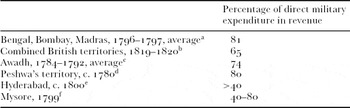
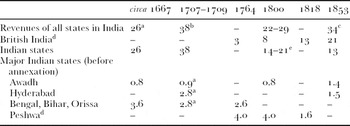
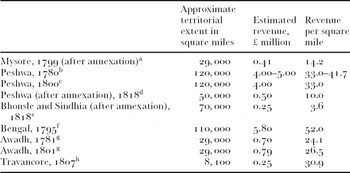
Despite these difficulties, two robust propositions can be advanced. First, the proportion of the military in total expenditure was high in the second half of the century (see Table 1). And second, the aggregate revenue flows to the Indian states taken together fell in the eighteenth century (see Table 2). There was one exception to this rule, and that was the Company. The Company did not experience a dramatic increase immediately after the takeover of the fiscal administration of Bengal. In fact, the 1770 famine even destroyed some of the initial gains. However, there was acceleration thereafter as the Company consolidated its land administration. On the Indian side, the fall partly reflected territorial losses, but not wholly so. The crisis arose from a weakening hold of the state upon its revenue assignees and officers. The revenue per unit of area or population did not rise to offset territorial losses. The Peshwa's revenues declined from £4 million in 1765 to £2.1 million in 1813 and £1.6 million before British takeover.Footnote 30 In 1770, Haidar Ali's dominions yielded revenue of about £0.8 million, which Tipu's conquests increased to £2.8 million in 1792.Footnote 31 The territory carved up by the alliance between the Company, Nizam, and the Marathas after the fall of Tipu produced revenue of £1.4 million. The territory of Mysore returned to the Wodeyar king produced an estimated revenue of £0.4 million (Table 3). Other instances of decline include Rohilkhand, where the end of Rohilla power led to a significant fall in revenues flowing into the Awadh state.Footnote 32
Military charges in total revenue

Notes: a. British Parliamentary Papers (BPP, Vol. 106) 1796–97, An Account of the Annual Revenues of the East India Company.
b. W. H. Sykes, ‘The Past, Present, and Prospective Financial Conditions of British India’, Journal of the Statistical Society of London, 22 (4), 1859, pp. 455–480.
c. Tribute paid to the Company for the defence of Awadh (average over 1786–1792) is taken as a proportion of revenues (average over 1784–1789). ‘Civis’, Letters, Political, Military and Commercial on the Present State and Government on the Province of Oude and its Dependencies (details unavailable) (circa 1796).
d. The revenue corresponds to actual inflow of cash into the treasury, and expenditure consists of payment to troops ‘who receive their allowances in ready money’, and maintenance of the 700-odd forts, Anon., ‘Of the Productions and Peculiarities of the Marratta Country’, Asiatic Miscellany, 1792, pp. 153–162. The revenue estimate is based on impression. But the amount, Rs. 50 million, is not improbable since official accounts show that in 1789, total inflow of tribute to the Peshwa state from subahs in Hindustan and Gujarat amounted to Rs. 21 million, see V. S. Kadam, Maratha Confederacy (Delhi: Munshiram Manoharlal, 1993), pp. 74–75.
e. Refers to circa 1830, and includes tribute to the Company and expenditure on domestic troops. I assume that the 1800 expenditure on the military establishment exceeded this percentage because of the ongoing hostilities with Mysore.
f. Infantry wages are assumed to range between Rs. 50 and Rs. 100 and cavalry Rs. 200 and Rs. 400 per annum. The foot-soldiers of Maratha households (paga) in 1800 earned Rs. 8 per month. The cavalry-infantry wage-ratio was usually 4:1 in the case of Awadh and the Company. For revenue, see Table 3. The assumptions are conservative. In a market characterized by high risk and high demand, wage structure was unstable. The salaries of European mercenaries as well as Indian commanders and musketeers immediately before a battle bore little relation to the regular pay and allowances of foot soldiers. In the 1764 Buxar campaign the Awadh Nawab Shujauddaula paid Rs. 300–1000 per month to his European commanders. Bartholomew Burgess, A Series of Indostan Letters (New York, 1790), p. xxii. Burgess was an American merchant.
Estimated state income, 1667–1853 (£ million)

Notes: a. Aggregate of all Mughal provinces. Irfan Habib, The Agrarian System of Mughal India 1556–1707 (New Delhi: Oxford University Press, 1999), pp. 455–459.
b. Aggregate of all Mughal provinces. William Bolts, Considerations on India Affairs (London: J. Almon, 1772), p. 17.
c. See Table 5.
d. BPP, Vol. 363, 1810, Select Committee on Affairs of East India Company Second Report, Appendix, pp. 16–26; Sykes, ‘Past, Present, and Prospective Financial Conditions’.
e. Estimates exist for some of the Maratha territories, and Awadh (see Table 3). A segment of these two regions accounted for half the revenues of the princely states in 1853. On this basis, I consider that the princely states for which there are no data could produce over half but less than two-thirds of the income of the Indian states. Two estimates of aggregate Maratha revenues during this time yield the figures of £12 million (1792) and £16 million (1800). If we accept these figures, the revenue of the Indian states should increase to £28–£32 million, still smaller than the amount for 1707. However, these were conjectural numbers, and greatly exaggerated the taxable capacity of the Maratha dominions in Hindustan.
Area and estimated revenue, 1780–1817

Notes: a. James Mill, A History of British India 1805–1835, Vol. 1 (London: James Madden, 1858), p. 4. The figures, reported in Kanthirai pagoda, were converted at the rate of 3 current rupees to a pagoda.
b. V. D. Divekar, ‘Survey of Material in Marathi on the Economic and Social History of India - 2’, Indian Economic and Social History Review, 15 (2), 1981, pp. 221–240, and Anon., ‘Productions and Peculiarities’. For want of a better benchmark, I have retained the size of the Bombay Presidency as the proxy of the tributary area. A mid-nineteenth century source places the size of the territory at 100,000 square miles. William Henry Tone, ‘Illustrations of Some Institutions of the Mahratta People’, Calcutta Review, 4 (7), 1845, pp. 178–240. The revenue is the amount actually deposited in the treasury.
c. John Taylor, Letters on India (London: Carpenter, 1800). p. 194. Taylor was an officer of the Company army and stationed in Pune at the time of his death in 1808.
d. Mill, History, Vol. 2, pp. 279–280. The Peshwa's territory acquired by the Company after the third Anglo-Maratha war amounted to an estimated 50,000 square miles and extended from Khandesh to Canara, and Konkan to western Deccan. The tributary dominion was considerably smaller than the area from which the Peshwa had received income in 1780.
e. Mill, History, Vol. 2, p. 283. Both the area and the revenue seem to have been underestimated.
f. BPP, Account of the Annual Revenues.
g. H. M. Lawrence, Essays, Military and Political Written in India (London: W. H. Allen, 1859), p. 101. The figures, when reported in Fyzabad rupees, were converted using the exchange of 2.9 Fyzabad rupees to a current rupee. Henry Montgomery Lawrence was Chief Commissioner and agent to the Governor-general in Oudh in 1856–1857, and died in the siege of Lucknow.
h. Mill, History, Vol. 1, p. 5.
The Company could not finance warfare from its income. The proportion of interest-bearing- debt-to-revenue ratio rose from 120 per cent in 1793 to over 300 per cent in 1809, declining to 200 per cent in 1833.Footnote 33 Ninety per cent of the war finance was raised in India. Although the cost of credit in England was about half (5 per cent) of that in India (10–12 per cent), the share of the English money market did not rise until after the territorial wars were over. In other words, all major rival states in the late-eighteenth century competed for money in the same money market. Credit was also critical to the other states. Possibly a quarter of the aggregate Maratha revenues in 1763–1765 came from loans. Rs. 10 million were taken from the bankers, according to one estimate for the 1760s.Footnote 34 Where, then, was there a difference between British territories and their Indian rivals? In Peshwa's territory, debt service in the 1760s took away about one-third of the net income of the state. There is reason to believe that Panipat left a permanent adverse effect upon sovereign debt in the Maratha dominion. In British India, in the decade of the third Anglo-Maratha wars, debt service as a percentage of revenue fell from nearly 20 per cent to 12 per cent.Footnote 35 In the second and third Anglo-Maratha wars, the Maratha states raised money by mortgaging the right to give land grants.Footnote 36 These figures suggest that sustainable capacity to borrow varied according to taxable capacity.
Access to increasing sums of money allowed the Company to expand its standing army between Plassey and the Sikh wars (see Table 4). The decision to do so was motivated less by long-term planning, and rather more by immediate anxieties regarding Indian power. Long before the Company became active in north Indian politics, its obsession with the defences of Fort William in Calcutta made a Dutch observer remark, ‘if they ever lose their power here, their fall will, in all probability, proceed from the heavy expences, [sic] which they sustain, in keeping up so important a military establishment. . .’.Footnote 37 Although the Company bore a heavy burden, the large expenditure commitments exerted a path-dependence effect, and turned military planning into a long-term project rather than one that had to adapt to every battle.
Approximate size of armies, major battles and reserves

Notes: a. The size of the Maratha army under Bhaskar Pandit sent to Bengal, 1742, and the army of Alivardi Khan, Bolts, Considerations, pp. 8–9.
b. Panipat, 1761, including cavalry 56,000, of which 2,000 belonged to Ibrahim Khan Gardi. Two contemporary accounts on the battle using different sources are, Anon. (1799), ‘An Account of the Battle of Panipat’, Asiatic Researches, 3: 91–140, translation of the Persian manuscript by Casi Raja (Kashiraj) Pandit, vakil of Awadh and an eyewitness; and Ghulam Husain Khan, Seir Mutaqharin of Ghulam Husain Khan, Vol. 3 of 3 (Calcutta: R. Cambray, 1902), pp. 385–389. They produce similar numbers, but also suggest that numbers for Panipat are unreliable, because of the preponderance of irregulars and camp-followers on both sides, numbering hundreds of thousands.
c. Wadgaon 1779, cavalry 16,000. M.R. Kantak, The First Anglo-Maratha War (Bombay: Popular Prakashan, 1993), p. 71.
d. Assaye, 1803. The size of the reserve army, like aggregate revenue (see Table 3), is estimated to be much larger. But in no single major battle, more than one-third of such numbers could be mustered.
e. 1767, Haidar Ali's forces, include 11,000 irregular cavalry. Roy, ‘Military Synthesis’, p. 668. Also account of the march to Erode, 1768, in Lewin B. Bowring, Lewin B, Rulers of India: Haidar Ali and Tipu Sultan (Oxford: Clarendon Press, 1893), p. 56, and the account of the battle with Eyre Coote in Porto Novo, 1780, Ibid., p. 98, for a similar total but a larger cavalry.
f. 1780, Haidar Ali's army, 28,000 cavalry. In addition, there were 40,000 ‘peons’ or irregulars. Charles Macfarlane, A History of British India (London: George Routledge, 1853), p. 183. 1790, Tipu Sultan, cavalry 20,000.
g. Battle of Plassey, 1757. 15,000 cavalry on the Bengal side. Peter Harrington, Plassey 1757 (London: Osprey, 1994). J. S. Stavorinus reported 50,000 foot and 18,000 horses on the Indian side, and 3,000 on the English side, including 900 Europeans, J. S. Stavorinus, Voyages to the East Indies, Vol. 1 of 3, (London: J. Robinson, 1798), p. 486.
h. 1792, potential size comprising all jagirs, cavalry 13,400. ‘Civis’, Letters.
i. Wadgaon, 1779. Kantak, Anglo-Maratha War, p. 71.
j. 2,340 cavalry.
k. Size of standing army in 1808, 10,400 cavalry. BPP Select Committee.
l. Size of standing army in 1832, 12,000 cavalry.
The increasing financial capacity allowed the Company to make forward-looking employment contracts. A simple comparison of salaries would be misleading, because pay practices depended on the composition of the army. There was, however, an emerging contrast in the implementation of employment contracts. The source of the contrast was the feasibility of altering the proportion of regular and irregular soldiers. The salaries of the Maratha infantry, which consisted of many irregulars, rarely followed the stated regulations. Haidar Ali paid fixed wages to his cavalry, but stretched by the campaign against the tributary kings, reduced the number of days of service, ‘the balance being supposed to be made up by. . .plunder’.Footnote 38 The predominance of irregulars and short-term credit made war budgeting an on-the-spot affair, a good illustration being the financing of Panipat by the Marathas by conducting raids in Delhi. There is no record of a pension plan for soldiers of the Indian armies. Land grants to retired soldiers were made, but not according to a stated policy. In the early nineteenth century, the Company had a policy of rewarding long service. The Bengal army resettled invalids and retired soldiers with land grants.Footnote 39 In Madras, half-pay pensions were granted after 22 years of service.Footnote 40 These policies had a practical aim. The challenging task before the Company's military command in the second quarter of the nineteenth century was how to disband large numbers of soldiers in a peaceful manner. The retirement scheme attained this goal.Footnote 41
If the steady rise in Bengal revenues over time reflected administrative efficiency or superior political capacity, the Company was undoubtedly fortunate in having its base in deltaic Bengal. The initial levels of revenue per head or per unit of land were higher in the Company-controlled areas. Overall, the revenue generation potentials of the Gangetic plains were higher than those in the Deccan and central India, because of differences in the productivity of land, and the larger extent of forests and wastes, the difficulty of transportation, high trade costs, and poor access to maritime commerce, in the latter. Revenue per square mile can be taken as a proxy for the relative cost of administration, for such costs should bear a positive relationship with the area administered.Footnote 42 At the time of the final conflict with the Marathas, the Company was earning a much larger income than any of the Indian states, from a territorial extent still smaller than that controlled by the Indian states. Only a small part of this income can be explained by tributes from dependent regimes. In 1795, two-thirds or more of the income was generated internally, whereas only half or less of the cash inflow into the Peshwa's treasury came from land revenue. And this internally generated stream was higher per square mile of territory controlled by the Company (see Table 3).
Three years after the third Anglo-Maratha war, when the territorial extent of Bengal, Bombay, and Madras had stabilized, gross revenue per square mile in Bengal was about four times (£54 per square mile) that of Bombay (£17), with Madras coming in between at £34. In 1827–1828, W. H. Sykes conducted a detailed survey of four districts of Bombay-Deccan, which had once formed the core of the Peshwa's territory (Poona, Ahmadnagar, Dharwar, and Khandesh).Footnote 43 Gross revenue was £17 per square mile. In the same year, the revenue of Bengal was nearly £30. In 1840, the figures for Bengal, Madras, and Bombay were, respectively, £35, £34 and £17.Footnote 44 These figures show the contrast between the former Maratha dominions and those of the British.
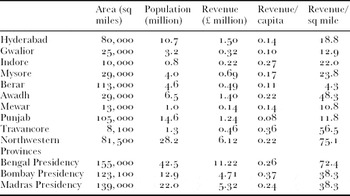
For a more meaningful comparison, we would like to collect fiscal data at a greater level of detail than the Presidency-wise revenues. More uniform and detailed data are available for a later date in a pamphlet on financial transactions between the Company and the princely states (see Table 5). By the time the data were compiled, circa 1850, the political contest had ended, tribute giving and taking reduced in scale, and in most regions new administrative institutions had been set up. But revenues still came mainly from land tax, and unless we assume that between 1820 and 1850 there had been radical changes in the methods of agricultural production, land tax per square mile reflected the long-term productive power of the regions conditioned by natural resource endowments. A particular virtue of this dataset is that all the revenue figures came from the same source, whereas the data presented in Table 3 come from discrete sources. Table 5 suggests that in terms of revenue per capita, Indian regions were quite similarly placed. However, in terms of revenue per unit of land, there was a significant difference. The more advanced regions were, predictably, located in the Gangetic plains. The more poorly endowed regions were situated in the arid peninsular India. Based on potential land revenue, any contest between Mysore, Hyderabad, Punjab, Rajputana, or the Maratha spheres in Hindustan, on the one hand, and the Company on the other, was an unsustainable one unless it was managed innovatively.
Area, population, and estimated revenue, 1853

Source: Anon. The Native States of India (Pamphlet) (London, 1853). The author of the 27-page pamphlet was possibly Edward Thornton, the East India House officer who prepared a number of pre-mutiny Gazetteers, and was also the author of E. Thornton. Statistical Papers relating to India (East India Company, London, 1853). which was the main source for the figures. Some of the area figures come from the Statistical Abstracts of India.
A story of military success that emphasizes only the level of earnings from land begs the question why pre-British Awadh or Bengal, also favoured by nature, had failed to emerge as the dominant military force in the eighteenth century. It is proposed in the next section that the difference reflected the effectiveness with which the Company could subject the intermediate orders of the landlords to the demands of the treasury. Such institutional innovations stemmed from a mode of political calculation that was not indigenous to India, and had consequences for military policy.
Patterns of institutional change
When addressing the issue of how effectively fiscal resources were deployed, it is necessary to connect three isolated propositions implicit in the scholarship on the eighteenth century. First, there was a growing difference between regions in the relationship between the state on the one hand and the intermediate orders, that is, tax officers and land grantees, on the other. Second, linked with this divergence, the states had variable capacities to create and control their forces. And third, geography mattered to the capacity of the rulers to control the intermediate order.
In pre-colonial Bengal, Hyderabad, and Awadh, the structure of proprietary rights followed the Mughal principle of awarding jagirs, and awarding the right to award jagirs, to nobles loyal to the king. These jagirs, however, were treated as heritable property. In Hyderabad, there was a largely peaceful passage into a harmonious partnership between ruler and landholders from the late eighteenth century, made possibly by the retreating military threat.Footnote 45 In Awadh, the peaceful transition to a successor state had made the zamindars more powerful and assertive. The Awadh Nawabs were partially successful in containing revolts in the west, whereas in the east, groups with more resources and military strength broke away. Facing the Maratha threat, the regime became militarily dependent on the Company, financially bankrupt, and lost control over the local agents in the fiscal system. English reaction to a crisis that they had themselves created in some measure was at first respectful submission of accounts showing a massive credit balance. The mood changed in the nineteenth century, when intelligence from Lucknow made a thinly veiled case for takeover, since ‘without our sepoys [the nawab] could not have. . .collected a rupee of revenue’.Footnote 46 ‘The present sovereign of Oude is just what might be expected of a person brought up in a harem.’Footnote 47 Statements such as these reflected the losing relevance of the Nawab for English interests in north India. The picture of a weak ruler more accomplished in the fine arts than in governance was perhaps a faithful one. What it omitted to mention was that the weakness was made worse by the British, leaving the ruler few options but to concentrate his energies on literary and musical pursuits. Bengal by contrast displayed swings in the balance of power between the state and the substantial landlords who supplied military service as well. Murshid Quli succeeded in wresting more taxes from them. But his harsh punitive measures were not wholly accepted by the nobility, and were reversed by his successor. Thereafter, some of the larger estates such as the Burdwan Raj prospered in the eighteenth century.Footnote 48 In the 1740s, the Nawab Alivardi Khan needed to press many landlords into military service to deal with the Marathas. Faced with potential takeover by the Company, the last independent Nawab Mir Kasim again tried to recast the equation, only to lose on the battlefield.
If in these examples we see the landlords maintaining control over arms and the means of collecting money, in the warlord-ruled states, we see a propensity towards gifting away these means to members of the military elite. In the case of nearly all the major Rajput states in the eighteenth century, military tenure holders became powerful as a result of the Maratha threat, and often turned kingmakers in their own domain. The most important example of the process was the Marathas. Although Shivaji had created an apparatus of state, and made some proclamations on good governance, his real legacy was not institutions of state, but an army funded by taxes raised by the centre. The army, consisting of an infantry and a mobile light cavalry, proved itself effective against the Mughal army, the core of which was formed of a cavalry that was heavily armed and moved slowly. In the early eighteenth century, there were several such units that joined together to lead the main territorial conquests. These bands were individually too small to pose a threat to a large organized army, but sufficiently large and mobile to make imperial armies ineffective.Footnote 49 Outright conquest, in other words, was not always a feasible strategy to raise taxable wealth. But sharp and frequent raids could paralyze the enemy enough to force a negotiation on tax sharing.
With the expansion of the territorial extent under Bajirao I (1700–1740), and the need to maintain military outposts in distant tributary zones, a different form of military-fiscal strategy was required. A general contrast can be drawn between zones of origin and zones of conquest. In zones of origin, that is, in the western Maharashtra territories where the Peshwa ruled, land grants were made to military chiefs to provide sustenance for the troops under their pay, creating a modified jagirdari system. In turn, the jagirdars as well as the state relied on professional state officers for conducting the businesses of state. Some of these officers emerged into the mainstream and in turn became landlords. In zones of conquest, on the other hand, the landlords who had served the Mughal provincial state continued to function under the Marathas, who employed a credible threat upon the landlords to make them comply. What kept the dualist machine running was the subsidy from Hindustan contributing to the consolidation of the intermediate order in Maharashtra. The flow was kept in place by a collection of self-financing military outposts at the exterior. The budget of each commander was separated from the central budget, and instead of provinces being financed out of a central pool of resources, the centre was subsidized by tributes from the provinces. As long as tribute came in from zones of conquest to subsidize the zones of origin, the whole could sustain its military enterprise. However, the defeat in Panipat put a check upon conquests, and 1803 saw serious territorial losses. The zones of origin, where fiscal administration had deteriorated by then, could not sustain military effort on its own and became a British dependency. At the time of the alliance with the English, the Peshwa ‘has not sufficient power to levy the kist.Footnote 50 The jagheerdars of the southern frontier are in a great degree independent of him, and pay him but a trifling, if any tribute’.Footnote 51 The dissension among Maratha chiefs, the increasingly disputatious nature of any accession in Poona, and the withholding of tribute from other branches of the dominion, even before territorial loss, need to be seen in the context of this endogenous economic crisis.
In Mysore, a great part of the extraordinary energies of Haidar Ali and Tipu Sultan was taken up in centralizing revenue. These efforts were disturbed by the fact that both rulers needed to maintain the flow of money from the tributary kings, which mission dissipated a great deal of state resources, and made fiscal enterprise too dependent on territorial expansion. To overcome the dilemma, Tipu issued a set of detailed regulations aiming to nationalize a number of trades, widen the tax base, and improve compliance. Historians have tended to read Tipu's regulations as evidence of real reform.Footnote 52 How successful he was in implementing the measures remains doubtful, however. The overwhelming focus of the regulations was a direct contract (‘a promise of engagement from a superior to an inferior’) between the state and the cultivator. The agent in charge of implementing that contract on behalf of the state was the village officer, which was a more or less hereditary office attached to the village and paid for with rent-free land. The regulations make it abundantly clear that neither this officer nor the amil (revenue-officer), mutsuddy (clerk) and kelladar (fort in charge) commanded the trust of the state. The regulations are filled with orders that start with the words, ‘it has been the practice in the districts’, and warning that such practices could invite the ‘severest displeasure’ of the huzoor (government). These included revenue farming, which clerks, accountants, and other officers indulged in, and the routine practice of village officers coercing the peasants to work their own lands. ‘Falsehood is an offence of the highest nature. . .and God has declared the lyar [sic] to be a companion of Satan'—the regulations remind the amil, who apparently had a realistic hope of evading punishment for dishonest conduct in this world.Footnote 53 The regulations leave one with the impression that these were attempts to mend a deeply flawed system. They were injunctions addressed to an officer-cum-gentry elite who could not be removed from their rights to village assets, and who, using their entrenched power, worked at cross purposes with the state.
The Company's mission in Bengal had been moving on a different trajectory after the British takeover of the fiscal authority of Bengal (1765). During the first round of land surveys conducted by a Committee of Circuit (1771), the administrators of Bengal agreed that it would be inadvisable to try to raise revenues ‘by destroying all the intermediate order of men between the ruler and the cultivator’.Footnote 54 But they also faced a situation where a large number of landlords and their associates failed to meet their revenue engagements from incapacity, mismanagement, or worse, a feeling that the new state like the old ones did not pose a credible threat. This threat earlier materialized in the shape of a visit by a state officer accompanied by a group of armed men, whose job it was to inspect the reasons for default, and take punitive action if appropriate. The penalty rarely included dispossession from tenure unless it was a question of disloyalty. This instrument had repeatedly failed to work, even failed to appear, during the Nawabi regime. Whilst expressing the need for a credible threat, the regime upheld the hereditary proprietary rights of the landlords, acknowledging ‘that the Zemindars, Talookdars, &c. were the hereditary proprietors [of land], and gave testimonies in favour of their rights’.Footnote 55
It was considered that ‘[t]he fear of the sale of their lands is the only probable instrument of keeping them to their engagements; and the actual sale of them is the only means of reimbursing the Government if they fail’.Footnote 56 A universal rule by coercion would be inviting trouble. A rule by market had the advantage that it separated the good from the bad zamindar, and reduced the costs of policing. The only resistance to the scheme was likely to come from the larger zamindars. The policing problem was to ensure compliance of these people. Subdivision of estates into smaller lots, whether via auction or inheritance law was in this context ‘for the interest of the Government’.Footnote 57
How was this mechanism put in place? Between 1770 and 1793, landlord asset was made more marketable, and increased in value as collateral. The Company was beginning to overhaul the legal infrastructure by instituting a set of courts and uniform procedural law. The claim to landed property was required to be verifiable in the new courts of law, rather than in the courts of Islamic law, courts of the royalty, or courts of the peasant communities as before. Furthermore, the state made the state-landlord relationship a contractual one, meaning that failure to pay revenues led to resumption and sale of estate to the highest bidder. The revenue auction element diluted and weakened the military element amongst the landlords, as it did in Awadh and Hyderabad, and brought in bankers and officers of state into the landlord cadre. On the other hand, the move towards a form of ownership defensible in the courts strengthened the landlord's property right. It was this quid-pro-quo that explains why the revolution could be carried through with comparatively little resistance from the landlords. These two principles were generalized in the Permanent Settlement of 1793. What followed these reforms is too well known to be repeated in detail. An outburst of auction sales splintered the large estates, and brought in many new people.Footnote 58 Within a few years, the military and nobility element in the landlord class became weaker. The outcome of the new paradigm on revenues was dramatic. Bengal revenues increased from around £2 million in the last days of the Nawab to over £5 million 25 years after Company takeover. The increase was achieved not by making land produce more, but wholly by wresting more from the landlords.
The relationship between the state and the intermediate orders of warlords and landlords cast a shadow on the formation of the army. The Indian armies were constituted of soldiers supplied by the holders of military-fiscal tenures, with a large number of irregulars among them. Such decentralization saved the king much money, but made three types of hazard more likely. First, the captains tended to include spoils from predatory raids into their reward structure, which made the level of war effort conditional upon the prospect of personal gain. Second, the coalitional nature of the large armies made command a difficult problem. The decentralized nature of the army could cause an adverse chain reaction. When the chance of a defeat increased during a battle, factions left the battlefield thus increasing the likelihood of defeat. On one occasion when the divided command was to cause utter devastation, Panipat, the commanders had taken ‘no account of any troops but those immediately under their own’.Footnote 59 More generally, Maratha ‘Sirdars followed their own interests’, a historian of Maharashtra observed.Footnote 60 Clearly they needed to, since they paid for their own troops. It was only on rare occasions that charismatic chiefs held disparate factions together. And their death led the whole army to slide back into chaos. This is what happened to the Sindhia army after the death of Mahadaji (1794), and the Sikh army after Ranjit Singh (1839). In both cases British victory on the battlefield was helped by factionalism. The Indian states’ attempts to induct Europeans created new conflicts of interest. The mixing of command structures and patterns with the induction of the Europeans left units confused. The exit of Benoit de Boigne in 1795 weakened and divided military command in the Sindhia camp. The new General Pierre Cuillier-Perron was not trusted by the king, Daulatrao, and as it turned out a few years later, nor by many of the officers, Indian and European.
The third problem was posed by the irregulars. For an idea of the scale, at Panipat, irregulars outnumbered regular soldiers 4:1 in the Durrany camp, and irregulars and camp-followers outnumbered soldiers 8:1 in the Maratha camp. The loss of life on a genocidal scale at this battle had much to do with the preponderance of non-combatants and semi-combatants. The number of camp-followers was large in the Company's army as well, but maintained a considerably smaller ratio, 3:1 according to a 1791 statement.Footnote 61 Being responsible for their capital cost, irregular soldiers were risk-averse and could not be easily integrated into military strategy. Towards the end of the century, the most important group among Maratha irregulars were the pendhary or Pindari, light cavalry who owned their horses and equipment, were not compensated if injured or suffered loss of horse, and therefore, felt no particular allegiance to any leader other than their own headmen. In peacetimes they pursued agricultural or other professions, during battles they were called in or joined of their own accord. There was a close association between conditions of agriculture and the incentive to join the irregular forces. ‘[T]he numbers of the Pindaris may be said to increase in the same ratio, as the means of subsistence diminish’.Footnote 62 For the main force, they had value in raiding campaigns. ‘In action, it was their custom immediately after the regulars had charged and broken the enemy, to fall upon them sword in hand, and complete the rout.’Footnote 63 But they could become a liability in a battle against a disciplined army.
The Pindaris were not popular with any of the major powers of the time. And yet, the logic of conflicts in the eighteenth century increased the supply of such soldiers to any new state that might wish to make use of them. Every military debacle released a large number of stragglers, deserters, and soldiers without command. Mercenary units that enlisted such people performed a significant column of support for the new armies raised.Footnote 64 Mahadaji Sindhia recruited from the remnants of Panipat, Ranjit Singh from the remnants of Assaye and Laswari, and the Holkars from the disbanded soldiery of Awadh and Rohilkhand. Some of them were retrained and absorbed in the regular army, but many remained outside the core army. Tipu Sultan's cavalry consisted of three units, the regulars (silahdars), the regulars who supplied their own horses, and kazzaks, or predatory cavalry irregulars. The last formed the largest body.Footnote 65 As military conflicts intensified, and states found their territorial control shrink, the dependence on irregulars became greater. In the final Anglo-Maratha wars, the northern Maratha armies relied mainly on the Pindaris.
Whereas the Indian military enterprise was increasingly dependent upon what one historian calls ‘old feudal elements’, the Company was able to create a unidirectional command structure owing to its reliance on regular forces.Footnote 66 More than the reliance on regular soldiers, the recruitment structure made a difference. The Company recruited its main body of soldiers from the Gangetic plains. At the time of the Anglo-Maratha wars, the Company did also recruit Rohilla and European mercenaries, but recruiting from other armies was not its preferred strategy. Brahmin and Rajput peasants recruited in Awadh and Benares formed the core of the standing army in Bengal. In Bombay a deliberate attempt was made to recruit down the caste hierarchy, and in Madras, no single community was allowed to dominate. In the major example of northern India, many of the recruits probably overlapped with the category of armed peasantry whose history Dirk Kolff has explored.Footnote 67 But even if they did, the majority did not enjoy an entrenched position in a state army before joining the Company's service. Even the so-called upper caste Bhumihar Brahmins in Benares came from a milieu where their superior status had been disputed. Through carefully crafted social policies that maintained a caste hierarchy inside the barracks, the Bengal army managed to preserve a situation in which the soldiers felt that they enjoyed a higher status in the army than outside.Footnote 68
The Company could pursue this course thanks to its location near the coasts and the delta. Location translated into military advantage in a number of ways. The principal one, of course, was revenue per area. The Company also had access to a large body of urban skilled labour based in Bombay.Footnote 69 At the time of the second Anglo-Maratha wars, at short notice, labour contractors and headmen could gather carpenters, loggers, and blacksmiths together, to build carriages for artillery. Parsi merchants took supply contracts for food. In turn, Bombay's situation as a port made it possible for the merchants to import Bengal rice for the troops. Disputes over contracts between merchant-suppliers and the stores in-charge did occur, but the form of a legal contract made such disputes in principle negotiable by a third party. Most importantly, the Bengal army had a virtual monopoly of saltpetre supplies and all three ports could cast cannons and iron implements on a larger scale and of better quality than did the enemy forces. In short, access to the port cities with a pool of industrial skills and commercial capital offset the disadvantage that distance from the overland supply routes could cause.
These overland supply chains were in decay. The early eighteenth century Maratha cavalry was legendary for its ability to subsist on little food. A few handfuls of millets collected from cropped field en-route and consumed on horseback were all that the riders lived on for days. Even if these reports were exaggerated, the small size of these bands made supplies a less serious problem than was the case with the Mughal armies. However, as the battles became bigger and the forces larger supplies were organized differently. The overland supply system relied on Banjara bullock trains. The Banjara chieftains, according to later English documents, had a special relationship of regard with the Marathas. The system was slow, and with territorial losses, at increasing risk of interception. On several occasions, beginning with Panipat, the Maratha troops were starving when real battle commenced.
Conclusion
The paper has illustrated three propositions which together should form a coherent account of the conquest of India by the East India Company in the late eighteenth century. First, of the contenders for hegemonic power, the Company alone managed to achieve mutually reinforcing growth in wealth and power. Second, an enabling factor working in its favour was a base in resource-rich Bengal and a tributary relationship with the second richest land, Awadh. Third, whilst playing the competitive game of extortion, which all prominent military powers in this time played, the Company also changed the rules of the game. It changed the equation between the state and the groups in command of local fiscal-military administration. It relied on their loyalty to a lesser extent than did the others, and subdued them by a new instrument, the land market. In the end, the move enabled the raising of more taxes from the core zone, a lesser degree of dependence on tributes, and less dependence on mercenaries. At the same time, persistence with shared sovereignty weakened the Indian states in the face of sustained conflict. The goal of tribute extraction by means of militaristic extortion became unsustainable when conflicts became long-term. Even as the Company wrested the control of the fiscal order from former warlords and nobles, its Indian rivals persisted with the tradition of rewarding warlords and nobles with fiscal powers. This is how more political competition disempowered the Indian states and strengthened the Company.
How far can the divergence be explained with reference to the foreign origin of the new rulers? I suggest that, in having to come to terms with warlords and landlords, the Company was addressing an essentially Indian issue, but its choice of the institutional means (land market and an army of regulars) displayed its outsider, if not European, roots. The successful pursuit of these institutional means made the new regime a sharply discontinuous factor in the political history of early modern India. As the divergence in means continued to grow, the goal before the Company changed from opportunistic exploitation to imperialism.