Introduction
Benign and malignant prostate disease is common in older men. Prostate cancer (CaP) is the most common male cancer in the UK, accounting for 24% of all new male cancer diagnoses. More than 35,000 new cases of CaP are diagnosed per year in the UK with 10,000 men per year dying from the disease. Men have a 1 in 12 lifetime risk of developing CaP. However, it is now known that many older men will die with CaP rather than from CaP. Benign prostatic disease is even more common and many older men accept lower urinary tract symptoms (LUTS) as a consequence of their ‘ageing prostate’. 3.5% of UK men aged 45–49 years and >30% of men over 85 years seek medical advice for LUTS.Reference Logie, Clifford and Farmer1 41% of over-50-year-olds have an International Prostate Symptom Score (IPSS) = 8, signifying moderate to severe LUTS.Reference Trueman, Hood, Nayak and Mrazek2 However, at the International Consensus Conference on BPH in 1995 it was recognized that not all LUTS had a prostatic cause. The term LUTS was therefore felt to be more appropriate than the traditionally used term ‘prostatism’, which implies causality.Reference Abrams3 LUTS are classified as storage symptoms; increased daytime frequency, nocturia, urgency and urgency incontinence, and voiding symptoms; hesitancy, intermittency, slow stream, straining and terminal dribbling.Reference Abrams, Cardozo and Fall4 Diagnosing the cause of LUTS involves identifying either dysfunction of the bladder, the outflow tract, or both; or identifying a disorder of fluid handling, such as polyuria and nocturnal polyuria.
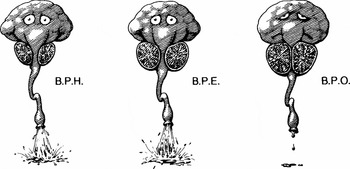
Equally it was recognized that benign prostatic enlargement (BPE), an increase in gland volume, does not always cause LUTS or obstruction to urinary flow (BPO): the term benign prostatic hyperplasia (BPH) is a histological diagnosis and should only be used as such. BPH is highly prevalent as 70% of men over 60 years and 90% over 80 years have histological nodular hyperplasia of BPHReference Berry, Coffey, Walsh and Ewing5 (see Figure 1). Bladder outlet obstruction (BOO) is diagnosed by low flow, high pressure voiding on pressure flow studies. BOO can occur in both men and women. The main cause for BOO in men is benign prostatic obstruction (BPO) due to BPH. In addition, not all men with LUTS will have BOO on pressure flow studies.Reference Abrams and Feneley6
Cartoon to represent the difference between benign prostatic hyperplasia (BPH), benign prostatic enlargement (BPE) and benign prostatic obstruction (BPO), where BPH leads to BPE, which in turn results in bladder outlet obstruction. Reproduced from Urodynamics, 3rd edition, 2006, p. 160, chapter 5, P Abrams, Figure 5.4 ©Springer-Verlag London Limited 2006: with kind permission of Springer Science and Business Media.

A large proportion of older men with bothersome LUTS will be referred to the urologist for assessment. A methodological approach is fundamental to identify the correct cause. In the older individuals, non-urological causes of LUTS are common. In addition, both benign and malignant enlargement of the prostate does not universally cause LUTS and the detection of CaP often occurs in asymptomatic individuals. This paper reviews the clinical assessment and investigation of LUTS, and management of benign prostatic disease and CaP.
Clinical assessment and investigation of LUTS
History
A detailed medical review is essential to identify the cause of LUTS and the severity of symptom bother. LUTS may be due to urological causes other than prostatic disease. These include urinary tract infection, detrusor overactivity, urethral stricture, urinary stone disease and malignancy of the lower urinary tract. Non-urological causes are more common in the older patients and may be secondary to excessive fluid intake, disorders of fluid handling due to renal or cardiac disease and side-effects of medications.
Symptom questionnaires can be helpful in determining symptom ‘bother’. Because all treatment options have potential side-effects, and active surveillance has become a viable treatment option for certain patients in both benign and malignant disease of the prostate, assessment of symptom bother is essential. The most commonly used symptom score is the International Prostate Symptom Score (IPSS). There are seven questions about LUTS and a final quality of life question: ‘If you were to spend the rest of your life with your urinary condition just the way it is now, how would you feel about that?’ Another symptom questionnaire, the ICIQ M-LUTS (see www.ICIQ.net), has the advantage of including a question on incontinence and a specific assessment of bother (graded 0 to 10) for all 13 LUTS-specific questions.
Examination
Abdominal examination may reveal a palpable bladder due to chronic retention and examination of the external genitalia may identify phimosis causing voiding difficulties. Neurological examination of the lower limbs and testing of sacral nerve sensation may suggest a neurological cause of LUTS. Digital rectal examination (DRE) is a crude method of measuring prostate volume,Reference Roehrborn, Sech, Montoya, Rhodes and Girman7 but can accurately identify abnormalities in contour. A benign prostate feels smooth with preservation of the median sulcus. A palpable nodule or a hard irregular gland with loss of the median sulcus suggests possible CaP.
Frequency volume charts
Frequency volume charts (FVC) provide a quantitative measurement of daily voiding pattern and are best kept for four 24-hour periods. The patient is asked to record the time of each micturition and the volume voided, day and night. During history taking patients may exaggerate or underestimate their symptoms, influencing management decisions. When completed correctly, FVCs provide real time documentation of urinary function and are not subject to recall bias.Reference Yap, Cromwell, Brown, Van Der Meulen and Emberton8 FVCs are invaluable in identifying 24-hour polyuria, nocturnal polyuria and excess fluid intake as a cause for LUTS, and have been recommended in the investigation of patients with predominant nocturia.Reference Abrams, Chapple, Khoury, Roehrborn and de la Rosette9
Urine tests
All patients should have a urine dipstick test to exclude urinary tract infection and further microbiological assessment if required. Haematuria warrants referral to a specialist haematuria clinic.
Blood tests
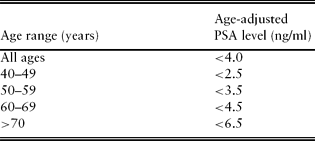
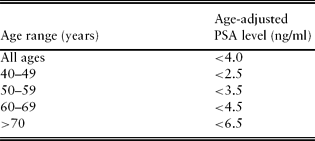
Chronic retention may generate back pressure on the kidneys, resulting in hydronephrosis and renal impairment. Serum creatinine should therefore always be checked. Prostate specific antigen (PSA) is an enzyme produced by the prostate: its role is to enable fertilization by liquefying the ejaculate. PSA is present in both benign and malignant cells. An elevated PSA is therefore not diagnostic for CaP. Equally, a normal PSA can exist in the presence of organ-confined CaP. Because PSA level is dependent on prostate volume and the prostate enlarges with age, age-adjusted values for PSA have been devised (see Table 1). Because of the implications of an elevated PSA level, testing it is not routinely recommended. PSA testing is undertaken only if the result would change management, taking other co-morbidities into account or following patient request, but then only after appropriate counselling.
Age-specific PSA reference ranges
Uroflowmetry and measurement of post-void residual urine
Uroflowmetry is a non-invasive method of assessing flow rate and can be combined with the abdominal ultrasound measurement of post-void residual (PVR) urine. Men with BOO have low maximum flow rates.Reference Reynard, Yang and Donovan10 However, there is considerable overlap of maximum flow rates in men with and without LUTS and a poor correlation with symptoms.Reference Reynard, Yang and Donovan10 Also, uroflowmetry cannot distinguish BOO from impaired bladder contractility as a cause for low flow rate.Reference Chancellor, Blaivas, Kaplan and Axelrod11 PVR can identify how well a patient empties their bladder. Whilst a PVR may be due to BOO, often it is the result of impaired detrusor contractility.Reference Abrams and Griffiths12
Pressure flow studies
Pressure flow studies (PFS) are invasive but remain the gold standard test to diagnose BOO. Urethral and rectal catheters are attached to pressure transducers. Detrusor pressure and flow are recorded as the patient voids into the flow meter. PFS should only be performed if accurate quantification of BOO and detrusor contractility are required, for example prior to surgery in men with a flow rate >10 ml/s or men over 80 years.Reference Abrams, Chapple, Khoury, Roehrborn and de la Rosette9
Trans-rectal ultrasound
Trans-rectal ultrasound (TRUS) of the prostate measures prostate volume and can identify abnormal areas suggestive of CaP. TRUS is not routinely used in the assessment of LUTS. When DRE or PSA are suspicious for CaP, TRUS guided biopsies of the prostate are taken for histological assessment if the diagnosis of CaP would change clinical management.
Imaging
The combination of a raised serum creatinine and LUTS is an indication for urinary tract imaging. Trans-abdominal ultrasound (TAUS) may identify hydronephrosis secondary to chronic retention. In some instances TAUS may reveal a bladder lesion causing LUTS and renal impairment secondary to ureteric obstruction. Such lesions require further investigation via more extensive radiological imaging and endoscopy.
Endoscopy
Endoscopy is not routinely performed in the assessment of LUTS. Occasionally however, LUTS may result from bladder stones or malignancy. Any patient with LUTS and suspicious symptoms such as haematuria or a positive urine dipstick for blood, requires endoscopic investigation.
Treatment for benign prostatic obstruction
Watchful waiting
If investigation suggests BPO, with no suspicious symptoms, normal renal function and no evidence of upper tract dilatation, then a number of treatment options are available. In patients with minor symptoms and little bother, watchful waiting is a sensible approach. A large proportion of patients managed with watchful waiting remain off treatment at long-term follow-up despite symptom severity.Reference Barry, Fowler, Bin, Pitts, Harris and Mulley13–Reference Thomas, Cannon, Bartlett, Ellis-Jones and Abrams15 Only 24% of over-55-year-olds treated with watchful waiting progress to surgery at 3 years.Reference Wasson, Reda, Bruskewitz, Elinson, Keller and Henderson16 The progression of LUTS, prostate growth and the development of complications is more likely in men with larger glands and PSA > 1.5 ng/ml.Reference Abrams, Chapple, Khoury, Roehrborn and de la Rosette9 Men treated with watchful waiting should be followed up yearly to review symptoms and symptom bother, and to ensure complications have not developed.
Medical treatment
In patients with bothersome symptoms, those who have not responded to watchful waiting or for whatever reason are not appropriate for surgery, drug therapy should be considered. The two main types of drug treatment for benign prostatic obstruction are α-adrenoceptor antagonists (α-blockers) and 5α reductase inhibitors (5αRIs).
Alpha blockers relax the smooth muscle of the bladder neck and prostate by blocking α-1 receptors. This has an immediate effect, allowing improvement in symptoms within weeks. The side-effects of α-blockers include weakness, dizziness, headache, postural hypotension and retrograde ejaculation. However, the newer α-1 subtype-selective blockers tamsulosin, doxazosin, terazosin and alfuzosin have fewer side-effects and improved tolerability.Reference Kirby and Pool17 Between 10 and 30% improvement in symptom scores and flow rate have been reported in men taking these newer drugs.Reference Lowe18 Despite this, approximately 50% of men stop taking an α-blocker within 3 years because of perceived lack of efficacy.Reference de la Rosette, Kortmann, Rossi, Sonke, Floratos and Kiemeney19
Benign and malignant prostatic cells replicate in response to dihydrotestosterone. 5αRIs block the conversion of testosterone to dihydrotestosterone, thereby shrinking the prostatic epithelium and reducing prostate volume. This takes months to occur and patients do not see an appreciable benefit until 3 months with dutasteride and 6 months with finasteride.Reference Roehrborn, Boyle, Nickel, Hoefner and Andriole20 However, with prolonged usage, lasting improvement in symptom scores and flow rate are observed, with the greatest effect in those with larger glands.Reference Andersen, Ekman and Wolf21, Reference Marberger22 In addition, finasteride decreases the risk of acute urinary retention and progression to surgical treatment.Reference McConnell, Bruskewitz and Walsh23 The side-effects of 5αRIs include loss of libido and impotence. There is little evidence to suggest an added benefit of combination therapy (alpha blockers plus 5ARI) to either drug alone.Reference Kirby, Roehrborn and Boyle24, Reference Debruyne, Jardin and Colloi25
A number of phyotherapeutic agents derived from plant extracts are available for the treatment of LUTS. Saw Palmetto (Seronoa repens) derived from the American dwarf palm includes 5αRI properties and is widely used in Europe. Whilst it has been shown to produce similar improvement in symptoms and flow rate as finasteride,Reference Wilt, Ishani, Stark, MacDonald, Lau and Mulrow26 a recent randomized trial showed that it was no more effective than placebo.Reference Bent, Kane and Shinohara27
Surgical treatment
For men with bothersome symptoms not improved by medical therapy, surgery is an option. Renal impairment secondary to chronic retention is an absolute indication for surgery or catheterization. Trans-urethral resection of the prostate (TURP) remains the gold standard treatment for BPO. Forty-one per cent of all TURPs performed in the UK from 2007 to 2008 were performed on men over 75 years. The mortality rate of TURP is less than 1% and the procedure can advantageously be performed under spinal anaesthesia in patients with co-morbidities not suitable for general anaesthesia. Possible complications include incontinence and retrograde ejaculation.Reference Rassweiler, Teber, Kuntz and Hofmann28 Open prostatectomy is more invasive, has an increased associated morbidity and mortality and is reserved for larger prostates, usually more than 100 cc (grams).
A number of alternatives to TURP have been developed, most involving either coagulative necrosis of the prostate or vapourization of prostatic tissue. Transurethral radiofrequency needle ablation (TUNA) involves the delivery of low-level radiofrequency to the prostate via a needle. The thermoablation produces coagulative necrosis within the prostate, reducing prostate volume whilst preventing damage to the urethra, rectum and bladder. Improvement in symptom scores, flow rate and PVR volumes have been reported.Reference Ramon, Lynch and Eardley29 Transurethral microwave thermotherapy (TUMT) delivers thermal microwave energy via an intraurethral catheter. A number of randomized trials comparing TUMT with TURP have reported similar subjective improvements for both treatments in the short term, greater complications with TURP, but less objective improvement and a higher re-operation rate with TUMT.Reference D'Ancona, Francisca, Witjes, Welling, Debruyne and De La Rosette30, Reference Hoffman, MacDonald, Monga and Wilt31 High-intensity focused ultrasound (HIFU) uses ultrasound beam via a trans-rectal probe to induce a temperature rise within the prostate. Whilst a modest improvement in flow rate and symptom scores is initially observed, this is not sustained in the long term and many patients require re-operation.Reference Madersbacher, Schatzl, Djavan, Stulnig and Marberger32 In a comparison of surgical methods of prostatectomy, HIFU did not perform as well as other less invasive procedures or TURP.Reference Schatzl, Madersbacher, Djavan, Lang and Marberger33
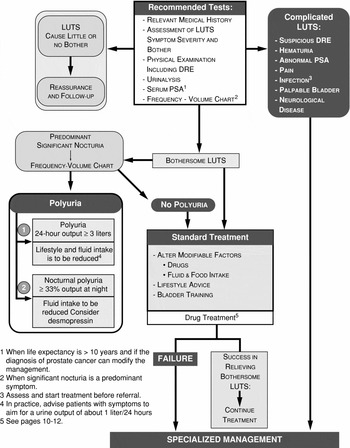
Laser heat has the advantage of producing rapid vapourization of prostatic tissue with minimal coagulation of underlying structures, whilst still maintaining adequate haemostasis. Potassium titanyl phosphate (KTP) laser vapourization of the prostate (also know as green light laser) and Holmium laser enucleation of the prostate (HoLEP) employ this method. Green light laser has the advantage of producing a bloodless operation and can be used in patients on anticoagulation.Reference Ruszat, Wyler and Forster34 It requires fewer blood transfusions, shorter post-treatment catheter times, fewer re-catheterizations and shorter hospital stay than TURPReference Horasanli, Silay, Altay, Tanriverdi, Sarica and Miroglu35, Reference Bouchier-Hayes, Anderson, Van Appledorn, Bugeja and Costello36 and open prostatectomy.Reference Alivizatos, Skolarikos and Chalikopoulos37 Improvement in symptom scores and flow rate in the short to medium term are reported, but long-term results are unavailable.Reference Naspro, Bachmann and Gilling38 HoLEP studies also report less bleeding, shorter catheter times and shorter hospital stays than TURP or open prostatectomy.Reference Naspro, Bachmann and Gilling38 Symptom scores and flow rates compare favourably with those having TURP.Reference Ahyai, Lehrich and Kuntz39, Reference Wilson, Gilling and Williams40 In randomized control studies of HoLEP vs. TURP the objective relief of BOO is similar, although in a randomized trial comparing TURP, green light laser and HoLEP, no difference in symptom scores, flow rate and PVR urine at 1 year between the three procedures was reported. Reduced blood loss, catheter time and hospital time in the laser and HoLEP groups was, however, observed.Reference Gupta, Sivaramakrishna, Kumar, Dogra and Seth41Figure 2 shows the International Scientific Committee of the 6th International Consultation on New Developments in Prostate Cancer and Prostate Diseases recently published recommended investigation and management of older men with LUTS.Reference Abrams, Chapple, Khoury, Roehrborn and de la Rosette9
Flow diagram to show the investigation and management of men with LUTS as recommended by the International Scientific Committee of the 6th International Consultation on New Developments in Prostate Cancer and Prostate Diseases. Reprinted from Journal of Urology, 2009, vol. 181, pp. 1779–1787, P Abrams, C Chapple, S Khoury, C Roehrborn and J de la Rosette, Evaluation and treatment of lower urinary tract symptoms in older men; with permission from Elsevier.

Treatment of prostate cancer
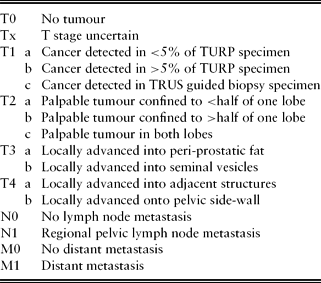
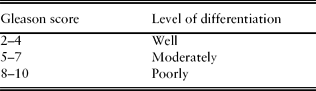
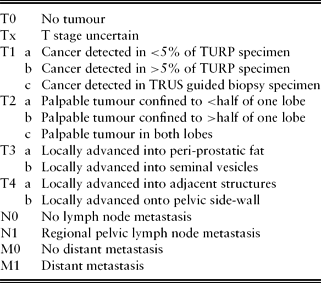
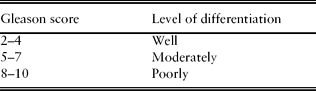
Treatment of CaP depends on patient age, patient preference, co-morbidities, clinical stage and histological grade. The TNM classification is used for staging (see Table 2). Histological grading is undertaken using Gleason grading. This system is applied to all TRUS guided needle biopsies and TURP resection specimens. In Gleason grading the level of gland differentiation is graded 1–5. The two dominant grades are added together, resulting in a score between 2 and 10. A level of differentiation is then attributed to the score (see Table 3). Treatment options differ for localized and metastatic CaP.
TNM staging for prostate cancer
Gleason score for histological grading of prostate cancer
Treatment of localized disease. In a number of men with localized disease, conservative treatment or active surveillance is a viable option.Reference George42 Primarily, men at any age with a low Gleason score (2–4), men with a life expectancy <10 years and a moderate Gleason score (5–6), or those with T1a disease and a normal PSA, are candidates for active surveillance.Reference Chodak, Thisted and Gerber43 The basis of active surveillance is that we now know that the majority of men will die with CaP rather than from CaP.Reference Albertsen, Hanley and Fine44 Men who opt for active surveillance undergo regular DRE, PSA testing and TRUS guided biopsies, but do not suffer the potential side-effects of other forms of treatment. Longitudinal follow-up studies are ongoing in the UK and elsewhere, to assess the long-term effects of active surveillance in comparison with other treatment options.
In men with a life expectancy >10 years and no serious co-morbidities, radical prostatectomy is the recommended treatment option. Radical prostatectomy can be performed as an open, laparoscopic and robotic-assisted laparoscopic procedure. Laparoscopic radical prostatectomy has the advantage of reduced bleeding, pain and faster recovery time. The popularity of robot-assisted surgery is growing fast, particularly in the USA, but it is currently available in only a few UK centres. Complications of radical prostatectomy include erectile dysfunction, incontinence and bladder neck stenosis. The majority of men will be continent and half will be potent 1 year post-operatively, with continuing improvement observed beyond 1 year.Reference Weldon, Tavel and Neuwirth45, Reference Stolzenburg, Rabenalt and Do46 There appears to be no difference in the return to baseline continence, erectile function and physical function at 1 year between open and laparoscopic approaches.Reference Dahl, Barry, McGovern, Chang, Walker-Corkery and McDougal47 Serum PSA is measured a few days post-operatively and then every 6 months. PSA < 0.1 ng/ml represents successful surgery.
External beam radiotherapy (EBRT) is suitable for men with localized CaP and a life expectancy >5 years. In those with a Gleason score >8 neo-adjuvant or adjuvant androgen therapy is administered. Serum PSA is checked regularly throughout the year following EBRT and should reach a nadir 18 months post-treatment. Side-effects of EBRT include radiation cystitis, radiation proctitis, erectile dysfunction and infertility, and therefore for some this may not be a tolerable treatment option. Fewer adverse effects are experienced with brachytherapy in which radioactive seeds are implanted into the prostate under ultrasound guidance.Reference Eckman, Ying, Hertzfeld, Kumar and Barrett48 This treatment option has the advantage of delivering low dose localized radiation to the prostate whilst limiting radiation to the surrounding tissues. Although the seeds are implanted permanently, almost all the radiation is released within the first 10 months. Brachytherapy is suitable for localized low risk disease (stage T1–2, Gleason < 6, PSA < 10) in men with a life expectancy >5 years. When compared with surgery, initial studies showed conflicting results in terms of disease-free survival;Reference Colberg, Decker, Khan, McKeon, Wilson and Peschel49, Reference Polascik, Pound, DeWeese and Walsh50 however, brachytherapy is still a relatively new procedure and adequate longitudinal randomized controlled trials are required.
Treatment of metastatic disease. Hormone therapy is the main stay of advanced (locally advanced but not metastatic) and metastatic CaP. Both benign and malignant prostate cells are dependent on testosterone for growth and undergo apoptosis in its absence. The aim of hormone therapy is therefore to reduce testosterone levels, resulting in androgen deprivation. Androgen deprivation produces a PSA reduction and clinical improvement in more than 70% of men. However, average time to disease progression after androgen deprivation is only 14 months. Only 25% of men with metastatic CaP are alive at 5 years.
Methods of androgen deprivation include bilateral orchidectomy, luteinising hormone releasing hormone (LHRH) agonists, oestrogen and anti-androgens. LHRH agonists used include goserelin (zoladex), leuprorelin (prostap), buserelin (suprefact) and triptorelin (decapeptyl). Administered monthly or three-monthly as intramuscular injections or subcutaneous implants into the abdomen, they provide an alternative to surgical bilateral orchidectomy. Initial induction of LHRH agonists produces a LH surge and rise in testosterone, resulting in a tumour flare and worsening of symptoms. A short course of anti-androgens is required before and after the first dose of LHRH agonists to prevent this. The anti-androgens bicalutamide (casodex), flutamide (drogenil) and cyproterone acetate (cyprostat) are currently available and are provided in tablet form. The side-effects of hormone therapy include loss of libido, erectile dysfunction, hot flushes, osteoporosis, tiredness, gynaecomastia, weight gain, muscle atrophy and mood changes. Oestrogens are rarely used nowadays due to significant cardiovascular side-effects, except in hormone refractory metastatic disease. Patients are said to have developed hormone refractory CaP when a consistent rise in PSA or symptomatic progression are observed during hormone therapy. In such patients treatment options include a change from LHRH agonists to anti-androgens or vice versa, or the initiation of both LHRH agonists and anti-androgens known as maximum androgen blockade (MAB). With further disease progression, treatment options become limited. Oestrogens, corticosteroids or chemotherapy may be offered but are often only appropriate in certain patients.
Conclusion
Benign and malignant prostate disease is common in older men. More than a third of men over 85 years seek medical advice for LUTS. In addition, a proportion of men seek reassurance that their LUTS are not the result of CaP. CaP is now the most common male cancer in the UK with over 35,000 new cases diagnosed each year. A methodological approach is required to identify urological from non-urological, and benign from malignant causes of LUTS. A number of treatment options are available for both benign and malignant prostate disease. In the older male, assessment of symptom bother, co-morbidities, potential side-effects and life expectancy should all be considered before initiating treatment.