

All kinds of peoples, previously marginalized in favor of the actions and thoughts of elite policy makers, now fill foreign relations histories. African Americans, Native Americans, Asian Americans, women, workers, and many others have been shown to be indispensable—if informal—diplomatic assets. And yet, diverse as this cast of characters has become, notice one thing they share in common: their adulthood. It is as if human experience with foreign affairs only begins with the age of majority. What might be gained once we appreciate the influence of young people, as both audience and agent, in the long history of America's entanglement with the wider world?
Children and adolescents, after all, are more present in the history of international affairs than might be suspected at first glance. They are hiding in plain sight. Imaginative scholars have begun to arrive at new and important insights by considering, in a more sustained manner, young people as an omnipresent audience for, object of, and even contributor to American foreign relations. There are tangible benefits to asking, as childhood studies scholar Sara Schwebel has, “What distortions of understanding have materialized because the lived experience and rhetorical deployment of childhood have not been scrutinized?” Interpretive dividends start to pay once we cease to treat young people as a silent minority, and instead recognize that for significant stretches of American history, people under the age of twenty have comprised a preponderance or a plurality of the population.Footnote 1
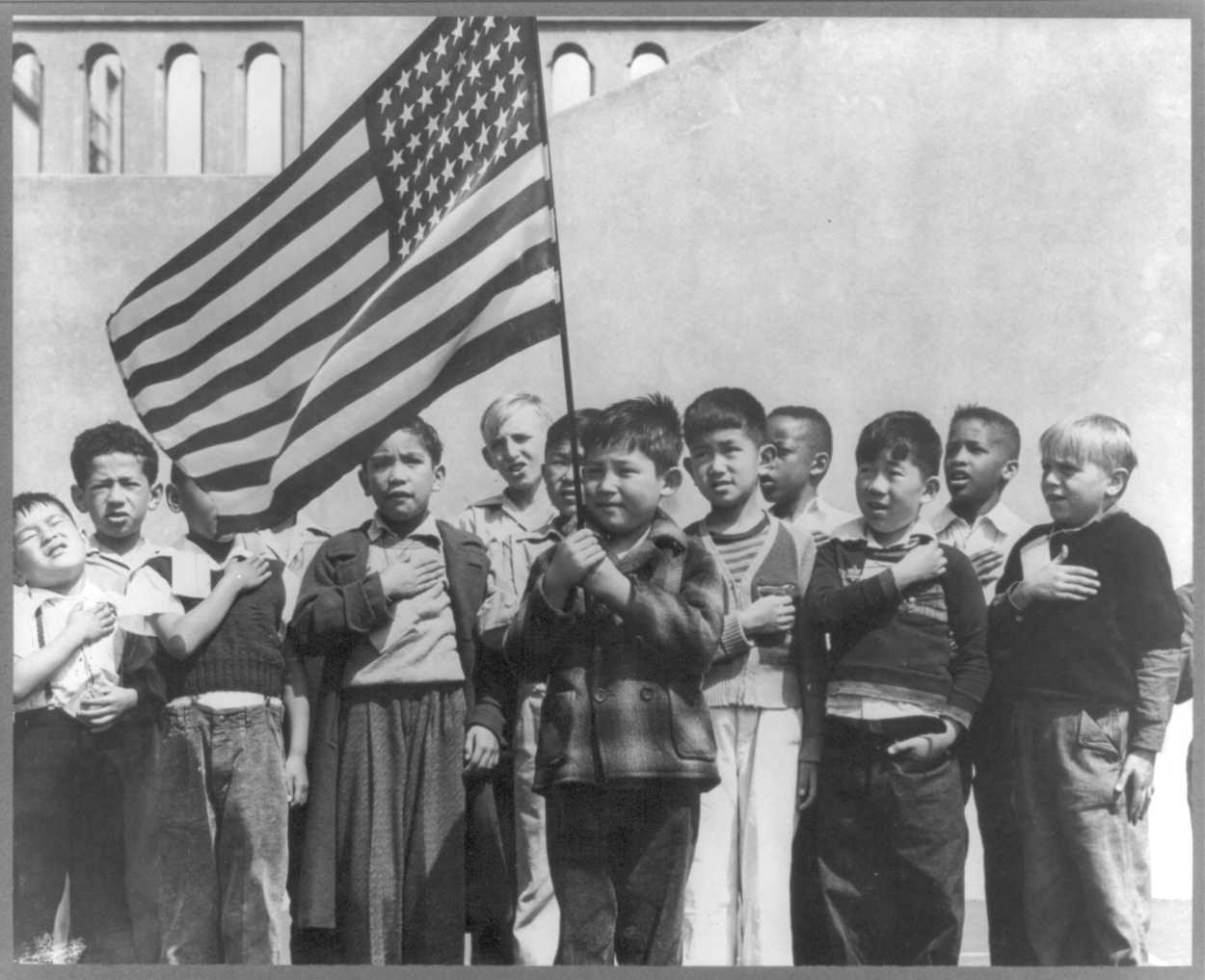
“War Evacuees Salute the Flag.” Children at San Francisco's Weill public school for international settlement perform patriotic exercises in 1942. The school operated as part of a larger War Relocation Authority effort to educate “foreign” children during World War II. Source: Library of Congress Prints and Photographs Division.

The following article aims to synthesize the arguments of specialists in the history of childhood, literature, and education as well as inspire more active collaboration and intellectual cross-fertilization between their fields and the history of the United States in the world. It will focus on three thematic factors. First, the article examines what children read as a measure of the embeddedness of internationalist and imperial discourse in the lives of the nation's youth. Second, it investigates the institutions (educational, recreational, and religious, to name a few) which grew to structure children's activities, and the ways in which, particularly during the twentieth century, adults sought to steer those organizations toward specific foreign policy ends. And, third, it looks at youth culture, which is to say, the lived experience of children, and the ways in which young people either embraced or rejected adult efforts to structure their perspectives on the wider world.
Ultimately, this article proposes that we view children, across the historical sweep of American foreign relations, not simply as “acted upon,” but rather as themselves actors. Doing so offers several benefits. The study of youths—and youth culture more broadly—aids our ability to comprehend how various assumptions regarding the rightful role of the United States in global affairs are either reproduced or altered across time. Young people have always developed new ways of seeing and engaging with the world that better reflected their own priorities, subtly and sometimes profoundly changing the nation's subsequent approach to foreign relations. “It is within children's cultures,” as Steven Mintz reminds us, “that new sensibilities evolve.” At moments when elders fail to satisfactorily explain the application of American power in the international arena to their successors, major shifts in policy have become possible. In ways we are only beginning to appreciate, generational distinctions, often cultivated by youths themselves, act as an important driver for fresh forms of diplomacy. When scholars of American foreign relations, broadly construed, pay closer attention to the history of childhood, they begin to find new types of transnational networks, discover varieties of international association they had not yet considered, and locate politics in hitherto unexpected places.Footnote 2
Children's Literature as Diplomatic Discourse
Laura Apol notes that “as a form of education and socialization, the literature written and published for children reveals a great deal about what adults wish children to know, to preserve, and to put into practice.” Indeed, all historians of childhood depend upon a version of this axiom as intellectual bedrock: words written for young people tell us much about the self-image of the culture which produces them. It would make sense, then, for scholars to scan the piles of printed matter read by young people to discover the basic principles Americans believed indispensable for furthering the nation's interests both domestically and abroad. Expansionist and imperial policies, after all, do not simply need to be promulgated; they need to be made generationally durable. Children's literature should be seen, in part, as a genre wherein adults have sought to manufacture juvenile consent regarding particular diplomatic initiatives. But it is a mistake to presume that authors held sway over a virtually captive youth audience. If publications are to succeed, juveniles must choose to find them palatable and worthy of perpetuation. And, moreover, the active correspondence between writers and youngsters reveals the important influence the latter exercised over published content.Footnote 3
Quantitatively speaking, no single subgenre of children's literature proved more popular than the Western. Even more remarkable than the sheer volume of material printed, however, has been the comparative lack of interest shown by scholars. But if we view U.S.–Indigenous relations and the long “War for the West” as the single most important driver of nineteenth-century diplomacy, it suddenly makes sense to see children's Westerns as core texts in the legitimization of settler colonial aims. Authors justified Americans’ expansionist impulses by portraying geographic growth as a gift to posterity, denouncing Indians as impediments to national progress, and attempting to enlist young people as the future stewards of territorial empire. Or, as one exemplary edition exclaimed, “many a young American” should extol “those brave men and women who drove out the savage from the Great West, and laid the foundations of that mighty empire, of which we Americans of to-day are so justly proud.”Footnote 4
Combat and conflict, more generally, has always been particularly generative of diplomatic discourse for children. Cheap periodicals sold to adolescents, such as the Starry Flag Weekly, The Boys’ World, or Our Army and Navy, drummed up support for American interventions in Cuba and the Philippines. Mass-produced series fiction outlined for young readers the contours of and larger stakes for the Great War. Popular pulp fiction like Edgar Rice Burroughs's Tarzan of the Apes (1912) helped to dramatize prevailing racial and civilizational discourse. Interwar publishers likewise encouraged a kind of “ludic imperialism” in American boys, which enabled them to see the world as a play space through which they would enact “symbolic conquest.” The Works Progress Administration (WPA) in turn hoped to stem the fascist tide by churning out reading material for young people which promoted democratic values.Footnote 5
Collectively, all of this material should be cited more regularly and examined more thoroughly by scholars seeking to shed light on the durability of imperial ideology and a broad-based acceptance of the United States as an arbiter in international affairs. It is telling that Edward Stratemeyer, children's author, progenitor of such household names as the Hardy Boys and Nancy Drew, and maybe the most prolific writer in American history, explicitly claimed that his books imparted “much the same message” as had been outlined by Secretary of State Richard Olney: that “the mission of this country is not merely to pose but to act [and] to forego no fitting opportunity to further the progress of civilization.” Even more important, however, was Stratemeyer's regular insistence that fan mail helped generate content for his stories. As young people wrote in to request more militarized or interventionist plotlines, the publishing firm's officers circulated memos enjoining empire in the company's output. In this sense, Stratemeyer was no puppet-master pulling the strings of the compliant masses. Rather, the demands of adolescents themselves helped to create a colonially inflected youth culture in the United States. Authors and audience united to mutually valorize empire after the War of 1898. The outward or externally oriented American state was built, in part, atop youthful ebullience.Footnote 6
Yet jingoes did not entirely control the conversation. Contrary impulses toward multilateralism, cosmopolitanism, and pacifism suffused certain corners of the children's literature market, particularly during the interwar years. Writing in opposition to the senseless slaughter of World War I, the rise of fascism in Europe, and the naked nativism that fueled the movement to restrict immigration, authors who subscribed to the so-called “cultural gifts” movement sought to build a better world by remaking the viewpoint of American youth. The growing class of Progressive-era child studies experts convinced many that the prejudices that produced war and racism were largely a product of youthful habits. Activists who found their arguments compelling sought to inculcate very different values in juvenile audiences. Childhood, as a concept, and children, as a cohort, were thus placed at the center of conversations meant to remake relations between states and the international order. Parents’ Magazine, one of the era's most widely circulated periodicals, and a proponent of this quest for education in the interest of international goodwill, characteristically claimed that “getting acquainted with children of other lands through travel and books can help build attitudes that will abolish war.”Footnote 7
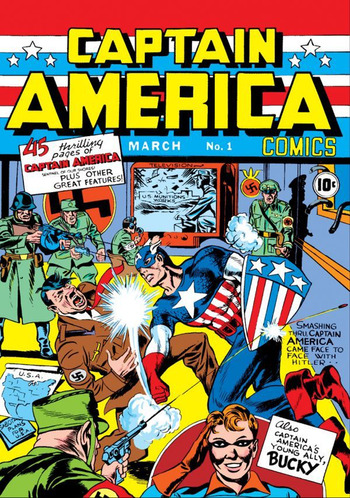
Comic books provide one of the more fascinating glimpses into how foreign policy programs were made palatable for young readers. Growing out of early-twentieth-century newspaper cartoons, they first appeared during the Depression and attained complete dominance of the youth literary market by 1950. Surveys conducted at that time both by the federal government and the industry itself revealed as much: an astonishing 95 percent of boys and 91 percent of girls aged six to eleven claimed to read comics regularly, and those figures dropped only slightly for those aged twelve to eighteen. Publisher's Weekly reported that, by 1953, Americans spent over $1 billion on comic books. The plots of those diverse publications—from superhero epics to high school romance—were rarely divorced from broader conversations about American engagement with the wider world, making the wildly popular genre essential to any understanding of children's engagement with international affairs. Indeed, the comic industry itself, accused of subversive messaging and communistic tendencies by groups from the American Legion and the Fraternal Order of Police to the House Un-American Activities Committee, often promoted an interventionist agenda to burnish its patriotic credentials. But such plot points were no mere cynical ploy. Big firms like Marvel and DC, as well as more niche outfits like EC and Quality, collected reams of market research as a means to understand their audience, and, at least through the Vietnam War, kids found fun in the country's growing global footprint.Footnote 8
Cover of Captain America Comics No. 1 (Marvel Comics, March 1941). By March 1941, months before the United States officially entered World War II, Captain America had already given the Axis powers a casus belli by knocking out Hitler.

While it would be a stretch to describe the comics business as an appendage of the federal government's propaganda machine, there can be no denying a close relationship between the two. Each found profit and purpose in the other. More important here, however, is the U.S. state's acknowledgment of young people as a crucial constituency in the explication and conduct of foreign affairs. Conscious efforts were made to politicize children's entertainment as part of an effort to purchase their loyalty and assent. During World War II, this involved direct appeals to children, asking for their participation in various bond sale or scrap collection drives. And with the rapid deterioration of U.S.–Soviet relations after 1945 and the onset of the Cold War, that impulse only increased. Hence Harry Truman's cameo in a 1950 volume of Fawcett Comics's Captain Marvel Adventures. The man from Missouri directly addressed the nation's boys and girls to announce that “the next half of the American Century, from 1950–2000, is yours! In your hands rests the fate of America, of democracy, and of freedom! It is a sacred trust!”Footnote 9
The idea was to assure young readers that they too were key players in the broader struggle against the forces of oppression, that children were soldiers in, as another publication put it, a “secret battle taking place … between communism and democracy for the youth of America.” Charlton Comics included a section called “Your Role in the Cold War” in each of its titles, which lauded an “American way of life that is without parallel in the civilized world.” And exhortations such as these were, of course, paired with portraits of Soviet villainy and Marxist machinations. Comic books often explicitly made the case for adventurism abroad. “Little Cold Warriors” avidly consumed popular culture, which, in Victoria Grieve's words, “socialized them into the new global balance of power” and “explained the role of the United States on new frontiers in Third World Nations.” The comic genre has even proven powerful enough to be adopted as an ideological weapon by the federal government. From the Cold War to the War on Terror, in-house writers at the CIA, state department, and defense department disseminated comics abroad as a means to win young hearts and minds to the nation's specific developmental and diplomatic aims. Since the War of 1898 at least, then, in both domestic and foreign spaces, diplomatic and military initiatives have assumed that winning children's allegiance is essential not only to securing peace but also perpetuating it across time.Footnote 10
But it is also important to acknowledge that while comics dominated the postwar children's literature market, they did not stand alone. Recent scholarship has pointed us in several new, exciting, and sometimes unexpected directions. Even the pages of imprints like Seventeen Magazine, historian Jennifer Helgren have shown us, bubbled over with references to the international obligations of American adolescents. Girls were asked to operate within their own diplomatic channels and spheres of influence to promote world peace. “You may be told that [international affairs] is a matter for the military or a highly specialized group of civilians,” one such editorial went, but “don't listen. You can understand; you can act.” By all accounts, readers responded enthusiastically, using the periodical as a springboard to spontaneous political organizing. Julia Mickenberg, meanwhile, discusses the home that many American communists and Popular Front “fellow travelers” found in the children's book industry. Self-described progressives who looked askance at what they believed to be the inherent imperialism and racism of U.S. foreign policy, these authors worked to produce printed matter that “challenged the culture of containment.” They consciously undermined a militarized and muscular foreign policy by emphasizing, in their stories, the virtues of peaceful coexistence. Historians of gender and postwar foreign relations in particular might also benefit from Mickenberg's insights, given her observation that “children's literature was a field controlled by women.” Women were mostly writing it, mostly teaching it, and mostly staffing the libraries that stocked it, meaning that those looking for female articulations of U.S. military and diplomatic obligations should engage more seriously with the era's juvenile reading lists. Of course, as Michelle Ann Abate chronicles, authors sympathetic to the New Right retaliated by publishing their own fair share of politically inflected children's literature.Footnote 11
The latter imprints, however, remain something of an outlier. By the 1960s, television came to replace children's literature as the medium most directly responsible for socializing young people regarding their obligations, as Americans, to the wider world. Curious silences, therefore, surround contentious foreign policy problems like the Vietnam War. Comic books, by that time, were already receding in popularity, and mostly refused to tackle the subject for fear of further alienating readers. Other adult-authored children's literature showed a similar hesitancy. Only very recently have niche publications begun to wrestle with the legacy of the conflict in Southeast Asia. In one somber story, a father and son travel to the Vietnam War Memorial in Washington, DC. Another features a young girl from Boston coming to grips with her brother's death on distant battlefields. Still more deal with Vietnamese immigrants fleeing their homeland following the U.S. withdrawal. The common thread running through these stories is an absence of the more celebratory rhetoric characterizing earlier juvenile literature. Only in the rarest of instances would young people's reading after the 1960s urge them to confidently project American values upon the world at large. New voices arose from within previously marginalized communities, and they often expressed skepticism regarding the exercise of national power both at home and abroad.Footnote 12
The Institutionalization of Children's Diplomacy
Reading material, however, is not the only place we might look to discover the ways that adults sought to solidify national foreign policy goals by ferrying them across the generational divide. So that they might “see” the world as their parents hoped—and become comfortable with the exercise of American power, particularly over “inferior” peoples—young people had to be reached in a variety of contexts: schools, youth organizations, churches, and other age-graded institutions, which increasingly structured the lives of little citizens after the late nineteenth century. Soon children often appeared as both the object of and rhetorical justification for any number of American diplomatic initiatives.
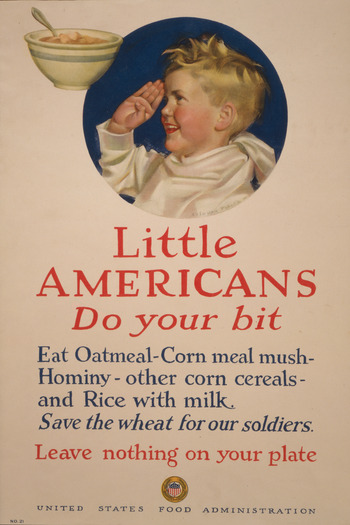
“Little Americans: Do Your Bit.” Many adults, and the U.S. state more particularly, saw children as an important constituency to mobilize in service of policy goals. Source: Library of Congress Prints and Photographs Division.

“It is to the little red school-house,” a 1901 observer of U.S. empire wrote, “that we must go to find the scepter of the American dominion.” Educational institutions, therefore, have been a focal point of much scholarship. Analysis of textbooks, for instance, has pointed toward their crucial role in legitimating “American economic power through empire-building projects both at home and abroad.” The preparations for future citizenship such publications offered were suffused with assertions regarding the fixity of racial hierarchies and the implicit benevolence of U.S. power. Also revealing, however, has been the sustained investigation into the construction of school infrastructure and the global dispersal of American educators. Both were essential to the legitimization of the nation's various imperial ventures.Footnote 13
Indian reservations, Native American boarding schools, Freedmen's Bureau districts, and other internal colonies have garnered the most attention from scholars, but good studies have also been conducted of pedagogical efforts in overseas territories or protectorates claimed by the United States. Similar-minded studies from the world wars and the Cold War era have revealed the persistence of this belief in Uncle Sam's role as an educator of children around the world. It was a firm conviction of this veritable army of teachers abroad that their efforts at uplift demonstrated the distinctly altruistic conduct of American diplomacy. Systematic educational efforts, under the auspices of reconstruction agencies or the Peace Corps, targeted children and would, so they supposed, prove far more effective in earning foreign allegiance than the bullets and bravado of European imperialists. Of course, as other historians have chronicled, good intentions did not guarantee unproblematic acceptance of these aims on the part of the colonized. Imperialistic educational institutions, despite their founders’ desires, often became incubators for subaltern solidarity and anticolonial protest.Footnote 14
Yet from the Progressive era to the present, a countervailing pedagogical movement sought to push back against militarized curricula. The National Education Association promoted instruction in world friendship. High school international exchanges and university study abroad programs proliferated (often at the behest of the state department). The American School Peace League saw social studies classrooms as opportunities to push global citizenship. High school cafeterias held “Bazaars of Nations,” where costumed children sold wares representing the artifacts of particular cultures. Children's International Summer Villages facilitated cross-cultural fellowship by allowing vacationing American students to host schoolchildren from around the world. Organizations orchestrated children's letter-writing campaigns aimed at top Soviet officials and pleading for peace. Margaret Peacock's recent investigation of ten-year-old Samantha Smith's correspondence with Yuri Andropov during the 1980s (and the subsequent media circus surrounding her trip to the Soviet Union) provides a particularly stirring example of the political dialogue that could be touched off by children. All of this was meant to encourage particular diplomatic outcomes: delegitimating U.S.-led interventionism in favor of internationalism.Footnote 15
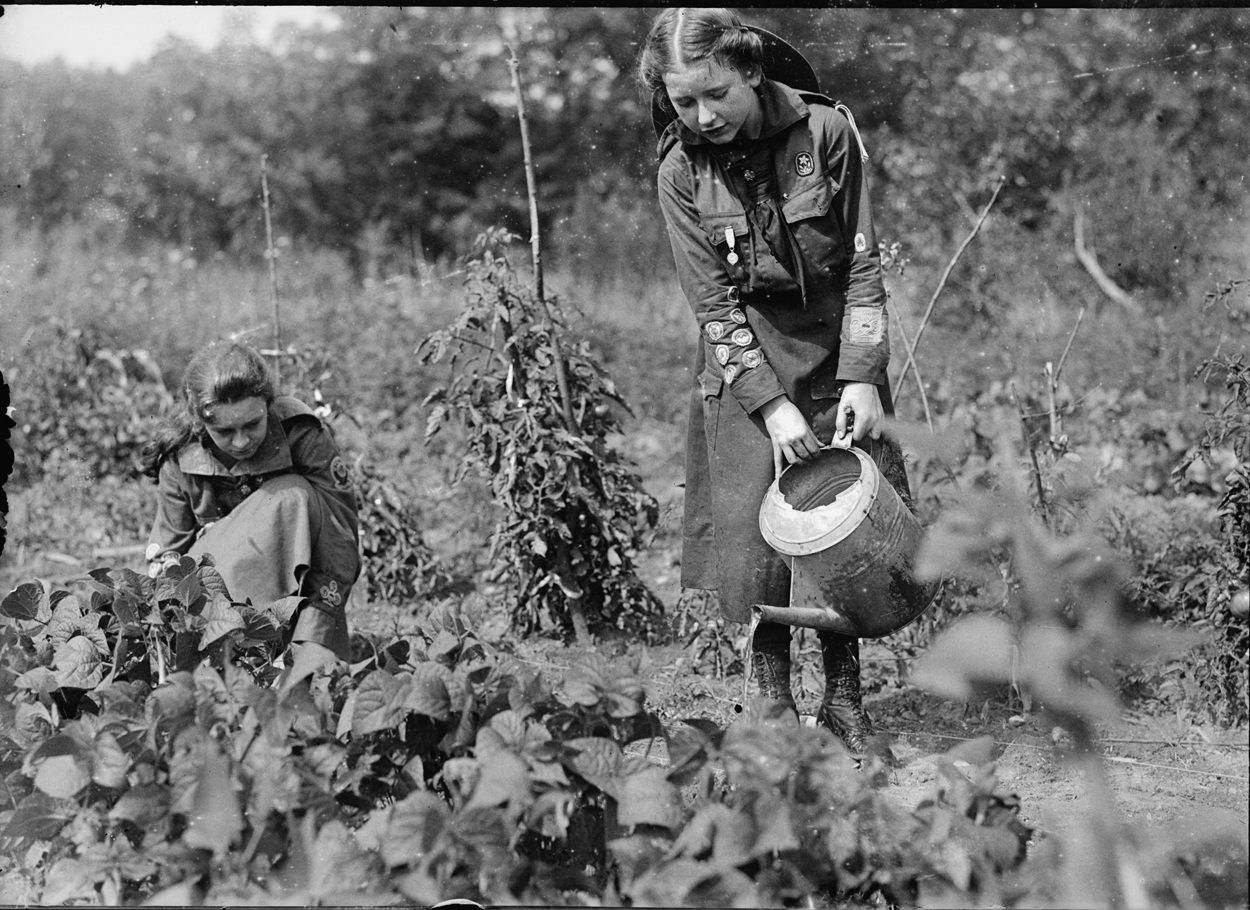
The dramatic expansion of schooling in the twentieth century also nurtured tighter peer bonds between similarly aged children. This, combined with a cultural preoccupation with the socially disruptive potential of unoccupied adolescents—delinquency, in other words—helped to fuel the formation of various organizations meant to structure and discipline young people's lives. During periods of international tumult and perceived national emergency, those associations could be harnessed as part of larger diplomatic imperatives. The lion's share of this scholarship has focused on the Boy Scouts of America, the Girl Scouts of the United States of America, and other closely related entities. Previously studied as indicative of domestic social currents, we now see the solidly international dimensions that fueled the dramatic growth and burgeoning influence of scouting (beginning with the fact that it was imported to the United States from Britain). Not only do troops now exist in hundreds of countries around the world, but, from very early on, the organizations erected platforms meant to promote cross-national fraternity. Jamborees and pen-palships fostered ties between children of different cultural backgrounds. Troops were founded in the Philippines, Puerto Rico, and other overseas regions touched by U.S. military installations, as a means to acclimatize people to indirect American rule. Scouts of various sexes and ages regularly participated in a variety of pledge drives, relief measures, and morale-boosting enterprises meant to promote particular foreign policy outcomes. In pamphlets and assembled at parade grounds, they were appealed to directly as quasi-diplomats, promoters of a global fellowship of boyhood and girlhood that would redeem the war-torn world. The Girl Scouts expressed it best by laying stress on “international friendship,” meant to “bring with it peace among all the people of one nation and all the peoples of the world.” Of course, as Mischa Honeck, Marcia Chatelain, and other scholars have keenly observed, young people did not always toe the official line. At multinational conferences, they pursued their own forms of intercultural engagement rooted in transgressive behavior scoutmasters found distasteful.Footnote 16
“Girl Scout Garden” (1917). Boy and Girl Scout troops regularly mobilized to meet national emergencies. Here, Washington, DC Girl Scouts tend a Victory Garden at the behest of the U.S. Food Administration. Source: Library of Congress Prints and Photographs Division.

Even as adults organized American children to serve as diplomatic auxiliaries, however, U.S. policy makers also increasingly set their sights on young people overseas as fit objects for rescue. Educational initiatives, as described above, were certainly a part of the equation. But youth-directed efforts proved far more diverse. There were several reasons why. First, the growing size and authority of the federal state meant that it began to assume a host of new responsibilities. As agents from the Children's Bureau (founded in 1912), the National Youth Administration (founded in 1935), and the White House Conference on Children and Youth (founded in 1909) intermingled with members of the state and war (later defense) departments, programs directed overseas began to take young people into account. When the United States joined the United Nations (UN)—with its many child-focused programs—these impulses were only fortified. Government agencies found that focusing on children provided both a more morally sound and politically useful justification for a number of policies. Complex initiatives were made palatable to the public if sold as “child saving” enterprises. Children were increasingly seen as icons of purity and innocence; harnessing their rhetorical power became one way for state and nonstate actors to justify U.S. ambitions overseas. Images of suffering children became a particularly potent means by which postwar Americans could be asked to care about human rights more broadly. Or, as Liisa Malkki notes, children, as avatars for “basic human goodness (and symbols of world harmony); as sufferers; as seers of truth; as ambassadors of peace; and as embodiments of the future,” do important political work.Footnote 17
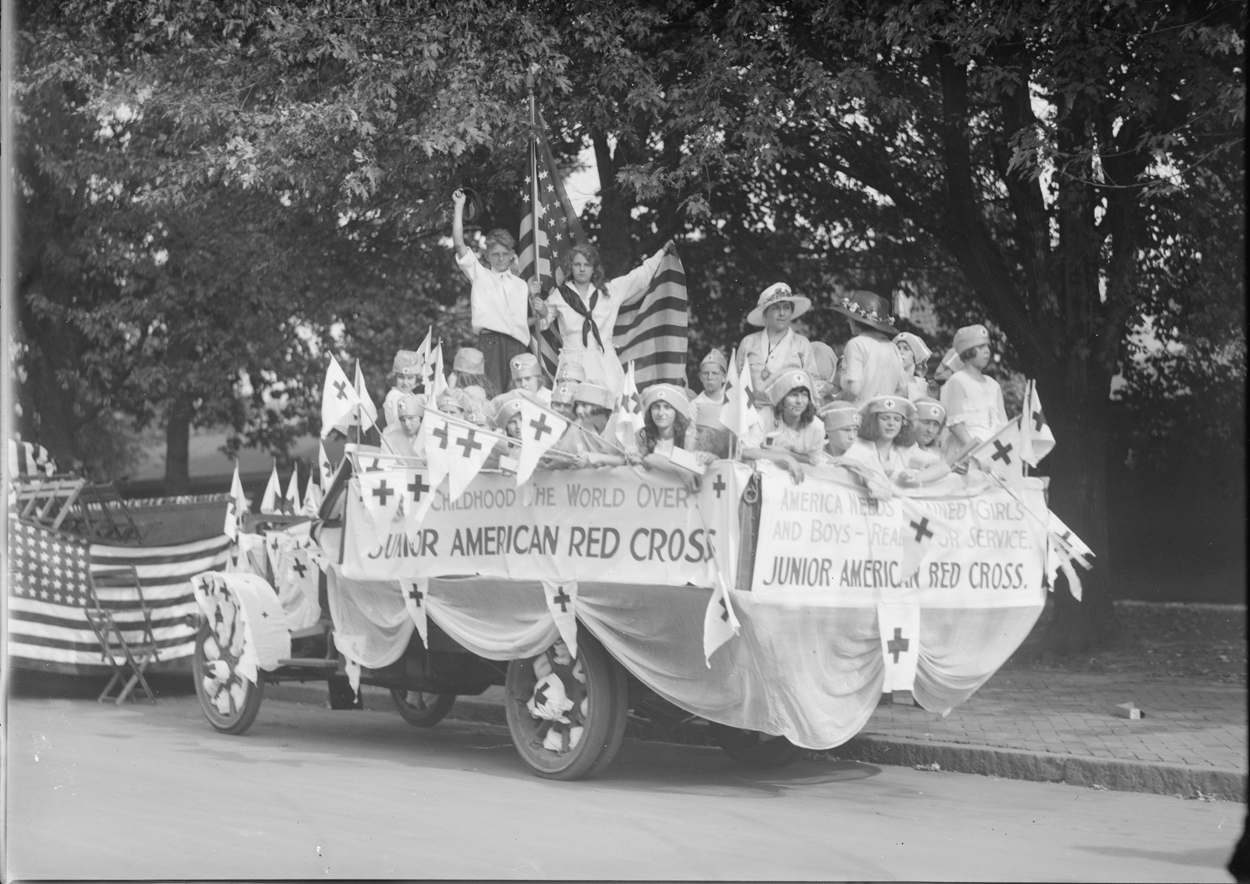
World War I acts as the departure point for much of the scholarship covering this phenomenon. Dominique Marshall, for instance, documents Herbert Hoover's herculean postwar relief efforts and his contributions to multiple international accords outlining basic legal protections for the world's youth. He “insisted that the love of parents for their children was a universal sentiment, one on which international collaboration could be established.” Thus his 1928 campaign's promise, that he would be the “Children's President,” came to be. One way to work around George Washington's injunction against foreign entanglements, Hoover and others found, was to claim that a task so noble as feeding, clothing, and caring for helpless children was fundamentally apolitical. Red Cross bodies such as the Bureau of Needy Children and the European Relief Council established transatlantic toeholds for American political and commercial interests under the banner of child welfare. Children aided by the United States, moreover, would, they assumed, grow up to become citizens more positively disposed toward a beneficent Uncle Sam. The organization's youth auxiliary, the Junior Red Cross, also mobilized American schoolchildren to raise money, collect food, and gather used clothing for their less fortunate peers overseas. As a result, U.S. children were thinking more globally, and asked to more regularly imagine their nation's role as both world policeman and planetary patron.Footnote 18
Missionary and religious organizations, though crucial actors in American foreign relations since the eighteenth century, also became more child-focused during the twentieth. The Student Volunteer Movement (1886) and Young People's Missionary Movement (1902), which shipped young Christian men and women around the world to spread the gospel, are perhaps the most famous examples. The Young Men's Christian Association (YMCA) also developed children's programming for its stations abroad. The National Council of Churches, representing twenty million congregants, bankrolled the Committee on World Friendship Among Children, which facilitated cultural contacts between young Americans and their counterparts around the world. Christian periodicals published for children, such as Everyland, worked explicitly to connect “our readers” with “boys and girls in the far-away countries of the world.” Organizations such as Youth for Christ called for a “Teenitiative” of junior evangelicals who would blanket the earth; “it's a younger world,” they implored, “a world that it will take young people to reach with the Gospel of Christ.” To do so would avert for developing nations the “danger of being buried in a Communist-dug grave.” An early president of the Youth for Christ organization—which deployed hundreds of teams of adolescent evangelicals overseas from the 1950s onward—called these efforts “the spiritual equivalent of the Marshall Plan.” Sara Moslener has examined Cold War fundamentalists and their campaigns to promote chastity, finding that for Billy Graham and others, youth “sexual morality was a crucial aspect of national security.” David Hollinger has deconstructed the importance of “mish kids,” the children of missionary couples who often lost their parents’ spiritual zeal but nevertheless become crucial actors in transnational ventures such as business, medicine, and education. Yet despite this tantalizing work, the religious dimension of American children in the wider world remains underexplored. Further research would surely bear fruit.Footnote 19
“Junior Red Cross Float in a Memorial Day Parade” (1923). Under the auspices of the Junior Red Cross, millions of American schoolchildren shipped care packages and correspondence to disadvantaged children around the globe. Acquaintanceships with the world's people were meant to produce peace, but the program also helped reinforce an international hierarchy, which placed the United States atop other “child-like” supplicant nations. As this float proclaims, American youths pledged to protect childhoods “the world over.” Source: Library of Congress Prints and Photographs Division.

World War II and the Cold War only accelerated these trends, particularly as relief agencies worked to reach European and Japanese youth as part of an effort to stave off the sort of complete societal collapse that might foster a communist takeover. Lynne Taylor, Tara Zahra, and others describe child-saving efforts in U.S. occupation zones throughout the European and Pacific theaters. Sara Fieldston writes eloquently about how child sponsorship agencies such as the Foster Parents’ Plan, the Save the Children Federation, and the Christian Children's Fund became strategic assets for the United States. The postwar department of agriculture's 4-H farming programs likewise “sustained transnational interactions between youth from abroad and youth in the United States.” As one aid administrator stated in 1947, “We are fighting a battle for freedom and democracy ourselves, even though our chosen weapons are food and shoes and overcoats and kindness.”Footnote 20
“New York Children's Colony” (1942). The New York Children's Colony was one of many institutions that worked to house, educate, and “Americanize” young World War II refugees evacuated to the United States. Here, a German boy reads the same Superman comics that were instilling in American kids a sense of their nation's growing global obligations. Source: Library of Congress Prints and Photographs Division.

Christina Klein, Karen Dubinsky, Arissa Oh, and others, meanwhile, point to international adoption as a key component of postwar U.S. efforts at containment in Europe, East Asia, and Latin America. Child rescue could move diplomatic mountains via what Lisa Cartwright calls a “transnational politics of pity.” Operation Christmas Kidlift hauled about 1,000 youngsters out of the Korean warzone in 1950. Operation Babylift evacuated many children out of South Vietnam after it collapsed in 1975. Operation Pedro Pan facilitated a mass exodus of Cuban children into the United States, with the help of the Catholic Church, the state department, and, allegedly, the CIA. Positioning the United States as a parent to the world's endangered youth became a powerful metaphor for the country's enhanced strategic obligations, even if it was often American intervention that created crises in the first place. The legacy of all these programs, however, seems mixed at best. Lives were undoubtedly saved, but accusations of kidnapping and abuse could also produce international discord.Footnote 21
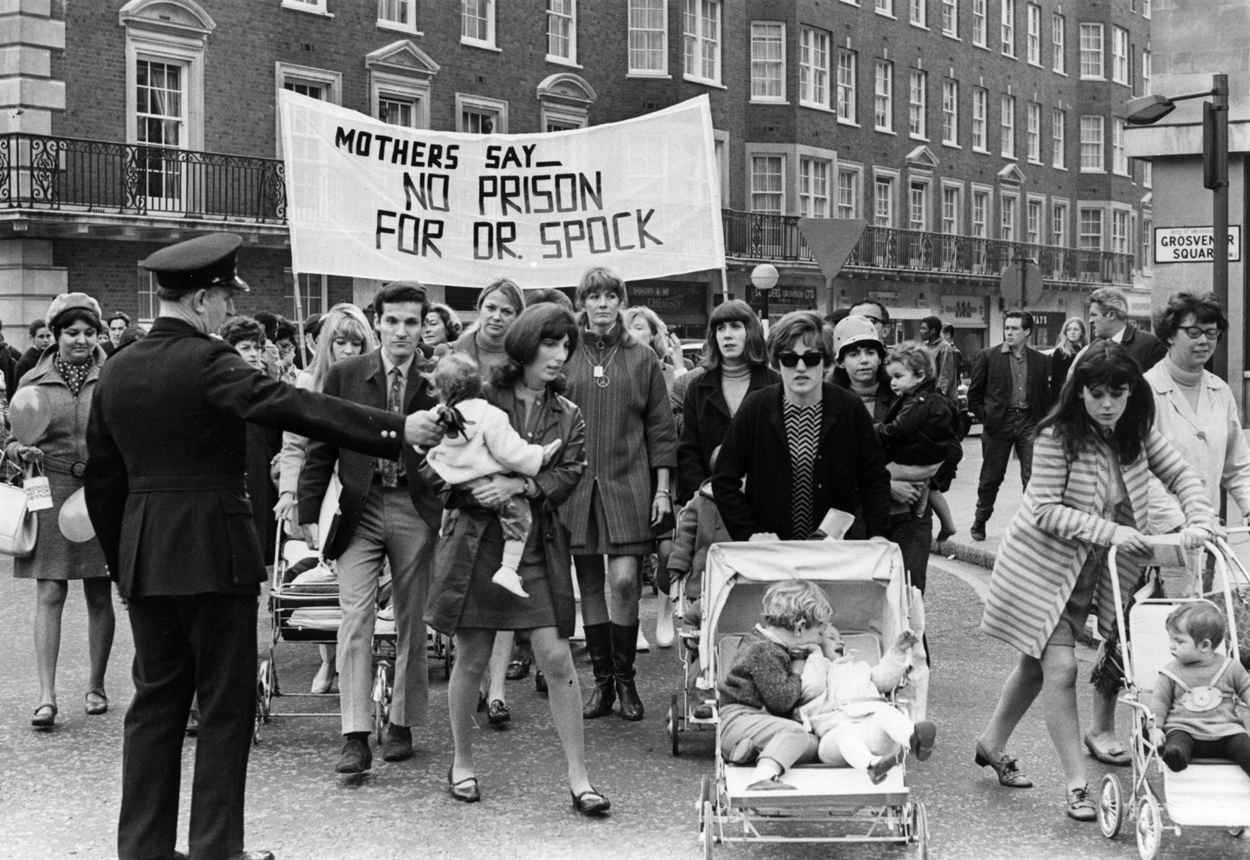
The Cold War has been particularly productive of historical narratives stressing an overlap between global anticommunist strategy and American children. After all, as historian Sharon Stephens states, policy makers believed that “winning the Cold War required not just the development of a vast nuclear arsenal” but also “the creation of strong and able children with clear political loyalties.” Many other scholars have built on that key insight regarding the nuclear family's centrality to foreign relations in the nuclear era and the “convergence of defense and domesticity.” Donna Alvah's examination of military households living on foreign bases pays particular attention to “service children's friendship with people overseas as a resonant metaphor for ideal relations between the United States and other nations.” Other scholars have examined the ways in which campaigns for nuclear divestment or an end to the Vietnam War—including those led by the immensely influential childcare expert Dr. Benjamin Spock—placed the welfare of children at the center of their demands. Even Disneyland can be reimagined as another brick in the national security state's edifice. Children attending the theme park had performed for them simplistic stories designed to contrast the moral superiority and abundance of the American way of life with the deficiencies and deprivation rampant elsewhere. But when taken together, all of this output helps place the contributions of fairly ordinary American homes closer to the center of foreign relations narratives. Building off the decades-old insights of Elaine Tyler May regarding the family as a kind of Cold War weapon, we should see that the diplomatic and the domestic were joined at the hip. The so-called American Century, defined by an activist foreign policy, was also commonly referred to as the Century of the Child, an era singularly focused on young people. Those two propositions can (and should) be placed into productive conversation.Footnote 22
“Mothers Say: No Prison for Dr. Spock.” Dr. Benjamin Spock wrote the Common Sense Book of Baby and Child Care, one of the best-selling books of all time. The state department even broadcast portions of the pediatrician's guide overseas to help families raise kids the proper, “American” way. But Spock also helped spearhead antiwar protests during the Vietnam War. Here, mothers and their children rally in support of him following his conviction for fomenting draft resistance. Many groups grounded their opposition to American foreign policy in its disastrousness for young people. Source: Library of Congress Prints and Photographs Division.

Juvenile Diplomats
Children's literature and child-centered institutions have clearly been important to the history of American foreign relations. But scholarship devoted to those subjects only allow us to speculate as to what effect, if any, these efforts had on children themselves. Published authors, organizational leaders, and statesmen were, after all, adults who could only aspire to shape the worldviews of their young audiences. Youths, however, rarely conform entirely to the wishes of their elders. Only kids themselves, therefore, can ultimately assess the effectiveness of grownup exertions. And therein lies what is, arguably, the subfield's core dilemma. We should think more about what children were saying and how they were responding to international affairs, and yet, their perspectives are extraordinarily difficult to extract from the archive. To put it plainly, how can we recover the agency of young people in the nation's diplomatic history? How do we find the voices of children themselves?Footnote 23
Correspondence of all kinds provides one possibility. Sitting in various archives, virtually untapped, lay the remains of the various letter-writing campaigns in which children participated. Presidential libraries hold thousands of missives to the chief executive from youngsters, and many of them touch upon issues that might interest scholars of American foreign relations. The same holds true of the official papers of other prominent political and diplomatic leaders. Particularly popular series fiction characters and comic book heroes, meanwhile, inspired kids to draft fan mail, and those letters often expressed nascent world outlooks; the young man who wrote to Iron Man to rebuke him that his disregard for international law might provoke World War III represents just one of thousands of informative primary sources.
And then, of course, there are the repositories of correspondence campaigns and pen-palships organized by youth organizations and set toward a variety of political ends. To name only a few, the Junior Red Cross, the American Field Service, Art for World Friendship, the Boy Scouts, the Girl Scouts, the Camp Fire Girls, the National Catholic Welfare Council, and the American Friends Service Committee all instituted transnational youth correspondence clubs and exchange programs. Even the government got on board, organizing the International Friendship League and the Children's Plea for Peace, as part of Eisenhower's People-to-People policy initiative. Later technological developments allowed for the appearance of similarly minded groups such as the World Tape Pals: thousands of kids in over sixty countries recorded and exchanged entire conversations. And the internet, of course, has remade this landscape in ways we are still attempting to appreciate. All of these efforts were backed by different groups and often geared toward divergent and even contradictory ends. Pacifists and hardened cold warriors alike saw potential benefits. But children themselves rarely stuck entirely to the script, and surveys of their own words might reveal diplomatic currents with the potential to run contrary to any era's dominant discourse.Footnote 24
Yearbooks, newspapers, and other periodicals, broadly speaking, also offer access to young people's views about transnational issues. They are imperfect sources, of course. Editors select and massage what they print. And adolescents often tailor their words in ways meant to please adult authority figures. But careful surveys of student-produced high school newspapers during the Cold War, for example, have revealed a good deal of depth and sophistication among teenagers trying to think through major foreign policy problems such as nuclear proliferation and Vietnam. College dailies and undergraduate-level political activists also spilled a good deal of ink over international affairs. Periodicals produced explicitly for juvenile audiences, meanwhile, frequently solicited and printed letters from their readers. They were rarely shy about expressing their opinions. The young Missourian who wrote Seventeen in 1947 to say that teenage girls often “thought beyond boys and clothes” and had opinions on “the world crisis, international relations, racial and religious tolerance and political affairs” suggests as much.Footnote 25
A particularly underexplored source is the amateur newspaper. Printed via tabletop toy presses by thousands of children of all ages in the nineteenth and twentieth centuries, these juvenile broadsheets circulated amongst friends and neighbors. Some of the material consisted of innocuous jokes, limericks, and short stories, but a surprising amount represented youth attempts to report and editorialize on major wars, immigration, race relations, and world events. We have only begun to scratch the surface of children's beliefs, conversations, and engagement with foreign relations in the public sphere but just beyond the adult domains that draw so much attention from scholars.Footnote 26
Other forms of childhood engagement with foreign relations and cross-cultural dialogue defy simple categorization. Multinational conferences, summer camps, protest groups, and organizations created by adults but functionally run by young people—such as the American Youth Congress, Youth and Government, Model UN, and the Encampment for Citizenship—all provided forums to engage in serious debate over international affairs. Extra-institutional youth “fads” or “crazes,” though difficult to pin down in the archives, also possessed implications for the history of the United States in the world. Richard Ivan Jobs's examination of young backpackers traveling through Cold War Europe comes to mind. So too does Raymond Patton's recent history on the transnational politics of punk rock, a youth movement that challenged authority behind the Iron Curtain and partly fueled the 1990s anti-globalization protests.Footnote 27
Play has likewise become a productive arena of inquiry. Games and toys have long shaped young people's developing understandings of the wider world. After World War II, lists for Santa Claus included Titan ICBM replicas, toy nuclear reactors, little lie detectors so that kids could “root out subversives,” and trading card games, such as “Children's Crusade Against Communism.” Toy drives organized to benefit kids in the developing world—premised on the idea that content and well-adjusted children provided “the best insurance against the warped mind that breeds the fanatic, the tyrant,” and in short, the communist—are also revealing. Oral histories might also provide interesting insight into twentieth-century practices, in the same way that historians of antebellum America have used WPA interviews to reconstruct the experiences of enslaved children. Joel P. Rhodes's recent studies of how growing up during the Vietnam Era affected the global outlook of Generation X provide models for such an approach. This wide-ranging scholarship is united in at least one respect: the presumption that “youth leaders were instrumental to ‘selling’”—or rejecting—“foreign policy.”Footnote 28
Growing Up
For all the worthy work that has been done, even more awaits. First, as this brief survey might suggest, the scholarship is still too monochromatic. Its sources mostly remain rooted in print culture, when children in larger and larger numbers “heard” foreign relations on the radio and “watched” it unfold at the drive-in or on television. Some solid studies of the postwar diplomatic context for phenomena like the B-movie creature features starring and marketed toward teens, Saturday-morning G.I. Joe cartoons, or video games exist, but much more could be done regarding broadcast media. Chronologically, meanwhile, studies tend to cluster around the Cold War. And demographically, white, middle- to upper-class children are overrepresented. Nonwhite perspectives, with some important exceptions, are largely absent from the story.Footnote 29
Such voices will inherently be harder to recover, but the efforts would provide an important contrast to “mainstream” youth thought. When, in 1920, a twelve-year-old black Philadelphian named Alice Martin wrote to the editors of a children's magazine sponsored by W. E. B. Du Bois to say that “sometimes in school I feel so badly” because the “geography lessons” that allowed her to learn “about the different people who live in the world” always made “the Africans … look so ugly,” something revealing was happening. “It made me so angry,” she said, but she also swore to “bend all of my efforts for the advancement of colored people.” Or, one might also consider the children's literature that sprung from the authorial collaboration between Langston Hughes and Arna Bontemps, a Haitian sharply critical of dollar diplomacy and the U.S. occupation of Hispaniola. While textbooks and other children's literature often worked to reinscribe racial hierarchies and neocolonial power relations, not all young people proved receptive to such messaging and some sought to create alternative understandings of the world's population.Footnote 30
Moreover, we need more insight into the impact of American foreign policies on children abroad, not to mention the ways in which choices made by families and young people overseas ended up shaping political and cultural outcomes in the United States. Some of the most important and influential critiques of American foreign policy, after all, have come from those afflicted by it while young. The now-unfolding drama over minors at the U.S.–Mexico border suggests as much, as does work detailing U.S. dealings with child soldiers abroad. It would be interesting to more thoroughly test, in a variety of contexts, the basic proposition of the nation's international child welfare workers after 1898: that young people around the world would experience an ascendant United States either as a benevolent or a malevolent force, and would grow into adulthood with one of those two formative ideas fixed in their minds. Youths overseas would need to be courted if the United States wished to exert global influence. Much of the scholarship, as it currently stands, deals with policy debate and diplomacy among American children themselves, but has much less to say about the experience of their counterparts in foreign contexts.Footnote 31
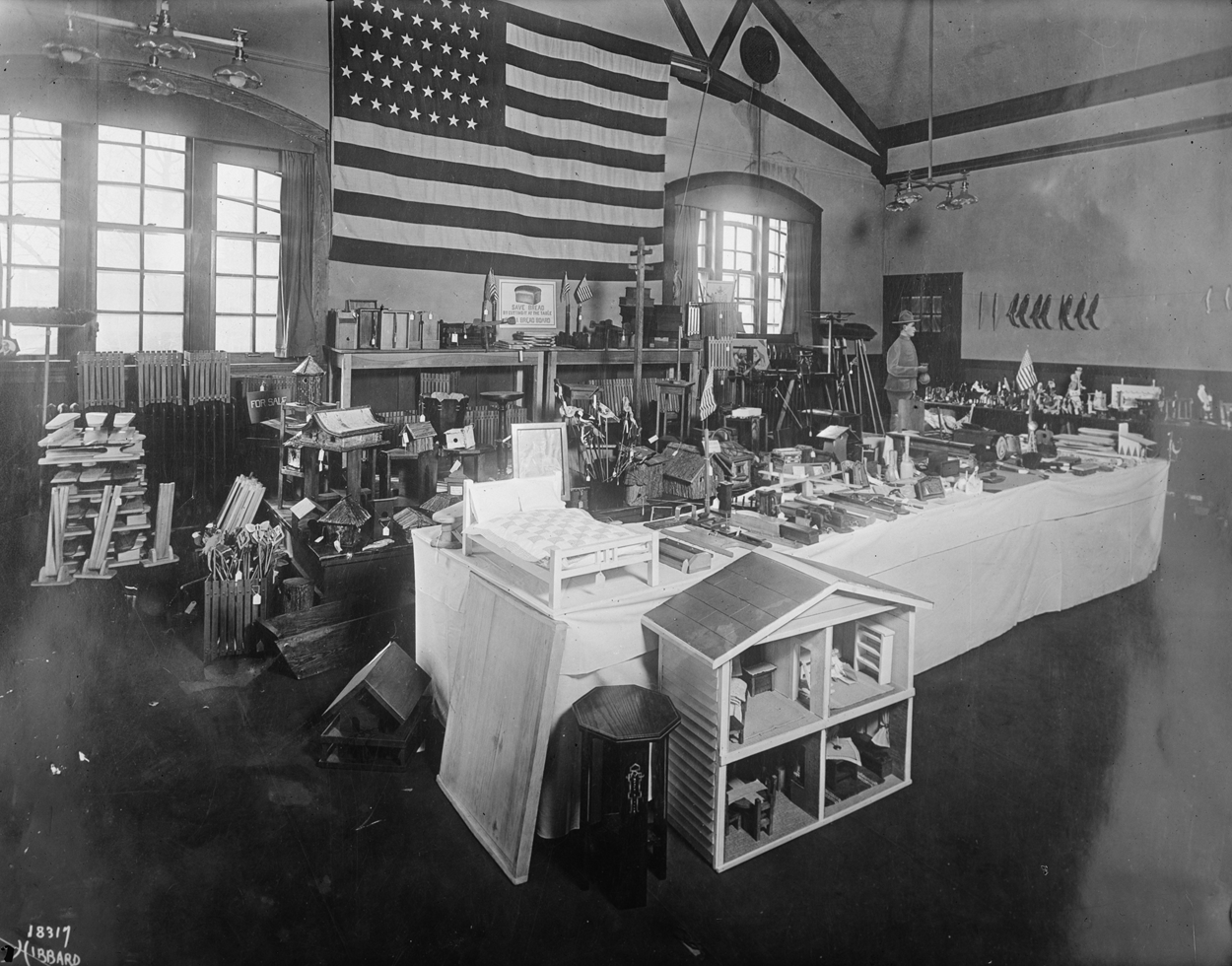
“Minneapolis Public School Bazaar” (1918). School children from around the United States helped build Christmas toys for disadvantaged youths overseas. Children in summer recreation camps operated by American NGOs reciprocated, and then shipped their creations to the United States as gifts for their benefactors. This was all one part of a much larger transnational matrix of children's exchanges during the twentieth century. Source: Library of Congress Prints and Photographs Division.

Finally, it seems worth noting the problem of conflating agency with resistance. There is a tendency among scholars to find young people as fully realized historical actors only in those moments where they actively worked to subvert or contest dominant social structures. We tend to be most fascinated with individuals who, for whatever set of reasons or motives, defied adult authority. The problem with this particular paradigm, however, is that it can overlook the crucial roles of consent and conformity in the replication of cultural norms, including those that govern understandings of the United States in the wider world. It is exceedingly rare for young people to offer anything like a full-throated challenge to the status quo and its grownup gatekeepers. Most youths ultimately aim to please their superiors in what is an age-based hierarchy; they are almost always rewarded for doing so and punished for failure. This is what Jessica Isaac has called the child's instinct toward compliance. But compliance should not be confused with unthinking obedience. Children's assent is its own form of agency. So, rather than fixating exclusively on youthful challenges to authority, we should work to understand how young people's choices to affirm and reproduce particular power structures is itself a phenomenon worthy of study. Many of the basic assumptions governing American foreign relations, broadly defined, represent the legacy of lessons learned (and willingly embraced) by young people working under their own auspices and toward their own agendas. Children, in fact, most often exercise power and shape the cultures in which they live largely by agreeing to ally themselves with adult desires. We should not fail, therefore, to deny them a say in their own history—even if they do not say what we might like to hear.Footnote 32
During the past 200 years, childhood in the western world has increasingly been seen as a developmental stage distinct from all others—a moment in life, many believe, that ought to be carefree and reserved almost exclusively for education and play. Children in the developed world have been, nearly universally, reimagined as emotional rather than material assets. In one of the most significant slow-motion revolutions in human history, virtually the entire cultural, economic, and legal architecture of our society has been altered to accommodate the rise of the sheltered child. It would seem only natural, then, to assume that such a sweeping transformation would have an impact on the conduct and history of American foreign relations. Important strides have already been taken to recognize this fact, and even more good work is in the pipeline. Yet with so much left to do, say, and explore, it can also safely be asserted that the intertwined histories of childhood and the United States in the world still have some growing up to do.Footnote 33