In the summer of 1820, near the headwaters of the Verdegris River, while they were trailblazing an overland return eastward from the Rocky Mountains and lost in the vast Arkansas Plains, three men deserted their commanding officer and the Stephen Long expedition party. These soldiers stole away on horseback, their saddlebags filled with stolen goods, incidentally including the various scientific journals of Thomas Say, a naturalist dispatched by the American Philosophical Society (APS) on what was labeled a “military and scientific expedition.” The journals likely included some of the meteorological tables ordered to be kept by the expedition.Footnote 1 These important materials, “utterly useless to the wretches who now possessed them,” Major Long wrote in his journal, “were probably thrown away upon the ocean of the prairie.” He went on to lament, “the labor of months was consigned to oblivion by these uneducated vandals”—these “worthless, indolent, and pusillanimous” deserters.Footnote 2
One can imagine the pages of meticulously recorded meteorological observations baking on the grassy plain, carefully inked numbers running together in the first rains to strike them. The Long Expedition—with its perils of route finding and desertion on what they famously termed the “Great American Desert” (what we now call the Great Plains)—exposes some of the challenges through which new spaces came to enter American government, territory, and science (Goetzmann Reference Goetzmann1966). For however much meteorological knowledge was successfully recorded, much was lost. Meteorologists faced tremendous difficulty in aligning a vast network of objects and interests—the vicarious weather, often inspiring poetic description more than disciplined measurement and numerical comparisons; the delicate instruments, inclined to break or lose calibration; variable forms of accounts by Natives, settlers, and traders; and the duties of underpaid troops prone to disease, drunkenness, and, in some cases, desertion, theft, and mutiny.
Indeed, both western lands and the weather came into view within scientific surveys and the journals of military missions during the early nineteenth century to be anything but conquered or remotely governable. Long's journal account, and the hopes of meteorologists in collecting new data from western lands, presents a picture of precarious wandering, not mastery. More than an isolated event, however, the Long Expedition desertions provide an illustrative entry point to a broader issue raised in this article: how the material and analytical challenges of knowing climate and crafting an expansive territorial state developed alongside one another within the early US context. By tracing this “coproduction” (cf. Jasanoff Reference Jasanoff2004) of climate knowledge and the state in the 1800–50 period, we can also develop broader insights into how climate knowledge operates as a practice of government in consistent ways, even though the configurations of knowledge claims, actors, and power change in different historical periods and contexts.
Historians of science (Feldman Reference Feldman, Frangsmyr, Heilbron and Rider1990; Fleming Reference Fleming1990, Reference Fleming1998) have primarily approached developments in nineteenth-century meteorology by emphasizing the mid-century as a period during which meteorology emerged as a bounded domain of scientific inquiry. Complete with standardized instruments, observational data networks, conventionalized methods, and theoretical controversies that superseded speculative dogma, the established narrative concludes, meteorology came to produce a more thoroughly scientific account of weather and circumscribed physical account of climate. Based on such a narrative of scientific progress, scholars have generally sought to explain how modern meteorology emerged from an “art” into a “science” (Harper Reference Harper2008: 1–2, 61) and how climate-change science proceeded through a logic of discovery, only later “breaking into politics” (Le Treut et al. Reference Le Treut and Solomon2007; Weart Reference Weart2008: 138). Yet such narratives remain incomplete, and we are left to wonder whether they adequately capture a possibly “impure” logic of climate knowledge, namely, a governmental one (cf. Epstein Reference Epstein1996).
To help explain key developments of nineteenth-century climate knowledge, the present article suggests we recover the impurity of climate as a category and reconstruct climate knowledge in terms of its governmental significance. As an analytic strategy, I conceptualize climate knowledge-state coproduction as a matter of meteorological government. I define meteorological government as a process by which climate knowledge develops in and through ways of constituting, categorizing, and calculating meteorological and social orders simultaneously. With this approach, three domains of statecraft emerge as significant to the dynamics of climate knowledge throughout the 1800–50 period: military-administrative concern with disease and discipline among soldiers and state agents; national-territorial expansion; and ideologies undergirding a “racial state” (Omi and Winant Reference Omi and Winant2015). In this article I link these respective domains to major developments in medical meteorology, meteorological statistics, and what I term “racial climatology.” I therefore trace how central efforts to advance climate knowledge articulated with strategies to govern, respectively, (1) soldiers’ bodies in a context of bureaucratization of the US Army; (2) western territories in a context of territorial acquisition and providential nationalism; and (3) a stratified population “legible” by biological understandings of racial difference and destiny.
The primary empirical contribution of a conceptual approach to meteorological government is to show how military discipline, expanding territoriality, and pre–Civil War racial politics were shaped by the progenitors of what is often characterized as a progressively bounded scientific field. A second contribution of the approach is to argue that climate knowledge may more broadly, in various contemporary and historical contexts, be situated relative to practices of government. The article concludes by suggesting that climate science and statecraft regarding global warming in recent decades signifies novel developments in meteorological government that preclude drawing neat boundaries between the logics of science and politics.
Science-State Coproduction and Meteorological Government
How is it possible to provide an alternative to approaches emphasizing progressive scientific autonomy, one that can problematize climate knowledge in relation to broader historical developments, especially state formation? As a conceptual point of departure, Foucault's (Reference Foucault, Burchell, Gordon and Miller1991, Reference Foucault and Burchell2008) historical analyses of governmentality inflect concerns with power and knowledge through a specific theory of “government” vis-à-vis the state, which informs how I understand meteorological government as a process that envelops the state-science relationship. Foucault argues that modern states were “governmentalized” through diverse historical processes in which political sovereignty was reflected in constituting, disciplining, and monitoring populations. Developments in technologies of surveillance, human sciences, and disciplinary institutions, Foucault explains, gave way to a biopolitical apparatus that aimed to order the dynamics of human life, chiefly through aggregation, categorization, and minute concern with the environs that control health, productivity, and normalized behavior. Although Foucault paid scant attention to climate (see Foucault Reference Foucault, Burchell, Gordon and Miller1991: 93–95; Reference Foucault and Burchell2004: 21–22), others (Golinski Reference Golinski, Delbourgo and Nicholas2008; Jankovic Reference Jankovic2000; Zilberstein Reference Zilberstein2016) have shown how achieving a productive and healthy population; “improving” climates to become more temperate and healthy; and advancing civilization as a climate-dependent process emerged as intertwined problems of government within eighteenth-century European and colonial contexts.
Yet it remains unclear how diffuse concern over climate, civilization, and improvement intersected (or “governmentalized”) US statecraft. To trace how elements of statecraft and science were coproduced through practices of meteorological government, I draw upon two major themes developed in existing scholarship—science-state coproduction and the imperial geographies of climate knowledge.
The first theme, developed among political sociologists and Science and Technology Studies scholars, regards the processes through which science and power constitute or interact through modern statecraft (Carroll Reference Carroll2006; Mukerji Reference Mukerji1997; Scott Reference Scott1998). These scholars challenge the relative inattention to science among state theorists. They also challenge histories of science that proceed asymmetrically, whereby scientific practices are reconstructed by emphasizing the development of reasoned truths, not the development of power. Jasanoff (Reference Jasanoff2004) organizes such analyses under a framework oriented to understanding the “coproduction” of science, society, and the state. A goal, within a coproduction framework, is to refrain from imposing a priori analytic boundaries onto historical formations and instead to evaluate, in Shapin and Shaffer's (Reference Shapin and Schaffer1985) terms, how “problems of knowledge” may have been settled in relation to “problems of social order.” Cast into view by this theoretical focus, it becomes clear that the governability of territories, state agents, subjects, and natural environments (including climates) is not given by nature, nor by force or command, but rather by projects diverse actors carry out to make relations between social and natural worlds “legible” (cf. Scott Reference Scott1998). Such legibility projects, as we might call them in the present case, entail both practical material relations and a specific analytic of government. As practical achievement, state power and meteorology both form material networks, the nodes and ties of which actors must struggle to align in the face of contingency or resistance, as the deserting soldiers, discussed in the preceding text, serve to illustrate. As an analytic of government, the category “climate” appears not as a feature of nature awaiting discovery but as a modality for governing populations, their environments, and their entwined trajectories.
A second relevant theme developed by cultural geographers and environmental historians (Golinski Reference Golinski, Delbourgo and Nicholas2008; Grove Reference Grove1995; Livingstone Reference Livingstone1991, Reference Livingstone2002; Mahony and Hulme Reference Mahony and Hulme2016; Zilberstein Reference Zilberstein2016) addresses how geographically expansive and socially stratifying forms of rule, especially colonialism, related to theories of climate. Such issues have been especially important to scholars of modern environmental thought and its articulation with British and French colonization in what many called the “torrid zone” of equatorial, tropical, and arid climates (Arnold Reference Arnold1996; Beattie et al. Reference Beattie, O'Gorman and Henry2014; Davis Reference Davis2016; Duncan Reference Duncan2007; Harrison Reference Harrison1999). These studies show how those who evaluated the “otherness” of such regions not only challenged deep-seated Enlightenment theories of global climate and human life but also served to advance climate discourse to differentiate, measure, and control territories and populations. This scholarship establishes that scientists and elites understood climate to strongly determine historical, physiological, and social developments. By elaborating the climatic character of social order, colonial officials and scientists effectively constructed European whiteness and civilization as something that must be anxiously protected (e.g., through “tropical medicine”), extended through a civilizing mission of “improvement” (Conklin Reference Conklin1997; Drayton Reference Drayton2000), or advanced through practices oriented to racial stratification or violence (Bashford Reference Bashford2004; Livingstone Reference Livingstone1991).
Apprehending or seeking to institute social and climatic order, what we are here labeling practices of meteorological government, is hardly reducible to colonial projects in specifically “torrid” or “tropical” spaces. Analysis of nineteenth-century US statecraft, not a focus among studies of colonialism and climate discourse in North America (Golinski Reference Golinski, Delbourgo and Nicholas2008; Kupperman Reference Kupperman1984; Zilberstein Reference Zilberstein2016), can contribute to the broader historical genealogy of meteorological government in two ways. The first is to show how meteorological government in the United States reflected practices developed in European and colonial contexts. Second, critical studies of climate governance in recent decades, although productively theorizing local and global scales in recent and historical contexts (Fleming et al. Reference Fleming, Janković and Coen2006; Jasanoff and Martello Reference Jasanoff and Martello2004), might be enhanced by investigating how climate knowledge is deployed through statecraft to govern climate-change impacts. Recent developments in climate-change “adaptation” and national securitization of climate-change impacts demonstrate Oels's (Reference Oels2005: 186) point that “the production of climate change is facilitated by a specific governmentality that renders it governable,” yet in ways that her focus on climate-change mitigation at the global level may not have anticipated. If the rise of global warming mitigation regimes has inspired genealogies of “global” knowledge (Coen Reference Coen2011; Mahony Reference Mahony2016; Miller Reference Miller and Jasanoff2004), then the rise of “adaptation” and securitization of climate-change impacts could inspire genealogies of what Baker (Reference Baker2017) has called the “climate state,” or what Parenti (Reference Parenti2014) more generically identifies as the “environment-making state” (see also Mahony Reference Mahony2014). Through a theorization of meteorological government, then, historical studies of climate and colonialism can contribute to largely separate efforts to critically analyze climate adaptation policies (Taylor Reference Taylor2014), the basic category of “climate” (Hulme Reference Hulme2008), and resurgent forms of climatic determinism (Livingstone Reference Livingstone2015).
War, Territory, and Race
As an empirical strategy for tracing the coproduction of climate knowledge and the state through meteorological government, I select three domains of statecraft—military-administrative order, territoriality, and racial stratification—that transformed the United States throughout the 1800–50 period and linked most significantly to climate knowledge. This strategy, if not providing a comprehensive view of US statecraft, nevertheless challenges claims, by Skowronek (Reference Skowronek1982) among others, that an American state is a product only of late-nineteenth-century industrialism.
Rather, the United States in the 1800–50 period presents an important case of state-science coproduction and of projects by various social actors to make legible populations and their environments. Particularly significant is a discourse of “civilization” that transected political and scientific efforts regarding the legibility of social progress in relation to natural order (Mazlish Reference Mazlish2004). Norbert Elias (Reference Elias2000 [1939]) famously argues that early modern state-formation proceeded through a diffuse “civilizing process,” yet in the US context, civilizing was endemic to political discourse. Indeed, many US revolutionaries and settlers believed the United States to be an originally civilized and enlightened polity, a governmental “city upon a hill” that many sought to reinforce on the axis of natural science.
Of course, US statecraft is reducible neither to a “civilizing” process nor a scientific program. Rather, as Mann (Reference Mann1993) and Tilly (Reference Tilly1990) emphasize, coercive power and war are critical in shaping state territoriality, bureaucratic expansion, and the capacity for state action to penetrate society. Here too, however, we can encounter science-state coproduction. The geopolitics of the US frontiers, complete with continental expansion and imperial wars, arguably marks the initial consolidation of US state power. In other words, those seeking to protect trade, settle new land, subjugate Native people, and control settlers and government agents, by the 1810s called for a formal military and a range of bureaucratic institutions to organize coercive powers. These powers, at the same time, served to integrate western land, peoples, and nature as governmental domains and in the form of a more diffuse, “civilizing” governmentality. Although it makes sense that scientific discourse would be significant to such statecraft, including both organizing various means of coercion and integrating a wider governmental apparatus, we know little about how climate knowledge developed in relation to statecraft in these terms.
The rise of a US territorial state, and the relationship to concurrent developments in science, moreover, is complicated by racial stratification in the antebellum period. As “Manifest Destiny,” territorial expansion represented a state-facilitated providential nationalism, upheld by a cultural frame of white superiority with officially sanctioned rights for whites to claim and exploit western lands (Horsman Reference Horsman1981). Contested issues of citizenship and political representation, in conjunction with a volatile politics of slavery, consolidated around a newly elaborated racial category of Anglo-Saxon whiteness. The American state emerged in this way as a “racial state,” anchored with symbolic power to naturalize hierarchy, often through appeals to political philosophies of citizenship rights and scientific defenses of racial order (Goldberg Reference Goldberg2002).
As already indicated, many scholars have pursued such elements of statecraft without any reference to meteorology or climate knowledge whatsoever, parallel to how most historical accounts of meteorology and related sciences in the United States have yet to coherently conceptualize state-making practices. A coproduction approach, however, suggests that such analyses may result in an incomplete account of important dynamics linking climate knowledge and statecraft. It is to these dynamics that we now turn.
Ordering Observations: Military Strategy and the Meteorological Register
At the turn of the nineteenth century the prospects of a national US state were unclear. Through the 1780s to the beginning of the nineteenth century, the United States remained highly fragmented along state lines. The Continental Army, formed during the American Revolution, had been almost entirely disbanded. Executive power was severely limited in its capacity to establish rule within the original thirteen states and their borderlands. Only after a series of wars with independent and foreign-backed Indian confederacies and, finally, the War of 1812 with Britain, did the United States establish a more permanent military-administrative bureaucracy through which to regulate its territories and wage national conflicts.
The administrative and military bureaucracy of the United States greatly expanded surrounding the War of 1812, to the great reluctance of many, including then president James Madison. In hastily mobilizing military and economic resources for waging the War of 1812, the Madison administration effectively reversed Democratic-Republican political commitments to a weak central state as it sought to build a national military, reestablish a Second National Bank, and expand taxation (Hickey and Clark Reference Hickey and Clark2016). After the war, military and administrative forces were further developed under President Monroe's Secretary of War, James C. Calhoun. These efforts largely proceeded in response to how poorly the War of 1812 had unfolded. Despite victories against Britain and allied Indian tribes, the number of casualties of war, primarily from disease, were unanticipated and totaled around 20,000 US soldiers. The security of border areas and territories in the face of Native tribes, imperial powers, and trading companies remained precarious, especially as US officials took advantage of the power vacuum left in the wake of British retreat and hastened land grabs and military advances against tribes on the southeast and northwest frontiers. These developments, by routinizing a level of military-administrative bureaucracy, extended the realm of federal government concerns.
Among these developments, the Military Reorganization Act of 1818 expanded the corps of the Army Medical Department, supervised by Army Surgeon-General James Tilton. Tilton, an army surgeon since the American Revolution, had ordered in 1814 that standardized meteorological observations be recorded at military posts. The network of observers was expanded alongside Secretary Calhoun's 1818 Reorganization and the appointment of Tilton's successor, Joseph Lovell, in the same year. Protecting the health of soldiers, especially those posted in unfamiliar and “insalubrious,” or inherently unhealthy, climates, was an eminent concern at a time when diseases appeared a worse enemy than Native tribes or competing powers.
The health of soldiers was an explicitly meteorological affair because health and disease were primarily demonstrated to be a matter of behavior within particular climates. For example, figure 1 presents a table based on army medical observations, in which “systems of climate,” once numerically represented, could be cross-tabulated by disease types, as presented within army hospital data.
Excerpt from Samuel Forry's Reference Forry1840 Statistical Report on the Sickness and Mortality of the US Army, page 172, cross-tabulating disease type by “systems of climate.”

In this context for understanding and treating disease, Army Surgeon Joseph Lovell's 1817 report, “Remarks on the Sick Report of the Northern Division,” amounted to a treatise on military-medical reorganization in light of the perils of hasty, undisciplined, and disease-ridden warfare. It demonstrates that developing a national military, especially in the broader nationalist context of post-1814 American politics, articulated directly with physicians’ concerns over climate-based disease etiology and over how to organize the medical profession within the War Department.
Because Lovell organized the first central collection of US meteorological statistics, it is worth reconstructing his work in some detail. Initially, he decried the underutilized expertise of the army surgeon, a strategy that proved successful in later securing his tenure as army surgeon-general:
It is from a knowledge of minutiae. . .that the experienced officer and surgeon becomes so much superior to the undisciplined recruit. It is almost entirely in order to acquire this kind of knowledge, that a military establishment is kept up in time of peace, and it is an undoubted fact that in no department of the army is it so slowly acquired and therefore so deficient as the medical. (Lovell Reference Lovell and Brown1873 [1817]: 105)
Noting the failure of the military to keep soldiers healthy, alive, and disciplined during the War of 1812—a failure “too well and too publickly known to need comment”—he called for regulatory reforms and an expansion of military medicine. “It is therefore suggested,” he claimed, “whether such alterations be not required in the regulations, as are calculated to produce a system of medical police” (ibid.: 104–5). It is precisely this system that he later instituted to govern the training, appointment, and monitoring of military physicians; their military hospitals and posts; and the bodies and behavior of soldiers.
A policy of “medical police,” present in European military-medical departments influenced by German physician Johann Frank's (Reference Frank1976 [1799]) A System of Complete Medical Police, became increasingly popular among physicians’ societies in the United States around the time of Lovell's appointment as surgeon-general. Medical policing was an appeal by physicians for government intervention into the regulation of unruly subjects and their environments, especially through hygiene laws and regulations of the medical profession. As Abbott (Reference Abbott2005) discusses in a later period using the case of medical licensing, a discourse of medical police served as a “hinge,” linking the logics of medical professional reformers with an emerging national military bureaucracy.
What, therefore, was the aim of medical policing? As Lovell (Reference Lovell and Brown1873 [1817]: 104) outlined, medical police were to be “best calculated to remedy the evil” of disease, considered chiefly as “the effect of climate.” Referring again to mortality during the War of 1812, he emphasized: “It must have been the climate—the weather—that produced the mischief” (103). Although espousing widely held claims linking climate and disease, Lovell was in a unique position to carry this concern into the realm of federal government policy. He thereby worked to incorporate mischievous climates into the government of military bodies and US territories. On this basis, Lovell (106) instructed,
It should be made the duty of every surgeon, together with his quarterly report to transmit an account of the local situation of his station, of the climate, the diseases most prevalent in the vicinity, and their probable causes, the state of the weather during the time reported with respect to temperature, winds, rain, etc.
Through such reports, later compiled within Meteorological Registers, army surgeons would “be enabled to give such an account of the diseases that had occurred, their causes and his treatment, as would be the best possible criterion not only of his medical abilities, but also of his industry and attention to duty” (ibid.). In other words, through the meteorological register, climate, soldiers, and the “industry” of officers could be centrally evaluated and, to use Lovell's terms, policed accordingly. In this way, meteorological knowledge in the form of a stable observational network was coproduced with urgent governmental efforts to regulate relations between soldiers’ bodies, officer duties, and the potentially disruptive forces of climate, especially at frontier military posts.
Lovell's scientific developments combined a meteorological and disciplinary gaze toward soldiers in their relations with allegedly unhealthy climates and dangerously unregulated behaviors. This approach was novel in its formality in the US context, but reminiscent of the prior history of military meteorology with which, as an army physician, Lovell was familiar. US officials concerned with military discipline and strategy in unknown or allegedly unfit climates borrowed from the lessons previously learned through British military medicine, especially the work of Sir John Pringle (Reference Pringle1753) and colonial medicine in the tropics.Footnote 3 British Army surgeon Robert Jackson (Reference Jackson1795), as just one example, outlined the culture and customs that comprise the proper soldier-climate relationship. He rejected the widespread belief that “European constitutions” were incapable of safely pursuing hard labor in “hot climates,” and instead argued that soldiers were susceptible to the climatic causes of diseases because of their poor moral situation.
The solution for Jackson (Reference Jackson1795) to the problem of dying armies was to monitor soldier behavior and institute medical discipline, much like that sought by Lovell decades later and by hygiene reformers in other contexts (Arnold Reference Arnold1996; Bashford Reference Bashford2004; Livingstone Reference Livingstone2002). “It is known to every medical person,” Jackson (Reference Jackson1795: 260) explained, “that the fevers of hot climates are most dangerous in full and plethoric habits.” However, because “soldiers have little self-command, and seldom resist the gratification of their appetites,” Jackson (Ibid.) directed officers toward practices of “great vigilance and attention,” including the daily inspection of meals and of sleeping, drinking, clothing, sexual habits, and exercise regimens. Jackson (Reference Jackson1795: 280–81) thereby rejected a policy of making “people of color do the drudgery of soldiers,” reasoning that indolence would only further degrade the moral constitutions of European soldiers. In other words, proper surveillance and discipline would mold the constitutions of European soldiers and secure a successful colonial policy in the region, the inherent unhealthiness of the climate notwithstanding.
Likewise, for the United States, on the eve of instituting military bureaucracy and imperial-continental ambitions, climate knowledge moved into the military body, onto the frontiers, and only through this process began to stabilize as a national form of knowledge. In September 1818, just months after publishing “Remarks on the Sick Report of the Northern Division” and subsequently being appointed surgeon-general, Lovell issued “Regulations of the Medical Department.” These regulations outlined bureaucratic roles and procedures aimed toward systematically examining “the diary of the weather, medical topography of the station or hospital, account of the climate, complaints prevalent in the vicinity, etc, [and] suitable inquiries concerning the clothing, subsistence, quarters, etc., of the soldiers” (Lovell Reference Lovell and Brown1873 [1818]: 111, 114). Although his orders were not always followed, they were more successful than calls in the decades prior for coordinated systems of meteorological observation, including parallel efforts by the General Land Office. By the standards of meteorologists and physicians at the time, Lovell's meteorological network provided a novel basis for evaluating the nature of American climate-disease relations and their governmental apprehension.
After Tilton and Lovell's initial struggles to order regular collection of meteorological data, army physicians continued to succeed at building the first national network of meteorological observations. Beyond pointing historically to the War of 1812, or in Tilton's (Reference Tilton1813 [1781]) case the debacle that was military life during the American Revolution, medical and military meteorologists expanded their range of concerns. Meteorological knowledge, first, could solve outstanding debates about allegedly ongoing climate change and its relationship to the civilizing practices of white Europeans. Second, meteorological networks could provide the basis of a “medical geography” of western lands, which could evaluate not only the health of military posts but also the health of lands for white settlement (Cassedy Reference Cassedy1986; Dorn Reference Dorn2001; Valencius Reference Valencius2002).
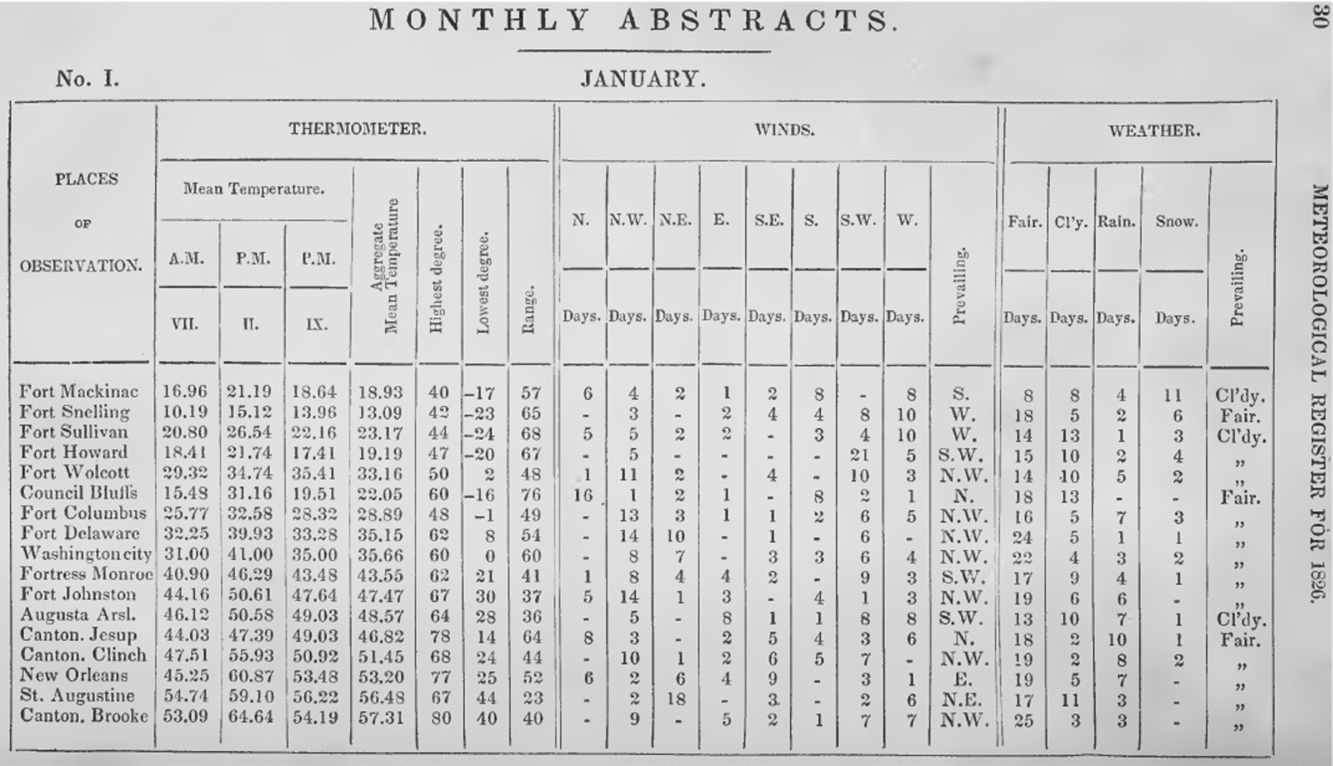
These issues clearly frame the first Army Medical Meteorological Register (see figure 2), based on observations submitted to the surgeon-general's office. These registers were widely circulated and cited among US and European meteorologists and physicians and were updated periodically even as other meteorological centers were also established (Lawson Reference Lawson1844).Footnote 4
Excerpt from Joseph Lovell's Reference Lovell1826 Meteorological Register, as reprinted in Lawson (Reference Lawson1840: 32).

The opening lines of Lovell's (Reference Lovell1826: 3) first Meteorological Register link the problem of medical meteorology directly to the active concern that American climates may be changing—a process widely held to impact the health and future habitability of certain areas:
On the question whether in a series of years there be any material change in the climate of a given district of country and if so, how far it depends upon cultivation of the soil, density of population, etc., the most contradictory opinions have been advanced.
US expansion into the uncivilized West, he continued, presented a unique “opportunity” to evaluate possible climate changes wrought by land clearing and related practices in the eastern United States. This opportunity, for Lovell, was a relatively urgent matter. Because of increasing white settlement throughout the 1820s, he claimed that the chance to establish the degree of climate change in civilized regions, “like that for recording the [customs] of the aborigines of the country, is fast passing away” (ibid.). He reasoned that “both these sons of the forest and the interminable wilderness they inhabited will, for all useful purposes, be as though they had never been.” Considering his results uncertain, however, Lovell argued that only a longer series of observations would help “ascertain what changes, if any, have taken place, either in the mean temperature, the range of the thermometer, the course of the winds, or the weather, in the Atlantic States” (4).
Lovell remained inconclusive on the point of civilization and its effects on climate, leading others to advance the controversy, as I discuss in the following text. Nevertheless, Lovell successfully reorganized the medical-meteorological bureaucracy within the War Department. Despite his reluctance to proclaim closure to controversies over climate change, and despite the fact that his programs were implemented inconsistently and his office even nearly abolished in 1830 (Gillett Reference Gillett1987: 27–52), those who followed him continued to pursue military meteorology in terms of climate dynamics, disease causation, and medical policing. Lovell established that meteorological data was a critical aspect of policing unruly subjects and securing the habitability of areas, especially along the frontiers. Although previous generations had attempted to construct stable meteorological observation networks, Lovell succeeded within the Army Medical Department by linking issues of meteorological observation to state-making strategies.
Territorial Exploration and Mapping Climatic Futures
Beyond issues of military medicine and administration, climate knowledge was also coproduced with the practices and analytics of government undergirding US territorial exploration and expansion. We begin such an inquiry on June 20, 1803, around the time Joseph Lovell was just beginning his education at Harvard College and when the Louisiana Purchase was being negotiated in France. On this date President Thomas Jefferson sent detailed instructions to Captain Meriwether Lewis as he and the Army Corps of Discovery prepared for their surveying campaign in the soon-to-be-purchased territory. Jefferson's instructions to Lewis make clear that projects to extend governmental order and “the Empire of liberty,” to use Jefferson's (Reference Jefferson1780) earlier terms, were to include not only topographical information but also “civilizing” interventions:
Considering the interest which every nation has in extending and strengthening the authority of reason and justice among the people around them, it will be useful to acquire what knowledge you can of the state of morality, religion, and information among [Indians], as it may better enable those who may endeavor to civilize and instruct them, to adapt their measures to the existing notions and practices of those on whom they are to operate. (Jefferson Reference Jefferson1803)
Civilizing in these terms meant to “instruct” and “operate” through “acquiring knowledge.”Footnote 5 However, for Jefferson and scientists broadly speaking, the prospects of civilization, like the health and discipline of soldiers, was partly a climatological issue. Jefferson and his contemporaries widely agreed that civilizational trajectories were climate dependent (Golinski Reference Golinski, Delbourgo and Nicholas2008). In Notes on the State of Virginia, Jefferson (Reference Jefferson1794 [1785]) argued that climates in eastern lands were changing because of cultivation, at the same time rejecting critics who argued American climates were degenerating, not improving, the relationship between climate and civilization. Jefferson pursued related concerns within the APS and, during the time of Lewis and Clark's expedition, with the visiting naturalist Alexander von Humboldt.Footnote 6
Concerned with the historical and possible future relations between atmospheric and civilizational orders, the expedition sought to institute a meteorological gaze over vast unknown areas of the continent. Jefferson (Reference Jefferson1803) therefore instructed Lewis to record all encounters with “climate, as characterized by the thermometer, by the proportion of rainy, cloudy, & clear days, by lightening, hail, snow, ice, by the access & recess of frost, by the winds prevailing at different seasons” and other factors. Historians (Kovarsky Reference Kovarsky2014) have emphasized Jefferson's position as a philosopher-statesman with a background in geographic surveying to help explain the meticulously planned scientific mission of the expedition and his concern over American climate change. However, expanding the frontiers through military, geographic, and meteorological intelligence was less about individual ambition and more about the broader science-state coproduction of frontier legibility. Jefferson's instructions and his scientific interests remained consonant with justifications before Congress that the expedition served to protect American economic interests against British and French traders encroaching on western territories. Measuring western lands, through boundary surveying, military documentation of possible threats, and meteorological and ethnological intelligence, provided a metric of the prospective trajectories of a civilized order in America.
Frontier cartographies, as a major component of frontier representation and capture, only deepened the promise that mapping climates would help to explain and evaluate the distribution and prospects of “civilization” more generally. Techniques for mapping political-territorial order through apprehending trends in climate, population, and civilization, therefore, linked meteorological knowledge to territorial statecraft. Efforts to map prospective futures—onto western lands in particular—brought together cartographic innovations within state surveying with parallel developments in meteorological mapping (see Anderson Reference Anderson2005: 171–233; Schulten Reference Schulten2012).Footnote 7
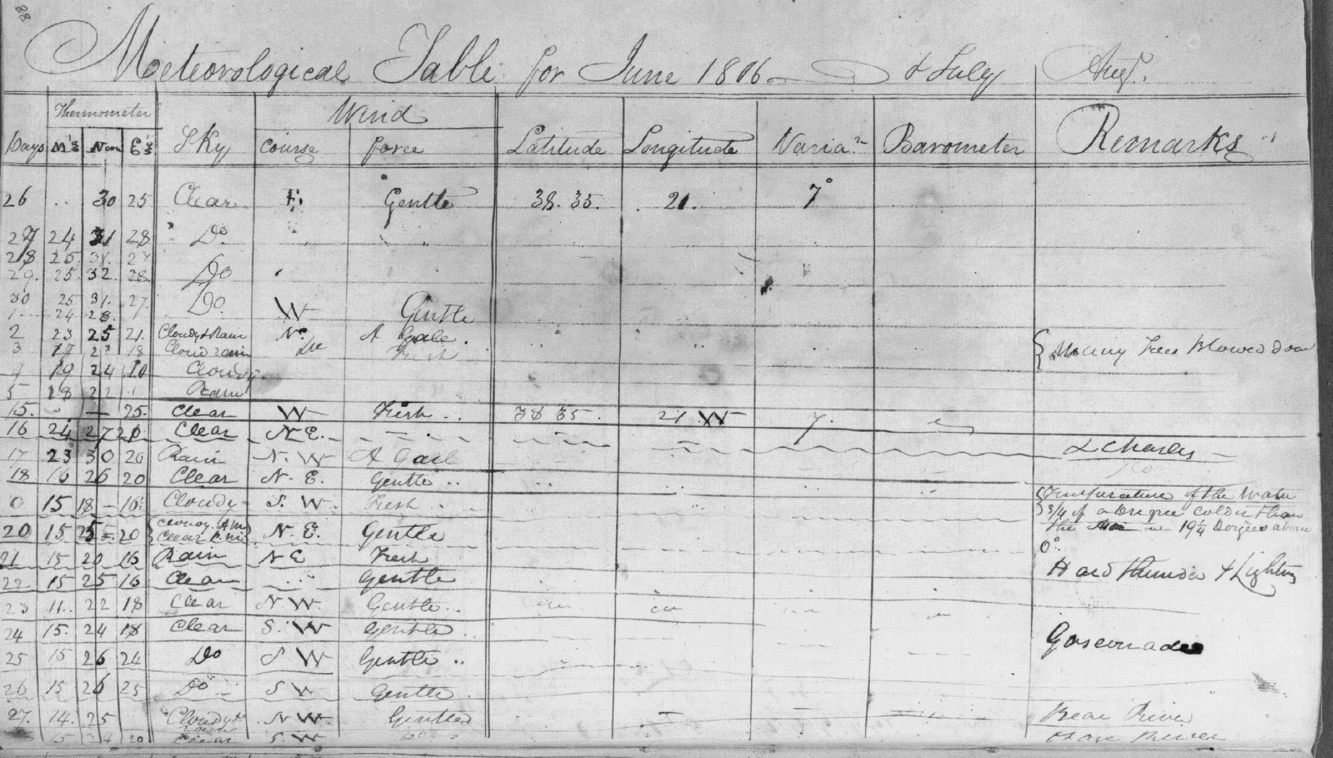
The scientific missions declared by expeditions to the US West, often jointly organized between the federal government and professional societies (chiefly the APS), articulated with military strategies to survey, evaluate, protect, or usurp territory otherwise used or claimed by foreign governments, trading companies, and Native tribes. Of course, securing frontier legibility did not always succeed as planned. Yet practical failure, as much as successes, indicate the coproduction of climate knowledge and state territorial expansion. The fate of Zebulon Pike's Reference Pike1805–7 expeditions and of his meteorological tables represent an important case of such mutual failures of meteorology and statecraft. Departing from Saint Louis and commissioned by General James Wilkinson to survey boundaries of the Louisiana Territory, the expedition party lost its course and ended in Mexican territory, where they were captured by Spanish authorities and brought to Santa Fe. The expedition was embroiled in political controversy. Amidst possibly imminent war with Spain and during federal investigation of Aaron Burr's conspiracy (implicating Pike's commanding officer, General Wilkinson) to secede and annex Spanish lands in the Southwest, Pike and his meteorological records were precarious.Footnote 8
Pike worried that his charts and tables (such as figure 3), kept in a single trunk upon capture, would be found by the Spanish and expose his party as spies. So, as Pike recalled, he strategically “caused [my] men to secrete my papers about their bodies, conceiving this to be safer than leaving them in the baggage.” However, “in the evening, finding the ladies of Santa Fe were treating them to wine, &c., I was apprehensive their intemperance might discover the secret”Footnote 9 (in Maguire Reference Maguire1889: 390). After collecting the papers, they were promptly discovered and confiscated by Spanish officials. After Pike's release, in an 1807 letter to Spanish Governor Salcedo (in Maguire Reference Maguire1889: 386), Pike appealed: “Your Excellency may be induced to conceive that the measure of seizing my notes, plans, meteorological and astronomical observations. . .may not be justifiable.” He argued to Salcedo that his papers “would enable the executive of the United States to take some steps to ameliorate the barbarous state of the various savage tribes whom I visited” and “would have added in some small degree to the acquirements of science, which are for the general benefit of mankind.” Salcedo, claiming Pike's papers violated international agreement, promptly refused. Pike's appeal to science, combined with efforts to have superior officials intercede on his behalf, failed to integrate his records into incipient efforts to construct a national view of climate. His meteorological observations were lost to such purposes. His instruments, “most of them. . .ruined in the mountains by the falling of the horses from precipices, &c,” were also sold during captivity to avoid having to carriage them back to Louisiana.Footnote 10
Zebulon Pike's “Meteorological Table for June 1806,” among those seized by Spanish officials.

If the materiality of meteorological observations were intimately tied to successes of state action, military-scientific expeditions through frontier areas also proceeded through a complementary Baconian analytic approach to scientific and governmental legibility. As Secretary of War John Calhoun instructed Major Stephen Long as he prepared to set off on a later expedition up the Missouri River in 1819:
The object of the Expedition, is to acquire as thorough and accurate knowledge as may be practicable, of a portion of our country, which his daily becoming more interesting, but which is as yet imperfectly known. With this view, you will permit nothing worthy of notice, to escape your view. (James Reference James1823: 37)
The Long Expedition, introduced at the beginning of this article, collected detailed meteorological instrument readings throughout the West. Among hosts of “interesting” facts, meteorological records could be considered a curious appendage to territorial expansion or else a failure of science based on false premises about disease or climate. Over time, however, efforts to stitch climate knowledge into larger tapestries of western settlement and progress helped to construct West territories as sites of agricultural productivity, “salubrious” landscapes, and the possible progress of civilization. From a military or natural-philosophical standpoint, such progress was hardly inevitable. Yet explorations and the matters of fact that they circulated to state officials and possible settlers helped construct western spaces as knowable, habitable, and governable.
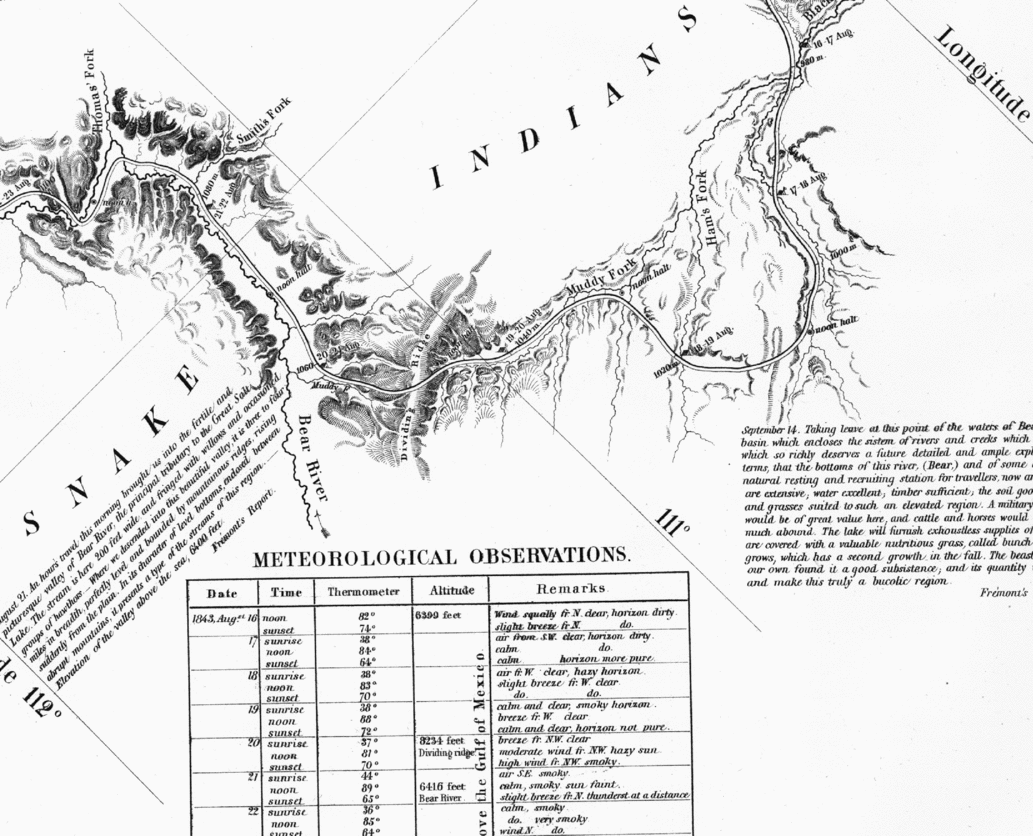
How did meteorological facts become integrated into prospective accounts of western territories as habitable and governable spaces? The influential maps produced by the Army Corps of Topographical Engineers of the Frémont Expeditions (1842–45) help answer this question. The expedition was mostly oriented to facilitating westward migration. The maps and associated reports contained not only topographical data but also novel cartographic representations of future settlement. Frémont's cartographer, Charles Preuss, presented minute notes, often reproduced from Frémont's journals, on the exact number of Indian “warriors” in various villages; notes on water, fuel, soil, grazing land, and “Indian” problems; and meteorological data collected during the expedition (see figure 4).
Excerpt from John Charles Frémont and Charles Preuss's Reference Frémont and Preuss1846 “Topographical Map of the Road from Missouri to Oregon, Section V.”

The inclusion of meteorological data on surveying expeditions did not intend to formally represent the stable climate of a region nor aid in specific predictions. Yet it signified that western climates were, in principle, knowable in ways that may align with national expansion.
Those who crafted a system of meteorological recordkeeping helped to make cartographic interventions alongside surveyors, military strategists, and settler-colonists. Such maps, and climate knowledge generally, yielded not only two-dimensional snapshots of areas but also narratives of spatial expansion and future progress.
One might imagine topographical surveyors as a corps of men, instruments, and logbooks, but their work comprised assembling chains of what Short (Reference Short2009) calls “cartographic encounters.” Maps and tables often began as a patchwork of Native, settler, trader, and explorer testimony and measurements. State actors translated and consolidated diverse information and then distributed it widely to government agents and through print media to settlers, often accompanied by adventure narratives, western boosterism, and medical advice. Popular “emigrants’ guides,” as they were often called, synthesized expedition reports and other information on western climates as exploration proceeded.Footnote 11 Such guides relied on federal expeditions for legitimacy and data, and they translated climate knowledge into medical and geographical terms that projected civilized futures in western territories. Timothy Flint (Reference Flint1826: 188–89), for example, combined his own travel narrative with official reports to portray the “exhaustless fertility” of the Missouri plains, on which he envisioned, “the climate will grow salubrious with its population and improvement,” and hence “will arise the actual ‘Ne plus ultra.’” Through such cartographic and narrative translations, territorial expansion was not only coproduced with the physical meteorological network, but also with an analytic view toward prosperous and governable climate futures.
Thus far we have traced how developments in meteorology first articulated with issues of forming a healthy and disciplined army, and then with concerns about the nature and trajectory of western territories. Clearly, central scientific issues concerning disease etiology and the relationship between civilization and climatic changes played out in and through military and territorial expansion in the West. Yet what of racial statecraft throughout this period? If the state and meteorological knowledge are indeed coproductive, issues of racial stratification in the decades leading to the American Civil War should provide a test case. It is to this issue that I now turn.
Racial Climatology
By the mid-nineteenth century, meteorology developed into what its leading participants and, later, historians have called an empirical and modernized science. Yet what was the character of this science? To consider this question, I here trace the work of a leading figure in this emergent scientific view of climate, Samuel Forry, and contextualize his work and climate knowledge more broadly with respect to racial ideologies in the pre–Civil War decades. As a “true science,” Forry's story suggests, climate knowledge coproduced elements of an American racial state. Footnote 12
Forry, a meteorologist and army surgeon, worked under the direction of Thomas Lawson, who was appointed surgeon-general after Joseph Lovell's death in 1836. Let us first observe how Samuel Forry summarized the field in his famous 1842 text entitled The Climate of the United States and Its Endemic Influences:
Numerical analysis applied to governmental objects soon bestowed the character of a science upon political economy [and] the doctrine of averages has been not unaptly styled the mathematics of medical science. . . . So [in] meteorology, nature has found faithful interpreters content to observe facts and to trace their relations and sequences, thus bestowing upon it the characters of a true science. (Forry Reference Forry1842a: 26, emphasis added)
In other words, “numerical analysis” of atmospheric patterns, disciplined by “facts,” “relations,” and “sequences,” meant meteorology was achieving scientific status. On this basis, Forry rendered the United States within one statistical view of climatological space (see figure 5).
Frontispiece to Samuel Forry's The Climate of the United States, showing isothermal lines.

To what end did meteorology construct such a view? Forry echoed Lovell's framework for meteorological observation:
A mass of facts thus accumulated will prove of immediate practical use to the philosopher, the physician, and the agriculturist; and to future generations, it will serve to determine what changes, if any, time may effect upon the climate of a particular region. (Forry Reference Forry1842a: 20)
Forry argued that Constantine Volney, Thomas Jefferson, Benjamin Rush, and others, who had promulgated a theory that civilization was actively changing American climates, had in fact made “premature deductions” reliant on the “testimonies of travelers” as opposed to the “thermometrical data” he provided (Forry Reference Forry1842a: 103). Based on decades of data collected through the Army Medical Meteorological Registers, Forry (ibid.: 108) granted that “climates are susceptible of melioration” by “the labors of man.” However, “[T]hese effects are extremely subordinate, compared with the modification induced by the striking features of physical geography.” In other words, Forry concluded that the activities broadly constitutive of civilization—especially clearing, reclaiming, and “improving” land—expressed minimal effects on the trajectories of American climates.
Considering Forry's ambivalence about having effectively settled a long-standing controversy helps to clarify the general terms by which concerns over climate, civilization, and government unfolded up to the mid-nineteenth century. Despite following Lovell's inconclusive results with ones that appeared to refute a clear progressive climatic trajectory over US territory, Forry nevertheless upheld a radical civilization-climate perspective especially adapted to issues of racial stratification. He (Reference Forry1842a: 95) reasoned: “As climate not only affects the health but modifies the whole physical organization of man, and consequently influences the progress of civilization,” it followed that comparing “systems of climate” would “reveal to the medical philosopher much that is now unknown, and to the political economist many of the circumstances that control the destinies of a people.”
As we saw with the issues of military-medical discipline and territorial expansion, the “whole physical organization” of bodies, lands, and civilization was entwined with categories endogenous to statecraft. By the 1840s, for Forry and for the state, race became just such a category. Numerous public discourses—including a civilizing mission expressed in formal policies like “Manifest Destiny” and the racial politics that undergirded slavery and Indian Removal—were steeped in scientific problems. The contested category of race linked the interests of state officials; partisan interests vehemently for or against national expansion and slavery; and medical and meteorological professionals. In particular, developments in static, biohereditary, and anatomical concepts of race had significant import into how scientists considered the relationship between “climate” and “civilization.” In this way, as I will show, race altered the terms by which climate knowledge proceeded to evaluate the dynamic relationship between populations and climates.
In addition to helping to solidify a national climatological field of vision, like his contemporaries in European colonial settings, Forry's foundational texts in American climatology presented comparative statistics to evaluate the natural-historical and probable futures of racial order. He concluded that “the superiority of the warlike nations of Southern Europe over the effeminate inhabitants of Asia” had resulted from “this all-pervading agency of atmospheric constitution” (Reference Forry1842a: 22). Climate, in this view, endowed “nations” with properties that explain their character and trajectory. Turning to Native people and “the political horizon of North America,” Forry (Reference Forry1842a: 22) further concluded:
If we look upon history as philosophy teaching by example, it requires not the gift of divination to foresee the destiny of Mexico and the States south of it, whose inhabitants, enervated by climate, conjointly with other causes, will yield, by that necessity which controls all moral laws, to the energetic arm of the Anglo-Saxon race.
Elements of Forry's conclusions, of course, were hardly new. African slaves had been consistently portrayed by slaveholders and scientists as having bodily “constitutions” suited for laboring in Southern heat, without succumbing to the diseases proper to the white constitution in such climates (Johnson Reference Johnson1827 [1813]). Arguments about differentiated constitutions rationalized a long-standing fear that whites were unfit for “intemperate” climates while also building a scientific basis for enslavement of Africans in the US South (Kupperman Reference Kupperman1984; McCandless Reference McCandless2011; Puckrein Reference Puckrein1973). Yet Forry's view of the “energetic” Anglo-Saxons was not one of an unfit race, but of one endowed with relatively stable racial features that exhibited exceptional biological qualities that transcend climatic influence.
Written only several years before the imperial Mexican-American War and amidst political tensions regarding slavery and territorial expansion, Forry's arguments concerning western climate and racial fitness indicate the broader conceptual import of racialized climate knowledge. We can call this knowledge a “racial climatology.” Advancing a complex climatic theory of racial domination, Forry's arguments helped to build the contours of racial theory in this period, and his authority as a meteorologist and his control over climate statistics were important to such developments. Forry's view of climate enacted what Omi and Winant term racialization, defined as “the extension of racial meaning to a previously racially unclassified relationship” (Omi and Winant Reference Omi and Winant2015: 13). In this case, the alleged relationship between a historicized racial type (the “energetic” Anglo-Saxon) and particular climates provided a novel construction of racial hierarchy and order.
In a series of articles (Forry Reference Forry1842b, Reference Forry1843b, Reference Forry and Schoolcraft1856) concerning racial polygenesis, or the theory that races lack common ancestry, Forry most explicitly developed the political (and theological) significance of his racial climatology. Although he rejected the polygenesis theory by affording a degree of flexibility and “adaptation” to racial types, his work nevertheless reified a superior Anglo-Saxon race. Having traced the Anglo-Saxon racial type to premodern population and climate dynamics in northern Europe, Forry then posited that degrees of intelligence, civilization, and morality were products of three major factors: climate, social organization, and, drawing positively from phrenologists, what he termed “cranial organization.” Forry (Reference Forry1842b: 130) concluded,
Can it be supposed that [the] noble developments of the present races contrasted with the low forehead, diminutive stature, and deformed figure, of some of the northern hordes who overran Southern Europe, are not owing mainly to the influence of civilization and a more genial clime?
Answering affirmatively, Forry nevertheless emphasized that prior accounts of civilization and climate were mistaken insofar as they proceeded “without any knowledge of the functions of different parts of the brain” (ibid.: 131). Regarding “Caucasians,” he concluded, “it is among these nations that the progress of civilization and the development of the anterior portion of the brain, each exercising on the other a mutual influence, have gone hand in hand” (Reference Forry1843b: 38). Unlike prior climatic theories of human difference dating back to Montesquieu's De L'esprit des Lois and Buffon's Histoire Naturelle, Forry synthesized the influential phrenological and anatomical-racist theories of his day, many of which challenged the entire paradigm linking climatic causes to racial formation.Footnote 13
To summarize, Forry provided an account of racial types as outcomes of interaction between, on the one hand, the physical and social effects of climate on degree of civilization, and on the other hand, the moral and “cranial” effects of the civilizing process. Recall that an initial governmental rationale for pursuing climate knowledge concerned the degrading or unhealthy effects of unknown or changing climates on “European constitutions.” By linking intelligence and morality to relatively stable categories of “cranial organization,” however, Forry's analysis did not problematize white “constitutions” as such. Rather, Forry's racial climatology was oriented to evaluating what he saw as inevitable racial domination. In other words, Forry was working out the political implications of how historical climates had inscribed brains—not only bodies, civilized minds, and moral behaviors—with qualities that were more stable than the bodily “constitutions” as considered by previous generations of medical meteorologists. If racially stable by biological fact, then the danger of unhealthy climates notwithstanding, Anglo-Saxons were by nature fit for continental expansion.
Racial climatology, in effect, helped constitute broader discourse concerning Native, immigrant, and black races that transcended political debates over slavery, expulsion of Native people, and other forms of state-sanctioned racial violence and subjugation. Alongside coercive racism, civilizational discourse as developed through racial climatology helped form a diffused biopolitics aimed toward a “productive” engagement with climate and racial difference (cf. Foucault Reference Foucault and Gordon1980: 119).
Advanced by Forry (Reference Forry1840; Reference Forry1842a: 28; Reference Forry1848)Footnote 14 and increasingly popular among urban reformers and western physicians, “medical geography,” and what Forry called “hygeiology” and “state medicine,” helped to work out a governmental and medical synthesis of climatological and racial difference. Contemporary studies in medical geography were highly racialized, demonstrably so by the famous Ohio physician, Daniel Drake. In his magnum opus, Drake (Reference Drake1850) provided a broad medical program based on comparative climate statistics and racially stratified biomedical indices and therapeutic techniques. He intricately mapped geographical and climatological areas, framing his analyses according to the “Caucasian,” “African,” “Indian,” and “Esquimaux” races (Drake Reference Drake1850: vi) races. Although primarily surveying the medical geographies of the Caucasian race (stratified by European ethnicities), he situated this racial type as a special subject of medical geography. By evaluating the “physiological etiology” of Caucasian diseases, Drake (ibid.: 637) analyzed westward migration as a modifying force on racial constitution and its medical consequences. Drake viewed westward movement of whites as a natural trajectory, suggesting racial destinies would culminate in “amalgamation”: “The homogeneous millions, with which time will people the great region between the Appalachian and Rocky Mountains [are] thus destined to present the last and greatest development of society” (647). Yet Drake nevertheless reified racial difference and focused on Caucasian diseases, stating that “I shall dismiss [the others], until the history of the diseases of the Caucasian races is finished” (638).
In effect, racial climatologies deepened claims that races were observable and treatable in biologically distinct ways, even if medical geographers diverged on political lines regarding slavery and reform movements. Valencius (Reference Valencius2002: 246) finds that Daniel Drake supported slavery and reserved his ambivalence toward racial “amalgamation” only for European nationalities. Polygenists who supported slavery, for example Josiah Nott (Reference Nott1851), rejected arguments of monogenists like Forry by denying the relevance of climate knowledge to scientific racism altogether. For his part, Forry rejected slavery as immoral, reasoning that “Negroes in the lowest stage of civilization are the ugliest, having depressed, fore heads, flat noses, projecting jaws, and crook'd legs.” Yet he concluded, these “most ferocious savages—stupid, indolent, and sensual,” could be “elevated in the scale of social condition,” leading to possible “improvement in their physical feature” (Forry Reference Forry1842b: 118). How might such improvement proceed? Forry wagered that “political institutions and social organization often struggle successfully against climatic agency,” the Anglo-Saxon race forming his primary historical case in point. In other terms, “the superior endowments of a more fortunate race should be exercised in extending the blessings of civilization” (ibid.: 132).
Racial superiority as a basis for allegedly necessary, beneficial, or inevitable social domination, of course, had long-standing consequences. Perhaps the most important were Democratic political movements to justify slavery and naturalize racial exclusion through such landmark policies as those reached through the 1857 Dred Scott decision. With perhaps more providential zeal than colonial discourse of climate in other contexts marked by racial anxiety (see Anderson Reference Anderson2006; Parsons Reference Parsons, Beattie, O'Gorman and Henry2014), a diffuse, “civilizing” racism emboldened Anglo-Saxon superiority as political and climatic destiny. The role of science in constituting “whiteness” and its racial others as socio-biological categories is widely recognized. Here we find that meteorologists helped evaluate a climatological basis for racial hierarchy in an expanding United States. In whatever degree less violent than biological justifications for slavery or state-sanctioned violence, racial climatology nonetheless advanced an ideology of providential nationalism that placed territorial and racial expansion on a scientific foundation. In this way racial climatology formed a component of the broader coproduction of statecraft and climate knowledge that emerged over the antebellum period.
Conclusion
The present analysis demonstrates how, during the period from 1800 to 1850, the development of meteorology was coproduced with three emerging domains of US statecraft: military medicine, discipline, and administration; territorial exploration and frontier expansion; and foundational ideologies of a racial state. Thus, making climate a category of scientific knowledge was simultaneously a matter of making legible the relations between mobile, often racially coded, bodies and their environs, thereby helping to secure a governable social order. My historical narrative of science-state coproduction holds two major implications. The first is empirical and concerns how to interpret matters of meteorological government in the 1800–50 period in the United States. The second is analytical, and concerns broader historical dynamics of meteorological government and theories of state-science coproduction.
Regarding historical narratives of meteorology, as Fleming (Reference Fleming1990) and others show, meteorological networks in the nineteenth century were foundational to subsequent developments in meteorology in the United States. Yet the narrative I have sketched of the formation of meteorological networks and climate knowledge in the 1800–50 period has not been uncovered through a historical approach seeking to trace the prehistory of weather forecasting and later modeling techniques that form the technical bases of contemporary atmospheric and climate sciences. Nor did meteorological observation succeed only by the hard work of those seeking accounts of storms patterns or stable regional characteristics, even if they later contributed to such efforts. Rather, climate knowledge succeeded by actors’ efforts to practically link meteorological networks to western territoriality and to develop an analytic of government that could make legible and then integrate new lands and stratified populations. Clearly, what gets stabilized throughout this period is something never achieved—a centralized meteorological observation network with widespread applications. But this network, its precipitating causes for institution and its meaningful significance, did not stand apart from broader networks of power. Rather it was constituted through the course of statecraft. From the management of the unruly and diseased military body, to evaluations and imaginaries of western territorial expansion, to the racial politics of diminishing or “civilizing” inferior groups, we find climate knowledge imbricated in a larger apparatus of power. Any historical assertion that meteorologists’ tables and maps of the climate of the United States might stand alone, to be considered in isolation, presents a myth that in effect sustains claims to an autonomous rationality of climate science and the apolitical nature of the very category of “climate.”
Regarding science-state coproduction, the analysis shows that statecraft involved neither an instrumental harnessing of scientific authority for an autonomous political logic, nor any inevitable capacity to make bodies, diseases, habitable territories, and state agents governable by a central bureaucratic administration. Rather, statecraft and climate knowledge were coproduced through practical and analytic forms of meteorological government. Governing relations between atmospheres and populations, in other words, first entailed aligning physical networks, including the diverse components assembled in meteorological statistics and the tenuous peripheries of state institutions. Second, meteorological government involved prospective evaluations of climate-population dynamics, making climatic and social orders legible and, hence, categories of governmental concern.
The analysis here presents one case of meteorological government, and reflects related analyses that have sought to recover the historical developments of social power and climate knowledge, especially in European colonial contexts. Such a project remains unfinished, not only because of other possible case studies but also because critical historical investigation, as Foucault (Reference Foucault and Gordon1980) outlines in his approach to genealogical analysis, is reflexively marked by ongoing developments in social power and “regimes of truth.” In this light, the conceptualization of meteorological government developed here, and an analytic focus on state-science coproduction more generally, may help inform recent studies of climate knowledge that seek to bridge histories of colonialism, imperialism, and science with emergent scientific and political discourse concerning global warming (see Mahony and Hulme Reference Mahony and Hulme2016). Although critical studies of climate science first emerged within a broad concern over globalization and its reflection in international science and climate policy arenas, climate expertise has shifted in recent decades. Attempts to govern the climate-society relationship have sharply turned toward building “resilience” to imminent climate impacts, primarily under a paradigm of “climate change adaptation.” The governmental apparatus that substantiates “adaptation” involves an array of scientific fields and a biopolitical concern with populations’ possible exposures to risk, insecurities, and disorder. As in the mid-nineteenth century, legibility projects are therefore underway to ensure that possibly radical changes in climatic and social orders remain governable. Coproduction of science and the state is here both practical, comprised chiefly of regional climate modeling and strategic scenario-building, and analytic, buoyed by a logic of maintaining an orderly relationship between global climate and variously stratified populations.
Yet we do not have a genealogy of climate knowledge that pulls together these and other such ordering strategies with reference to the power relations and trajectories they may entail. The dominant approach to the climate knowledge-power relationship in the social sciences is to show how political and economic interests impede the development and salience of scientific truth regarding global warming. Complementing this stake in current struggles over scientific authority, scholars have traced genealogies of climate science, arguing the field proceeds through a logic autonomous from the politics that surround or inhibit its progress (Weart Reference Weart2008). The analysis presented here, however, suggests that climate knowledge—in its truth—may comprise practices of meteorological government. Reconstructing such practices remains an important project in various historical and contemporary contexts.