1. INTRODUCTION
Across the world there are over 300 watercourses shared between two or more states,Footnote 1 governed by international law through a variety of legal sources, which include treaties, conventions, custom, and principles.Footnote 2 Approximately 60% of these watercourses are covered by legal agreements at the bilateral, regional, or multilateral level, which offer frameworks of binding norms for water cooperation.Footnote 3 These agreements tend to address, at least, two substantive issues – equitable and reasonable utilization, and the due diligence obligation not to cause significant harm – and set out various procedural rules, such as prior notification, consultation, and information sharing. These rules have been codified and progressively developed through the two global water conventions: the 1997 Convention on the Law of the Non-Navigational Uses of International Watercourses (Watercourses Convention)Footnote 4 and the 1992 Convention on the Protection and Use of Transboundary Watercourses and International Lakes (Water Convention).Footnote 5 While there are 153 states that share transboundary freshwaters with at least one other state,Footnote 6 the global water conventions have limited membership, leaving major gaps in their implementation.Footnote 7 This has led some to question their continued relevance,Footnote 8 with others pointing to the need for regional approaches.Footnote 9
For a variety of reasons, reaching a binding agreement in many basins has proved to be impractical, impossible, or undesirable. This raises concerns about transboundary water cooperation moving forward in the form of binding agreements, which can assist in providing predictability and stability for state cooperation.Footnote 10 Although this continues to be a source of debate among international lawyers,Footnote 11 it is increasingly recognized that the normative force of international law exists along a spectrum,Footnote 12 ranking from binding agreements to an array of softer alternatives. The softness of law comes in a variety of forms, divided here into ‘soft negotium’, provisions of binding instruments that do not include clear obligations, and ‘soft instrumentum’, instruments created by legal actors which contain normative commitments that are not readily enforceable through dispute settlement mechanisms.Footnote 13 Although non-binding, this soft instrumentum has a series of legal effects,Footnote 14 and is therefore deserving of the attention of international lawyers.Footnote 15
China is upstream of many of Asia's major rivers that it shares with its 14 neighbouring states and three states further downstream.Footnote 16 However, China is not party to either of the global water conventions, preferring to engage with its riparian neighbours through what has been referred to as its ‘soft path’, characterized by both binding agreements that exhibit soft negotium and, increasingly, soft instrumentum.Footnote 17 While China's binding transboundary water agreements, including aspects of their soft negotium, have been explored elsewhere,Footnote 18 little attention has been paid to the soft instrumentum on China's transboundary waters.
China's recent emphasis on soft instrumentum finds its origins in the Belt and Road Initiative (BRI), a ‘hub and spoke network’Footnote 19 of economic growth and interconnectivity between China and states around the world composed of ‘hardware’, mainly infrastructure investments, and ‘software’, such as institutions and soft law instruments.Footnote 20 While the BRI has been linked primarily to international economic law, arguably it relates to a broader range of international legal areas,Footnote 21 including the law of international watercourses. The Lancang-Mekong Cooperation (LMC), a branch of the BRI established by China in 2015,Footnote 22 seeks greater engagement between China and its Southeast Asian neighbours (Cambodia, Laos, Myanmar, Thailand, and Vietnam) with whom it shares the Lancang-Mekong River. It does so through a broad framework encompassing three pillars and five priority areas, one of which is ‘water resources’.Footnote 23
This article seeks to revisit China's ‘soft path’ with an emphasis on the soft instrumentum of the LMC. In order to do so, firstly it unpacks the softness of international law and explores the legal effects of soft instrumentum, with a focus on the law of international watercourses. It then analyzes the soft instrumentum of the LMC, including its relation with international law and its approach to transboundary water governance. Whereas previous research has illustrated the importance of the law of international watercourses for the successful implementation of the BRI,Footnote 24 this article seeks to draw lessons from the BRI and LMC for the governance of transboundary watercourses, while highlighting the significant potential for soft instrumentum to act as a vehicle of transboundary water cooperation around the world. As is argued here, the LMC is merging with international best practice of the law of international watercourses and thus plays a supportive role, but it is increasingly developing international water law as it exhibits its own influence through its project approach, its emerging normativities. As such, through an analysis of the LMC, the article highlights the significant potential for soft instrumentum to act as a vehicle of transboundary water cooperation around the world.
2. THE ROLE OF SOFT INSTRUMENTUM IN THE LAW OF INTERNATIONAL WATERCOURSES
The law of international watercourses comprises two framework conventions and a multitude of regional, multilateral, and bilateral agreements. As treaties, these agreements fall within the scope of the Vienna Convention on the Law of Treaties (VCLT) and are binding upon states parties under the principle of pacta sunt servanda.Footnote 25 Select treaty norms, most notably equitable and reasonable utilization and the due diligence obligation not to cause significant harm, are also considered customary international law and are therefore binding also on non-party states.Footnote 26
While these conventions and customary norms are binding, in some ways they exhibit soft negotium. The fundamental principle of equitable and reasonable utilization, for example – which provides all states with the right to utilize a transboundary watercourse and the corresponding obligation to do so in an equitable and reasonable manner – exhibits a degree of softness as it has been described as a ‘vague aspirational goal’ as well as a ‘starting point for a process’ of reconciling the needs and interests of states.Footnote 27 Furthermore, international water law itself has developed in no small part as a result of soft instrumentum, divided here into primary and secondary soft instrumentum, which capture state practice either directly or indirectly. Primary soft instrumentum refers to those instruments created by states and addressed to the international community or a group of states, whereas secondary soft instrumentum refers to recommendations or comments from international institutions, commissions, special rapporteurs, and resolutions of international organizations, among others.Footnote 28
Whereas the LMC developed through primary soft instrumentum made by states (discussed below), international water law developed initially through the secondary soft instrumentum of various international institutions, including the International Law Association (ILA), International Law Commission (ILC), and Institute of International Law (IIL). Unlike primary soft instrumentum, these instruments are not written by states, but the expert nature of these committees reflects the standard of the ‘most highly qualified publicists’ as subsidiary sources of international law, and their relationship with states and the international community lend them significant weight.Footnote 29 As such, these secondary examples of soft instrumentum capture state practice and international norms at various stages of maturity in order to ‘spark the development of international law through an iterative process of practice and norm consolidation’.Footnote 30
Soft instrumentum occupies a unique legal space as it is not quite law, but is more than a simple policy statement. It shares a ‘proximity to law’ and can have legal relevance, but is not itself legally binding.Footnote 31 In this position, it can support, develop, and interact with binding legal regimes in a variety of ways. First, soft instrumentum can insert norms into state cooperation, assisting in the codification, crystallization, and establishment of customary international law by influencing practice or providing evidence of opinio juris.Footnote 32 In the case of the law of international watercourses, this includes equitable and reasonable use and the due diligence obligation not to cause significant harm. These rules are founded upon the notion of limited territorial sovereignty over transboundary water resources, first included in the IIL International Regulation regarding the Use of International Watercourses for Purposes other than Navigation (1911).Footnote 33 Noting a lack of rules in this area, the Regulation includes provisions that ‘should be observed from the point of view of (any) use of international streams’.Footnote 34 It provides one of the first codifications of the substantive rules, indicating that states may utilize the water resources within their own territory, but that such utilization shall not ‘seriously interfere with’ the utilization of other states.Footnote 35 It also provides for a limited obligation not to cause significant harm, stating that ‘no establishment may take so much water that the constitution … of the stream shall, when it reaches the territory downstream, be seriously modified’.Footnote 36 Similar statements are found in the Declaration concerning the Industrial and Agricultural Use of International Rivers (1933),Footnote 37 the ILA Resolution of Dubrovnik (1956),Footnote 38 the ILA Resolution on the Use of the Waters of International Rivers (1958),Footnote 39 and the IIL Resolution on the Use of International Non-Maritime Waters (1961).Footnote 40 Taking note of the crystallization of these norms in the aforementioned documents,Footnote 41 these rules were then codified in the ILA Helsinki Rules on the Uses of the Waters of International Rivers (1966), widely recognized as the ‘first general codification of the law of international watercourses’.Footnote 42 While non-binding, these rules include detailed provisions on equitable and reasonable utilization (Articles IV, V, VI) and the due diligence obligation not to cause significant harm (Articles IX, X, XI). In 1970, the ILC began the process of study that would ultimately lead to the Watercourses Convention.Footnote 43
Soft instrumentum can also play a supporting role, filling gaps in agreements and assisting in interpretation or through the establishment of standards.Footnote 44 This extends to the filling of gaps in the application of international water law rules. In 1986, for example, the ILA adopted the Complementary Rules Applicable to International Water ResourcesFootnote 45 and the Rules on International Groundwaters,Footnote 46 which provide greater detail on provisions of the 1966 Helsinki Rules generally, and their application to transboundary groundwaters. Various soft instruments have also sought to confirm interpretation of the rules of international water law. The 1978 United Nations Environmental Programme (UNEP) Principles of Conduct in the Field of the Environment for the Guidance of States in the Conservation and Harmonious Utilization of Natural Resources Shared by Two or More States, for example, links equitable and reasonable utilization (Principle 1) with the obligation not to cause significant harm (Principle 3), while ensuring the primacy of equitable and reasonable utilization.Footnote 47 This history of progressive development through soft instruments may have assisted in establishing the consensus needed for the adoption of the global water conventions, illustrating the potential for soft instruments to act as a first step in the treaty-making process.Footnote 48 Both global water conventions contain norms of equitable and reasonable use and the due diligence obligation not to cause significant harm, as developed in these soft instruments. The interpretive functions of soft instruments, however, do not stop after codification, as binding agreements can refer specifically to soft instruments. The Preamble to the Watercourses Convention, for example, refers both to Agenda 21Footnote 49 and the Rio Declaration,Footnote 50 assisting in the interpretation of ‘sustainability’ in Article 5 – Equitable and Reasonable Utilization and Participation, among others.Footnote 51
3. THE SOFT APPROACH OF THE LANCANG-MEKONG COOPERATION
Soft instrumentum has played developmental and supporting roles in international water law, and can also act as a replacement for binding agreements, especially in instances where states perceive binding agreements to be too costly.Footnote 52 As noted above, China is not party to either of the global water conventions and, although it has binding agreements with its neighbours in its Northeast and Northwest, there are limited agreements with its neighbours in the Southwest.
In order to fill this gap and seek closer relations with its Southeast Asian neighbours,Footnote 53 China established the LMC in 2015. As a branch of the BRI, it takes a similar approach with cooperation facilitated by primary soft instrumentum that exhibits a ‘dual track normative approach’ – existing alongside binding agreements and exerting their own normative influence.Footnote 54 Such an approach allows for increased flexibility, allowing states to avoid the complicated and slow process of ratification associated with binding agreements, and to more easily amend them.Footnote 55 Thus, in utilizing soft instrumentum, China can guarantee the rapid development of the LMC, while ensuring maximum flexibility in its future direction.Footnote 56
LMC soft instrumentum consists primarily of multilateral texts, established between China and the other five riparian states. They have emerged from multiple high-level forums, including annual Foreign Ministers’ Meetings, occasional Ministers’ Meetings directly related to water resources, and Leaders’ Meetings held every two to three years. By the end of 2021, there had been three Leaders’ Meetings, six Foreign Ministers’ Meetings, and one Water Ministers’ Meeting (see Table 1), with more planned in the future.Footnote 57 Even though only one LMC instrument – a memorandum of understanding (MoU) between the LMC and Mekong River Commission (MRC) – clearly indicates that it is not legally binding,Footnote 58 LMC instruments do not adopt the binding ‘shall’. Rather, they use vague language such as ‘strengthen cooperation on’, ‘advance’, and ‘promote’ areas of water cooperation.
List of High-Level LMC Instruments as of December 2021

LMC instrumentum are non-binding, but they set norms for state relations, most commonly reflecting the Five Principles of Peaceful Coexistence, which China views as ‘basic principles of international law’.Footnote 59 These include: (i) mutual respect for territorial integrity and sovereignty; (ii) mutual non-aggression; (iii) mutual non-interference in internal affairs; (iv) equality and mutual benefit; and (v) peaceful coexistence.Footnote 60 While the norms of LMC documents have evolved over time, a core set – common across nearly all of the LMC instruments studied here – has emerged. This includes consensus, equality, mutual consultation and coordination, voluntarism, common contribution and shared benefits, openness, and inclusiveness. This reflects the Five Principles, particularly mutual respect for territorial integrity and sovereignty, ensuring the protection of the right of each state to choose. Emphasis on the Five Principles has become more explicit over time, with the Vientiane Declaration directly including equality, mutual benefit, respect for sovereignty and territorial integrity, and non-interference.Footnote 61 Ensuring that decisions are based on consensus, equality and mutual consultation, for example, ensures that all member states have a voice in decisions. While it is unclear if this is the case in practice, such an approach would strongly align with Chinese perspectives of sovereignty as a way in which ‘different political and social systems, different forms of civilization and culture should correlate and treat each other in international relations’.Footnote 62 This would also be in line with regional approaches to international law, as many Asian states place strong emphasis on traditional notions of sovereignty.Footnote 63 Reciprocity is also a pivotal norm, as almost all documents mention both ‘common contribution and shared benefits’,Footnote 64 making it clear that states that do not contribute will not receive benefits, or at least not the same benefits as those that do contribute.
This soft approach recognizes its connection with international law. However, while LMC instrumentum mentions international law, these references are often linked to project development, rather than legal development.Footnote 65 LMC instruments recognize international law generally with limited mention of specific agreements. This typically occurs alongside the aforementioned norms. Whereas some instruments make no mention of international law at all,Footnote 66 there is consistent reference to ‘respect for the UN Charter and international laws’.Footnote 67 Given the strong emphasis on the Five Principles, mention of the UN Charter is not surprising as the two are ‘naturally linked’.Footnote 68 This formulation is slightly expanded in the Vientiane Declaration, which includes ‘respect for the UN Charter, ASEAN Charter, and international laws, as well as in accordance with domestic laws and regulations and procedures of each member country’.Footnote 69 One instrument, the Fifth Foreign Ministers’ Meeting, makes an expansive mention of international law, indicating that LMC states ‘reaffirmed their support for multilateralism, upholding the international order underpinned by international law, the UN-centered international system, and the rules-based multilateral trading system with the World Trade Organization as its foundation’.Footnote 70 The Statement of the Sixth Foreign Ministers’ Meeting recognizes these basic principles and their connection with international law, and goes on to indicate that ‘in this context, the Ministers issue the statement as follows’, clearly recognizing that state cooperation of the LMC takes place within this legal context.
Although not necessarily in relation to transboundary water resources, LMC instruments also place strong emphasis on projects. The Sanya Declaration of the First Leaders’ Meeting, for example, indicates that the LMC adopts a ‘project-oriented model’.Footnote 71 Later declarations and joint statements continue this emphasis on projects, through the establishment of the LMC Special Fund to assist in project implementation and the creation of a list of ‘early harvest’ projects, as well as subsequent lists of projects such as the ‘List of the Projects Supported by LMC Special Fund of 2021’.Footnote 72
4. WATER RESOURCES GOVERNANCE UNDER THE LANCANG-MEKONG COOPERATION: (E)MERGING NORMATIVITIES
As illustrated above, the LMC approach utilizes primary soft instrumentum as its main method of development. This, however, is often conducted with project development in mind, rather than the development of international law. While this may be true at the general level for the LMC, water resources cooperation under the LMC does not appear to be addressed solely towards specific projects, but towards the slow and progressive development of transboundary water cooperation between Lancang-Mekong riparians. Of the thirteen soft instrumentum studied here (see Table 1), three do not directly mention water resources.Footnote 73 Of the remaining ten, six mention transboundary waters related to projects generally, and four do not.Footnote 74 It should be noted that those that do mention ‘projects’ are typically joint communiqués or action plans, whereas those that do not are leaders meeting declarations. Given their heightened status, this may signify that even though projects remain important, they are not the primary focus for aspects of the LMC that relate to transboundary waters. Instead, the LMC takes a middle path on this spectrum of softness between fully binding agreements and soft instrumentum, emphasizing international legal rules and offering a pathway for states to fulfil their customary obligations, while also developing the law of international watercourses.
4.1. International Law Relevant to Transboundary Water Resources and the Lancang-Mekong Cooperation
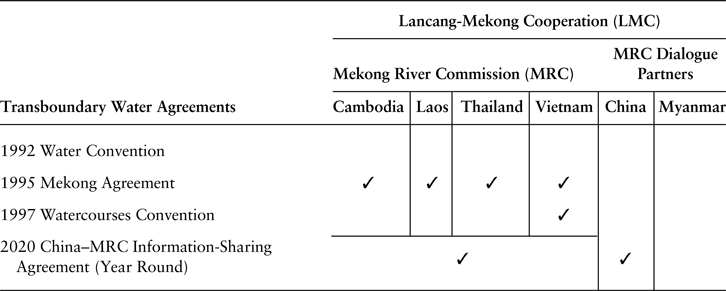
Upon its establishment in 2015, state parties to the LMC were already bound by a selection of international agreements relevant to the governance of transboundary waters. These agreements include the Watercourses Convention, the Mekong AgreementFootnote 75 and a bilateral information-sharing agreement between China and the MRC.Footnote 76 However, not all LMC states are party to (all) these agreements (see Table 2). Although LMC instruments do not mention any specific legal agreements, LMC states continue to be bound by agreements to which they are party, as well as various customary rules. As ‘international laws’ are consistently mentioned across LMC instruments, this deserves closer attention as LMC activities and soft instrumentum are influenced by these rules. Together, these global, regional, and bilateral agreements, as well as relevant customary law, provide the regulatory context within which the management of the Lancang-Mekong takes place, including substantive rules, procedural rules, institutions and dispute settlement mechanisms.
Party Status of Relevant Legal Regimes in the Context of the LMC

In terms of substantive rules, equitable and reasonable utilization and the due diligence obligation to prevent significant harm are of most relevance. Both rules are codified in the 1997 Watercourses Convention (Articles 5–7) and, although not identically, the 1995 Agreement on the Cooperation for the Sustainable Development of the Mekong River Basin (Articles 5–7).Footnote 77 In relation to the Watercourses Convention, of all the Lancang-Mekong states only Vietnam is party. With only one party in the region, the impact of the Convention is limited as the law of treaties indicates that state parties have obligations only to other state parties.Footnote 78 Thus, Vietnam's status as a party to the Watercourses Convention has limited impact until a second state with whom Vietnam shares transboundary waters also becomes a party. In spite of this, aspects of the Convention remain binding on states in the region as a codification of customary international law, confirmed by international case law.Footnote 79 This most notably includes the principle of equitable and reasonable utilization and the due diligence obligation not to cause significant harm. Equitable and reasonable utilization, found in Articles 5 and 6, requires states to ‘utilize an international watercourse in an equitable and reasonable manner’, whereas the due diligence obligation not to cause significant harm, found in Article 7, requires states to ‘take all appropriate measures to prevent the causing of significant harm to other watercourse States’.
As customary law, these rules apply to all LMC states regardless of their status as party or non-party to binding agreements. Rules of customary international law, however, also exhibit softness as they lack clear mechanisms for their implementation and enforcement.Footnote 80 In the context of the Lower Mekong, however, these customary rules are codified in the Mekong Agreement, established by Cambodia, Laos, Thailand, and Vietnam. The Agreement contains binding rules for the joint management of the Lower Mekong, including Article 5 (Reasonable and Equitable Use), Article 6 (Maintenance of Flows on the Mainstream), and Article 7 (Prevention and Cessation of Harmful Effects).Footnote 81 While not identical to the Watercourses Convention, these provisions are recognized as complementary.Footnote 82 The Agreement also established the MRC, which acts as a central node through which states can cooperate, fulfil their obligations and work to ensure enforcement of the regime. Neither Myanmar nor China are party to the Agreement and, therefore, are not legally bound by it. However, they participate in the regime as ‘dialogue partners’.
These two agreements have also established a series of procedural rules that are fundamental to the fulfilment of their substantive obligations, including information sharing, prior notification, and consultation. In the Watercourses Convention, states are to ‘share readily available information on the condition of the watercourse on a regular basis’ (Article 9), to go through a process of notification regarding planned measures with potential adverse effects (Articles 12 to 16), and enter into consultations regarding said measures (Article 17).Footnote 83 Of these rules, only prior notification is currently recognized as customary international law.Footnote 84 While no similar rules are found in the Mekong Agreement, there are several relevant procedures developed by the MRC, which include the following: (i) Procedures for Data and Information Exchange and Sharing; (ii) Procedures for Water Use Monitoring; (iii) Procedures for Notification, Prior Consultation and Agreement; (iv) Procedures for Maintenance of Flows on the Mainstream; and (v) Procedures for Water Quality.Footnote 85 These procedures have guided cooperation between the Lower Mekong states, although they are largely viewed as non-binding.Footnote 86 Furthermore, China signed a bilateral agreement with the MRC in 2002 to share wet-season hydrological information.Footnote 87 This agreement was expanded in 2020 to share year-round information.Footnote 88
4.2. Merging Normativities: Soft instrumentum of the Lancang-Mekong Cooperation as Support for the Law of International Watercourses
Although states are bound by international customary law and some of the aforementioned agreements, there are considerable gaps in coverage with no single agreement covering the entire river (see Table 2). Whereas soft instrumentum has traditionally been utilized to fill gaps through, for example, the establishment of subsequent standards, LMC soft instrumentum appears to be too vague to do so. The LMC, however, could fill gaps in both the binding effect and implementation of international water law norms, thus providing a base standard for cooperation across the basin. Although recognition of international law in LMC instruments is broad, they embody almost all of the key rules of transboundary water agreements. As soft instrumentum can represent examples of state practice and opinio juris, this could offer a pathway for states to reinforce and implement customary norms.
In terms of the substantive rules, nine of the thirteen instruments studied here include reference to ‘sustainable water resources management and utilization’, ‘sustainable development of water resources’ or similarly worded phrase as the primary objective of the LMC in relation to water governance. This includes each of the Leaders’ Meetings, two of the six Foreign Ministers’ Meetings, the Five-Year Action Plans, the Water Ministers’ Communiqué and the LMC-MRC MoU.Footnote 89 While the LMC does not utilize the wording ‘equitable and reasonable utilization’ from the global water conventions, the term ‘sustainable utilization’ is included in the Preamble to the Watercourses Convention and Article 5(1), which indicates that ‘the watercourse shall be used and developed by watercourse States with a view to attaining optimal and sustainable utilization’.Footnote 90
As the LMC has developed, it has also started to recognize the due diligence obligation not to cause significant harm. The Joint Communiqué of the Fifth Foreign Ministers’ Meeting indicates that states would ‘improve water resources management capabilities with a view to ensuring sustainable use of water resources, and minimizing negative impact on the livelihood and environment along the Mekong-Lancang River’.Footnote 91 This inclusion was partially in response to a controversial report and growing regional concerns regarding the potential impact of upstream hydropower dams.Footnote 92 It remains to be seen if this norm will continue to be mentioned in LMC instruments, as it was not included in the subsequent 2020 Vientiane Declaration. In the 2021 Joint Declaration, however, the states ‘encourage all the six-member countries to intensify their efforts and step up coordination and collaboration at the drainage basin level to address water related issues of common concern’, including ecosystem protection and the ‘adverse impact of floods and droughts’.Footnote 93
Similar to China's approach to its other transboundary waters, the LMC places significant emphasis on procedural aspects, most notably information sharing. Information sharing has become a central pillar of LMC cooperation, found in nine of the thirteen instruments, including each of the Leaders’ Meetings Declarations, two Foreign Ministers’ Meetings,Footnote 94 as well as the Five-Year Action Plans, the Water Ministers’ Communiqué, and the LMC-MRC MoU. In the Sanya Declaration, information sharing is listed as one of the methods through which states will ‘enhance cooperation’ in ‘sustainable water resources management and utilization’.Footnote 95 This has been reinforced as the LMC established an information-sharing platform, first mentioned in the Five-Year Action Plan on Lancang-Mekong Water Resources,Footnote 96 and completed after China committed to year-round information sharing.Footnote 97 This information sharing takes place within the context of China's agreement with the MRC, and also as part of the LMC via the newly established Lancang-Mekong Water Resources Cooperation Information Sharing Platform.Footnote 98 Consistent with China's transboundary water agreements,Footnote 99 none of the LMC instruments mention prior notification for planned measures, although there is mention of ‘sharing information in the emergency case of flood and drought’.Footnote 100 This emergency notification does not include notification regarding planned measures as found in the Watercourses Convention, but it is possible that states could notify each other via their joint planning activities.Footnote 101 Whereas the Watercourses Convention and Mekong Agreement provide significant space for consultation, there is no mention of consultation with regard to shared water resources under the LMC. There are, however, several institutional bodies through which consultation could take place, including Foreign Ministers’ Meetings, Water Ministers’ Meetings, Leaders’ Meetings, and joint working group meetings, among others.
4.3. Emerging Normativities: Lancang-Mekong Cooperation Soft Instrumentum and the Development of the Law of International Watercourses
Soft instrumentum can assist in the development of international law through the establishment of standards and the insertion of new norms. There are a variety of norms in LMC instruments with the potential to assist in the development of international water law, although they appear to be too vague to do so at present. For example, ‘sustainability’, requiring policies that ‘equitably meet development needs and environmental needs of both present and future generations’,Footnote 102 is mentioned in nearly all LMC instruments.Footnote 103 Although it is present in these documents, without specific guidance or further elaboration it is likely to have little impact on the development of the law in this area. What is unique about the approach of the LMC, however, is its emphasis on projects. This project-based approach may assist in the development of international water law, which has long sought ways to better implement the substantive rules through a benefit-sharing approach.
Although benefit sharing is widely discussed in legal literature, the notion has not been clearly defined.Footnote 104 It has been variously described as an ‘emerging principle of equitable sharing of downstream benefits’,Footnote 105 a general principle of international environmental law and international water law,Footnote 106 and even a ‘strategy’.Footnote 107 A clearly defined and practical concept of benefit sharing could assist in framing cooperation and facilitating agreement ‘as parties are being motivated by their perception of the benefits that would derive’ from cooperation.Footnote 108 Benefit sharing was first recognized as part of the 1961 Columbia River Treaty between Canada and the United States (US),Footnote 109 under which Canada received a lump sum payment from the US for flood prevention benefits derived from upstream projects in Canada. Canada, furthermore, received power from hydropower plants downstream that required flooding of Canadian territory.Footnote 110 These types of action alter the allocation of costs and benefits between riparian states,Footnote 111 ensuring that other riparians also have an interest in the project.Footnote 112 Such an approach assists in the establishment of an equitable and reasonable apportionment of the benefits of the utilization of shared water resources, offering ‘a means of giving practical effect to the principle of equitable and reasonable utilization’.Footnote 113 There are examples of benefit sharing with regard to China's transboundary water development on the Lancang-Mekong, evidenced by, for example, actions of reciprocity in the form of hydropower electricity-sharing agreements with downstream riparians.Footnote 114 The establishment of the LMC, however, places mutual benefit at the core of China's relations with its co-riparians. This represents an opportunity to explore and further develop this emerging customary normFootnote 115 in the context of transboundary waters, thus providing a concrete example of state practice.
Whereas the example of the Columbia River emphasizes benefit sharing in the context of hydropower, the LMC allows for shared benefits across a broad spectrum of issue areas with water at its core. Although water issues are one of five areas of cooperation, transboundary water resources are recognized as a cross-cutting issue. Declarations of Leaders’ Meetings recognize the river as an interconnecting factor, for example, recognizing that the ‘six countries are linked by mountains and rivers’, or that it is a defining feature of the subregion.Footnote 116 Furthermore, the 2019 Joint Statement of the Ministerial Meeting of Lancang-Mekong Water Resources Cooperation indicates that ‘in order to contribute to the economic and social development of sub-regional countries, enhance the well-being of our peoples, narrow the development gap among our countries’, among other issues, the states established the LMC and called for ‘enhanced cooperation on sustainable management and utilization of water resources among the LMC countries’.Footnote 117 In order to do so, the LMC places strong emphasis on mutual benefits while offering opportunities for joint projects.
With ‘mutual benefits’ as a common norm across all LMC instruments, the LMC provides ample opportunity and support for joint projects that could assist in achieving shared benefits. In recognizing that water resources are linked with other LMC issue areas, the Five-Year Action Plan on Water Resources encourages all states to ‘actively explore opportunities of coordination and synergies’ between these areas.Footnote 118 This is completed through the LMC's various dialogue bodies, joint studies, and capacity building.Footnote 119 However, states are also strongly encouraged to identify joint projects ‘which are conducive to enhancing mutual benefits in the region and producing significant social, economic and environmental benefits, with demonstrative effect’.Footnote 120 This project-based approach has led to a range of joint studies and projects by various stakeholders in the Lancang-Mekong states,Footnote 121 as well as a series of projects proposed by specific member states, which include capacity building, water-quality assessments, mapping and surveys, risk management, and early warning systems, among others.Footnote 122 Many of these projects are funded by the LMC Special Fund, through which China has provided USD 300 million over a period of five years for small and medium-sized projects.Footnote 123 There is also a series of non-water-related projects that receive significant support and funding via the LMC/BRI platform, such as the China-Laos high-speed railway, with China providing 70% of the total cost.Footnote 124 While China also benefits from these projects, they provide LMC states with an opportunity to distribute the benefits they receive from the river and minimize adverse impact.
4.4. Compliance, Competition and Convergence
The use of soft instrumentum has the potential to support and develop the law of international watercourses, yet it raises two significant concerns. Firstly, while LMC agreements contain statements of the member state's intent, how can they be enforced? Secondly, as the LMC operates alongside existing agreements, might the LMC compete with them? While soft instrumentum is non-binding and unenforceable through legal means, this does not mean that states do not abide by these instruments. Two of the primary contributing factors for state compliance are reputation and reciprocity. Perceptions of state commitments, even those established through soft instruments, can create expectations between states,Footnote 125 with a reputation for compliance providing evidence that a state is a good partner and ensuring smooth state relations. Furthermore, as a general principle of state cooperation, considerations of reciprocity imply that states return like-with-like, reciprocating positive and negative behaviour. If a state were to renege on a soft commitment, other states may do the same or may even retaliate in other ways.Footnote 126
The potential for these factors of compliance to play a role in enforcing soft commitments has been illustrated by China's 2020 commitment to share hydrological information all year round. China has shared wet-season hydrological information with the Lancang-Mekong states since 2002 through the MRC by means of an agreement that has gradually expanded in scope.Footnote 127 After repeated and serious drought in the region and a controversial report, which argued that China's upstream hydropower dams had held back significant water resources from the downstream,Footnote 128 there were calls for greater information sharing from China to downstream states.Footnote 129 This created significant reputational difficulties for China, risking limitations on cooperation in other areas. While downstream states did not retaliate over the issue, a diminished reputation would certainly have provided significant challenges for China's relationship with Southeast Asia, where China has significant economic interests. In response, China made soft commitments in the LMC, pledging in August 2020 that information would be shared year-round.Footnote 130 This soft commitment ultimately resulted in a binding agreement, as China expanded the information-sharing agreement it had with the MRC to include year-round sharing of information the following October.Footnote 131
The successful use of these strategies, however, is complicated by China's status as a regional and increasingly global superpower. As a result, China may be better able to withstand these reputational impacts and downstream states may not be able to utilize reciprocity successfully to ensure compliance with soft instrumentum. In this respect downstream states could utilize a strategy of issue linkage, through which states link cooperation or defection in one area to other areas of cooperation. This has been applied in China-Kazakhstan relations, where cooperation on water resources is connected to cooperation concerning energy and anti-terrorism measures, allowing Kazakhstan to have an advantage in respect of some issues.Footnote 132 Given the broad approach of the LMC in connecting water to various other issues, issue linkage may be particularly useful.
These difficulties and gaps surrounding information sharing, however, also illustrate an area where soft instruments may act as a replacement for binding agreementsFootnote 133 as there is significant overlap between the information-sharing activities of the MRC and the LMC. Whereas previous literature on softness has identified the role of soft instrumentum as a replacement for agreements in instances where none have been established,Footnote 134 in this case LMC instruments could potentially act as a replacement for, or at least compete with, cooperation via previously established binding regimes. While the LMC clearly encourages complementarity with existing regional institutions,Footnote 135 and even signed an MoU to enhance cooperation between the two institutions in 2019,Footnote 136 there are regional concerns regarding competition between the two institutions.Footnote 137
In relation to information sharing, this overlap provides significant normative indeterminacy, as all states have pledged to share information without further guidance in LMC instrumentum, whereas the four Lower Mekong states are legally obligated to do so in line with the Mekong Agreement and specific MRC procedures. Information sharing is a fundamental component of the Mekong Agreement, with Article 24(C) and (E) laying the foundation for the 2001 adoption of the Procedures for Data and Information Exchange and Sharing.Footnote 138 Information, including that which is shared by China, has been made available online since 2006 via the MRC data portal.
China has consistently shared information with the MRC. There has also been consistent mention of strengthening information sharing in LMC instruments and an LMC information-sharing platform was first mentioned in the 2019 Joint Statement of the Ministerial Meeting of Lancang-Mekong Water Resources Cooperation. It indicates that China would continue to uphold its agreement with the MRC, and also states that LMC states would ‘strengthen and expand cooperation on data and information sharing among member countries towards comprehensive LMC data and information sharing in the field of water resources’.Footnote 139 In December 2020, the LMC launched its Information Sharing Platform, acting as an online portal for hourly water level data from China's Manan and Jinghong hydropower stations, LMC policy documents, news and other publications.Footnote 140 The hydrological information shared here is identical to that shared on the MRC data portal.Footnote 141
While China continues to be bound by its legal agreement to share information with the MRC, the establishment of the LMC Water Information Sharing Platform raises some concerns as to the future of this agreement. Although it is too early to tell, given the duplication of functions and the information shared, might the LMC act as a replacement for information sharing via the MRC? Alternatively, might this offer another example of merging normativities and continued opportunities for cooperation? Given the flexibility of soft instrumentum, however, it is possible that the LMC may alleviate this indeterminacy by developing guidance on this issue, further aligning itself with MRC procedures.
5. CONCLUSION
Although the law of international watercourses is characterized by foundational norms codified in global, regional, and bilateral agreements around the world, significant gaps in coverage remain and many river basins lack cooperative agreements. This article has explored the potential of softness, particularly soft instrumentum, in filling these gaps. This potential is being unlocked in the Lancang-Mekong via the LMC, a branch of the BRI. While softness comes in a variety of forms, soft instrumentum has played an important role in the development of the law of international watercourses. China has not signed up to major global or even multilateral agreements, instead preferring a bilateral approach and a growing use of soft instrumentum. While soft instruments may act as a replacement for binding agreements, in the case of the LMC there is evidence of both merging normativities as it takes on global norms and best practices, and emerging normativities through its unique project approach.
Compared with the MRC, the LMC is still in its infancy. Established in 2015, it has accomplished much in a short time, but there continues to be room for growth and improvement. How might the LMC and its member states further capitalize on these merging and emerging normativities? Firstly, as illustrated here, there are already areas where the LMC has taken on board various norms and best practices from the law of international watercourses. As the LMC develops, deeper and more meaningful convergence could offer clear pathways for cooperation between LMC states. Explicit mention of the substantive rules, for example, could illustrate a strong commitment to customary international law, capitalizing on already strong connections with procedural rules that offer clear pathways to operationalize them. This would also align itself more broadly with China's bilateral practice, as well as regional practice in the Lower Mekong through the Mekong Agreement.
Secondly, even though the LMC utilizes soft instrumentum, it still has legal relevance. While this article has illustrated how LMC states and activities remain bound by their legal commitments, the LMC could also utilize the legal effects of soft instruments to further elaborate on regional practices and regional approaches to the law of international watercourses. Lancang-Mekong states share common values and approaches in international law that could be better reflected in global instruments. Inputting new norms and emphasis on specific principles in relation to transboundary waters could assist in the interpretation of international legal norms in this context, and the rapid development of soft instrumentum offers significant opportunities to do so. Connecting the values of the Five Principles with transboundary watercourses, for example, might better reflect regional perceptions and the practice of international law, while also making the global norms more palatable.Footnote 142
Thirdly, the mutual benefits and project approach of the LMC is truly unique among water resources institutions. The question is whether this approach also achieves a sustainable use of resources. Offering a potential uniting objective for the region, sustainability plays an important role in LMC instruments. It is, however, underdeveloped, with the LMC project approach primarily emphasizing economic benefits.Footnote 143 There is growing best practice in this area, particularly in the global water conventions, which include future generations and sustainability alongside robust procedural and institutional mechanisms.Footnote 144
While the Lancang-Mekong region is unique, soft instrumentum and the LMC approach have significant potential to promote transboundary water cooperation in other regions. Sometimes a soft commitment is the best that can be achieved at the time and, at least in some cases, might be better than no agreement at all. Illustrating this potential, the BRI touches nearly every continent, with 140 states signing an MoU with China thus far.Footnote 145 As many parts of the world face water security challenges, might an LMC soft approach be useful in other regions? It has already been suggested elsewhere that China might consider establishing such an institution with its neighbours on the Brahmaputra-Yaluzangbu River, shared with Bangladesh, Bhutan, India, and Nepal.Footnote 146 Here, China has constructed hydropower dams on the upper reaches of the river and has announced further plans for hydropower construction near the border with India.Footnote 147 As in the case of the Lancang-Mekong, there are already bilateral mechanisms of information sharing available between China and India,Footnote 148 and China and Bangladesh,Footnote 149 but cooperation is limited. An LMC-like project-focused mechanism developed by soft instrumentum might offer opportunities for greater cooperation and collaboration, ensuring that downstream India and Bangladesh have a stake in upstream development. Utilization of soft instrumentum, however, does not need to be limited to China and its transboundary waters as its various legal effects could be harnessed in transboundary basins around the world. The further use of soft instrumentum as vehicles of transboundary water cooperation could be particularly attractive for states that are reluctant to accede to the global water conventions or to become party to binding agreements.
In these regions soft instrumentum could provide a safe space for normative experimentation, taking into consideration their obligations under customary international law. Although it has significant potential, there is still reluctance in the international community towards accepting soft instrumentum in this way. Under Goal 6 of the Sustainable Development Goals (SDGs), states have committed to implementing ‘integrated water resources management at all levels, including through transboundary water cooperation’ by 2030.Footnote 150 While the SDGs themselves are an example of a soft instrument, they encourage the creation of binding transboundary water agreements as progress towards this goal is monitored through reporting of active ‘agreements or arrangements’ that fall under the VCLT.Footnote 151 While soft instrumentum could evolve into ‘agreements or arrangements’ and should therefore not be discouraged, it is clear that further research into the softness of international water law is needed before we can unlock its full potential.
China and many in the international scholarly community appear willing and ready to endorse the use of such instruments.Footnote 152 They are not binding, but states appear to abide by them. They are not law, but they offer support for and assist in the development of international law in various ways. Thus, in spite of Weil's warnings against soft law as it risks ‘blurring’ international legal normativity and ‘does not help strengthen international law’,Footnote 153 the softness of the LMC and its (e)merging normativities may do just that.