Background
Increasing specialisation and complexity has led to the introduction of multi-disciplinary teams (MDTs) for the management of patients with cancer, both world-wide and in the UK.1 Site-specific teams, including those addressing head and neck cancer, have been constituted according to standard national guidance.2 The British Association of Head and Neck Oncologists has drawn up standards for head and neck cancer care, setting the challenge to each professional group involved in patient care to aspire to meet these standards in every department in the country, and to assure patients of their compliance.3
In 2007, the National Cancer Action Team commenced work with practitioners and partner organisations (i.e. the Department of Health, National Workforce Review teams, rehabilitation specialist interest groups, royal colleges, commissioners, and National Cancer Network Lead Allied Health Professionals Forum members) to raise the profile and improve the provision of rehabilitation services for cancer and palliative care patients, in line with National Guidance.4–6 A national cancer and palliative care rehabilitation workforce project was initiated specifically to describe, clarify and quantify the role of rehabilitation, in order to support people with cancer and cancer-related palliative care needs,7 and aimed at supporting quality assurance of cancer services and enabling quality improvement.
The implementation and delivery of supportive and palliative care for patients with cancer have already commenced.8, 9 There are currently 28 Cancer Networks in England, which work across organisational boundaries to bring together organisations, clinicians, managers, patients and carers, in order to facilitate partnership and to plan and co-ordinate services in line with national guidance, and to improve and monitor the quality of local service delivery. These Cancer Networks co-ordinate the services of community health and social care professionals, local hospitals, cancer centres, hospices, voluntary organisations, and many other organisations.
Cancer Networks consist of two distinct types of group. Network Site Specific Groups focus on cancers affecting specific tumour sites within the body (e.g. head and neck cancer). Network Generic Groups focus on common issues relevant to cancer treatment whatever the tumour site (e.g. rehabilitation and palliative care).
The purpose of these groups is to provide a forum for communication and to supply expert clinical advice. The groups make recommendations on the most appropriate clinical and care ‘pathways’ for patients, on service improvements, and on the implementation of new National Health Service (NHS) guidelines (with particular reference to clinical best practice and continual audit of service delivery and outcomes). It is the responsibility of the Network Site Specific Groups and the Network Generic Groups to ensure that all of the relevant national standards for cancer care (e.g. peer review standards) are met, as regards their area of service.
The Cancer Networks have previously been closely involved with Primary Care Trusts as commissioners of cancer services, and were at the time of writing supported by Strategic Health Authorities, which were responsible for strategic planning of services (e.g. for cancer). Primary Care Trusts are in the process of being replaced by Clinical Commissioning Groups, and the Cancer Networks will forge links with these new groups as they develop.
Rehabilitation is an essential component of cancer care. All patients are likely to need rehabilitation at some stage, although their needs will differ. Cancer and its treatment can give rise to problems with mobility, function and daily activities, which in turn can contribute to feelings of helplessness, low self-worth and compromised well-being. Problems can persist long after treatment has concluded, and access to rehabilitative services for patients who are cured or in long-term remission needs to be considered alongside access for those receiving active treatment, suffering advanced disease or requiring palliative support.
In 2004, the National Institute for Health and Clinical Excellence (NICE) published Improving Supportive and Palliative Care for Adults with Cancer,5 which stated that ‘Commissioners, working through Cancer Networks, should ensure they provide the range and volume of rehabilitation services appropriate to meet the needs of the local population’.
The National Cancer Action Team8 has identified a number of challenges for cancer rehabilitation: (1) the current lack of a strong evidence base for the effectiveness of rehabilitation interventions; (2) lack of emphasis on rehabilitation in the commissioning process, leading to varied provision across the country; (3) lack of explicit inclusion of rehabilitation in cancer care pathways; and (4) lack of recognition that well resourced cancer rehabilitation teams can reduce the length of hospital stay, and possibly also reduce readmission rates.
At present there are no specific national tariffs for rehabilitation.10 This causes difficulties when establishing the relevant costs, savings and benefits of rehabilitation. This omission has been recognised at national level. Due to the variability of rehabilitation services, costs have been encompassed either within unbundled services or block contracts; the specific costs of rehabilitation itself have not been established.
The National Cancer Action Team has assessed the size of the cancer rehabilitation workforce,11 and has undertaken an evidence review and developed the evidence base for rehabilitation interventions.12 The Team has also developed tumour-specific intervention pathways the use of which has helped to model service provision. As part of this process, a rehabilitation care pathway for head and neck cancer patients has been produced, which explicitly describes the involvement of allied health professionals during immediate and long-term care both during and after treatment.13 This pathway needs time to be implemented and assessed; if agreed, it will require review and revision at regular intervals.
Current guidelines state that speech and language therapists who specialise in head and neck cancer care should be available to work with every patient whose primary treatment disrupts their ability to speak, eat or swallow.2, 3, Reference Taylor-Goh14, 15 Furthermore, a full range of techniques, products and facilities should be available for swallowing and voice restoration, and should be provided for those who need it.2 Implementation of these guidelines will increase the workload for speech and language therapists, particularly within cancer centres. The 2004 NICE guidance on head and neck cancer services2 recognised that additional posts (or part-time posts) may be required to allow the duties of existing speech and language therapists to be expanded to meet the demands of a greater volume of patients, and to enable attendance at specialist clinics and MDT meetings, involvement in training, and appropriate holiday and sick leave. The Clinical GuidelinesReference Taylor-Goh14 of the Royal College of Speech and Language Therapists present evidence to support speech and language therapists' involvement in head and neck cancer patients' care, within the following areas: MDT membership; pre- and post-treatment patient assessment; pre-treatment counselling and information provision; meetings; selection of communication methods; provision and planning of alternative communication; selection of appropriate treatment strategies; long-term management; and involvement in issues identified from consultation with service users.
Recent reviews of the clinical resources and services available for the treatment of head and neck cancer patients in England have shown that speech and language therapists have a greater than 80 per cent attendance record at weekly head and neck cancer MDT meetings, an attendance rate exceeded only by that of medical staff.Reference Bradley, Zutshi and Nutting16, Reference Hughes, Homer, Bradley, Nutting, Ness and Persson17
Rehabilitation of laryngectomees with the ‘gold standard’ treatment, surgical voice restoration,15, Reference Oozeer, Owen, Perez, Jones, Welch and Paleri18 provides a clear example of the need both for highly specialised speech and language therapists and for sufficient funding for both staff and equipment. The National Association of Laryngectomees has voiced concern over the loss of local surgical voice restoration services (E Culling, personal communication), which places this small but very vulnerable group of head and neck cancer patients at further risk. Patients may have to travel many miles to a central hospital both for specialist care and for out of hours emergency care, as in the latter case their local ENT and speech and language therapy provider may be closed.13
Aim
This study was undertaken to assess the current surgical voice restoration service provided by speech and language therapists working in England, for patients undergoing total laryngectomy for laryngeal and/or hypopharyngeal cancer.
The study was prompted by concerns raised by the National Association of Laryngectomees regarding provision of out of hours surgical voice restoration services in some regions of the country.
Method
A list of speech and language therapists was obtained from the 2010 National Head and Neck Cancer Audit data19 submitted by Cancer Networks. We identified NHS Trusts which had registered 10 or more new laryngeal cancer patients within any one study year (the study period extended from November 2009 to October 2010). Eighty-two Trusts were identified in England as potential and likely responders. There was no available list of speech and language therapists specialising in head and neck cancer, so approaches were made through speech and language therapist colleagues, ENT surgeons and via telephone calls to hospitals. A list was compiled of speech and language therapists who provided specialised care in surgical voice restoration.
A questionnaire was developed and assessed for suitability by four senior speech and language therapist colleagues. After receiving feedback, the questionnaire was revised. The final version of the questionnaire (see Appendix 1) was e-mailed with a covering letter to the identified list of speech and language therapists providing specialised surgical voice restoration care, within each of the identified 82 NHS Trusts.
The initial e-mailed questionnaire prompted a response from 21 of the 82 individual speech and language therapy units approached. A subsequent e-mail was sent after a period of four months, followed by an explanatory telephone call; this achieved a response from a further 47 units. Responses from four more speech and language therapists were obtained over the telephone. One of the authors (PC) was designated responsible for obtaining a response from each of the speech and language therapy units identified.
Results
We received 72 questionnaires which were appropriate for analysis, giving a response rate of 87.8 per cent (72 of 82).
Fifty-nine respondents worked in NHS Trust based units which performed total laryngectomy procedures, while 13 provided surgical voice restoration services for other units or centres. In the latter situation, patients underwent surgery at a Cancer Centre elsewhere (performed either by their own surgeon or another surgeon), while speech and language therapy services were provided locally. Two respondents were from community-based speech and language therapy services.
When gathering information on surgical voice restoration service provision, we accepted only responses received from speech and language therapists. Two ENT surgeons responded on behalf of their surgical voice restoration staff, but these questionnaires were not used: both were replaced by a speech and language therapist's response obtained from a subsequent telephone conversation.
Respondents' own unit or hospital
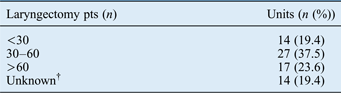
Respondents were asked about their estimated number of laryngectomees (see Table I): 23.6 per cent (17 of 72) had more than 60 patients while 56.9 per cent (41 of 72) had 60 patients or fewer.
Estimated number of laryngectomeesFootnote *
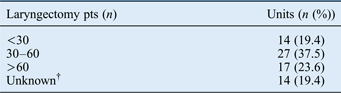
* For 72 units. †Respondents who did not know the number of laryngectomees or who did not respond to this question. Pts = patients
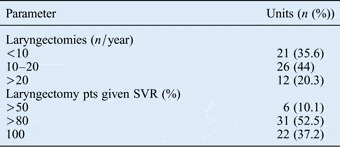
Fifty-nine of the 72 units had associated surgical centres which performed total laryngectomy procedures (see Table II). Of these 59 units, 2 volunteered the information that they performed fewer than 2 laryngectomies per year, whilst 12 performed more than 20 per year. Twenty-six units (44 per cent) performed between 10 and 20 laryngectomies per year. Twenty-two respondents reported that all laryngectomy patients received surgical voice restoration at their unit (Table II). One respondent explained that surgical voice restoration would have been performed if prior funding had been obtained.
Total laryngectomy and surgical voice restoration load in surgical unitsFootnote *

* For 59 units with an associated surgical centre. Pts = patients; SVR = surgical voice restoration
Forty-one of the 72 units (56.9 per cent) provided surgical voice restoration services for other centres, either because there was no local speech and language therapist or clinical nurse specialist available, and for out of hours cover. Three respondents provided a ‘trouble-shooting’ service for colleagues outside their unit who were experiencing difficulties with surgical voice restoration patients.
Immediate post-operative care
Respondents' comments indicated that in 22.2 per cent of units the voice prosthesis was initially fitted by a surgeon, while in the remaining units it was fitted by a speech and language therapist (56 of 72) with assistance from a doctor (12 of 56) or a clinical nurse specialist (8 of 56). All respondents stated that their unit's speech and language therapists were trained to change valves; 35.7 per cent also stated that their unit's doctors and clinical nurse specialists were also thus trained. In just over half the surgical units, there was more than one whole time equivalent speech and language therapist available for laryngectomy care; however, more than 90 per cent of the non-surgical units had less than one whole time equivalent speech and language therapist for this work.
Normal hours service
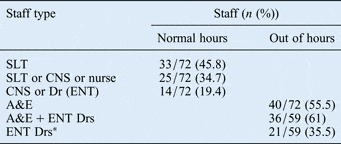
Almost half the units surveyed (45.8 per cent) provided surgical voice restoration services delivered by a speech and language therapist during normal office hours (i.e. 9 a.m. to 5 p.m.) (Table III). In 54.1 per cent of units, surgical voice restoration was also provided by a clinical nurse specialist, nurse or doctor. The service was described as elective and planned in 54.1 per cent of units (40.3 per cent of respondents did not answer this question). A local ‘drop-in’ service was available at 54.1 per cent of units. Respondents' comments indicated that many did not have such a service, preferring patients to call in advance for a telephone consultation prior to attending the department.
Staff providing surgical voice restoration

*ENT doctors contacted directly. SLT = speech and language therapist; CNS = clinical nurse specialist; Dr = doctor; A&E = accident and emergency staff; A&E + ENT Drs = A&E staff plus contacted ENT doctors
As regards furthest distance travelled by patients for a valve change, 65 per cent of respondents stated 20 miles or less. Up to 7 per cent of units had patients needing to travel a maximum distance of more than 20 miles. A large number of units (35.6 per cent) reported a maximum distance of more than 50 miles. Almost 60 per cent of respondents indicated that valve changes could be performed at sites other than the Head and Neck Centre.
Out of hours service
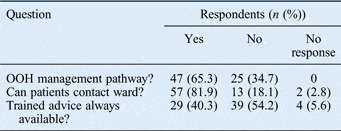
The majority of departments confirmed that they had a care pathway for the management of leakage, displacement, dislodgement and aspiration outside of normal working hours (i.e. 5 p.m. to 9 a.m. on working days, plus weekends and bank holidays) (Table IV). In 81.9 per cent of units, patients could contact the ENT ward out of hours for advice. This was obviously dependent on the unit having an active in-patient head and neck ward; 61.5 per cent of units operating outside a surgical centre did not have such a ward.

The majority of respondents (87.5 per cent) estimated that their unit received fewer than 10 emergency calls about surgical voice restoration problems per month. In 40.3 per cent of units, a trained person was always available to give advice (i.e. 24 hours a day, throughout the year), but this was not the case in 54.2 per cent of units. Surgical units had better provision in this respect, as expected, while 69 per cent of non-surgical units stated that there was not a trained person always available for advice. In 55.5 per cent of units, the ‘in hospital’ source of out of hours advice was the accident and emergency department; this percentage rose to 100 per cent for non-surgical units. Of the 59 respondents from surgical units, 36 volunteered the information that they recommended that patients attend the accident and emergency department but that ENT staff should be contacted for advice, while 21 surgical unit respondents commented that they recommended that ENT doctors be contacted directly in this situation.
Comment on local surgical voice restoration provision
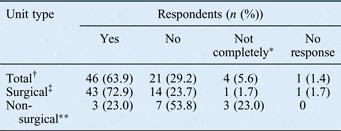
Forty-six of the 72 respondents (63.9 per cent) were happy with their local surgical voice restoration service (72.8 per cent of these 46 respondents were based in surgical units). Of respondents in non-surgical units, 29.2 per cent stated they were not happy with the service, while 4 volunteered the information that they were not completely happy with the service (Table V).
Responses to ‘happy with local surgical voice restoration’ question

*Data represent respondents who volunteered this comment. †n=72; ‡n = 59; **n = 13.
Microsoft Word was used to tabulate data on (1) the constant availability of a trained advisor, and (2) happiness with the local surgical voice restoration service; data were then exported and analysed using the statistical software package R (version 2.11; R Foundation for Statistical Computing, Vienna, Austria). All ‘no’ responses to the question on happiness with the local surgical voice restoration service were excluded from the analysis.
The results of analysis indicated that out of hours care was significantly more available when the speech and language therapy service was attached to a surgical unit (p = 0.002; Fisher's exact test). After grouping together respondents who were not happy with their local surgical voice restoration service plus respondents whose comments indicated that they were not completely happy, we found a similar result: speech and language therapists attached to a surgical unit were significantly more likely to be happy with their local surgical voice restoration provision than respondents attached to a non-surgical unit (p = 0.009, Fisher's exact test).
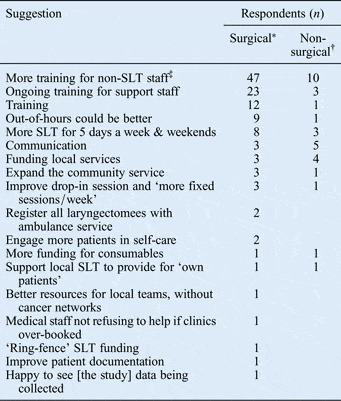
Respondents' suggestions on how their local surgical voice restoration service could be improved are summarised in Table VI.
Suggestions for surgical voice restoration service improvement

*n=59; †n = 13. ‡ENT staff, clinical nurse specialists, nurses, and accident and emergency staff. SLT = speech and language therapy.
Discussion
The high overall response to our surgical voice restoration questionnaire (87.8 per cent) was an indication that the service was seen as important by speech and language therapists. Respondents' answers, and especially their free text comments, indicated that many units believed there was room for improvement in the surgical voice restoration service offered to patients, particularly out of hours. Some centres were still performing small numbers of laryngectomy procedures: 29 per cent of responding units performed fewer than 10 such procedures per year. This can lead to ‘deskilling’ not only surgically but also in terms of ongoing management of voice restoration. Almost all units offered primary surgical voice restoration; however, sadly, one unit indicated that they still had to seek funding approval before offering surgical voice restoration, even though this is considered the gold standard treatment for post-laryngectomy voice restoration.
Survey results indicated that, within normal working hours, the surgical voice restoration service was mainly provided by speech and language therapists and clinical nurse specialists, and utilised an elective, planned approach. As one might expect, there was more provision and coverage during normal working hours than at other times, with some departments cross-covering for others out of hours. Some units also offered cover, within normal working hours, for smaller units where surgical voice restoration services were not available every day. In the majority of units, the provision of surgical voice restoration services was planned and patients were encouraged to telephone prior to attendance. However, some units offered planned and drop-in clinics only weekly or even less frequently.
Out of hours service was provided by accident and emergency, ENT medical and ENT ward nursing staff. These staff members could be expected not to have regular involvement with surgical voice restoration; therefore, we recommend improved training of ward nursing staff and junior ward doctors in the management of leaking and displaced valves. Permanent, ENT-trained nursing staff could be trained in valve replacement, or simply the insertion of stents or a rubber catheter to stabilise the patient until they can be seen by an appropriate professional able to assess the puncture and refit a valve. In addition, the ability to recognise valve problems is a vital part of the ENT specialty training curriculum, and ENT registrars should be able to change the valve or stent the puncture as appropriate. Most units ensured that patients had direct access to ENT staff out of hours, rather than via the accident and emergency department; however, this issue caused concern in some units, with fears that patients with an underlying airway issue may require assistance but be managed in settings without appropriate equipment or ENT-trained staff. Despite this concern, only two-thirds of units had a written pathway guiding the out of hours management of patients with leaking or displaced valves.
The study findings clearly indicate that patient care pathways vary in different areas. In many units, patients had a maximum journey of less than 20 miles to access surgical voice restoration care (this group included all 13 of the speech and language therapy units where surgery was performed off-site). However, in a number of units the maximum patient journey exceeded 50 miles. The care pathways used in these two types of service may differ, both within and outside normal working hours, due to availability of medical and specialist care. However, it should be mandatory that units have a written pathway for the provision of care out of hours, and that this pathway be known to the local ambulance service, accident and emergency departments and healthcare providers.
Some units commented that all their laryngectomy patients were registered with the local ambulance service. This can be invaluable, not only for aphonic laryngectomees phoning for help, but also to ensure that patients are transported to the most appropriate care facility. The current use of Short Message Service ‘texts’ for 999 calls by registered individuals may go some way to achieving this. Other possibilities include the use of pre-programmed voice aids, whereby stock phrases can be recorded and played over the telephone if patients become aphonic.
Surgical voice restoration often needs to be tailored to the individual patient, taking a number of factors into consideration. Such factors include not only the patient's speech ability but also their safety and access to specialist care. Patients can be taught how to change their own valve and how to insert stents to keep the puncture site open. However, a large number of patients are simply unable to perform these tasks, and may, despite all efforts to manage problems expectantly, develop problems at a time when no speech and language therapist is available.
Two-thirds of respondents reported being happy with their local surgical voice restoration service; however, 10 of the 13 respondents from non-surgical units were either unhappy or not completely happy with their service. This is of interest, since one of the concerns raised by the National Association of Laryngectomees is the long distances some patients must travel to access specialised surgical voice restoration care, when they would prefer to receive care closer to home. Our survey results indicated that speech and language therapists who were unattached to surgical units were less happy with their local service, possibly due to lack of medical support and back-up. One could argue that these units should not provide surgical voice restoration care if they are not satisfied with the level of care provided.
An improved service could be provided by designating clinicians who are available for advice. The mistaken belief that only cancer clinicians can manage such patients may drive away highly trained and otherwise available ENT generalists who could provide leadership. Similarly, many acute issues associated with surgical voice restoration and stoma care do not require a cancer specialist, but do require appropriate training to ensure an understanding of the anatomy and physiology involved and an ability to manage the acute situation. A leaking valve can be removed and the tracheoesophageal puncture stented overnight. Mucous plugs and aspiration should be able to be managed by trained individuals (e.g. ENT nursing staff), so appropriate training may achieve the desired improvement. Such training should be targeted at more permanent staff members, rather than junior medical staff in the accident and emergency department, where turnover is high. It would seem reasonable to implement mandatory training in laryngectomee management for a targeted group of individuals, in particular accident and emergency department nursing staff and paramedics.
The provision of surgical voice restoration is a changing field. Many patients with advanced laryngeal cancer now undergo primary chemoradiotherapy, with salvage laryngectomy if needed. These patients often have poorly healing, fibrotic tissues. Those patients who do undergo primary laryngectomy are either unfit for chemoradiotherapy or have advanced symptoms due to late presentation. There can be associated mental health issues, reluctance to seek advice, alcohol dependency and poor nutrition. Both groups offer new rehabilitative challenges and may have more complex problems due to co-morbidity, emphasising the need for highly specialised surgical voice restoration services.
• Surgical voice restoration services vary within and between English Cancer Networks
• Speech and language therapists were surveyed on their unit's service provision
• Surgical unit therapists were happier with service provision levels than non-surgical unit therapists
• Only 65.3 per cent of units had a written pathway for managing laryngectomy emergencies
• Training of staff managing out of hours laryngectomy emergencies is urgently needed
Conclusion
The rehabilitation of head and neck cancer patients remains complex and involves many different groups of healthcare specialists. A MDT approach is essential in order to provide maximal, ongoing care during all stages of the management process: preventive, restorative, supportive and palliative. This study sought to gather information and elicit opinion on the current service provision for laryngectomees receiving surgical voice restoration. Study findings indicated that service provision varied both within and between cancer networks. There is a need for a nationally agreed management protocol addressing prosthetic voice valve problems. There is also a need for education for emergency services staff, and for review of the staffing levels of speech and language therapists providing surgical voice restoration and general services throughout England.
Head and neck cancer rehabilitation is a very patient-dependent service. Therefore, we recommend the establishment of a National Head and Neck Cancer Rehabilitation Forum for England. This forum should include all relevant stakeholders (including patients, carers, commissioners, Primary Care Trust successors, hospitals, speech and language therapists, clinical nurse specialists, ENT surgeons, and the National Association of Laryngectomy Clubs), and should work to ensure that laryngectomy patient rehabilitation is provided uniformly and equitably within and between the 28 English Cancer Networks.
Addendum: Authors' admission of error and apology
During the copy-editing of this manuscript, it was drawn to the attention of the authors that the survey questionnaire contained errors: greater-than (>) signs had been used where less-than (<) signs had been intended, and vice versa. This error had not been remarked upon by respondents during the survey phase of the study, nor by reviewers of the manuscript. The authors feel that the arrangement of possible answers within the questionnaire was such that the authors' original meaning would have been self-evident (i.e. greater-than signs would have been read as less-than signs, and vice versa), and that the information obtained therefore expressed respondents' answers to the intended, rather than verbatim, questions. Thus, the authors believe that the information published in this paper is still valid.
The authors thank the Editors of The Journal of Laryngology & Otology for accepting this apology and publishing their manuscript.
Appendix 1. Surgical voice restoration questionnaire for total laryngectomy and pharyngolaryngectomy
Demographics
Your name:
Status:
Address:
E-mail:
Your hospital (name):
Cancer Centre (name):
Does your unit perform total laryngectomy? Y/N
Number per year? >10, 10–20, >20, More
Do all get SVR? Y/N
? Number
Estimated number of laryngectomees? >30, 30–60, <60
Comments:
What proportion of laryngectomee patients receives SVR? >25%, >50%, >80%, All
Do you provide services for SVR patients from other centres or units? Y/N
Explain?
Why this need?
Immediate post-surgery
Who performs the initial fitting? Doctor (grade – SHO, SpR, Staff G, Con), Nurse, SLT, CNS, other (name)
Comment?
Who is trained to change valves in your unit? Doctor (grade – SHO, SpR, Staff G, Con), Nurse, SLT, CNS, other (name)
Comment?
How many WTE SALT for laryngectomy care alone? >1, 1, 2, 3, <3
Comment?
During the working day (w/d) (09.00–17.00 hrs, Monday–Friday)
During the w/d who provides the SVR service? Doctor (grade – SHO, SpR, Staff G, Con), Nurse, SLT, CNS, other (name)
Is this an elective, planned service? Y/N
Comment?
Or a phone-in service? Y/N
Comment?
Is there a local ‘drop-in service’? Y/N
Comment?
Emergency service (at night (17.00–09.00 hrs), weekends, bank holidays, etc)
Do you have a pathway of management of leaks, displacement, aspiration – out of hours? Y/N
Explain further?
Provide evidence of pathway (paper copy)
Can patients contact the ward for explanations and advice? Y/N
Can you estimate the number of emergency calls about SVR per month? >10, 10–20, <20
Is there always somebody trained available to give advice – 24/7/52? Y/N
If no pathway exists, do you allow 999/ambulance access to HnN Centre out of hours, or direct to A&E? HnN Centre Y/N A&E Y/N
If A& E, who provides the emergency service? A&E staff, ENT SHO, ENT SpR, Ward visit, other
Who provides SVR emergency services? ORL team, SLT, Ward nurses, CNS, A&E dept, other (name)
What is the furthest a patient would need to travel for a valve change? >10, 10–20, <20, <50 miles
Are all valve changes done at HnN Centre only? Y/N or elsewhere (name)
If service is NOT provided as emergency, what can/do patients do?
Explain?
Are you happy with your local SVR service? Y/N
How can it be improved?
Any further comments? (If more paper is required, write on other side)
Can we make further contact if required? Y/N
How? Phone E-mail Mail
Many thanks