INTRODUCTION
Approximately 10% of all affective disorders show a seasonal pattern (SP) of recurrence (Faedda et al. Reference Faedda, Tondo, Teicher, Baldessarini, Gelbard and Floris1993), which is more frequent among bipolar patients (Shin et al. Reference Shin, Schaffer, Levitt and Boyle2005), with some studies reporting seasonality rates higher than 20% (Schaffer et al. Reference Schaffer, Levitt and Boyle2003). In the case of bipolar patients, data about the pattern of seasonality are inconclusive. A study conducted at both hemispheres found a peak for depressive episodes in the autumn, but no seasonality for mania (Silverstone et al. Reference Silverstone, Romans, Hunt and McPherson1995), and another study found a peak for pure mania in early spring and for mixed mania in late summer (Cassidy & Carroll, Reference Cassidy and Carroll2002). However, other studies have found no differences regarding hospitalization rates according to seasonality (Partonen & Lönnqvist, Reference Partonen and Lonnqvist1996).
Twin studies suggest that there is a genetic component behind susceptibility to seasonal changes (Madden et al. Reference Madden, Heath, Rosenthal and Martin1996; Jang et al. Reference Jang, Lam, Livesley and Vernon1997; Hakkarainen et al. Reference Hakkarainen, Johansson, Kieseppa, Partonen, Koskenvuo, Kaprio and Lonnqvist2003), but environmental stimuli, such as exposure to light, may also play a major role, as shown by the fact that seasonality is much more frequent in northern European countries, where light variations are extreme.
Although several aspects of seasonality have been addressed recently, long-term follow-up studies of bipolar patients presenting with SP are scarce. Here we present a 10-year naturalistic follow-up study comparing clinical and demographic features of bipolar patients with and without SP.
METHOD
All patients included in the present study had been enrolled in the systematic prospective follow-up of the Bipolar Disorders Program of the Hospital Clinic, University of Barcelona, for at least 10 years. The Bipolar Disorders Program provides integrated care for difficult-to-treat bipolar patients referred from all over Spain, but also provides clinical care to all bipolar patients coming from a specific catchment area (Eixample Esquerre) in Barcelona. More than 700 out-patients are currently being treated regularly, about two-thirds of them from the catchment area and one-third as tertiary referrals.
This systematic follow-up obtained monthly clinical and sociodemographic data from all patients included in the Bipolar Disorders Program. The procedure was approved by the Ethical and Research Committee of the Hospital Clinic Barcelona. To be included in our database, patients had to provide written informed consent for the collection of their data for research purposes. Confidentiality was always maintained.
For their initial assessment, all patients (and first-degree relatives if possible) enrolled in the Bipolar Disorders Program undergo a non-standardized structured interview where bipolar disorder is diagnosed according to DSM-IV criteria and several clinical variables are obtained, such as number and polarity of previous episodes, hospitalizations, age of onset, age of first hospitalization, polarity of first episode, history of rapid cycling, history of psychosis, suicidal behavior, and medical and psychiatric co-morbidities. Follow-up includes monthly clinical assessments where episodes (relapse or remission) are assessed according to DSM-IV criteria, and severity of symptoms (and subsyndromal symptoms) is rated according to the Young Mania Rating Scale (YMRS), the Hamilton Rating scale for depression (HAMD) and the Clinical Global Impressions (CGI) scale. These data are introduced yearly into the database.
Inclusion criteria for the present study were fulfilling DSM-IV criteria for bipolar I or II disorder and having reliable information about seasonality. Data collection regarding SP started on October 1994 and lasted for the next 10 years. SP was defined according to DSM-IV criteria (see Table 1). Several more variables were specifically assessed: demographic data, predominant polarity as defined by Colom et al. (Reference Colom, Vieta, Daban, Pacchiarotti and Sanchez-Moreno2006), and psychiatric history of first-degree relatives. Information was also recorded about social and occupational functioning and the presence of life-events related to illness onset, assessed by means of the Holmes & Rahe inventory (Reference Holmes and Rahe1967).
DSM-IV criteria for seasonal pattern specifier

Patients with and without SP were compared regarding clinical and sociodemographic variables. Statistical methods consisted of χ2 statistics with Yates' correction or Fisher's exact test for the comparison of categorical data, and Student's t test for normally distributed dimensional variables. Finally, a stepwise logistic regression was performed. All statistics were two-tailed, and significance was set at p<0·05.
RESULTS
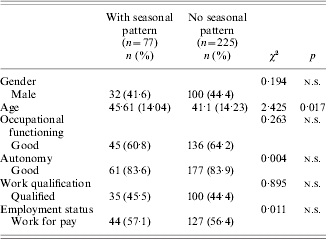
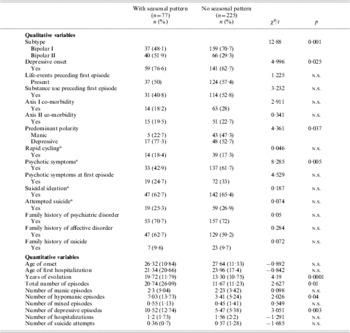
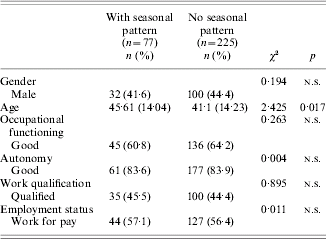
Three hundred and twenty-five consecutive patients (325) were included in the follow-up. Of those, 23 patients (7%) were excluded from the study because it was unclear whether they had seasonality or not. Seventy-seven patients (23·7%) were classified as presenting with SP, while 225 (69·2%) were considered as presenting with no significant seasonal variation. There were no differences between groups regarding demographic variables or global social functioning (see Table 2). Table 3 shows the differences between patients with and without SP regarding clinical features. Patients with SP had bipolar II disorder predominantly. Depressive onset was more common among patients with SP and their predominant polarity was more frequently depressive. SP patients were less likely to have a lifetime history of psychotic symptoms. With regard to other clinical variables, the greater number of episodes due to almost doubling the number of depressive phases among patients with SP is noteworthy, although these patients also showed a longer course of illness.
Demographic and global social functioning variables
n.s., Not significant.
Differential clinical features between patients with and without seasonal pattern

n.s., Not significant.
a Lifetime history.
All the variables that showed statistical significance on binomial statistics were included in a stepwise logistical regression test. This test finally showed how an equation formed by diagnostic subtype (exp β=2·591, p=0·007), years of evolution (β=−0·037, p=0·014) and number of episodes (β=−0·34, p=0·005) accounted for 18% of the variance. The rest of the variables were excluded from the model.
DISCUSSION
Our study links the presence of SP with both bipolar II disorder and a predominant depressive component. Both onset of the illness and predominant polarity, a construct that has recently been shown to be clinically meaningful (Colom et al. Reference Colom, Vieta, Daban, Pacchiarotti and Sanchez-Moreno2006), were found more frequently in patients with SP than in those without SP. Consistent with our results, a recent report from the Systematic Treatment Enhancement Program for Bipolar Disorder (STEP-BD) found greater seasonal fluctuation in bipolar II patients than bipolar I (Friedman et al. Reference Friedman, Gyulai, Bhargava, Landen, Wisniewski, Foris, Ostacher, Medina and Thase2006). SP is defined by the DSM based mainly on the seasonality of major depressive episodes. An individual patient with recurrent manic episodes in a specific season, but suffering non-seasonal depressions, is not classified as seasonal, according to the DSM. Therefore, there is the possibility that the definition of the phenomena itself is biasing our findings. Broadening the criteria to include seasonality for manic episodes would be a step forward for a better understanding of the whole bipolar course.
Dimensional approaches to measuring the severity of seasonality, using tools such as the Seasonal Pattern Assessment Questionnaire (SPAQ), a questionnaire translated and validated into Spanish by our group (Goikolea et al. Reference Goikolea, Miralles, Bulbena Cabre, Vieta and Bulbena2003), could be more sensitive. The Toronto group (Shin et al. Reference Shin, Schaffer, Levitt and Boyle2005) found that bipolar patients defined as non-seasonal (<50% of the episodes were seasonal) still experienced significant seasonal fluctuations. Nevertheless, it is unclear whether seasonal mood variations are directly linked to relapses or not, and a previous study failed to find a correlation between the SPAQ and seasonality according to DSM-III-R (Christensen et al. Reference Christensen, Larsen and Gjerris2003).
A surprising finding, which is probably an artifact, is the longer course of illness found among patients with SP. Of interest, despite having consequently suffered more affective episodes, and especially depressive ones, patients with SP do not show a higher rate of suicidality, more hospitalizations or worse functional outcome, suggesting that episodes may be of milder severity. The predominance of atypical depressions in bipolar II patients with a seasonal pattern could explain this finding to some extent.
Although some studies (Arnold, Reference Arnold2003) report gender differences regarding SP, we did not find such a difference in our study.
The main limitations of our study are the above-mentioned categorical approach to define seasonality and the use of DSM criteria to define SP, without subtyping different forms in an attempt to correlate specific phases of the illness and specific seasons of the year. Another possible bias comes from the whole analysis of patients from the catchment area and patients referred because of more severe or difficult-to-treat disorders.
As a naturalistic study, medication was not controlled, which raises the possibility previously suggested by some authors (Sakamoto et al. Reference Sakamoto, Nakadaira, Kamo and Takahashi1995) that drugs, especially antidepressants, may alter a seasonal course. However, we should take into account that the present study was performed in Catalonia/Spain, a site with relatively minor light fluctuation compared to northern countries, which may have caused underestimation of seasonality, although the higher prevalence of seasonality in northern countries, or even the variation in the prevalence of seasonality according to latitude, is still a matter of debate (Sayer et al. Reference Sayer, Marshall and Mellsop1991; Schaffer et al. Reference Schaffer, Levitt and Boyle2003; Friedman et al. Reference Friedman, Gyulai, Bhargava, Landen, Wisniewski, Foris, Ostacher, Medina and Thase2006).
In conclusion, there is a close link between seasonality and bipolar II disorder. When treating bipolar patients and particularly bipolar II, close attention to seasonality is advised. Patients with SP are more predictable in terms of recurrence, and therefore treatment efforts should be directed towards preventing recurrence, and particularly depressive recurrence, in this subpopulation. Broadening and enriching criteria to define seasonality could improve the understanding of the course of bipolar disorder, providing useful information for a better form of treatment.
ACKNOWLEDGEMENTS
This work was supported by grants from the Spanish Ministry of Health, Instituto de Salud Carlos III (FIS:PI050206), RETICS RD06/0011 (REM-TAP Network) and the Stanley Medical Research Institute (Bethesda, USA).
DECLARATION OF INTEREST
None.