Introduction
Prevalence of disinhibited behaviors
Disinhibited behaviors are reported far less often than other behavioral and psychological symptoms of dementia (BPSD) and where they are reported, prevalence rates are inconsistent. Higher prevalence has been found in residential care than in community settings and in people with more severe cognitive impairment (Baikie, Reference Baikie2002), though disinhibition can also occur in people with milder symptoms. By contrast, a retrospective cross-sectional study found higher prevalence of disinhibited behaviors in mild cognitive impairment prior to a diagnosis of Alzheimer’s disease (AD) (Alagiakrishnan et al., Reference Alagiakrishnan2005). This study also found disinhibition was associated more with vascular dementia compared to AD. The presence of sexual disinhibition in people living with dementia has been reported as between 1.8% and 25% (Chapman and Spitznagel, Reference Chapman and Spitznagel2019); apathy and indifference to sex are reported more frequently (de Giorgi and Series, Reference de Giorgi and Series2016). Earlier studies report more frequent occurrence of sexual disinhibition in older men (Harris and Wier, Reference Harris and Wier1998), whereas later studies report equal frequency in men and women (Series and Dégano, Reference Series and Dégano2005).
What are disinhibited behaviors?
The construct of disinhibited behavior refers to an individual’s ability to self-control or regulate their behavior and has been associated with a range of psychopathologic conditions, health behaviors, and public health concerns (Mullins-Sweatt et al., Reference Mullins-Sweatt, DeShong, Lengel, Helle and Krueger2019). Examples include substance use disorders, unhealthy eating and obesity, though research focusing on the role of dementia on disinhibition is relatively sparse. Definitions of disinhibited behaviors associated with dementia and their measurement vary across the literature and professional organizations (e.g. Dementia Australia, 2021). Disinhibited behaviors come under the broader term of BPSD (also referred to as changed behaviors, responsive behaviors, and neuropsychiatric symptoms). BPSD include agitation, aggression, apathy, depression, delusions, disinhibited behaviors, hallucinations, and sleep disturbances. Agitation and aggression are sometimes ascribed to disinhibition, and other times disinhibited behaviors are described as distinct behaviors. Disinhibited behaviors also include impulsive behaviors, such as gambling, increased online shopping and risk taking, particularly in frontotemporal dementia (FTD) (Cipriani et al., Reference Cipriani, Cammisuli, Danti and Fiorino2016), and sexually disinhibited behavior (e.g. Canevelli et al., Reference Canevelli, Talarico, Tosto, Troili, Lenzi and Bruno2013; Mendez et al., Reference Mendez, Shapira, McMurtray and Licht2007; Segrec et al., Reference Segrec, Zaman and Pregelj2016). Sexual disinhibition (also termed inappropriate sexual behavior and hypersexuality) is characterized by inappropriate sexual behaviors (Chapman and Spitznagel, Reference Chapman and Spitznagel2019) that include inappropriate verbal and physical behaviors and hypersexuality (i.e. increased libido). Other disinhibited sexually related behaviors include cuddling, touching of genitals, sexual remarks, propositioning, grabbing, groping, use of obscene language, and masturbating (Nagaratnam and Gayagay, Reference Nagaratnam and Gayagay2002). These are more likely to cause concern when they arise in inappropriate contexts in which they are displayed (i.e. in front of other residents, families, and carers and when the behavior causes discomfort for others or involves others without their consent). Disinhibited behaviors also include intrusiveness and Witzelsucht (disinhibited humor) (Stewart, Reference Stewart2018). Inconsistent definitions and conceptualizations may explain inconsistent rates of occurrence (Sachdev, Reference Sachdev2017). Other important factors to consider are context and consent rather than the behavior per se, where acceptable behaviors are considered inappropriate because they are being performed publicly.
Effects of disinhibited behaviors
Disinhibited behaviors can cause significant distress to those experiencing them and people around them (Chapman and Spitznagel, Reference Chapman and Spitznagel2019). Disinhibited behaviors, particularly those of a sexual nature, remain highly controversial and labeling them as occurring due to illness may have enormous individual, cultural, and medico-legal implications (Nagaratnam and Gayagay, Reference Nagaratnam and Gayagay2002). As with other BPSD, families and carers may not always understand why certain behaviors occur, or that behaviors are not necessarily willful. Lack of understanding and miscommunication can lead to others responding to BPSD in unhelpful ways which can exacerbate behaviors. The associations between cognitive function and sexual behavior in healthy aging and dementia are complex as cognitive decline is often associated with diminished sexual behavior (Hartmans et al., Reference Hartmans, Comijs and Jonker2014).
Aims of this research
The aim of this research is to systematically review the efficacy of pharmacological and nonpharmacological interventions for disinhibited behaviors in dementia.
Methods
Search methods
Relevant studies published between 2002 and March 2020 were sourced by searching electronic databases: MEDLINE, EMBASE, PsychINFO, Social Work Abstracts, and the Cochrane Central Register of Controlled Trials. Studies that included outcome measures relevant to disinhibited behaviors [e.g. the disinhibition subscale of the Neuropsychiatric Inventory (NPI), Frontal Behavioral Inventory (FBI), and Cohen–Mansfield Agitation Inventory (CMAI)] were included in this review. Searching for papers published since 2002 was done to capture research published since a previous review (Alkhalil et al., Reference Alkhalil, Tanvir, Alkhalil and Lowenthal2004) allowing for gaps between reviews being conducted and published.
Search terms were BPSD OR behav* psychological symptoms dementia OR challenging behav* OR disturbing behav* OR difficult behav* OR disruptive behav* OR behav* concern OR agitat* OR restles* OR pacing OR resist* OR apathy OR social* disinhibiti* OR sexual* disinhibiti* OR catastrophic reaction OR verbal outbursts OR screaming OR delusion OR hallucination OR anxiety OR depression OR neuropsychiatr* symptoms AND psychosocial management OR psychosocial intervention OR psychosocial treatment OR pharmacological management OR pharmacological intervention OR pharmacological treatment OR nonpharmacological management OR nonpharmacological intervention OR nonpharmacological treatment AND dementia OR alzheim* OR lewy bod* OR fronto-temporal OR frontotemporal.
Eligibility criteria and study selection
Two reviewers (CB and KB) hand-searched titles and abstracts for reviews and original articles including case reports, cohort studies, and randomized controlled trials (RCTs) for pharmacological or nonpharmacological interventions with outcomes relevant to social and/or sexual disinhibition in dementia. Studies focused on people with brain-related conditions other than dementia or involving animal research and those not in English were excluded. The quality of studies was rated by authors CB and KB based on the study design, participant characteristics, outcome measures, and statistical analyses by adapting previously used tools (e.g. Verhagen et al., Reference Verhagen1998). The tool reflected changes in the research landscape (e.g. more eligible intervention studies of higher research quality) and ensured quality ratings reflected ability to determine potential statistical and clinical significance. Points were given based on study design and statistical analysis (see Supplementary Material S1). Discrepancies were discussed between researchers until consensus was reached. Total scores on the quality rating tool ranged from 0 to 16 (i.e. scores 0–5 indicated modest, 6–10 moderate, and 11–16 strong quality of research).
Effect sizes for RCTs were included where provided or Cohen’s d was calculated where sufficient data were available such as means and standard deviations (see Table 1). Cohen’s d is the difference in the means divided by the pooled, or average, of the two groups, where d = 0.2 is considered a small, 0.5 a medium, and 0.8 or more a large effect. Where medians and confidence intervals were provided, we used Cochrane methods and those developed by Wan et al. to convert these into means and standard deviations, from which we were then able to calculate effect sizes (Chinn, Reference Chinn2000; Wan et al., Reference Wan, Wang, Liu and Tong2014).
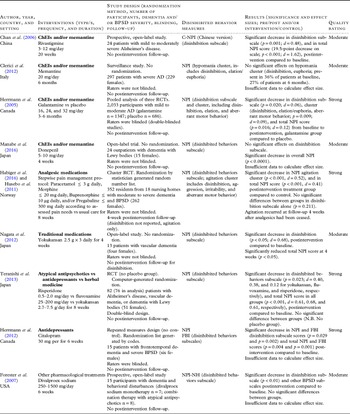
Pharmacological intervention studies that measured disinhibited behaviors in dementia (ordered by class, then alphabetically; blue shows studies that reduced disinhibited behaviors)

AD, Alzheimer’s disease; BPSD, behaviors and psychological symptoms associated with dementia; ChEIs, cholinesterase inhibitors; FBI, Frontal Behavioral Inventory; NPI, Neuropsychiatric Inventory.
Results
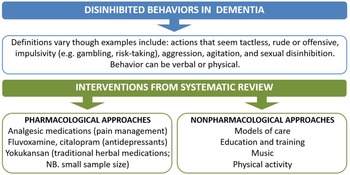
Articles were searched in accordance with PRISMA guidelines (Figure 1). In total 29,406 studies were found through the database search of studies published from 2002 to March 2020. Following removal of duplicates, article screening and removal of studies that did not measure disinhibited behaviors, 30 studies remained that included measures of disinhibited behaviors in dementia, of which 9 involved pharmacological interventions (Table 1) and 21 were nonpharmacological interventions (Table 2). Twenty were excluded when calculating the average effect size; 14 were not RCTs and 6 had insufficient data to calculate the effect size (Figures 1 and 2).
PRISMA flow diagram.

Results from this systematic review: effective approaches for reducing disinhibited behaviors in dementia.

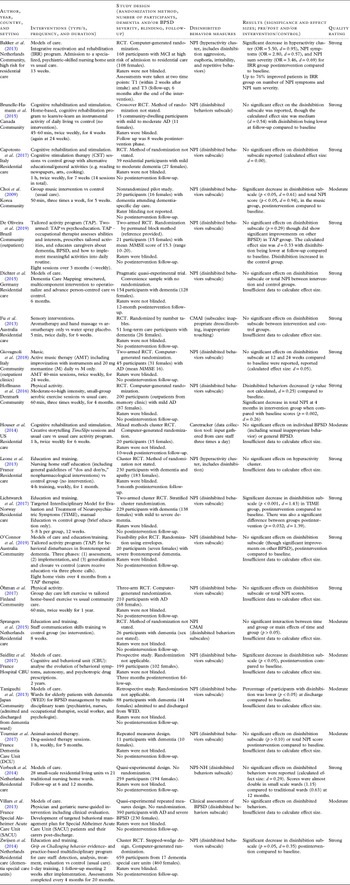
Nonpharmacological intervention studies that measured disinhibited behaviors in dementia (blue shows studies that reduced disinhibited behaviors)

AD, Alzheimer’s disease; BPSD, behaviors and psychological symptoms associated with dementia; CMAI, Cohen–Mansfield Agitation Inventory; NPI, Neuropsychiatric Inventory; MCI, Mild cognitive impairment; MMSE, Mini-mental state examination.
Most studies that included outcome measures relevant to disinhibited behaviors used the NPI subscale or hyperactivity cluster. Other measures used were the FBI and CMAI subscales for disinhibited behaviors.
Pharmacological intervention studies
Nine studies, including three RCTs, investigated the effects of pharmacological approaches on disinhibited behaviors (measured using the subscales or clusters of the NPI and/or FBI) in people living with dementia (Table 1; Figure 2). Seven studies (2,825 participants, total number of females is not clear) demonstrated significantly reduced disinhibited behaviors following a pharmacological intervention (Chan et al., Reference Chan, Chan and Li2006; Forester et al., Reference Forester2007; Habiger et al., Reference Habiger, Flo, Achterberg and Husebo2016, Herrmann et al., Reference Herrmann, Rabheru, Wang and Binder2005, Reference Herrmann, Black, Chow, Cappell, Tang-Wai and Lanctot2012; Nagata et al., Reference Nagata2012; Teranishi et al., Reference Teranishi2013). The overall research quality was strong (see Supplementary Material S1 for scoring criteria). The mean effect size of the three pharmacological RCTs for reducing disinhibited behaviors was small to medium (Cohen’s d = 0.27). No follow-up data were available. Dementia diagnoses included AD, vascular dementia, and FTD of moderate to severe severity.
None of these studies had disinhibition as a primary outcome. In a cluster-randomized RCT, level of pain was positively associated with disinhibition at baseline (OR: 1.18; p < 0.001) (Habiger et al., Reference Habiger, Flo, Achterberg and Husebo2016). Following an intervention of analgesics, agitation was significantly reduced, but there was no effect on the disinhibition subscale (Husebo et al., Reference Husebo, Ballard, Sandvik, Nilsen and Aarsland2011). Pharmacological agents resulting in significantly reduced disinhibited behaviors were atypical antipsychotics (e.g. risperidone; Teranishi et al., Reference Teranishi2013) and antidepressants (e.g. citalopram; Herrmann et al., Reference Herrmann, Black, Chow, Cappell, Tang-Wai and Lanctot2012). However, three studies were uncontrolled (Chan et al., Reference Chan, Chan and Li2006; Clerici et al., Reference Clerici2012; Nagata et al., Reference Nagata2012), and three had small sample sizes (Chan et al., Reference Chan, Chan and Li2006; Herrmann et al., Reference Herrmann, Rabheru, Wang and Binder2005; Manabe et al., Reference Manabe, Ino, Yamanaka and Kosaka2016; Nagata et al., Reference Nagata2012). Three studies of cholinesterase inhibitors and memantine found no significant effects (Clerici et al., Reference Clerici2012; Manabe et al., Reference Manabe, Ino, Yamanaka and Kosaka2016; Teranishi et al., Reference Teranishi2013). Two studies showed evidence for traditional Asian herbal medications (e.g. yokukansan). Only 13 participants were recruited in one open-label study investigating the effects of yokukansan (Nagata et al., Reference Nagata2012). In the other study, that did not include a placebo group, risperidone and yokukansan groups had larger effect sizes than the fluvoxamine group though all three groups improved (Teranishi et al., Reference Teranishi2013) (Table 1).
Nonpharmacological intervention studies
Twenty-one studies, including 14 RCTs (seven with sufficient information to calculate effect sizes), reported the effects of nonpharmacological approaches on disinhibited behaviors measured on the NPI subscale (Table 2; Figure 2); disinhibition was not a primary outcome measure in any of these studies. Seven studies (1,563 participants; 955 female), including four RCTs, demonstrated significantly reduced disinhibited behaviors following a nonpharmacological intervention (Bakker et al., Reference Bakker, Duivenvoorden, Van Der Lee, Olde Rikkert, Beekman and Ribbe2013; Choi et al., Reference Choi, Lee, Cheong and Lee2009; Hoffmann et al., Reference Hoffmann2016; Lichtwarck et al., Reference Lichtwarck2017; Saidlitz et al., Reference Saidlitz, Sourdet, Voisin and Vellas2017; Taniguchi et al., Reference Taniguchi2013; Zwijsen et al., Reference Zwijsen2014). Effects in the remaining 14 studies were not significant (Öhman et al., Reference Öhman2017; Brunelle-Hamann et al., Reference Brunelle-Hamann, Thivierge and Simard2015; Capotosto et al., Reference Capotosto2017; Dichter et al., Reference Dichter2015; Fu et al., Reference Fu, Moyle and Cooke2013; Giovagnoli et al., Reference Giovagnoli, Manfredi, Schifano, Paterlini, Parente and Tagliavini2018; Houser et al., Reference Houser, George and Chinchilli2014; Leone et al., Reference Leone2013; O’Connor et al., Reference O’Connor2019; Sprangers et al., Reference Sprangers, Dijkstra and Romijn-Luijten2015; Tournier et al., Reference Tournier, Vives and Postal2017; Verbeek et al., Reference Verbeek, Zwakhalen, van Rossum, Ambergen, Kempen and Hamers2014; Villars et al., Reference Villars2013; de Oliveira et al., Reference de Oliveira2019).
Of the seven studies that reported significant associations, three involved models of care (see Table 2) (Bakker et al., Reference Bakker, Duivenvoorden, Van Der Lee, Olde Rikkert, Beekman and Ribbe2013; Saidlitz et al., Reference Saidlitz, Sourdet, Voisin and Vellas2017; Taniguchi et al., Reference Taniguchi2013), two involved education and/or training of care staff (Lichtwarck et al., Reference Lichtwarck2017; Zwijsen et al., Reference Zwijsen2014), one used a music-based approach (Choi et al., Reference Choi, Lee, Cheong and Lee2009), and one was a physical activity intervention (Hoffmann et al., Reference Hoffmann2016). One study was in a residential care setting (Lichtwarck et al., Reference Lichtwarck2017), one was in a dementia special care unit (Zwijsen et al., Reference Zwijsen2014), one was community-based following a hospital intervention (Saidlitz et al., Reference Saidlitz, Sourdet, Voisin and Vellas2017), one in day care services (Choi et al., Reference Choi, Lee, Cheong and Lee2009), and three in the community (Bakker et al., Reference Bakker, Duivenvoorden, Van Der Lee, Olde Rikkert, Beekman and Ribbe2013; Hoffmann et al., Reference Hoffmann2016; Taniguchi et al., Reference Taniguchi2013). Severity of dementia or disinhibition ranged from mild to severe; people with mild cognitive impairment were included in one study (Bakker et al., Reference Bakker, Duivenvoorden, Van Der Lee, Olde Rikkert, Beekman and Ribbe2013).
The research quality for the 21 studies was strong (see Supplementary Material S1 for scoring criteria). The mean effect size of the seven nonpharmacological RCTs (included both effective and ineffective studies, where sufficient information was provided) for reducing disinhibited behaviors was medium (Cohen’s d = 0.49). Follow-up data available from two studies using models of care reported a significant decrease on the hyperactivity cluster at 6 months following the end of the 13-week community-based intervention (Bakker et al., Reference Bakker, Duivenvoorden, Van Der Lee, Olde Rikkert, Beekman and Ribbe2013) and 3 months after returning home from a hospital-based intervention (Saidlitz et al., Reference Saidlitz, Sourdet, Voisin and Vellas2017).
Models of care and educational training led to significant decreases in NPI symptom clusters including disinhibited behaviors in two studies from the Netherlands (Bakker et al., Reference Bakker, Duivenvoorden, Van Der Lee, Olde Rikkert, Beekman and Ribbe2013; Zwijsen et al., Reference Zwijsen2014). Studies that reported the highest effect sizes are discussed in more detail in the following section. The highest effect size was observed in an educational training study (Cohen’s d = 1.43; see Table 2) using a manualized Targeted Interdisciplinary Model for Evaluation and Treatment of Neuropsychiatric Symptoms (TIME) (Lichtwarck et al., Reference Lichtwarck2017). The 12-week TIME intervention included overlapping phases of registration and assessment (including medical examination, pain assessment, and daily monitoring of symptoms), guided systematic reflection (between the leading registered nurse and physician resulting in a detailed treatment plan), and action and systematic evaluation in 229 participants living in residential care. These phases were adapted from problem-solving methods used in Cognitive Behavioral Therapy. Disinhibition, as measured by the NPI subscale, was significantly reduced postintervention compared to baseline with a large effect size (p < 0.001, d = 1.43).
A large effect size (d = 0.95; Table 2; converted using methods described in Chinn, Reference Chinn2000), rated on the NPI hyperactivity cluster, was also observed in an integrative reactivation and rehabilitation (IRR) program which was provided to a total care home sample of 160 participants, randomly assigned to receive IRR for 13 weeks or usual care (Bakker et al., Reference Bakker, Duivenvoorden, Van Der Lee, Olde Rikkert, Beekman and Ribbe2013). IRR is a person-orientated psychotherapeutic intervention created for each patient and caregiver based on six dimensions: emotion, personality, life events, social functioning, cognitive functioning, and somatic functional disorders.
The Grip on Challenging Behavior care program (Zwijsen et al., Reference Zwijsen2014) also reported a significant decrease in disinhibition with a small to medium effect size (d = 0.35) when comparing baseline to postintervention measures. The program consisted of multidisciplinary assessment procedures and tools involving four steps: (1) detection of BPSD in daily care and screening every 6 months, (2) systematic analysis of contributing factors, coordinated by psychologist or physician, (3) treatment including psychosocial approaches, staff training, treatment of somatic comorbidity, and administration of psychoactive drugs, and (4) evaluation of treatment in regular multidisciplinary team meetings (including nursing staff, psychologist, physician, and so forth). One full day of training about the four steps preceded implementation with a follow-up meeting 2 weeks later. Assessments were completed every 4 months for 20 months.
A 16-week RCT of the effects of moderate to high intensity exercise in 200 participants with mild AD in a community setting (Hoffmann et al., Reference Hoffmann2016) significantly favored the exercise group over the control postintervention (mean change in NPI: −3.5, p = 0.007, d = 0.26). In the study, arm effect size analysis showed this was driven by a general effect on NPI subitems including disinhibition (p = 0.002; d = 0.25), agitation, aberrant motor behavior, and night-time behavior change (Hoffmann et al., Reference Hoffmann2016).
Case studies
Nine case studies/series used pharmacological approaches for disinhibited behaviors in dementia, namely rivastigmine (Alagiakrishnan et al., Reference Alagiakrishnan, Sclater and Robertson2003), atypical antipsychotics olanzapine (Dhikav et al., Reference Dhikav, Anand and Aggarwal2007) and quetiapine (Prakash et al., Reference Prakash, Pathak, Munda and Bagati2009), antidepressant citalopram (Tosto et al., Reference Tosto, Talarico, Lenzi and Bruno2008), gabapentin (Alkhalil et al., Reference Alkhalil, Hahar, Alkhalil, Zavros and Lowenthal2003), carbamazepine (Freymann et al., Reference Freymann, Michael, Dodel and Jessen2005), divalproex (Tune and Rosenberg, Reference Tune and Rosenberg2008), yokukansan (Kimura et al., Reference Kimura, Hayashida, Furukawa, Miyauchi and Takamatsu2009), and medroxyprogesterone acetate, a type of female hormone (Light and Holroyd, Reference Light and Holroyd2006). The prescription of hormonal therapy is controversial, and depending on the jurisdiction, it may require consent from a tribunal or board.
Observed improvements were reported for general disinhibited behaviors in studies using gabapentin (Alkhalil et al., Reference Alkhalil, Hahar, Alkhalil, Zavros and Lowenthal2003), citalopram (Tosto et al., Reference Tosto, Talarico, Lenzi and Bruno2008), yokukansan (Kimura et al., Reference Kimura, Hayashida, Furukawa, Miyauchi and Takamatsu2009), and specifically in three studies for sexual disinhibited behaviors using rivastigmine (Alagiakrishnan et al., Reference Alagiakrishnan, Sclater and Robertson2003), olanzapine (Dhikav et al., Reference Dhikav, Anand and Aggarwal2007), and medroxyprogesterone acetate (Light and Holroyd, Reference Light and Holroyd2006). Two studies using gabapentin and citalopram showed continued improvements in behavior if patients remained on treatment (Alkhalil et al., Reference Alkhalil, Hahar, Alkhalil, Zavros and Lowenthal2003; Tosto et al., Reference Tosto, Talarico, Lenzi and Bruno2008).
Discussion
Summary of findings
For the qualitative synthesis, we present findings from 30 studies (including 17 RCTs) where 14 out of the 30 total studies were significantly effective in reducing disinhibited behaviors in dementia. There were 10 RCTs in the quantitative synthesis, where the effect size for nonpharmacological was greater than for pharmacological approaches (mean Cohen’s d = 0.49 and 0.27, respectively). Previous research in this area has been criticized for basing conclusions on individual case studies. We also highlight discrepancies between findings from single-case studies and larger trials. In summary, effective pharmacological approaches included pain management, antipsychotics, and antidepressants; effective nonpharmacological approaches included models of care, education, and training and physical activity. Compared to pharmacological approaches, nonpharmacological RCTs showed higher effect sizes, particularly models of care, education and training and music approaches that were embedded within a therapeutic framework (see Tables 1 and 2). Interventions yielding the highest effect sizes are described in the Results. Case studies highlight the heterogeneity of dementia and associated disinhibited behaviors, where each case should lead to creative individualized solutions (Tune and Rosenberg, Reference Tune and Rosenberg2008).
Assessment ratings
The NPI was the most used tool in this systematic review and includes a measure of disinhibited behaviors (Cummings et al., Reference Cummings, Mega, Gray, Rosenberg-Thompson, Carusi and Gornbein1994). The NPI has been adapted into several versions (nursing home, informant, and clinician; NPI-NH, NPI-Q, and NPI-C, respectively) and languages. When considering disinhibited behaviors, the NPI-C version includes several general questions addressing occurrence within the past 4 weeks: “Does (person’s name) seem to act impulsively without thinking? Does (person’s name) do or say things that are not usually done or said in public? Doe he/she do things that are embarrassing to others?,” with the option to answer “yes/no” (de Medeiros et al., Reference de Medeiros2010). This is followed by several subquestions relating to sexually disinhibited behaviors and loss of impulse control.
A review focusing on sexual disinhibition (Chapman and Spitznagel, Reference Chapman and Spitznagel2019) acknowledged the need for consistency and a gold standard approach in their evaluation of 20 tools. The review reported that no single measure addressed all subdomains of behaviors (e.g. hypersexuality, inappropriate sexual advances, inappropriate sexual comments, and socially disruptive sexual behavior). Behavior prior to dementia onset should also be considered to ensure such behaviors are new (considering different social and cultural factors) and are indeed associated with dementia and not explained by other factors (e.g. individual differences). Adequate attempts to capture, measure, and interpret these behaviors are required so that effects of management approaches can be evaluated. Other instruments that include disinhibition scales are the FBI and CMAI. The CMAI is most often used to measure agitation in dementia (Keszycki et al., Reference Keszycki, Fisher and Dong2019). The FBI distinguishes between FTD and other subtypes, though as discussed previously, disinhibited behaviors can occur in any dementia subtype.
Critical analysis of the literature
The studies in this review did not address disinhibited behaviors specifically (i.e. disinhibition was not a primary outcome measure). Most disinhibited behaviors were captured using the NPI, with limitations that have been previously discussed (Lai, Reference Lai2014). Models of care and education often included multicomponent approaches (i.e. person-centered care), sometimes combined with pharmacological approaches (e.g. medication review and management; see Zwijsen et al., Reference Zwijsen2014). This makes it difficult to tease apart pharmacological and nonpharmacological approaches, although the emphasis is generally on only using pharmacological approaches when there is no effective nonpharmacological approach. Many of the studies did not have a placebo group, which is a limitation, particularly given that there is typically a high placebo response rate or natural improvement with some nonpharmacological approaches. A conceptual framework describing the underlying mechanisms of disinhibition is also lacking, which may help guide what approaches will be most effective for whom and with what subtypes of disinhibited behaviors.
Limitations of this review
Despite a comprehensive list of terms, it is possible we may have missed studies of interest that used different terms to “disinhibition” (e.g. “compulsive” and “impulsive” behaviors), though “disinhibition” is the more often used term. We were unable to complete a full meta-analysis due to high heterogeneity across studies, While we provided effect sizes from individual studies and present mean effect sizes from RCTs as a guide, the lack of placebo-controlled trials mentioned above, and the great heterogeneity across studies, means that interpretation of these values should be taken with caution. In our review, the subdomains of disinhibited behaviors (e.g. vocal, physical, and sexual) were not reported. It is unclear whether this is because subdomain measures were not analyzed or whether they were not reported because no effects were observed. Appropriate measurement tools and studies focusing on disinhibition as the primary outcome are sorely lacking.
Conclusion and future directions
As with other BPSD, emphasis should be on tailoring approaches to the individual person (Burns et al., Reference Burns, Jayasinha, Tsang and Brodaty2012), while considering cultural, religious, societal views, and medicolegal issues (Joller et al., Reference Joller, Gupta, Seitz, Frank, Gibson and Gill2013). The nonpharmacological RCTs reported higher effect sizes than the pharmacological interventions (mean Cohen’s d = 0.49 and 0.27, respectively) and should be used first. Drug therapy should be reserved for use when nonpharmacological strategies have failed and then only used if necessary and in the short term. Clinicians need to consider the drug’s toxicity profile and adverse effects and ensure to communicate potential harms as well as benefits to family and caregivers and document all discussions that take place. All interventions should respect the rights of the person living with dementia, the views of family caregivers and jurisdictional regulations about informed consent.
Acknowledgements
This research was funded by the Dementia Centre for Research Collaboration and supported by the Australian Government, National Health and Medical Research Council.
Conflict of interest
CB and KB – none. HB has been a consultant for Biogen, Nutricia Australia, Roche, and Skin2Neuron.
Description of authors’ roles
C. Burley designed the study, collected data, carried out quality ratings, analyzed the data, and drafted the article. K. Burns collected data, carried out quality ratings, analyzed data, and assisted with writing the article. H. Brodaty designed the study, supervised data collection, and assisted with writing the article. All authors reviewed and authorized the final version of the article.
Supplementary material
To view supplementary material for this article, please visit https://doi.org/10.1017/S1041610222000151