Although there is no single definition of disruptive behavior, the term is consistently conceptualized across the literature as behaviors that disrupt the teaching-learning process or those that interfere with the orderly functioning of the class (Álvarez Martino, Álvarez Hernández, Pañeda, & De Mesa, 2016; Thompson, Reference Thompson2009). These disruptive behaviors may be, for example, talking loudly, shouting, skipping class or being late to class, disrupting class, disrespecting the teacher, whispering, laughing,… and a host of other minor acts listed across the educational literature (Uruñuela, Reference Uruñuela2007). These behaviors, often referred to by teachers as “undisciplined”, are generally relatively mild in character and cannot be considered as aggressive or violent.
This lack of conceptual delimitation causes the meaning of the term “disruptive student” to be usually subject to the interpretation and evaluation of each teacher. In this sense, those behaviours that one teacher may consider as disruptive, another teacher may consider them as normal behaviors (Reed & Kirkpatrick, Reference Reed and Kirkpatrick1998). In any case, teachers claim to waste a great deal of teaching time dealing with students’ behavioral problems (Reynolds, Stephenson, & Beaman, Reference Reynolds, Stephenson and Beaman2011), especially in secondary education.
In short, disruption is perhaps one of the phenomena that occur in a classroom that most seriously interferes with students’ learning and that can have a strong negative impact on teachers and, consequently, on the quality of teaching (Galand, Lecocq, & Philippot, Reference Galand, Lecocq and Philippot2007).
Disruption and its relationship with teachers’ stress and burnout
As mentioned above, disruption refers to situations produced in the classroom in which some students hinder the normal development of the class with their behavior. As a consequence, teachers need to use more and more time to control the discipline and order in their classrooms, resulting in a progressive psychological burnout of the teacher. As an example, a survey carried out in Spain by the Teachers Federation (FETE-UGT, 2010) on a sample of 1,223 teachers and school principals from public, semi-private and private schools, revealed that 37.4% of teachers consider themselves to be stressed or very stressed by the interaction with their students (between 7 and 10 points on a scale of 1 to 10).
Thus, and even considering the existence of other variables unrelated to teachers or schools, students’ behavioral and disciplinary problems have been consistently identified as one of the main sources of teacher stress and burnout. Significant correlations have been found between discipline problems and the three dimensions of burnout (Skaalvik & Skaalvik, Reference Skaalvik and Skaalvik2007), especially between the dimension of emotional exhaustion, followed by depersonalization. As for personal accomplishment, Aloe, Shisler, Norris, Nickerson and Rinker’s (Reference Aloe, Shisler, Norris, Nickerson and Rinker2014) recent meta-analysis shows that it is negatively related to teacher burnout, so that when disruptive behavior increases, the teacher’s personal accomplishment feelings decrease.
Researchers agree that daily experiences of negative emotions brought on by chronic stressors are key processes in the development of burnout (Spilt, Koomen, & Thijs, Reference Spilt, Koomen and Thijs2011). Thus, repeatedly experiencing discipline problems with students can lead to emotional exhaustion and to the expectation of future problems, which in turn can cause stress, concern and anxiety in teachers (Skaalvik & Skaalvik, Reference Skaalvik and Skaalvik2011). In addition, students’ disruptive behavior may pose a threat to the achievement of the teacher’s goals, whether they are maintaining order in their classrooms, following the academic program, managing their students’ behavior, or helping their students achieve their educational goals.
In terms of efficiency, research also shows that teachers spend a considerable amount of their teaching time on behavior management and that using ineffective strategies to control disruption causes higher levels of stress (Clunies-Ross, Little, & Kienhuis, Reference Clunies-Ross, Little and Kienhuis2008). In this sense, the emotional exhaustion dimension is particularly important because emotional exhaustion is likely to hinder the teacher’s use of effective strategies to reduce student misbehavior and to increase the use of punitive practices (Bibou-Nakou, Stogiannidou, & Kiosseoglou, Reference Bibou-Nakou, Stogiannidou and Kiosseoglou1999), which may, in turn, increase student disruption.
The relationship between disruptive behavior and teacher burnout is dynamic and is influenced by the teacher’s assessment of the student’s behavior, by the perception of his/her own effectiveness, by the methods used for behavior control, and by the resulting impact on behavior, relationships and classroom climate. The management of disruptive behavior by the teacher affects not only the behavior itself but also the classroom climate and the teacher-student relationships (Marzano, Marzano, & Pickering, Reference Marzano, Marzano and Pickering2003). Thus, a poor teacher-student relationship and low teacher emotional support, as perceived by students, may also increase conflict and disruptive behavior in the classroom (Bru, Stephens, & Torsheim, Reference Bru, Stephens and Torsheim2002).
For these reasons, students’ disruptive behaviors are recognized as important stressors within teaching, ahead of factors such as organizational variables, role ambiguity or administrative pressures. In all these cases, students’ negative behavior emerges as the strongest predictor of teacher burnout (Hart, Wearing, & Conn, Reference Hart, Wearing and Conn1995).
Research on teacher stress indicates that none of the causes associated with burnout can be separated from teachers’ perceptions and actually interact with them (Haberman, Reference Haberman2005). In this sense, the teacher’s perception and evaluation of what is happening is what gives meaning and sense to the experience of stress and/or burnout. Therefore, student behavioral problems do not necessarily lead to stress, and different teachers will exhibit different levels of stress when faced with similar levels of disruption. In turn, students considered as disruptive by some teachers are engaged in and work hard in other teachers’ classrooms, emphasizing the highly individualized and dyadic nature of this relationship (Greene, Beszterczey, Katzenstein, Park, & Goring, Reference Greene, Beszterczey, Katzenstein, Park and Goring2002).
Discomfort with the school or lack of job satisfaction
Teachers play a crucial role in the education system. They are responsible for engaging students in school tasks and promoting their learning (Organización para la Cooperación y el Desarrollo Económicos [OCDE], 2014). Therefore, it is inevitable that the degree of satisfaction (or dissatisfaction) of these teachers will have an effect on the good (or bad) functioning of the school. Teacher dissatisfaction reduces student’s engagement with his/her work and also has a negative impact on student motivation (Galand et al., Reference Galand, Lecocq and Philippot2007).
The effect that disruption can have on teacher discomfort can be best understood if the causes of satisfaction are delved into by consulting the Spanish INCE report (Instituto Nacional de Evaluación y Calidad del Sistema Educativo, 2003). The results of this report reflect that, for most of these teachers, the main sources of satisfaction during the performance of their job are within the area of relationships: with their students, with their peers, and with the management team. This implies that situations of teacher exclusion and isolation, and lack of support from peers and management team increase the teachers’ discomfort and their intention to leave their job at the school. And in terms of disruption, its presence degrades interactions with students (FETE-UGT, 2010), which take up most of the school time, and hence, become chronic stressors over the months and years.
From previous research, three dimensions can be extracted that are of particular concern to teachers and affect their satisfaction or discomfort: the school climate, the recognition of teacher’s work on behalf of the management team and the closeness and good relationships with other teachers.
Regarding the school climate, it is known that it is related to satisfaction, and previous literature mentions differential effects, across different school climates, between teachers’ stress and satisfaction. In relation to the type of school management, Haberman (Reference Haberman2005) argues that in traditional and rigid, bureaucratically managed schools, teachers have a lower level of commitment and job satisfaction than in more flexible schools that use collaborative strategies to solve problems and that promote a greater affiliation of the teacher with the school. The Teaching and Learning International Survey (TALIS); (OCDE, 2014) found important differences in teacher satisfaction across all participating countries, depending on the opportunities offered by the school to actively participate in decision-making processes. In more flexible schools, where teachers believed they could contribute towards positive change at the school, they exhibited higher levels of job satisfaction.
Problems with management team
The management style of an educational center can help determine the relationships that are established between its members. The attitudes and behaviors of the school’s management team contribute towards creating a work environment within the school that is highly predictive of teacher satisfaction and their willingness to remain working at that school.
Thus, a climate of recognition and appreciation on behalf of the management team contributes towards the teachers’ job satisfaction and increases their desire to remain in the school, while a bad relationship with the management team or a lack of leadership on their behalf are the main factors related to professional disengagement. With regard to school disruptions, a carefree management team with no leadership and no communication skills has been associated with ineffective schools and greatly affects the disciplinary climate of the centers (Hernández-Castilla, Murillo, & Martínez, Reference Hernández-Castilla, Murillo and Martínez2014). Its influence is greater, as Maslach, Schaufeli and Leiter (Reference Maslach, Schaufeli and Leiter2001) pointed out, insisting on the importance of social support within the organization and its relation to burnout, noting that lack of support from school principals is especially important, even more than peer support.
The existence of a good relationship with the management team generally depends on practicing a more democratic leadership style. Promoting the participation of teachers in decision-making processes leads to a better performance of the teaching task, favoring the development and implementation of interventions aimed at improving the school, and making teachers feel more support and experience less burnout (Dworkin, Saha, & Hill, Reference Dworkin, Saha and Hill2003).
The relationship between teachers and management team can also be a source of tension, contributing to the increase of stress in different ways, such as when management does not support or acknowledge teachers’ work or shows favoritisms, especially affecting the emotional exhaustion dimension (Jackson & Maslach, Reference Jackson and Maslach1982).
Regarding disruption, the role of management teams and their collaboration with teachers is, according to the TALIS study (OCDE, 2014), essential in order to solve discipline problems, indicating that 80% of Spanish school principals recognize collaborating with teachers to solve discipline problems within the classroom.
Overall, teachers are more satisfied with the teaching profession when they receive the support of their management team, the cooperation of their peers and the resources they need to teach. If their schools are also supported by the students’ parents, teachers perceive greater control over their classes, and the possibility of influencing schools’ decisions and students’ behavior (Thapa, Cohen, Guffey, & Higgins-D’Alessandro, Reference Thapa, Cohen, Guffey and Higgins-D’Alessandro2013).
The quality of school rules and sanctions
In any center or organization, a healthy coexistence requires fair, well-known, and properly applied rules. Thus, coexistence in schools depends to a great extent on how the rules governing the relationships and behaviors of all those who make up the school community are established and applied. One of the most important effects derived from the justice perceived by students is its effect on students’ behavior (Thapa et al., Reference Thapa, Cohen, Guffey and Higgins-D’Alessandro2013).
For example, there is evidence that schools where rules are enforced or those that have a better discipline management present less behavioral problems, and even lower rates of victimization and violence among students (Gottfredson, Gottfredson, Payne, & Gottfredson, Reference Gottfredson, Gottfredson, Payne and Gottfredson2005). When asked about the rules of their school, students valued the school’s order the most, followed by the content of the rules (Martín, Rodríguez, & Marchesi, Reference Martín, Rodríguez and Marchesi2003). However, students are more dissatisfied as to the extent to which teachers share the same criteria when applying established rules, and they are even more critical about the arbitrariness with which certain students are treated on certain occasions.
However, teachers have an important role in legitimizing their authority and compliance with classroom rules through their daily interactions with students. In this sense, research shows that when students perceive the teacher as competent and respectful, the classroom behavior improves. On the contrary, when students perceive their teachers as unfair, they behave more negatively, creating a negative cycle among students that leads them to perceive the teacher and the school as unfair, and to manifest behaviors of opposition or resistance towards the teacher (Colquitt, Reference Colquitt2001). In short, both the unfairness of teacher rules and the inconsistency in their application may lead to confrontation with students (Tattum, Reference Tattum1986), while the perception of a well-structured school, fair disciplinary practices, and positive teacher/student relationships result in a lower frequency of subsequent behavioral problems (Power, Higgins, & Kohlberg, Reference Power, Higgins and Kohlberg1991).
Yet, in addition to justice, the application of the rules should also seek some kind of improvement. In this sense, the majority of students consider that the school sanctions are just but ineffective in changing the behavior of the student who has transgressed a school rule. In the majority of cases, the most common response to disruptive behavior in schools is exclusion or punishment behaviors. For example, in Spain, the most frequently used punishment in secondary education is to force the student to copy a text, followed by forcing him/her to remain in a room. When asking other agents of the school, the answers are similar; teachers, management teams and guidance departments emphasize the ineffectiveness of sanctions in improving the sanctioned behavior as a major obstacle for coexistence (Díaz-Aguado, Martínez, & Martín, Reference Díaz-Aguado, Martínez and Martín2010).
Objectives and hypotheses of the present study
Although there are studies in the USA on the disruption perceived by teachers and their relationships with other types of variables (e.g., Aloe et al., 2014), research in Europe has been scarce. In particular, there have been no studies performed with a Spanish sample, which is one of the main motivations to carry out the present work.
Thus, this study analyzes the relationship between the level of disruption perceived by teachers and variables at the teachers’ level and at the school’s level. In a first group of hypotheses, an association is expected between the different levels of disruption in the classroom and variables of an emotional nature and of teachers’ individual satisfaction. In particular, a negative relationship is expected between disruption and a higher level of personal accomplishment (Hypothesis 1a). Regarding the levels of burnout, a positive association is expected between the level of perceived disruption and discomfort with the school (Hypothesis 1b) and with depersonalization and emotional exhaustion (Hypothesis 1c).
In a second group of hypotheses, an influence is expected at the organizational level of the school with respect to levels of disruption. In particular, deficient organizational levels in the coordination problems with the management team are expected to be associated with higher levels of disruption (Hypothesis 2a). On the other hand, it is expected that the difficulty in managing and organizing rules, both regarding their quality and the level of compliance at the school, will be associated with worse levels of disruption (Hypothesis 2b). Thirdly, interaction effects are expected between the organizational variables and the psychological variables of the teacher (hypothesis 3), in particular, with emotional exhaustion and the organizational variables of the school.
Method
Participants
The selection of the sample of participants was carried out following a stratified two-stage cluster sampling procedure, proportional to the size of the educational centers in Spain. The strata considered were the Autonomous Community or region (16 of the 17 regions), including the autonomous city of Melilla, and the ownership of the centers (public or private, the latter divided into two sub-types: semi-private (partly state-funded), and completely private), with a total of 16 x 2 = 32 strata. The sample was affixed proportionally to the size of the strata and the primary sampling unit was the schools in which Compulsory Secondary Education (ESO) is taught (with four courses and students aged between 12 and 16 years). The sampling frame, duly stratified by ownership, was made available by each of the participating Autonomous Communities. This procedure resulted in the selection of 187 secondary education schools. In the second stage, the classrooms of each of the selected schools (one for each course, from 1st to 4th year of ESO) were randomly selected. The participation rates of the schools were very high, with the overall rate being 94.65%, with 93.85% in public schools and 95.93% in private and semi-private schools.
The number of questionnaires duly completed by the teaching staff was 4,090. However, after constructing the indicators, the Disruption perceived by teachers indicator (the main dependant variable being studied) could not be obtained for 35 of the 4,090 cases (0.9%). According to Tabachnick and Fidell (Reference Tabachnick and Fidell2007), a small fraction (5% or less) of randomly lost data does not constitute a problem. Thus, these cases were eliminated for the present study, leaving a total of 4,055 valid questionnaires.
Out of the final sample of teachers taking part in the present study, 56.8% were women and 43.2% were men (compared to the 57.3% of women in the national population of ESO and Bachillerato -that is, secondary education- teachers, according to the Ministerio de Educación, Cultura y Deporte [MECD], 2016). A 31.1% of these teachers worked in privately-owned schools (private and semi-private) and 68.9% taught in public schools (22.2% and 77.8% respectively in the national population, MECD, 2016). Of the latter, 35.1% were interim teachers and 64.9% were civil servants. There was a 12.4% of teachers aged up to 30 years old, a 34.7% of teachers aged between 31 and 40 years, a 30.6% aged between 41 and 50, and a 22.2% of teachers were 51 years of age or older. The 4,055 teachers taking part in the study constitute a 1.38% of the national population of teachers of Compulsory Secondary Education.
Procedure
The data collection process was initiated with a selection of the schools taking part in the study by the research team, according to the sampling procedure described above. The school participation proposal was carried out by the Preventive Psychology Unit of the Universidad Complutense de Madrid. After contacting the selected schools, each school communicated whether they accepted or refused to participate in the study. If a school refused to take part, it was replaced by the corresponding school of a first (and if necessary, of a second) previously elaborated substitute sample list. Once the school had agreed to take part, each school’s coordinator generated, via a web address, a document containing the access codes for the questionnaires corresponding to each of the different groups within the school. The questionnaires were completed using a computer application especially created by the Preventive Psychology Unit of the UCM, using Web PHP 5.0 programming language and a MySQL database.
Regarding the completion of the questionnaires by each class group, the teachers completed their questionnaire either at the school’s computers or through external computers.
Measurements
The measures were obtained through a questionnaire elaborated by the Preventive Psychology Unit of the Complutense University of Madrid and loaned for this study. Therefore, the items used were elaborated by the aforementioned unit, unless otherwise indicated. The questionnaire consisted of 15 sections that explored the perceptions of teachers regarding different aspects of coexistence and relationships within each educational center. Firstly, to construct the indicators, the number of optimal factors to be extracted from the set of items of each section was determined through a parallel analysis (Horn, Reference Horn1965). Subsequently, an exploratory factor analysis was performed with the number of factors previously obtained and the items constituting each factor were determined. Finally, the indicators were constructed by averaging their component items (Martínez, Reference Martínez2016).
It should be emphasized that the indicators used, which are defined below, are derived from the teachers’ perceptions and are not objective measures. This is especially relevant when considering aspects external to the teaching staff, such as the dependent variable itself, the perceived disruption, or variables that allude to the teachers’ perception of the functioning of the school.
Dependant Variable
The dependent variable was Disruption perceived by teachers (α = .86), an indicator that includes eight student behaviors related to disruption, disinterest and disaffection towards the teacher in the classroom, including lack of respect (“Students ignore me during class”, “They arrive late to class without justification”, “Students reject me”, “They despise me”, “They give me cheeky answers”, “They disrespect me”, “They annoy me and prevent me from teaching”, “They confront me”), answered on a four-point scale (Never, Sometimes, Often, Many times).
Indicators regarding individual aspects of the teachers
Gender. The gender variable was coded by assigning value “0” to women (who served as a reference group in the regression equation) and value “1” to men.
Discomfort with the school. It is composed of three items which are frequently used in other scales of teacher dissatisfaction (α = .83). The items are: “I feel uncomfortable and out of place”, “I feel marginalized”, “I would like to change to a different school". The answers to the question "How do you feel in this school?" were provided on a four-point scale (Not at all in agreement, Slightly in agreement, In agreement, Strongly in agreement).
Moreover, two indicators corresponding to the main factors of the burnout measure were also used:
Personal accomplishment. It is composed by three items that collect the positive emotional aspects of teaching in terms of influence and disposition (α = .82). The first two items correspond to the Maslach Scale (Maslach, Jackson, & Seisdedos, Reference Maslach, Jackson and Seisdedos1997) for the detection of burnout among teachers (“I feel that I am positively influencing the lives of others through my work”, “I feel I can create with ease a pleasant climate in my work”, “I feel willing to make the necessary efforts to improve the coexistence in the school”), and can be answered through a four-point scale (Never, Sometimes, Often, Many times).
Depersonalization and emotional exhaustion. It is composed of four items (also present in the Maslach scale) that contemplate negative emotional aspects related to teaching tasks, especially burnout and emotional hardening (α = .77). The component items (“I feel emotionally defrauded or disappointed by my work”, “I feel that my work is wearing me down”, “I feel that I am treating some students as if they were impersonal objects”, “I am worried that this work is making me emotionally distant”) are answered through a four-point scale (Never, Sometimes, Often, Many times).
Indicators regarding school management
Integration and cooperation between teachers. It focuses on measuring the integration, cooperation and, in general, the help among teaching staff (α = .87). It consists of four items (“I can count on the help of other teachers if I need it”, “I feel that my colleagues count on me”, “I cooperate with other teachers to improve our work”, “I can count on management when I need them”) that are answered by indicating their frequency on a four-point scale (Never, Sometimes, Often, Many Times).
Problems with management. It measures the difficulties related to the actions and competencies of the management team (α = .90). The teachers have to evaluate “In this school, to what degree is coexistence harmed by what is indicated below?” applied to four items (“The lack of regular coordination between the professionals working at the school”, “The lack of a project for the school that manages to involve the majority of those at the school”, “The difficulty of the Management Team to lead the improvement of coexistence”, “The lack of involvement of the Management Team”). The response to each item is given through a four-point scale (Nothing, A little, Sufficiently, A lot).
Quality and compliance with rules. This indicator evaluates the degree of justice and usefulness of the coexistence rules and sanctions, as well as their compliance (α = .82) through 7 items. Teachers have to indicate on a 4-point scale (from Not at all in agreement to Strongly in agreement) their degree of agreement with the items presented (“Rules are fair”, “Teachers follow the rules”, “Students follow the rules”, “Students try to resolve conflicts without hitting or insulting anyone”, “The teachers´ opinions are taken into account when changing the rules”, “Sanctions for breaching the rules are fair”, “Sanctions serve to improve the punished behavior” ).
Data Analyses
Firstly, a descriptive and correlational study of the indicators used was carried out, followed by a hierarchical regression analysis in order to study the disruption perceived by teachers from two sets of predictors: variables related to individual characteristics of the teachers, and variables where the management of the school is evaluated. To do this, the results for three models are presented. The first model included the predictors at the individual level; the second model included the variables of the school, and the third model included both sets of variables and, in addition, the interactions between depersonalization and emotional exhaustion and the variables of the school. In this way, the existence of moderators and their interpretation can be explored. For the graphical representation of the simple slopes of the interactions, the instructions provided by Aiken, West and Reno (Reference Aiken, West and Reno1991) were followed. All analyzes were performed using the SPSS 19.0 software.
All variables, except the dependent variable, were typified, which facilitated the interpretation of the results. In addition, the study of moderators required multiplying the variables whose interaction was to be studied, which could have resulted in a non-essential multicollinearity problem (that is, spurious and solely dependent on the scale) which was avoided by this transformation (Cohen, Cohen, West, & Aiken, Reference Cohen, Cohen, West and Aiken2013).
One issue to be considered in this type of analysis is that the large sample size causes many predictors to show statistically significant coefficients without these substantially increasing the predictive power of the model. Thus, to avoid inclusion of non-relevant predictors, the strategy of dividing the initial sample randomly into two subsamples, one of validation and one of cross-validation, was followed, so that the selected predictors should be significant in both subsamples. The results were practically equivalent; hence, the data provided in the Results section correspond only to the validation sample.
Results
Descriptive analyses and correlations
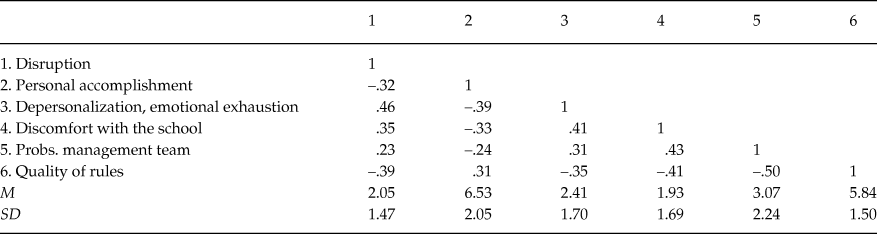
Descriptive analyses and correlations are presented in Table 1, where the values for each indicator have been transformed to a scale of 0 to 10 to facilitate their interpretation. It can be observed that the dependent variable, perceived disruption, yielded a value that could be considered apparently low (M = 2.05), but that must be taken into account considering the negative implications of this type of behaviors on teaching and the school climate. Regarding the individual variables of teachers, a medium-high level of personal accomplishment (M = 6.53) can be observed, while the discomfort with the school (M = 1.93) and the depersonalization and emotional exhaustion (M = 2.41) yielded values that, although numerically low, are indicators of very serious problems. The assessments regarding the school yielded problems related to the management team that were medium-low (M = 3.07), while the fairness of school rules and their application only yielded a medium level (M = 5.84).
Descriptive Analyses and Pearson Correlation Coefficients for the Indicators (n = 4,055)

Note: All correlations are significant, p < .001.
In relation to the relationships between the considered variables, significant relationships were found with values between medium and low (between r = .23 and r = .50 in absolute values). The signs of the coefficients reflected directions for the relationship that were consistent with expectations; with respect to disruption, for example, positive values indicated those variables whose presence occurred concurrently with the disruption; the negative values indicated that the variables with high values were associated to a low disruption. Regarding the proposed predictors of disruption, the highest relationships occurred with depersonalization and emotional exhaustion (r = .46), and with the quality of the rules (r = –.39).
Before performing the regression, the accomplishment of the assumptions of independence of the errors (through the Durbin-Watson statistic, which showed no correlation, D-W = 1.826 > 1.746), the normality and homoscedasticity of errors (through P-P and homogeneity graphs) and the absence of multicollinearity (with tolerance values of .688, well above the .20 recommended, and VIF values below 1.5, and therefore lower than the limit value of 12) were verified.
Hierarchical regression analyses
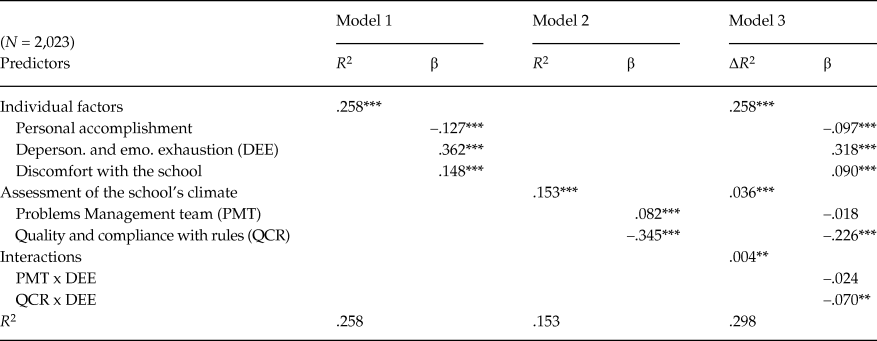
Table 2 shows the linear regression models obtained for the variable disruption perceived by teachers. Among the variables related to the individual, it should be noted that gender was not predictive of the level of disruption in the classroom in any of the models, and therefore, was excluded.
Hierarchical Analysis for the Dependant Variable, Disruption Perceived by Teachers

Note: Results of the validation sample. β represents the standardized coefficients obtained over the standardized variables.
** p < .01. *** p < .001.
Model 1 showed that the three individual teacher variables were good predictors of disruption, accounting for 25.8% of its variability. It can be observed that the variables of depersonalization and emotional exhaustion and discomfort with the school were positively associated with disruption (β = .52 and β = .217, respectively, with p < .001 in this case and in all other cases unless otherwise specified), while personal accomplishment was negatively related to the level of disruption (β = –.183).
Model 2 contained the predictors related to the school, which solely accounted for 15.3% of the total variability of perceived disruption. Problems with the management team were positively associated with disruption (β = .117), indicating that when in the school there was an adequate leadership and coordination on behalf of management, the disruption levels at such center were diminished. Regarding the rules of coexistence, a negative association was observed (β = –.501), indicating that fair rules and an adequate compliance were associated with a low level of disruption.
Model 3 included the groups of variables (individual and related to the school) mentioned above, obtaining equivalent results except for the problems of the management team, which lost its predictive power in this model. A more detailed analysis showed that the reason for this exclusion was in the three variables related to teachers, which subtracted predictive ability from the problems of the management team, making it non-significant. Specifically, from the initial correlation (r = .227; p < .001) between this variable and disruption, smaller partial correlations were obtained as the personal accomplishment variables (r = .172; p < .001), the depersonalization (r = .098; p < .001) and the discomfort with the school (r = .039; p = .078) variables were added as predictors.
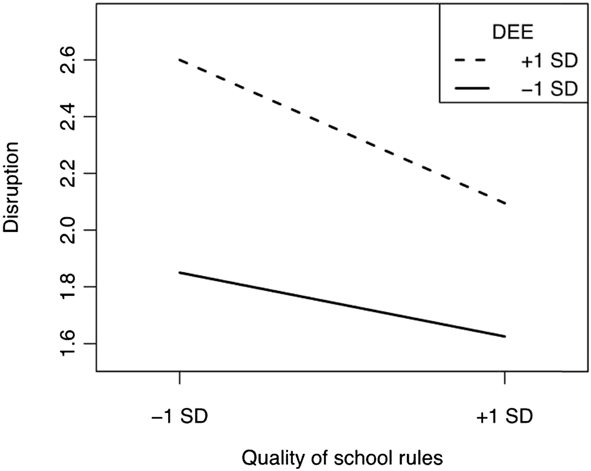
Furthermore, the study of the interactions showed that there was a portion of variance associated with the depersonalization of teachers and the quality of the rules of the school that was not explained by each variable in isolation, and whose combination showed a relationship with perceived disruption (β = –.093; p = .001). This relationship can be understood as a moderating effect of the quality and fairness of rules regarding the relationship between disruption and depersonalization, and can be observed in Figure 1 through the simple slopes of such interaction. Depersonalization and emotional exhaustion were positively associated with disruption in all schools, however this association showed a slower slope in those schools that presented high levels of quality of rules.
Interaction effect of teachers’ depersonalization and emotional exhaustion (DEE) on the relation between perceived disruption and the quality and fairness of rules. The lines show the perceived disruption for those teachers who have one standard deviation above and below the mean in depersonalization (different lines) and emotional exhaustion (lower axis).

However, no moderating effect of depersonalization and emotional exhaustion on the relationship between problems with management and perceived disruption was observed. Moreover, it was observed that this interaction did not depend on the inclusion of other indicators of an individual nature. Thus, and parting from a significant relationship with disruption (r = .073; p = .001), a regression analysis was performed only with the interactions, which did not show depersonalization and emotional exhaustion as a significant moderator of the relationship between management problems and perceived disruption (β = .005; p = .894).
Discussion
This study aims to analyze the influence of individual variables of the teacher and organizational variables of the school on the disruption perceived by teachers. It is worth noting, on the one hand, that the sample used is representative of the population of Secondary school teachers in Spain due to its size and sampling technique. On the other hand, this study combines, in the same analysis, the perception of teachers regarding variables normally treated separately (individual and those regarding management of the educational center). To better understand these relationships, a hierarchical regression procedure was used, separately introducing sets of variables according to their scope.
The first group of hypotheses, which were all confirmed, considered the relationship between variables of an emotional type and teacher satisfaction and their relationship to the perceived disruption. The influence of burnout through the discomfort with the school and depersonalization and emotional exhaustion has shown to be significant and directly related to disruption (Hypothesis 1b and c). The results, therefore, confirm the aforementioned studies that had considered these relationships between students’ behavioral problems and the three dimensions of burnout (Skaalvik & Skaalvik, Reference Skaalvik and Skaalvik2007). Personal accomplishment, on the other hand, was associated with a lower level of disruption (Hypothesis 1a). Previous research has found a similar negative relationship between these two variables, so that high disruption values are found in the classroom associated with feelings of low sense of accomplishment on behalf of the teacher and vice versa (Aloe et al., Reference Aloe, Shisler, Norris, Nickerson and Rinker2014).
The hypotheses related to variables of the school explored relationships at an organizational level regarding disruption, which confirmed that the quality of the rules and their level of compliance are associated with lower levels of disruption (Hypothesis 2b). This result confirms the results of Gottfredson et al. (Reference Gottfredson, Gottfredson, Payne and Gottfredson2005) that showed that schools with better management and compliance of rules have fewer behavioral problems and that the perceived injustice of rules or inconsistency in their application can lead to students perceiving the teacher and the school as unfair (Colquitt, Reference Colquitt2001). This, in turn, can lead to confrontations between teachers and students in the classroom (Tattum, Reference Tattum1986).
With regard to the existence of problems with the management of the school (Hypothesis 2a), both the correlations found with perceived disruption (see Table 1) and the results of Model 2 (see Table 2) support the relationship found in other studies (Maslach et al., Reference Maslach, Schaufeli and Leiter2001) and its predictive ability. Its disappearance from Model 3 as a relevant predictor (Table 2) is simply due, as was explained above, to the fact that its variance associated with disruption is already explained by individual level variables. This is an indication that the problem associated with management teams in relation to disruption shows variations (or aspects) that are already collected when measuring certain aspects of how teachers feel, in particular, the degree of burnout and accomplishment associated with their daily work (Jackson & Maslach, Reference Jackson and Maslach1982).
The study of the interactions between predictors (Hypothesis 3) is of special interest as, beyond the study of each variable in isolation, it shows an additional effect on disruption of the possible combinations of these predictors. Depersonalization and emotional exhaustion were chosen as moderators, as their presence may affect the way in which other circumstances are lived (in this case, the variables of the school; see, for example, Skaalvik & Skaalvik, Reference Skaalvik and Skaalvik2011) and therefore the perception of disruption (Tsouloupas, Carson, Matthews, Grawitch, & Barber, Reference Tsouloupas, Carson, Matthews, Grawitch and Barber2010).
Contrary to the hypotheses, the difficulties of coordination and leadership among the management team of the school have not presented the expected interaction, which indicates that the possible effect of this variable on disruption is not modified by the degree of emotional exhaustion of the teaching staff. The additional analyzes also show that this independence is not due to having controlled the other effects of the teacher’s individual variables.
On the contrary, there is a moderating effect of depersonalization and emotional exhaustion on the relationship between the quality of the center’s rules and the perceived disruption. Figure 1 shows how the relationship between quality of rules and disruption is generally negative, decreasing the latter when rules are perceived to be fairer and more adequately met (Gottfredson et al., Reference Gottfredson, Gottfredson, Payne and Gottfredson2005). However, this behavior differs according to whether teachers feel a low level (with low levels of disruption and a slope close to the horizontal, as part of low disruption values) or a high level (with much higher values for disruption and a steeper slope) of depersonalization.
The interactions between variables are mathematically symmetric and, as long as there is no clear causal direction, they allow for any of the variables to be interpreted as moderators. With this in mind, the care for the coexistence rules, both in their elaboration and their application, is therefore presented as a protection factor that allows to maintain the levels of disruption (in general) below the average values (see Figure 2.1), even with high levels of depersonalization and emotional exhaustion of teachers, thus weakening this association. It is interesting to note that a better management of the rules, both in their creation and their compliance, will be a collective task necessarily led by the management team. This fact may explain why the initially meaningful interaction between depersonalization and problems with management (β = .102; p = .001) disappears from the equation by introducing the depersonalization-quality of the rules interaction, whereas both variables are necessarily related (r = .43; p < .001) due to the reasons mentioned above.
Through the hierarchical regression technique, possible variables predicting the disruption perceived in the classroom on behalf of teachers are analyzed in the present study. This study is based on data from a representative sample of more than 4,000 teachers, and includes individual teacher variables, variables related to the management of the school, and interactions between variables from both these groups.
It is observed that the individual variables of the teacher explain a greater amount of variance regarding disruption (25.8%), where the variables predicting burnout (discomfort with the school and depersonalization and emotional exhaustion) are positively associated with higher levels of disruption. The feeling of personal accomplishment on behalf of the teachers confirms the hypothesis of a negative relationship.
The studied variables related to the school explain 15.3% of the variability of the perceived disruption, where the problems with the management team, initially a significant predictor, cease to be predictors when the individual variables of the teachers are controlled for. On the contrary, the quality of rules proves to be an important factor of protection. In this sense, it is not only negatively associated with disruption, but also minimizes the negative effects of depersonalization and emotional exhaustion.
Therefore, in dealing with disruption, it must be borne in mind that the individual teacher variables are most likely to act as cause and effect in their relationship with disruption, and may possibly be affected by the conditions of the school. In this sense, it would be advisable to influence those predictors that have been shown to be relevant and that are modifiable, such as the creation and adequate application of coexistence rules. Only an effective rule system, agreed upon and fairly-applied by the teaching staff can generate a situation of perceived control over situations where students present disruptive or aggressive behaviors towards teachers. Of course, this depends on having, or proposing, a management team capable of leadership that can initiate a change in that direction.
Finally, it is necessary to include some limitations of the present study that the reader must take into account. Firstly, the use of a non-experimental methodology through a cross-sectional design for data collection limits the possibility of establishing causal relationships between variables. Furthermore, it should also be emphasized that all the variables used refer to the perception of teachers, and are not objective measures of the aspects being studied. Finally, it should be taken into account that the indicators used have been obtained from items constructed specifically, and, especially, the small number of items used for the measurement of burnout, which nevertheless show adequate reliability values for all cases.