The past is never there waiting to be discovered, to be recognized for exactly what it is.
John Berger, Ways of Seeing Footnote 1Native Women of South India: Manners and Customs (2000–2004) is created by Pushpamala N. – an Indian photo-video-performance artist based in Bangalore, best known for her women-centric tableaux performances – and Clare Arni, a British photographer who has lived largely in south India. In Native Women of South India, Pushpamala and Arni aim to ‘explore and rethink popular images of South Indian women by recreating well known images in the genre of photo-performance, while deconstructing them in various ways’.Footnote 2 The resulting work consists of four image sets, with more than 250 photographs, modelled on ‘the concept of a film or theatre museum’ and exhibited along with costumes, props and backdrops. Each set – the Native Types, the Ethnographic Series, the Process Series and the Popular Series – explores a different genre of photography. The Indian women figures constructed in performance are various: cinema actors, politicians, women from famous paintings, circus performers, subjects of colonial ethnography and a bricolage of sculptures and shrines, among others. These women are largely played by Arni and Pushpamala, who call themselves the ‘protagonists’ of a performance that explores ‘the history of photography as a tool of ethnographic documentation’.Footnote 3
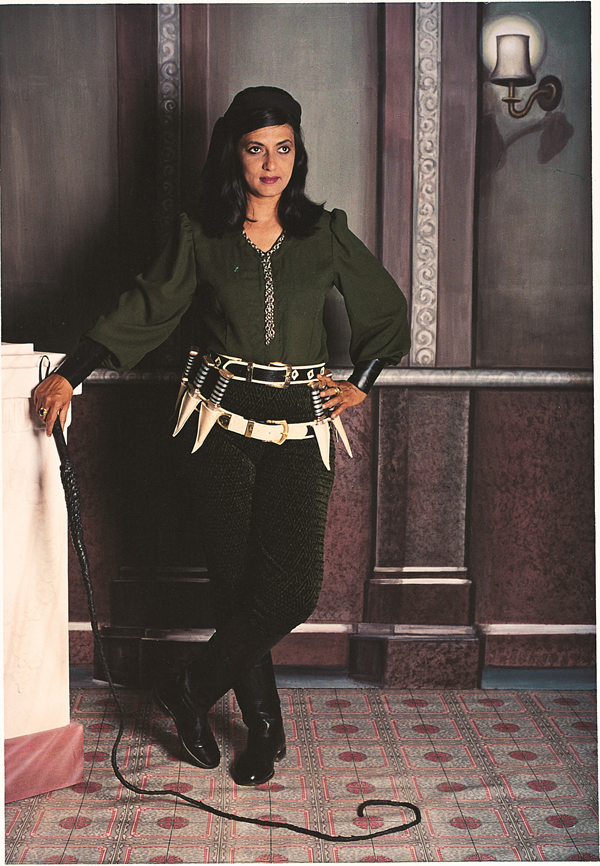
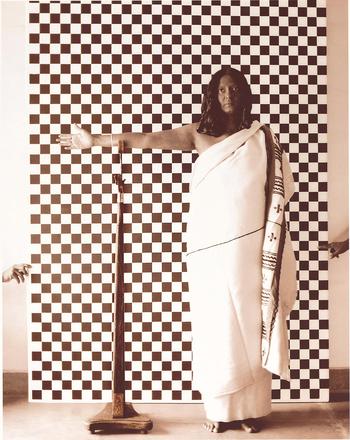
This article considers the narrative movement of two women in the series – Tamil actress and politician Jayalalitha, whose image is sourced from the cover of the May 1998 issue of India Today (not pictured) and who is enacted by Pushpamala (Fig. 1), and a Toda woman who is based on an M. V. Portman image (see Figs. 2 and 4). This analysis takes place through three image sets: the Native Types series, the Ethnographic Series, and the Process Series. I seek to highlight critical performance dimensions of Native Women of South India that have previously remained undiscussed in a rich mode of aesthetic criticism that has framed Native Women of South India as a piece of visual art situated in traditional/modern, colonial/postcolonial and authentic/simulacrum dialectics.Footnote 4 These dimensions include the changing temporalities of the image sets, and the improvisation by the artists and the cast on these sets responding directly to colonial historiography as a theatrical process. The improvisation is undertaken by the artists deeply engaging with what I term ‘performance objects’ that are associated with the photo-performance, namely the images and make-believe interview in the Native Women of South India catalogue, and the costumes, sets and other theatrical aspects in the framing of the work as photo-performance.
Pushpamala as Jayalalitha in ‘Cracking the Whip: after 1970s? Tamil Film Still’ from the Native Types series. Copyright the artist. Photo credit: the artist and Chemould Prescott Road, Mumbai, India.

Pushpamala as a Toda woman in ‘Toda: After Late 19th Century British Anthropometric Photograph’ from the Ethnographic Series. Copyright the artist. Photo credit: the artist and Chemould Prescott Road, Mumbai, India.

I am also interested in examining the ‘feminist effects’ of this performance, which I see emerging through the re-creation of women in/as colonial ethnographic archetypes, while considering how these effects invoke a form of transnational solidarity with the ‘native woman’ subject by attempting to tune into an affective register of hapticality.Footnote 5 I lean on Stefano Harney and Fred Moten's definition of hapticality with respect to the undercommons to recognize that Pushpamala and Arni have attempted a haptic citation,Footnote 6 a shared vision of modern Indian and colonial history that slips between acknowledging difference and eliding it, and clarifies the conditions for solidarity, or seeing oneself as kin to the ‘native women’, if not as akin. Speaking specifically of the context of the slave hold, Harney and Moten define hapticality as ‘a feel for feeling others feeling you’; ‘modernity's insurgent feel, its inherited caress, its skin talk, tongue touch, breath speech, hand laugh’ that ‘no individual can stand, and no state abide’.Footnote 7 In this article, I explore the possibilities and conditions for an epistemology of transnational feminist solidarity – the haptic premise of a work such as Native Women of South India. I ask in what ways does Native Women destabilize the colonial category, and iterate an aesthetic register, of political empathy to the ‘native woman’ subject? How does this photo-performance develop a haptic attempt at solidarity through collaboration?
Eyeing the other: collaboration as solidarity
While Native Women of South India has been viewed and studied as a work primarily in the domain of visual culture, bearing concerns – rightfully – around authenticity and mimesis, my focus is on how considering this as a work of (photo-)performance that relies on hapticality as a form of solidarity necessitates a troubling of the feminist ethics and aesthetics of transnational collaboration.
In their performance of colonial ethnographic archives (amongst other popular images of women) Arni and Pushpamala play powerfully on the subject-making of ‘the native’ – the gendered process of becoming-subject, from a colonial image to a contemporary image responding to the colonial gaze – but also on the history of studio photography. The project of solidarity visualized here is partly one of representation of the ‘native women’ category, of casting a gaze back on the gaze of the colonial camera. This aspect of the project emerges due to its concern with the very form of photo-performance, wherein the contemporary process of haptic collaboration of the two artists and their team is itself a performative response to the dominance of the colonial ethnographic photo-project.
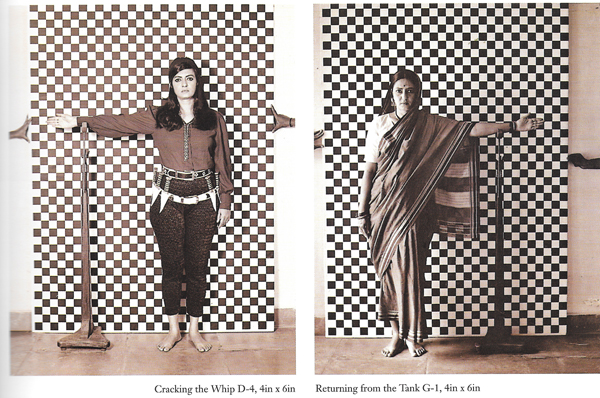
In Figures 1 and 3, the character of Jayalalitha transitions from being the cover girl in the re-created magazine photograph to being ethnographically measured as Jayalalitha, with metal supports and a chequered grid as props. In a contact sheet (not pictured), a series of images depict Jayalalitha posing pleasantly and whimsically with the same metal props, but as weapons wielded by her, over her shoulder and above her head; dismantled objects that are no longer the dehumanizing tools in Figure 3. In a sepia image from the same contact sheet, the lady from the Raja Ravi Varma painting – played by Pushpamala, also seen in Figure 3 – stands tall next to Clare Arni, who is seated on a chair with her arms crossed.
Pushpamala playing Jayalalitha in ‘Cracking the Whip D-4, 4in × 6in’, and playing the woman from a Raja Ravi Varma painting in ‘Returning from the Tank G-1, 4in × 6in’ from the Ethnographic Series. Copyright the artist. Photo credit: the artist and Chemould Prescott Road, Mumbai, India.

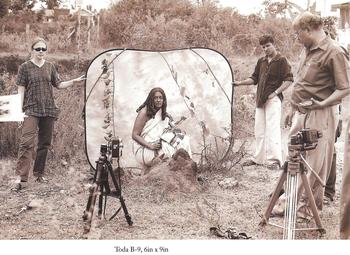
In all of these images, the construction of the ‘native’ is cleverly troubled through role play, posture, gaze, costume and the mise en scène, but also through the ghostly personae who populate the images alongside the various characters, who in turn take on other personae (such as Arni herself) in neighbouring image sets. Additionally, and crucially, Native Women of South India partially succeeds in this project of détournement of the ‘native’ by exposing the skeletal make-up of the very process of historiography, and capturing it as a collaborative process. The Process Series image set testifies to this project, but the process of how the various ‘native women’ are (de)constructed through the photo-performance is a continual theme, as seen, for instance, in Figure 4, which is from the Ethnographic Series, and very slightly varies from a similarly performed Process Series image (not pictured). The feminist effect of this exposure is to indicate the construction of feminist subjectivity as an archival record to be as potent as the documents themselves. However, this formulation of subjectivity is not one that responds to or corrects the dialectic of the colonizer/colonized, as much as it reaffirms its commitment to the relational challenge of transnational solidarity with the subject facing the lens on her own terms, unlike the history of colonial photography.
From the Ethnographic Series, ‘Toda B-9, 6in × 9in’, featuring Pushpamala as a Toda woman. Copyright the artist. Photo credit: the artist and Chemould Prescott Road, Mumbai, India.

Pushpamala and Arni's photo-performance responds to the history of colonial photography and its subsequent entanglement with studio photography. In the nineteenth century, colonial administrator Maurice Vidal (M. V.) Portman photographed inhabitants of the Andaman Islands using a variation of Lamprey's anthropometric grid; the inhabitants were framed against a monochrome chequered board, supported by metal props. These portraits constituted a commonplace imperial attempt to ethnographically ‘measure’ the inhabitants; a project of fear and subjugation that, like other tools of colonial dominance, emerged as a tightly controlled mode of production of the narrative of Otherness, and perpetuated the suppressive colonial gaze. Portman eventually generated a photographic archive of the colonial subject, which is now part of the British Museum online collection.Footnote 8 The contrast between the colonial endeavour and Pushpamala and Arni's sharp, lively response in the form of Native Women of South India was stark: my being directed to the nineteenth-century photograph through their project made the original photograph look like a parody of the simulacrum that followed two centuries later.Footnote 9
The British Museum collection curator's comments online reveal that Portman created ‘statistical norms from the mass of evidence [he] gathered’.Footnote 10 The webpage notes that the human subject was a ‘personal ornament’. As with other objects, the photograph also had a registration number.Footnote 11 One evening in the winter of 2017, the longer I looked at the source text for the tableaux re-created by Pushpamala and Arni – at the bemused stare of a naked colonial subject juxtaposed against the clean, white background of the institutional page – the more I wondered if the registration number applied to the man or to the photograph. While museum registration numbers constitute a common practice of archival labelling, the ambiguity is important for the erasure it indicates between subject and object, particularly in colonial photographs. Colonial photography, specifically the photography that was produced as part of colonial anthropology, has a long legacy of scholarship.Footnote 12 Contemporary archiving methods and practices, housed at museums and galleries, continue to perform and uphold coloniality in the preservation and presentation of objects, and the objectification of colonial subjects such as the man in Portman's photograph.
Christopher Pinney notes that much of early colonial anthropology was a double effort between missionaries, traders and administrators, and ‘theorists and synthesizers based in the colonial metropole (Oxford, Paris, Berlin and elsewhere)’.Footnote 13 The advent of fieldwork, aided by the camera, broke this shared labour: to each (man), his own (camera). Pinney adds that M. V. Portman's austere demands of photography – no ‘aesthetics’ or ‘foliage’ – extended to his treatment of those he patronized with his brutal gaze, as, logistically, ‘native servants and savages’ could be handed cleaning tasks but not the equipment. ‘Lock up all apparatuses from savages and others’, Portman wrote.Footnote 14 The colonial subject was not to take his representation into own hands, even by accident.
Zahid Chaudhary claims that the history of photography in India runs parallel to that in Europe and that photography was available in India from 1840 – a year after Daguerre's experiments – but was widely dispersed across the subcontinent only after the 1857 Rebellion, when the Crown replaced the East India Company.Footnote 15 Colonial photography chooses and constructs a theatrical visual narrative as documented, ‘measured’ truth, but simultaneously (as Chaudhary notes) gives its own project credence.Footnote 16 The gaze of the colonizer – and its patriarchal possession of the archive project – is reflected back in the photograph, and in its making by what feminist philosopher Chandra Mohanty calls colonial ‘bureaucratic masculinity’.Footnote 17
In their work on theorizing transnational feminist praxis, Amanda Lock Swarr and Richa Nagar delineate between international, global and transnational feminist agendas. While they cite the first two modalities as relying more heavily on nation state borders prioritizing feminist encounters in the global North, they posit transnational feminism as an intersectional set of practices that attend to the heteronormative role of ‘globalization and capitalist patriarchies’ and the ‘multiple ways in which they (re)structure colonial and neocolonial relations of domination and subordination’.Footnote 18 Native Women of South India is uninterested in reclaiming the colonial gaze, and is more interested in circumnavigating it through the consolidated efforts of a performative detouring aided by a feminist panorama, that centres the interiority of women as the mirror to the falsehood of colonial ‘objectivity’ through its attempted emphasis on haptic collaboration.
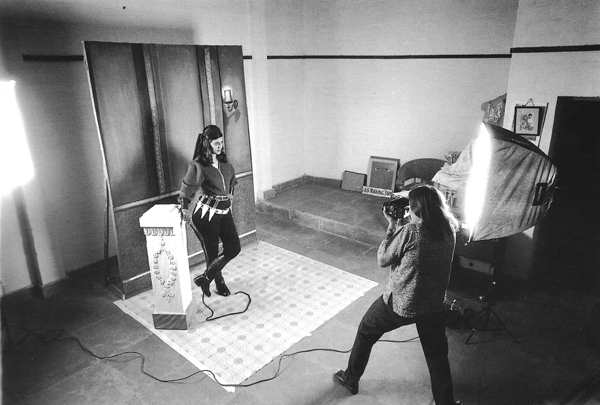
Native Women of South India departs from the (colonial) photographic studio as a starting point, but rushes to reveal the labour behind the process of photo-performance making at every step: in the exhibitions, the catalogue and the images themselves. Unlike the colonial photographs, these portraits, as the image sets move on, reveal the characters in mocking, spirited poses, and turn the figures into subjects. The setting of the pose is revealed, as is the team behind it (see Figs. 1, 5 and Figs. 2, 4). The commitment to transnational solidarity is thus consolidated because the performance explores various political premises through which solidarity – or a unified vision of its genealogy – is founded, such as systems of power, dominant structures of representation and intersections of race, caste, nationhood and gender.Footnote 19
From the Process Series, featuring Pushpamala as Jayalalitha posing for the image ‘Cracking the Whip’. Copyright the artist. Photo credit: the artist and Chemould Prescott Road, Mumbai, India.

This is partly reflected in the very nature of the collaboration itself. The performance hinges on an awareness of the different forms of labour that were involved in the production, and demonstrates a preoccupation with the politics of collaboration. This is indicated by the interview published at the end of the Native Women of South India catalogue, an important performance object. Indeed, the interview in question is with Pushpamala herself, wherein the questions are posed by her playing a reporter called ‘N. Rajyalakshmi’ for the cheekily named Ideal Times, and Pushpamala's answers are supplemented impatiently by Arni and herself.Footnote 20 The interview in the Native Women catalogue teases traditional notions of collaboration, such as assuming predetermined or fixed positions and segregating labour; the artist mirrors herself but through role playing the journalist, and the text of the interview remains mediated both by the constructed persona of the journalist and by Arni and Pushpamala themselves. The interview here is not the traditional means of authenticating the work of the artists, since the role playing by both artists continues, even as it doubles up as a space to communicate the artists’ shared vision of the work.
Ajay Sinha writes that Pushpamala engages in a ‘transcultural bordercrossing’ here because of her irreverence towards notions of authenticity, particularly how her claim that ‘one is inside the image, not just outside, looking’,Footnote 21 purports to create ‘an illicit flow with kitsch, which postcolonial iconophilia has overlooked’. He adds, ‘The transcultural movement requires another sort of explanation’.Footnote 22 The ‘bordercrossing’ Sinha refers to is not restricted to form, but also refers to embodied differences between the performers and the team behind the piece. The central performative gesture of Native Women of South India is its irreverence for patriarchal dominance personified by the trope of the lone colonial man with a camera.
Native Women of South India demonstrates this irreverence – both temporal and affective – by exposing the make-up of the very process of colonial and national historiography. Before Pushpamala speaks about being ‘inside the image, not just outside’, she notes that ‘the performance brings in autobiography and subjectivity, besides the irony and critique’.Footnote 23 Even in the interview in question, Pushpamala and Arni are essentially interviewing one another through the guise of the persona of the fictitious Rajyalakshmi; they split personae and authorship, even as they collaborate with a haptic, shared subjectivity through performing ‘native women’.Footnote 24 One is inside the image, not outside, looking, because there is no outside – even an interview, where one is normally confronted by the other, here becomes a further exposition of Pushpamala and Arni's own place making in the genealogy of native women. The heightened self-reflexivity of the artists is reflected in the documentation of the performance too, such as the images of the image making, and the interview.
In defining their work as photo-performance, the artists draw attention not just to the process of historical temporality at work in the original and the copy, but also to constructions of gendered nationhood.Footnote 25 Native Women of South India pushes beyond postcolonial dialectics such as colonizer/colonized, foreign/native and other such binaries. It reaffirms its commitment to the relational challenge of transnational solidarity by questioning the dominant political premises under which solidarity – or a unified vision of its genealogy – is founded. Jayalalitha – who finds her way from magazine cover to re-created paean in the Native Types series, to a prophetic pastiche being measured like a colonial subject in the Ethnographic Series, to a solitary figure being created by her crew in the Process Series – is an indication of this vision (Figs. 1, 3 and 5).
The gaze of colonial ethnography is tight and controlling. The performance of Native Women of South India notes this by attempting to centre multiple testimonies and interpretations of women's histories. It is process-oriented and creates a critical (auto)biography of the ‘native woman’ trope. In the Native Types series, the performance shoots are meticulously documented, like the programme notes on an opening night, to include attributions of costume (‘riding boots borrowed from Judy Bidapa’, ‘belt decoration added by Ajaz Auto Decorator’), set pieces (‘patterned linoleum flooring from JC Road’) and the team members behind make-up, video and shooting.Footnote 26 In the Process Series, Arni's camera stages the staging, making clear that the performative nature of the piece emphasizes its collaborative mode, thus revealing ‘the tacky artifice of the science of ethnography’.Footnote 27
The photo-performance process of Native Women of South India moves gradually, according to Pushpamala and Arni, from one that was interested in reproducing popular images of women as tableaux, ‘with great attention to the costume, props and mood of the image’, where experimentation meant a variety of photo filters and the production for each tableau took three months, to a state of spontaneity and playfulness, wherein the studio itself becomes a set of image reconstruction, and the process of creating the performance expanded to include the very act of photo-making.Footnote 28 Margaret Iversen, writing about performative photography in the context of Ed Ruscha's work, notes that the genre ‘makes something happen rather than describing a given state of affairs … involves the partial abdication of authorial control, in favour of accident, chance or unforeseen circumstances’.Footnote 29 All through the making of the photographs, Pushpamala borrowed props and costumes from various friends and family members, sourcing and commissioning material from urban artisans such as cinema hoarding painters and costume companies, creating a collaborative performance where the photographs became traces of a larger devised work.Footnote 30
The hapticality of feminist citation
The photographs that are eventually showcased in Native Women of South India are narrative stopgaps in the performance – they create an affectively dissonant world where temporally distant women, and their mythologies, cross paths, and thus create new ones. In one instance, a slight shift of positions, people and colour turns a sepia-toned image of the team working to formulate a ‘Toda’ image from the Ethnographic Series (Fig. 4) into a colourful, busier one from the Process Series. In another image, an aerial view catches Pushpamala posing as Jayalalitha all alone in a set-up, being photographed, it would seem, for ‘Cracking the Whip’, but without the rest of her team in sight, and several versions of this image being made all the same, creating an enclosed matryoshka-doll-esque illusion of the collaborative process (Fig. 5). ‘It is important to remember that citation works to align oneself with desired and intimate formations that constitute a way of life, a set of valued norms, skills or practices, as well as to pull away from them’, writes Susie Tharu.Footnote 31 While Tharu conceives of the various citational properties in Native Women as a means to formulate the debates between citation, performativity and reiteration, in expanding the textuality of the relation to an affective and ethical mode, I posit the feminist citational practices in Native Women of South India as haptic endeavours, grasping for a common political, feminist solidarity with the subjects in the images.
In M. V. Portman's image, the colonizer is outside, looking. His collaborators are inside the image. In Native Women of South India, a makeshift community – built across religious, caste and racial spheres – is cited in the image, even when it is missing, because feminist subjectivity accounts for multiple genealogies of womanhood. The citation of colonial ethnography does not contain the work, but becomes a point of reference to move past, and this is where the gesting/jesting nature of the performance allows for reconceptualizing traditional notions and images of ‘native’ women. Pushpamala and Arni cite themselves in the work, and in interlacing it with the pulse of their interiority, build new epistemologies of collaboration. As Mohanty notes, community ‘is the product of work, of struggle; it is inherently unstable, contextual; it has to be constantly reevaluated in relation to critical priorities’.Footnote 32 The work of solidarity, particularly in a collaboration headed by an Indian woman – a still-native – with a white British woman, holds not in spite of difference, but because of it.
An especially moving tableau, not pictured in this article, is titled ‘Our Lady of Velankanni’, modelled after contemporary votive images collected by Arni from Shivajinagar Church in Bangalore and photographs taken by her of roadside shrines. Arni and Pushpamala riff off Western art-history imagery by playing two angels paying their respects to and shyly peeking at a painted shrine of the Virgin Mary – a backdrop that resembles the shrine of Mary at the Basilica of Our Lady of Good Health (also known as Our Lady of Velankanni), in the tiny town of Velankanni in Tamil Nadu. Both angels hold red garlands in their hands, and the scene is lit by candles and fairy lights. One of the angels meets our gaze with a slight smile from the top of the painting while the other gazes at Mary, her face hidden from us. In this playful exploration of quotidian faith practices that reveals the spirited kinship of two distinct angels, the differences in their on- and offstage personas are very clearly highlighted too, without an attempt to sew them together. In the catalogue, citations of the source texts or prompts, such as the roadside shrines, sit alongside citations of the primary sources for the disparate elements constructing the scene – the sari, the carpet, the angel wings and the black curtain, for instance. Once again, the labour of collaboration is drawn out as a mode of performance, but with an emphasis on its different forms and the identities of the people involved in the process – the crew, electrical shops, painters and the artists themselves in other backstage capacities.Footnote 33 ‘Citations can be feminist bricks: they are the materials through which, from which, we create our dwellings’, writes feminist philosopher Sara Ahmed.Footnote 34 The vividness of the tableaux is reflected in the call to its makers too, conjuring up a vivid, busy rehearsal space in its details.
In the interview, Pushpamala describes both herself and Arni as South Indian women, asking, ‘A native is the original inhabitant of a place, but who is more native, one who comes from there, or the one who chooses to be there?’Footnote 35 It is notable that the performance itself interrogates the making of the native (woman) in its powerfully repetitive and coalescing genealogies of the various forms this woman takes across Indian histories. The idea that ‘the native’ is a stable category or that the colonizer–colonized relationship is anything short of hybrid has been adequately challenged by post-colonial and subaltern theorists. However, Pushpamala's question (un)easily collapses power dynamics between her and Arni – and indeed the women represented by them in performance – in its positioning of Arni as South Indian, a positioning that Arni affirms. Arni and Pushpamala, in their personae production of tableaux such as ‘Toda’, produce visions of national and gendered myth making that give way to concerns of a unidimensional ‘authentic’ reading of the colonial ethnographic archive rather than the ironic departure of their other images such as ‘Cracking the Whip’ and ‘Our Lady of Velankanni’. While ‘Toda’ defies colonial representations of ‘the native’, missing are the delicate frequencies acknowledging the various strands of subjection produced through the measured subjects of the ethnographic photographic archive as overlapping, juxtaposed and uneven hierarchies of caste and race, as reflected in the beguiling and challenging movement of characters like Jayalalitha and Ravi Varma's lady returning from the tank, across the Ethnographic Series.
The difference between Arni's and Pushpamala's identities – professional, national and racial – are occasionally collapsed in favour of a unifying narrative of national and gendered comradeship. ‘South Indian’ is no more a clearly defined identity than ‘native’ but the conflation of the differing positions of the two women – and their (trans)national histories – invokes a flattening of attempts at solidarity through narrating and embodying native women, with a shared affective notion of what the category constitutes. ‘The challenge of political solidarity is not simply about the ability to see the other as like us but is also about the inability to see through the other's eyes’, notes Juliet Hooker.Footnote 36 Arni's statement that, while growing up in South India, she dreamed of marrying a Tamil Brahmin is particularly striking,Footnote 37 as an alienating revelation that betrays ingrained caste hierarchies, only sharpened by the smudging of her position as white/British, even as she (re)produces and enacts the subject on either side of the lens. Arni is not unaware of the historical dominance of the colonial gaze, when she talks about ‘the fear and unease of a tribal woman confronted by a British camera’. But in the same breath, she mentions wanting to empathize with this (imagined) experience, and says, ‘We became at one with these women and were able to share in their story’.Footnote 38 Hooker insists that solidarity ‘is more than just an emotion; it is also an ethical orientation that moves us to action’.Footnote 39 When action – here, collaborating on a transnational photo-performance – produces an aesthetics of empathy rather than solidarity, the imperatives behind the performance choices usher a closing down, rather than an opening up, of the possibilities of feminist collaborative praxis.
Herein lies the danger of that double-edged sword of empathy, masquerading as solidarity, of which Saidiya Hartman has warned us. She rightfully testifies, in the context of empathy towards the enslaved by white abolitionists such as John Rankin, that ‘in making the other's suffering one's own, this suffering is occluded by the other's obliteration’.Footnote 40 In the case of Pushpamala adopting the guise of a Toda woman through the darkening of her skin, for instance, the categories of casteist oppression dissolve under the larger rubric of colonial subjugation. At its most evocative, this ‘we’ results in images such as the portrait with Pushpamala in the contact sheet mentioned above, and in images such as ‘Our Lady of Velankanni’. On the other hand, it elides difference in favour of a cohesive ‘native’, such as in the ‘Toda’ portrait. Neither Arni nor Pushpamala can merge as ‘we’ with the Toda woman, modern or historical, and the embodiment by Pushpamala, because it replaces the ironic cue of other photographs such as ‘Cracking the Whip’ with a sincere attempt at representing ‘the’ native women through skin-darkening and other traditionally fraught signifiers of caste, emerges as empathy for one native woman from another rather than solidarity with a native woman constructed by another woman interrogating the term through a photo-performance. Arni plays an Indian goddess in the Native Types series, but also poses as a white British woman in a photograph for the Ethnographic Series; this slippage illuminates a thought-provoking breakdown of essentialist tropes.
Native Women of South India is at its most potent when it acknowledges slippage as countering erasure, rather than slipping into erasure itself. Pushpamala and Arni's haptic recognition of a shared positionality is not constant; it falters and flickers, betraying, even more clearly, their different experiences of womanhood, and their different lineages of subjection – and subjugation, as Pushpamala's embodiment of the Toda woman indicates. Harney and Moten's idea of hapticality is a shared, almost forced, intimacy under subjugation. Arni and Pushpamala do not embody the same histories of subjugation, but the work makes motions, through the representation of certain personae, to mimic that intimacy regardless. Moten and Harney's articulation of hapticality as an ongoing ethical destabilization of subjecthood through solidarity helps us understand why it is important to read the photo-performance as a haptic unsettling of the vision of the two women, where the spectre of play and irony slips into trappings of mimicry and authenticity. Rizvana Bradley articulates Moten and Harney's call ‘to philosophize the haptic as an explicitly minoritarian aesthetic and political formation – a figuration of alterity that simultaneously marks the overlap of and break between thought and feeling’.Footnote 41 The women gesture towards this alterity, failing – necessarily – in their adoption of it, but they fail further to cite this failure, which is not a failure of solidarity – it is process, not a canvas, after all – but a testimony towards the necessity of its continuous rebuilding.Footnote 42
The various concerns surrounding a harmony of political empathy in and across women's performative collaborations can manifest as productive dilemmas about the ethics of collaboration, particularly when framed uniquely in the case of (photo-)performance: when two women of different ethnicities and nationalities attempt to devise a contemporary critical and imaginative response to the colonial photographic studio archive – especially the photography emerging from colonial anthropology – as performance, the process of devising and collaborating on a focused genealogy of ‘native women’, and its failures, can produce new epistemologies of feminist solidarity. As Simon Murray notes of performance collaborations, collaboration itself ‘emerges as a slippery term: a practice whose shape and purpose remains endlessly negotiable and in flux, a highly ideological practice and – like most interesting terms – a site of dispute and contestation’.Footnote 43
Conclusion
Siona Wilson notes that performance photographs, ‘as relics’ and records, ‘are understood as haptically invested substitutes for the body of the performer, a surviving trace of the event that is held as a remembrance, souvenir, or precious keepsake’.Footnote 44 Photo-performance is ‘haptically invested’ but inverts the notion of substitution – the photographs reroute remembrance by indexing back to the performance making, the act of it, existing always in an aporia that furthers the effects of the photo-performance beyond the binary of either/or, (non-)native, or Barthes's here–now and there–then.Footnote 45 In the case of Native Women of South India, this haptic hovering manifests as a perpetual reconsideration of patriarchal dominance – what we remember is what we are not allowed to forget – which haunts the subject of the photo-performance: the subject who holds our gaze, as the Toda woman, as Jayalalitha, as the woman citing these archetypes in her performance. The recognition that solidarity in transnational subjecthood itself is only partially reflected back in the performance, due to both conjectures and erasures, must build on the labour of critical empathy, a labour that will always be unfinished but all the more powerful for acknowledging power in difference, and difference as power.