Attention-deficit hyperactivity disorder is a growing health concern in the United States of America, with ~9.5% of children aged 4–17 years (5.4 million) diagnosed at some time. Using a conservative prevalence rate of only 5%, the annual societal “cost of illness” for attention-deficit/hyperactivity disorder is estimated to be between $36 and $52 billion in 2005 dollars, and the individual cost is estimated to be between $12,005 and $17,458 annually.Reference Pelham, Foster and Robb 1
Children who have undergone neonatal aortic arch surgery, in which cerebral blood flow has been compromised, may have an increased risk for attention-deficit/hyperactivity disorder. Among the school-aged children born with hypoplastic left-heart syndrome, more than two-thirds have symptoms of inattention, hyperactivity, or both.Reference Mahle, Clancy, Moss, Gerdes, Jobes and Wernovsky 2 An in-depth study on 5- to 10-year-olds who had undergone infant cardiac surgery revealed that 30% were at high risk for attention-deficit/hyperactivity disorder, according to the ADHD-IV rating scale, and 49% received remedial school services – a prevalence rate three to four times higher than the normal population.Reference Shillingford, Glanzman, Ittenbach, Clancy, Gaynor and Wernovsky 3
Recognition and treatment for attention-deficit/hyperactivity disorder is important to improve the quality of life for children with attention-deficit/hyperactivity disorder by maximising the use of appropriate support services and pharmacologic therapies.Reference Sistino 4 Therefore, the primary purpose of this study was to determine the prevalence of attention-deficit/hyperactivity disorder among children following neonatal surgery with aortic arch repair. Secondary purposes were to assess the impact on their quality of life and to determine the percentage of patients who received treatment for attention-deficit/hyperactivity disorder and/or requiring special education classes.
Materials and methods
Subjects
This was a cross-sectional observational study on the prevalence of attention-deficit/hyperactivity disorder in a single-centre surgical cohort of children who underwent aortic arch repair between 1 July, 1995 and 30 June, 2006. The study was approved by the Medical University of South Carolina Institutional Review Board. A review of the surgical records of the Medical University of South Carolina during this time period identified all subjects who underwent neonatal aortic arch surgery. Children who had died before the study, who had undergone cardiac transplantation, or whose parents could not be contacted were excluded. Surgical data for the children whose surveys were returned completed were compared with data for the children whose surveys were not completed to determine whether there was a sampling bias.
Attention-deficit/hyperactivity disorder assessment
Parents completed the questionnaires to determine (1) whether a diagnosis and treatment of attention-deficit/hyperactivity disorder had been made, and (2) to assess the severity of inattention, hyperactivity, and general health. The surveys included both the Child Health Questionnaire-50 and the ADHD-IV survey (home version). The ADHD rating scale-IV is a validated instrument for assessing risk for attention-deficit/hyperactivity disorder in boys and girls aged 5–17 years of age. The ADHD-IV rating scale is linked directly to Diagnostic and Statistical Manual of Mental Disorders-IV diagnostic criteria for attention-deficit/hyperactivity disorder and has 18 scale items.Reference Anastopoulos, DuPaul, Power and Reid 5 The Child Health Questionnaire-50 quality of life instrument has been validated and normed for children 5–18 years of age and measures 14 psychosocial and physical concepts.Reference Rentz, Matza, Secnik, Swensen and Revicki 6 The Child Health Questionnaire-50 summary scores combine results to derive an overall physical and psychosocial score and identify key health conditions related to attention-deficit/hyperactivity disorder, such as attention problems, learning, and behavioural problems. The Child Health Questionnaire-50 has been validated in a population of children diagnosed with attention-deficit/hyperactivity disorder.Reference Rentz, Matza, Secnik, Swensen and Revicki 6
Study design and measurements
To identify all children who may have developed attention-deficit/hyperactivity disorder following neonatal aortic arch repair, the attention-deficit/hyperactivity disorder prevalence rate was based on a parent-reported diagnosis of attention-deficit/hyperactivity disorder and/or a score on the ADHD-IV inattention scale of ⩾93 percentile.Reference Anastopoulos, DuPaul, Power and Reid 5 An ADHD-IV inattention score of ⩾93 percentile is the optimal cutoff score reported for the diagnosis of attention-deficit/hyperactivity disorder in the ADHD-IV survey instrument manual.Reference Rentz, Matza, Secnik, Swensen and Revicki 6 Some children receiving medical treatment for attention-deficit/hyperactivity disorder had reduced symptoms and did not reach the ADHD-IV cutoff score of ⩾93 percentile, but they were included in the overall prevalence rate. The Child Heath Questionnaire-50 results were used to confirm the attention-deficit/hyperactivity disorder behaviour and provide additional information on the impact of attention-deficit/hyperactivity disorder on the quality of life for both the child and their parents.
Patient medical records were reviewed to determine the perioperative and operative risk factors. These included: operative weight, age at the time of first operation, known genetic syndromes, circulatory arrest time, regional cerebral perfusion time, and lowest haematocrit and carbon dioxide level during cooling. Surgical variables for the children with returned surveys when compared with the non-returned surveys. A comparison was made to determine whether there was selection bias in the returned surveys.
Statistical methods
Archived and newly acquired survey data served as the basis for this study. Descriptive statistics and normality testing were completed for all the variables in the data set. The proportion of patients who met the criteria for classification as attention-deficit/hyperactivity disorder was determined. Next, the ADHD-IV, Child Health Questionnaire-50 physical and psychosocial summary scores, and the scores for the Child Health Questionnaire-50 subcategories were compared between participants classified as having attention-deficit/hyperactivity disorder and non-attention-deficit/hyperactivity disorder using the Mann–Whitney U test for independent samples. The pattern of Child Health Questionnaire-50 subcategory scores were compared with the subcategories for children with attention-deficit/hyperactivity disorder in the Child Health Questionnaire-50 ADHD validation study.Reference Rentz, Matza, Secnik, Swensen and Revicki 6 The experimental wise error rate for all the analyses tested was held constant at p<0.05. All analyses were performed using IBM SPSS Statistics for Windows, Version 20.0 (IBM Corp, Armonk, NY, USA).
Results
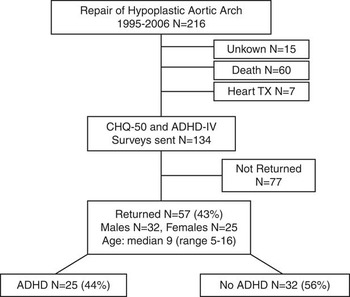
A total of 216 children were identified who met the inclusion criteria. A total of 134 children who were identified as still alive with current contact information comprised the study population and were mailed the study surveys.
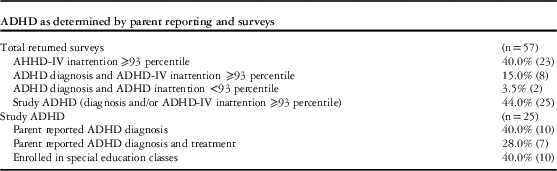
A flow chart of the neonates who underwent surgery and the survey responses can be seen in Figure 1. Of the 134 children, the parents of 57 returned the surveys completed (43% response rate). The median age of the children at the time of the survey was 9 years (range: 5–16 years), 56% were male, and 44% were female. Of the children, 23 (40%) met the criteria of the 93rd percentile on the ADHD-IV inattention score. Of the 10 children with a parent-reported diagnosis of attention-deficit/hyperactivity disorder, 8 had an ADHD-IV Inattention score of ⩾93 percentile. The two children without a diagnosis of attention-deficit/hyperactivity disorder had scores in the 91st and 92nd percentiles. A total of 25 children had an ADHD-IV inattention score of ⩾93 percentile and/or a parent-reported diagnosis of attention-deficit/hyperactivity disorder; therefore, the prevalence rate of attention-deficit/hyperactivity disorder for this study is 44%. Of the 10 children with a parent-reported diagnosis of attention-deficit/hyperactivity disorder, 7 received medical treatment. Overall, of the 57 children, parents of 13 (23%) reported that their child was in a special education class. Of the children classified as attention-deficit/hyperactivity disorder, 40% were in special education class versus 9% without attention-deficit/hyperactivity disorder (p=0.006). The results are summarised in Table 1.
Flow chart of study subjects.

ADHD as determined by parent reporting and surveys.

ADHD=attention-deficit/hyperactivity disorder
The primary surgical procedures for the returned surveys were Stage I Norwood (n=33; 58%) followed by interrupted aortic arch with ventricular septal defect repair (n=13; 23%), and combined repair of aortic coarctation with ventricular septal defect (n=7; 12%). The remainder (n=4; 7%) included two repairs of the double outlet right ventricle and interrupted the aortic arch, one arterial switch and interrupted aortic arch, and one pulmonary artery band with interrupted aortic arch repair.
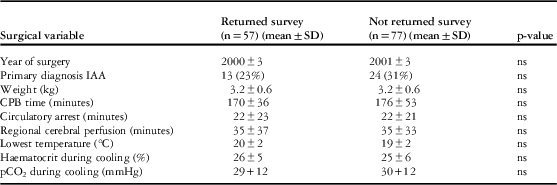
There were no significant differences found in any of the surgical variables for the children with returned surveys when compared with the non-returned surveys (Table 2). Interrupted aortic arch in this surgical cohort was found to be a significant risk factor for attention-deficit/hyperactivity disorder (p<0.05). Eleven of the 13 children, with interrupted aortic arch (85%), 3 of 7 children with combined coarctation/ventricular septal defect repair (42.9%), and 9 of 33 children who underwent Norwood Stage I repair (27.3%) were classified as having attention-deficit/hyperactivity disorder. The highest rate of attention-deficit/hyperactivity disorder was in children with interrupted aortic arch. Although only 6 of the 13 children with a diagnosis of interrupted aortic arch were tested with fluorescence in situ hybridisation testing, 3 (50%) were positive. Of the children with interrupted aortic, 12 were Type B and 1 was Type A.
Comparison of surgical data for survey responders and non-responders.

CPB=cardiopulmonary bypass; IAA=interrupted aortic arch
ADHD-IV and Child Health Questionnaire-50 scores for children designated as attention-deficit/hyperactivity disorder
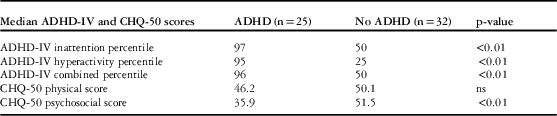
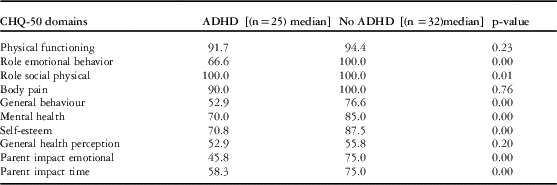
The three ADHD-IV scores – inattention, hyperactivity, and combined – and the Child Health Questionnaire-50 psychosocial score were significantly different (p<0.05) for the children designated as attention-deficit/hyperactivity disorder. There was no significant difference observed in the Child Health Questionnaire-50 physical summary score (Table 3). The Child Health Questionnaire-50 subcategory scores are shown in Table 4. Significant differences (p<0.05) were found in the subcategories of role emotional behaviour, role social behaviour, general behaviour, mental health, self-esteem, and both parent emotional impact and time.
ADHD IV scores and CHQ-50 summary scores for subjects classified as ADHD and no ADHD.

ADHD=attention-deficit/hyperactivity disorder; CHQ-50=Child Heath Questionnaire
CHQ-50 sub categories for subjects classified as ADHD and no ADHD.

ADHD=attention-deficit/hyperactivity disorder; CHQ-50=Child Heath Questionnaire
Discussion
In this cross-sectional study on children aged 5–16 years of age who underwent neonatal surgery with aortic arch repair, the overall percentage of patients classified as having attention-deficit/hyperactivity disorder was 44%. This represents a 10-fold increase in attention-deficit/hyperactivity disorder in this surgical cohort over the general paediatric population.Reference Kessler, Adler and Ames 7 Interrupted aortic arch in this surgical cohort was found to be a significant risk factor for attention-deficit/hyperactivity disorder. Interrupted aortic arch has a 40% association with velocardiofacial (22q11.2 deletion) syndrome, which has a high rate of attention-deficit/hyperactivity disorder.Reference Gothelf, Presburger and Levy 8 In the general population of children with confirmed 22q11.2 deletion syndrome, the reported rate of attention-deficit/hyperactivity disorder is 42%.Reference Botto, May and Fernhoff 9 Neuroanatomy in 22q11.1 deletion syndrome shows an increase in the size of the mid-saggital corpus callosum and Sylvian fissures, and a decrease in the size of the posterior fossa, cerebellum, and the caudate nucleus.Reference Momma 10 The change in the white matter in these regions, especially the caudate nucleus, is associated with impairments in attention and executive function.Reference Momma 10
The rate of attention-deficit/hyperactivity disorder in our study for the children without interrupted aortic arch was 32%, which is similar to a recent study on 5- to 10-year-olds who underwent circulatory arrest before 45 days of age.Reference Shillingford, Glanzman, Ittenbach, Clancy, Gaynor and Wernovsky 3 In that study, Shillingford used both parent and/or teacher ADHD-IV surveys. Parents and teachers identified 30% of the children as high risk for attention-deficit/hyperactivity disorder.
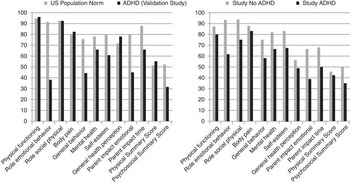
The Child Health Questionnaire-50 overall psychosocial score was significantly lower for children classified as attention-deficit/hyperactivity disorder, indicating an increase in behavioural problems. Our findings are consistent with the validation studies for the Child Health Questionnaire-50 that have shown that attention-deficit/hyperactivity disorder is associated with a psychosocial score below 37.Reference Rentz, Matza, Secnik, Swensen and Revicki 6 The Child Health Questionnaire-50 subcategories that were significantly lower for attention-deficit/hyperactivity disorder children in this study are also the same as those reported in the Child Health Questionnaire-50 validation study in attention-deficit/hyperactivity disorder when compared with a normal population (Fig 2).
Child Health Questionnaire-50 subcategories – US Population Norm versus attention-deficit/hyperactivity disorder (ADHD) in validation study, current study: No ADHD versus ADHD.

An increased incidence of attention-deficit/hyperactivity disorder in this population may be because of higher prevalence of genetic syndromes in children undergoing heart surgery than the normal population. Therefore, the risk for attention-deficit/hyperactivity disorder will unfortunately always be higher than in the normal population. However, an additional consideration is the potential impact of interrupting cerebral blood flow during neonatal aortic arch surgery with the subsequent loss of dopamine receptor activity.Reference Lou 11 Reduced dopaminergic activity in the striatum has been documented in attention-deficit/hyperactivity disorder patients, indicating the possibility of a link between cardiac surgery, hypoxia, and attention-deficit/hyperactivity disorder.Reference Decker and Rye 12 Although hypothermia is routinely performed in these operations as a protective effect, cooling of the striatum may be limited by its location in a watershed area of the brain.Reference Qiu, Crocetti and Adler 13
Participation in special education also confirms the increased behavioural problems in this population. In our study, 23% of the children were in special education classes, which is higher than the 15% reported by Shillingford in 2008.Reference Shillingford, Glanzman, Ittenbach, Clancy, Gaynor and Wernovsky 3 Although this might suggest that there could be increasing awareness and utilisation of services over time, we were quite surprised to find that in our study only 28% of the children classified as attention-deficit/hyperactivity disorder were receiving treatment for attention-deficit/hyperactivity disorder. The use of stimulants to treat attention-deficit/hyperactivity disorder in patients with known cardiac defects is a controversial issue. A recent study has outlined that a majority of paediatric cardiologists favour standard treatment of attention-deficit/hyperactivity disorder in most types of congenital heart disease, except for specific conduction defects such as Wolff–Parkinson–White Syndrome and QT prolongation. This has changed from previous warnings regarding stimulant therapy in this population.Reference Batra, Alexander and Silka 14
The impact on the parents of raising a child with attention-deficit/hyperactivity disorder was clearly seen in the Child Health Questionnaire-50 scores. Children classified as attention-deficit/hyperactivity disorder had significantly lower Child Health Questionnaire-50 scores for parent time and emotional involvement. Our findings are consistent with the daily challenges highlighted in “Safeguarding Precarious Survival: Parenting Children Who Have Life-Threatening Heart Disease”.Reference Rempel and Harrison 15 This study found that behaviours associated with attention-deficit/hyperactivity disorder increase demands on parents and extend health-care concerns well into adolescence.
In summary, attention-deficit/hyperactivity disorder after neonatal aortic arch surgery is underdiagnosed and therefore undertreated in this paediatric surgical population. Identification and treatment of attention-deficit/hyperactivity disorder may improve the quality of life for children and their family members. This population should be considered high risk for the development of attention-deficit/hyperactivity disorder to ensure timely diagnosis and appropriate treatment if and when indicators should appear.
Limitations
There may be discrepancies in the reported rate of attention-deficit/hyperactivity disorder because of the methodology used for classification. Formal diagnosis of attention-deficit/hyperactivity disorder is a function of health-care access and may underestimate the prevalence. Combined parent and teacher scores on attention-deficit/hyperactivity disorder rating scales yield a lower prevalence than parent scores alone.Reference Anastopoulos, DuPaul, Power and Reid 5 Owing to the number of school districts and the requirement of the University Institutional Review Board that approval would have to be obtained from every school board, using teacher surveys was prohibitive. Therefore, it is possible that we may have misclassified some of the respondents in our study.
Another limitation is that parents consented to participate in a survey on attention-deficit/hyperactivity disorder. There may have been selection bias by parents who suspected this disorder in their child and were more likely to complete the survey. This would also increase the prevalence rate.
Conclusion
Attention-deficit/hyperactivity disorder is a common disease following neonatal aortic arch repair and is related to genetic predisposition with additional potential risk factors related to hypoxic injury. Our study is significant because it identifies attention-deficit/hyperactivity disorder as a common long-term comorbidity of neonatal aortic arch repair. Our findings also demonstrate that attention-deficit/hyperactivity disorder is underdiagnosed, and therefore undertreated, among children who have undergone this surgery. As the quality of life of children with attention-deficit/hyperactivity disorder is negatively impacted, the findings have significant implications for the quality of life in this population.
Acknowledgements
None.
Financial Support
This research received no specific grant from any funding agency, commercial or not-for-profit sectors.
Conflicts of Interest
None.
Ethical Standards
This study was approved by the Medical University of South Carolina Institutional Review Board and was conducted within all guidelines of the approval.