INTRODUCTION
The incidence of depressive disorders after traumatic brain injury (TBI) varies between 20 and 50% (Jorge, Robinson, Arndt, Starkstein, Forrester, & Geisler, Reference Jorge, Robinson, Arndt, Starkstein, Forrester and Geisler1993) with a lifetime prevalence of 11.1% (Silver, Kramer, Greenwald, & Weissman, Reference Silver, Kramer, Greenwald and Weissman2001), more than twice the rate of the general population. Depression is often associated with suicide ideation (SI), which can increase the risk of an actual suicide attempt (Schotte & Clum, Reference Schotte and Clum1982). Several studies have reported high rates of depression and SI after TBI (Diekstra & Garnefski, Reference Diekstra and Garnefski1988; Silver et al., Reference Silver, Kramer, Greenwald and Weissman2001; Teasdale & Engberg, Reference Teasdale and Engberg2001). The study by Silver et al. estimated suicide attempts to be 5.7 times higher after TBI compared with those with no history of TBI. Simpson and Tate (Reference Simpson and Tate2002) have argued that as suicide is a frequent psychological legacy of TBI we need to be able to identify those at risk, regardless of injury severity or time since injury, so that brain injury services can provide appropriate support.
Diekstra and Garnefski (Reference Diekstra and Garnefski1988) reported that 23% of people with depression and SI after TBI reported cognitions that range from thoughts about the worthlessness of life to the formation of concrete plans for ending life. Hall, Plant, and Hall (Reference Hall, Platt and Hall1999) found that 29% of patients with feelings of worthlessness had actually made a suicide attempt. Whereas a sense of worthlessness seems to be an important characteristic of depression capable of predicting suicide, Hall et al. also found that 64% of cases reported a sense of hopelessness, reflecting the findings of Beck, Steer, Kovacs, and Garrison (Reference Beck, Steer, Kovacs and Garrison1985) who found that non-TBI patients with high-levels of hopelessness were 11 times more likely to commit suicide. More recently, Simpson and Tate (Reference Simpson and Tate2002) found that a sense of hopelessness (which may not become evident until many years post injury) was a significant predictor of SI which helps explain the findings of Teasdale (Reference Teasdale2006) who reported that 17% of TBI cases attempt suicide, on average, 5 years following injury.
An association also exists between depression, SI, and the emotional construct alexithymia (Hirsh, Hautekeete, & Kochman, Reference Hirsch, Hautekeete and Kochman2001; Honkalampi, Honkanen, Tanskanen, Hintikka, Lehtonen, & Viinamäki, Reference Honkalampi, Honkanen, Tanskanen, Hintikka, Lehtonen and Viinamäki2001; Iancu, Dannon, Poreh, Lepkifker, & Grunhaus, Reference Iancu, Dannon, Poreh, Lepkifker and Grunhaus2001; Kauhanen, Kaplan, Cohen, Julkunen, & Salonen, Reference Kauhanen, Kaplan, Cohen, Julkunen and Salonen1996; Taiminen, Saarijarvi, Helenius, Keskinen, & Korpilahti, Reference Taiminen, Saarijarvi, Helenius, Keskinen and Korpilahti1996). People with alexithymic tendencies have difficulty identifying, describing, and expressing emotions, and exhibit a concrete and externally oriented style of thinking (Taylor, Bagby, & Parker, Reference Taylor, Bagby and Parker1997). Therefore, it is possible that alexithymia also contributes to an increased risk of SI after TBI by limiting awareness of emotions, making it difficult to identify, express or talk about feelings, thereby inhibiting the use of coping strategies and stress-management skills. Consistent with this, Hintikka et al. (Reference Hintikka, Honkalampi, Honkanen, Antikainen, Tanskanen and Haatainen2004), in a general population study, found that SI was present in 31.5% of participants with alexithymic characteristics compared with only 9.1% of non-alexithymic participants. Hirsh et al. (Reference Hirsch, Hautekeete and Kochman2001) also reported an association between depression, alexithymia, and SI which led to the formation of early maladaptive schemas involving hopelessness which contributed to the risk of suicide attempts.
Recently, a link has been identified between alexithymia and psychological distress after TBI (Williams & Wood, Reference Williams and Wood2009; Wood & Williams, Reference Wood and Williams2007, Reference Wood and Williams2008). However, so far, no attempt has been made to examine associations between alexithymia and SI in a TBI sample. The current study, therefore, aimed to (1) determine the frequency of alexithymia, depression, and SI in a TBI sample compared with a healthy control group; (2) compare the proportion of depressed TBI cases with alexithymia against non-TBI depressed samples who report alexithymia; (3) examine the associations between alexithymia, depression, and SI in a TBI sample; and (4) examine the relative contribution made by alexithymia and depression, plus two prominent features of depression—hopelessness and worthlessness, to SI.
We predicted that (a) the frequency of alexithymia, psychological distress, and SI in a TBI sample would exceed that in a demographically matched control group; (b) the proportion of alexithymia in a TBI depressed sample would exceed that of a non-TBI depressed sample; (c) that a significant association would emerge between alexithymia and SI in the TBI group, which would be largely explained by feelings of hopelessness and worthlessness as measured on the BDI.
METHOD
Participants
One hundred ninety-five patients attending Swansea University Head Injury Clinic for neuropsychological assessment and rehabilitation advice represented the target population. Patients were excluded if they had a pre-accident history of psychiatric and/or personality disorder based on self-report and review of GP records; a history of previous head trauma; a developmental history of learning disability, estimated pre-accident IQ < 70 (which might affect ability to recognize and express emotion); any other neurological disorder that would compromise ability to complete measures reliably. We could not control for medication prescribed before referral but only a small number (<15%) had been taking psychotropic medication for more than 6 weeks before assessment.
One hundred five (54%) patients met these criteria. Sixty-eight (65%) were male. Mean age at injury was 34.75 years (SD = 15.32; range, 11–72 years); at assessment 37.52 years (SD = 15.21; range, 16–74 years). The mean time between injury and assessment was 2.77 years (SD = 1.50; range, 0.64–8.32 years). Injury severity was determined by the length of post traumatic amnesia (PTA) (M = 14.38 days; SD = 27.67; range, 1–210) and Glasgow Coma Scale (GCS) scores (M = 9.59; SD = 4.37; range, 3–15) (see Table 1 for TBI characteristics by severity level). Pre-morbid intelligence was estimated using the Wechsler Test of Adult Reading (WTAR) (Wechsler, Reference Wechsler2001) (M = 94.71; SD = 10.41; range, 70–117).
TBI characteristics by PTA severity level

Note
Severity groups based on PTA scores: mild = <1 hour; moderate = 30 min-1 day; severe = >1 day. TBI = traumatic brain injury; PTA = post traumatic amnesia.
A control group comprised 74 participants known to the authors. All were 18 years of age or over and had no previous history of a traumatic brain injury, formal psychiatric illness or personality disorder. 50 (67.57%) were male. Their mean age was 36.89 years (SD = 16.09 years; range, 18–74 years). The TBI and control group did not differ in gender (χ2 (1, n = 179) = .0005; p > .05) or age at assessment (t(177) = .264; p > .05).
Measures
The Toronto Alexithymia Scale (TAS-20) (Bagby, Parker, & Taylor, Reference Bagby, Parker and Taylor1994; Taylor, Bagby, & Parker, Reference Taylor, Bagby and Parker1992)
This consists of three sub-scales: Difficulty Identifying Feelings (DIF), Difficulty Describing Feelings (DDF), and Externally Oriented Thinking (EOT). Participants rate the 20 items using a 5-point Likert scale ranging from “Strongly Disagree” to “Strongly Agree”. Total scores range from 20 to 100; ≤ 51, no alexithymia; 52–60, possible alexithymia; ≥ 61, positive for alexithymia (Taylor et al., Reference Taylor, Bagby and Parker1992). The TAS-20 has been widely used within clinical, non-clinical and TBI groups (Hintikka et al., Reference Hintikka, Honkalampi, Honkanen, Antikainen, Tanskanen and Haatainen2004; Honkalampi et al., Reference Honkalampi, Honkanen, Tanskanen, Hintikka, Lehtonen and Viinamäki2001; Williams & Wood, Reference Williams and Wood2009; Wood & Williams, Reference Wood and Williams2007).
The Beck Depression Inventory (BDI-II) (Beck, Steer, & Brown, Reference Beck, Steer and Brown1996)
This measures affective, cognitive, physiological and motivational aspects of low mood (Larsson & Ivarsson, Reference Larsson and Ivarsson1998). Each category consists of four statements endorsed on a 4-point scale. Scores range from 0 to 63 with higher total scores indicating more severe depressive-type symptoms. The BDI-II demonstrates good reliability and validity in clinical and nonclinical samples (Kühner, Huffziger, & Nolen-Hoeksema, Reference Kühner, Huffziger and Nolen-Hoeksema2007).
Suicide ideation
The BDI-II sub-scale of Suicidal Thoughts or Wishes was used to assess SI. Several other studies have used this sub-scale for the same purpose in both clinical and non-clinical populations (Hintikka et al., Reference Hintikka, Honkalampi, Honkanen, Antikainen, Tanskanen and Haatainen2004; Kaltiala-Heino, Rimpela, Marttunen, Rimpela, & Rantanen, Reference Kaltiala-Heino, Rimpela, Marttunen, Rimpela and Rantanen1999; Larsson & Ivarsson, Reference Larsson and Ivarsson1998; Steer, Kumar, Ranieri, & Beck, Reference Steer, Kumar, Ranieri and Beck1998). The sub-scale consists of four statements; (0) “I do not have any thoughts of killing myself”; (1) “I have thoughts of killing myself, but I would not carry them out”; (2) “I would like to kill myself”; and (3) “I would kill myself if I had the chance”.
Hopelessness and worthlessness
These constructs were examined using BDI-II sub-scales of Hopelessness (Pessimism) and Worthlessness. Beck et al. (Reference Beck, Steer, Kovacs and Garrison1985) found that the Pessimism item of the BDI-II was almost as predictive of eventual suicide as the Beck Hopelessness scale itself.
Procedure
Ethical approval for the study was obtained from the Psychology Research Ethics Committee, School of Human Sciences, Swansea University.
Participants were divided into groups based on their total BDI-II scores (BDI: minimal, 0–13; mild, 14–19; moderate, 20–28; severe, 29–63). Participants were also divided into groups based on their responses to the Suicidal Thoughts or Wishes item of the BDI-II. Participants reporting a score of 0 formed the no suicide group, participants scoring 1–3 formed the SI group. Similarly, participants were grouped according to their responses on the Hopelessness and Worthlessness items on the BDI-II (Absent = score 0; Present = score 1–3). Finally, participants were divided into alexithymia and non-alexithymia groups based on TAS-20 total scores (Taylor et al., Reference Taylor, Bagby and Parker1992). The alexithymia group comprised all participants who scored ≥ 61 on the TAS-20 and the non-alexithymic group consisted of all participants who scored ≤ 60.
Statistical Analyses
Independent sample t tests, χ2, and proportion analyses were used to determine differences between groups (TBI vs. control; TBI depressed vs. non-TBI depressed; suicide ideation vs. no suicide ideation) on measures of suicide ideation, alexithymia, depression, hopelessness, and worthlessness. Eta squared values were calculated to indicate the magnitude of significant differences (Cohen, Reference Cohen1988). Depending on the statistical approach, ratings of depression and alexithymia were examined as both continuous (e.g., BDI-II total scores) and categorical variables (e.g., depression: minimal, mild, moderate, and severe; or: depression present/absent). To examine factors that may predict the likelihood that TBI patients would report the presence of SI, univariate and multivariate logistic regression analyses were performed. Where necessary, to account for the possibility of inflated type 1 error, Bonferroni adjusted alpha levels were used. All data were analyzed using SPSS (version 16.0) for Windows.
RESULTS
Confounding Variables
Before examining relationships between SI, alexithymia, depression, hopelessness, and worthlessness in the TBI group, the presence of possible confounding variables was examined.
Socio-economic status (SES)
The χ2 analysis revealed no significant associations between pre-accident socioeconomic status and any of the variables under investigation (SES and SI: df(3,1) = .934; p > .05; SES and TAS-20: df(3,1) = 2.176; p > .05; SES and BDI: df(9,1) = 3.738; p > .05; SES and Hopelessness: df(3,1) = .159; p > .05; SES & Worthlessness: df(3,1) = .838; p > .05).
Injury severity
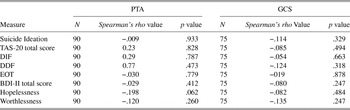
Spearman rho analysis revealed no significant correlations between SI and PTA or GCS scores, alexithymia, depression, hopelessness, or worthlessness (Table 2).
Injury severity, SI, alexithymia, depression, and anxiety

SI = suicide ideation; PTA = post traumatic amnesia; GCS = Glasgow Coma Scale; TAS = Toronto Alexithymia Scale-20; DIF = Difficulty Identifying Feelings; DDF = Difficulty Describing Feelings; EOT = Externally Oriented Thinking; BDI = Beck Depression Inventory.
TBI and Control Group Differences
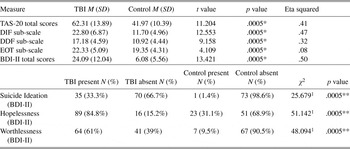
The TBI group reported significantly higher ratings of alexithymia and depression compared with the control group. The TBI group also recorded a higher frequency of suicide ideation, hopelessness, and worthlessness on the BDI-II (Table 3).
TBI and control group differences

Note
TBI = traumatic brain injury; TAS = Toronto Alexithymia Scale-20; DIF = Difficulty Identifying Feelings; DDF = Difficulty Describing Feelings; EOT = Externally Oriented Thinking; BDI = Beck Depression Inventory.
1 Continuity correction applied.
* Significant at adjusted alpha level of .0008 (i.e., 0.05/6).
** Significant at adjusted alpha level of .01 (i.e., 0.05/3).
Depression and Alexithymia
For the purpose of the analysis the TBI group were divided into groups based on their BDI-II total scores. Forty-seven (44.76%) reported scores ≤ 19 (minimal-mild), and 58 (55.23%) reported BDI-II scores ≥ 20, forming a moderate-severely depressed group.
The TBI moderate-severely depressed group (70.68%) recorded a significantly higher frequency of alexithymia compared with a non-TBI group with comparable BDI-II scores (53.92%; Z = 2.081; p < .018) (Honkalampi, Hintikka, Tanskanen, Lehtonen, & Viinamäki, Reference Honkalampi, Hintikka, Tanskanen, Lehtonen and Viinamäki2000). Similarly, the TBI moderate-severely depressed group (70.68%) recorded a significantly higher frequency of alexithymia compared with a group of patients diagnosed with Major Depressive Disorder (44.8%; Z = 3.224; p < .0006) (Honkalampi et al., Reference Honkalampi, Honkanen, Tanskanen, Hintikka, Lehtonen and Viinamäki2001).
Suicide Ideation and Depression
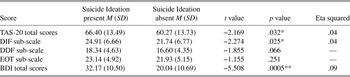
A total of 74.3% (26 of 35) patients in the SI group reported BDI-II scores consistent with severe depression, compared with 24.3 (17 of 70) in the no-SI group (Table 4).The χ2 analysis revealed a medium significant association between SI and BDI-II groups (χ2[3,105] = 25.565; p < .005, Cramer’s V = .493; SI group: minimal depression N = 2 (5.7%); mild N = 4, 11.4%; moderate N = 3, 8.6%; severe N = 26, 74.3%; No-SI group: minimal depression N = 27, 38.6%; mild N = 14, 20%; moderate N = 12, 17.1%; severe N = 17, 24.3%). Independent sample t tests revealed large significant group differences on the BDI-II, with higher ratings of depression in the SI group (Table 4).
Suicide ideation group differences

Note
TAS = Toronto Alexithymia Scale-20; DIF = Difficulty Identifying Feelings; DDF = Difficulty Describing Feelings; EOT = Externally Oriented Thinking; BDI = Beck Depression Inventory.
* Significant at .05.
** Significant at .0005.
Suicide Ideation and Alexithymia
In the TBI group, 77.1% (27 of 35) of patients reporting SI recorded scores consistent with alexithymia, compared with only 52.9% (37 of 70) in the no-SI group. A χ2 test for independence indicated a small significant association between SI and alexithymia (χ2[1,105] = 5.78; p < .05; Phi = −.235). Independent sample t tests revealed that those cases reporting SI recorded significantly higher TAS-20 total scores, but the only significant sub-group difference was on the Difficulty Identifying Feelings (DIF) sub-scale (Table 4)
Suicide Ideation and Hopelessness
A total of 91.4% (32 of 35) of the SI group endorsed hopelessness on the BDI, compared with 81.4% (57 of 70) in the no-SI group. However, χ2 analysis did not find a significant association between SI and hopelessness (χ2[1,105] = 1.807; p > .05; Phi = .131; SI group: hopelessness N = 32, 91.4%; no hopelessness N = 3, 8.6%; No-SI group: hopelessness N = 57, 81.4; no hopelessness N = 13, 18.6%) (Table 4).
Suicide Ideation and Worthlessness
A total of 91.4% (32 of 35) of the SI group endorsed worthlessness on the BDI, compared with 45.7% (32 of 70) in the no-SI group reflecting a medium significant association (χ2[1,105] = 20.488; p < .0005; Phi = .442; odds ratio = 12.667; 95% confidence interval, 3.545–45.260; SI group: Worthlessness group: N = 32, 91.4%; no worthlessness N = 3, 8.6%; No-SI group: worthlessness N = 32, 45.7%; no worthlessness N = 38, 54.3%) (Table 4).
Risk of Suicide Ideation
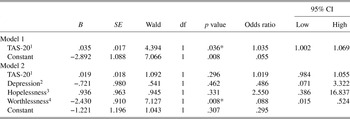
Direct logistic regression assessed the impact of alexithymia (TAS-20 total scores) on the likelihood that TBI patients would report the presence of SI (model 1). The model distinguished patients reporting and not reporting SI (χ2[1,105] = 4.792; p < .05). The model explained between 4.5% (Cox & Snell R Square) and 6.2% (Nagelkerke R Squared) of the variance in SI and correctly classified 67.6% of cases (Table 5). The odds ratio for TAS-20 scores indicated that for every point increase on the TAS-20, the odds of reporting SI increased by a factor of 1.035.
Logistic regression models for the risk of suicide ideation

Note
CI = confidence interval; TAS = Toronto Alexithymia Scale-20.
1 TAS-20 total score.
2 BDI-II score ≤12/≥13.
3 Yes/No.
4 95%.
* Significant at .01.
A second logistic regression was performed containing four independent variables; TAS-20 total scores, depression, hopelessness, and worthlessness (model 2, Table 5). The full model was statistically significant (χ2[4,105] = 30.830; p < .0005), explaining between 25.4% (Cox & Snell R Square) and 35.3% (Nagelkerke R Squared) of the variance in SI and correctly classified 74.3% of cases. Only one independent variable (worthlessness) made a unique significant contribution to the model. Patients reporting feelings of worthlessness on the BDI-II were 1.908 times more likely to report SI.
DISCUSSION
Consistent with previous research (Williams & Wood, Reference Williams and Wood2009; Wood & Williams, Reference Wood and Williams2007) the TBI group recorded significantly higher alexithymia TAS-20 total and sub-scale scores compared with a matched control group. Based on BDI-II scores, the TBI sample recorded higher rates of depression compared with the control group, while 84.8% reported a sense of hopelessness, and 61% feelings of worthlessness, compared with only 31.1% and 9.5%, respectively, in the control group. As expected, the frequency of SI following TBI (33%) was much higher than a matched control group (1.4%), consistent with previous findings (Silver et al., Reference Silver, Kramer, Greenwald and Weissman2001; Teasdale & Endberg, Reference Teasdale and Engberg2001).
Those reporting SI in the TBI group had significantly higher alexithymia (TAS-20) total scores compared with those with no SI, largely explained by group differences on the Difficulty Identifying Feelings sub-scale of the TAS-20. However, to address the possibility that SI could be explained by high BDI-II scores reflecting depressed mood, rather than alexithymia per se, the TBI data from this study was compared with data from two studies (Honkalampi et al., Reference Honkalampi, Hintikka, Tanskanen, Lehtonen and Viinamäki2000, Reference Honkalampi, Honkanen, Tanskanen, Hintikka, Lehtonen and Viinamäki2001) that examined relationships between alexithymia and depression in non-TBI depressed patients. This showed that the proportion of moderate-severely depressed TBI cases reporting alexithymia was significantly higher than in the non-TBI depressed studies, suggesting that alexithymia may act as an important mediator for mood disorders after TBI, contributing to an increased risk of SI by limiting awareness of one’s own emotions, thereby restricting the use of coping strategies and stress-management skills.
Logistic regression analyses performed to determine the strongest predictors of SI in the TBI group showed that alexithymia scores distinguished between patients reporting and not reporting the presence of SI, explaining between 4.5% and 6.2% of the variance, with every point increase on the TAS-20 increasing the odds of reporting SI by a factor of 1.035. However, when measures of depression, hopelessness, and worthlessness were introduced into the model, alexithymia no longer made a unique significant contribution to the amount of variance explained. The overall model remained significant but worthlessness scores made a unique significant contribution. Feeling worthless was reported by 91.4% of those with SI in the TBI group compared with 45.7% in the TBI group who did not report SI. Indeed, patients who reported feelings of worthlessness were 1.908 times more likely to report SI.
These findings are consistent with previous research on non-TBI depressed samples (Hall et al., Reference Hall, Platt and Hall1999) with the exception that after TBI, a sense of hopelessness did not prove a major mediating factor in SI. This was unexpected and is difficult to explain, especially because injury severity did not prove to be significant factor influencing SI. However, it seems to suggest that depression following head trauma (a single major life event) may have different characteristics when compared with depression associated with a biological diathesis.
There are several limitations to this study. Although the BDI-II item for screening suicide ideation has been used in previous studies (e.g., Hintikka et al., Reference Hintikka, Honkalampi, Honkanen, Antikainen, Tanskanen and Haatainen2004), more detailed screening instruments (e.g., Beck Hopelessness Scale) may have provided a better risk assessment of SI. Another limitation is that the patients recruited to this study were referred because they exhibited executive or associated behavior problems in everyday life and, therefore, represent a biased clinical sample. Some patients were also on antidepressant medication which may have influenced their response to questionnaire items. The self-report measures themselves also represent an area of weakness because some patients exhibit a lack of self awareness and/or biased perception. The inability of many patients to recognize functionally relevant problems (anosognosia) means that collateral information from relatives is advisable whenever possible. However, anecdotally, the majority of cases interviewed as part of this study were aware that they had difficulty “feeling” emotion after their injury, but seemed largely unconcerned about this deficit. Clinical observations of this kind seem to distinguish (at least in part) what has been termed “alexithymia” from the more familiar post traumatic phenomenon, “anosognosia”. However, more work needs to be carried out to fully discriminate these conditions.
Despite these limitations, the findings of this study have implications for rehabilitation and support services, especially at later stages of recovery when a person has to adjust to permanent life changes as a result of brain injury. With this in mind, there does appear to be a case for recommending early screening for alexithymia after TBI because if, with the passage of time, a sense of worthlessness is experienced as part of a depressive disorder, possibly reflecting poor adjustment to disability, it could increase the risk of SI. In people who tend to be rather concrete and dichotomous in their style of thinking, this could seriously increase the risk of an actual suicide attempt. Early psychological intervention could reduce this risk by targeting awareness of emotions and helping individuals express their feelings in a manner that can be addressed as part of a therapeutic dialogue.
ACKNOWLEDGMENTS
The authors report no conflicts of interest. The authors alone are responsible for the content and writing of the paper.