Teachers often say that students do not learn because they lack adequate motivation, that is, because students consider that the goal to achieve is not worth the necessary time and effort to achieve it. This is true according to Eccles’ expectancy-value theory (Eccles & Wigfield, Reference Eccles and Wigfield2002). However, according to this same theory, what often happens is that they are not motivated because they do not experience progress when trying to learn, because students do not know how to manage their learning process. Therefore, the lack of adequate self-regulation negatively influences self-efficacy expectancies - the expectancy to be able to cope with the task in an efficient way - and success expectancies - the expectancy that performance will be successful in terms of some criterion.
As summarized by Efklides (Reference Efklides2011), self-regulation (SR) is a self-initiated and cyclic process through which students 1) self-represent a task, 2) decide to do or not to do it depending on their interests, on their perception of knowledge and ability and on their success expectancies; 3) plan how to carry it out, 4) monitor and assess whether its realization is adequate or not, 5) cope with difficulties and emotions that usually arise, 6) decide to change their strategies, to go on or to abandon, 7) assess their performance and, 7) make attributions concerning the origin of the outcomes (Efklides, Reference Efklides2011; Winne, Reference Winne, Zimmerman and Schunk2011; Zimmerman, Reference Zimmerman2008).
Self-regulation is, then, a crucial competence for being a successful learner. However, there are important differences between students in the way they self-regulate the cognitive, emotional, motivational and behavioral activities that configure the self-regulation process (Boekaerts, Reference Boekaerts, Zimmerman and Schunk2011; Efklides, Reference Efklides2011; Zimmerman & Shunk, Reference Zimmerman, Schunk, Zimmerman and Schunk2011a). Students differ in their interest, previous knowledge, perceived self-efficacy in the task domain, and motivational goals from which they represent the task and assess its value, their competence, and their control and success expectancies. The interaction between all these variables influences the way each student decides whether to initiate the task or not, and how to carry it out (Efklides, Reference Efklides2011; Heckhausen, Reference Heckhausen1991; Kuhl, Reference Kuhl, Boekaerts, Pintrich and Zaidner2000). Once students decide to initiate the task, they continue without interruption unless the process is interrupted by the difficulties they experience. Awareness of difficulties depends in some degree on students’ self-monitoring and self-assessment, processes in which students differ depending on their interest, motivation and knowledge of criteria from which to assess the procedure they are following (Alonso-Tapia & Panadero, Reference Alonso-Tapia and Panadero2010). In any case, in these occasions students differ in the way they cope with experienced difficulties depending on their motivation, intrinsic or extrinsic, (Deci & Ryan, Reference Deci and Ryan1985), motivational goals (Senko, Hulleman, & Harackiewicz, Reference Senko, Hulleman and Harackiewicz2011), volitional orientation (Kuhl, Reference Kuhl, Boekaerts, Pintrich and Zaidner2000), self-efficacy expectancies (Bandura, Reference Bandura1997) and available strategies. These differences influence the way they reassess their decision to go on with the task or to abandon it. Finally, if students go on and finish the task, they differ in how they assess their outcomes depending on available standards, in the attribution processes, in the reassessment of competence and self-efficacy, and in self-reinforcement (Weiner, Reference Weiner1986).
Given the importance of self-regulation for successful learning, and given the fact that many students do not adequately self-regulate their learning processes (Zimmerman & Schunk, Reference Zimmerman and Schunk2011b), many researchers have tried to facilitate the acquisition of this competency. Their work has supported the generation of a wide body of knowledge about how self-regulation functions, and how to intervene to promote it (Dignath & Büttner, Reference Dignath and Büttner2008; Dignath, Büttner, & Langfeldt, Reference Dignath, Büttner and Langfeldt2008; Perry & Rahim, Reference Perry, Rahim, Zimmerman and Schunk2011; Stoegler & Ziegler, Reference Stoegler, Ziegler, Zimmerman and Schunk2011; Zimmerman & Schunk, Reference Zimmerman and Schunk2011b). However, as shown in these studies, not all students benefit in the same degree from instructional interventions aimed at improving self-regulation. So, it is important to diagnose these self-regulation deficiencies in order to establish intervention objectives and to evaluate the effectiveness of intervention programs. The problem is how to do it.
There are different procedures for assessing self-regulation, each one with its advantages and limitations (Boekaerts & Corno, Reference Boekaerts and Corno2005). If the objective of self-regulation assessment is to describe what a student does when trying to understand a specific task, then procedures such as observing or tracking the students habits (Schmitz, Klug, & Schmidt, Reference Schmitz, Klug, Schmidt, Zimmerman and Schunk2011), recording thinking-aloud protocols (Corno, Reference Corno, Zimmerman and Schunk2011) or carrying out deep interviews oriented to micro-analyzing the self-regulation process (Cleary, Reference Cleary, Zimmerman and Schunk2011) are preferable. This is especially true when the objective of self-regulation assessment is to uncover the strategic processes related to specific task - summarizing, solving problems, writing an essay, etc., as these processes are related to the nature of the task. Nevertheless, if the objective is the assessment of self-regulation processes of groups of students, or the evaluation of intervention programs with groups of students (especially if information gathering has to be done in conventional classrooms), then the procedure most adequate, though not perfect, is the self-report questionnaire in which students report on his or her cognitive, emotional or behavioral processes. In these cases, self-reports are especially useful because according to Castañeda (Reference Castañeda2004), and McCombs (Reference McCombs and Freiberg1999), students’ self-perceptions are best predictors of motivation and achievement than teachers’ perceptions.
There are two types of self-reports on self-regulation. The first type includes self-reports that inform of strategies and processes related with the specific task and learning situation -planning, use of strategies, time management, etc. Questionnaires of this kind are, for example, Learning and Study Strategies Inventory (Weinstein, Palmer, & Schulte, Reference Weinstein, Palmer and Schulte1987) and Motivated Strategies for Learning Questionnaire (MSLQ: Pintrich, Smith, García, & McKeachi, Reference Pintrich, Smith, García and McKeachi1991), as well as Patterns of Adaptive Learning Scales (Midgley et al., Reference Midgley, Maher, Hruda, Anderman, Anderman, Freeman and Urdan2000), Study Process Questionnaire (Biggs, Reference Biggs1987), Survey of Study Habits and Attitudes (Brown & Holtzman, Reference Brown and Holtzman1967), Inventory of Learning Processess (Geisler-Bernstein & Schmeck, Reference Geisler-Bernstein, Schmeck, Birembaum and Dochy1996) and Metacognitive Awareness Inventory (Schraw & Dennison, Reference Schraw and Dennison1994). Dugan (Reference Dugan2007) has shown that these are the self-regulation (SR) questionnaires most often used, though not the only ones. However, in fact most of these questionnaires do not assess self-regulation processes related to emotion and motivation, but variables that can influence such processes. For example, the MSLQ motivational scales assess interest, intrinsic and extrinsic motivation, task-value, self-efficacy, control expectancies and text anxiety; whereas the scales on learning strategies assess the use of rehearsal, elaboration, organization, critical thinking, time and study environment, peer learning and help seeking. The only scales of the MSLQ that assess self-regulation are “metacognitive regulation” and “effort regulation”. The first of these scales assesses the kind of students’ experiences and actions while studying, whereas the second assesses whether students go on trying or not when faced with difficulty.
The second type of self-report includes those that inform of self-messages through which students manage motivation and emotion in different kind of tasks. For example, self-messages such as “What a boring task! Let's see if I finish it and leave” translate an emotional experience as well as avoidance motivation. In the same way, self-messages such as “Well, it seems that every time I do it better, I’m progressing” and as “How difficult, but how interesting! I have to understand how to do it” translate actions implying positive regulation of motivation through self-reinforcement, and orientation to learning goals, respectively. This second kind of self-regulation indicator, not usually considered in the first type of SR self-report, is the one we are interested in, as they might be better indicators of emotional, motivational and volitional processes affecting SR.
As described above, the students’ goal orientations (GO) are one of the factors affecting not only the decision to start a learning activity, but also the cognitive, emotional and behavioral reactions arising during the learning process in front of the experiences of difficulty, progress, failure or success (Efklides, Reference Efklides2011). The influence of GO can be manifest in mental verbalizations through which students self-regulate, adequately or not, their learning activities, the positive and negative emotions that can favor or interfere with them, and the motivation itself. According to Meichenbaum and Goodman (Reference Meichenbaum and Goodman1971), verbal self-messages are an excellent way of regulating and controlling behavior. These kinds of self-messages may define “styles” as far as they reflect more or less consolidated reaction habits of dealing with emotional experiences and motivational threats. However, this does not mean that they are not modifiable, as they may be the result of past learning experiences and can again be influenced by new ones. So, we decided to develop a questionnaire whose contents were the kind of self-messages through which students with different GO self-regulate emotional experiences and motivational threats aroused during learning activities in different kind of tasks.
The development of the questionnaire was based first on the trichotomos model of GO (Dweck & Elliot, Reference Dweck, Elliot, Mussen and Hetherington1983, Elliot, Reference Elliot, Elliot and Dweck2005) and on our own analysis of the nature of GO (Alonso-Tapia, Huertas, & Ruiz, Reference Alonso-Tapia, Huertas and Ruiz2010). This analysis showed that the term “goal” in “goal orientation” should be considered as an inclusive concept embracing specific motives, expectancies and volitional processes. According to such a model, it was considered that the new questionnaire should include items related to learning, performance approach (outcome) and avoidance orientation. Besides, building on Kuhl’s (Reference Kuhl, Kuhl and Beckmann1994) volition theory and Boekaerts and Corno’s (Reference Boekaerts and Corno2005) SR theory -both underlay the importance of emotion self-regulation-, and on Wolters’s ideas on regulation of motivation (Wolters, Reference Wolters2003), it was also considered necessary to include items reflecting motivation and self-regulation of stress.
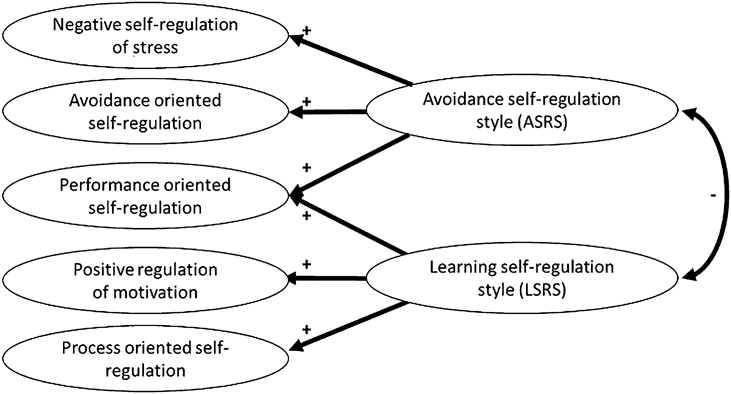
Moreover, on the base of results from previous studies (Alonso-Tapia, Reference Alonso-Tapia2005; Alonso-Tapia et al., Reference Alonso-Tapia, Huertas and Ruiz2010) and on evidence reflecting the positive and negative effects of performance approach on self-regulation (Hulleman, Schrager, Bodmann, & Harackiewicz, Reference Hulleman, Schrager, Bodmann and Harackiewicz2010), we expected that scales corresponding to the five kinds of item mentioned would be structured as shown in Figure 1, defining two main emotion and motivation self-regulation styles (EMSRS): Learning and Avoidance.
Motivation and volition self-regulation model: Expected relations.

First, scales implying positive emotions (process oriented SR and positive regulation of motivation) might correlate positively in some degree. The reason is that when students focus on the process, the possibilities of experiencing progress and of increasing their self-efficacy are greater, and these two facts might increase the likelihood of positive self-messages aimed at sustaining motivation to achieve the learning objectives.
Second, scales implying negative emotions (Negative SR of Stress and Task-avoidance oriented SR) might also correlate positively in some degree. The reason is that the experience of not being able to manage stress when faced with difficulty might activate a view of the task as being boring, dull and threatening, emotions which could move the student towards avoiding the task.
As for the scale Performance oriented SR (associated to Performance GO), our suppositions are based first on the dual effects that this orientation can have on learning and achievement (Senko et al., Reference Senko, Hulleman and Harackiewicz2011). As these authors show, there is evidence that this orientation correlates negatively with achievement, but there is also evidence showing that, under some conditions, the correlation is positive. Reflecting on the nature of results reviewed by Senko et al. (Reference Senko, Hulleman and Harackiewicz2011), we supposed that the Performance SR scale would correlate positively with both SRS, though there is no direct evidence supporting our assumptions. On one side, even if students are centered on learning, they do not forget, and should not forget, the importance of performance for achieving their long-life goals. On the other side, even if students are avoidance oriented, they do not forget that a bad performance usually has negative consequences. Finally, it is expected that both self-regulation styles (SRS) will correlate negatively in some degree, as it usually occurs with Learning and Avoidance GO.
Summarizing, we propose two main EMSRS, Learning and Avoidance, that are defined by the kinds of self-messages included in our questionnaire and grouped in scales according to the model in Figure 1. The main authors describing SRS similar to the ones we have just proposed are Boekaerts and Corno (Reference Boekaerts and Corno2005). They distinguished between SR oriented to learning and SR oriented to preserve well-being, and point that these styles can interact. However, they do not develop a model describing in detail the kind of students’ self-messages that configure each way of dealing with emotions. It is what we have done, though we prefer to name the last SRS as Avoidance SRS instead of well-being SRS, in parallel with the GO to which this SRS is associated.
In order to validate the new self-regulation questionnaire, it is then necessary to achieve several specific objectives.
-
1) It is necessary to see whether the obtained data supported our theoretical model, an objective that can be achieved through the use of confirmatory factor analysis techniques.
-
2) Our model was developed on two assumptions: a) that different types of self-regulatory messages are related to GO, and b) that GO, according to previous work on their nature (Alonso-Tapia et al., Reference Alonso-Tapia, Huertas and Ruiz2010), are encompassing concepts embracing not only specific motivational goals, but also efficacy and control expectancies. So, an additional form of validating it is to see whether SR scales related to scales measuring GO and expectancies as suggested by the theory. This second objective can be achieved through correlation and factor analyses. Correlation analyses will show whether the specific relations between each pair of variables are as expected; factor analysis, on its side, will show whether the different SRS can be grouped together with the different GO considered as encompassing concepts, thus providing an integrated and simplified view of all the expected relations. Both analyses will test different hypotheses related to the convergent and discriminant validity of the questionnaire.
-
3) We were also interested in gathering information about the relationship between self-regulation and classroom motivational climate (CMC) oriented to learning, because such information can contribute to the construct validity of our questionnaire. This interest stems from two main reasons related to the nature of CMC and to its effect on self-regulation.
CMC is a concept similar, but not equivalent, to the concept of classroom goal structure (CGS) (Meece, Anderman, & Anderman, Reference Meece, Anderman and Anderman2006; Midgley et al., Reference Midgley, Maher, Hruda, Anderman, Anderman, Freeman and Urdan2000), as assessment of this structure relies only on teachers’ messages (Midgley et al., Reference Midgley, Maher, Hruda, Anderman, Anderman, Freeman and Urdan2000), though, there are more teaching patterns that configure the CMC. According to Ames (Reference Ames1992) and Alonso-Tapia and Fernández (Reference Alonso-Tapia and Fernández2008, Reference Alonso-Tapia and Fernández2009), the CMC can be defined as the result of the set of different teaching patterns that a teacher uses (ways of introducing classes, of organizing students’ work, of assessing progress, etc.). The degree in which students perceive that such patterns orient them to learning can be assessed. However, the perception of the CMC could be moderated by the motivational and self-regulatory characteristics, more or less consolidated (though not un-modifiable habits), that the students carry on when they enter the classroom. For example, even if a teacher tries to focus students’ attention on learning instead of on performance, as activities promoting deep learning and understanding often demand great effort, students whose SRS are not adequate for dealing with the stress that it may convey can perceive the CMC as stressful and not learning oriented. Thus, it seems adequate to test whether SRS moderates CMC perception as suggested, hence gathering additional evidence on the construct validity of SRS.
Second, CMC can affect students’ self-regulation skills since CMC is based on the instructional techniques that the teacher uses in the classroom, for example supporting autonomy or working step by step (Alonso-Tapia & Fernández, Reference Alonso-Tapia and Fernández2008). The teacher’s working style is relevant since students can use the teacher as a model and he/she can establish, as a goal of teaching, helping students to adequately self-regulate their learning. The classroom motivational climate also may influence self-regulation in another important manner: the learning process involves emotions, and a positive classroom climate provides a better emotional context. So, if students feel safe in their learning environment due to the supportive and fair style of their teacher, the chances are higher that they self-regulate their work, pursuing learning goals instead of well-being goals that are not optimal for learning (Boekaerts & Corno, Reference Boekaerts and Corno2005). However, if the general self-regulation style of the student can moderate CMC perception, as described in the previous paragraph, the effect of CMC on self-regulation and other motivational variables might also be moderated by the general self-regulation style of the student, a style that our questionnaire will try to measure.
There is some evidence supporting the plausibility of our hypotheses. Our previous studies on the relation between GO and CMC defined by teachers’ instructional patterns (Alonso-Tapia & Fernández, Reference Alonso-Tapia and Fernández2008, Reference Alonso-Tapia and Fernández2009; Fernández, Reference Fernández2009) had shown that GO moderated student’s perception of CMC motivational value, and that CMC related positively with students’ attribution of motivational improvement to teacher’s work. Thus, considering the expected relation of SR with GO, it is reasonable to expect that SR also acts as a moderator of CMC perception, and that CMC oriented to learning relates positively with students’ attribution of his or her SR improvement to teacher’s work. A third step in validating the EMSR-Q was to test these two hypotheses. Moreover, our interest in knowing the relationships SR→CMC→SR was not only theoretical, but also practical because if our hypotheses were supported, acting on CMC would improve SR which, in turn, would improve CMC perception as well as its perceived effects: interest, effort, perceived ability, success expectancies and satisfaction with teacher’s work improvement (Alonso-Tapia & Fernández, Reference Alonso-Tapia and Fernández2008, Reference Alonso-Tapia and Fernández2009).
In order to test our two main hypotheses, the two objectives of this study are, first, to determine whether the structure of the EMSR-Q correspond to the theoretical model that provided the base for its development; and second, to test the hypotheses just formulated on their convergent, discriminant and predictive validity, that is, that EMRS 1) relates with GO and expectancies in ways predicted by GO theory, 2) moderates the perception of CMC, and 3) the effect of CMC on self-regulation. Besides, a complementary objective is to analyze the reliability of the scales integrating the questionnaire.
Method
Sample
A total of 664 students from six urban middleclass public secondary and high schools in Madrid, Spain, participated in the study. Public schools do not represent students in private schools in Madrid (18.8 %). The study was part of a large project in which 24 schools participated. So, six schools could be randomly assigned to this study. Their managers were informed of the purpose of the study; then they informed to the staff and parents, and finally accepted to take part in the project. Students were also told about the final aim of the research and encouraged to participate. Schools were large in size, with about 800 students that voluntarily accepted to participate. The final sample was composed by 330 females and 334 males. Age range ran from 12 to 18 years old (M = 16.5; SD = 2.35). The sample was randomly divided in two sub-samples with 334 and 330 subjects respectively, 157 males and 187 females in the first sub-sample, and 175 males and 155 females in the second. The first sample was used for carrying out the initial analysis and the second sample for cross-validating the results.
Materials
In order to test our hypotheses, the following instruments were used.
“Emotion and Motivation Self-regulation Questionnaire” (EMSR-Q)
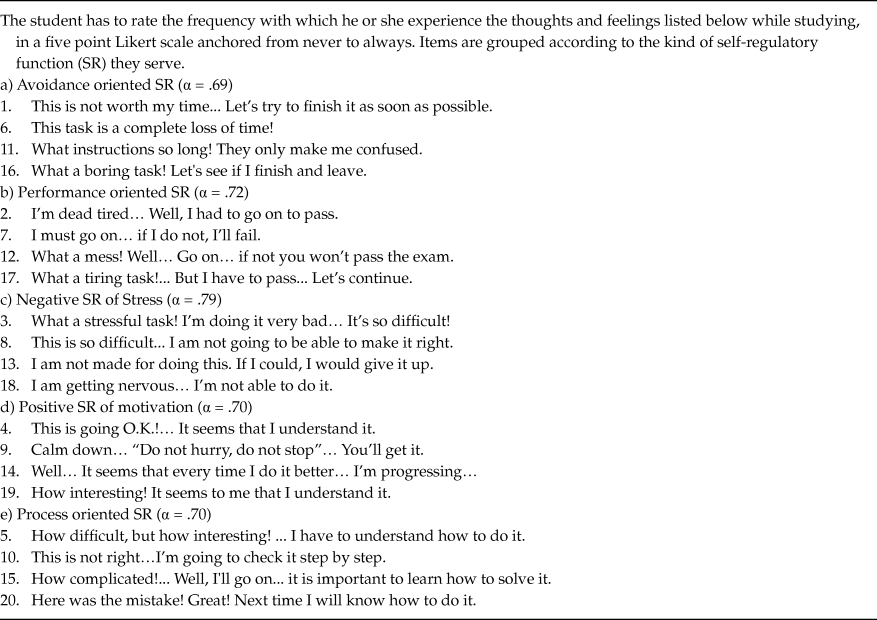
This questionnaire, shown in Table 1, contains 20 items including five types of general self-messages or mental verbalizations through which students self-regulate (adequately or not) the positive and negative emotions which can favour or interfere with their learning activities, and the motivation itself.
Items of the Emotion and Motivation Self-Regulation Questionnaire (EMSR-Q)

“Motives and expectancies” questionnaire (MEVA3)
This is an abbreviated version of the MEVA questionnaire (Alonso-Tapia, Reference Alonso-Tapia2005). It includes two parts. The first is composed of three scales assessing the three main goal orientations described in the literature: learning (α = .79) (LGO), performance (approach) (α = .74) (PGO) and avoidance (α = .75) (AGO) (Elliot, Reference Elliot, Elliot and Dweck2005). The second is formed by two scales assessing self-efficacy expectancies (α = .68), and control expectancies (α = .80). Goal orientations were first used, in order to test the hypothesized relations between these variables and self-regulation (Alonso-Tapia et al., Reference Alonso-Tapia, Huertas and Ruiz2010), and second, to depict their relative weight in predicting the degree in which perceived change in self-regulation and motivational variables, such as interest, perceived efficacy, effort, success expectancies and satisfaction with teacher’s work, are predicted by these variables.
The Classroom Motivation Climate Questionnaire (CMCQ) (Alonso-Tapia & Fernández, Reference Alonso-Tapia and Fernández2008)
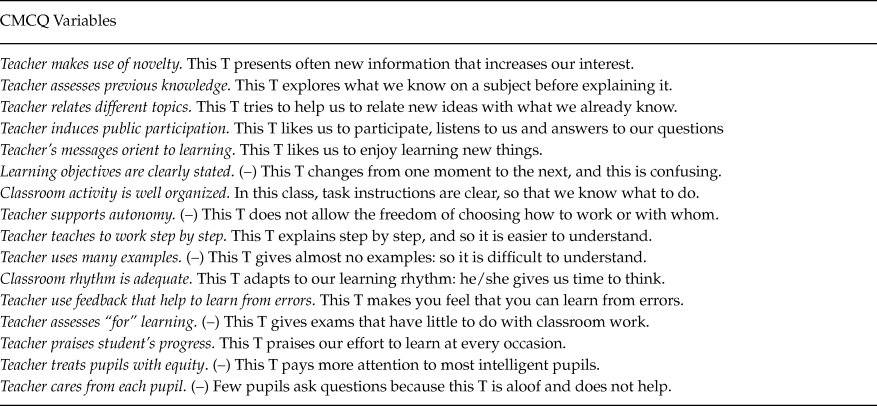
This questionnaire, developed on the previous work of Ames (Reference Ames1992) and Alonso-Tapia and Pardo (Reference Alonso-Tapia and Pardo2006), was designed to cover 16 types of teaching strategies or patterns that could affect positively student motivation to learn. Two items were written to assess each kind of pattern. To avoid acquiescence effects, one was positive and the other negative. Each item had to be answered in a five-point Likert scale, so the score for each pattern ranged from 1 to 10. Table 2 shows the 16 variables and examples of the items. The questionnaire has only one global scale, Classroom Motivation Climate oriented to learning (reliability α = .93). This scale was used to test, first, whether SRS, as a more or less stable perceived personal characteristic, moderates the student’s perception of the classroom motivational climate; and second, to examine whether the degree in which students attribute SR and motivational changes to teacher’s work depends mainly on classroom motivational climate or is moderated by other variables as, for example, previous SRS.
Teaching patterns assessed by the CMCQ with item-examples

Note: T = Teacher, CMCQ = Classroom Motivation Climate Questionnaire.
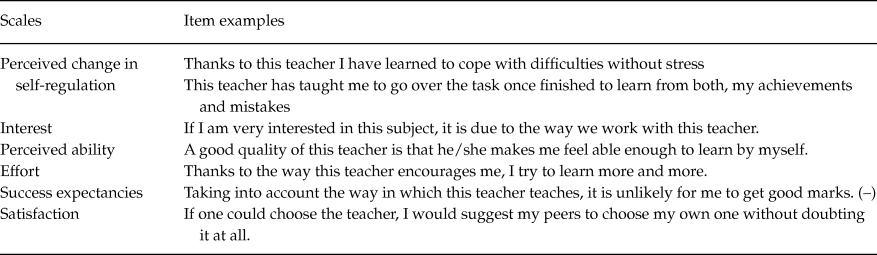
Six independent scales were also used for assessing the Perceived teacher role in changing student’s self-regulation (perceived change in self-regulation,(PCSR), interest (INT), perceived ability (PAB), effort expenditure (EFF), success expectancies (SE) and satisfaction with teacher work (SAT). The PCSR scale has six items, the following four scales have three items and SAT scale has four items. Their internal consistency indexes were good enough (Fernández, Reference Fernández2009). They have been replicated in the present study, as will be shown later. Table 3 includes item examples of these scales. They were used for examining whether the degree to which students attribute self-regulation and motivational changes to teacher work depends mainly on classroom motivational climate or on the potential moderating role of goal orientations, expectancies and general self-regulation messages.
Item examples of scales assessing the role attributed to teacher in self-regulation and motivational change

Procedure
The students filled in the questionnaires in two sessions. They answered the MEVA and the EMSRQ, and then each group of students was instructed to fill in the CMCQ and the final scales in relation to the teacher of one of their academic subjects selected randomly.
In order to determine the EMSRQ factorial structure, three confirmatory factor analyses (CFA) were carried out. First, the structure derived from the theoretical consideration was used as baseline model (See Figure 1) to be estimated with confirmatory techniques (CFA-1) using the AMOS statistical software (Arbuckle, Reference Arbuckle2003). Estimates were obtained using the maximum likelihood method. Absolute fit indexes (χ2, χ2/df, GFI), incremental fit indexes (IFI) and non-centrality fit indexes (CFI, RMSEA) were used to assess model-fit, as well as criteria for acceptance or rejection based on the degree of adjustment described by Hair, Black, Babin, Anderson, and Tathan (Reference Hair, Black, Babin, Anderson and Tathan2006).
Second, in order to cross-validate the results of the above analysis, a confirmatory multiple group analysis was carried out using the two sub-samples. The theoretical model proposed was used as the baseline for comparison without any restriction for parameter equality between samples. Against this model, several nested models were estimated and compared, in which equality between the groups was imposed for different sets of parameters. The relative decline in goodness-of-fit was assessed by means of the difference in the chi-square statistic between the model with restrictions imposed and the model without restrictions.
Third, as in previous studies with different variables related to motivation sex seemed to influence the structure of the questionnaires (Alonso-Tapia et al., Reference Alonso-Tapia, Huertas and Ruiz2010), with the aim of testing in this case whether gender had a significant effect on the structure of the self-regulation messages questionnaire, the sample was divided by gender in two sub-samples, and a re-estimation by groups was carried out.
Fourth, the reliability -internal consistency- of the EMSRQ scale was calculated using Cronbach’s alpha coefficient.
Fifth, in order to get initial information on the external validity of the EMSRQ, correlation analyses between scores on all the general scales used in the study were computed using the whole sample, as well as a factor analysis of the correlations between goal-orientations, expectancies and self-regulation styles to test our first hypothesis. Moreover, three regression analyses were carried out. In the first one, in order to test our second hypothesis, goal orientations, expectancies and self-regulation styles were used as predictors, and the score in the CMCQ as criterion. In the second, goal orientations, expectancies, SRS and perceived classroom motivational climate were used as predictors, and the scales assessing the role attributed to the teacher in the degree of improvement experienced in self-regulation (perceived change in self-regulation (PCSR)) and the remaining motivational variables (interest (INT), perceived ability (PA), effort expenditure (EF) and success expectancies (SE)) as criterion. Finally, in the third model, the same variables were used again as predictors, and satisfaction with teacher’s work was set as criterion.
Results
Emotional and motivational Self-regulation Questionnaire (EMSRQ): Confirmatory factor analysis (CFA-1)
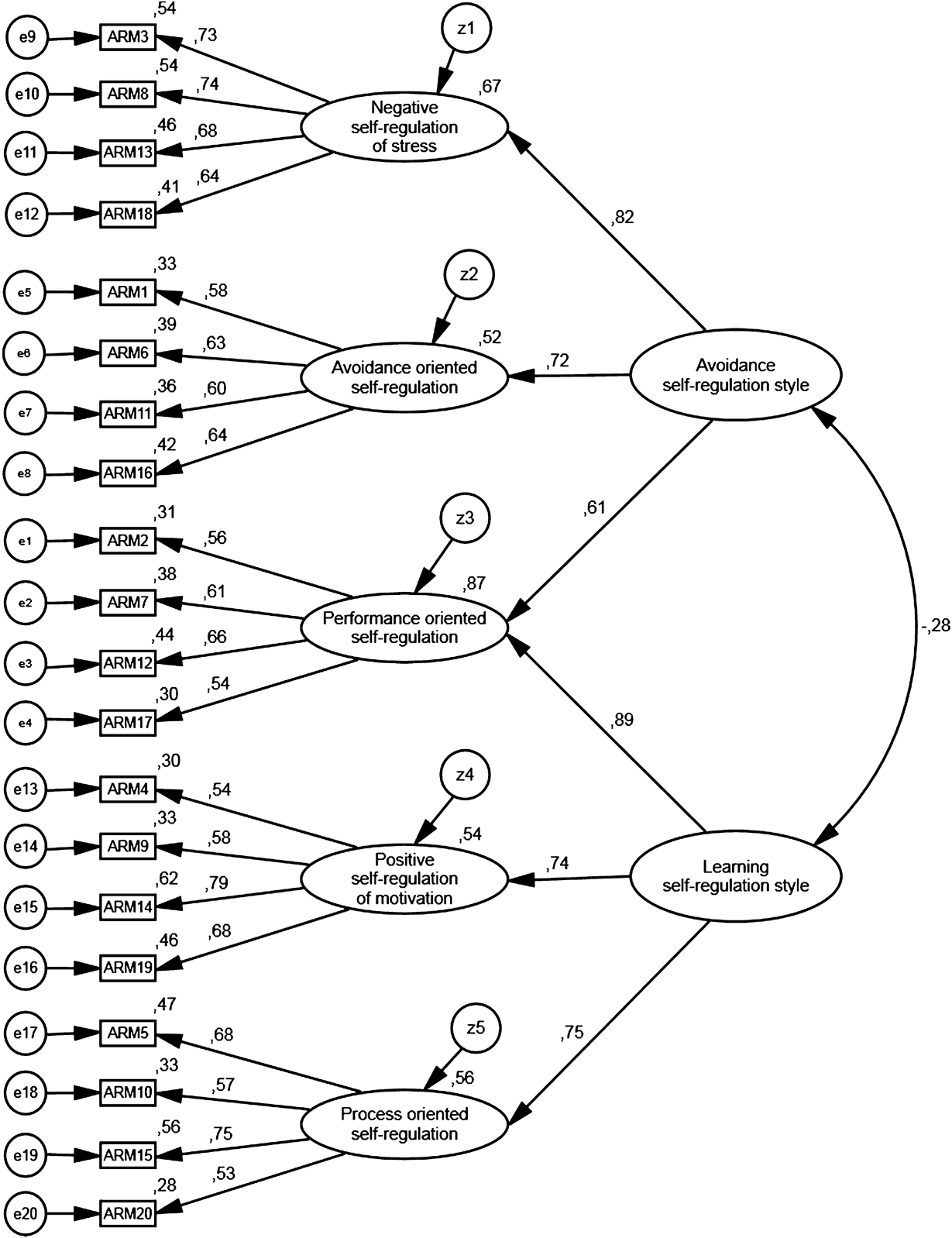
Figure 2 shows the standardized estimates of the confirmatory baseline model. All the estimated measurement loadings (λ) were significant (p < .001), as well as proposed structural relations (γ and Φ). Table 4 shows the fit statistics of the proposed model (CFA-1). Chi-square statistic was significant, probably due to sample size, but the ratio χ2 /df (χ 2 /df = 2.71 < 5) and Root Mean Square Error of Approximation (RMSEA = .07 < .08) were well inside the limits that allow the model to be accepted. The remaining fit indexes fell slightly short on the standard limits of acceptance: GFI (Goodness of Fit Index) = .89; IFI (Incremental Fit Index) = .84; CFI (Comparative Fit Index) = .84. Hence, it was necessary to consider cross validation analyses to decide whether the model was well defined. Second order latent factors were well represented by their respective first order latent factors, and explain the 63% of their variance. Specially, they had a significant predictive effect on Performance oriented SR, explaining 87 % of its variance. All estimated parameter signs matched with the theoretically expected direction of relation.
SRMQ: Baseline confirmatory model (standardized estimates).

Goodness of fit statistics for CFA of baseline model, multi-group cross-validation analysis (CVA), and multi-group analysis by gender

1 Results corresponding to the unconstrained model.
Multi-group cross-validation analysis (CFA-3, CVA)
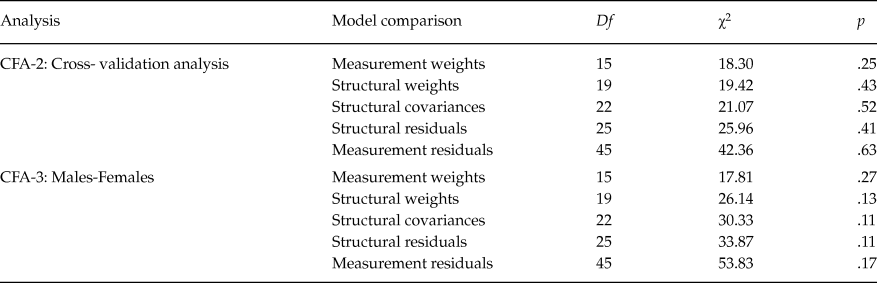
The fit indexes of multi-group analysis were inside acceptable limits, though GFI, IFI and CFI again fell slightly short on accepted cut-off points (see Table 4, CFA-2, CVA). Nevertheless, the model comparison statistics presented in Table 5 (CFA-2: CVA) show that fit is not reduced significantly even if restrictions on measurement weights, structural weights, structural covariances, structural residuals and measurement residuals are imposed. Therefore, it can be concluded that the model is well defined and should not be rejected.
Cross validation of the model using multi-group analyses with two samples. Chi-square differences for model comparison against the unconstrained multi-sample model

Testing gender effects on goal structure: Multi-group analysis by gender (CFA-3. Males-Females)
The adjustment indexes were inside acceptable limits although some of them fell slightly short on accepted cut-off points (see Table 4, CFA-3 Males-Females). Again, however, the model comparison statistics presented in Table 5 (CFA-3: Males-Females) show that fit is not reduced significantly when considering the different restrictions imposed. Therefore, it can be concluded that the model is valid for males and females and should not be rejected.
EMSRQ Reliability
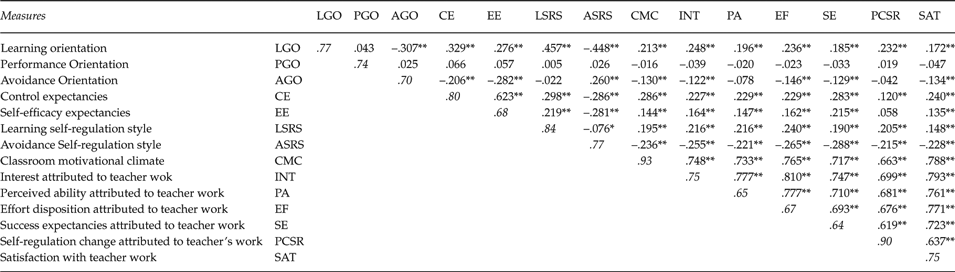
Cronbach’s alpha (α) coefficients were computed for the scales of this questionnaire. The reliability indexes of the self-regulation styles were quite good (LSR = .84; PSR = .77) as well as those of the five basic EMSRQ scales (See Table 1). As shown in Table 6, the indexes of the remaining scales were satisfactory with respect to the aims of our study.
Correlations and internal consistency (Whole sample, N = 664) 1,2

1 **Correlations significant at the .01 level; *Correlations significant at the .05 level.
2 Reliability indexes (α) are shown in the diagonal.
Additional factor, correlation and regression analyses
Table 6, shows the correlations between EMSRQ styles and the remaining scales used in the study. In order to obtain these estimates, scores on SR styles were obtained summing up the scores on those first order scales loading in each second order factor. Several results deserve to be pointed out.
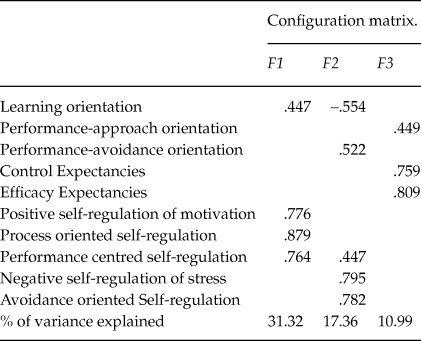
First, correlations between goal orientations, expectancies and EMSRQ second order scales were as expected, a fact giving support to our first hypothesis. Moreover, Table 7 shows the results of the exploratory factor analysis carried out to simplify correlation interpretation between goal orientations, expectancies and EMSRQ first order scales. The three factor solution explained 59.67 % of variance. Learning goal orientation and self-regulation scales defining the learning self-regulation style loaded in the first factor; avoidance goal orientation and self-regulation scales defining the task avoidance self-regulation style load in the second one; and expectancies as well as performance approach goal orientation load in the third. Besides, factors correlate as it could be expected according to our hypothesis: r 12 = –.210; r 13 = .263; r 23 = –.361.
Factor analysis of correlations between goal orientations, expectancies and self-regulation variables

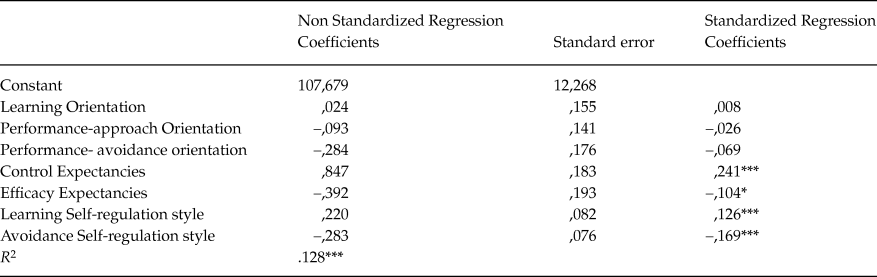
Second, according to our next prediction, EMSRQ styles and CMC correlated positively and in a significant way. Regression analysis presented in Table 8, show that self-regulation styles along with expectancies, are the only significant predictors of the degree in which students perceived the CMC as learning oriented.
Regression analysis. Criterion: Perceived Learning Classroom Motivational Climate (CMC)

***p < .001; **p < .01; *p < .05.
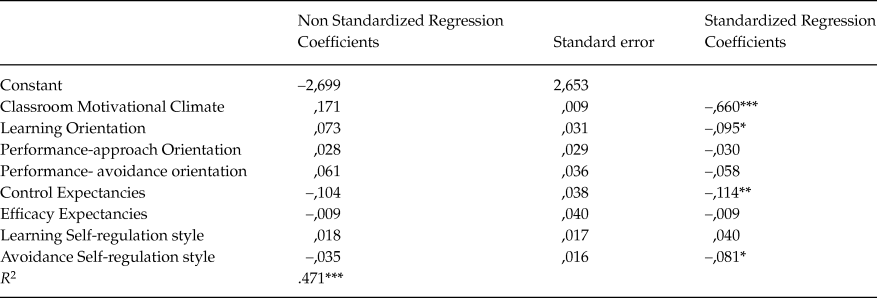
Third, also as expected, CMC correlated in a significant way with the degree in which students attribute perceived changes in motivational variables (interest (INT), perceived ability (PA), effort expenditure (EF), success expectancies (SE) and perceived change in self-regulation (PCSR)) and in self-regulation to the work of their teachers. Moreover, CMC, control expectancies, EMSRQ styles, and LGO and AGO contribute in a significant way to explaining most of the variance of the attribution of “perceived change in self-regulation” to teacher’s work (PCSR) (see table 6), as it is shown by the regression analysis presented in Table 9. This result highlights the importance of creating a learning oriented CMC for favouring self-regulation improvement.
Regression analysis. Criterion: Perceived change in self-regulation attributed to teacher’s work (PCSR)

***p < .001; **p < .01; *p < .05.
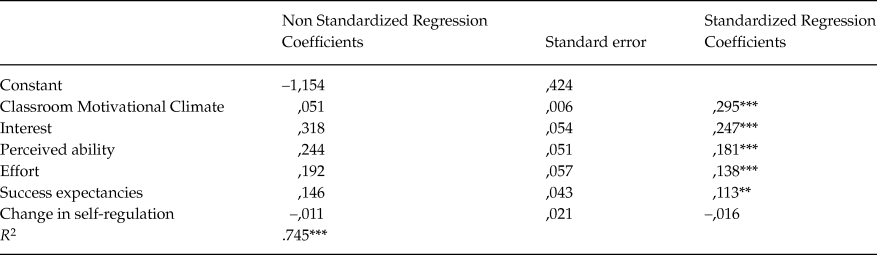
Finally, perceived changes in all motivational variables as well as in self-regulation -interest (INT), perceived ability (PA), effort expenditure (EF), success expectancies (SE) and perceived change in self-regulation (PCSR)-, correlated as expected with satisfaction with teacher’s work (SAT, see Table 6). Moreover, the regression analysis presented in Table 10 shows that the amount of variance explained by the set of predictors is very high (R 2 = .744). However, perceived self-regulation change does not add any significant weight to this variance, probably due to its correlation with the other predictors.
Regression analysis. Criterion: Satisfaction Attributed to teacher’s work (SAT)

***p < .001; **p < .01; *p < .05.
Discussion
The objectives of this study were, first, to develop a questionnaire allowing, first, to assess the kind of messages through which students self-regulate their learning on the base of their goal orientations, expectancies and volition, the EMSRQ, and second, to gather evidence on different aspects of its construct validity (convergent, discriminant and predictive), especially on the relationships between self-regulation styles (SRS) and classroom motivational climate, as it is perceived by students. What kind of contributions has our study made in relation to these objectives?
First, our results have shown that the EMSRQ adjusts well to the theoretical structure on which it is based: five first order factors that have adequate reliability, organized around two second order factors corresponding to learning and avoidance self-regulation styles. The first of these styles, Learning SRS, implies that the more the students think about the process and give themselves positive self-motivating messages, the less they tend to think on giving up the task. This relationship, however, is greater if students give themselves messages related to the need to achieve positive outcomes. This result is in line with the positive effect that pursuing performance goals seem to have according to the studies revised by Hulleman et al. (Reference Hulleman, Schrager, Bodmann and Harackiewicz2010) and Senko et al. (Reference Senko, Hulleman and Harackiewicz2011). The second style, Avoidance SRS, implies that the more the students think on the stressful emotions generated by experienced difficulties and on the perceived lack of personal meaning of the tasks they are working on, the more they tend to consider giving up the task. Moreover, this relation is also greater if students give themselves messages related to the need to achieve positive outcomes. In this case, this result is in line with the negative effect that pursuing performance goals seems to have according to other studies also revised by the authors just cited. It seems, then, that the positive or negative effect of performance self-regulation messages may not rely on the kind of messages they are, but on whether they are associated with self-messages corresponding to learning or avoidance goal orientations.
Second, our results have also shown, on one side, that acquired self-regulation styles, more or less stable through modifiable self-regulation habits, with which students enter into classrooms seem to have a moderating effect on the motivational value they attribute to the set of teaching patterns that configure the classroom motivational climate. Even if teachers do their best for orienting their students to learning, the students’ perception of the CMC created will be mediated by their goal orientations and, overall, by SRS and control expectancies. The implication of this result is that unless SR styles and expectancies are changed in the adequate direction, the effect of teachers’ effort to improve motivation and learning will be limited. Fortunately, our results have shown too that perceived improvement in self-regulation is attributed to the teacher’s work in the degree in which this work reflects at least the kind of teaching patterns that configure a CMC oriented to learning. Moreover, they have also shown that though this change correlates with SR styles as could be expected, the main weight of it is associated to CMC. This means that even there are initial differences in SRS, self-regulation changes seem to depend more on the quality of CMC created by their teacher that on such differences.
The result just described has two main implications. On one side, it means that even if students’ SR style is avoidance and not learning oriented, and even if their SR style makes them consider that the CMC does not motivate them to learn, they finally recognize the positive effect of this climate in the improvement of the way they self-regulate their learning. Moreover, in this study as in previous ones (Alonso-Tapia & Fernández, Reference Alonso-Tapia and Fernández2008, Reference Alonso-Tapia and Fernández2009) students also recognize the positive effect of CMC oriented to learning in the improvement of other motivational variables: interest, perceived ability, effort, success expectancies, satisfaction with teacher’s work, and even subjective resilience (Alonso-Tapia, Nieto, & Ruiz, Reference Alonso-Tapia, Nieto and Ruiz2013). Thus, teachers can be optimistic about the possibility of improving self-regulation styles as far as they try to implement a CMC oriented to learning (Ames, Reference Ames1992). On the other side, the result suggests that the optimism mentioned has to be taken conservatively, as the impact of a CMC oriented to learning will usually be moderated by the students’ level in each SR style.
Third, our study has several implications for future research. Our conclusions, though encouraging, are based on cross-sectional correlational data. They are based neither on results coming from repeated direct assessment of self-regulation messages related to emotional experiences and motivational threats along learning tasks, nor on results coming from interventions aimed at improving CMC and, through this improvement, at changing SR styles. The cross-sectional nature of our data is a limitation that makes convenient at least two kinds of studies in order to provide additional evidence on the EMSR-Q validity.
-
A) SRS measures using the EMSR-Q should be related to repeated direct assessment of self-regulation messages related to emotional experiences and motivational threats along learning tasks, as SRS should predict the kinds of self-regulation messages observed.
-
B) It should be necessary to implement interventions centered on the variables configuring the CMC oriented to learning and assessed through the CMCQ, in order to test the effect of CMC modification on changes in self-regulation (Efklides, Reference Efklides2011). Additionally, in order to increase the amount of evidence on the construct validity of the EMSRQ, it would be important in these studies to use this instrument not only to assess SRS as a moderator variable, but also as a dependent one, and to analyze the relation between this measure and measures capturing the ways of self-regulating the specific learning processes carried out in different learning situations, and the dependence of both on the kind of intervention.
-
C) The SMSR-Q can be used, together with more direct measures of self-regulation, to explore the relationship between emotional and cognitive self-regulation.
Finally, though cross-validation analysis has shown that the EMSRQ adjusts well to the theoretical structure on which it is based, the fact that two of the adjustment indexes fell short of the standard limits of significance suggests the need of additional research aimed at identifying the sources of this limitation of the questionnaire.