

INTRODUCTION
Agrarian pseudosteppes (open areas of mainly dry/unirrigated farmland) account for a high percentage of the south-west European land area (c. 47% in Spain) and thus its management may have a significant impact on biodiversity conservation (Pain & Pienkowski Reference Pain and Pienkowski1997). The advent of modern agrarian management systems, agricultural intensification and subsequent land abandonment during the last century have modified the quality and quantity of available habitat, and consequently have had an impact on the viability of many species (Chamberlain et al. Reference Chamberlain, Fuller, Bunce, Duckworth and Shrubb2000; Donald et al. Reference Donald, Green and Heath2001; Bota et al. Reference Bota, Morales, Mañosa and Camprodon2005).
The red-legged partridge (Alectoris rufa) is a typical species of the agrarian pseudosteppes of south-western Europe, where it has considerable socioeconomic value in rural environments as the principal small game species (Lucio Reference Lucio1998; Bernabeu Reference Bernabeu2000; Martínez et al. Reference Martínez, Viñuela and Villafuerte2002). Yet, despite its importance as a quarry species, populations of this game bird have suffered marked declines during the last century throughout its range (Cramp & Simmons Reference Cramp and Simmons1980; Potts Reference Potts1980), including Spain, the main stronghold of its native populations (Aebischer & Potts Reference Aebischer, Potts, Tucker and Heath1994; Blanco-Aguiar et al. Reference Blanco-Aguiar, Virgós, Villafuerte, Madroño, González and Atienza2004). Several reasons may explain these declines, but the most important appears to be habitat alteration, particularly changes occurring during recent decades in agrarian management systems (Lucio & Purroy Reference Lucio and Purroy1992; Blanco-Aguiar et al. Reference Blanco-Aguiar, Virgós, Villafuerte, Madroño, González and Atienza2004; Vargas et al. Reference Vargas, Guerrero, Farfán, Barbosa and Real2006; Blanco-Aguiar Reference Blanco-Aguiar2007). Predation, overhunting and problems associated with farm-reared game releases, such as the introduction of new diseases or genetic introgression, may also be of concern (Nadal Reference Nadal1992; Villanúa et al. Reference Villanúa, Pérez-Rodríguez, Casas, Alzaga, Acevedo, Viñuela and Gortázar2008; Blanco-Aguiar et al. Reference Blanco-Aguiar, González-Jara, Ferrero, Sánchez-Barbudo, Virgós, Villafuerte and Dávila2008), but little is known about the relative importance of each one of these factors. Blanco-Aguiar (Reference Blanco-Aguiar2007) concluded that agricultural intensification, along with overhunting of declining populations, were the main factors behind the deep decline in red-legged partridge hunting bags in Spain during the last few decades. However, little is known about which of the many agricultural changes are behind the red-legged partridge decline.
Ground vegetation height and cover around the nest have been described as the main factors affecting nesting success of red-legged partridges (Rands Reference Rands1988; Ricci et al. Reference Ricci, Mathon, Garcia, Berger and Esteve1990). Nevertheless, the majority of previous studies on red-legged partridge nesting habitat have been limited to general descriptions of habitat use (Potts Reference Potts1980; Rands Reference Rands1986; Rueda et al. Reference Rueda, Baragaño and Notario1993), whereas, few studies have considered nesting habitat selection (Rands Reference Rands1988; Ricci et al. Reference Ricci, Mathon, Garcia, Berger and Esteve1990). In France and UK, hedgerows and other permanent field boundaries are considered important nesting habitats for this species. However, in the Iberian Peninsula, these landscape structures are scarce, and field boundaries are formed instead by linear annual herbaceous-vegetation strips of unploughed land placed between cultivated plots or between these plots and tracks, known as lindes. Agricultural intensification in Spain, as in other European countries, has been associated with a decrease in the availability of lindes (Pain & Pienkowski Reference Pain and Pienkowski1997; Fuller Reference Fuller, Aebischer, Evans, Grice and Vickery2000).
The red-legged partridge, like other ground-nesting birds (Yanes & Suárez Reference Yanes and Suárez1995), is subject to a high nest-loss rate, and nesting success is an important parameter affecting population dynamics (Potts Reference Potts1980). Previous studies showed that nesting habitat quality was a critical factor affecting breeding success (Rands Reference Rands1988; Ricci et al. Reference Ricci, Mathon, Garcia, Berger and Esteve1990). A positive correlation between breeding density and the amount of suitable nesting cover has been found for this species (Rands Reference Rands1986). Thus, habitat management is considered to be the main management strategy for the maintenance of sustainable wild populations (Rands Reference Rands1987a, Reference Randsb; Duarte & Vargas Reference Duarte, Vargas, Lucio and de Buruaga2002). However, Reitz et al. (Reference Reitz, Le Goff and Fuzeau2002) found a high predation rate in preferred nesting habitats. While the availability of favoured nesting habitat may affect breeding density, breeding success may be more greatly influenced by other factors, such as agricultural or game management.
Finally, the hunting community often considers predation as the main factor behind reduced breeding success of this and other small-game species in Spain (Nadal & Comalrena Reference Nadal and Comalrena1995). This perception has led to an increase in efforts to control predators (Nadal Reference Nadal and de Buruaga1998), both legally and illegally, reducing the populations of some endangered predator species (Viñuela & Villafuerte Reference Viñuela, Villafuerte, Thompson, Redpath, Fielding, Marquiss and Galbraith2003). The impact of predators on red-legged partridge breeding success has received scarce attention in Spain, but available information indicates that it may be highly variable (reviewed by Yanes et al. Reference Yanes, Herranz, de la Puente, Suárez and Sáenz de Buruaga1998).
We evaluated nest habitat selection from 2003 to 2005 for this territorial gamebird in its most widespread habitat ecosystem, the agrarian pseudosteppes of central Spain, where partridges reach their highest densities (Vargas et al. Reference Vargas, Guerrero, Farfán, Barbosa and Real2006), obtaining quantitative information on the factors affecting nesting success, the relative importance of nest predation versus other causes of nest failure and how these relate to nesting habitat. Most previous studies about nesting habitat have considered non-native introduced populations, or populations at the northern edge of the red-legged partridge range; our aim was to identify optimum management and conservation strategies for this important species.
METHODS
Study area
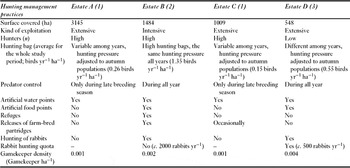
Our study area covered 125 km2 and was located in Campo de Calatrava (Central Spain, 38° 80′ N, 3° 80′ W, 610 m above sea level). This is an area of undulating farmland, dominated by a mosaic of crops, mainly cereal (particularly barley Hordeum vulgare), with interspersed patches of olive groves, vineyards and a few patches of dry annual legume crops (mainly vetch Vicia sativa) and sugar beet (Beta rubra). Natural vegetation areas are very scarce, limited to some small areas of short scrubland and pastureland, mainly on rocky hill tops. Other crops, ploughed or abandoned farmland and urban areas (mainly country houses) cover less than 10% of the area. Study area included four game estates, with different hunting management practices (Table 1). Predator control was the main management tool applied in the study area, but with different intensities, according to the game estate (pooled in three hunting management policies, hereafter sites; Table 1). For each estate, we calculated gamekeeper density per hectare as an estimate of predator control (see Baines et al. Reference Baines, Moss and Dugan2004 for a similar procedure; Table 1). Predator control targeted common magpies (Pica pica), red foxes (Vulpes vulpes), feral cats (Felix catus) and feral dogs (Canis familiaris), which are the main predators of partridge nests (see Yanes et al. Reference Yanes, Herranz, de la Puente, Suárez and Sáenz de Buruaga1998; Herranz Reference Herranz2000).
Main hunting management practices in the four game states studied. Game estates were pooled into three hunting management policies (1 = Game estate A and C; 2 = Game estate B; 3 = Game estate D).

Data collection
Capture, radio-tracking and nest monitoring
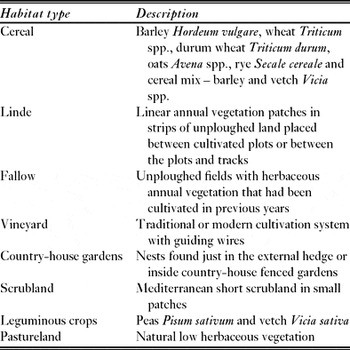
We conducted the fieldwork from February to June in 2003–2005 on hunting estates A, B and C in 2003, A, B and D in 2004 and only in A and D in 2005, owing to access restrictions. Over the three years, 115 adult partridges were captured in late winter/early spring (Appendix 1, see supplementary material at Journals.cambridge.org/ENC). We used cage traps with live adult partridges as a decoy. Traps were baited with wheat daily. All birds were sexed from plumage, biometry and ornaments (Sáenz de Buruaga et al. Reference Sáenz de Buruaga, Lucio and Purroy2001). We took a blood sample from the brachial vein (0.5–1 ml) to confirm the sex of birds using genetic analyses of blood samples (J.T. García & M. Calero-Riestra, IREC, unpublished data 2007). Each individual was fitted with a necklace radio-transmitter, each equipped with a mortality sensor (weighing 10 g; Biotrack, Dorset, UK) and released at the capture site shortly (c. 20 min) after capture. The first time nests were located, we recorded their exact position by GPS (geographic positioning system), date, habitat type (Table 2) and clutch size. Most nests (87%) were found once incubation had begun, and were located in all study years by radio-tracking nesting birds (n = 47) or by systematically searching all the areas within the fields selected for suitable nesting habitat (n = 50, thereafter referred to as systematically searching; Appendix 2, see supplementary material at Journals.cambridge.org/ENC), defined as all substrates with enough vegetation cover to install a nest. We based this searching criterion on preliminary interviews with gamekeepers, game managers and farmers, and on nesting-site selection patterns described in previous studies of this species (Potts Reference Potts1980; Rands Reference Rands1986, Reference Rands1988; Ricci et al. Reference Ricci, Mathon, Garcia, Berger and Esteve1990; Rueda et al. Reference Rueda, Baragaño and Notario1993).
Habitat types used to build nest for red-legged partridges in the study area during 2003–2005 study period.

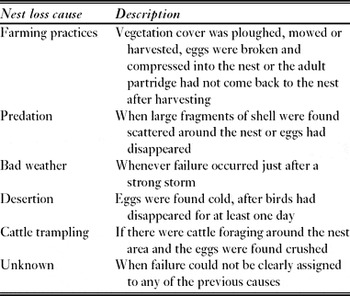
We monitored nests by radio-tracking tagged incubating birds at a distance of 1–5 m, or by observating nests of untagged birds at a distance of 1–2 m. We approached the nests only when adults were far from nests. We determined nest fate by inspecting nests every 2–5 days to establish clutch condition (broken, hatched or disappeared). Nests were considered successful when at least one chick hatched (recognized by small regular breaks in the egg shells, often with half the shell within the other; Bro et al. Reference Bro, Reitz, Clobert and Mayot2000b). We also recorded nest loss cause (Table 3). We recorded the distance from the nest to the nearest field boundary, once the final nest fate was known, to avoid unnecessary disturbance during incubation. We excluded replacement clutches (n = 4) from all analyses, because habitat selection and nesting success could differ (Bro et al. Reference Bro, Reitz and Clobert2000a, Reference Bro, Reitz, Clobert and Mayotb).
Main nest loss causes for red-legged partridges in the study area during 2003–2005 study period.

Nests were classified as ‘early’ or ‘late’ in relation to the mean start date of incubation for the study period. We determined the onset of incubation for 61 nests (±2 days). This was done either from (1) daily radio-tracking that allowed us to determine the exact day when incubation began, or (2) backdating from known hatching date (assuming that incubation lasts 24 days and starts after the last egg is laid; Del Hoyo et al. Reference Del Hoyo, Elliott and Sargatal1994). We calculated the mean incubation start date of these nests by pooling data for all years as 17 May (n = 61; range 20 April–7 June). Nests were classified as ‘early’ if incubation began on the 17 May or before, or as ‘late’ when incubation started after that date. For 36 nests we could not determine the date when incubation began, owing to nest loss during incubation. In these cases, we considered the date when nest was located and the number of days it was monitored before it was lost, assuming an incubation period of 24 days (if a nest was discovered on 25 May and monitored for 20 days, incubation should have started after May 17 and thus it was considered a late nest). We were unable to classify seven nests as early or late, and thus excluded these nests from analyses considering this variable.
Nesting habitat availability
We recorded the cover of each kind of habitat in each hunting estate monthly onto maps and subsequently calculated the total area covered by each habitat type using ArcMap 9.1 (ESRI 1999–2005). For the analyses of nest site selection, we calculated habitat availability during May, as the period when most nests were built (Casas et al. Reference Casas, Mougeot and Viñuela2009). Habitat availability was measured as the proportional area of each habitat within the study area. In cereal fields, we also calculated the area between the edge of the field and 5 m inwards, 5–10 m from the edge, 10–15 m from the edge and >15 m from the edge. We selected strips of 5 m width because we found the highest frequency of nests within this external strip (see Results), and also because it corresponded to the general width of combine harvesters (and could thus be the width that could be applied easily in habitat management programmes).
Statistical analyses
Proportion of nests in each habitat
To investigate the possible variation in the use of different nesting habitats among the three study years, we performed a chi-squared analysis on a contingency table with the variables ‘habitat’ and ‘year’. Owing to the low sample size for some habitats, we pooled data into four habitat categories, namely cereal, linde, fallow and other (vineyards, country-house gardens, scrubland and leguminous crops). Similarly, we explored possible differences between sexes (female can lay eggs in more than one nest, usually two, one incubated by her mate and the other by herself; Green Reference Green1984; Casas et al. Reference Casas, Mougeot and Viñuela2009) and nest location methods in the nesting habitat used using chi-squared analyses.
We further analysed the nests located in cereal fields (n = 44), given the importance of this crop as nesting habitat (see Results). We tested for differences in field-margin distance according to year and sex, using a generalized linear model (GLM) with Poisson error distribution and log link function. When variation in field-margin distance was explained by year, we conducted pairwise comparisons between years.
Nesting habitat selection
Chi-squared goodness-of-fit analyses were used to test for differences between the expected and the observed frequency of use of each nesting habitat by red legged partridges (Byers et al. Reference Byers, Steinhorst and Krausman1984). Partridges nest in habitat with well developed vegetation, avoiding areas with low or no cover. Therefore, we excluded groves and ploughed fields from the analysis. We followed the Bonferroni method to determine which habitats were positively selected or avoided, then we calculated 95% Bonferroni confidence intervals for the proportions of nests in each habitat and compared these intervals to look for significant differences (Byers et al. Reference Byers, Steinhorst and Krausman1984; Appendix 3, see supplementary material at Journals.cambridge.org/ENC). We also carried out a similar procedure to investigate the selection of different parts of cereal fields in relation to their distance to the field edge.
Nest fate
We tested the factors that could affect nesting success (success = 1, unsuccessful = 0) using a GLM with a binomial error distribution and logit link function. Initial models included sex, year, sites, nest location method, nest period and habitat. The resulting saturated models (including two-way interactions with biological sense) were reduced by eliminating in a backward stepwise manner explanatory variables or interactions. For this purpose and to assess model fitting, we used the Akaike's information criterion (AIC) with respect to the principle of parsimony (Burnham & Anderson Reference Burnham and Anderson1998; Manly et al. Reference Manly, McDonald, Thomas, McDonald and Erickson2002). Whenever nest success was explained by habitat, we conducted pairwise comparisons. Red-legged partridge laying dates have higher inter- than intra-annual variation (Casas et al. Reference Casas, Mougeot and Viñuela2009), therefore we compared data year-by-year to assess the possible effect of nest period on nesting success. We fitted a GLM with a binomial error distribution and logit link function. Secondly, a similar procedure was carried out for nests within cereal fields, with field margin distance and year as independent categorical variables.
Causes of nest loss
Owing to the small samples of some causes of nest loss, we pooled data into three categories: predation, farming practices and other (unknown, bad weather, desertion and cattle trampling). Data were analysed by a GLM with multinomial error distribution and logit link function using AIC to select the most parsimonious model, considering nest-loss causes as the dependent variable and sex, nest location method, nest period, sites, habitat, year and their two-way interactions as independent and categorical variables. Additionally, a similar procedure was carried out for nests within cereal fields, with field-margin distance as the independent variable.
All of the analyses were performed with the statistical package Statistica 6.0. (StatSoft, Tulsa, OK, USA). Given that differences between nest searching methods could influence nesting selection and success, we included nest-location method as a fixed effect in our models, to test for possible nest-location method differences. All data are expressed as means ± SE.
RESULTS
Proportion of nests in each habitat
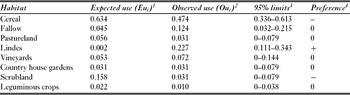
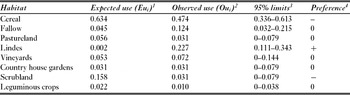
Red-legged partridge nested in practically all habitats with vegetation cover found in the study area, but with markedly different frequencies (Table 4). Nests in cereal were located more commonly by radio tracking than by systematically searching, and the opposite occurred for nests in lindes and other habitats (Appendix 4, see supplementary material at Journals.cambridge.org/ENC). However, differences in habitat use in relation to nest-location method were not statistically significant (χ2 = 6.61; df = 3, p = 0.09). We did not detect any significant differences in the frequency of use of nesting habitats among years (χ2 = 6.09; df = 6, p = 0.41) or between sexes (χ2 = 4.24; df = 3, p = 0.24).
Red-legged partridge nest-site selection (n = 97), central Spain (2003–2005). Pattern of selection was estimated following the method outlined by Byers et al. (Reference Byers, Steinhorst and Krausman1984), based on 95% Bonferroni confidence intervals (see Byers et al. Reference Byers, Steinhorst and Krausman1984 and Appendix 1, see supplementary material at Journals.cambridge.org/ENC, for a brief description of the methodology). 1The relative proportional area of the habitat; 2calculated for habitat i as Oui = ni/N, where ni is the number of nest of red-legged partridge located in that habitat and N is the total number of nest across all habitats; 395% limits = Bonferroni 95% confidence limits; 4preference: + = use significantly greater than expected; – = use significantly less than expected; 0 = use no different to expected.
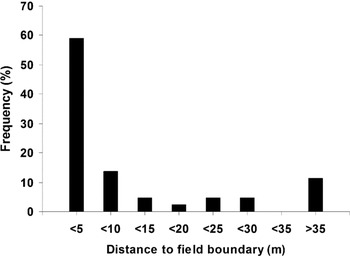
Overall, 72.7% of nests in cereal fields were found within 10 m from the field margin, 59.1% of them were less than 5 m away (Fig. 1). Distance to the field edge did not vary between sexes (χ2 = 0.67; df = 1, p = 0.41) but varied significantly among years (χ2 = 9.72; df = 2, p < 0.01). Nests were closer to the field margin in 2004 (4.69 ± 1.06 m; n = 18) than in 2003 (17.94 ± 6.02 m; n = 19; χ2 = 6.95, df = 1, p < 0.01) and in 2005 (31.99 ± 18.35 m; n = 7; χ2 = 11.76, df = 1, p < 0.001). No significant differences were found between 2003 and 2005 (χ2 = 0.91; df = 1, p = 0.34).
Frequency distribution of distance to the field boundary for red-legged partridge nests within cereal fields (n = 44) in central Spain, 2003–2005.

Nesting habitat selection
We found that the pattern of nesting habitat used by partridges differed significantly from that expected from the area occupied by each habitat in the study area (χ2 = 2657.01; df = 7, p < 0.001). Bonferroni analysis indicated that partridges positively selected lindes and negatively selected scrubland and cereal fields. No positive or negative selection was detected for other habitat types (Table 4, Appendix 5, see supplementary material at Journals.cambridge.org/ENC).
In cereal fields, nesting partridges positively selected the area less than five meters from the field margin and avoided areas > 15 m away (χ2 = 87.94; df = 3, p < 0.001; Table 5).
Red-legged partridge nest distance to field boundary selection within cereal fields (n = 44), central Spain (2003–2005). Selection estimated according Byers et al. (Reference Byers, Steinhorst and Krausman1984) method. 1The relative proportional area of the habitat; 2calculated for habitat i as Oui = ni/N, where ni is the number of nest of red-legged partridge located in that habitat and N is the total number of nest across all habitats; 395% limits = Bonferroni 95% confidence limits; 4preference: + = use significantly greater than expected; – = use significantly less than expected; 0 = use no different to expected.

Nest fate
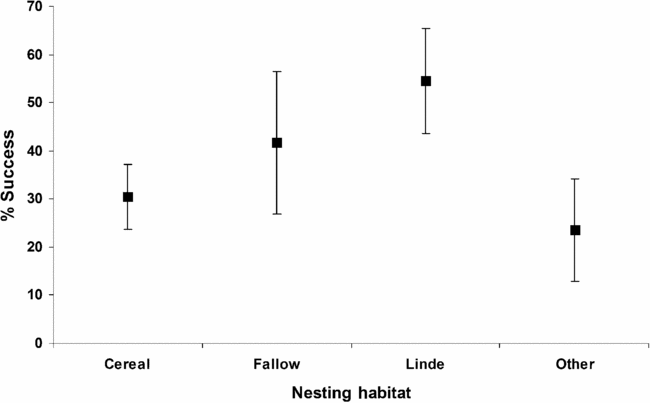
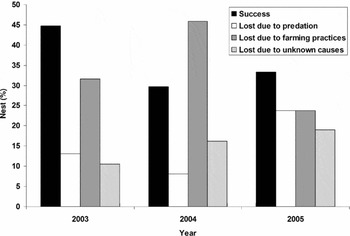
Overall rate of nest loss in the red-legged partridge in our study area was relatively high (63.92% of 97 nests). Nest success did not differ among years (χ2 = 2.31, df = 2, p = 0.31), sites (χ2 = 1.62, df = 2, p = 0.44) or nest location method (χ2 = 1.37, df = 1, p = 0.24), but varied among habitats (χ2 = 10.67, df = 3, p < 0.05); nests located in lindes had the highest success (χ2 = 3.99, df = 1, p < 0.05), while no significant differences were found for the other three habitat types (Fig. 2). Nest success also was significantly affected by sex of incubating bird (χ2 = 5.77, df = 1, p < 0.05; nests incubated by males had higher success probability, 77%, than those incubated by females, 43%), and by nest period (χ2 = 7.40, df = 1, p < 0.01; Fig. 3). Success was higher in early nests than in late nests (46.8% and 26% respectively, all years combined), although differences between periods varied among years. Nest success was significantly higher for early than late nests in 2003 (χ2 = 11.87, df = 1, p < 0.001), but no significant differences were found in 2004 (χ2 = 1.79, df = 1, p < 0.18), and 2005 (χ2 = 0. 79, df = 1, p < 0.37; Fig. 3).
Nesting success (mean ± standard error) in relation to nesting habitat in the red-legged partridge (n = 97) in central Spain, 2003–2005.

Percentage of successful (mean ± standard error) red-legged partridge nests in relation to year and breeding period (n = 90) in central Spain, 2003–2005.

For nests in cereals fields, we did not find significant differences in nesting success related to distance to field margin (Wald = 0.08; p = 0.77) or among years (Wald = 3.54; p = 0.17).
Causes of nest loss
The main cause of nest loss was farming practices, affecting 56.4% of all failed nests (Fig. 4), a percentage almost three times higher than the proportion of nests lost to predation (20.97%). Causes of failure did not significantly vary among years (Wald = 0.36; p = 0.64; Fig. 4), sites (Wald = 1.21; p = 0.30), nest location methods (Wald = 0.01; p = 0.96) or nesting periods (Wald = 0.73; p = 0.41), but we found significant differences in nest-loss causes related to sex of the incubating bird (Wald = 56.58; p < 0.05) and nesting habitat (Wald = 1.17; p < 0.001). Nests incubated by females were affected by farming practices, as were nests placed in cereal fields.
Percentage of cause of nest loss of red-legged partridge nests in the study area during the study period (n = 97) in central Spain, 2003–2005.

For nests in cereal fields, we did not find differences in nest-lost causes in relation to field-margin distance (Wald = 1.15; p = 0.76).
DISCUSSION
In a landscape dominated by agricultural land, we found that red-legged partridge nests were located mainly in cereals, which contrasts with other studies, where hedgerows and natural vegetation were the main nesting habitat (Rueda et al. Reference Rueda, Baragaño and Notario1993; Ricci et al. Reference Ricci, Mathon, Garcia, Berger and Esteve1990; Green Reference Green1984; Rands Reference Rands1987a). Nevertheless with respect to nesting habitat selection, red-legged partridge positively selected linear landscape features, while avoided cereal fields. This is in agreement with previous studies (Rands Reference Rands1986, Reference Rands1988; Ricci et al. Reference Ricci, Mathon, Garcia, Berger and Esteve1990) and the habitat use pattern of adult birds during the breeding season (Fortuna Reference Fortuna2002). Fallows could potentially be an important nesting habitat, but owing to agricultural intensification they are an increasingly scarce habitat in agricultural areas (Pain & Pienkowski Reference Pain and Pienkowski1997). In any case, we cannot rule out that fallows could be positively selected by partridges in our study area, owing our relatively low sample size (Appendix 1, see supplementary material at Journals.cambridge.org/ENC). Lindes occupied only 0.19% of the area, and although they were the preferred habitat, they were not the one containing more nests. However, well-vegetated lindes were also relatively scarce in our study area, and this may be forcing partridges to use negatively-selected agricultural substrata, rarely used in other areas. Because nesting habitat influenced nesting success, in this species as in other Galliformes (Taylor et al. Reference Taylor, Church and Rusch1999; Tirpak et al. Reference Tirpak, Giuliano, Miller, Allen, Bittner, Edwards, Fridhof, Igo, Stauffer and Norman2006), cereal fields could be considered a suboptimal habitat working as an ecological trap (partridges select external strip of cereal fields, and they then suffer decreased fitness; Battin Reference Battin2004).
As previously reported (Ricci et al. Reference Ricci, Mathon, Garcia, Berger and Esteve1990; Bro et al. Reference Bro, Reitz and Clobert2000a), nests in cereal fields were generally located close to the field margins, and partridges positively selected the outer strip (0–5m from the edge), further supporting the importance of field boundaries. Partridges nesting close to the edge in cereal fields may benefit from increased food abundance in field boundaries (Thomas & Marshall Reference Thomas and Marshall1999), but they may also suffer from increased predation risk in linear habitats (Haensly et al. Reference Haensly, Crawford and Meyers1987; Ricci et al. Reference Ricci, Mathon, Garcia, Berger and Esteve1990). However, nesting success did not differ significantly in relation to distance to field boundaries and lindes were the most successful nesting habitat, both results contradicting that predation may be a problem for nests in this habitat.
Agricultural practices, particularly harvesting, were the main cause of nest failure in red-legged partridge, and were appreciably more important than predation. We found differences among years in the pattern of nesting success with respect to nesting period. Early nests had a higher success rate than late nests, particularly in a year of early laying (Casas et al. Reference Casas, Mougeot and Viñuela2009) when the effect of harvesting on early nests may be lower. Other studies also have indicated the strong impact of agricultural practices on nesting success of this species (Potts Reference Potts1980; Vargas & Cardo Reference Vargas and Cardo1996). The study area is a good example of typical agricultural landscape prevailing in the range of red-legged partridges in Spain, where their populations reach maximum densities (Vargas et al. Reference Vargas, Guerrero, Farfán, Barbosa and Real2006), and thus the strong negative effect of agricultural practices we identified also may be applicable to partridge populations more widely. Harvest activity may be considered the main factor negatively affecting red-legged partridge reproduction at a national scale. Our results support the conclusion of long-term hunting bag analyses showing that agricultural change may have been the main factor behind red-legged partridge declines in Spain (Blanco-Aguiar Reference Blanco-Aguiar2007).
The relatively low importance of predation in our study is unlikely to be due to predator control related management practices. The main predators of partridge nests (Herranz Reference Herranz2000) are generalist predators associated with human activities and buildings, and were common in our study area (abundance index per km of diurnal transects: 1.5 magpies km−1; abundance index per km of nocturnal transects: 0.08 foxes km−1, 0.08 feral dogs km−1, 0.16 feral cats km−1; F. Casas & J. Viñuela, unpublished data 2010). Predator control is the main game management tool in Spain (Arroyo & Beja Reference Arroyo and Beja2002), but our results show that, at least during the incubation period, changes in the agricultural system would be more effective than predator control at increasing nesting success. However, more research is needed in different study areas, and under different situations of predator density, game management and farming management, before concluding that predation is less important than farming practices for nesting success of partridges.
As in other studies (Rands Reference Rands1987a; Bro et al. Reference Bro, Reitz, Clobert and Mayot2000b), our results showed the crucial importance of lindes as a nesting habitat, because it was the nesting substrate with the highest breeding success (but see Reitz et al. Reference Reitz, Le Goff and Fuzeau2002), and was also strongly selected as a nesting site. Several studies have shown that highest red-legged partridge densities are found in areas with higher fragmentation and hedge abundance (Rands Reference Rands1986; Peiró Reference Peiró1992; Lucio & Purroy Reference Lucio and Purroy1992; Blanco-Aguiar et al. Reference Blanco-Aguiar, Virgós, Villafuerte, Martí and Del Moral2003). However, up to now, no clear proximate reasons had been presented to explain this general pattern. Our results suggest that the high nesting success associated with nests located in lindes can be a key factor explaining higher partridge abundance in landscapes with abundant and well preserved lindes, while low success in cereal fields would explain low abundance on intensively-farmed areas.
The difference found in nesting success between sexes (males more successful than females) and between nesting periods (early nests more successful than later ones) could be owing to differences in incubation onset (Casas et al. Reference Casas, Mougeot and Viñuela2009), reflecting that some nests are most likely affected by harvesting. This result also illustrates how small differences in hatching dates or in harvesting dates could be very important for reproductive success of this species. Therefore, slight delays in cereal harvesting could be an important tool to improve red-legged partridge reproductive success. More specifically, stopping or delaying harvesting in a 5-m wide strip surrounding the cereal fields might be an effective partridge management action, particularly in certain specific situations, such as years of early harvesting. Such actions could also be favourable for other species with similar nesting habits (cereal fields), such as little bustards (Tetrax tetrax; F. Casas & J. Viñuela, unpublished results 2010), great bustards (Otis tarda; Morgado & Moreira Reference Morgado and Moreira2000), or Montagu's harrier (Circus pygargus; Ferrero Reference Ferrero1995). Other studies have identified negative impacts of harvesting on the reproductive success of the Montagu's harrier (Castaño Reference Castaño1995; Arroyo et al. Reference Arroyo, Garcia and Bretagnolle2002) and the little bustard (C. Attié, LPO/BirdLife, personal communication 2003). Our results show that a species with high socioeconomic value, such as the red-legged partridge, suffers similarly. Perhaps this might encourage future collaboration between hunters and conservationists.
The Spanish pseudosteppes support the largest number of steppe bird species in the EU (Tucker Reference Tucker, Goriup, Batten and Norton1991), most of which are Species of European Conservation Concern (Tucker & Heath Reference Tucker and Heath1994). Our study area is typical of the agricultural landscape that prevails in the distribution range of red-legged partridges in Spain. Our data indicate that partridge breeding success may be improved by developing appropriate management of agricultural areas in order to increase the availability of preferred nesting habitats. Maintaining or increasing lindes in agricultural areas, along with careful cereal harvesting management, may have a positive effect on the breeding success of partridges and other similar species in Spanish farmland (Tella et al. Reference Tella, Forero, Hiraldo and Donazár1998; Vickery et al. Reference Vickery, Carter and Fuller2002), and thus should be considered a priority among the eco-conditionality measures of the new CAP (Common Agrarian Policy). Providing suitable financial incentives to farmers could help maintain and improve partridge habitats. We believe both farmers and hunters should agree that an increase in the area covered by lindes would probably be a better and cheaper measure than delaying harvesting times. Unfortunately, current implementation of eco-conditionality measures of the CAP in Spain has not properly incorporated management of lindes as a priority (BOE 2004).
ACKNOWLEDGEMENTS
Salvador Luna, Gustau Calabuig, Antonio Linares, Jesús Martínez-Padilla, Laura Iglesias, Fabián Casas Castellanos, Jesús and Carlos Nieto Arenas helped with field work. Fidel Sánchez-Campos helped with GIS and habitat availability data. We thank all game managers and hunting societies’ presidents who kindly allowed us to work on their game estates, especially Inocencio Bastante, Lorenzo Sobrino, Delfín Martín de Lucía and Jose Juan Bermejo. Ambrosio Donate provided invaluable help. We thank Beatriz Arroyo, Steve Redpath, Raimundo Real and Dave Parish for their helpful comments on earlier drafts of the paper. Fabián Casas received support from a pre-doctoral grant of the Junta de Comunidades de Castilla-La Mancha (JCCM) and financial support from the CYCIT projects MCYT-REN200307851/GLO and CGL2004-02568/BOS.