1. Introduction
The marine reservoir effect (MRE) is defined as the radiocarbon (14C) age offset between contemporaneous marine and terrestrial samples and is expressed as the reservoir age (R), a fundamental parameter essential for the accurate calibration of 14C ages of marine-derived organisms (e.g., Heaton et al. Reference Heaton, Köhler, Butzin, Bard, Reimer, Austin, Bronk Ramsey, Grootes, Hughen, Kromer, Reimer, Adkins, Burke, Cook, Olsen and Skinner2020; Jull et al. Reference Jull, Burr and Hodgins2013; Stuiver et al. Reference Stuiver, Pearson and Braziunas1986). Regions influenced by the upwelling of 14C-depleted deep ocean waters are well known to exhibit pronounced MRE values (e.g., Alves et al. Reference Alves, Macario, Ascough and Bronk Ramsey2018; Druffel and Williams Reference Druffel and Williams1991; Hua et al. Reference Hua, Webb, Zhao, Nothdurft, Lybolt, Price and Opdyke2015).
In East Asia, reservoir ages derived from known-age samples reveal a distinct spatial pattern, with elevated MRE values in the northeastern sector and comparatively lower values in the west. This distribution closely corresponds to the respective influence of the cold Oyashio Current and the warm Kuroshio Current (Hideshima et al. Reference Hideshima, Matsumoto, Abe and Kitagawa2001; Hirabayashi et al. Reference Hirabayashi, Yokoyama, Suzuki, Miyairi and Aze2017; Kong and Lee Reference Kong and Lee2005; Konishi et al. Reference Konishi, Tanaka and Sakanoue1982; Kuzmin et al. Reference Kuzmin, Burr and Jull2001, Reference Kuzmin, Burr, Gorbunov, Rakov and Razjigaeva2007; Shishikura et al. Reference Shishikura, Echigo and Kaneda2007; Southon et al. Reference Southon, Kashgarian, Fontugne, Metivier and Yim2002; Yoneda et al. Reference Yoneda, Kitagawa, van der Plicht, Uchida, Tanaka, Uehiro, Shibata, Morita and Ohno2000, Reference Yoneda, Uno, Shibata, Suzuki, Kumamoto, Yoshida, Sasaki, Suzuki and Kawahata2007; Yoshida et al. Reference Yoshida, Hara, Kunikita, Miyazaki, Sasaki, Yoneda and Matsuzaki2010; CHRONO marine reservoir database; red points in Figure 1).
Study sites and marine reservoir ages in East Asia. A-K: Previous study sites by Nakanishi et al. (Reference Nakanishi, Hong, Sung and Lim2013, Reference Nakanishi, Hong, Sung, Sung and Nakashima2015, Reference Nakanishi, Hong, Shimoyama, Sato, Park and Lee2017a, Reference Nakanishi, Hong, Sung, Nakashima, Nahm, Lim and Katsuki2017b, Reference Nakanishi, Takemura, Matsuyama, Shimoyama, Hong and Okuno2017c, Reference Nakanishi, Hong, Kuwahata, Sugiyama, Shimoyama, Ohkushi, Yamaguchi, Park and Nanayama2019a, Reference Nakanishi, Tsuji, Nanayama, Yamaguchi, Kondo, Ikeda and Hong2019b, Reference Nakanishi, Niwa and Hong2023a, Reference Nakanishi, Nanayama, Kondo, Yamada, Sakai, Yamaguchi, Shigeno, Katsuki, Oda, Furukawa and Hong2023b, Reference Nakanishi, Hori, Nakashima and Hong2025, Reference Nakanishi, Ishiyama, Sung and Hong2026), 1: Kuroshio Current, 2: Tsushima Current, 3: Oyashio Current, 4: Liman Current. Topographic map around Shizuoka City was based on Geospatial Information Authority of Japan. Drilling sites of SMZ-2 to SMZ-4, SMZ-9, and SMZ-11 were based on Kitamura and Kobayashi (Reference Kitamura and Kobayashi2014).

Paired 14C measurements of marine mollusks and terrestrial plants obtained from coastal sediment cores of the Korean Peninsula (Nakanishi et al. Reference Nakanishi, Hong, Sung and Lim2013, Reference Nakanishi, Hong, Sung, Sung and Nakashima2015, Reference Nakanishi, Hong, Sung, Nakashima, Nahm, Lim and Katsuki2017b; sites A, B and D in Figure 1) and the Japanese Islands (Nakanishi et al. Reference Nakanishi, Hong, Shimoyama, Sato, Park and Lee2017a, Reference Nakanishi, Takemura, Matsuyama, Shimoyama, Hong and Okuno2017c, Reference Nakanishi, Hong, Kuwahata, Sugiyama, Shimoyama, Ohkushi, Yamaguchi, Park and Nanayama2019a, Reference Nakanishi, Tsuji, Nanayama, Yamaguchi, Kondo, Ikeda and Hong2019b, Reference Nakanishi, Niwa and Hong2023a, Reference Nakanishi, Nanayama, Kondo, Yamada, Sakai, Yamaguchi, Shigeno, Katsuki, Oda, Furukawa and Hong2023b, Reference Nakanishi, Hori, Nakashima and Hong2025, Reference Nakanishi, Ishiyama, Sung and Hong2026; sites C and E–K in Figure 1) have enabled the reconstruction of spatio-temporal variability in the MRE over the past ∼12,000 cal BP.
Against this background, the present study investigates, for the first time, temporal variations in the marine reservoir effect in Suruga Bay, a region where the influence of deep ocean circulation has been postulated. The results are further evaluated through comparison with data from a preliminary study conducted in the innermost part of the bay (site K in Figure 1), an area predominantly affected by the Kuroshio Current (sites C, E-G and J in Figure 1).
2. Study area
The Shizuoka region is situated on the Pacific coast of central Japan and is influenced by the Kuroshio Current (Figure 1). This region lies within an uplift zone formed by the convergence of the Philippine Sea Plate and the Eurasian Plate (Fitch and Scholz Reference Fitch and Scholz1971; Matsuda Reference Matsuda1978; Sugimura Reference Sugimura1972). The plate boundary coincides with the axis of Suruga Bay, which reaches depths exceeding 2500 m. In Suruga Bay, strandings of deep-sea organisms—particularly octopus, oarfish, deep-sea pufferfish, and lanternfish—have been reported relatively frequently compared with other regions of Japan (Shinohara and Matsuura Reference Shinohara and Matsuura1997). The Suruga Trough and the marine terraces around Udo (Nihon-daira) and the Makinohara Hills provide clear evidence of active tectonism during the late Quaternary (Sugiyama and Shimokawa Reference Sugiyama and Shimokawa1990; Tsuchi Reference Tsuchi1984).
Coastal water around the Shizuoka region is strongly influenced by the warm Kuroshio Current, which originates from the North Equatorial Current. The Shimizu Plain is developed along the western coast of Suruga Bay and was formed by sediment supply from the Tomoe River in the eastern part of Shizuoka City. The bedrock of the Tomoe River catchment consists of Late Miocene to Pliocene alternating beds of sandstone and mudstone, early to middle Miocene dacite lava, rhyolite, and alkali dolerite, and contains no carbonate rocks (Sugiyama and Shimokawa Reference Sugiyama and Shimokawa1990).
Kitamura and Kobayashi (Reference Kitamura and Kobayashi2014) investigated evidence for earthquakes and tsunamis using data obtained from 14 sediment cores and one trench excavated in the coastal area of the Shimizu Plain. On the basis of lithological characteristics, fossil assemblages, and 14C dating of 82 samples, they identified geological and paleontological evidence for abrupt changes in depositional environments attributed to coseismic uplift associated with the AD 1854 Ansei-Tokai earthquake. The sediment cores were classified into five facies—fluvial plain, inner bay with a silty to sandy bottom, inner bay with a muddy bottom, intertidal flat, and marsh—based on lithology, grain size, color, sedimentary structures, fossil content, and stratigraphic succession.
Sediment cores SMZ-2 to SMZ-4, SMZ-9, and SMZ-11 contained abundant terrestrial plant fragments and marine mollusks and were therefore suitable for identifying the MRE during the Holocene. These sediment cores were interpreted as representing landfill, fluvial plain, inner bay with a silty to sandy bottom, and inner bay with a muddy bottom facies (Kitamura and Kobayashi Reference Kitamura and Kobayashi2014; Figure 2).
Geological column of the coastal area of Shimizu Plain. Geologic information was based on Kitamura and Kobayashi (Reference Kitamura and Kobayashi2014).

3. Methods
The SMZ-2 to SMZ-4, SMZ-9, and SMZ-11 sediment cores were obtained from marsh and sand-dune environments in the western parts of the Shimizu Plain (Kitamura and Kobayashi Reference Kitamura and Kobayashi2014; Figure 2). The drilling sites are located at elevations of < 10 m above sea level near the mouth of the Tomoe River. The cores were collected at 1 m intervals using a double-walled tube sampler.
To establish a stratigraphically consistent chronology and to evaluate the MRE, 30 terrestrial macrofossils and 22 well-preserved carbonate marine samples were selected from the cores for accelerator mass spectrometry (AMS) 14C dating. Wood fragments larger than 2 cm, which may be affected by the “old wood effect,” were excluded from sample selection. When such fragments were nevertheless included, they were interpreted on the assumption that redeposition, rather than the old wood effect, was the dominant source of age offset. To interpret the depositional environments, molluscan assemblages were identified following the classification of Okutani (Reference Okutani2000).
Prior to analysis, samples were repeatedly washed using an ultrasonic cleaner. Surface contaminants of plant samples were removed by repeating acid-alkali-acid treatments. More than 10% of the carbonate sample was removed by treatment with dilute hydrochloric acid to eliminate the outer surface and then powdered with a mortar and pestle. Samples of 14C-free wood and the IAEA C-1 reference material were processed using the same procedure for blank correction.
All samples, including the standards NIST OxII and IAEA C-7 and C-8, were combusted in an elemental analyzer. The resulting CO2 gas was cryogenically purified using a high-vacuum automatic preparation system (Hong et al. Reference Hong, Park, Kim, Woo, Kim, Choi and Kim2010a; Park et al. Reference Park, Hong, Woo, Choi, Kim and Kim2010) and subsequently reduced to graphite using Fe powder and hydrogen gas in quartz tubes. Radiocarbon ages of both samples and standards were measured at the AMS facility of the Korea Institute of Geosciences and Mineral Resources (Hong et al. Reference Hong, Park, Sung, Woo, Kim, Choi and Kim2010b). Isotopic fractionations were corrected using δ13C values measured at the AMS facility.
Radiocarbon ages of the terrestrial samples were calibrated to calendar ages using the IntCal20 calibration curve (Reimer et al. Reference Reimer, Austin, Bard, Bayliss, Blackwell, Bronk Ramsey, Butzin, Cheng, Edwards, Friedrich, Grootes, Guilderson, Hajdas, Heaton, Hogg, Hughen, Kromer, Manning, Muscheler, Palmer, Pearson, van der Plicht, Reimer, Richards, Scott, Southon, Turney, Wacker, Adolphi, Buntgen, Capano, Fahrni, Fogtmann-Schulz, Friedrich, Kohler, Kudsk, Miyake, Olsen, Reinig, Sakamoto, Sookdeo and Talamo2020) and the CALIB 8.20 software (Stuiver and Reimer Reference Stuiver and Reimer1993; Stuiver et al. Reference Stuiver, Reimer and Reimer2023).
4. Lithofacies and ages of sediment cores
The chronological variation in lithofacies and 14C ages are discussed based on the results from five sediment cores (SMZ-2 to SMZ-4, SMZ-9, and SMZ-11; Figures 2 and 3). Detailed sedimentological descriptions of these cores were previously reported by Kitamura and Kobayashi (Reference Kitamura and Kobayashi2014). Specimens previously identified as Dentalium aprinum by Kitamura and Kobayashi are herein reassigned to Dentalium octangulatum based on a re-examination.
Sedimentary curves of 14C ages from marine and terrestrial samples in the coastal area of Shimizu Plain. The 14C ages indicated by the blank symbols significantly contradict the stratigraphic relationships; therefore, they were interpreted as redeposited and excluded from the interpretation of the depositional curve and reservoir age. Reservoir ages were measured by age offsets between plant and shell samples in black circles.

4.1. Lithofacies and ages of the SMZ-2 core
The SMZ-2 core consists of three lithostratigraphic units: (1) an upper gravely sand layer, (2) a middle unit of alternating sandy gravel and gravelly sand layers, and (3) a lower unit of alternating very fine to fine sand and silt layers. These units were interpreted as landfill, fluvial plain, and inner-bay environments with a silty to sandy bottom, respectively (Kitamura and Kobayashi Reference Kitamura and Kobayashi2014). Terrestrial plant fragments and abundant molluscan shells, including Batillaria multiformis (Lischke 1869), Batillaria zonalis (Bruguière 1792), Rhinoclavis sordidula (Gould 1849), and Niotha livescens (Philippi 1849), are common throughout the inner bay sediments. Radiocarbon ages obtained from eight terrestrial and seven marine samples range from 7560 ± 40 BP to 40,190 ± 420 BP. These ages are consistent with the four shell 14C ages reported by Kitamura and Kobayashi (Reference Kitamura and Kobayashi2014).
4.2. Lithofacies and ages of the SMZ-3 core
The SMZ-3 core is divided into an upper unit of alternating sandy gravel and gravelly sand layers and a lower unit of alternating very fine to medium sand and silt layers. These units were interpreted as landfill, fluvial plain, inner-bay environments with a silty to sandy bottom, and an inner-bay muddy-bottom environment, respectively (Kitamura and Kobayashi Reference Kitamura and Kobayashi2014). The inner-bay sediments contained plant fragments and many shells, such as Ringiculina doliaris (Gould 1860), Dentalium octangulatum (Donovan 1804), Episiphon subrectum (Jeffreys 1883), and Pecten albicans (Schröter 1802). Radiocarbon ages obtained from four terrestrial plant samples and three shell samples range from 2230 ± 30 BP to 43,180 ± 500 BP, consistent with the 11 14C ages previously reported for this core by Kitamura and Kobayashi (Reference Kitamura and Kobayashi2014).
4.3. Lithofacies and ages of the SMZ4 core
The SMZ-4 core consists of three lithostratigraphic units: (1) an upper unit of alternating sandy gravel and gravelly sand layers, (2) a middle unit of alternating very fine sand and silt layers, and (3) a lower unit of alternating very fine to fine sand and silt layers. These units were interpreted as fluvial plain, inner-bay environments with a muddy bottom, and inner-bay environments with a silty to sandy bottom, respectively (Kitamura and Kobayashi, Reference Kitamura and Kobayashi2014). Molluscan shells, including D. octangulatum, R. sordidula, N. livescens, and P. albicans, are abundant throughout the inner-bay sediments. Radiocarbon ages obtained from nine terrestrial and three marine samples range from 4810 ± 40 BP to 50,300 ± 1110 BP. These results are consistent with the 19 14C ages reported for this core by Kitamura and Kobayashi (Reference Kitamura and Kobayashi2014).
4.4. Lithofacies and ages of the SMZ-9 core
The SMZ-9 core can be divided into three units: (1) an upper unit of alternating sandy gravel and gravelly sand layers, (2) a middle gravelly sand layer, and (3) a lower unit of alternating very fine to medium sand and silt layers. These units were interpreted as landfill, fluvial plain, and inner-bay environments with a silty to sandy bottom, respectively (Kitamura and Kobayashi Reference Kitamura and Kobayashi2014). The inner-bay sediments contain terrestrial plant fragments and abundant molluscan shells, including D. octangulatum, E. subrectum, R. sordidula, N. livescens, and P. albicans. Radiocarbon ages obtained from five terrestrial and four marine samples range from 2590 ± 30 BP to 3530 ± 30 BP, consistent with the seven 14C ages reported by Kitamura and Kobayashi (Reference Kitamura and Kobayashi2014).
4.5. Lithofacies and ages of the SMZ-11 core
The SMZ-11 core consists of four lithostratigraphic units: (1) an uppermost gravely sand layer, (2) a unit of alternating sandy gravel and gravelly sand layers, (3) a unit of alternating very fine to fine sand and silt layers, and (4) a lowermost unit of alternating very fine to medium sand and silt layers. These units were interpreted as landfill, fluvial plain, inner-bay environments with a muddy bottom, and fluvial plain, respectively (Kitamura and Kobayashi Reference Kitamura and Kobayashi2014). The inner-bay sediments contain terrestrial plant fragments and abundant molluscan shells, including D. octangulatum, E. subrectum, R. sordidula, Pillucina pisidium (Dunker 1860), and P. albicans. Radiocarbon ages obtained from four terrestrial plant samples and five shell samples range from 2330 ± 30 BP to 7370 ± 40 BP, consistent with the six 14C ages reported by Kitamura and Kobayashi (Reference Kitamura and Kobayashi2014).
5. Radiocarbon marine reservoir ages
To identify the optimal set of 99 samples from SMZ-2 to SMZ-4, SMZ-9, and SMZ-11, both paired terrestrial and marine samples from the same stratigraphic horizons and unpaired samples were analyzed in this study and in Kitamura and Kobayashi (Reference Kitamura and Kobayashi2014). The scattering patterns of terrestrial plant 14C ages were examined using age-altitude diagrams in conjunction with stratigraphic characteristics. Subsequently, an accumulation curve was constructed by connecting the youngest terrestrial age at each stratigraphic level (Figure 3). A comparable accumulation curve was generated for shell samples using the same procedure. Based on these analysis, 14 anomalous age offsets attributable to sediment reworking were identified within the cores and excluded from further analyses.
5.1. Marine reservoir ages in the Shizuoka area
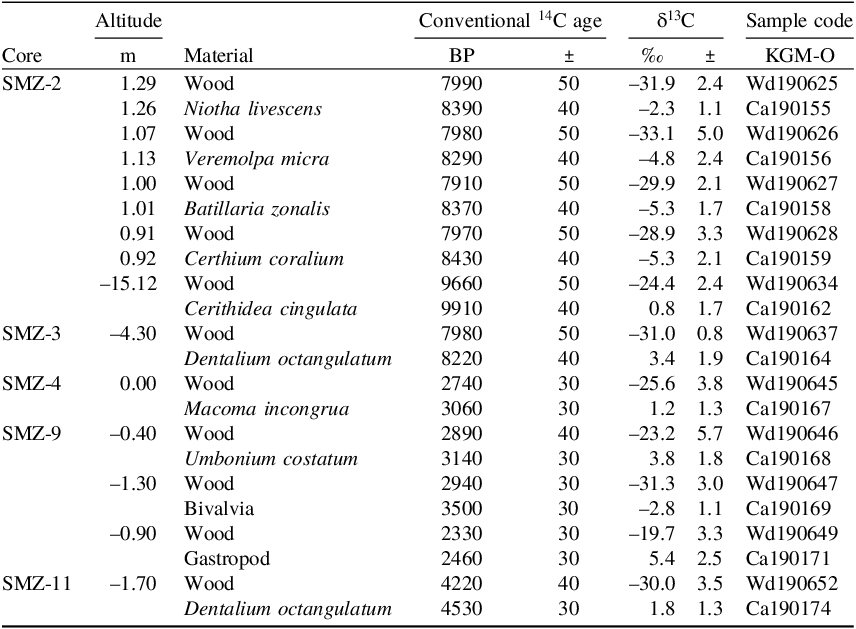
MREs were quantified as 14C age differences (R values) between coeval terrestrial and marine samples that showed no evidence of reworking or contamination. Twelve 14C age offsets between paired plant remains and shell samples from identical stratigraphic horizons were identified in the SMZ-2 to SMZ-4, SMZ-9, and SMZ-11 cores, spanning 2300–11,000 cal BP (Table 1, Figure 4). Uncertainty was calculated using a simple error propagation formula.
Radiocarbon ages of SMZ-2 to SMZ-4, SMZ-9, and SMZ-11 cores from the Shimizu Plain that were measuring marine reservoir ages.

Table 1. Long description
A table comparing radiocarbon ages of different cores from the Shimizu Plain. The table has 11 rows and 6 columns. Column headers are Altitude, Material, Conventional 14C age, δ13C, and Sample code. Row 1: Altitude, 1.29 m, Material, Wood, Conventional 14C age, 7990 BP ± 50, δ13C, -31.9 ‰ ± 2.4, Sample code, KGM-O Wd190625. Row 2: Altitude, 1.26 m, Material, Niotha livescens, Conventional 14C age, 8390 BP ± 40, δ13C, -2.3 ‰ ± 1.1, Sample code, Ca190155. Row 3: Altitude, 1.07 m, Material, Wood, Conventional 14C age, 7980 BP ± 50, δ13C, -33.1 ‰ ± 5.0, Sample code, KGM-O Wd190626. Row 4: Altitude, 1.13 m, Material, Veremolpa micra, Conventional 14C age, 8290 BP ± 40, δ13C, -4.8 ‰ ± 2.4, Sample code, Ca190156. Row 5: Altitude, 1.00 m, Material, Wood, Conventional 14C age, 7910 BP ± 50, δ13C, -29.9 ‰ ± 2.1, Sample code, KGM-O Wd190627. Row 6: Altitude, 1.01 m, Material, Batillaria zonalis, Conventional 14C age, 8370 BP ± 40, δ13C, -5.3 ‰ ± 1.7, Sample code, Ca190158. Row 7: Altitude, 0.91 m, Material, Wood, Conventional 14C age, 7970 BP ± 50, δ13C, -28.9 ‰ ± 3.3, Sample code, KGM-O Wd190628. Row 8: Altitude, 0.92 m, Material, Cerithium coralium, Conventional 14C age, 8430 BP ± 40, δ13C, -5.3 ‰ ± 2.1, Sample code, Ca190159. Row 9: Altitude, -15.12 m, Material, Wood, Conventional 14C age, 9660 BP ± 50, δ13C, -24.4 ‰ ± 2.4, Sample code, KGM-O Wd190634. Row 10: Altitude, 0.92 m, Material, Cerithidea cingulata, Conventional 14C age, 9910 BP ± 40, δ13C, 0.8 ‰ ± 1.7, Sample code, Ca190162. Row 11: Altitude, -4.30 m, Material, Wood, Conventional 14C age, 7980 BP ± 50, δ13C, -31.0 ‰ ± 0.8, Sample code, KGM-O Wd190637.
Marine reservoir ages under the Kuroshio Current during 12,000 years. Blue line indicates result of Shimizu Plain (SMZ-2 to SMZ-4, SMZ-9, and SMZ-11). E-G and J-K were measured by Nakanishi et al. Reference Nakanishi, Hong, Sung, Nakashima, Nahm, Lim and Katsuki2017b, Reference Nakanishi, Hong, Kuwahata, Sugiyama, Shimoyama, Ohkushi, Yamaguchi, Park and Nanayama2019ab, Reference Nakanishi, Hori, Nakashima and Hong2025, Reference Nakanishi, Ishiyama, Sung and Hong2026 (Figure 1).

5.1.1. Marine reservoir ages from the SMZ-2 core
Four reservoir age offsets between wood fragments and shells (N. livescens, Veremolpa micra (Pilsbry 1904), B. zonalis and Certhium coralium (Kiener 1841) were identified from the same stratigraphic horizons at elevations between 1.26 and 0.92 m above mean sea level in the SMZ-2 core. These offsets correspond to the period from 8200 to 8900 cal BP. The calculated R values range from 310 ± 60 to 460 ± 60 14C yr, with a mean value of 410 ± 70 14C yr. These samples were derived from transgressive sediments, as indicated by the occurrence of subtidal mollusks such as R. sordidula and N. livescens (Okutani Reference Okutani2000) in the upper portion of the core (approximately 2 to 1 m above mean sea level; Kitamura and Kobayashi Reference Kitamura and Kobayashi2014). These values are consistent with those reported for contemporaneous transgressive sediments in Hakata Bay, the Oita Plain, and the Nobi Plain (Nakanishi et al. Reference Nakanishi, Hong, Shimoyama, Sato, Park and Lee2017a, Reference Nakanishi, Takemura, Matsuyama, Shimoyama, Hong and Okuno2017c, Reference Nakanishi, Hori, Nakashima and Hong2025; sites C, E, and J in Figure 1).
5.1.2. Marine reservoir age from the SMZ-3 core
An age difference of 250 ± 60 14C yr was calculated between a wood fragment and C. cingulate from a depth of 15.12 m below mean sea level in the SMZ-3 core. This offset represents the oldest MRE identified at the study site, occurring at approximately 11,000 cal BP. The samples originate from transgressive sediments, as evidenced by the presence of prodeltaic mollusks such as E. subrectum and P. albicans (Okutani Reference Okutani2000) in the upper portion of the core (approximately 6 to 4 m below mean sea level; Kitamura and Kobayashi Reference Kitamura and Kobayashi2014). This value is consistent with MREs reported from transgressive sediments in the Oita Plain (Nakanishi et al. Reference Nakanishi, Takemura, Matsuyama, Shimoyama, Hong and Okuno2017c; site E in Figure 1).
5.1.3. Marine reservoir age from the SMZ-4 core
An R value of 240 ± 60 14C yr was obtained from paired wood and D. octangulatum samples collected at 4.30 m below mean sea level in the SMZ-4 core. This offset corresponds to approximately 8900 cal BP. The samples were derived from transgressive sediments, as indicated by the occurrence of subtidal mollusks such as R. doliaris and D. octangulatum (Okutani Reference Okutani2000) in the upper part of the core (approximately 2 m below mean sea level; Kitamura and Kobayashi Reference Kitamura and Kobayashi2014). Comparable values have been reported from transgressive sediments in Hakata Bay, the Oita Plain, the Sukumo Plain, and the Nobi Plain (Nakanishi et al. Reference Nakanishi, Hong, Shimoyama, Sato, Park and Lee2017a, Reference Nakanishi, Takemura, Matsuyama, Shimoyama, Hong and Okuno2017c, Reference Nakanishi, Tsuji, Nanayama, Yamaguchi, Kondo, Ikeda and Hong2019b, Reference Nakanishi, Hori, Nakashima and Hong2025; sites C, E, G, and J in Figure 1).
5.1.4. Marine reservoir ages from the SMZ-9 core
Three reservoir age offsets were obtained from paired wood samples and shells of Macoma incongrua (Martens 1865), Umbonium costum (Kiener 1838), and an unidetified bivalve from depths of 0.00 to 1.30 m below mean sea level in the SMZ-9 core. These R values range from 250 ± 50 to 560 ± 40 14C yr, with a mean value of 380 ± 160 14C yr. The samples were interpreted as deltaic sediments, based on the occurrence of prodeltaic mollusks such as D. octangulatum and E. subrectum (Okutani Reference Okutani2000) in the lower portion of the core (approximately 5 to 4 m below mean sea level; Kitamura and Kobayashi Reference Kitamura and Kobayashi2014). These values fall within the range reported for contemporaneous sediments in Hakata Bay, the Oita Plain, and the Nobi Plain (Nakanishi et al. Reference Nakanishi, Hong, Shimoyama, Sato, Park and Lee2017a, Reference Nakanishi, Takemura, Matsuyama, Shimoyama, Hong and Okuno2017c, Reference Nakanishi, Hori, Nakashima and Hong2025; sites C, E, and J in Figure 1).
5.1.5. Marine reservoir ages from the SMZ-11 core
Two reservoir age offsets were calculated from paired wood samples, a gastropod, and D. octangulatum collected from depths of 0.90 and 1.70 m below mean sea level in the SMZ-11 core. The resulting R values were 130 ± 40 and 310 ± 50 14C yr, respectively, and show a decreasing trend toward younger ages. Comparable age offsets have been reported from deltaic sediments in the Sukumo Plain (Nakanishi et al. Reference Nakanishi, Tsuji, Nanayama, Yamaguchi, Kondo, Ikeda and Hong2019b; site G in Figure 1).
5.2. Chronological change of marine reservoir ages
The six reservoir ages obtained from transgressive inner-bay sediments in the SMZ-2 to SMZ-4 cores yield a mean R value of 370 ± 100 14C yr. An increasing trend in R values from 250 ± 60 14C yr to 370 ± 100 14C yr (n=5) is observed during the period from 11,000 to 8200 cal BP. This trend is comparable to those reported for transgressive sediments in four cores from Hakata Bay, the Sukumo Plain, and Nobi Plain in southwestern Japan (Nakanishi et al. Reference Nakanishi, Hong, Shimoyama, Sato, Park and Lee2017a, Reference Nakanishi, Tsuji, Nanayama, Yamaguchi, Kondo, Ikeda and Hong2019b; sites C and G in Figure 1). A similar increase has also been documented in transgressive sediments from four cores along the western and southern coasts of the Korean Peninsula (Nakanishi et al. Reference Nakanishi, Hong, Sung and Lim2013, Reference Nakanishi, Hong, Sung, Sung and Nakashima2015; sites A–B in Figure 1). These consistent regional trends strongly suggest that the observed increase in R values reflects enhanced marine influence associated with regional sea-level rise.
In contrast, the average of five R values obtained from deltaic inner-bay sediments in the SMZ-9 and SMZ-11 cores is 310 ± 160 14C yr. Although this mean value is comparable to that of the transgressive inner-bay sediments from the SMZ-2 to SMZ-4 cores, the temporal trend is opposite. In these deltaic settings, the MRE decreases from 560 ± 40 14C yr to 130 ± 40 14C yr (n = 4) during 4800–2300 cal BP. A similar decreasing trend has been recognized in deltaic sediments from two cores in the Sukumo Plain and southwest Korea (Nakanishi et al. Reference Nakanishi, Hong, Sung and Lim2013, Reference Nakanishi, Tsuji, Nanayama, Yamaguchi, Kondo, Ikeda and Hong2019b; sites A and G in Figure 1). These changes are interpreted as reflecting an increased influence of freshwater input associated with delta progradation.
Thus, the spatiotemporal distribution of the MRE in the mid-latitudes of East Asia appears to be correlated with paleoenvironmental changes influenced by sea-level fluctuations and crustal movements. Such characteristics have not been reported in detail in previous studies conducted in the low-latitude regions of the South Pacific (e.g., Burr et al. Reference Burr, Beck, Corrège, Cabioch, Taylor and Donahue2009, Reference Burr, Haynes, Shen, Taylor, Chang, Beck, Nguyen and Zhou2015; Petchey and Schmid Reference Petchey and Schmid2020; Petchey and Ulm Reference Petchey and Ulm2012; Petchey et al. Reference Petchey, Clark, Lindeman, O’Day, Southon, Dabell and Winter2018). In contrast, an increase in the MRE from ca. 5500 cal BP to the present has been reported from shell mounds along the southeastern coast of Brazil, particularly in the state of Rio de Janeiro (Macario et al. Reference Macario, Alves, Oliveira, Scheel-Ybert, Dias and Lima2023). This trend is contrary to the results we obtained in the East Asian region. If information on the depositional environment, such as the δ1 3C and δ1⁸O values of the shell fossils, had been available, it might have been possible to discuss the reasons for these contrasting results.
The R value obtained in this study is consistent with those reported in previous studies based on pre-bomb samples (Figure 1). It also consistent with values reported from the inner part of Suruga Bay (Nakanishi et al. Reference Nakanishi, Hori, Nakashima and Hong2025; site K in Figure 1), as well as with values from regions influenced by the Kuroshio Current, except for those reported from the Miyazaki Plain (Nakanishi et al. Reference Nakanishi, Hong, Kuwahata, Sugiyama, Shimoyama, Ohkushi, Yamaguchi, Park and Nanayama2019a; site F in Figure 1). Therefore, the influence of deep water on the MRE in the study area is considered to be limited.
6. Conclusions
Spatio-temporal variations in the MRE were evaluated using paired 14C ages of marine shells and terrestrial plant remains from identical stratigraphic horizons in Holocene sediment cores from East Asia. As a first step toward establishing a comprehensive dataset for the western Pacific coast, this study presents preliminary results based on five sediment cores from the Shimizu Plain in the Shizuoka region of central Japan. The mean reservoir age derived from 11 paired samples is 340 ± 120 14C yr for inner-bay sediments spanning 2300–11,000 cal BP. The observed temporal variations in reservoir ages are consistent with previously reported results from the Korean Peninsula and southwestern Japan, including Hakata Bay, the Oita Plain, and the Sukumo Plain. This regional consistency suggests relative stability of the MRE in environments influenced by the warm Kuroshio Current. In contrast, the R value may increase or decrease in response to sea-level rise and associated environmental changes, such as delta progradation, indicating that careful interpretation is necessary. A spatio-temporal database of 14C MREs will provide a robust framework for establishing precise chronologies of environmental change and human activities in oceanic and coastal regions.
Acknowledgments
This research project began in 2010 with studies along the Korean coast and has since been supported by research grants from the Japan Geographic Data Center (since 2014), the National Research Council of Science and Technology of Korea, and the Japan Society for the Promotion of Science (JSPS) through KAKENHI Grant No. JP18H01310 (since 2018). This manuscript was improved by constructive comments from two anonymous referees and editors. The authors would like to express their sincere gratitude to Professor Yoshinori Yasuda, the founding director of the institution with which the first author is affiliated, for his support of this and many other research projects.