Introduction
The Weddell seal, Leptonychotes weddellii (Lesson), is the southernmost breeding mammal, and one of the largest of the phocid seals, with some adult females exceeding 500 kg (Wheatley et al. Reference Wheatley, Bradshaw, Davis, Harcourt and Hindell2006). The estimated total population of 800 000 seals is found only in the circumpolar Antarctic, and is therefore subject to little or no potential impact from commercial fisheries and other anthropogenic influences (Siniff Reference Siniff1991). The Erebus Bay population in McMurdo Sound (c. 1000) is one of the most comprehensively monitored groups, with early pup tagging efforts in 1968 leading to ongoing annual surveys since 1978. The proportion of animals tagged at birth and returning to Erebus Bay to breed due to high philopatry approaches 70% (Cameron & Siniff Reference Cameron and Siniff2004, Cameron et al. Reference Cameron, Siniff, Proffitt and Garrott2007). These are long-lived mammals (27 years, Proffitt et al. Reference Proffitt, Garrott, Rotella and Wheatley2007) with little to no evidence of reproductive senescence until at least age 17 (Cameron & Siniff Reference Cameron and Siniff2004). Despite the inherent difficulties of working in the Antarctic, this population has been an ideal model for studies of lactation (e.g. Wheatley et al. Reference Wheatley, Bradshaw, Davis, Harcourt and Hindell2006, Reference Wheatley, Bradshaw, Harcourt and Hindell2008), population ecology (e.g. Cameron & Siniff Reference Cameron and Siniff2004), aging (Proffitt et al. Reference Proffitt, Garrott, Rotella and Wheatley2007, Hindle et al. Reference Hindle, Horning, Mellish and Lawler2009) and diving physiology (e.g. Ponganis et al. Reference Ponganis, Kooyman, Castellini, Ponganis and Ponganis1993, Williams et al. Reference Williams, Fuiman, Horning and Davis2004). Some animals are sampled once in a lifetime, others multiple times in a single season. While the ultimate effects of multiple handling events can only be inferred through determination of lifetime reproductive success or survival rates (e.g. Baker & Johanos Reference Baker and Johanos2002, McMahon et al. Reference McMahon, Field, Bradshaw, White and Hindell2008), the potential for short-term, or acute responses to research-related manipulations can be substantial. Well-documented in other mammals, these can include behavioural aversions (Born et al. Reference Born, Riget, Dietz and Andriashek1999), reduced digestive efficiency (Trevisi et al. Reference Trevisi, Lombardelli, Minuti and Bertoni2007), increased stress hormones (Fletcher & Boonstra Reference Fletcher and Boonstra2006, Petrauskas et al. Reference Petrauskas, Atkinson, Gulland, Mellish and Horning2008), inflammatory response (Viswanathan & Dhabhar Reference Viswanathan and Dhabhar2005, Mellish et al. Reference Mellish, Hennen, Thomton, Petrauskas, Atkinson and Calkins2007b) and hyperthermia (Groenink et al. Reference Groenink, Vandergugten, Zethof, Vanderheyden and Olivier1994, Oka et al. Reference Oka, Oka and Hori2001). While there is no single accepted method to define impact, efforts to describe and quantify its effects are growing (McMahon et al. Reference McMahon, van den Hoff and Burton2005, Wilson & McMahon Reference Wilson and McMahon2006). Short-term and long-term responses to capture, handling, blood sampling and tagging have been investigated in only a handful of pinniped species (e.g. Lander et al. Reference Lander, Westgate, Bonde and Murray2001, Baker & Johanas Reference Baker and Johanos2002, Englehard et al. Reference Engelhard, Baarspul, Broekman, Creuwels and Reijnders2002a, Littnan et al. Reference Littnan, Baker, Parrish and Marshall2004, McMahon et al. Reference McMahon, Field, Bradshaw, White and Hindell2008).
As part of a larger investigation of aging in Weddell seals, the objective of this study was to document the acute responses of repeated handling within the same season in adult, non-reproductive seals. We specifically identified parameters that may be indicative of negative effects on general body condition (mass, blubber depth) and immune status (white blood cells, platelets, globulins, haptoglobins) rather than immediate stress per se (e.g. serum cortisol), such that small scale variations in the timing of sample collection in relation to capture and handling events would not substantially contribute to the variance within the data collected. Where possible, comparisons of low disturbance and high disturbance areas within the Erebus Bay study region are included.
Methods
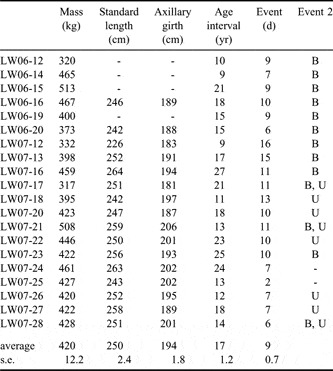
Biological samples were collected from adult Weddell seals (9–27 yrs) in the McMurdo Sound region (77°53′S 166°40′E) in the breeding seasons of 2006 and 2007 (October–December) as part of a larger study (e.g. Hindle et al. Reference Hindle, Horning, Mellish and Lawler2009) investigating the physiological and behavioural characteristics of aging in this species. A total of 50 seals (n = 24 non-reproductive female, n = 26 male) were included in a preliminary investigation of the effect of geographic location on physiological measures of stress and body condition, by grouping initial sampling location into low and high disturbance areas. Low disturbance areas (n = 17 samples) included: remote McMurdo Sound, Cape Evan’s Road, Turk’s Head, Tryggve Point, and Inaccessible Island. High disturbance areas (n = 33 samples) included: Little Razorback Island, Big Razorback Island, Tent Island and Turtle Rock. For females included in the assessment of multiple handling events (see below), only Event 1 data were included in this comparison. A preliminary assessment of the effect of repeated handling for research purposes included non-reproductive females only (n = 20), with two sampling events per individual (e.g. Event 1 & Event 2). Event 1 lasted approximately three hours and included physical restraint, chemical immobilization (described in detail in Mellish et al. in press), blood sampling, ultrasound for blubber depth, mass, morphometric measurement (standard dorsal length) and telemetry instrument attachment. Opportunistic faecal samples (e.g. voided by the animal during processing or collected from the rectal thermometer housing) were collected when possible (n = 14). Event 2 included physical restraint for telemetry instrument removal, with opportunistic blood sampling only occurring in individuals that required intravenous chemical immobilization (n = 13; Table I). Ultrasound blubber depth was collected opportunistically during Event 2 in a smaller subset of animals (n = 8, Table I).
Demographic summary for non-lactating female Weddell seals (Leptonychotes weddellii) sampled twice within a two week period in McMurdo Sound, Antarctica. Mass, standard length (ventral recumbancy) and girth were taken on initial sample only. Second event activities are noted (B = blood collection, U = ultrasound blubber depth).

In all cases, seals were aged prior to handling using uniquely numbered flipper tags in place as part of a long-term population monitoring project (Cameron & Siniff Reference Cameron and Siniff2004). Animals were initially approached on foot and slowly herded away from others prior to initial restraint via head bag (Stirling Reference Stirling1966). All animals were chemically immobilized to facilitate ease of handling and enhance animal and human safety. An intramuscular injection of 2 mg kg-1 ketamine hydrochloride and 0.1 mg kg-1 midazolam hydrochloride was utilized for induction, with intravenous or intramuscular administration at a reduced concentration (0.5 mg kg-1 ketamine and 0.025 mg kg-1 midazolam) as required for extended handling events. There were no measurable effects of multiple anaesthesia events as described in detail in Mellish et al. (in press). Animals were weighed only during Event 1 via sling net from a handing tripod scale to the nearest 0.5 kg. Blood samples were collected from the extradural intravertebral vein with a 6 inch 18 g spinal needle. Portable imaging ultrasound (SonoSite Vet180Plus) was used to identify non-pregnant females prior to handling and to determine blubber depth (including skin) at up to eight sites along the body (four lateral, four dorsal). The eight body locations correspond to sites 2–5 as described in Mellish et al. (Reference Mellish, Horning and York2007a), at roughly four equidistant sites between the axial girth and hip at lateral and dorsal positions. Blubber depth data are presented as both a summary data point and for indicator sites as found in Mellish et al. (Reference Mellish, Horning and York2007a) as appropriate.
Collected blood was held in a cooler to prevent freezing while in the field. White blood cells and platelets were counted manually (Unopette® system, Becton-Dickenson, Franklin Lakes, NJ). Spun sera were aliquoted and frozen at -80°C until analysis. Globulin concentrations were assayed with a Vetscan® Diagnostic Profile Plus analysis rotor system (Abaxis, Union City, CA). Haptoglobins were analysed with TriDelta diagnostics EIA as per Thomton & Mellish (Reference Thomton and Mellish2007). We specifically did not include serum cortisol as a measure of handling effect due to difficulties in standardizing time of blood collection, known rapid response and individual variation shown in other pinnipeds (e.g. Petrauskas et al. Reference Petrauskas, Atkinson, Gulland, Mellish and Horning2008). As a longer-term cumulative measure of stress effect, faecal samples were extracted and assayed for corticosterone concentration as described and validated for pinnipeds in Petrauskas et al. (Reference Petrauskas, Atkinson, Gulland, Mellish and Horning2008). All data are shown as mean ± standard error. Data were analysed for differences between repeat handling events by paired t-test, and unpaired t-test for differences between high and low disturbance regions. Given the small sample sizes throughout, an estimate of power for each test is also shown at alpha 0.05, two tailed 95% statistical analyses were performed using InStat 3.0b for Macintosh.
Results
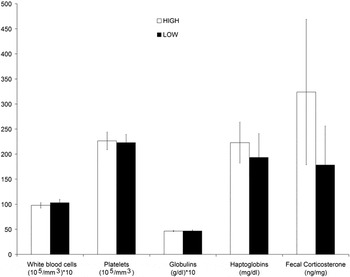
In comparing differences between low (n = 17) and high disturbance (n = 33) areas, there was no variation in animal demographic (mass P = 0.658 or age P = 0.905) that might influence interpretation of physiological data. However, body condition did vary by location for summed blubber depth (low n = 12, 50.8 ± 1.94 cm; high n = 22, 44.3 ± 1.57 cm, P = 0.016) and at two indicator sites (L2 low 8.1 ± 0.51 cm, high 6.9 ± 0.33 cm, P = 0.047; D2 low 6.2 ± 0.38 cm, high 5.1 ± 0.12 cm, P = 0.002). White blood cells, platelets, globulins, haptoglobins and faecal corticosterone showed no difference between the two groupings (P > 0.05, Fig. 1). Our current sample size should detect the following differences as significant at a 95% power: white blood cells 3.3 m mm-3, platelets 109 m mm-3, globulins 0.8 mg dl-1, haptoglobins 257 mg dl-1, and faecal corticosterone 815 ng mg-1. Of these, the current amount of variation noted in haptoglobins and faecal corticosterone suggests that we would require a much larger sample size than currently available to determine a statistical difference between these means (n = 1000 haptoglobins, and n = 50 faecal corticosterone).
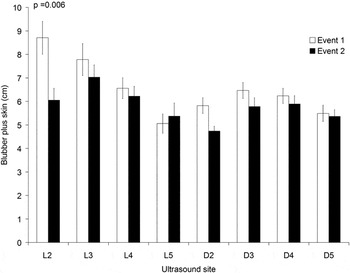
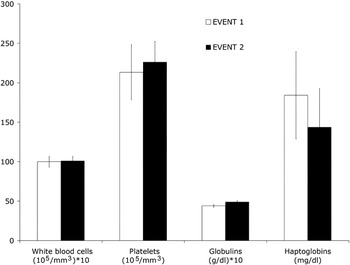
A subset of twenty females aged 17 ± 1.2 yrs were handled twice in 9 ± 0.7 d intervals. On Event 1, animals averaged 419 ± 12.2 kg (Table I). Seals were not reweighed during Event 2 processing. Although mass and morphometrics were only taken on the initial event, blubber depth measured via ultrasound (n = 8) did decline on a site-specific basis by Event 2 (Fig. 2). This effect was masked when all data were pooled as a single blubber measure (Event 1 50.3 ± 2.66 cm, Event 2 46.5 ± 2.4, P = 0.139). Blood samples were collected twice from thirteen females (10 ± 0.8 d interval). Of the five primary serum indicators measured, none changed between handling Event 1 and Event 2 (P > 0.05; Fig. 3). Based on the difference in standard deviations, our sample size of 13 would be able to detect, at a 95% power, differences of the following: white blood cells 2.0 m mm-3, platelets 106 m mm-3, globulins 0.3 mg dl-1 and haptoglobins 126 mg dl-1. As with our location comparison, our low power with the existing haptoglobin measures suggests that we would need a much greater sample size to determine a significant difference between the current data (n = 500).
Trends in white blood cell count, platelets, globulins, haptoglobins and faecal corticosterone between a high and low disturbance location in adult male and non-lactating adult female Weddell seals (Leptonychotes weddellii) in McMurdo Sound, Antarctica. There was no significant variation between areas in any parameter (P > 0.05).

Blubber depth via imaging ultrasound at eight sites (e.g. Mellish et al. 2007a) on non-lactating adult Weddell seals in McMurdo Sound during two capture events in a single season. Paired results showed that three of the eight sites differed between sampling events (L2, D2, D3).

Trends in white blood cell count, platelets, globulins and haptoglobins over two repeated sampling events in non-lactating adult female Weddell seals (Leptonychotes weddellii) in McMurdo Sound, Antarctica. There was no significant variation between events (P > 0.05).

Discussion
Concern over the impact of research and human disturbance effects has grown in the past decade, particularly in the few remaining ‘pristine’ environments such as the Antarctic (e.g. Tin et al. Reference Tin, Fleming, Hughes, Ainley, Convey, Moreno, Pfeiffer, Scott and Snape2009). The Weddell seal is one of the most-studied species due to its large size, extreme diving capabilities, low aggression and relative accessibility. Due to changes in the polar ice patterns, it is very likely that Weddell seals may become even more heavily researched as models for Arctic species, as the more northern animals are extremely difficult to access.
Behavioural studies in the McMurdo Sound region have shown that adult, lactating Weddell seals will respond to over-snow vehicles, but that this response was largely mediated by the distance between the vehicle and the animal (van Polanen Petel et al. Reference van Polanen Petel, Giese, Wotherspoon and Hindell2007). Similarly, lactating southern elephant seal females of Macquarie Island display modified behaviour patterns during and immediately after human presence (increased alertness, reduced vocalizations; Engelhard et al. Reference Engelhard, Baarspul, Broekman, Creuwels and Reijnders2002a). In McMurdo Sound, varied levels of human foot traffic within a two-hour window resulted in habituation of Weddell seals, but repeated exposure over a longer period of three weeks had the opposite result of sensitization (van Polanen Petel et al. Reference van Polanen Petel, Terhune, Hindell and Giese2006). This suggests there is a potential for increased stress among individuals repeatedly disturbed over a single season due to general traffic and/or research activities. This effect clearly needs to be investigated to assist in conservation measures and to allow individual researchers to account for the potential of acute stress due to their experimental protocol, including whenever possible overall traffic levels and individual-specific repeated disturbance.
General classification of Weddell seal location into low and high traffic areas was associated with some variation in body condition, but the immediate cause is unclear. Measured blood indicators were not found to vary based on human activity level at the seal’s location, similar to lactating southern elephant seals (Engelhard et al. Reference Engelhard, Hall, Brasseur and Reijnders2002c). Individual seals in our study (e.g. Hindle et al. Reference Hindle, Horning, Mellish and Lawler2009) were handled twice within a two-week period. Despite our repeated handling, there was no evidence of a generalized immune response (white blood cells, platelets, globulins) or an acute phase reaction (haptoglobins) in Weddell seals, a finding similar to that observed in other Antarctic phocids (Engelhard et al. Reference Engelhard, Brasseur, Hall, Burton and Reijnders2002b), but contrary to other pinniped species in response to various traumas (e.g. Mellish et al. Reference Mellish, Thomton and Horning2007b, Reference Mellish, Hennen, Thomton, Petrauskas, Atkinson and Calkins2007c, Thomton & Mellish Reference Thomton and Mellish2007). This suggests that our level of disturbance was much lower than required to elicit a mounted or protracted physiological effect, but our statistical power was poor for serum haptoglobins, which warrants further investigation in a longitudinal study. The importance of suitable statistical power is highlighted by the individual variability of an acute stress response. For example, immediate adrenal response in elephant seals (e.g. serum cortisol) to disturbance appears to vary with age and level of disturbance (Engelhard et al. Reference Engelhard, Brasseur, Hall, Burton and Reijnders2002b).
While there was some evidence of reduced body condition (e.g. blubber depth) between the first and second handling events, this most probably reflects the typical changes in condition with season and altered foraging habits due to breeding behaviour. In the absence of a control set, we cannot distinguish between the effects due to seasonality and the potential effects of handling. Indeed, one of the largest constraints associated with the study of wild pinnipeds is the ability to include a true control in the study design, such that few investigators are able to truly perform a meaningful comparison (e.g. Baker & Johanas Reference Baker and Johanos2002). In a long-term study of southern elephant seals, McMahon et al. (Reference McMahon, Field, Bradshaw, White and Hindell2008) were able to show no impact to individual mass or survival on individual seals that participated in up to eight telemetry device deployments. Combined with our current data, this suggests that Antarctic species may be generally tolerant to some types of research activities. In summary, although there are no clear indicators of negative physiological effect in this preliminary assessment, it is imperative that appropriate biological samples be collected whenever possible to gain a clearer picture of the impact of general disturbance and research activities on the species.
Acknowledgements
We would like to recognize the field efforts of M. Gray, R. Hill, S. Hill, J. Nienaber, J. Thomton, P. Tuomi and the support of the Crary Science Laboratory Staff. All work was conducted under Marine Mammal Protection Act 1034-1854, Antarctic Conservation Act 2007-007, ASLC Animal Use Protocol 05-004 and OSU Animal Use Protocol 3454. This project was funded by the National Science Foundation Polar Programs Antarctic Organisms and Ecosystems (Awards 0649609 and 0440715).