




No CrossRef data available.
Article contents
Parental decision-making in congenital heart disease
Published online by Cambridge University Press: 21 January 2005
Abstract
Objective: To explore whether prenatal diagnosis of congenital heart disease is associated with lower levels of parental distress and greater satisfaction with decisions about cardiothoracic surgery when compared to postnatal diagnosis. Methodology: A combined quantitative–qualitative design was used. Participants included the parents of 31 neonates (30 mothers and 22 fathers) admitted to the cardiac intensive care unit between 1 November 2001 and 1 May 2002 for repair of congenital cardiac malformations. Participants completed self-report measures of anxiety, optimism, and life events pre-operatively, and semi-structured qualitative interviews assessing satisfaction with decision-making within 1 week of the operation. Results: At the time of surgery, mothers of neonates receiving the diagnosis prenatally did not differ from mothers of neonates receiving the diagnosis postnatally on measures of anxiety, optimism, and life events. Fathers of neonates receiving the diagnosis prenatally, however, reported more optimism, lower state and trait anxiety, and fewer negative life events than fathers of neonates receiving the diagnosis postnatally. When we analyzed the interviews, we found that, regardless of the timing of the diagnosis, parents felt as though they made a genuine choice for their baby to have surgery. Conclusions: In this pilot study, fathers who learned prenatally that their child had a congenital cardiac malformation were less distressed than those who discovered this fact only postnatally. From the parental perspective, nonetheless, distress and urgency do not impair their ability to make decisions about neonatal cardiac surgery.
Information
- Type
- Original Article
- Information
- Copyright
- © 2004 Cambridge University Press
Congenital cardiac malformations occur in from four to eight of each 1000 live births.1 One-third of the children with such malformations become critically ill and die, or require surgical or catheter intervention during the first year of life.2 Of these, an increasing portion are now diagnosed prenatally with fetal echocardiography, while the remainder are diagnosed postnatally. Fetal echocardiography between 18 and 22 weeks of gestation is both specific and sensitive for most cardiac abnormalities. Routine prenatal screening for congenital cardiac malformations, however, remains a controversial topic.3, 4 Although prenatal diagnoses of complex malformations permit detailed counseling about the outcome, the impact of such diagnosis on informed consent has not, to the best of our knowledge, previously been evaluated.5
The impact of postnatal diagnosis of a critically ill neonate on parental informed consent for participation in research, however, has been investigated. Thus, Mason et al.6 reported concerns surrounding informed consent in a randomized controlled trial of neonates undergoing extra-corporeal membrane oxygenation compared with conventional mechanical ventilation. They found potential deficiencies in informed consent in seven-tenths of the parents interviewed.6 Informed consent involves four different components: understanding, appreciation, voluntariness, and decision.7 Voluntariness is freedom from force, fraud, deceit, duress, or other forms of constraint or coercion.8 The concern is that the stress associated with having a sick neonate may preclude adequate informed consent.9
Parents of neonates with critical congenital cardiac disease must make several crucial decisions. The urgency of these decisions is related to the timing of diagnosis. The first decision for parents of fetuses known to have congenital cardiac malformations is if the baby should have surgery, and if so, where the surgery should be performed. For parents of postnatally diagnosed neonates, these decisions are often rushed, and are made while grieving for the loss of the healthy child. As such, the psychological impact of the diagnosis is compounded by the urgency to make a decision to proceed with surgery. Often these babies are transported to a tertiary center for care, requiring separation from the mother and other family members. These factors can increase the impact of the stress associated with the diagnosis. For the mothers of these infants, the combination of the postpartum state and separation from the baby, in addition to having to deal with a life-threatening issue for the neonates, may increase the stress and anxiety, which could decrease the quality of the decision-making.
We hypothesized that parents of neonates diagnosed prenatally would have lower levels of stress and anxiety at the time of surgery than the parents who first discovered the illness of their child postnatally, and that the lower levels of stress and anxiety would be associated with a higher quality of informed consent. The parents of those neonates in whom the diagnosis has been made prenatally have less urgency, defined as the time between diagnosis and surgery, and therefore may have an improved quality of informed consent. The goal of this study, therefore, is to evaluate the impact of stress, anxiety, and urgency on the informed consent made by parents of neonates with critical congenital cardiac malformations.
Methods
Following approval from our institutional review board, our study had three phases, which took place between 1 October 2001 and 1 May 2002. The first phase consisted of setting up focus groups with parents of children who had undergone repair of congenital heart disease at an age less than 28 days between January 2001 and September 2001. The focus groups were held in October 2001. The purpose of the focus groups was to generate issues to be included in a semi-structured interview during the third phase of the study.10 The focus of the discussion was the decisions needed to be made by the parents for repair of the congenital cardiac malformation, as well as the potential impact of the timing of diagnosis. The discussions were audio-taped, transcribed, and then the transcripts were analyzed by two different raters to generate themes. The themes were generated out of phrases frequently used by the parents. The themes of the focus groups were analyzed and then used for construction of the semi-structured interview tool (see Table 1).
All English-speaking parents of neonates undergoing surgery at our institution between 1 November 2001 and 1 May 2002 were eligible for the second and third phases of the study. For the second phase, the quantitative portion of the investigation, three constructs were chosen to characterize the levels of stress suffered by the parents, specifically anxiety, optimism, and the perception of experiences of life. We quantified levels of anxiety using the Spielberger State/Trait Anxiety Inventory.11 This measure taps both dispositional (trait) anxiety, and situational (state) anxiety. The life orientation test was used to quantify optimism. This tool assesses dispositional optimism irrespective of the stresses of life, and can be used to predict how people will respond to stress.12 The life experiences survey was used to measure perceptions of the experiences of life as positive or negative.13 The instruments were used pre-operatively to detect possible differences in the groups before the additional stress of the peri-operative period. Each instrument was coded only with a number, and was scored only at completion of the study.
The third phase of the study consisted of post-operative semi-structured interviews with the parents. Verbal consent was obtained on tape at the beginning of all interviews. All of the interviews were done by the principal investigator (K.S.H.) and were tape recorded, transcribed, and then analyzed. The interviews and the instruments were both coded by number to ensure confidentiality, with the list of names maintained independently from the data. Each transcript was coded independently by two raters (including K.S.H.) trained in the coding categories, with codes assigned to the data using NVivo software.14 Transcripts were compared to ensure that codes were being applied consistently. There was 75% agreement between coders at the first comparison. Where there were differences in the codes applied to the same selections of text, the rationale for applying a code was discussed, and agreement was reached on the most appropriate code.
Table 1. Semi-structured interview tool.

Results
For the first phase, of a total of 45 eligible families, 5 families (10 adults) came to the first focus group; and 9 adults, representing 6 families, came to the second focus group, giving a total of 19 adults. The themes discussed in the focus groups were the perception of active choice for the baby to have surgery, and the effect of stress on the understanding of the complex congenital cardiac malformations afflicting the baby. The themes from the focus group were used to generate the semi-structured interview tool, and to code the interviews. The themes were choice, stress, understanding, and focus. Choice refers to whether or not the parents felt as though they made a genuine choice for their baby to undergo surgery, a component of voluntariness. Stress refers to the description by the parents of their emotional state. Understanding reflects the parental appreciation of the information that they received. Focus is the ability, as described by the parents, to process specific information despite overwhelming stress and anxiety.
For the second and third phases, of 41 eligible neonates, parents of 31 agreed to participate. The racial breakdown of the neonates included 21 Caucasians, 6 African-American, 3 Latinos, and 1 Asian neonate. The diagnoses of the 31 neonates are shown in Figure 1. For the pre-operative questionnaires, 52 of 62 possible parents chose to participate, 30 mothers and 22 fathers. A two-tailed independent group t-test was used, analyzing mothers and fathers separately, to test for differences in the pre-operative measures as a function of the timing of diagnosis.
At the time of surgery, there were no statistically significant differences between the mothers of neonates diagnosed prenatally as opposed to postnatally in terms of anxiety, optimism, or perception of the experiences of life (Fig. 2, Table 2). Fathers of neonates who were diagnosed prenatally, however, had less anxiety, were more optimistic, and reported fewer negative life events compared to fathers of those neonates diagnosed after birth (Fig. 3, Table 2).
In the third phase, we enrolled 44 parents of 31 babies, all parents being interviewed between the first and seventh post-operative day, with the mean number interviewed on the third post-operative day. The 14 mothers of prenatally diagnosed neonates were generally diagnosed between the 22nd and 24th weeks of gestation. Their perception was that, between diagnosis and delivery, they moved from a period of grief and mourning to a period of active planning. In the case of 13 mothers of postnatally diagnosed neonates, there was the added stress of being in the postpartum state. These mothers felt a variety of emotions, but their perception was that they were able to focus to make decisions, and to advocate for their babies.
The 10 fathers of neonates diagnosed prior to birth ran the spectrum from being overwhelmed with grief to being more detached until the baby was born. These fathers stated concern about the financial impact on their family; in contrast to the fathers of neonates diagnosed postnatally. In this cohort, the seven fathers of neonates diagnosed postnatally with critical malformations did not feel that non-intervention was an option; yet they wanted information prior to making their final decisions. These fathers had the additional stress of worrying about the mother and the baby being in different hospitals.
With regard to informed consent, parents of both groups of neonates felt as though they made a genuine informed choice for their baby to have surgery. They understood that the baby could not survive without surgery, and thus chose surgery to keep the baby alive. The parents of neonates with hypoplastic left heart syndrome were different from the other parents in this study because of the number of “options” available for their children. At other institutions, those who received a prenatal diagnosis were offered the choices of termination, staged reconstruction, cardiac transplantation, non-intervention subsequent to birth. It is of interest that non-intervention was not given as an option for diagnoses other than hypoplastic left heart syndrome. Those who received their prenatal counseling at this institution were offered either termination or staged reconstruction as the options presented. Despite the variety in the options presented to the parents of neonates with hypoplastic left heart syndrome, they had similar quality of informed consent to the other parents. All of the parents understood that their neonate would die without intervention, and, thus, chose staged reconstruction.
The parents of prenatally diagnosed neonates may have had a more sophisticated understanding of the process of the disease, but both groups of parents perceived that they understood the consequences of not having surgery. In the qualitative interviews undertaken within 1 week of surgery, none of the participating parents expressed regret about their decision to opt for surgery. All of the parents included in the study felt satisfied with the decision they made for the baby to have surgery, regardless of whether they made the decision 3 months in advance or shortly before surgery.

Figure 1. Diagnoses of the neonates.

Figure 2. Results of the mothers’ pre-operative psychological instruments.

Figure 3. Results of the fathers’ pre-operative psychological instruments.
Table 2. Means and standard deviations on quantitative measures by parental role and timing of diagnosis.

Discussion
Prenatal diagnosis of critical congenital cardiac disease has various physiological effects for the baby; and may improve the health and outcome of the neonate.15 Hypoplastic left heart syndrome is a subgroup within complex congenital heart disease that necessitates special consideration given the different choices, specifically palliative surgery, cardiac transplantation, and non-intervention, and the variability in outcome.16–18 To the best of our knowledge, ours is the first study to evaluate the impact of prenatal diagnosis on parental decision-making.
In this small pilot study, the quantitative data revealed fathers of neonates in whom the diagnosis has been made prior to birth were less anxious, more optimistic, and perceived fewer negative life events than did those who learnt of the illness of their child after birth. One reason for this could be that the fathers of those diagnosed prenatally have more time to make a plan for action, both for their jobs, and for the care of their other children. The fathers may use this element of control as a coping skill. An alternate explanation is that fathers with less anxiety and more optimism may be more likely to pursue prenatal testing. No differences were seen when mothers of prenatally diagnosed neonates were compared to mothers of neonates diagnosed after birth. This could be because both groups of mothers were equally distressed at the time of surgery.
The qualitative data suggested that, irrespective of the timing of the diagnosis, both sets of parents felt as though they made a genuine decision for their baby to undergo surgical repair of the congenital cardiac malformation. The parents felt as though they understood, and then actively decided, for the baby to undergo surgery. Both groups felt satisfied with the decisions they made.
Our investigation is novel and unique in that it examined informed consent in close proximity, less than 1 week, from the decision to proceed with cardiothoracic surgery. The population with complex malformations was chosen specifically because of the urgency to make a decision for surgery prior to the death of the baby. This is in contrast to previous retrospective studies of informed consent, which suggested deficiencies in informed consent in parents of neonates with life-threatening conditions, such as the Euricon trial of extra-corporeal membrane oxygenation.6 In the Euricon trial, parents had similar decisions to make as in our study, since non-intervention was associated with a high likelihood of mortality. Our study suggests that parents of critically ill children may adequately weigh options and make decisions on the behalf of their child.
A strength of our study is that we interviewed parents shortly after the decision for surgery. Other studies investigating the quality of informed consent have all involved a much longer time lag between the parental decision and the research interview. The Euricon study, which examined randomized controlled trials involving neonates, included interviews done up to a year after the decision of the parents to enroll their neonate in the trial. In addition, the deficiencies identified in competence, information, understanding, and voluntariness were based on the subjective recall of both parents and physicians.6 Recall bias from newer knowledge about the allocation of treatment allocation may impact on studies of informed consent carried out retrospectively.19 Other studies dispute that stress has a negative impact on informed consent, suggesting rather that parents assessed the probability and magnitude of risks and benefits.20, 21 Fathers, in particular, have to worry about the postpartum mother in addition to the baby.22
There are several limitations to our pilot study. The proximity of the interview to the date of surgery, seeking to avoid the impact of surgical outcome on parental recall, separates our study from others related to informed consent, but does leave it open to other parental bias. Parents may be biased by the condition of the baby, or by comments made by the surgeons, such as “surgery went well”. The difference in trait anxiety between the two groups of fathers is another limitation, because they are not the same at baseline. The wide variety of cardiac diagnoses is another limitation, because the emotional responses to the anticipated clinical courses may be quite different. This heterogeneity also limits the comparison between the groups of neonates diagnosed postnatally as opposed to prenatally. There is also an inherent selection bias, secondary to incomplete recruitment for all three phases of the study. Our selected population included only the parents of neonates diagnosed prenatally who chose to continue the pregnancy, and to have the surgery carried out at our institution. Other limitations of our study include lack of objective testing of parental understanding and institutional bias. Those who chose non-intervention did not present to our center. Non-intervention is generally not presented as an option for parents who receive counseling at our institution, unless there are multiple congenital anomalies, genetic syndromes, or severe hypoxic ischemic encephalopathy.
In summary, therefore, our study validates our hypothesis that prenatal diagnosis of a critical congenital cardiac malformation may enhance paternal adjustment, and that from the parental perspective, stress, and urgency do not impair decision-making about neonatal cardiac surgery.
References
Goldmuntz E. The epidemiology and genetics of congenital heart disease. Clin Perinatol 2001; 28: 1–10.Google Scholar
Marino BS, Bird GL, Wernovsky G. Diagnosis and management of the newborn with suspected congenital heart disease. Clin Perinatol 2001; 28: 91–136.Google Scholar
Carvalho JS. Early prenatal diagnosis of major congenital heart defects. Curr Opin Obstet Gynecol 2001; 13: 155–159.Google Scholar
Lee W, Smith RS, Comstock CH, Kirk JS, Riggs T, Weinhouse E. Tetralogy of Fallot: prenatal diagnosis and postnatal survival. Obstet Gynecol 1995; 86: 583–588.Google Scholar
Allan LD. The outcome of fetal congenital heart disease. Semin Perinatol 2000; 24: 380–384.Google Scholar
Mason SA, Allmark PJ. Obtaining informed consent to neonatal randomised controlled trials: interviews with parents and clinicians in the Euricon study. Lancet 2000; 356: 2045–2051.Google Scholar
Beauchamp TCJ. Principles of Biomedical Ethics. Oxford University Press, New York, 1994, pp 144–145.
Alderson P, Goodey C. Theories in health care and research: theories of consent. Br Med J 1998; 317: 1313–1315.Google Scholar
Mason SA. Obtaining informed consent for neonatal randomised controlled trials – an elaborate ritual? Arch Dis Child Fetal Neonatal Ed 1997; 76: 143F–145F.Google Scholar
Madriz E. Focus groups in feminist research. In: Lincoln YS (ed.). Handbook of Qualitative Research. Sage Publications, California, 2000, pp 835–853.
Spielberger CD. Manual for the State–Trait Anxiety Inventory. Consulting Psychologists Press, Inc., Palo Alto, CA, 1983.
Scheier MF, Carver CS. Optimism, coping and health: assessment and implications of generalized outcome expectancies. Health Psychol 1985; 4: 219–247.Google Scholar
Sarason IG, Johnson JH, Siegel JM. Assessing the impact of life changes: development of the life experiences survey. J Counsel Clin Psychol 1978; 40: 931–946.Google Scholar
Richards L. Using NVivo in Qualitative Research, 2nd edn. QSR International Pty. Ltd., Victoria, Australia, 2000.
Kumar KM, Newburger JW, Gauvreau K, Kamenir SA, Hornberger LK. Comparison of outcome when hypoplastic left heart syndrome and transposition of the great arteries are diagnosed prenatally versus when diagnosis of these two conditions is made only prenatally. Am J Cardiol 1999; 83: 1649–1653.Google Scholar
Brawn WJ, De Giovanni JV, Hutchison S, et al. Hypoplastic left heart syndrome: more families now have choice. Br Med J 1997; 314: 1414–1415.Google Scholar
Vandvik IH, Forde R. Ethical issues in parental decision-making. An interview study of mothers of children with hypoplastic left heart syndrome. Acta Paediatr 2000; 89: 1129–1133.Google Scholar
Corrow C, Lapuk C, Mazzarella K, Sable A, Leopold H, Eisenfeld L. Hypoplastic left heart syndrome: factors influencing therapeutic choice. Conn Med 2001; 65: 195–203.Google Scholar
Elbourne D, Snowdon C, Garcia J, Field D. Trial experience and problems of parental recollection of consent. Br Med J 2001; 322: 49–50.Google Scholar
Zupancic JA, Gillie P, Streiner DL, Watts JL, Schmidt B. Informed consent for randomised controlled trials in neonates. Arch Dis Child Fetal Neonatal Ed 1998; 78 (2): F156–F157.Google Scholar
Garson A Jr, Benson RS, Ivler L, Patton C. Parental reactions to children with congenital heart disease. Child Psychiatr Hum Dev 1978; 9: 86–94.Google Scholar
Svavarsdottir EK, McCubbin M. Parenthood transition for parents of an infant diagnosed with a congenital heart condition. J Pediatr Nurs 1996; 11: 207–216.Google Scholar
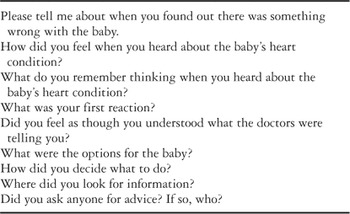
Table 1.

Diagnoses of the neonates.

Results of the mothers’ pre-operative psychological instruments.

Results of the fathers’ pre-operative psychological instruments.
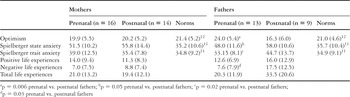
Table 2.
 You have
Access
- 38
- Cited by