INTRODUCTION
Maize (Zea mays) is life in Malawi, and its availability is a measure of both food supply and social security nationally and for the household. Per capita calorific consumption of maize in Malawi is the highest in the world (Smale and Heisey, Reference Smale, Heisey, Byerlee and Eicher1997). However, maize grain yields in the dominant smallholder sector declined in recent decades (Blackie et al., Reference Blackie, Benson, Conroy, Gilbert, Kanyama-Phiri, Kumwenda, Mann, Mughogho and Phiri1998; Kumwenda et al., Reference Kumwenda, Waddington, Snapp, Jones, Blackie, Byerlee and Eicher1997) until 2005 when a fertilizer subsidy was reintroduced. Depletion of soil fertility is one major factor that has led to low agricultural production in Malawi (Blackie et al., Reference Blackie, Benson, Conroy, Gilbert, Kanyama-Phiri, Kumwenda, Mann, Mughogho and Phiri1998; Kumwenda et al., Reference Kumwenda, Waddington, Snapp, Jones, Blackie, Byerlee and Eicher1997; Snapp, Reference Snapp1998). Lack of access to sufficient mineral fertilizers limits opportunities for soil fertility improvement in African smallholder agriculture. Recent efforts to replenish and maintain soil nutrients in southern Africa have included the use of legumes as one of the most practicable and cost effective means of improving the soil fertility of smallholder farms (Kumwenda et al., Reference Kumwenda, Waddington, Snapp, Jones, Blackie, Byerlee and Eicher1997; Mafongoya et al., Reference Mafongoya, Bationo, Kihara and Waswa2006; Snapp et al., Reference Snapp, Rohrbach, Simtowe and Freeman2002a; Waddington et al., Reference Waddington, Sakala and Mekuria2004).
Research in Malawi, as elsewhere, has demonstrated that integrating more legumes into cropping systems provides a cheap source of nitrogen (N) for the soil, as well as producing grain to fortify diets (Kerr et al., Reference Kerr, Snapp, Chirwa, Shumba and Msachi2007; Snapp et al., Reference Snapp, Mafongoya and Waddington1998; Reference Snapp, Rohrbach, Simtowe and Freeman2000a; Waddington et al., Reference Waddington, Sakala and Mekuria2004). Although legume technologies cannot generally produce enough N for maximum maize yields in the short term, they provide limited but significant amounts of soil N that can increase maize yields, and arrest depletion of soil fertility at a low cost and at low risk for the poor farmer (Giller, Reference Giller2001; Giller et al., Reference Giller, Misiko and Tittonell2006; Waddington et al., Reference Waddington, Sakala and Mekuria2004). Researchers in southern Africa have generated substantial information on soil fertility benefits from legumes in research stations, but less is known about the feasibility of these options on smallholder farms. There has been limited adoption of new legume technologies for soil fertility improvement by smallholder farmers in Malawi (Kumwenda et al., Reference Kumwenda, Waddington, Snapp, Jones, Blackie, Byerlee and Eicher1997; Snapp et al., Reference Snapp, Rohrbach, Simtowe and Freeman2002a; Reference Snapp, Kanyama-Phiri, Kamanga, Gilbert and Wellard2002b), but long-term engagement between researchers and smallholders there has been shown to raise uptake (Kerr et al., Reference Kerr, Snapp, Chirwa, Shumba and Msachi2007).
Risk and vulnerability analysis can help fit technologies to classes of farmers differing in resource endowment (Legesse and Drake, Reference Legesse and Drake2005). Vulnerability here refers to things that are outside farmers’ control but influence their capacity to cope with risk (Patt, Reference Patt2001). Successful reduction of risk increases or stabilizes incomes, which can then reduce vulnerability. Legume-related technologies can often reduce vulnerability by raising crop yields. However, sometimes they may reduce maize yields and thus increase vulnerability, as may occur when legumes replace a maize crop in rotation, or if there is excessive competition between intercrops in dry years (Adato and Meinzen-Dick, Reference Adato and Meinzen-Dick2002). Few studies have attempted to evaluate maize-legume technologies in terms of their impact on risks of meeting household food security for farmers varying in resource (land, labour, draught power, off-farm income) availability. Differences in resource endowment (Wellard, Reference Wellard1996) are influential in decision-making processes for household livelihoods. Thus the identification of resource groups among target farmer communities can help the understanding of differences in farmers’ behaviour and preferences, perceptions of risks and their interest in the adoption of new technologies.
This paper reports an agronomic and economic evaluation of the risks and potential relevance of legume-based soil fertility technologies to different resource groups of smallholder farmers in central Malawi. We examined the link between soil fertility technologies, the magnitude of associated risk and the feasibility of the technologies under smallholder farming conditions. We focused on maize-legume combinations because farmers showed interest in experimenting with legumes to improve soil fertility.
MATERIALS AND METHODS
Site description
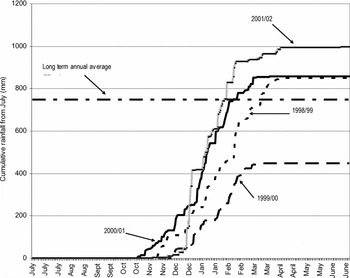
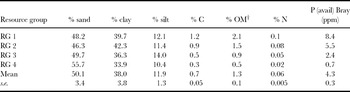
The study was conducted from 1998 to 2002 in Chisepo, Dowa District, situated 100 km northwest of the capital Lilongwe in the mid-altitude plateau of central Malawi (13°32′S, 33°31′E., elevation 1100 m asl). The climate is semi-arid to sub-humid, characterized by a unimodal pattern of rainfall from November to April, with a 10–20% chance of either prolonged dry spells or flooding. The 70-year average seasonal rainfall is 748 mm, with an annual range from 400 mm to 1100 mm (Figure 1). Mean temperature is 22.2 °C. Soils are predominantly Alfisols of low to moderate fertility and sandy loam to loamy sand textures underlain by laterites, which impede drainage (Wendt, Reference Wendt1993). Chisepo soils are generally poor in soil organic carbon (C) (1.3% on average) and N (0.06%) (Table 1). The main crops in Chisepo are maize and burley tobacco (Nicotiana tabacum), with maize yields ranging from as low as 0.1 t ha−1 to 5 t ha−1 (Kamanga, Reference Kamanga2002). Legumes grown by farmers include: groundnut (Arachis hypogaea), common bean (Phaseolus vulgaris), Magoye – a promiscuously nodulating variety of soyabean (Glycine max) (see Mpepereki et al. (Reference Mpepereki, Javaheri, Davis and Giller2000)), a bunch-type of cowpea (Vigna unguiculata) and Bambara nut (Vigna subterranea).
Cumulative distribution of rainfall (mm) for each of four years in Chisepo, central Malawi from 1998/99 to 2001/02.

Soil physical and chemical properties for the 0–20 cm soil layer in legume-maize mother and baby trial fields belonging to farmers from four resource groups (RG) in Chisepo, central Malawi. n = mean of 8 farmers per RG.

†Organic matter.
Farmer resource groups
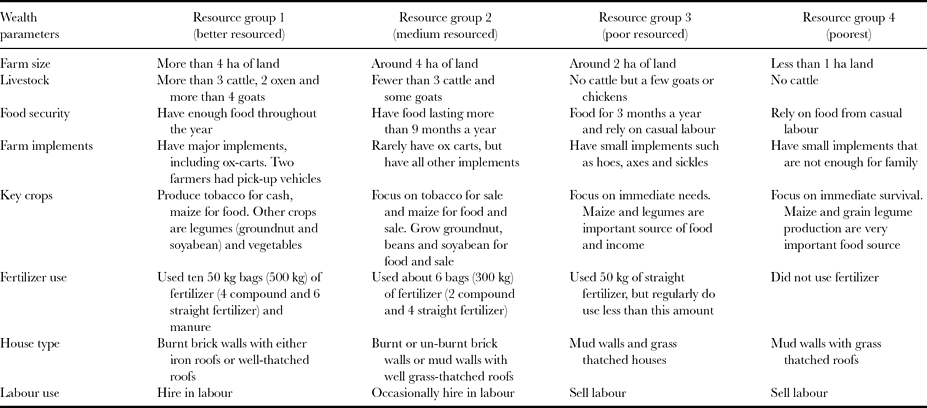
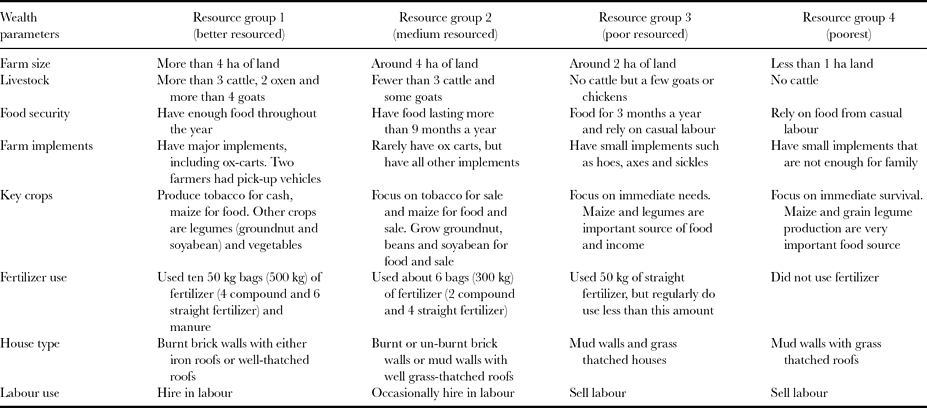
Four groups of farmers, varying in their level of resource endowment, were identified in Chisepo in 1998. Wealth ranking (Jeffries et al., Reference Jeffries, Warburton, Oppong-Nkrumah and Fredua Antoh1997) was used to characterize the farm households into relatively homogeneous groups with similar resources, constraints and degree of poverty. Key informants, with an intensive knowledge of the area, helped develop the grouping characteristics and the groups. Information used included the resource endowment of a household, number of months that a household had maize grain from its own harvest, housing quality, access to inputs and influence in the community. Farmers from 136 households in seven villages around Chisepo were assigned to the appropriate resource groups by key informants. Farmers in Resource Group (RG) 1 were ‘better resourced’ and had enough food throughout the year, adequate farm tools and livestock, iron-roofed houses and sufficient land (Table 2). They also could afford enough fertilizer and to hire in labour. RG 2 farmers were ‘medium resourced’. They had enough food almost throughout the year, enough farmland, good thatch houses and were able to buy some fertilizer and hire labour. Farmers in RG 3 were ‘poor’ or ‘less well resourced’ and cultivated small pieces of land, had little to harvest, relied on casual labour, used no fertilizers and had poor houses. RG 4 farmers were the ‘poorest’ with few resources for agriculture, and they largely relied on the sale of casual labour for survival.
Wealth parameters and characteristics of farmers in four resource groups in 1998 in Chisepo, Malawi.
Design and implementation of mother and baby trials
An on-farm mother and baby trial approach (Snapp, Reference Snapp1999; Snapp et al., Reference Snapp, Kanyama-Phiri, Kamanga, Gilbert and Wellard2002b) was used as an evaluation and extension tool. Replicated and researcher-managed mother trials are used to test many different crop technologies on a few farms and associated baby trials (not replicated and farmer-managed) test subsets of the technologies on many farms. Mother and baby trials ran for four seasons from 1998/99 to 2001/02 on sandy loam and loamy sand soils, the main soil types in the area. They were located within a radius of 6 km.
During an initial participatory planning session, 32 farmers, comprising eight from each resource group, were selected at random to be involved in the mother-baby trial programme. In each resource group, two farmers were selected to host mother trials and six farmers agreed to conduct single replicate baby trial plots. Analysis of mother and baby trials showed few differences in results. Thus, this paper reports the full results from mother trials and draws comparisons, where relevant, with results from the baby trials.
Participatory planning sessions were held with the farmers in 1998 to determine the experimental treatments and trial management. Farmers expressed interest in testing maize-legume combinations on fields that had different management histories. Four maize-legume technologies, along with two concerning fertilizer inputs on sole maize, were identified for testing in the mother-baby trials (Kamanga Reference Kamanga2002). Pigeonpea (Cajanus cajan) and groundnut were given high priority because, in addition to improving soil fertility, farmers stated that they could get edible grain from them. The maize-legume technologies were: maize (cv. MH18) in rotation with pigeonpea (cv. ICP 9145) intercropped with groundnut (cv. CG 7) (Mz/Pp+Gn); maize intercropped with tephrosia (Tephrosia vogelii) (Mz+Tv); maize intercropped with pigeonpea (Mz+Pp); and maize in rotation with mucuna (Mucuna pruriens) (Mz/Mp). In the intercropped treatments (Mz+Tv and Mz+Pp), the legumes were grown and harvested in each of the four years, whereas the legumes in the rotational treatments were grown only in the first and third years. The four maize-legume technologies were compared with sole crop maize without fertilizer (Mz−Ft) and sole maize with half (i.e. 35 kg N ha−1) the national fertilizer recommendation of 69 kg N ha−1 (Mz+Ft). Urea was used to supply the N and was applied once when the maize was knee-high. No other nutrients were applied.
Experimental treatments for mother trials were laid out in a randomized complete block design with three replicates on each farm and a plot size of 10 m × 10 m. Legumes and maize were planted with recommended plant spacings (Government of Malawi, 1996) giving the following plant population densities: 37 000 plants ha−1 for maize and pigeonpea in both systems and 74 000 plants ha−1 for mucuna and groundnut. In the fourth year, a split-plot design was used. Plots were split into two, where half of each plot received 35 kg N ha−1 and the other half did not. The Mz+Ft treatment received a full fertilizer recommendation of 69 kg N ha−1. Yields from plots that received N fertilizer in the 2001/02 season were used to compare the riskiness of technologies when fertilizer was applied in addition to organic sources of N from legume biomass. Overall implementation (plot size, experimental treatments, time of planting, seeding rates, harvest) of the trials was the responsibility of the researchers. Farmers in the RGs provided management decisions and inputs (such as labour) on non-experimental practices such as ridging, weeding and banking. Thus crop management and yields reflected some investments the RG farmers gave to the trials.
Baby trials were planted in plots of 10 m × 10 m each on individual farms by farmers belonging to the RGs and managed according to their individual preferences. Legume pods from grain legumes were harvested, and all remaining biomass from all legumes was incorporated after samples from net plots of 5 m × 5 m were taken and weighed. Maize stover was removed for domestic use. At several times each season, farmers in each RG visited their mother trials and assessed the treatments together, providing information to researchers on performance and preferences, and used this information to compare with their baby trials. Theft and human consumption of grain, mainly of pigeonpea and groundnut before data measurement and animal grazing was reported in the second and third years. These contributed to low or no yields measured in a few cases.
Measurements and analysis
Soil samples were collected from the eight fields of each RG group that hosted mother and baby trials from 0–20 cm soil depth to establish initial soil fertility status. Samples were analysed for soil texture, organic C, N and phosphorus (P) using standard methods for tropical soils (Anderson and Ingram, Reference Anderson and Ingram1993) (Table 1).
Maize and legume grain yields from mother and baby trial net plots of 25 m2 were harvested at maturity. A moisture meter was used to determine grain moisture content at harvest and maize grain yields were adjusted to 12% moisture content; all legume grain yields were adjusted to 10% moisture content. All plant samples were sun-dried and recorded at the Soils and Plant Laboratory, Bunda College of Agriculture. Shoot biomass N was calculated from the measured legume biomass, which was then returned into the soil at harvest in each year. Sampling for biomass N was done from the net plot at peak flowering and at harvest. Biomass N was plotted against the corresponding maize grain yield in the following season to determine if maize yield responded to incorporated biomass.
Yield data from mother and baby plots were analysed separately by analysis of variance using GenStat Release 9.1. When a split-split plot design was used in the fourth year, resource groups were considered as blocks, farmers were main plots, the replicates sub-plots and experimental treatments sub-sub-plots.
Risk analysis
Calculation of lower confidence limits as described by Hildebrand and Russell (Reference Hildebrand and Russell1996) was used to assess risks of technologies. This technique requires that ‘recommendation domains’ are determined and a minimum acceptable yield limit established for each domain. Our focus was on the risks associated with the legumes for each RG, thus the RGs formed the socioeconomic environments or recommendation domains. Production risk analysis of the technologies was based on the yields obtained from each treatment in the mother and baby trials belonging to each RG. Mean maize grain yields from mother and baby trials were calculated for each RG and used as environmental indices (EIs). An EI is the average of all the observed maize yields from each treatment in a field and indicates the capacity of the field to produce the crop. We used the EI to establish the minimum acceptable yield levels for each resource group. Evaluation of risk was done on the average minimum maize food requirement of 1.3 t per household per year considering a basic requirement of 250 kg of maize per adult per year in Malawi to sustain a healthy diet (Peter and Herrera, Reference Peters and Herrera1989) and at the area average family size of 5.2 people. Considering that farmers grow maize primarily for household food, for income when there is a true surplus and also use it for distress sale in time of emergency, the lower confidence limits were adjusted upwards to ensure that the households still remain food secure even after occasional distress sale of maize to meet emergency household needs. Thus for RG 1 and 2 the adjusted lower confidence yield limit was set at 2 t ha−1, and for RG 3 and 4 it was 1.5 t ha−1. RG 1 and RG 2 had the same minimum acceptable limit of 2 t ha−1 because farmers from these groups had a similar behaviour pattern of food utilization, as did farmers from RG 3 and RG 4 (e.g. Fonte, Reference Fonte2002).
Riskiness of the technologies to farmers as assessed in this paper is the probability that the technology will give a yield below the minimum acceptable yield (Foti et al., Reference Foti, Rusike, Dimes and Waddington2003). If the maize-legume technology gave a maize grain yield below the minimum acceptable limits, it was considered risky and not attractive to the RGs for which the technology was assessed, since it may not offer the farmers expected returns. Since we were interested in the risks associated with the technologies to individual farmers and farmer risk aversion varies depending on socioeconomic status (Legesse and Drake, Reference Legesse and Drake2005), the confidence limits were varied from 75% (p = 0.25) to 95% (p = 0.05). The value p = 0.25 indicates the minimum maize yield that an individual farmer could expect to obtain one in four years (i.e. more frequently), and p = 0.05 estimates the minimum maize yield a farmer could expect only once in twenty years (i.e. which may be encountered less frequently). The lower confidence yield limits (risks) were calculated using a formula in Hildebrand and Russell (Reference Hildebrand and Russell1996) as:

where:
n = the number of observations used to calculate the mean of the group
t = values from one tailed t-table
d.f. = degrees of freedom associated with that mean
Sd = standard deviation associated with the mean
p = the chosen probability level in a one tailed t- table.
Lower confidence limits were then plotted against the probabilities to show the risks associated with the technologies for the farmers in each RG.
Financial analysis
A financial analysis of the technologies for each RG was performed on the four-year (1998–2002) maize grain yield averages from the mother trials belonging to each RG to compare performance and complement the risk analysis of the technologies. Total variable costs included those for labour, fertilizer applied, and maize and legume seed. Labour was valued at a minimum wage of MK56.00 (US$0.53) day−1 (Chirwa et al., Reference Chirwa, McCord, Mvula and Pinder2004). Urea fertilizer had a selling price of MK86.70 (US$0.81) kg−1 and maize seed cost was MK70.00 (US$0.65) kg−1, while legume seed sold (on average) at MK20.00 (US$0.19) kg−1. Benefits were calculated using the average farm gate price of MK7.00 (US$0.1) kg−1 maize grain in Chisepo and the value of legume grains in local markets. Maize prices were obtained through survey questions to farmers about the maize they sold. The technology recommendations for each RG in Table 4 were identified using different thresholds. Agronomic risk assessment used minimum acceptable yields for each RG (see Figure 5). A US$0.53 day−1 threshold for labour was used, which is the minimum wage rate for Malawi that rural people got when they sold their labour in ganyu (i.e. temporary off-farm casual labour for income, food or other materials). The threshold for returns to total costs was calculated using the average minimum maize requirement of each RG. If all returns to total costs in each RG were invested in obtaining the minimum maize requirement, then it would need not less than 15.3 kg maize per US$ invested to achieve the minimum maize requirement goal.
RESULTS
Soil fertility status
Soil analysis in Table 1 showed significant differences in physical and chemical properties of soils among the RGs. Soils from RG 1 farms had 0.9% more C, 0.8% more N and an additional 7.7 ppm available P (Bray) than soils from RG 4. These differences were reflected in the maize and legume grain yields in the RGs in the four years (see Figures 2 and 3).
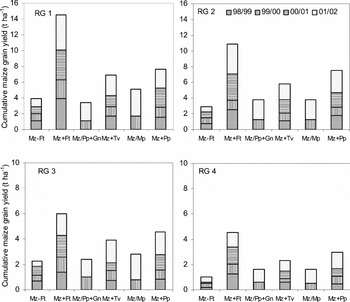
Maize grain yield (t ha−1) from legume-maize mother trials in Chisepo, Malawi from 1998 to 2002.

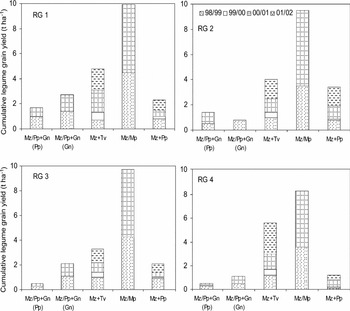
Legume grain yield (t ha−1) from legume-maize mother plots in Chisepo, Malawi from 1998 to 2002.

Maize productivity
Cumulative maize grain yields from mother trials over four years (Figure 2) were greater in those experiments located on RG 1 and 2 farms and less for RGs 3 and 4. In all the groups, Mz+Ft significantly (p < 0.001) outperformed all the other treatments with the highest cumulative grain yield of over 14 t ha−1 in RG 1. The response of maize to fertilizer in mother and baby plots showed a similar trend, although baby plots (15.2 t ha−1 for RG 1 and 5 t ha−1 for RG 4) had slightly higher cumulative maize grain yields than mother plots (14.5 t ha−1 for RG 1 and 4.6 t ha−1 for RG 4). Maize grain yield ranged from 0.9 t ha−1 in the second year for RG 1 and 0.1 t ha−1 in the third year for RG 4 without fertilizer to 4.4 t ha−1 in RG 1 and 1.3 t ha−1 in RG 4 with fertilizer (both in the fourth year). All treatments gave lower maize yields in the second year when there was poor rainfall (Figure 1). The growing season of 2001/02 experienced good rainfall and that was reflected in large yields and responses of maize to legumes and fertilizer. Maize intercropped with pigeonpea or tephrosia gave greater cumulative yields than maize in rotation with mucuna or the pigeonpea/groundnut intercrop. In general, maize grain yields in mother plots improved with the introduction of legumes by between 0.2 and 4 t ha−1, in comparison with yields from the Mz -Ft treatment.
Cumulative maize yields from baby trials displayed a similar pattern. The maize grain yields in baby plots improved with the introduction of legumes from 0.1 to 2 t ha−1. Maize yields from the fertilized baby plots were similar to those in mother plots. Farmers were generally pleased with the performance of maize in their baby plots in the final year of experimentation after being grown with legumes and fertilizer.
Legume productivity
Groundnut and pigeonpea in the Mz/Pp+Gn treatment in mother and baby plots were harvested separately, and grain yields are shown separately (Figure 3). Both groundnut and pigeonpea yielded poorly in all treatments in all years. The largest yield of groundnut was 1.2 t ha−1 grain in the mother plots of the RG 1 farmers in the first year and 1.4 t ha−1 in the first year from RG 1 in baby plots. The largest yield of pigeonpea (1.5 t ha−1 grain) in mother plots was found with RG 2 in the fourth year and 1.8 t ha−1 in baby plots of RG 1 farmers in the first year. Yields of the green manure legumes were larger, with tephrosia achieving almost 3 t ha−1 in plots of the RG 4 farmers in the last year, and mucuna yielding up to 6 t ha−1 of grain in the third year. Both tephrosia and pigeonpea yielded little grain in the second (dry) year. Overall, the legumes yielded most grain in the plots of the RG 1 farmers, followed by RG 2 and least with the RG 4 farmers. Cumulative grain yields were greatest in Mz/Mp (about 10 t ha−1) for RG 1 and poorest in the RG 4 farmers’ plots. Pigeonpea yields in RG 2 were higher than RG 1 whose yields were almost the same as RG 3. Pigeonpea yielded less in all cases than groundnut in the mixed legume treatment. There was no yield of groundnut for RG 2 in the third season because of theft of grain and animal damage. The total grain yield across the two legumes, however, in these treatments was more than with Mz+Pp alone.
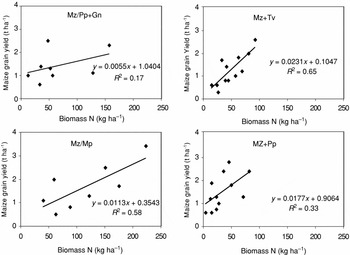
Biomass N from the legumes ranged from 12 to 223 kg N ha−1 (Figure 4). Maize grain yields without fertilizer (that ranged from 0.6 to 3.4 t ha−1) in the year after legume biomass incorporation was correlated positively with the amount of incorporated biomass N in the previous season. Mz+Tv and Mz/Mp had a higher correlation and greater response of maize yield to legume N inputs than Mz/Pp+Gn and Mz+Pp.
Maize grain yield (t ha−1) response to biomass N (kg ha−1) incorporated in farmers’ fields in Chisepo, Malawi from 1998 to 2002.

The RGs selected different legumes for evaluation in the baby trials. Farmers of RG 1 and RG 2 expressed most interest in growing Mz/Mp and Mz+Pp based on their experiences with the baby trials. RG 4 farmers preferred growing Mz+Pp to other maize-legume combinations. RG 1 and RG 2 farmers mainly selected Mz/Mp, Mz+Pp and Mz+Tv from their mother trials to test in their non-experimental plots outside baby trials. RG 3 farmers selected Mz+Pp and Mz/Pp+Gn, and RG 4 farmers preferred Mz+Pp for testing.
Legume yields from baby trials showed little difference from the mother trials. Mz/Mp and Mz+Pp legume grain yields for RG 1 were 0.6 and 1 t ha−1 more than in the mother trials in the first year. Cumulative yield over the four years was 0.5 t ha−1 smaller for Mz/Mp, and 3.3 t ha−1 more than in the mother trials for the same RG. Cumulative legume grain yields for Mz+Tv and Mz/Pp+Gn in baby plots were 0.9 and 0.8 t ha−1 smaller, respectively, than in mother plots. Cumulative legume grain yields from baby plots for RG 4 were the same at 1.2 t ha−1 for Mz+Pp and 0.4 t ha−1 for Mz/Pp+Gn. Mz/Mp and Mz+Tv were 2.6 and 2.1 t ha−1 less than in the mother plots for the same RG.
Riskiness of the technologies
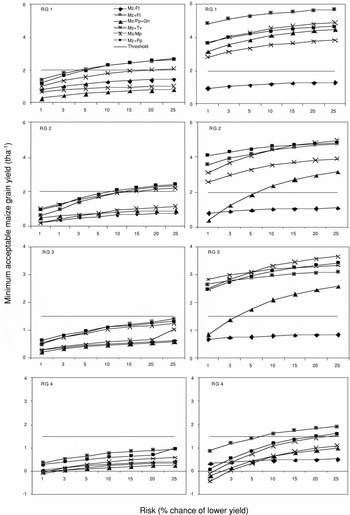
The risks associated with the legume technologies and farmer vulnerability were analysed by comparing the yields obtained from mother trials with the minimum acceptable yield and risk factors for each farmer RG. Minimum acceptable yield limits or confidence yield limits were established and adjusted to reflect consumption and distress sale of maize by farmers. RG 1 and RG 2 had minimum confidence yield limits of 2 t ha−1, while 1.5 t ha−1 was adjusted from 1.3 t ha−1 for RG 3 and 4 to take into account distress sale of maize for immediate cash needs and consumption. The risk probability (%) for Mz+Pp, which crossed the threshold line at p = 0.05, means that a farmer using this technology in RG 1 could expect a yield below 2 t ha−1 once in 20 years. For RG 1 farmers, three of the maize-legume technologies (Mz+Ft, Mz+Pp and Mz+Tv) had lower frequencies of risk occurrence (Figure 5) than other technologies. Mz+Ft crossed the threshold line for minimum acceptable yield at p = 0.04 and Mz+Tv at p = 0.17. Mz+Pp had the least frequency of risk occurrence of the legume treatments for the better-resourced RG 1. A similar frequency of riskiness was observed in RG 2 where Mz+Pp, Mz+Ft and Mz+Tv were equivalent in yield (Figure 5). Mz+Pp crossed the threshold line at p = 0.075, Mz+Ft at p = 0.1 and Mz+Tv at p = 0.12. Other technologies had a high frequency of risk occurrence for RG 2 where none of them crossed the threshold line. When 35 kg N ha−1 fertilizer was applied to the treatments, Mz+Ft, Mz+Pp, Mz+Tv, Mz/Pp+Gn and Mz/Mp had a lower frequency of risk at both p = 0.05 and p = 0.25. Mz/Pp+Gn crossed the threshold line at p = 0.07 and had a lower frequency of risk. With those technologies combining legumes with N fertilizer, the expected risk of yields less than 2 t ha−1 was reduced to below 1%.
Minimum acceptable maize grain yield (t ha−1) at different levels of risk (probability of occurrence) in Chisepo, Malawi. The left column shows level of risk as influenced by legumes only while the right column shows level of risk as influenced by legume added together with 35 kg N ha−1.

Considering the minimum acceptable yield of 1.5 t ha−1 for RG 3 and RG 4, all the treatments gave far below the threshold yield. All the treatments had a high frequency of risk occurrence for members of RG 3, but relatively better than for RG 4 whose yields were constantly below 1 t ha−1. However, RG 3 and 4 farmers were still able to benefit from fertilizer. With RG 3, when fertilizer was applied to the treatments, all except Mz−Ft became less risky at varying probabilities. Mz+Ft, Mz+Tv, Mz+Pp and Mz/Mp had low frequencies of risk occurrence at both probability intervals while Mz/Pp+Gn crossed the threshold line and became not risky at p = 0.04. Mz+Pp and Mz+Tv became equivalent in yield and least risky at p = 0.25 and p = 0.05. Results for RG 4 were no better in terms of riskiness. None of the treatments gave yields closer to the threshold yield of 1.5 t ha−1 with legumes alone. When 35 kg N ha−1 was applied, Mz+Ft, Mz+Pp and Mz/Mp became less risky at p = 0.25. Mz+Ft crossed the threshold line and had a lower risk frequency at p = 0.07, Mz+Pp at p = 0.175 and Mz/Mp at p = 0.20.
Economic performance and recommended technologies
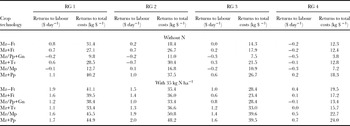
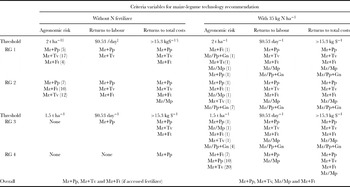
Financial returns were highest when 35 kg N ha−1 fertilizer was used with maize in combination with legume biomass in all the RGs (Table 3). RG 1 had the highest returns while RG 4 had least. Market returns to labour and total variable costs showed the same trend but varied from one resource group to the other. Mz+Pp intercrop had consistent positive returns across the farmer RGs indicating its suitability to a wide range of environments and for the poorer farmers. The rotation systems were variable, with more-negative returns in the less well-resourced groups.
Economic risk assessment of legume-maize technologies for four resource groups (RG) of smallholder farmers in Chisepo, Malawi; without N fertilizer and with 35 kg N ha−1 applied.

Table 4 proposes maize-legume technology (with and without fertilizer) recommendations for the RGs. Mz+Pp and Mz+Tv were observed to meet almost all the criteria for RG 1 and 2 with or without N fertilizer. In addition, Mz/Mp and Mz/Pp+Gn met the criteria only when N fertilizer was applied. For RG 3 and 4, Mz+Pp and Mz+Tv met some of the criteria for recommendation without N fertilizer. The application of N fertilizer to maize-legume combinations made almost all technologies meet the criteria for recommendation to RG 3 and 4. Thus the Mz+Pp technology met many of the evaluation criteria for RGs, suggesting it is suitable for widespread use in Central Malawi.
Legume-maize technology recommendations based on yield level risk and returns to the farmers in Chisepo, Malawi from 1998 to 2002.

† Used in risk analysis as the minimum maize required for the RG 1 and RG 2 farmers.
‡ Minimum agricultural wage rate for Malawi. Returns to labour should exceed the minimum agricultural wage rate.
§Assuming the total returns are invested to obtain minimum maize requirement of 2 t ha−1 for the household, then needs not less than 15.3 kg for every dollar investment to meet the goal.
Figures in brackets are probability level of risk.
DISCUSSION
Maize production and risks
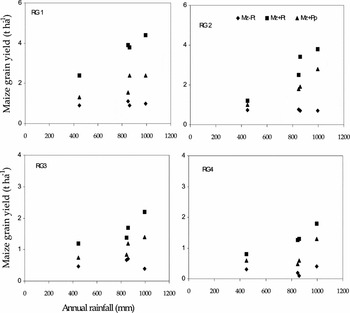
Both seasonal variation in rainfall and differences in previous field management and soil fertility are likely reasons for differences in technology performance between RGs. With low rainfall the maize grain yield from the soil fertility technologies was poor and the yields increased with higher rainfall (Figure 6).
Relationship between maize grain yield (t ha−1) from mother trials and annual rainfall at Chisepo, Malawi from 1998 to 2002.

Maize yields increased when legumes were integrated in the crop system. Maize yield response was better with normal rainfall and in the better-resourced groups (Figure 6). Maize grain yields were consistently poor on control plots (Mz−Ft) and best with N fertilizer, while maize yields in maize-legume mixtures were intermediate in all the RGs.
Differences in field management between better-resourced and poorly resourced households before the experiment probably contributed to the yield variations. Low yields in less well-resourced groups was likely associated with previous continuous cropping of fields without adequate soil fertility inputs thus reducing their inherent soil fertility (Kumwenda et al., Reference Kumwenda, Waddington, Snapp, Jones, Blackie, Byerlee and Eicher1997). RG 3 and RG 4 farmers had a long history of using less fertilizer and less labour in their own agriculture and more interest in off-farm income generation activity (see Table 2; Kamanga, Reference Kamanga2002). Additionally, our soil analysis results showed their fields contained less N, soil organic matter and P (Table 1). The findings of this study on maize grain yield increments with legume biomass incorporation confirm the findings of earlier studies on maize-legume interactions (e.g. Waddington et al., Reference Waddington, Sakala and Mekuria2004).
Bringing vulnerability analysis to technology assessment helps fit technologies to different classes of farmers. In our study, most of the maize-legume technologies were less risky for the better-resourced farmers. Maize-legume technologies alone were risky to RG 3 and RG 4 and made poor farmers more vulnerable to maize food shortage. Better-resourced farmers had the capacity to maintain the fertility of their fields while less well-resourced farmers did not (Kamanga, Reference Kamanga2002), and that might have contributed to the yield variations and the risks the technologies gave them. In this case, legume-maize technologies that give low maize yields may actually increase vulnerability for poorly resourced farmers in RG 3 and RG 4 while the better-resourced farmers with higher yields are less vulnerable. The low yields and high frequency of risk experienced by the least resourced groups may indicate the difficulties those farmers have to realise better maize yields by just integrating legumes in their fields for soil fertility.
Legume grain, biomass production and soil fertility
Legumes were incorporated into the maize cropping combinations assessed here as a strategy to increase overall crop yields, crop diversity and the stability of crop production. Farmer choices of the legumes studied here were based on their desire to experiment on how best to use the legumes to improve their maize yields. Farmers were especially keen to test Mz+Pp, Mz+Tv and Mz/Mp in baby trials on their farms. RG 3 and 4 farmers were happy with Mz+Pp, RG 1 and 2 with Mz+Pp and Mz/Mp. Apart from mucuna, all the legumes had low grain yields. These probably resulted from poor and variable management of legumes in the field, especially in RG 3 and RG 4, and lack of adequate residual moisture in the case of pigeonpea after maize harvest. Pests such as pod sucking bugs (Nezara viridula) and pod borers (Helicoverpa armigera) also contributed to the low legume yields during the four years. Reports of theft of legume grain, especially in the third year, contributed somewhat to low yields.
Legume grain offers important food and income benefits to farmers, including fortifying their diets with protein (e.g. from pigeonpea and groundnut). Mucuna gave higher yields because of its high yield potential, good adaptability to poor soils and resistance to pest attack. Mucuna is considered a ‘hunger crop’ in Malawi and farmers mentioned its use for food during the 2001/02 famine when it saved the lives of many people in Chisepo. Generally in Malawi the use of mucuna grain as human food is associated with poverty, although in areas of southern Malawi where this crop is more of a traditional food, the grain is marketable. Where markets are available, farmers easily integrate legumes in cropping systems especially when legumes are a marketable commodity, not grown only for soil fertility. A deliberate policy to develop formal markets for legumes from smallholder farming would help three-fold by improving soil fertility, income and food fortification.
Effective use of legumes to improve soil fertility depends on the amount of biomass produced and the amount of N2 fixed (Giller, Reference Giller2001). As a rule of thumb, legumes have to produce at least 2 t ha−1 of dry matter biomass that provides about 50–60 kg N ha−1 to show measurable impact on maize yield. The positive response of maize to retained biomass in Figure 4 may indicate that most of the legumes were able to supply adequate biomass N over the years. Unlike pigeonpea and groundnut, little biomass of mucuna and tephrosia was grazed by livestock and so more biomass returned into the soil. Thus, although the accumulation of residual nutrients through use of legumes is a slow process (Giller, Reference Giller2001), continuous use of legumes has additive effects on soil fertility (Shepherd et al., Reference Shepherd, Ndufa, Ohlsson, Sjogren and Swinkels1997).
Economic performance, risks and technology recommendations
The risks of technologies as identified by the calculation of lower confidence limits (minimum acceptable yield) assist in technology choice for integration in farmers’ fields. From an agronomic perspective the domain for technologies in each resource group was identified based on their vulnerability and riskiness. The economic analysis furthered the assessment by incorporating costs of inputs used, labour and land in producing the crops. Results showed that some technologies recommended to RGs based on the lower risk (lower confidence levels) were not viable when costs of inputs were factored in (Table 4). Mz+Pp, Mz+Tv and Mz+Ft were all recommended for RG 1 when analysis was based solely on lower confidence limits, but when returns to land and labour were used Mz+Pp became the most attractive technology. This was the same with RG 2 where Mz+Pp and Mz+Tv satisfied most of the criteria. For the poorest farmers (those in RG 4), no technology was chosen because none met the minimum food requirement. However, considering returns to labour, Mz+Pp was found to be suitable also for both RG 3 and RG 4. Mz+Pp was the only maize-legume technology assessed suitable for all the RGs, albeit using different criteria for assessing its suitability.
Returns to labour is an important criterion for most farmers in Malawi, especially the less well-resourced farmers from RG 3 and RG 4. Since they get inadequate yields from their fields, these poorer farmers self their labour to other farmers (known as ganyu) to supplement food supplies and income. Mz+Pp has been shown here to be one such agricultural technology that less well-resourced farmers could rely on. It has high stable yields and good returns on small land areas.
Better-resourced farmers have several options. In addition to Mz+Ft, we recommend Mz+Pp, Mz+Tv and Mz/Mp for farmers in RG 1 and RG 2. Farmers in these groups have a high probability of purchasing inputs such as fertilizer and hiring in labour for timely farm operations. They also tend to have more land and may be able to afford to practice crop rotation. For less well-resourced farmers in RG 3 and RG 4, Mz+Pp is recommended. In cases where less well-resourced farmers access fertilizer either through public work programmes or through charitable organizations, the fertilizer would be more profitably used in the longer term in a maize-legume cropping system involving pigeonpea than on short-term sole-crop maize.
CONCLUSIONS
New maize-legume technologies bring more risks to less well-resourced farmers than to better-resourced farmers. Better-resourced farmers in central Malawi had larger maize grain yields than less well-resourced farmers. As often reported, use of N fertilizer is the most rapid way to increase maize yields but is suitable only for better-resourced households. The integration of legumes in maize-based systems reduces the level of risk to farmers compared with continuous maize without fertilizer, and contributes to improvement of soil fertility. In assessing crop technologies for farmer suitability or recommendations, a combination of agronomic and economic criteria provides useful insights. An agronomic risk assessment showed that maize with N fertilizer is least risky to farmers, the inclusion of costs of inputs at current retail prices in the risk analysis showed that it was still risky to farmers. We recommend a maize + pigeonpea intercrop for soil fertility and maize yield improvement for most poorly resourced farmers in Chisepo and similar areas of central Malawi. Continuous use of legumes such as pigeonpea in maize systems should be encouraged in smallholder agriculture. Long-term policy support is needed in central Malawi to help the poorer farmers to access seed of food legumes (especially pigeonpea) as well as N fertilizer for maize.
Acknowledgements
We thank the farmers of Chisepo for their interest in the work and co-operation in conducting the field experiments. Larry Harrington, former director of the CIMMYT Natural Resources Group, helped guide the project. The Rockefeller Foundation Food Security Program and the Australian Centre for International Agricultural Research (through the CIMMYT Risk Management Project in Malawi) funded this research.