

Racial disparities and climatological disasters are complex topics rarely addressed in K-12 curricula. It can be argued that each topic has long been neglected in the K-12 classroom vis-à-vis a pedagogy that has either lagged behind contemporary issues or has intentionally sidestepped the importance of addressing these themes through legal and policy mechanisms that limit educators’ ability to discuss each topic. However, when it comes to students and communities of color in the U.S. who are unequally vulnerable to and affected by the impacts of climate change, it is a significant disservice not to provide fundamental learning opportunities that allow students to engage and contribute to the discourse surrounding the most pressing issues of our time, exacerbated inequalities and climate change; let alone the intersection of the two. Our initial effort in designing a curriculum to address this multifaceted gap in education stemmed from forming an interdisciplinary team funded by the National Science Foundation’s Research Experiences for Undergraduates and Educators. By design, our team was created to reduce inequality in research opportunities provided to aspiring researchers of underrepresented communities in academia. As part of this program, the National Center for Disaster Preparedness of the Climate School at Columbia University welcomed an undergraduate student and two K-12 educators to research and create a curriculum on the intersection of racial inequality and climatological disasters. We intended to support educators and administrators in implementing pedagogy around these topics conducive to curriculum standards and developed for students in grades 8-12. These grade levels were selected based on the research team’s familiarity with this grade range, project scope, and the assumption that students in grades 8-12 would best be able to synthesize the two topics. However, it is essential to note that further work is equally critical for grades that precede 8-12. Our guiding research question was, “How can the racial inequalities of disaster vulnerability and recovery be addressed in the classroom effectively to build a comprehensive knowledge base, to educate and empower a generation of students who will experience considerably more climatological disasters in the future?
By pursuing this research question and leveraging the ADDIE (Analysis, Design, Development, Implementation, Evaluation) model of curriculum design, we equipped students, educators, and their families with a curriculum to generate effective disaster preparedness and awareness as well as to provide critical attention to the longstanding consequences of disaster-related inequities. As part of the ADDIE model, our team conducted a needs assessment with current teachers in the analysis stage to better understand gaps in content and barriers to implementation. In addition, our curriculum design was grounded in the work of Paulo Freire’s thematic investigation, which posits a common striving toward awareness of reality and self-awareness through an educational process aimed at liberation.Reference Freire 1 Liberation education is rooted in empowering learners to take ownership of their thinking by critically discussing thought processes and views of the world, which positions education as a constant unveiling of reality and the practice of freedom.Reference Freire 1
Background
A growing body of literature has brought the trend of inequalities exposed by disasters to the forefront. Youth are often the bellwethers of disasters as their lives become entirely disrupted by a given event and may lead to indirect traumas carried with them and their families throughout life.Reference Abramson, Park and Stehling-Ariza 2 There are more questions than answers in the immediate aftermath of a disaster event. The institutions that youth depend on for answers are often equally inundated with questions about their own recovery. In this case, youth become a critical group to engage with before, during, and after a disaster.
Experiencing trauma in childhood, which can include experiencing a climatological or human-caused disaster, increases the risk of impairments in emotional, behavioral, social, and academic functioning.Reference Perfect, Turley and Carlson 15 , Reference Porche, Costello and Rosen-Reynoso 16 The U.S. Substance Abuse and Mental Health Services Administration (SAMHSA) has advocated for schools and other public institutions to take a trauma-informed approach to care for trauma survivors and prevent additional trauma. 14 Additionally, researchers have highlighted the importance of school-based interventions for promoting disaster risk reduction and psychological resilience in youth and children.Reference Wisner, Paton and Alisic 3
By failing to address the needs of youth, particularly their preparedness for and ability to cope with climatological disasters, we are at risk of the continued perpetuation of inequality in youth outcomes across academic, social, behavioral, and economic dimensions.Reference Bigelow and Dankbar 4 This project aimed to inform students of disaster-related challenges that marginalized individuals and people of color in the U.S. experience and provide opportunities for increasing knowledge and disaster preparedness among learners and educators.
When shifting the focal point of change from individuals to the critical structural foundations of inequality that limit life chances and the well-being of young people, significant work in the classroom must be done to dislodge the deep roots of inequality of disasters and disaster recovery. After engaging the extant literature on both the causes and consequences of inequality in the disaster recovery space, it is apparent that the depth of these roots is extensive.
The inequality in how Americans experience and recover from specific natural hazards has been well-researched and documented.Reference Elliott and Pais 5 -Reference Fussell and Harris 7 More recently, researchers have used large data sets to identify broad trends across states to understand if inequalities from natural hazards are experienced similarly in different regions. Howell and ElliottReference Howell and Elliott 8 used Panel Study of Income Dynamics data on the wealth of over 3000 American households from 1999 to 2013 to understand how natural hazards like floods, fires, and hurricanes impact overall financial well-being. They found that as the amount of damage to a local area increases, so does wealth inequality, noting, “especially along the lines of race, education, and homeownership.”Reference Howell and Elliott 8 (p.450) Most importantly, they find that as federal disaster aid to an area increases, so does this wealth inequality. Their results highlight the importance of connecting “two defining social problems of our day - wealth inequality and rising natural hazard damage.”Reference Howell and Elliott 8 (p.464)
At each stage of the recovery process, communities of color are susceptible to significant hurdles. Racial bias is known to be a factor in an individual or family’s ability to secure housing after a disaster.Reference Sovacool, Tan-Mullins and Abrahamse 9 In the case of Hurricane Katrina in New Orleans, 47 percent of African Americans could not return to New Orleans compared to only 19 percent of white households.Reference Bullard, Race, Bullard and Wright 10
There is considerably less literature on the pedagogical implications of teaching and learning racial inequalities and disasters. However, existing literature underlines educators’ challenges in incorporating new emergent topics and social issues into a highly standardized K-12 curriculum. Costigan and CroccoReference Crocco and Costigan 11 expand the definition of the phrase “narrowing of the curriculum” to describe not only the lost time in science and social studies in schools due to emphasis on accountability but also to include the limits of pedagogical options due to the heavily prescribed curriculum. Despite the challenges involved in the narrowing of curriculum, earlier research from CostiganReference Costigan 12 found new teachers to be remarkably resilient in exploring ways to deal with teaching in the age of accountability.
Regarding teaching racial equity and justice in the classroom, ShahReference Shah 13 offers recommendations based on a review of the past 10 to 15 years of research on teaching and teacher education. The recommendations include developing robust measures of racially equitable and just teaching, explicitly naming and focusing on race and specific types of racism, building infrastructure for race-focused teacher education, and clarifying definitions and goals for “racial equity” and “racial justice.” Importantly, Shah underpins the role of the teacher as the most direct and frequent touchpoint between Black, Indigenous, and other People of Color (BIPOC) students and the U.S. education system. In turn, how teachers approach teaching bears an influence on whether anti-blackness, color evasiveness, and other forms of racism are addressed or amplified.Reference Shah 13
Survey Methods and Findings
To gain insights into the perspectives of K-12 teachers regarding the inclusion of racial inequality, disasters, and climate change in their classrooms, a survey was conducted among 45 teachers. Approximately 70% of the participants reported teaching grades 10 and above, while the remaining teachers covered lower grade levels.
When asked about teaching racial inequality in the classroom, the survey revealed that 17.8% of the teachers strongly agreed, and 37.8% agreed that they currently teach about racial inequality in the classroom. However, a significant portion, 25%, indicated that they do not currently teach about racial inequality.
Regarding the availability of appropriate curriculum materials to teach about racial inequality, only 22% of the teachers agreed that they had sufficient resources. Most respondents expressed inadequate materials, indicating the need for more comprehensive and accessible resources. Regarding teaching about disasters, 66% of the surveyed teachers confirmed that they covered this topic in their classrooms. However, only 30% believed there is currently enough curriculum material available to teach about disasters effectively. The preliminary needs assessment suggests a potential gap in the resources and materials dedicated to disaster education.
In the context of climate change, 53% of the teachers stated that they teach about this subject. However, only 35% believed that there was enough curriculum material available to educate students about climate change effectively. This finding highlights the need for improved access to comprehensive and engaging curriculum materials on climate change. Moreover, when asked about discussing the relationship between disasters and inequality in the classroom, only 23% of the teachers agreed on the importance of incorporating this aspect into their teaching, while 44% disagreed. This finding suggests that there may be a need for more awareness or understanding regarding the connection between disasters and social inequalities.
Interestingly, when asked if educators would use a new curriculum focused explicitly on disasters and racial inequality, 57.8% of the teachers responded positively, while 35% were unsure. Some teachers expressed concerns about integrating these topics into subjects like math or physical education, indicating a need for clear guidelines and examples on how to incorporate the intersection of these topics effectively. The survey also provided insights into the challenges teachers face concerning state standards and the availability of classroom resources. Some teachers expressed frustration with the vagueness of state standards, particularly in world language classes, making it challenging to find appropriate content for language learning to address broader issues. Additionally, limited classroom budgets posed barriers to accessing and utilizing necessary materials for teaching about these topics.
Overall, the survey findings highlight the need for comprehensive curriculum materials and professional development opportunities to effectively support teachers in addressing racial inequality, disasters, and climate change in their classrooms.
Implications for the Classroom
Building upon our needs assessment survey findings, it becomes evident that addressing disaster-related inequities in the classroom requires practical and comprehensive approaches. While the literature on disaster-related inequality is substantial, more progress has yet to be made in practical contributions to address these issues head-on in the classroom. Our curriculum intended to develop a practical classroom-based tool to enhance education and awareness-building on racial disparities within the context of disaster science.
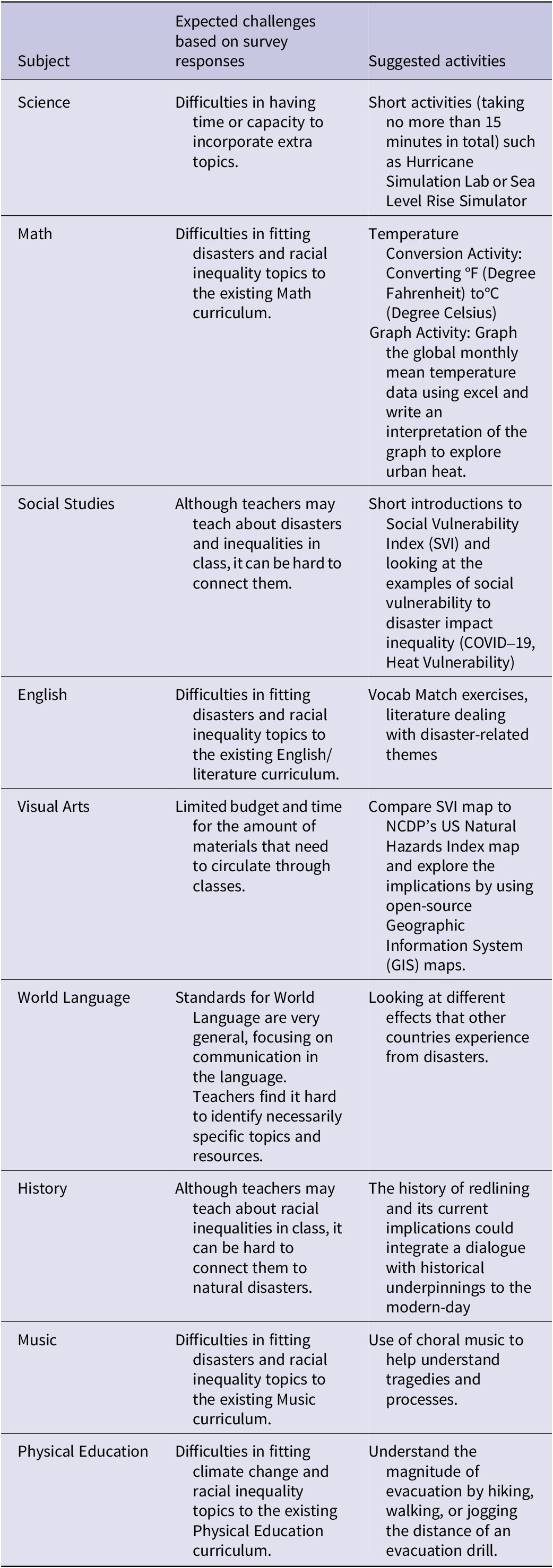
Our needs assessment indicated that many teachers do not have appropriate curriculum materials to teach about climate change and the relationship between disasters and inequality, even if they recognize the need to do so. If a disaster and inequality curriculum met grade and subject standards were available, our assessment indicates that teachers would plan for and have these conversations in classrooms. Further, there is a preference amongst teachers for multimodality pedagogy, including visual resources and activities, which can be combined with documentaries, guest speakers, and case studies to bring real-life examples to the classroom and allow for students and teachers to discuss disasters and racial inequalities in a more hands-on way. Importantly, our assessment included teachers from several different subject areas. Notably, each subject area within a school can be assumed to have its own expected challenges when integrating such a curriculum. Table 1 provides a summary of some common concerns to anticipate across subject areas and some recommendations for addressing them from our curriculum development work.
Expected challenges and example activities
At the outset and at the conclusion of our curriculum, teachers are provided with 2 conceptual surveys for students to fill out. A conceptual survey instead of a pre-test/post-test assessment will provide more insights to the educator on the class’s understanding, knowledge, values, and beliefs before and after embarking on teaching the intersectionality of what are assumed to be two new topics.
Currently, the curriculum materials have been developed and piloted with students in various instructional settings, primarily for students engaging in pre-college programs where some of the constraints noted as far as curriculum standards are much more flexible. The results of the needs assessment heavily guided the pilot curriculum. This work has impactful implications in both the classroom and research more broadly. Further directions in the classroom are to scale the curriculum and to make course materials widely accessible. As a continuation of this work, our team has proceeded to research practical ways in which the curriculum can align with standards across the country. Future research will benefit from closely understanding the experience of teachers. It is also worth noting that this project was only successful due to the integration of teachers from the initial phases. Future work should follow a similar model of combining research and teaching.
Summary of the Curriculum
Our culturally responsive curriculum aimed to reduce disparities by incorporating transdisciplinary modules. The teaching materials developed begin with an overview of existing climate change science and the relationship between climate change and more frequent and severe disasters. It then introduces the concept of social vulnerability and how socioeconomic factors influence the extent to which households recover from disasters. In addressing post-disaster outcomes, learning materials then elucidate how disasters exacerbate marginalization and inequalities during the recovery process and the challenges faced by individuals needing assistance, often associated with inequality within the federal aid process post-disaster. Finally, the curriculum invites both teachers and students to examine how inequalities are currently being addressed and provide ideas to prevent the exacerbation of inequalities connected to disasters at the community level. Students and educators are both encouraged through the curriculum to explore themes of climate (in)justice to elucidate the hegemonic inequality that exists in disaster recovery based on race, ethnicity, economic standing, language minority status, and/or immigrant origins.
Teaching materials include slides and activity guides on the following topic areas:
-
1. What is Climate Change and What are Disasters?
-
2. Climate Change & Disasters: A Focus on Inequality
-
3. Disasters Impact People Differently: Understanding Social Vulnerability
-
4. The Long-Term Effects of Disaster Recovery: Exacerbating Existing Social Inequality
-
5. Disaster Policy’s Role in Mitigating Inequality
-
6. What Comes Next?
-
7. Call to Action - Focusing on the Local Level
Teachers are encouraged to adapt slides based on available time, student readiness for the material, and resources.
Discussion
The overall objective of our curriculum is to reduce inequality, increase awareness, and improve the lives of young people and their families in the United States. However, achieving such an objective will require bridging several communities across research and education. Through a novel curriculum, our project contributes at the individual and systemic level at a critical juncture. However, it will take more than a curriculum to achieve the aims set out in our project. Additionally, it will require support across local communities to enable the timeless ingenuity of educators and administrators. Examples of the kind of support are span funding, resources for community-based education, support from state law and policymakers, technologies, mentorship, racial equity/justice-focused teacher preparation,Reference Costigan 12 and ultimately, the time and space for such a curriculum to be adequately covered.



