Introduction
Children begin to produce verbs early on, but typically produce just one form of each verb they attempt and build their inflectional paradigms only gradually. In this paper, we focus on the role of adult–child interaction, specifically on the role of adult responses to children's early verb productions, in order to see how they contribute to children's acquisition of verb inflections. To this end, we examined adult–child conversations in Hebrew, a richly inflected language that does not offer children any type of ‘base’ verb form (such as English talk, fall, etc.) as part of its inflectional paradigms. This allowed us to ask whether and how adults provide feedback on children's early verb use, and the extent to which information provided in such adult feedback is contingent on how much children know.
When adults talk to young children, they consistently check on what their children mean by what they say. This checking up often takes the form of reformulations in side-sequences where an adult offers an interpretation and waits for confirmation, often given by the child's repeating the corrected adult form, or by acknowledging the interpretation offered with yeah or uhuh (Chouinard & Clark, Reference Chouinard and Clark2003). That is, adults offer immediate feedback to children, ratifying an appropriate form from the child by repeating it, or offering a corrective, conventional form with question intonation to the child, as they check up on the intended meaning. Note that we use the term ‘construal’ in this paper to cover all adult responses that offer feedback that interprets the child's form using the same verb lexeme, in the next turn. Some immediate adult responses elaborating the same topic may also use the same lexeme but offer only positive feedback, as they do not interpret the child's production. Studies of the acquisition of French have shown that adults also take into account the context of use, and distinguish, for example, between anticipated versus completed events in offering feedback in response to indeterminate verb forms produced by young children (Clark & de Marneffe, Reference Clark and de Marneffe2012; see also Veneziano & Parisse Reference Veneziano and Parisse2010). In short, adults consistently produce conventional verb forms that fit the context as they check up on what their children mean by any non-conventional verb forms they produce.
The acquisition of verb inflections
Verb meanings are generally assumed to be harder to acquire than noun meanings, in part because of the transient nature of actions, which makes mapping meanings more difficult, and in part because verbs are relational terms that link the participants in specific events (Gentner, Reference Gentner1978; Gentner & Boroditsky, Reference Gentner, Boroditsky, Bowerman and Levinson2001). Furthermore, different languages package information about events differently. For example, some combine motion and manner, some motion and path, in motion-verb meanings (Göksun, Aktan-Erciyes, Hirsh-Pasek, & Golinkoff, Reference Göksun, Aktan-Erciyes, Hirsh-Pasek, Golinkoff, Nihan Ketrez, Küntay, Özçaliʂkan and Özyürek2017). In addition, verb paradigms typically encode a variety of distinctions for person, number, tense, aspect, mood, and voice. The complexity of verb paradigms may differ with language type, and with the number of distinctions made in the verb within a language.
Previous research has focused on the order in which children acquire inflections, and how consistent patterns of acquisition are across children (e.g., Brown, Reference Brown1973; de Villiers & de Villiers Reference de Villiers and de Villiers1973; Richards, Reference Richards1990; Rispoli, Hadley, & Holt, Reference Rispoli, Hadley and Holt2009, Reference Rispoli, Hadley and Holt2012; Xanthos & Gillis, Reference Xanthos and Gillis2010). Children typically begin with just one form for each verb, and produce that form for each event that ‘matches’ the verb meaning. For example, a child acquiring Spanish might start with cayó ‘3SG fall-PRET = he fell’, and then use cayó for every event of falling. When children add a second form for that same verb (e.g., caer ‘fall-INF = to fall’ or caído ‘fall-PP = fell’), they begin to identify some of the distinctions made on the verb stem (Rojas Nieto, Reference Rojas Nieto, Arnon and Clark2011). But constructing verb paradigms takes time (see, e.g., for Estonian: Vihman & Vija, Reference Vihman, Vija, Gagarina and Gülzow2006; for French: Bassano, Reference Bassano2000; Clark & de Marneffe, Reference Clark and de Marneffe2012; Veneziano & Clark, Reference Veneziano and Clark2016; for Hebrew: Ashkenazi, Ravid, & Gillis, Reference Ashkenazi, Ravid and Gillis2016; Berman, Reference Berman1978, Reference Berman1982; Lustigman, Reference Lustigman2012, Reference Lustigman2013; for Hungarian: MacWhinney, Reference MacWhinney1975; for Italian: Pizzuto & Caselli, Reference Pizzuto, Caselli and Levy1994; for Spanish: Gathercole, Sebastián, & Soto, Reference Gathercole, Sebastián and Soto1999; Rojas Nieto, Reference Rojas Nieto, Arnon and Clark2011; for Tzeltal: Brown, Reference Brown1998; for Tzotzil: de León, Reference de León1999a, Reference de León, Fox, Jurafsky and Michaelis1999b).
Hebrew verb inflections
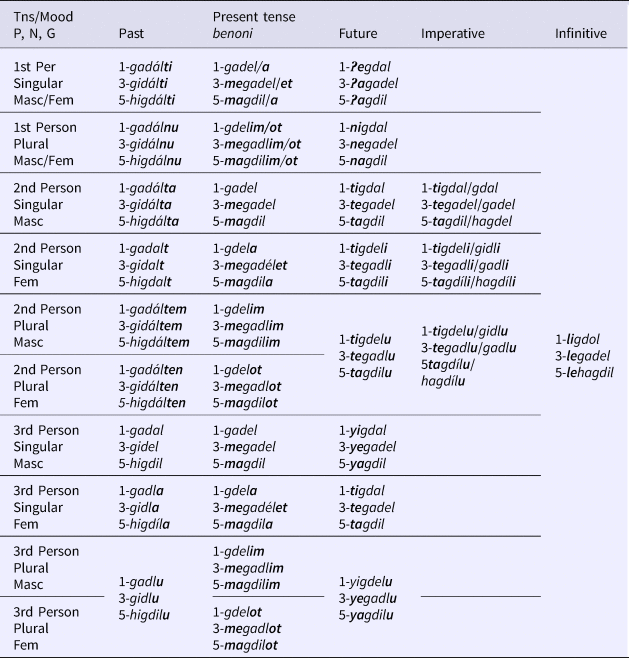
The Hebrew verb system is of particular interest for following children's transition to fully marked inflections as adults interpret their early verb uses, since it has a rich set of verb inflections (see Table 1) and lacks any clear base form for verbs (Berman, Reference Berman1978). Hebrew verbs are marked for five grammatical categories of Tense/Mood, but have no grammatical marking of Aspect (Berman & Lustigman, Reference Berman, Lustigman, Ball, Crystal and Fletcher2012; Berman & Neeman, Reference Berman, Neeman, Berman and Slobin1994). Infinitives are always marked with an initial prefixed l-; Imperatives are marked for 2nd Person, Number (singular/plural), and Gender (masculine/feminine); Past and Future Tense verbs are marked for 1st, 2nd, and 3rd Person, Number, and Gender; but Present-Tense benoni ‘intermediate’ verb forms are inflected only for Number and Gender (Berman, Reference Berman1978, Reference Berman1990). In addition, all verbs in Hebrew are assigned to one of the five binyan patterns, each with a restricted set of prosodic templates (Bat-El, Reference Bat-El and Shimron2002; Berman, Reference Berman1993). For example, the verb meaning ‘plant’ in the pa'al pattern (P1) has three different stems: Past Tense CaCaC (šatal), Present Tense CoCeC (šotel), and also the CCoC stem used for Future yištol, Imperative (ti)štol, and Infinitive lištol; while the verb meaning ‘talk’ is constructed in the pi'el pattern (P3) has only two stems: Past Tense CiCeC as in diber ‘talked’ versus the stem CaCeC in ledaber ‘to-talk’ medaber ‘is-talking, talks’, yedaber ‘will-talk’.
Tense/Mood Values of Verbs Based on the Consonants G-D-L in Three Binyan Patterns, Inflected for Number (N), Gender (G), and Person (P)

Note. The prefixed number on each verb form identifies the binyan. Non-final stress in Hebrew transliteration is marked with an accent aigu.
Table 1 illustrates these inflectional categories (inflectional affixes are bolded) for verbs formed with the consonantal root g-d-l in three high-frequency binyan patterns: P1 pa'al (Intransitive verb meaning ‘grow’), P3 pi'el (Transitive ‘raise’), and P5 hif'il (Causative ‘make-bigger, enlarge’).
As Table 1 shows, although inflectional affixes are consistent across different binyan patterns, different tense-related stem changes appear in different patterns. If, for example, we take 3rd Person Singular Feminine forms: in P3 and P5 (but not in P1), the Present- and Future-tense forms appear to share the same stem, and in P3 this stem is also shared with the infinitival form. P1 is characterized by more stem changes across tenses, although, as shown in Table 1, same-tense verbs often share a stem (all future forms, say), and for some verb lexemes, future tense stems are the same as the infinitival stem. For some P1 Singular Masculine forms, tense changes do not involve stem-external affixes, but are shown with a vocalic pattern change (e.g., Past gadal vs. Present gadel). It is clear, then, that the Hebrew verb system presents a number of challenges for children, not only in terms of the number of inflectional categories, but also in terms of the structural changes and stem–affix relations to be acquired. The present study investigates how these inflectional and structural features are reflected in adult responses to early child verb productions.
Previous research on the acquisition of Hebrew verb inflection has dealt with various properties of the domain, including children's initial verb forms (Berman, Reference Berman1978; Berman & Armon-Lotem, Reference Berman, Armon-Lotem and Martinot1997), with special attention to children's pervasive reliance on un-affixed ‘bare stems’ (Adam & Bat-El, Reference Adam, Bat-El, Gavarró and Freitas2008; Armon-Lotem & Berman, Reference Armon-Lotem and Berman2003; Lustigman, Reference Lustigman2012); the order and distribution of different inflectional categories (Armon-Lotem, Reference Armon-Lotem1996; Lustigman, Reference Lustigman2013); and individual differences in the course of acquisition (Bat-El, Reference Bat-El2012; Ravid, Reference Ravid1997). The present analyses add to previous findings by focusing on immediate adult responses to early Hebrew verb forms produced by young children, including the rates and nature of adult construals and elaborations, and the structural relations that hold between child and adult verb forms. Our goal is to see exactly what types of structural information are offered to children in immediate feedback to their verb productions, and whether, and how, the nature of this feedback changes as children produce more advanced verb forms.
In analyzing children's verbs, we distinguish between forms with a clear inflectional target (even if the child form is somewhat truncated, e.g., aflu for naflu ‘fell-3PL’) and those verb forms that are ambiguous or opaque, that could correspond to several target forms (e.g., the truncated stem pol that can have as its target lipol ‘to-fall, yipol ‘will-fall-3SG’, nipol ‘will-fall-1PL’, and more). Early opaque forms in children's speech have been well documented for Hebrew (Adam & Bat-El, Reference Adam, Bat-El, Gavarró and Freitas2008; Armon-Lotem & Berman, Reference Armon-Lotem and Berman2003; Lustigman, Reference Lustigman2012, Reference Lustigman2013, Reference Lustigman2015), as well as for other richly inflected languages. Opacity refers here to children's early production of linguistic forms that are ambiguous because their grammatical targets are not fully identifiable. These opaque forms contrast with transparent forms that are structurally unambiguous and so more readily interpretable, even out of context. Opacity, in the sense used here, is observable in much prior research on early child grammar. For example, in the acquisition of verb inflections in Italian, Pizzuto and Caselli (Reference Pizzuto, Caselli and Levy1994) observed children's extensive early reliance on unclassifiable verb forms and suggested that these were indicative of a degree of uncertainty in children's productions, and even in their knowledge at given points in development. Veneziano (Reference Veneziano1999) discussed children's early uses of ambiguous verb forms in French, where the verb system is pervaded with homophony. We will show not only that opacity characterizes many of the early verb forms children produce in Hebrew, but also that their adult interlocutors respond differently as the proportion of opacity in children's verbs decreases.
The goal of this study is to examine adult responses to children's early verb productions and how they affect, and are affected by, changes in children's usage. That is, based on the assumptions that adult–child conversations are central in language development, that adult interlocutors consistently expose children to the conventional forms in their language, and that they provide feedback about the forms children produce (e.g., Berman & Lustigman, Reference Berman, Lustigman, Arnon, Casillas, Kurumada and Estigarribia2014; Chouinard & Clark, Reference Chouinard and Clark2003; Clark & de Marneffe, Reference Clark and de Marneffe2012; de Villiers, Reference de Villiers1985; Farrar, Reference Farrar1990; Ravid et al., Reference Ravid, Ashkenazi, Levie, Ben Zadok, Grunwald, Bratslavsky, Gillis and Berman2016), we wished to establish how extensive and constructive immediate adult feedback on verb forms is, and the extent to which it is fine-tuned to children's level of development in production.
General predictions
Many early child verbs in Hebrew are opaque: one cannot tell what the child's target verb form is. Adults should reformulate such opaque uses, adding person, number, and tense as relevant in each context of use. We therefore predicted high rates of adult reformulation for opaque verb forms in children's early verb production. Adults who assigned an interpretation to children's opaque verb forms should supply conventional verb forms for the meanings apparently intended, including both completion of stem structure and addition of affixes to opaque, incomplete, verb forms. They should do this more frequently during the earlier months of verb use, but their overall rate of verb-form reformulation should later decline as children add inflections for person, number, and gender, as well as tense, to their verb forms.
Previous research has shown that infinitives and present tense forms, unlike past and future forms, are marked only for number and gender (but not person), and are the first to emerge in Hebrew. Such forms dominate children's early inflections in Hebrew for several months before they begin to add other inflections to their repertoire (Lustigman, Reference Lustigman2012, Reference Lustigman2013). We predicted that adult responses, whether reformulations or other types of construal, might also focus initially on infinitival and present tense forms of the verbs children produced, and adults only later present the children with a larger array of verb forms in their responses (see Bloom, Lifter, & Hafitz, Reference Bloom, Lifter and Hafitz1980).
Method
The analyses presented below are based on naturalistic longitudinal samples from four children acquiring Hebrew as their first language. Details of the database and our coding categories are described below.
The data
The data for the present analyses consist of longitudinal recordings from four children acquiring Hebrew: two girls – LI and RO, and two boys – SH and LE, aged from 1;3 to 2;5. All four children were from well-educated, middle-class families in central Israel. The children were audio-recorded for one hour per week in their home environment, in everyday interactions with their caregivers. Family members made all the recordings (the mother in the case of LI, and paternal aunts in the case of RO, SH, and LE). The data for SH and RO were collected in the Child Language Project of Bat-El and Adam, Tel Aviv University (ISF Research Grant #554/04); those for LI and LE are taken from the Child Language DataBase of the Berman lab at Tel Aviv University, a subset of which is available in the Berman corpus on CHILDES (https://childes.talkbank.org/browser/index.php?url=Other/Hebrew/). All child and adult utterances were transcribed in broad phonemic transcription following the CHILDES conventions (MacWhinney, Reference MacWhinney2005), as adapted in the Berman lab at Tel Aviv University to conform optimally to the non-Latinate orthography and contemporary pronunciation of Israeli Hebrew. The speech output of SH and RO was also transcribed phonetically and, where possible, a corresponding phonetic target form entered for each use. All four children's output was double-checked where necessary using the digitized database constructed of their auditory recordings.
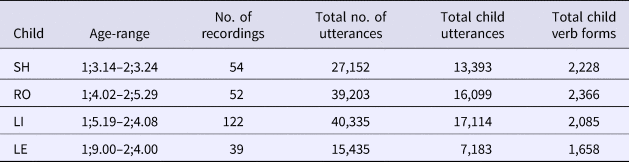
Data-analysis began with the earliest occurrences of forms identified as verbs in each child's speech, and continued up until the point where verb inflections no longer exhibited structural opacity in the sense specified below. We analyzed a total of 8,337 child utterances containing verbs. Table 2 gives the details for each child. ‘Total number of verbs’ refers to verb tokens, that is, to all occurrences of those verb forms in the children's speech, excluding only occasional repetitive use of a verb within the same utterance (e.g., tni li, tni li, tni li ‘give me, give me, give me’) that clearly did not involve initiation of a new utterance.
Database of the Study, by Age, Number of Sessions, Number of Utterances, and Total Number of Verbs, for Each Child

The numbers in Table 2 reflect the relative density of the database, as follows. SH and RO were recorded for one hour a week in a single session, following the traditions of child language sampling since the 1970s (Bloom, Reference Bloom1970; Brown, Reference Brown1973). Recordings of LI and LE were recorded for the same amount of time, with the one hour per week made up from two or three shorter stretches in each session. As shown in Table 2, despite the differences in how the recordings were made, the data for SH, RO, and LI all yielded around 2,000 utterances containing verbs during the period studied here. LE's dataset included a slightly smaller number of utterances since his recordings began only later, at age 1;9.
Coding categories
We coded all the children's verb forms and the immediate adult responses to them, using the categories described below.
Child verb forms
We analyzed all the children's utterances containing verbs. Each verb form was coded as either transparent or opaque, based on whether it had a clearly identifiable target form or not. Transparent verb forms were grammatically and lexically interpretable, whether adult-like or somewhat mispronounced. These were coded in relation to the corresponding target, or adult, form for the following five inflectional categories: Mood (Infinitive, Imperative), Tense (Past, Present, Future), Number (Singular, Plural), Gender (Masculine, Feminine), and Person (1st, 2nd, 3rd) (see Table 1 above). Opaque verb forms were defined as verb productions where the target form was unclear or ambiguous. Non-affixed bare stem forms were divided into three groups, the first two transparent and the third opaque: (i) forms that were clearly interpretable in relation to non-affixed masculine singular targets (e.g., šoméa ‘hears’, baxa ‘cried’); (ii) truncated verbs that, due to the unique infinitival forms of some verb lexemes, clearly corresponded only to an adult infinitival target (e.g., xol for le`exol ‘to-eat’, šon for lišon ‘to-sleep’); and (iii) truncated forms of target affixed verbs considered ‘opaque’ because they corresponded to more than one possible target. For example, the verb ber ‘talk’ is represented only by its root and binyan pattern value [d-b-r, P3], since its target could be the infinitive ledaber, present tense medaber, past diber, or future yedaber; or the verb takel ‘look’ [s-k-l, P4] where the target could be the infinitive lehistakel, present tense mistakel, past tense histakel, or future yistakel. Bare-stem forms in category (iii) may be both inflectionally and derivationally opaque. For example, the stem xec not only has several inflectional targets, it is also ambiguous between the transitive P1 lexeme roxec ‘wash’ and the reflexive P4 lexeme mitraxec ‘wash-oneself’ from the same consonantal root (i.e., either [r-x-c, P1] or [r-x-c, P4]). Opaque stems are typically non-adult-like, although a small number may correspond to adult imperatives, usually in P1 (e.g., zuz ‘move!’; šev ‘sit!’).
Strings were identified as opaque even where the child's intentions could be inferred from the linguistic or non-linguistic context. Take for example the child form in (1):
(1)


It is clear from the context of the utterance that the target of the child's string is metapes ‘climbing-SG-M’; however, this verb production was coded as inflectionally opaque, since the child's utterance pes in itself contains no structural cues to this particular adult target, rather than to any of the following: letapes ‘to-climb’, netapes ‘climbing-1PL-M’, yetapes ‘will-climb-SG-M’.
Other verb forms that exhibit structural opacity are the unanalyzed, rote-learned affixed forms that represent non-productive uses of inflectional marking. In distinguishing rote-learned forms from productive verb inflection (e.g., Bassano, Reference Bassano2000; Bowerman, Reference Bowerman and Slobin1985; MacWhinney, Reference MacWhinney1975; Vihman & Vija, Reference Vihman, Vija, Gagarina and Gülzow2006), we measured productivity in terms of the syntactic environment of the verb, rather than relying on purely quantitative measures (see, e.g., Bloom, Reference Bloom1991; Gathercole, Sebastián, & Soto, Reference Gathercole, Sebastián and Soto1999; Lieven, Reference Lieven2008; Pizzuto & Caselli, Reference Pizzuto, Caselli and Levy1994; Tomasello & Stahl, Reference Tomasello and Stahl2004). Our choice of a qualitative criterion here was motivated by the fact that, as Brown (Reference Brown1973) pointed out, quantitative accounts depend critically on the nature of the data collection and sample size, and so may vary from one linguistic category to another, even from one child to the next (see Rowland, Fletcher, & Freudenthal, Reference Rowland, Fletcher, Freudenthal and Behrens2008). They may also fail to take into account that non-productive expressions common in children's speech output at a given point tend to be associated with particular extralinguistic settings, while forms that are in fact productive are relatively infrequent when they first emerge. Although recent studies of the acquisition of tense and agreement have addressed these problems by filtering out repeated uses of frequent, and therefore potentially rote-learned, combinations (Hadley & Holt, Reference Hadley and Holt2006; Rispoli et al., Reference Rispoli, Hadley and Holt2009, Reference Rispoli, Hadley and Holt2012), quantitative criteria alone run the risk of either over- or under-estimating children's productive command of a given category (Richards, Reference Richards1990).
In the present study, our concern is not with the frequency of children's uses of affixes, but rather with change in their production with respect to inflectional affixes, reflected in the shift to use of inflected forms that are grammatically well motivated rather than simply rote-learned (Lustigman, Reference Lustigman2013). This context-sensitive criterion is adapted from Brown's (Reference Brown1973) ‘obligatory contexts’. Our measure of productivity, however, allows for the omission of required inflections during the early productive period. That is, even once productive inflection is identified, although children no longer rely on unanalyzed amalgams (i.e., rote-learned affixed forms), they may continue to use some bare stems where affixed forms are required – still omitting obligatory inflections.
The utterances in (2) illustrate uses of unanalyzed affixed child forms of verbs, clearly erroneous in Subject–Verb agreement, whether in the immediate linguistic environment (2a, 2d), or within the more distant situational and/or conversational context (2b and 2c), where the relevant context and adult form is specified in parentheses.
(2) Unanalyzed affixed forms produced by each of the four children

The criterion of productivity here is the appropriate use of verb inflections such that instances like those in (2) no longer appear in the child's speech. This qualitative criterion applies relatively independently of sample-size, since it does not count occurrences of verb lexemes with specific affixes nor does it measure correct against incorrect uses. It is particularly relevant to children acquiring Hebrew, who have no recourse to morphologically unmarked verb forms like English talk, go, sleep (that might appear grammatical in a range of syntactic environments), and who may go on producing child-like bare stems for a relatively long time.
To sum up, based on these coding categories, children's verb productions were divided into four types: opaque truncated stems with no clear inflectional targets, unanalyzed affixed forms, transparent truncated stems (with clear targets), and transparent (productive) affixed forms. We turn next to the types of adult responses to children's verb forms and the structural relations holding between child and adult productions.
Adult responses
All immediate adult responses to children's verb productions fell into one of the following categories:
A. Adult construals of the child's verb use – where the adult offers an interpretation or confirmation of the preceding child utterance, using the same verb lexeme. These could take the following forms:
1. Reformulations of incomplete forms produced by the child (with addition, change, or completion of stem or affix elements)
2. Repetitions of the verb produced by the child – typically a conventional, context-appropriate production by the child, but in very rare cases this included adult repetition of an incomplete non-conventional form.
3. Inflection shifts – where the adult confirms the verb form produced by the child by repeating the verb lexeme from a different inflectional perspective (e.g., person shift from 1P to 2P, say; or from present to past tense, etc.); these shifts almost exclusively followed conventionally inflected child forms.
B. Adult elaborations (same lexeme) – where the adult takes up the same verb lexeme in order to elaborate on the topic, but does not offer an interpretation of the preceding child utterance
C. Adult elaboration (different lexeme) – where the adult elaborates on the same topic with a different, semantically related, verb lexeme
D. Responding without mentioning the verb lexeme used by the child, or any other related verb lexeme
These adult response-types are illustrated in (3) below, with examples from the current data.
(3) Types of adult responses
(a) Construals containing the child's verb lexeme
• Reformulation of the child's form:
(b) Elaborations using the same lexeme
(c) Elaboration using a semantically and/or derivationally related verb lexeme
(d) Responding without mentioning the same verb lexeme or a related verb lexeme


Coding reliability was assessed on a randomly selected 8% of the total child utterances containing verbs – 651 of 8,337 utterances. These utterances were independently rated by a Hebrew-speaking linguistics graduate student who indicated what she took to be the possible target forms of the verbs, if any, and how grammatical each form was in the context provided. Inter-judge agreement with the first author was 97.7% (Krippendorf's Alpha = 0.93). Reliability in recording the onset of productive inflection was assessed by another Hebrew-speaking linguistics graduate student who independently identified, for each child, the recording session in which s/he stopped using rote-learned forms.
Results
The results of our study are presented below in terms of (1) the structure of the verb forms produced by the children; (2) the relations between the proportion of structural opacity in children's verb productions over time and the rates of immediate adult response (construals and elaborations) using the same verb lexeme; (3) the inflectional and structural diversity offered to children in the adult responses (construals and elaborations); and (4) the structural relations between each child production and the following adult response.
Structure of child verb forms
As noted above, all the children's verb productions fell into one of the following four categories, in terms of their structural composition and transparency:
• Opaque verb stems – truncated verb stems that correspond to several possible target forms so that their inflectional target is unclear
• Unanalyzed affixed forms – verbs that include inflectional affixes clearly rote-learned or amalgam-like and therefore not corresponding to a clear inflectional target for the context
• Transparent truncated stems – verb stems or parts of verb stems that have an unambiguous target
• Transparent affixed forms – well-formed verb forms that have a clear inflectional target form
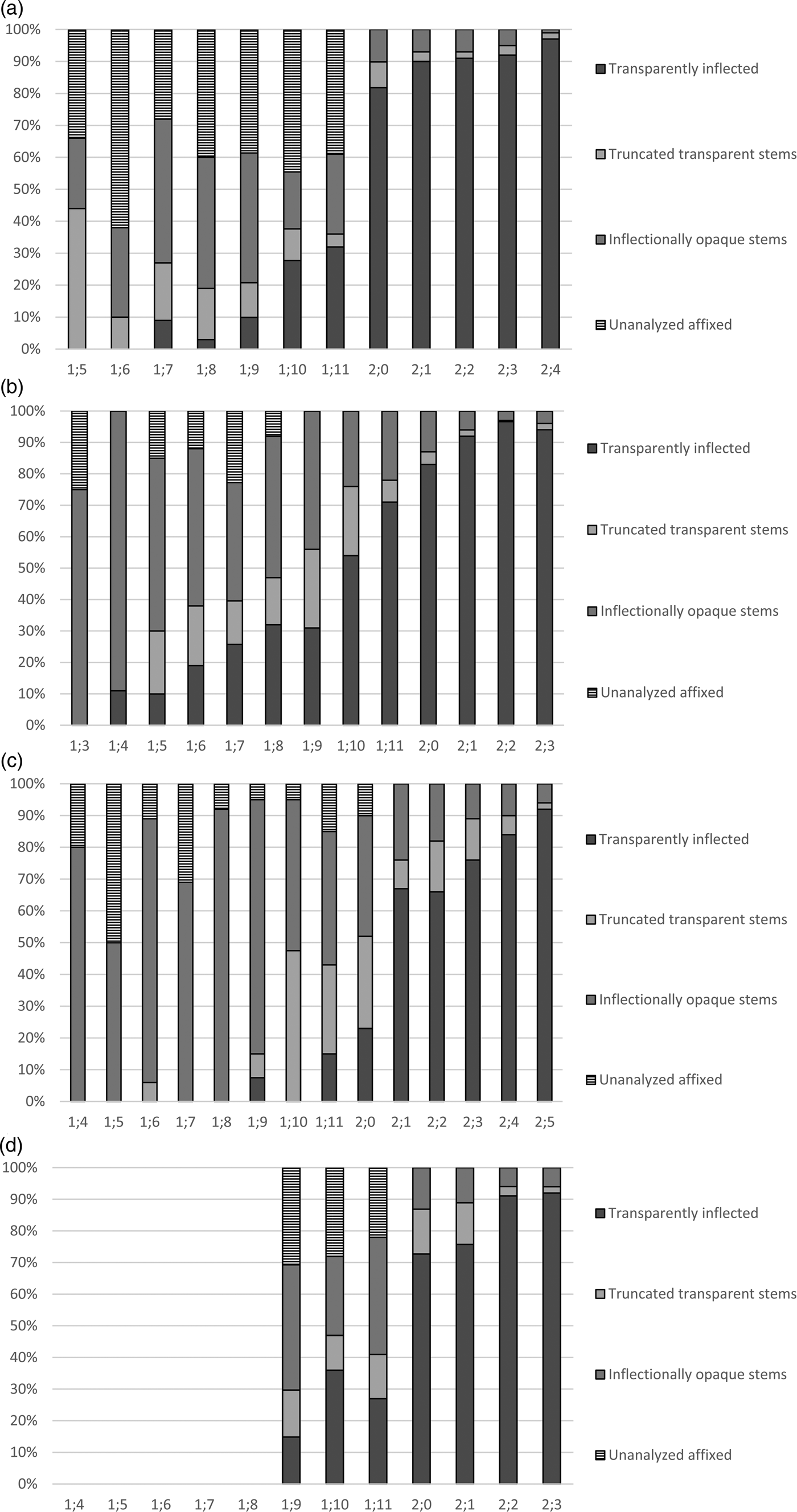
Figures 1a–d show the proportion of each of these structural verb types (opaque, unanalyzed affixed, truncated transparent, transparent) out of the total verb productions for each month, for each of the four children.
Proportion of types of verb productions per month for each child. (a) LI (N = 2,054), (b) SH (N = 2,205), (c) RO (N = 2,348) and (d) LE (N = 1,659).

Figures 1a–d show that each child gradually moves from pervasively opaque usage (in the form of opaque stems or unanalyzed affixed forms) to increasingly transparent use of inflected verb forms. It is also clear that each child abandons use of unanalyzed affixed forms at a certain point in time, with the emergence of productive inflection on their verbs (LI at age 2;0, SH at 1;9, RO at 2;1, and LE at 2;0). In the next section, we examine the relations between the decreasing percentages of children's opaque verb uses and the rates of adult responses, for both construals and elaborations.
Structural opacity and rates of adult responses
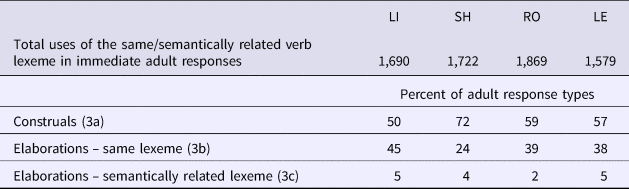
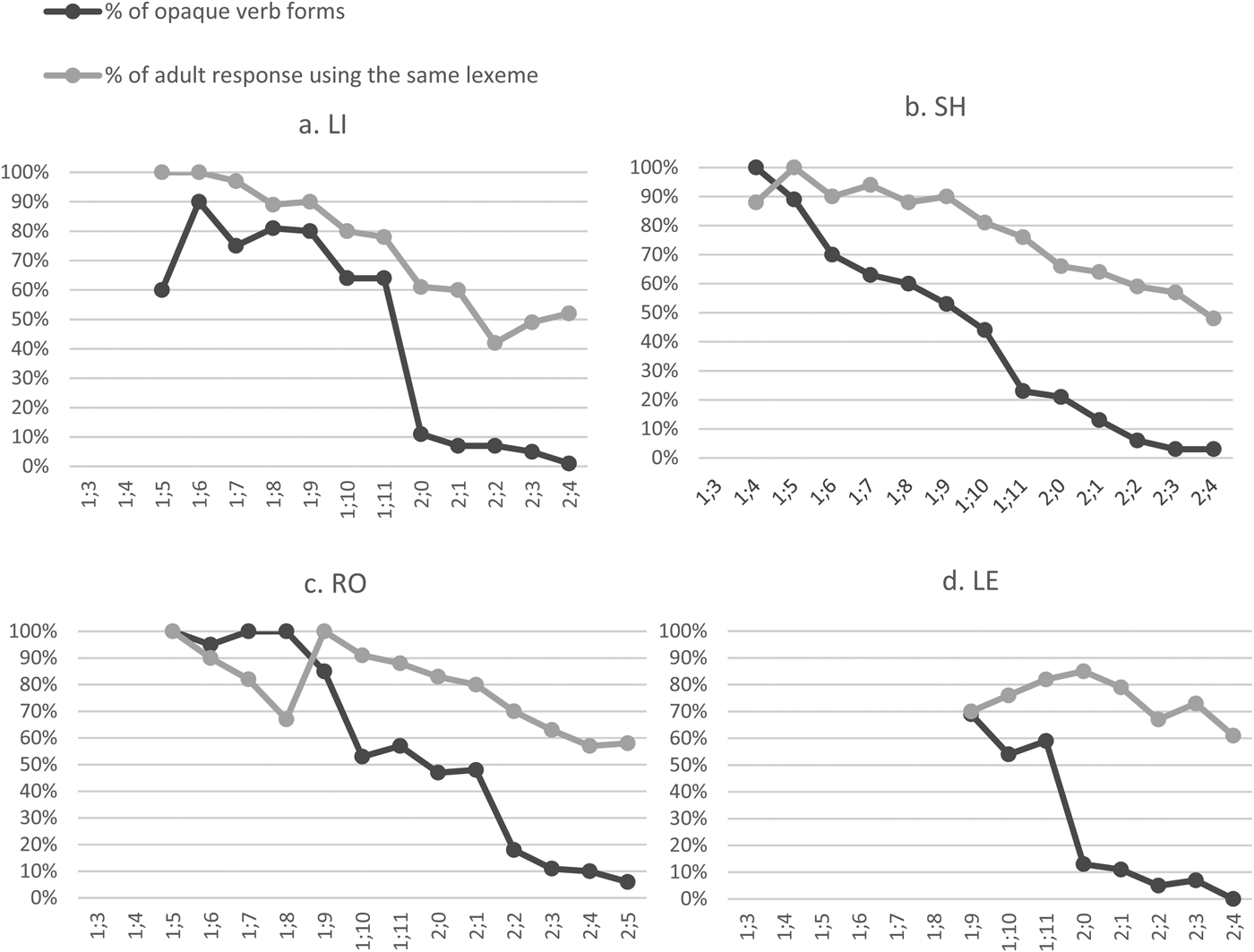
As shown in Figures 1a–d, children's verb forms showed a steady decrease over time in the proportion of opaque uses out of their total verb forms produced. Their earliest verbs exhibited pervasive opacity, ranging from 70% to 100% of their verb productions. These uses decreased gradually until opaque forms were completely abandoned by each of the four children. Table 3 shows the numbers and breakdown in percent of adult response types to children's verb productions, for each child.
Percentage of Each Adult Response Type, by Child

Adult construals and elaborations (same lexeme) together were very frequent during the earlier months of the children's verb productions, accounting, on average, for 96% of adults’ immediate responses to the children's verb productions. The proportions of these adult response types decreased as children's verb forms became more transparent. Figures 2a–d show the concurrent decrease in the opacity of children's verbs and the adult rates of construals and same-lexeme elaborations (combined), for each of the four children.
Rates of opacity of child verb productions and adult responses with the same verb lexeme (for construals and same-lexeme elaborations), for each child, by month (total N = 8,337).

Figures 2a–d show that the children's earliest verbs were typically opaque and were usually followed by same-lexeme responses from the adult interlocutor. As the level of opacity in the children's verbs decreased, adults offered fewer reformulations and elaborations.
In order to see what information adults offered to children in these immediate responses, we turn next to the inflectional categories adults used in their construals and elaborations, before and after the emergence of productive inflectional affixes in the children's verb forms.
Inflectional forms in adult responses
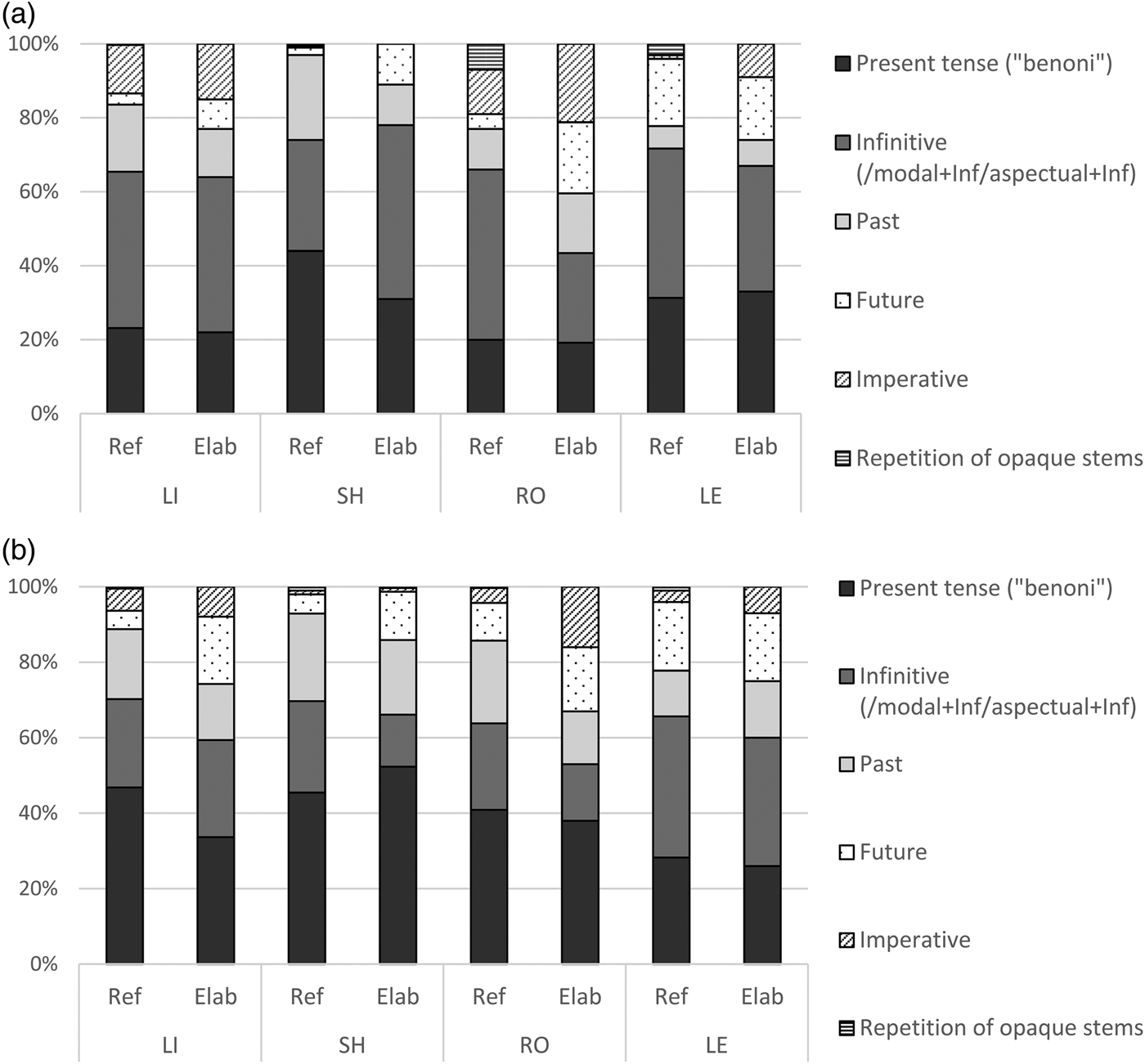
As noted in the ‘Coding categories’ section, we coded construals interpreting or repeating what the child had said, and further elaborations using the same, or in rarer cases, a semantically related verb lexeme, separately. Figures 3a–b show the array of inflectional categories used in adult construals and elaborations separately, across time, for each of the children.
Figure 3a shows that, during the pre-productive period, when children's verb forms were mainly opaque, adults often interpreted children's verbs by providing interpretations in the form of either infinitives or present-tense (singular masculine / singular feminine / plural masculine / plural feminine) verb forms. These two inflectional categories also predominate in children's early productive inflection use (Lustigman, Reference Lustigman2012, Reference Lustigman2013).
Inflectional categories in immediate adult construals and elaborations of each child's verb forms, before (3a) and after (3b) the emergence of productive morphology (total adult responses: 6,348). (a) Adult construals and elaborations during the pre-productive period, by child. (b) Adult construals and elaborations during the productive period, by child.

As the children became more productive in their verb uses, adults used relatively fewer infinitival forms when their pre-productive period construals are compared to their productive period ones. This decrease was significant for three children (LI: X 2(N = 1,539) = 51.24, p < .00001; SH: X 2(N = 1,580) = 29.59, p < .00001; RO: X 2(N = 1,787) = 63.77, p < .00001). The data for LE did not show a significant decrease (X 2(N = 1,442) = 0.095, n.s.) but, as noted before, his recordings started only at age 1;9, so we could not document his earliest verb productions.
Since children's earliest verbs took the form of unaffixed stems, we also compared the relative numbers of non-affixed conventional forms in adult responses for their pre-productive construals compared to their productive period construals. As noted earlier in Table 1, the only forms not marked by stem-external affixes are Past, Present, and Imperative Singular Masculine ones. The proportions of adult uses of such non-affixed Singular Masculine forms also decreased significantly during the productive period (see Figure 3b), in adult responses to all four children (LI: X 2(N = 1,539) = 6.35, p < .012; SH: X 2(N = 1,580) = 12.21, p < .001; RO: X 2(N = 1,787) = 42.450, p < .00001; LE: X 2(N = 1,442) = 8.44, p < .004). This trend held for the two boys and the two girls, even though the girls were exposed to more affixed Feminine forms when addressed by their adult interlocutors.
The decreases in adult uses of infinitival and non-affixed forms reflect the finding that, as children began to use their verbs productively, adult responses became more diverse, both inflectionally – with adults producing more inflectional categories, and structurally – with adults producing more affixed forms. Children were exposed to high adult response rates from the beginning of their verb production, and were then exposed to an increasing array of verb forms, either through adult construals of their own productions, or through adult elaborations using the same verb lexeme that the child had just produced.
In addition to exposure to the different verb forms provided in both construals and elaborations, immediate adult construals are uniquely informative for children, because they provide immediate feedback, in the next turn, for the verb form children had just produced, given the meaning they apparently intended. But what type of structural information do such immediate construals offer to the child who at first produces mainly opaque truncated stems? To what extent, and how, do the verb forms adults offer correspond to the forms children produce? What information do adults add? And how does this information change over time as children's verb inflections start to become productive?
Structural relations between adult reformulations and child verbs
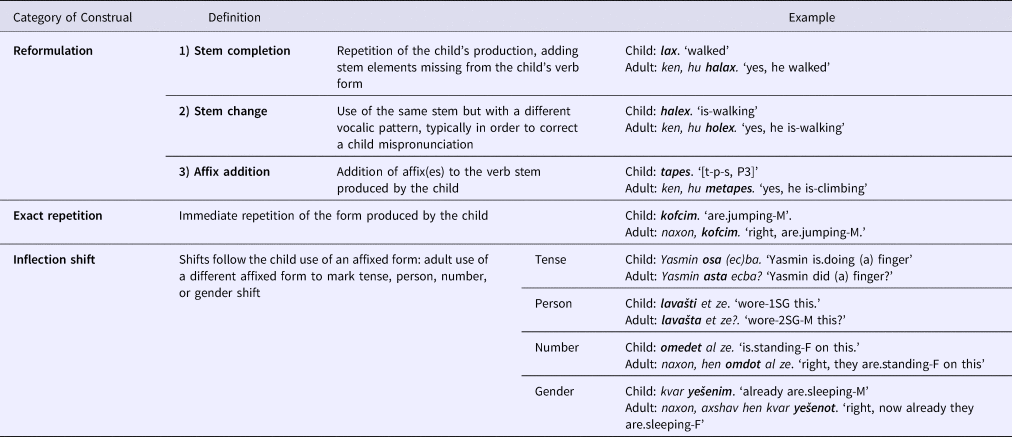
How are adult construals related, structurally, to children's verb forms? Adult construals, as we noted above, include (a) reformulations, (b) repetitions, and (c) inflection shifts. While repetitions and inflection shifts typically follow well-formed, transparently inflected child verbs, adult reformulations offer conventional forms as interpretations of incomplete, typically opaque, child verb forms. In a closer examination of the adult reformulations, we found that they consistently provided completion of stem elements, a change of stem, and addition of affixes, or some combination of two or more of these. Table 4 illustrates the different types of construal including the three subtypes of reformulation.
Categories of Relations between Child Verb Productions and Adult Construals

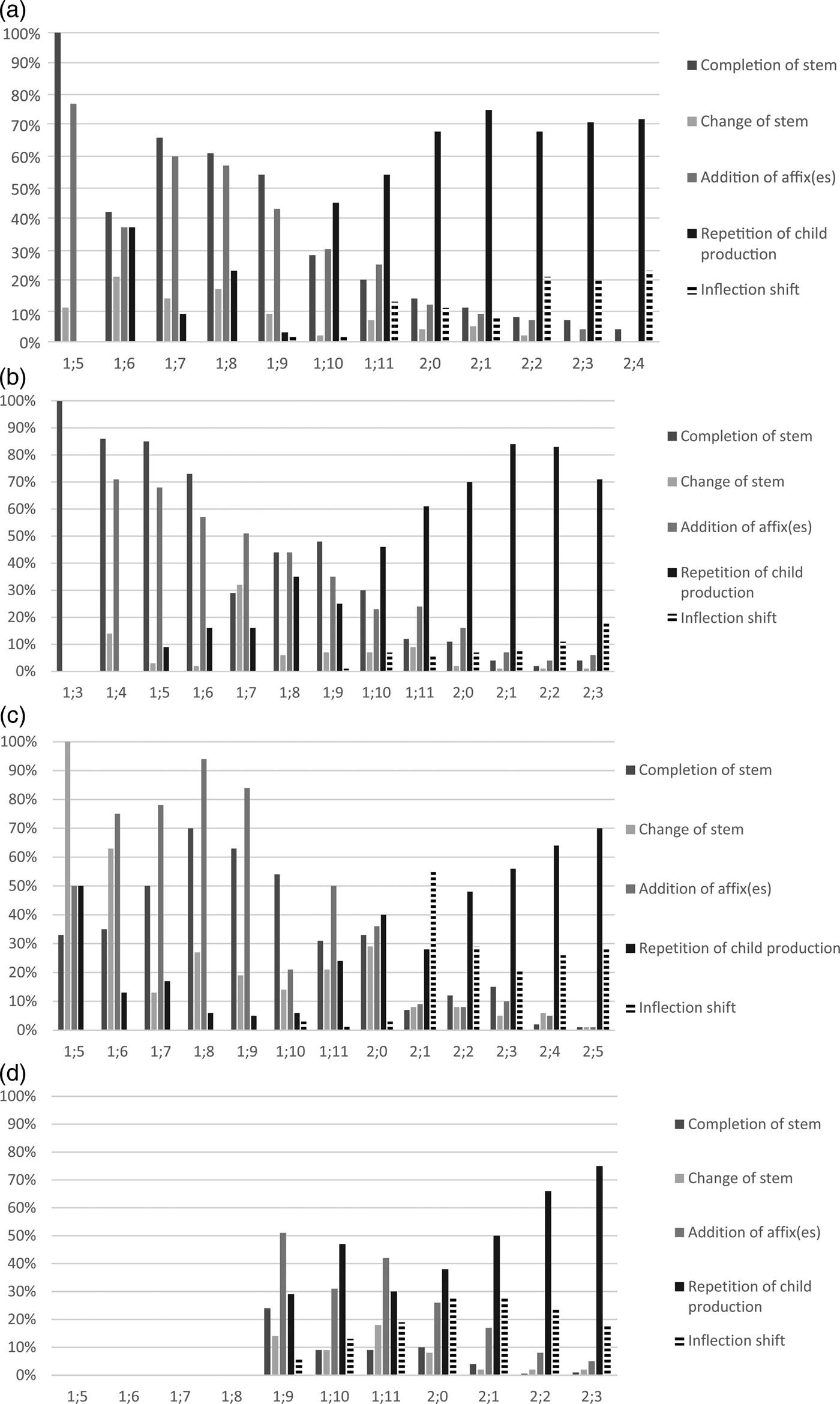
These structural relations between child productions and adult construals were examined for all child verb productions for each of the four children. Notice that some reformulations may include two types of structural relations. For example, if the child produces the form ftax ‘[p-t-x, P1 = open]’ and the adult reformulates this with liftoax ‘to-open’, the adult reformulation provides both a stem change (ftax → ftoax) and the addition of an affix (li-), so it is credited with both. Figures 4a–d show, for each of the children, the percentage of each type of structural relation, out of the total adult construal responses offered each month.
Proportion of each structural relation type (stem completion, stem change, affix addition, inflection shift, exact repetition) out of total adult reformulations per month, for each child. (a) LI (number of adult construals = 848), (b) SH (number of adult construals = 1,245), (c) RO (number of adult construals = 1,096), and (d) LE (number of adult construals = 897).

Figures 4a–d show several trends in adult construals, shared across the four children: (1) during the earlier sessions, when children's productions were mainly opaque, adults generally completed or changed stem elements, and added affixes to children's truncated forms (categories 1–3 in Table 3 above); (2) as children started to produce more inflectionally transparent forms, not only did adults reformulate them less often (Figures 2a–d above), but, as shown here, they also shifted to using more repetitions and inflection shifts (see Table 4); and (3) for three of the four children, the emergence of inflection shifts in adult construals occurs at nearly the same time that each child exhibits use of productive verb inflection. Even though the data for LE do not cover his earliest verb uses, the responses of his adult interlocutors still exhibit similar trends – mainly completion or change of stems and affix addition at the beginning, followed by more repetitions and inflection shifts in later sessions.
Adult construals, then, appear to move from initially interpreting children's truncated forms by completing them and adding stem and affix elements, to repeating and so ratifying children's well-formed productions, and then moving on to offer different inflectional perspectives by supplying inflection shifts immediately after the children have produced an inflected verb. These trends show that, in addition to the children following similar developmental trajectories, the adult responses to children's verb forms are closely linked to the forms that the children produce.
Discussion
The aim of this study was to provide an in-depth analysis of adult contributions to children's acquisition of verb inflections in a relatively richly inflected language with no base verb forms, and very little homophony. We assume that conversational exchanges are a fundamental resource for children's language learning, in terms of the language children are exposed to, the scaffolding of linguistic information by adult interlocutors, and the interactional settings where adult–child conversations occur (Clark, Reference Clark2016; Veneziano, Reference Veneziano, Arnon, Casillas, Kurumada and Estigarribia2014).
Our findings reveal developmental trends in children's productions of verb forms, paralleled by changes in adult responses to those forms, in terms of both rates and types of structural information. Changes over time in adult responses appear to be directly contingent on what children can produce. After showing how the four children gradually moved from opaque to transparent verb uses, we showed that adult construals and elaborations, initially very frequent, gradually decreased in frequency as the children produced more transparent verb forms (Figures 1a–d). We distinguished between construals that provide immediate feedback in the form of possible interpretations for the children's forms, and elaborations that make use of the same verb lexeme, in immediate adult responses (see examples in (3) above).
We examined the inflectional categories and verb forms used by adult interlocutors in all the construals and elaborations provided, and found the following trends: (a) the dominant inflectional categories in adult responses to children's early verbs are Infinitival and Present Tense forms; these adult uses anticipate the categories favored by children in their early productive verb uses; and (b) as productive inflections emerged in children's verb usage, adult responses contained fewer infinitival forms (significantly so for three of the four children) and fewer non-affixed Masculine forms (a significant decrease for all four children). These trends reflect the increased inflectional and structural diversity in adult responses as the children's verbs became more transparent and specific in meaning.
In order to examine the direct feedback children receive on their verb productions, we carried out a form-by-form analysis of the structural relations between children's verb forms and next-turn adult construals, and found that adults initially provide completion of stem elements and missing affixes, but as children's verbs become more transparent in structure, adult construals include fewer reformulations and more exact repetitions and inflection shifts (i.e., recasting the same event from a different perspective). The emergence of inflectional shifts in adult construals occurs around the same time as the emergence of productive inflection for each child.
In short, immediate adult responses to children's verb uses provide extensive positive evidence in the form of varied inflectional forms at the same time that they provide consistent negative evidence in the form of immediate reformulations of children's incomplete verb forms. Moreover, as initial productive inflection emerges in children's usage, adult responses become more diverse in structure and in the inflectional categories they offer.
The general course of acquisition for verb forms
Children start out with single forms for their early verbs – most often opaque forms where the adult target is unclear, and the adult has to construct something that will make sense in context, or rote-learned forms that may contain an inflection or affix, but are not quite appropriate for the occasion. This is because both opaque and rote-learned forms of verbs are used initially for any instances of the particular activity-type, as when a child produces saxek ‘[s-x-k, P3]’ for any event of ‘playing’, for past, present, or future; for any person – 1, 2, or 3; and for singular or plural. Such use of a single form is common in children's earliest verb uses in other languages as well (e.g., Rojas Nieto, Reference Rojas Nieto, Arnon and Clark2011; Veneziano & Clark, Reference Veneziano and Clark2016). Once children start to produce two distinct forms for any one verb, they must work on how these different forms contrast in meaning: this is the point at which they can begin to construct verb paradigms. Our analyses here have focussed on the role adult–child conversational turns play in this development – how adults respond to children's incomplete, opaque productions, and the information children are exposed to as they go from unproductive single verb uses to multiple forms of the same verb, forms that contrast in meaning.
Interaction and acquisition: attention to what children know
Adults appear to be guided by children's level of knowledge. This is evident both in the transition from a restricted to more varied number of conventional verb forms that parents offer in their responses to children's earliest verb uses, and in their transition from reformulations to other forms of construal, namely repetitions and inflection shifts. In effect, adults fine-tune their own verb forms to fit what their children appear to intend and the forms they (now) seem able to produce.
The dominant categories in immediate adult responses, infinitival and present-tense verbs, provide children with the first categories they favor when they themselves start producing inflections productively (Lustigman, Reference Lustigman2012, Reference Lustigman2013). This further cements the status of these inflectional categories as both basic and multi-functional in early language development. As children begin to use more verb forms and to mark them with appropriate inflections and affixes, adults offer a wider array of responses, with more diverse inflections and structures. This probably occurs because adults interpret changes in their children's usage as reflecting more knowledge of the verb forms in question. This in turn appears to license adult use of more elaborations as well as more semantically diverse verb forms as they talk with their children. From the perspective of children acquiring language, such trends in adult responses allow for early focused practice on structurally and inflectionally ‘neutral’ forms suited to the initial period of verb production, followed by the gradual addition of new categories that expand children's practice to include other paradigmatic forms. What our data make clear is that adults are attuned to how much their children can do, and at the same time they offer more advanced forms that are only slightly above the child's current level. This is demonstrated by the fact that adults start with infinitival and present tense forms while the children are producing opaque stems, and then gradually expand their responses to include more inflected forms and perspectival shifts once children begin to use some inflections productively. In short, adults offer construals and elaborations as relevant, adjusting over time to what their children know about verb usage. Lastly, adult construals depend critically on what is happening during adult–child conversations: what the child says and what the child is doing (see Clark & de Marneffe, Reference Clark and de Marneffe2012). As a result, adult construals are guided pragmatically and semantically by what is happening in context when adult speakers decide how to interpret young children's opaque verb forms in Hebrew.
Feedback is critical: providing contrastive evidence
The checking up that adults do offers children the conventional way to express what they appear to intend on each occasion. That is, the adults offer children ways to be specific and to streamline what they are trying to express, and hence to clarify what they intend to communicate. Our interpretation of the child–adult data presented here depends on the role of the principle of contrast in language acquisition (Clark, Reference Clark1990, Reference Clark1993), where the adult's use contrasts directly, in the next turn, with the child's verb use in the turn before. Contrast, combined with children's general trajectory as their verb uses develop from opacity to transparency, together drive the acquisition of verb inflections in Hebrew (Lustigman, Reference Lustigman2016). That is, children begin by producing opaque verb forms because they have managed to extract only those stem elements shared across different inflected forms in a given verb paradigm. When they receive immediate feedback on these incomplete forms in the adult reformulations they hear in the next turn, they can contrast their own opaque forms with the full adult forms containing added stem and affix elements. Children's attention to morpheme boundaries then enables them to make use of the information in adult affixed forms in specific contexts. The contrasts here offer an effective setting for learning morpheme structure and function, thereby expanding children's inflectional paradigms. This is crucial to the process of acquisition since it is this immediate contrasting feedback that allows children to compare the structure of the forms they have just produced with the full adult forms, and so begin to build up the paradigm for each verb. It is possible that such feedback may be more essential, and extensive, in exchanges with children acquiring richly inflected languages, for two inter-related reasons: (a) such languages often do not offer ‘base’, or citation, forms of verbs, so children begin with truncated forms; and (b) adults therefore offer more structural information in their immediate responses. By comparison, for example, Clark and de Marneffe (Reference Clark and de Marneffe2012) found lower rates of adult reformulations in their study of adult reformulations of French children's early verb forms than we did in the current study, perhaps because French verb paradigms contain fewer contrasts in spoken forms than are found in the Hebrew verb system.
Once children start producing inflections productively, adult construals begin to include inflectional shifts. Such shifts not only expose children to new inflectional categories, but also provide them with alternative inflectional perspectives, e.g., in the shift from 2nd to 3rd person, or from singular to plural. That is, inflection shifts introduce alternative ways of talking about events that children can already capture in some form in context. Inflection shifts offer children additional ways to represent events, and provide them with further exposure to some of the subtle perspectival differences marked by inflectional choices. This is particularly important in richly inflected languages like Hebrew that encode multiple features in each verb form. The inflectional complexity here reflects the complexity of inter-speaker event constructions, where a single event can be viewed from two or more speaker perspectives (e.g., ‘I am-stacking the blocks’, ‘right, you are-stacking the blocks’). We have addressed this structural and conceptual challenge for children in conversational interactions by following how each verb lexeme (in each event) is realized inflectionally by the child and the adult. Our study has shown not only that adults expose children to the variety of verb forms available in their language, but also that they thereby allow children to participate directly in constructing multi-perspective representations of events through their shifts between inflectional forms.
In summary, our findings suggest that when adult responses to children's verb uses are examined in relation to children's developmental trajectories for verb inflections, adults display extensive fine-tuning in their responses. By providing direct feedback in their reformulations, and re-using the same verb lexeme in their elaborations, adults both support and challenge children during their acquisition of verb inflections as they begin to construct verb paradigms. This in turn allows children to participate in conversation from early on, while helping them extend their grammatical knowledge of their first language.
Acknowledgements
This research was partially supported by the Rothschild Postdoctoral Fellowship, the Israel Science Foundation (ISF) Postdoctoral Fellowship in Social Sciences, and the Stanford University Department of Linguistics. We would like to thank the Editor, the Action Editor, and two anonymous reviewers for their invaluable comments and feedback, and Gal Belsitzman and Sara Kessler for testing coding reliability.